---
layout: post
title: Introduction
---
Intelligent agents are constantly generating, acquiring, and processing
data. This data could be in the form of *images* that we capture on our
phones, *text* messages we share with our friends, *graphs* that model
interactions on social media, *videos* that record important events,
etc. Natural agents excel at discovering patterns, extracting
knowledge, and performing complex reasoning based on the data they observe. How
can we build artificial learning systems to do the same?
In this course, we will study generative models that view the world under the lens of probability.
In such a worldview, we can think of any kind of
observed data, say $$\mathcal{D}$$, as a finite set of samples from an
underlying distribution, say $$p_{\mathrm{data}}$$. At its very core, the
goal of any generative model is then to approximate this data
distribution given access to the dataset $$\mathcal{D}$$. The hope is that
if we are able to *learn* a good generative model, we can use the
learned model for downstream *inference*.
Learning
--------
We will be primarily interested in parametric approximations to the data
distribution, which summarize all the information about the dataset $$\mathcal{D}$$ in
a finite set of parameters. In contrast with non-parametric models,
parametric models scale more efficiently with large datasets but are
limited in the family of distributions they can represent.
In the parametric setting, we can think of the task of learning a
generative model as picking the parameters within a family of model
distributions that minimizes some notion of distance[^1] between the
model distribution and the data distribution.
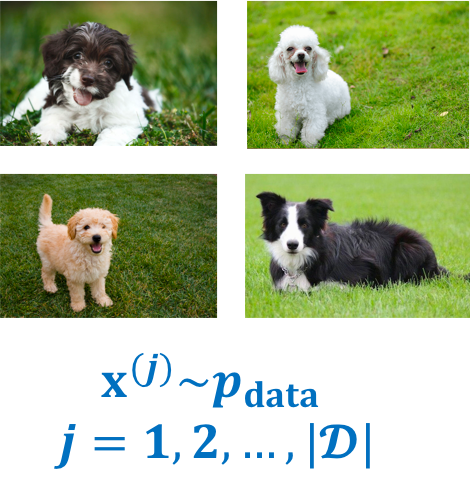
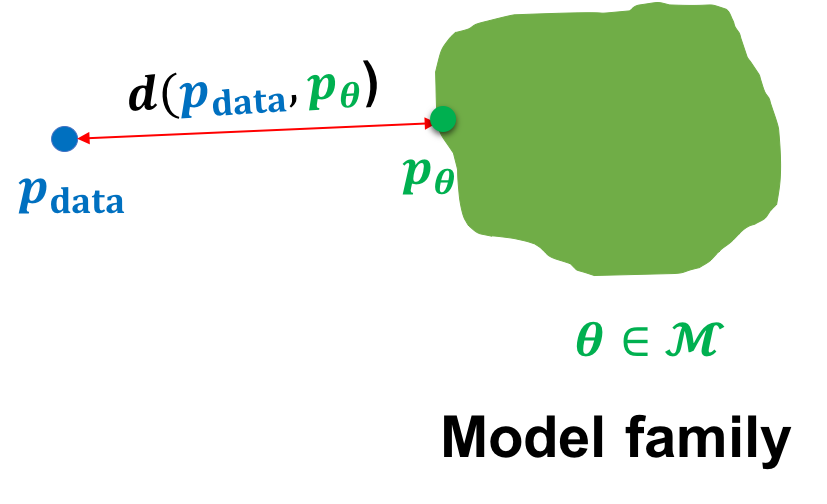 For instance, we might be given access to a dataset of dog images $$\mathcal{D}$$ and
our goal is to learn the parameters of a generative model $$\theta$$ within a model family $$\mathcal{M}$$ such that
the model distribution $$p_\theta$$ is close to the data distribution over dogs
$$p_{\mathrm{data}}$$. Mathematically, we can specify our goal as the
following optimization problem: $$$$\begin{equation}
\min_{\theta\in \mathcal{M}}d(p_{\mathrm{data}}, p_{\theta})
\label{eq:learning_gm}
\tag{1}
\end{equation}$$$$where $$p_{\mathrm{data}}$$ is accessed via the dataset
$$\mathcal{D}$$ and $$d(\cdot)$$ is a notion of distance between probability distributions.
As we navigate through this course, it is interesting to take note of
the difficulty of the problem at hand. A typical image from a modern
phone camera has a resolution of approximately $$700 \times 1400$$ pixels.
Each pixel has three channels: R(ed), G(reen) and B(lue) and each
channel can take a value between 0 to 255. Hence, the number of possible
images is given by $$256^{700 \times 1400 \times 3}\approx 10 ^{800000}$$.
In contrast, ImageNet, one of the largest publicly available datasets,
consists of only about 15 million images. Hence, learning a generative
model with such a limited dataset is a highly underdetermined problem.
Fortunately, the real world is highly structured and automatically
discovering the underlying structure is key to learning generative
models. For example, we can hope to learn some basic artifacts about
dogs even with just a few images: two eyes, two ears, fur etc. Instead
of incorporating this prior knowledge explicitly, we will hope the model
learns the underlying structure directly from data. There is no free
lunch however, and indeed successful learning of generative models will
involve instantiating the optimization problem in
$$(\ref{eq:learning_gm})$$ in a suitable way. In this course, we will be
primarily interested in the following questions:
* What is the representation for the model family $$\mathcal{M}$$?
* What is the objective function $$d(\cdot)$$?
* What is the optimization procedure for minimizing $$d(\cdot)$$?
In the next few set of lectures, we will take a deeper dive into certain
families of generative models. For each model family, we will note how
the representation is closely tied with the choice of learning objective
and the optimization procedure.
Inference
---------
For a discriminative model such as logistic regression, the fundamental
inference task is to predict a label for any given datapoint. Generative
models, on the other hand, learn a joint distribution over the entire
data.[^2]
While the range of applications to which generative models have been
used continue to grow, we can identify three fundamental inference
queries for evaluating a generative model.:
1. *Density estimation:* Given a datapoint $$\mathbf{x}$$, what is the
probability assigned by the model, i.e., $$p_\theta(\mathbf{x})$$?
2. *Sampling:* How can we *generate* novel data from the model
distribution, i.e.,
$$\mathbf{x}_{\mathrm{new}} \sim p_\theta(\mathbf{x})$$?
3. *Unsupervised representation learning:* How can we learn meaningful
feature representations for a datapoint $$\mathbf{x}$$?
Going back to our example of learning a generative model over dog
images, we can intuitively expect a good generative model to work as
follows. For density estimation, we expect $$p_\theta(\mathbf{x})$$ to be
high for dog images and low otherwise. Alluding to the name *generative
model*, sampling involves generating novel images of dogs beyond the
ones we observe in our dataset. Finally, representation learning can
help discover high-level structure in the data such as the breed of
dogs.
In light of the above inference tasks, we note two caveats. First,
quantitative evaluation of generative models on these tasks is itself
non-trivial (in particular, sampling and representation learning) and an
area of active research. Some quantitative metrics exist, but these
metrics often fail to reflect desirable qualitative attributes in the
generated samples and the learned representations. Secondly, not all
model families permit efficient and accurate inference on all these
tasks. Indeed, the trade-offs in the inference capabilities of the
current generative models have led to the development of very diverse approaches as
we shall see in this course.
## Footnotes
[^1]: As we shall see later, functions that do not satisfy all
properties of a distance metric are also used in practice, e.g., KL
divergence.
[^2]: Technically, a probabilistic discriminative model is also a
generative model of the labels conditioned on the data. However, the
usage of the term generative models is typically reserved for high
dimensional data.
For instance, we might be given access to a dataset of dog images $$\mathcal{D}$$ and
our goal is to learn the parameters of a generative model $$\theta$$ within a model family $$\mathcal{M}$$ such that
the model distribution $$p_\theta$$ is close to the data distribution over dogs
$$p_{\mathrm{data}}$$. Mathematically, we can specify our goal as the
following optimization problem: $$$$\begin{equation}
\min_{\theta\in \mathcal{M}}d(p_{\mathrm{data}}, p_{\theta})
\label{eq:learning_gm}
\tag{1}
\end{equation}$$$$where $$p_{\mathrm{data}}$$ is accessed via the dataset
$$\mathcal{D}$$ and $$d(\cdot)$$ is a notion of distance between probability distributions.
As we navigate through this course, it is interesting to take note of
the difficulty of the problem at hand. A typical image from a modern
phone camera has a resolution of approximately $$700 \times 1400$$ pixels.
Each pixel has three channels: R(ed), G(reen) and B(lue) and each
channel can take a value between 0 to 255. Hence, the number of possible
images is given by $$256^{700 \times 1400 \times 3}\approx 10 ^{800000}$$.
In contrast, ImageNet, one of the largest publicly available datasets,
consists of only about 15 million images. Hence, learning a generative
model with such a limited dataset is a highly underdetermined problem.
Fortunately, the real world is highly structured and automatically
discovering the underlying structure is key to learning generative
models. For example, we can hope to learn some basic artifacts about
dogs even with just a few images: two eyes, two ears, fur etc. Instead
of incorporating this prior knowledge explicitly, we will hope the model
learns the underlying structure directly from data. There is no free
lunch however, and indeed successful learning of generative models will
involve instantiating the optimization problem in
$$(\ref{eq:learning_gm})$$ in a suitable way. In this course, we will be
primarily interested in the following questions:
* What is the representation for the model family $$\mathcal{M}$$?
* What is the objective function $$d(\cdot)$$?
* What is the optimization procedure for minimizing $$d(\cdot)$$?
In the next few set of lectures, we will take a deeper dive into certain
families of generative models. For each model family, we will note how
the representation is closely tied with the choice of learning objective
and the optimization procedure.
Inference
---------
For a discriminative model such as logistic regression, the fundamental
inference task is to predict a label for any given datapoint. Generative
models, on the other hand, learn a joint distribution over the entire
data.[^2]
While the range of applications to which generative models have been
used continue to grow, we can identify three fundamental inference
queries for evaluating a generative model.:
1. *Density estimation:* Given a datapoint $$\mathbf{x}$$, what is the
probability assigned by the model, i.e., $$p_\theta(\mathbf{x})$$?
2. *Sampling:* How can we *generate* novel data from the model
distribution, i.e.,
$$\mathbf{x}_{\mathrm{new}} \sim p_\theta(\mathbf{x})$$?
3. *Unsupervised representation learning:* How can we learn meaningful
feature representations for a datapoint $$\mathbf{x}$$?
Going back to our example of learning a generative model over dog
images, we can intuitively expect a good generative model to work as
follows. For density estimation, we expect $$p_\theta(\mathbf{x})$$ to be
high for dog images and low otherwise. Alluding to the name *generative
model*, sampling involves generating novel images of dogs beyond the
ones we observe in our dataset. Finally, representation learning can
help discover high-level structure in the data such as the breed of
dogs.
In light of the above inference tasks, we note two caveats. First,
quantitative evaluation of generative models on these tasks is itself
non-trivial (in particular, sampling and representation learning) and an
area of active research. Some quantitative metrics exist, but these
metrics often fail to reflect desirable qualitative attributes in the
generated samples and the learned representations. Secondly, not all
model families permit efficient and accurate inference on all these
tasks. Indeed, the trade-offs in the inference capabilities of the
current generative models have led to the development of very diverse approaches as
we shall see in this course.
## Footnotes
[^1]: As we shall see later, functions that do not satisfy all
properties of a distance metric are also used in practice, e.g., KL
divergence.
[^2]: Technically, a probabilistic discriminative model is also a
generative model of the labels conditioned on the data. However, the
usage of the term generative models is typically reserved for high
dimensional data.