保留正文与补采附件。源页面当前未重新核验;具体限制见交付清单。
 We value your privacy
We use cookies to enhance your browsing experience, serve personalised ads or content, and analyse our traffic. By clicking "Accept All", you consent to our use of cookies.
Customise Reject All Accept All
Customise Consent Preferences
 We use cookies to help you navigate efficiently and perform certain functions. You will find detailed information about all cookies under each consent category below.
The cookies that are categorised as "Necessary" are stored on your browser as they are essential for enabling the basic functionalities of the site. ... Show more
NecessaryAlways Active
Necessary cookies are required to enable the basic features of this site, such as providing secure log-in or adjusting your consent preferences. These cookies do not store any personally identifiable data.
-
Cookie
BCTempID
-
Duration
10 minutes
-
Description
No description available.
-
Cookie
__cf_bm
-
Duration
1 hour
-
Description
This cookie, set by Cloudflare, is used to support Cloudflare Bot Management.
-
Cookie
AWSALBCORS
-
Duration
7 days
-
Description
Amazon Web Services set this cookie for load balancing.
-
Cookie
_cfuvid
-
Duration
session
-
Description
Cloudflare sets this cookie to track users across sessions to optimize user experience by maintaining session consistency and providing personalized services
-
Cookie
li_gc
-
Duration
6 months
-
Description
Linkedin set this cookie for storing visitor's consent regarding using cookies for non-essential purposes.
-
Cookie
__hssrc
-
Duration
session
-
Description
This cookie is set by Hubspot whenever it changes the session cookie. The __hssrc cookie set to 1 indicates that the user has restarted the browser, and if the cookie does not exist, it is assumed to be a new session.
-
Cookie
__hssc
-
Duration
1 hour
-
Description
HubSpot sets this cookie to keep track of sessions and to determine if HubSpot should increment the session number and timestamps in the __hstc cookie.
-
Cookie
wpEmojiSettingsSupports
-
Duration
session
-
Description
WordPress sets this cookie when a user interacts with emojis on a WordPress site. It helps determine if the user's browser can display emojis properly.
-
Cookie
BCSessionID
-
Duration
1 year 1 month 4 days
-
Description
Blueconic sets this cookie as a unique identifier for the BlueConic profile.
-
Cookie
_octo
-
Duration
1 year
-
Description
No description available.
-
Cookie
logged_in
-
Duration
1 year
-
Description
No description available.
-
Cookie
__Secure-YEC
-
Duration
past
-
Description
YouTube sets this cookie to stores the user's video player preferences using embedded YouTube video
-
Cookie
__eoi
-
Duration
6 months
-
Description
Description is currently not available.
-
Cookie
AWSALBTGCORS
-
Duration
7 days
-
Description
No description available.
-
Cookie
login-status-p
-
Duration
past
-
Description
Description is currently not available.
-
Cookie
AWSALBTG
-
Duration
7 days
-
Description
No description available.
-
Cookie
csrf_token
-
Duration
session
-
Description
No description available.
-
Cookie
token_v2
-
Duration
1 day
-
Description
Description is currently not available.
-
Cookie
D
-
Duration
1 year
-
Description
Description is currently not available.
-
Cookie
PHPSESSID
-
Duration
session
-
Description
This cookie is native to PHP applications. The cookie stores and identifies a user's unique session ID to manage user sessions on the website. The cookie is a session cookie and will be deleted when all the browser windows are closed.
-
Cookie
VISITOR_PRIVACY_METADATA
-
Duration
6 months
-
Description
YouTube sets this cookie to store the user's cookie consent state for the current domain.
-
Cookie
cookietest
-
Duration
session
-
Description
The cookietest cookie is typically used to determine whether the user's browser accepts cookies, essential for website functionality and user experience.
-
Cookie
__Host-airtable-session
-
Duration
1 year
-
Description
This cookie is used to enable us to integrate the services of Airtable.
-
Cookie
__Host-airtable-session.sig
-
Duration
1 year
-
Description
This cookie is used to enable us to integrate the services of Airtable.
-
Cookie
m
-
Duration
1 year 1 month 4 days
-
Description
Stripe sets this cookie for fraud prevention purposes. It identifies the device used to access the website, allowing the website to be formatted accordingly.
-
Cookie
BIGipServer*
-
Duration
session
-
Description
Marketo sets this cookie to collect information about the user's online activity and build a profile about their interests to provide advertisements relevant to the user.
-
Cookie
__cfruid
-
Duration
session
-
Description
Cloudflare sets this cookie to identify trusted web traffic.
-
Cookie
_GRECAPTCHA
-
Duration
6 months
-
Description
Google Recaptcha service sets this cookie to identify bots to protect the website against malicious spam attacks.
-
Cookie
__Secure-YNID
-
Duration
6 months
-
Description
Google cookie used to protect user security and prevent fraud, especially during the login process.
-
Cookie
cookieyes-consent
-
Duration
1 year
-
Description
CookieYes sets this cookie to remember users' consent preferences so that their preferences are respected on subsequent visits to this site. It does not collect or store any personal information about the site visitors.
Functional
Functional cookies help perform certain functionalities like sharing the content of the website on social media platforms, collecting feedback, and other third-party features.
-
Cookie
lidc
-
Duration
1 day
-
Description
LinkedIn sets the lidc cookie to facilitate data center selection.
-
Cookie
brw
-
Duration
1 year
-
Description
No description available.
-
Cookie
brwConsent
-
Duration
5 minutes
-
Description
Description is currently not available.
-
Cookie
WMF-Uniq
-
Duration
1 year
-
Description
Description is currently not available.
-
Cookie
loom_anon_comment
-
Duration
1 year
-
Description
No description available.
-
Cookie
loom_referral_video
-
Duration
session
-
Description
Description is currently not available.
-
Cookie
VISITOR_INFO1_LIVE
-
Duration
6 months
-
Description
A cookie set by YouTube to measure bandwidth that determines whether the user gets the new or old player interface.
-
Cookie
yt-remote-connected-devices
-
Duration
Never Expires
-
Description
YouTube sets this cookie to store the user's video preferences using embedded YouTube videos.
-
Cookie
ytidb::LAST_RESULT_ENTRY_KEY
-
Duration
Never Expires
-
Description
The cookie ytidb::LAST_RESULT_ENTRY_KEY is used by YouTube to store the last search result entry that was clicked by the user. This information is used to improve the user experience by providing more relevant search results in the future.
-
Cookie
yt-remote-device-id
-
Duration
Never Expires
-
Description
YouTube sets this cookie to store the user's video preferences using embedded YouTube videos.
-
Cookie
yt-remote-session-name
-
Duration
session
-
Description
The yt-remote-session-name cookie is used by YouTube to store the user's video player preferences using embedded YouTube video.
-
Cookie
yt-remote-fast-check-period
-
Duration
session
-
Description
The yt-remote-fast-check-period cookie is used by YouTube to store the user's video player preferences for embedded YouTube videos.
-
Cookie
yt-remote-session-app
-
Duration
session
-
Description
The yt-remote-session-app cookie is used by YouTube to store user preferences and information about the interface of the embedded YouTube video player.
-
Cookie
yt-remote-cast-available
-
Duration
session
-
Description
The yt-remote-cast-available cookie is used to store the user's preferences regarding whether casting is available on their YouTube video player.
-
Cookie
yt-remote-cast-installed
-
Duration
session
-
Description
The yt-remote-cast-installed cookie is used to store the user's video player preferences using embedded YouTube video.
-
Cookie
cp_session
-
Duration
3 months
-
Description
Codepen sets this cookie for Help systems found in the website.
-
Cookie
loid
-
Duration
1 year 1 month 4 days
-
Description
This cookie is set by the Reddit. The cookie enables the sharing of content from the website onto the social media platform.
Analytics
Analytical cookies are used to understand how visitors interact with the website. These cookies help provide information on metrics such as the number of visitors, bounce rate, traffic source, etc.
-
Cookie
__hstc
-
Duration
6 months
-
Description
Hubspot set this main cookie for tracking visitors. It contains the domain, initial timestamp (first visit), last timestamp (last visit), current timestamp (this visit), and session number (increments for each subsequent session).
-
Cookie
hubspotutk
-
Duration
6 months
-
Description
HubSpot sets this cookie to keep track of the visitors to the website. This cookie is passed to HubSpot on form submission and used when deduplicating contacts.
-
Cookie
_ga
-
Duration
1 year 1 month 4 days
-
Description
Google Analytics sets this cookie to calculate visitor, session and campaign data and track site usage for the site's analytics report. The cookie stores information anonymously and assigns a randomly generated number to recognise unique visitors.
-
Cookie
ga*
-
Duration
1 year 1 month 4 days
-
Description
Google Analytics sets this cookie to store and count page views.
-
Cookie
__Host-psifi.analyticsTrace
-
Duration
6 hours
-
Description
Description is currently not available.
-
Cookie
__Host-psifi.analyticsTraceV2
-
Duration
6 hours
-
Description
Description is currently not available.
-
Cookie
_gh_sess
-
Duration
session
-
Description
GitHub sets this cookie for temporary application and framework state between pages like what step the user is on in a multiple step form.
-
Cookie
YSC
-
Duration
session
-
Description
YSC cookie is set by Youtube and is used to track the views of embedded videos on Youtube pages.
-
Cookie
ajs_anonymous_id
-
Duration
1 year
-
Description
This cookie is set by Segment to count the number of people who visit a certain site by tracking if they have visited before.
-
Cookie
vuid
-
Duration
1 year 1 month 4 days
-
Description
Vimeo installs this cookie to collect tracking information by setting a unique ID to embed videos on the website.
Performance
Performance cookies are used to understand and analyse the key performance indexes of the website which helps in delivering a better user experience for the visitors.
-
Cookie
AWSALB
-
Duration
7 days
-
Description
AWSALB is an application load balancer cookie set by Amazon Web Services to map the session to the target.
-
Cookie
acq
-
Duration
past
-
Description
Description is currently not available.
-
Cookie
acq.sig
-
Duration
past
-
Description
Description is currently not available.
-
Cookie
ptc
-
Duration
2 years
-
Description
No description available.
Advertisement
Advertisement cookies are used to provide visitors with customised advertisements based on the pages you visited previously and to analyse the effectiveness of the ad campaigns.
-
Cookie
muc_ads
-
Duration
1 year 1 month 4 days
-
Description
Twitter sets this cookie to collect user behaviour and interaction data to optimize the website.
-
Cookie
guest_id_marketing
-
Duration
1 year 1 month 4 days
-
Description
Twitter sets this cookie to identify and track the website visitor.
-
Cookie
guest_id_ads
-
Duration
1 year 1 month 4 days
-
Description
Twitter sets this cookie to identify and track the website visitor.
-
Cookie
personalization_id
-
Duration
1 year 1 month 4 days
-
Description
Twitter sets this cookie to integrate and share features for social media and also store information about how the user uses the website, for tracking and targeting.
-
Cookie
guest_id
-
Duration
1 year 1 month 4 days
-
Description
Twitter sets this cookie to identify and track the website visitor. It registers if a user is signed in to the Twitter platform and collects information about ad preferences.
-
Cookie
bcookie
-
Duration
1 year
-
Description
LinkedIn sets this cookie from LinkedIn share buttons and ad tags to recognize browser IDs.
-
Cookie
__Secure-ROLLOUT_TOKEN
-
Duration
6 months
-
Description
YouTube sets this cookie to manage feature rollout and experimentation. It helps Google control which new features or interface changes are shown to users as part of testing and staged rollouts, ensuring consistent experience for a given user during an experiment.
-
Cookie
yt.innertube::nextId
-
Duration
Never Expires
-
Description
YouTube sets this cookie to register a unique ID to store data on what videos from YouTube the user has seen.
-
Cookie
yt.innertube::requests
-
Duration
Never Expires
-
Description
YouTube sets this cookie to register a unique ID to store data on what videos from YouTube the user has seen.
-
Cookie
session_tracker
-
Duration
session
-
Description
This cookie is set by the Reddit. This cookie is used to identify trusted web traffic. It also helps in adverstising on the website.
-
Cookie
edgebucket
-
Duration
session
-
Description
Reddit sets this cookie to save the information about a log-on Reddit user, for the purpose of advertisement recommendations and updating the content.
-
Cookie
did
-
Duration
1 year
-
Description
Arbor sets this cookie to show targeted ads to site visitors.This cookie expires after 2 months or 1 year.
Uncategorised
Other uncategorised cookies are those that are being analysed and have not been classified into a category as yet.
No cookies to display.
Reject All Save My Preferences Accept All
Toggle SearchToggle Mobile Navigation
Publish AI, ML & data-science insights to a global community of data professionals.
Sign inSubmit an Article
LatestEditor's PicksNewsletterShipAI
Write For TDS
LinkedInXToggle Search
Data Science
Understanding Buffer of Thoughts (BoT) - Reasoning with Large Language Models
New prompt engineering tool for complex reasoning, compared with Chain of thought (CoT) and Tree of Thought (ToT)
Hesam Sheikh
June 14, 202410 min read
A new prompting tool for complex reasoning, compared with Chain of thought (CoT) and Tree of Thought (ToT)
If you're not a member, read for free!✨
 Photo by Etienne Girardet on Unsplash
Squeezing proficiency in complex reasoning tasks and avoiding hallucinations remains a major research topic in Large Language Models (LLMs). Despite the effort, LLMs need help with generalized reasoning capabilities. Traditional methods such as Chain-of-Thought (CoT) or Tree-of-Thought (ToT) often require multiple assumptions or numerous back-and-forth prompting which means intensive computation.
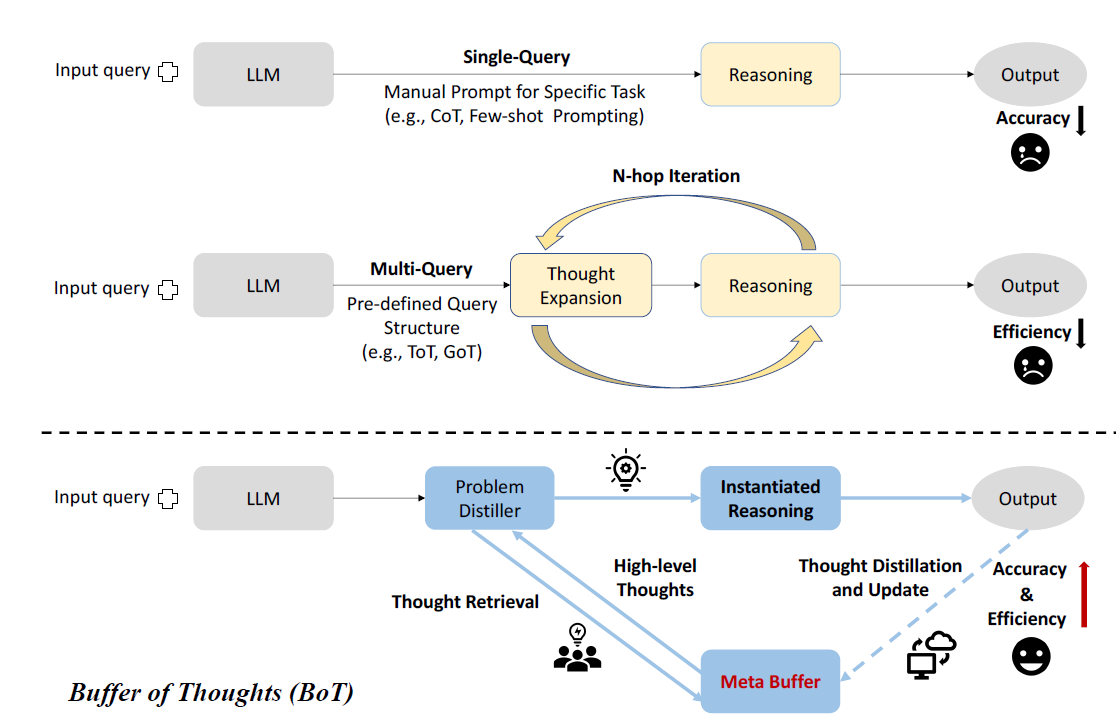 Buffer of Thoughts (BoT) vs other prompting methods. (source: Paper)
The new proposed method in the paper, Buffer of Thoughts: Thought-Augmented Reasoning with Large Language Models[1] , combats these limitations with a dynamic, adaptive repository of high-level thought templates **** called** meta-buffer.In BoT, once the user presents a new problem, it is first simplified and analyzed to extract key elements, which then guide the retrieval of a relevant thought template from a dynamic dataset. This allows adaptive and efficient problem-solving through modified and complex reasoning patterns. According to the original paper, this is so effective that _ "Llama3–8B+BoThas the potential to surpass Llama3–70B model.**_"
BoT achieves efficient reasoning across problems that are similar to its templates as it:
- (1) leverages previous solutions on new challenges,
- (2) boosts efficiency by eliminating the need for multiple query iterations (as we see in Graph-of-Thoughts (GoT) or ToT), and
- (3) dynamically updates its template repository to ensure it evolves as it encounters new tasks.
In this article, we will first go through the general outline of how BoT works, understand the function of each key part, and test the procedure with an example.
How does BoT work?
The general thought-augmented reasoning process (as shown in the figure below) starts with Problem Distillation , which analyzes and condenses the incoming task into essential elements and constraints and then creates a simplified problem statement.
This distilled information is then used to query the Meta-Buffer , a dynamic repository that contains high-level thought templates. From the thought templates, one that is most similar to the distilled problem is retrieved. Then, during the Instantiation Process , it is instantiated with specific requirements and information about the distilled problem.
Throughout this process, the Buffer Manager actively keeps an eye on the Meta-Buffer. Once it detects a new insight not included in the meta-buffer, Buffer Manager updates it to ensure a continual evolution of the thought template repository.
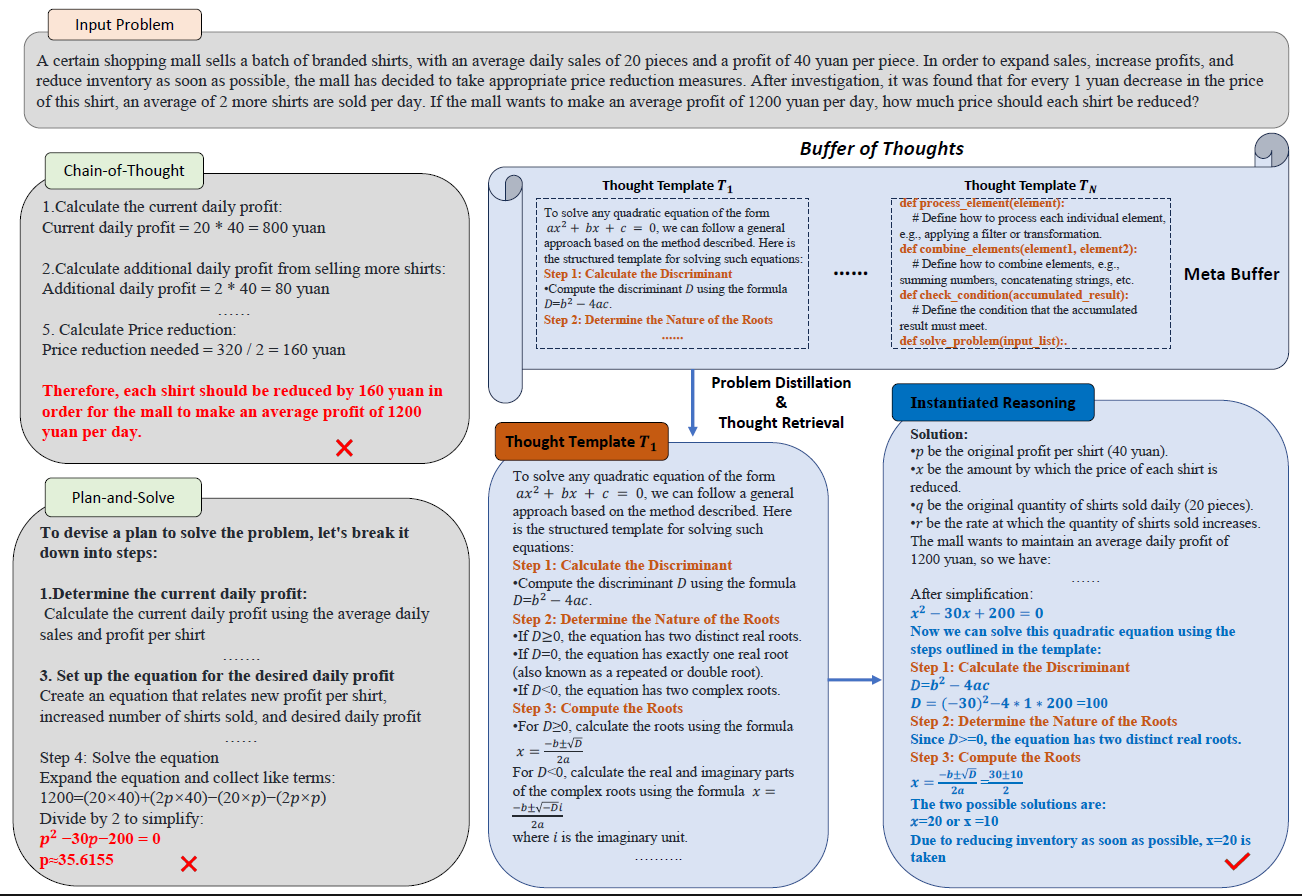 The BoT process. (source: Paper)
Let's go through each of these key parts to gain a more detailed look:
Problem Distiller
Problem Distiller can be thought of as a preprocess on the input tasks in order to...
- (1) extract essential information of the problem, and
- (2) simplify complex tasks for a better search and retrieval of thought templates.
Problem Distiller takes the burden off of LLM to identify and extract vital information and constraints of the problem. This is done by a meta prompt ϕ:
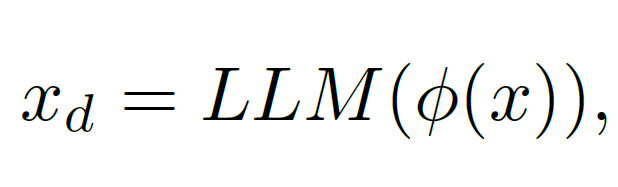 (source: Paper)
The prompt used by the authors to distill key information about a task is as follows:
vbnet
[Problem Distiller]:As a highly professional and intelligent expert in information distillation, you excel atextracting essential information to solve problems from user input queries. You adeptlytransform this extracted information into a suitable format based on the respective type of theissue.Please categorize and extract the crucial information required to solve the problem from theuser's input query, the distilled information should include.1. Key information:Values and information of key variables extracted from user input, which will be handed overto the respective expert for task resolution, ensuring all essential information required to solvethe problem is provided.2. Restrictions:The objective of the problem and corresponding constraints.3. Distilled task:Extend the problem based on 1 and 2, summarize a meta problem that can address the userquery and handle more input and output variations. Incorporate the real-world scenario of theextended problem along with the types of key variables and information constraints from theoriginal problem to restrict the key variables in the extended problem. After that, use the userquery input key information as input to solve the problem as an example.
Meta-Buffer
The meta-buffer is a central database that stores high-level thought templates. These templates are high-level abstractions representing various problem-solving processes. The idea is that LLM can leverage past problems and insights to solve current challenges. The best part is that the Meta-Buffer dynamically updates to ensure new unseen problems are also included. The Meta-Buffer doesn't enforce thought templates to follow a specific instruction.
Template Retrieval : Once a task is distilled, BoT would go through the thought templates and grab the one most similar to the task. This is done by calculating the embedding similarity between the task and the thought templates.
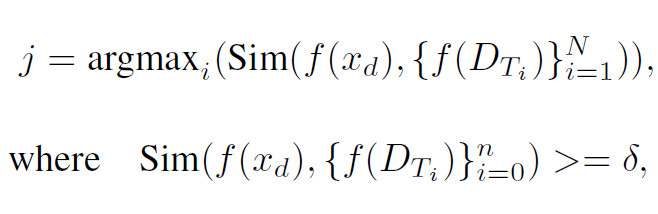 The retriever would calculate the similarity between the embedding of the input task f(xd), and the embedding of templates f(DTi ). (source: Paper)
the retriever would calculate the similarity between the embedding of the input task f(xd) , and the embedding of templates f(D Ti). This is only done if the similarity is above a certain threshold δ (0.5–0.7). If none of the thought templates have a similarity score with the task above the δ threshold, then the xd is identified as a new task. Depending on if the task is new or not, one of the two paths would be taken:
- If the task is similar to one of the thought templates, the template would be instantiated with the distilled information using an instantiation prompt (which you can check in the paper). This instantiation process can be denoted as
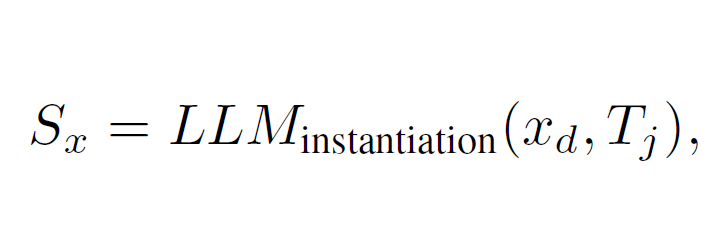 Instantiated Reasoning. (source: Paper)
- If the task is new, a general thought template that is designed to address a broad set of problems is used. As the task is processed, the Buffer Manager observes and learns and potentially creates a new, more specific thought template and pushes it to the meta-buffer.
Buffer Manager
The Buffer Manager serves as a crucial player in maintaining and enhancing the meta-buffer. Based on the new insights and outcomes from the tasks that are solved, it updates the thought templates. Also, whenever a new or drastically different problem is solved, the buffer manager assesses whether or not to create a new thought template. This is to ensure thought templates remain to the point and are not redundant.
 checking whether or not a newly generated template is similar to the existing ones. (source: Paper)
By employing the above formulation, the Buffer Manager checks whether or not the meta-buffer already has the necessary knowledge to tackle a problem.
BoT vs. Single-Query vs. Multi-Query
How does the BoT stand out compared to previous methods? The authors of the paper evaluate various methods on different datasets of various tasks, such as Data Understanding, Python Programming Puzzles, Multilingual Grade School Math **** (MGSM), etc. The results show a surprising advantage of** BoT** in almost all the tasks.
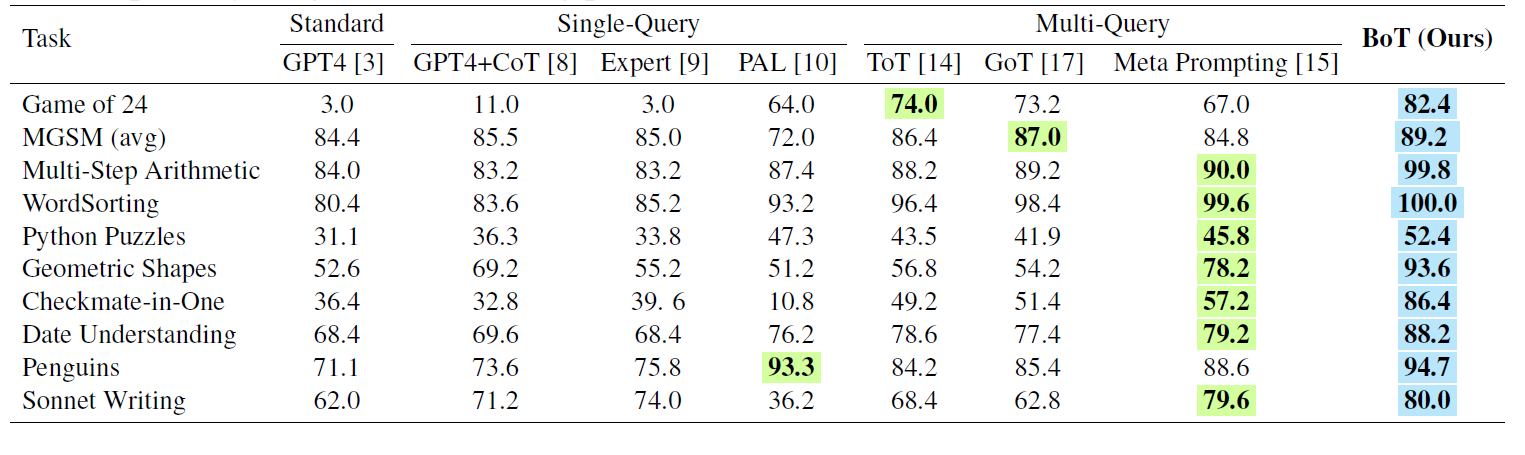 BoT vs previous methods. The best results (marked in blue) are all achieved by BoT. (source: Paper)
One of the key advantages of BoT is its efficiency - requiring only 12% of the computational cost on average when compared to multi-query prompting methods. This high computational cost and latency of multi-query methods such as ToT often renders them impractical in real-world use cases.
BoT+Llama3–8B has the potential to surpass single Llama3–70B model
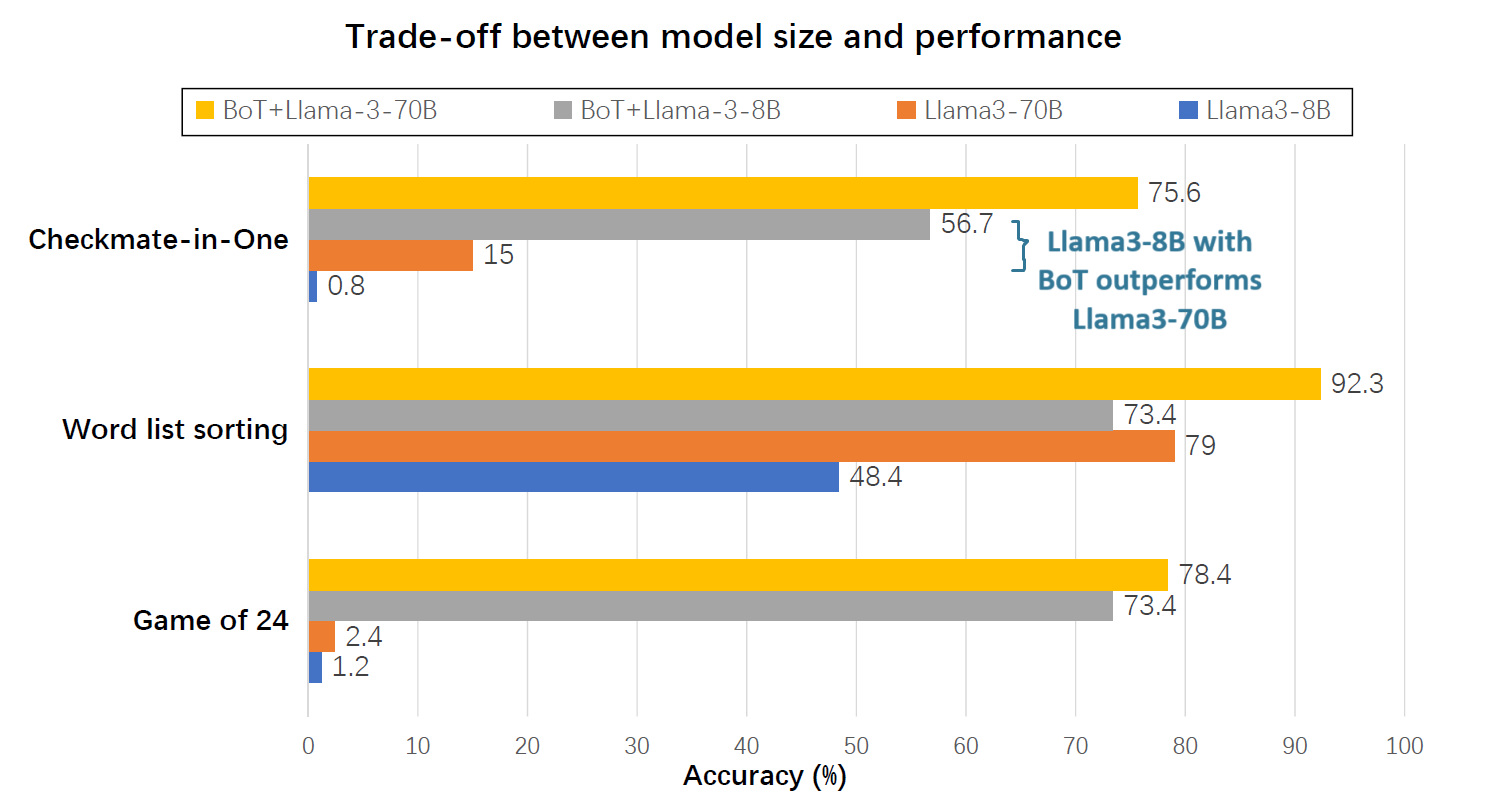 comparing the effect of BoT on Llama3–8B and 70B. Annotated. (source: Paper)
Buffer of Thoughts in Practice
The demo code for Buffer of Thoughts is published on GitHub [2]. To test out the functionality in practice, I will use this method on a custom task: Word Reordering. In this task, the LLM must take a scrambled sentence, such as "Sam name is my" , and return a permutation of these words that is semantically meaningful, which in this example would be "my name is Sam", (this is not a benchmark with baseline performance). Some examples of the scrambled sentences and the correct ones are as follows:
json
{"input": "<start> life plan and families to for social hospital workers outside with patients work the <end>",
"target": "<start> social workers work with patients and families to plan for life outside the hospital <end>"}
{"input": "<start> yield plant refers dry total to production biological matter <end>",
"target": "<start> biological yield refers to total plant dry matter production <end>"}
{"input": "<start> the bloodstream into alcohol from directly stomach goes the <end>",
"target": "<start> alcohol goes directly from the stomach into the bloodstream <end>"}
I will also use the following user prompt to explain the task:
text
Reorder a list of words to make them semantically meaningful,
for example "Sam name is my" -> "my name is Sam".
Please provide only the reordered sentence without any explanations.
Start the ordered sentence with <start> and end it with <end>
Provided this task, the BoT framework first distills my task and extracts the goal, the restriction, and how I would like my output along with other key information. The full procedure of BoT in detail, is the following terminal output:
bash
User prompt:
Reorder a list of words to make them semantically meaningful, for example "Sam name is my" -> "my name is Sam". Please provide only the reordered sentence without any explanations. Start the ordered sentence with <start> and end it with <end>
Input:
<start> the melting in solid to gold leaf metals is achieve made by desired gold and mixing color other <end>
Distilled information:Meta distiller Respond:

Distilled Information:

1. Key information:
- Input: "<start> the melting in solid to gold leaf metals is achieve made by desired gold and mixing color other <end>"

2. Restriction:
- Reorder the list of words such that the sentence is semantically meaningful
- The output should begin with "<start>" and end with "<end>"

3. Distilled task:
- The task is to reorder the words to create a meaningful sentence from the provided mixed words inside the tags "<start>" and "<end>"

4. Python transformation:
   (Optional, skip when Python tag is Not for Python) Input parameters:
     input_sentence = "<start> the melting in solid to gold leaf metals is achieve made by desired gold and mixing color other <end>"

5. Answer form: (Optional, skip when there is no specific answer form)
     The output sentence should be in the form of "<start> ... <end>"

  **Note: The generation ends here. Do not show this message in your answer !**
Instantiated reasoning result: ```python
def ReorderWords(input_sentence):
    # Remove the start and end tags, and split the sentence into words
    words = input_sentence.replace("<start>", "").replace("<end>", "").strip().split()

    # Tentative reordering to form a meaningful sentence
    # Based on the context provided in the task, the following reordering seems logical
    reordered_words = ["the", "melting", "in", "solid", "metals", "is", "achieved", "by", "mixing", "gold", "leaf", "and", "desired", "other", "color", "gold"]

    # Join the words into a single sentence and add start and end tags
    reordered_sentence = "<start> " + " ".join(reordered_words) + " <end>"

    return reordered_sentence

# Input sentence provided in the task
input_sentence = "<start> the melting in solid to gold leaf metals is achieve made by desired gold and mixing color other <end>"
print(ReorderWords(input_sentence))
The result of code execution: the melting in solid metals is achieved by mixing gold leaf and desired other color gold
text
Some of the examples of the reordered sentences using BoT:

```bash
{"input": "<start> life plan and families to for social hospital workers outside with patients work the <end>",
"result": "<start> Hospital workers work outside with social patients and plan to the families for life <end>n"}
{"input": "<start> yield plant refers dry total to production biological matter <end>",
"result": "<start> Plant yield refers to total dry matter biological production <end>n"}
{"input": "<start> the bloodstream into alcohol from directly stomach goes the <end>",
"result": "<start> the alcohol goes directly from the stomach into the bloodstream <end>n"}
Note, that the BoT repository I used is a demo code and lacks some of the features mentioned in the original paper, such as a general thought template, the dynamic updating of the Meta-Buffer, or finding the closest template embedding to the user task. These are important aspects of the framework and without them, we cannot conclude the performance of Buffer of Thoughts in practice.
Final Words
In conclusion, BoT shows promising results in both accuracy and efficiency in various domains and tasks. It's an interesting approach to breaking down a reasoning problem into its fundamental restrictions and key information and building on top of previous solutions and templates to better formulate the task for an LLM to understand.
By addressing some of the limitations in other prompting techniques, Buffer of Thoughts allows LLM to have more complex thinking patterns, potentially making smaller lightweight models perform at the level of larger ones.
Allowing small LLMs to achieve results close to large LLMs is a key topic addressed in many of the current research papers. The goal is to employ various prompting and fine-tuning techniques to extract accurate AI outputs with low computation and cost.
Buffer of Thoughts is a novel and promising prompting framework that leverages a domain of techniques to guide LLM step by step, in a reasoning process. A complete practical implementation of the Buffer of Thoughts technique is yet to come, but in the meanwhile, test out the provided benchmarks in the demo GitHub repository [2].
If you have made it this far, consider this for a further read :
Platonic Representation: Are AI Deep Network Models Converging?
🌟 Join +1000 people learning about Python, ML / MLOps / AI, Data Science, and LLM. follow me and check out my X/Twitter , where I keep you updated Daily**.**
Thanks for reading,
— Hesam
[1] Yang, L., Yu, Z., Zhang, T., Cao, S., Xu, M., Zhang, W., Gonzalez, J. E., & Cui, B. (2024). Buffer of Thoughts: Thought-Augmented Reasoning with Large Language Models. arXiv. Retrieved from https://arxiv.org/abs/2406.04271
[2] buffer-of-thought-llm, https://github.com/YangLing0818/buffer-of-thought-llm
Register Now to Continue Reading
Unlock Towards Data Science with a Free Account
All articles on Towards Data Science are available to registered users. Create a free account today to access this article and thousands more.
Register for freeSign in to your account
 Written By
See all from Hesam Sheikh
Chain Of ThoughtData ScienceLarge Language ModelsMachine LearningPrompt Engineering
Share This Article
Towards Data Science is a community publication. Submit your insights to reach our global audience and earn through the TDS Author Payment Program.
Write for TDS
Related Articles
Programming
What you need to know as graph theory adoption continues to take off
Miguel Saldana
March 22, 20218 min read
Data Science
An analogy to help explain common myths and pitfalls to management
Koen Peters
January 18, 20238 min read
Artificial Intelligence
A Python Guide to Quickly Generate Knowledge Graphs
Jye Sawtell-Rickson
January 1, 20235 min read
Data Governance
How to put a dollar value on your organization's operational data
Thuwarakesh Murallie
September 21, 20268 min read
Machine Learning
Generative and discriminative are classes of machine learning models.
Saurav Singla
September 12, 20206 min read
Programming
Learn the difference between long-form and wide-form data, and how to transition between them in Pandas.
Murtaza Ali
October 13, 20225 min read
Data Science
Retail Power Prices in Texas: Analyzing the Whole Market in Context This is the second...
Dale Furrow
May 6, 20213 min read
Machine Learning
A brief presentation of KG Recommender Systems Families
Amine Dadoun
April 1, 20237 min read
Artificial Intelligence
And how you can do the same with your docs
Jacob Marks, Ph.D.
April 25, 202315 min read
Your home for data science and AI. The world's leading publication for data science, data analytics, data engineering, machine learning, and artificial intelligence professionals.
Subscribe to Our NewsletterWrite For TDS•About•Advertise•Privacy Policy•Terms of Use
© Insight Media Group, LLC 2026•The New Stack•roadmap.sh•Creator Network
Recommended Articles
Close