保留正文与补采附件。源页面当前未重新核验;具体限制见交付清单。
 We value your privacy
We use cookies to enhance your browsing experience, serve personalised ads or content, and analyse our traffic. By clicking "Accept All", you consent to our use of cookies.
Customise Reject All Accept All
Customise Consent Preferences
 We use cookies to help you navigate efficiently and perform certain functions. You will find detailed information about all cookies under each consent category below.
The cookies that are categorised as "Necessary" are stored on your browser as they are essential for enabling the basic functionalities of the site. ... Show more
NecessaryAlways Active
Necessary cookies are required to enable the basic features of this site, such as providing secure log-in or adjusting your consent preferences. These cookies do not store any personally identifiable data.
-
Cookie
BCTempID
-
Duration
10 minutes
-
Description
No description available.
-
Cookie
__cf_bm
-
Duration
1 hour
-
Description
This cookie, set by Cloudflare, is used to support Cloudflare Bot Management.
-
Cookie
AWSALBCORS
-
Duration
7 days
-
Description
Amazon Web Services set this cookie for load balancing.
-
Cookie
_cfuvid
-
Duration
session
-
Description
Cloudflare sets this cookie to track users across sessions to optimize user experience by maintaining session consistency and providing personalized services
-
Cookie
li_gc
-
Duration
6 months
-
Description
Linkedin set this cookie for storing visitor's consent regarding using cookies for non-essential purposes.
-
Cookie
__hssrc
-
Duration
session
-
Description
This cookie is set by Hubspot whenever it changes the session cookie. The __hssrc cookie set to 1 indicates that the user has restarted the browser, and if the cookie does not exist, it is assumed to be a new session.
-
Cookie
__hssc
-
Duration
1 hour
-
Description
HubSpot sets this cookie to keep track of sessions and to determine if HubSpot should increment the session number and timestamps in the __hstc cookie.
-
Cookie
wpEmojiSettingsSupports
-
Duration
session
-
Description
WordPress sets this cookie when a user interacts with emojis on a WordPress site. It helps determine if the user's browser can display emojis properly.
-
Cookie
BCSessionID
-
Duration
1 year 1 month 4 days
-
Description
Blueconic sets this cookie as a unique identifier for the BlueConic profile.
-
Cookie
_octo
-
Duration
1 year
-
Description
No description available.
-
Cookie
logged_in
-
Duration
1 year
-
Description
No description available.
-
Cookie
__Secure-YEC
-
Duration
past
-
Description
YouTube sets this cookie to stores the user's video player preferences using embedded YouTube video
-
Cookie
__eoi
-
Duration
6 months
-
Description
Description is currently not available.
-
Cookie
AWSALBTGCORS
-
Duration
7 days
-
Description
No description available.
-
Cookie
login-status-p
-
Duration
past
-
Description
Description is currently not available.
-
Cookie
AWSALBTG
-
Duration
7 days
-
Description
No description available.
-
Cookie
csrf_token
-
Duration
session
-
Description
No description available.
-
Cookie
token_v2
-
Duration
1 day
-
Description
Description is currently not available.
-
Cookie
D
-
Duration
1 year
-
Description
Description is currently not available.
-
Cookie
PHPSESSID
-
Duration
session
-
Description
This cookie is native to PHP applications. The cookie stores and identifies a user's unique session ID to manage user sessions on the website. The cookie is a session cookie and will be deleted when all the browser windows are closed.
-
Cookie
VISITOR_PRIVACY_METADATA
-
Duration
6 months
-
Description
YouTube sets this cookie to store the user's cookie consent state for the current domain.
-
Cookie
cookietest
-
Duration
session
-
Description
The cookietest cookie is typically used to determine whether the user's browser accepts cookies, essential for website functionality and user experience.
-
Cookie
__Host-airtable-session
-
Duration
1 year
-
Description
This cookie is used to enable us to integrate the services of Airtable.
-
Cookie
__Host-airtable-session.sig
-
Duration
1 year
-
Description
This cookie is used to enable us to integrate the services of Airtable.
-
Cookie
m
-
Duration
1 year 1 month 4 days
-
Description
Stripe sets this cookie for fraud prevention purposes. It identifies the device used to access the website, allowing the website to be formatted accordingly.
-
Cookie
BIGipServer*
-
Duration
session
-
Description
Marketo sets this cookie to collect information about the user's online activity and build a profile about their interests to provide advertisements relevant to the user.
-
Cookie
__cfruid
-
Duration
session
-
Description
Cloudflare sets this cookie to identify trusted web traffic.
-
Cookie
_GRECAPTCHA
-
Duration
6 months
-
Description
Google Recaptcha service sets this cookie to identify bots to protect the website against malicious spam attacks.
-
Cookie
__Secure-YNID
-
Duration
6 months
-
Description
Google cookie used to protect user security and prevent fraud, especially during the login process.
-
Cookie
cookieyes-consent
-
Duration
1 year
-
Description
CookieYes sets this cookie to remember users' consent preferences so that their preferences are respected on subsequent visits to this site. It does not collect or store any personal information about the site visitors.
Functional
Functional cookies help perform certain functionalities like sharing the content of the website on social media platforms, collecting feedback, and other third-party features.
-
Cookie
lidc
-
Duration
1 day
-
Description
LinkedIn sets the lidc cookie to facilitate data center selection.
-
Cookie
brw
-
Duration
1 year
-
Description
No description available.
-
Cookie
brwConsent
-
Duration
5 minutes
-
Description
Description is currently not available.
-
Cookie
WMF-Uniq
-
Duration
1 year
-
Description
Description is currently not available.
-
Cookie
loom_anon_comment
-
Duration
1 year
-
Description
No description available.
-
Cookie
loom_referral_video
-
Duration
session
-
Description
Description is currently not available.
-
Cookie
VISITOR_INFO1_LIVE
-
Duration
6 months
-
Description
A cookie set by YouTube to measure bandwidth that determines whether the user gets the new or old player interface.
-
Cookie
yt-remote-connected-devices
-
Duration
Never Expires
-
Description
YouTube sets this cookie to store the user's video preferences using embedded YouTube videos.
-
Cookie
ytidb::LAST_RESULT_ENTRY_KEY
-
Duration
Never Expires
-
Description
The cookie ytidb::LAST_RESULT_ENTRY_KEY is used by YouTube to store the last search result entry that was clicked by the user. This information is used to improve the user experience by providing more relevant search results in the future.
-
Cookie
yt-remote-device-id
-
Duration
Never Expires
-
Description
YouTube sets this cookie to store the user's video preferences using embedded YouTube videos.
-
Cookie
yt-remote-session-name
-
Duration
session
-
Description
The yt-remote-session-name cookie is used by YouTube to store the user's video player preferences using embedded YouTube video.
-
Cookie
yt-remote-fast-check-period
-
Duration
session
-
Description
The yt-remote-fast-check-period cookie is used by YouTube to store the user's video player preferences for embedded YouTube videos.
-
Cookie
yt-remote-session-app
-
Duration
session
-
Description
The yt-remote-session-app cookie is used by YouTube to store user preferences and information about the interface of the embedded YouTube video player.
-
Cookie
yt-remote-cast-available
-
Duration
session
-
Description
The yt-remote-cast-available cookie is used to store the user's preferences regarding whether casting is available on their YouTube video player.
-
Cookie
yt-remote-cast-installed
-
Duration
session
-
Description
The yt-remote-cast-installed cookie is used to store the user's video player preferences using embedded YouTube video.
-
Cookie
cp_session
-
Duration
3 months
-
Description
Codepen sets this cookie for Help systems found in the website.
-
Cookie
loid
-
Duration
1 year 1 month 4 days
-
Description
This cookie is set by the Reddit. The cookie enables the sharing of content from the website onto the social media platform.
Analytics
Analytical cookies are used to understand how visitors interact with the website. These cookies help provide information on metrics such as the number of visitors, bounce rate, traffic source, etc.
-
Cookie
__hstc
-
Duration
6 months
-
Description
Hubspot set this main cookie for tracking visitors. It contains the domain, initial timestamp (first visit), last timestamp (last visit), current timestamp (this visit), and session number (increments for each subsequent session).
-
Cookie
hubspotutk
-
Duration
6 months
-
Description
HubSpot sets this cookie to keep track of the visitors to the website. This cookie is passed to HubSpot on form submission and used when deduplicating contacts.
-
Cookie
_ga
-
Duration
1 year 1 month 4 days
-
Description
Google Analytics sets this cookie to calculate visitor, session and campaign data and track site usage for the site's analytics report. The cookie stores information anonymously and assigns a randomly generated number to recognise unique visitors.
-
Cookie
ga*
-
Duration
1 year 1 month 4 days
-
Description
Google Analytics sets this cookie to store and count page views.
-
Cookie
__Host-psifi.analyticsTrace
-
Duration
6 hours
-
Description
Description is currently not available.
-
Cookie
__Host-psifi.analyticsTraceV2
-
Duration
6 hours
-
Description
Description is currently not available.
-
Cookie
_gh_sess
-
Duration
session
-
Description
GitHub sets this cookie for temporary application and framework state between pages like what step the user is on in a multiple step form.
-
Cookie
YSC
-
Duration
session
-
Description
YSC cookie is set by Youtube and is used to track the views of embedded videos on Youtube pages.
-
Cookie
ajs_anonymous_id
-
Duration
1 year
-
Description
This cookie is set by Segment to count the number of people who visit a certain site by tracking if they have visited before.
-
Cookie
vuid
-
Duration
1 year 1 month 4 days
-
Description
Vimeo installs this cookie to collect tracking information by setting a unique ID to embed videos on the website.
Performance
Performance cookies are used to understand and analyse the key performance indexes of the website which helps in delivering a better user experience for the visitors.
-
Cookie
AWSALB
-
Duration
7 days
-
Description
AWSALB is an application load balancer cookie set by Amazon Web Services to map the session to the target.
-
Cookie
acq
-
Duration
past
-
Description
Description is currently not available.
-
Cookie
acq.sig
-
Duration
past
-
Description
Description is currently not available.
-
Cookie
ptc
-
Duration
2 years
-
Description
No description available.
Advertisement
Advertisement cookies are used to provide visitors with customised advertisements based on the pages you visited previously and to analyse the effectiveness of the ad campaigns.
-
Cookie
muc_ads
-
Duration
1 year 1 month 4 days
-
Description
Twitter sets this cookie to collect user behaviour and interaction data to optimize the website.
-
Cookie
guest_id_marketing
-
Duration
1 year 1 month 4 days
-
Description
Twitter sets this cookie to identify and track the website visitor.
-
Cookie
guest_id_ads
-
Duration
1 year 1 month 4 days
-
Description
Twitter sets this cookie to identify and track the website visitor.
-
Cookie
personalization_id
-
Duration
1 year 1 month 4 days
-
Description
Twitter sets this cookie to integrate and share features for social media and also store information about how the user uses the website, for tracking and targeting.
-
Cookie
guest_id
-
Duration
1 year 1 month 4 days
-
Description
Twitter sets this cookie to identify and track the website visitor. It registers if a user is signed in to the Twitter platform and collects information about ad preferences.
-
Cookie
bcookie
-
Duration
1 year
-
Description
LinkedIn sets this cookie from LinkedIn share buttons and ad tags to recognize browser IDs.
-
Cookie
__Secure-ROLLOUT_TOKEN
-
Duration
6 months
-
Description
YouTube sets this cookie to manage feature rollout and experimentation. It helps Google control which new features or interface changes are shown to users as part of testing and staged rollouts, ensuring consistent experience for a given user during an experiment.
-
Cookie
yt.innertube::nextId
-
Duration
Never Expires
-
Description
YouTube sets this cookie to register a unique ID to store data on what videos from YouTube the user has seen.
-
Cookie
yt.innertube::requests
-
Duration
Never Expires
-
Description
YouTube sets this cookie to register a unique ID to store data on what videos from YouTube the user has seen.
-
Cookie
session_tracker
-
Duration
session
-
Description
This cookie is set by the Reddit. This cookie is used to identify trusted web traffic. It also helps in adverstising on the website.
-
Cookie
edgebucket
-
Duration
session
-
Description
Reddit sets this cookie to save the information about a log-on Reddit user, for the purpose of advertisement recommendations and updating the content.
-
Cookie
did
-
Duration
1 year
-
Description
Arbor sets this cookie to show targeted ads to site visitors.This cookie expires after 2 months or 1 year.
Uncategorised
Other uncategorised cookies are those that are being analysed and have not been classified into a category as yet.
No cookies to display.
Reject All Save My Preferences Accept All
Toggle SearchToggle Mobile Navigation
Publish AI, ML & data-science insights to a global community of data professionals.
Sign inSubmit an Article
LatestEditor's PicksNewsletterShipAI
Write For TDS
LinkedInXToggle Search
Data Science
Sentiment Analysis Of Political Speeches Using Hugging Face's Pipeline Feature
Who would you rather trust to assess political speeches - human pundits, or an algorithm? A test run on Covid-19 speeches in Singapore...
Chua Chin Hon
June 22, 20206 min read
Who would you rather trust to assess political speeches - human pundits, or an algorithm? A test run on Covid-19 speeches in Singapore between February and June 2020 turns up some interesting results.
 Election season fills many of us with dread. But it is also a good opportunity to test out some of the new NLP features out there with a practical use case.
In recent weeks, I've been experimenting with Hugging Face's (HF) pipelines feature to see how they can be used with ease and speed to analyze/summarize political speeches in Singapore. This post will outline my attempts to conduct short and long-term sentiment analysis of said speeches, delivered between February and June 2020, with HF's pipeline feature.
I find the results pretty impressive, despite just using the default model without additional fine tuning with local data. With elections coming up in countries like the US and Singapore, there is further scope for testing how well these transformers-based models hold up under different political contexts.
Learn this step by step with the interactive AI and Data Scientist and Data Analyst roadmaps.
REPO, DATA AND CAVEATS
The Github repo for this post contains a notebook and the data needed to generate some of the charts in this post, as well as a sample of the Plotly chart and CSV table of the results. The code can be easily tweaked if you wish to generate results for multiple speeches in one go.
The data comprises six official speech transcripts taken from the websites of the Singapore Government as well as the Prime Minister's Office. These speeches focused on the Government's plans to deal with the challenges from Covid-19, and are set to frame the broader debate for Singapore's upcoming election. Some excessively long chunks of text were broken up into smaller paragraphs for a fairer assessment of the sentiment, but the vast majority of the speeches were analysed in their original form.
A more rigorous application of sentiment analysis would require fine tuning of the model with domain-specific data, especially if specialized topics such as medical or legal issues are involved. In this post, however, I'm using the HF pipeline for sentiment analysis "out-of-the-box", meaning results are based on the default Distilbert model (more specifically: distilbert-base-uncased-finetuned-sst-2-english). HF's website has a growing list of other models compatible with the tasks of sentiment analysis and text classification if you wish to experiment further.
ANALYZING THE SENTIMENT OF 1 SPEECH
Thanks to the good folks at HF, the pipeline API takes care of the heavy lifting in terms of the complex coding required. Executing the sentiment analysis just takes a few lines of code, after simple text pre-processing (splitting into paragraphs) and cleaning.
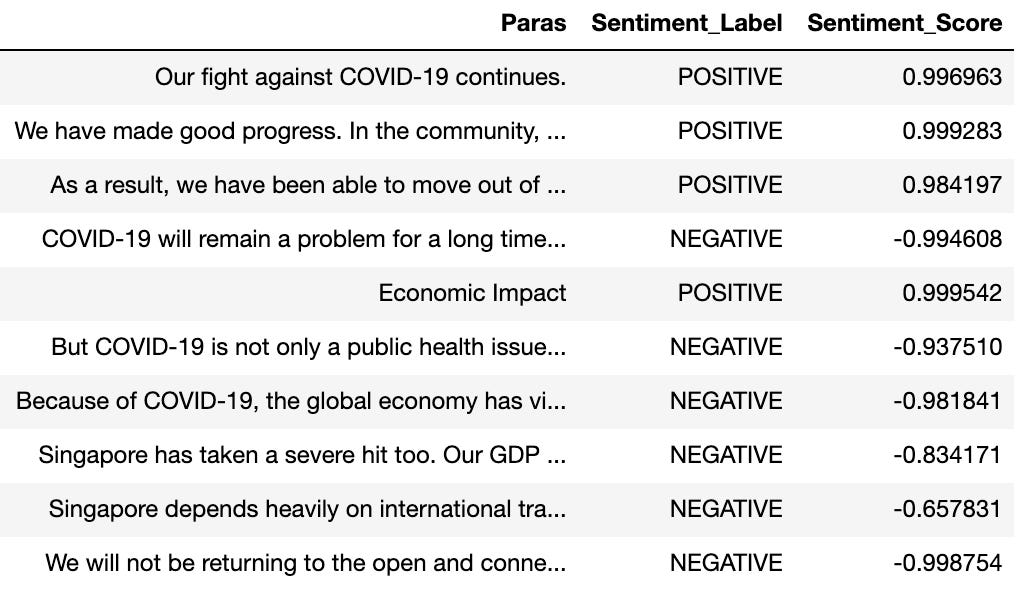
The pipeline generates a sentiment label as well as a score. By extracting the labels and scores into a separate data frame, we can easily inspect the results and see where the model might have made mistakes:
 The tricker task, for me, is in finding a good way to visualize and annotate the results. I eventually settled on a combination of Plotly and Google Slides for clarity and ease of use. Feel free to switch to a visualization library of your choice.
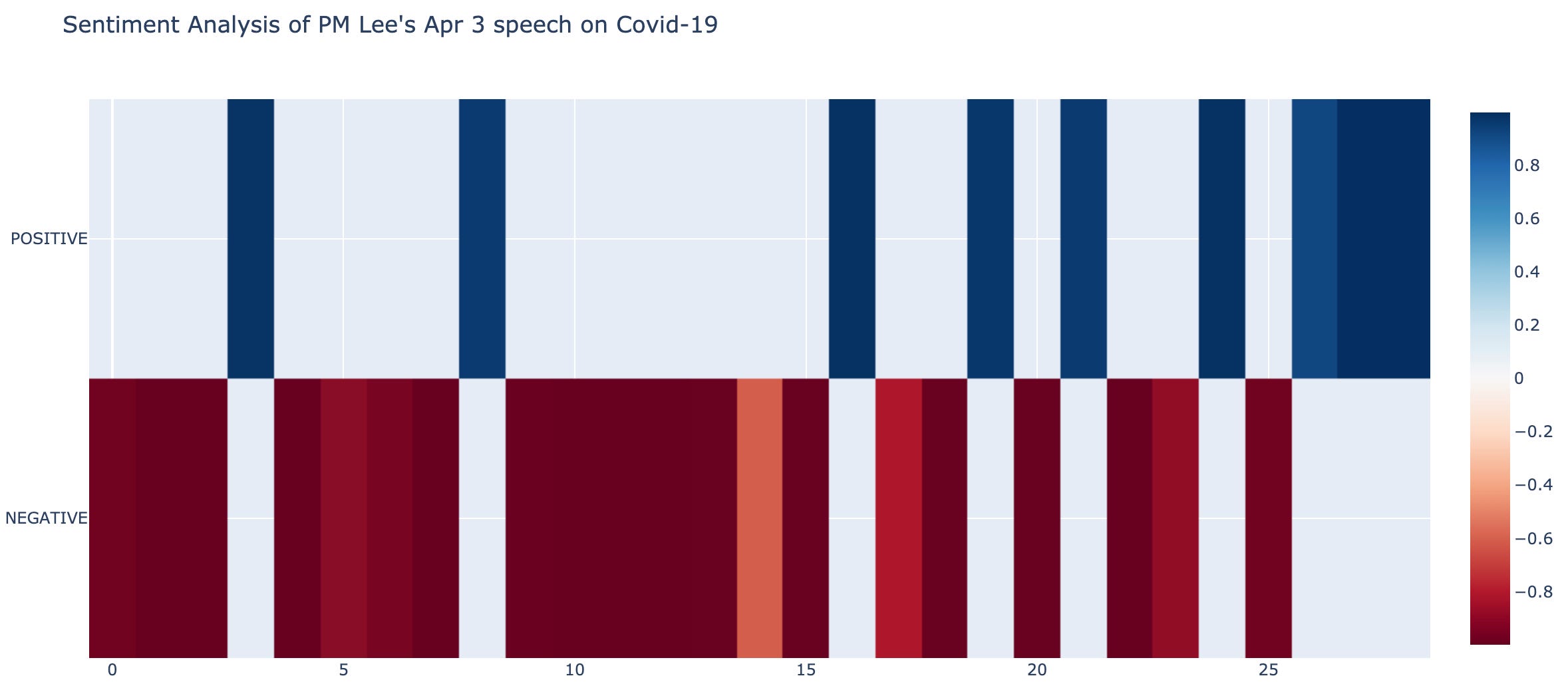
This is the sample results from the sentiment analysis of the first speech in the dataset:
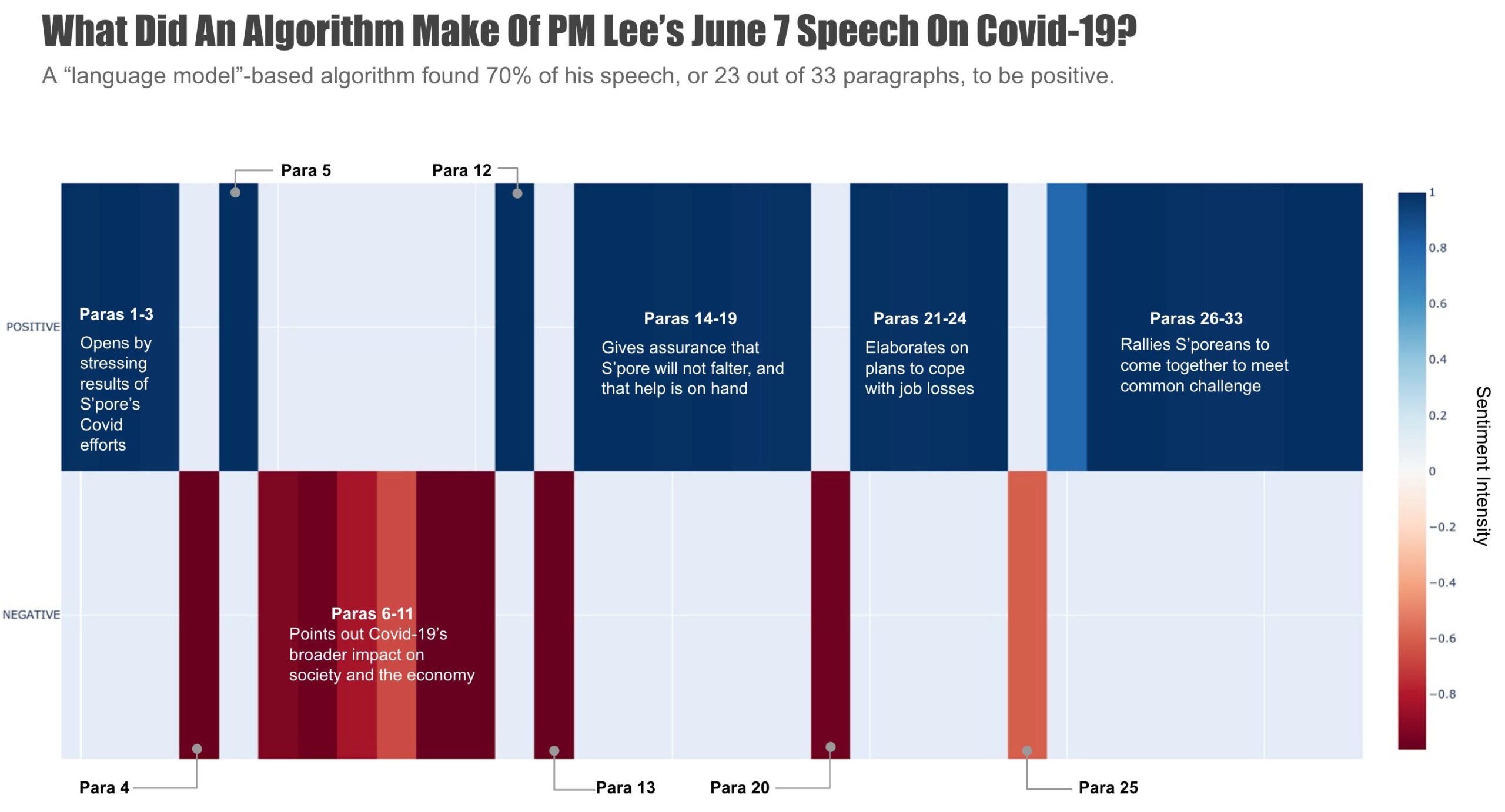 HF's sentiment analysis pipeline assessed 23 of this speech's 33 paragraphs to be positive.
At a glance, you can tell where and for how long a speaker dwelled in the positive or negative territory. In this case, we can see how Singapore Prime Minister Lee Hsien Loong balanced out the grim warnings of Covid-19's economic impact with assurances of the Government's plans to help Singaporeans cope with job losses. He also ended his June 7 speech on a positive note by rallying the country around a common challenge.
ANALYZING THE SENTIMENT OF A GROUP OF SPEECHES
If we group a series of these "sentiment structure" charts together, we can quickly get a sense of whether speakers from the same outfit are delivering a consistent message, tone-wise, or if each person is singing a different tune. You can also use this to observe how sentiment on a subject changed over time.
The chart below features an example using 10 speeches to show how political leaders in Singapore changed the tone of their speeches on Covid-19 between February and June, ahead of expected polls. If you compare the left and right columns, you'll notice a distinct shift in overall sentiment (on Covid-19) from being predominantly negative in tone between February and late April, to a more positive note in June:
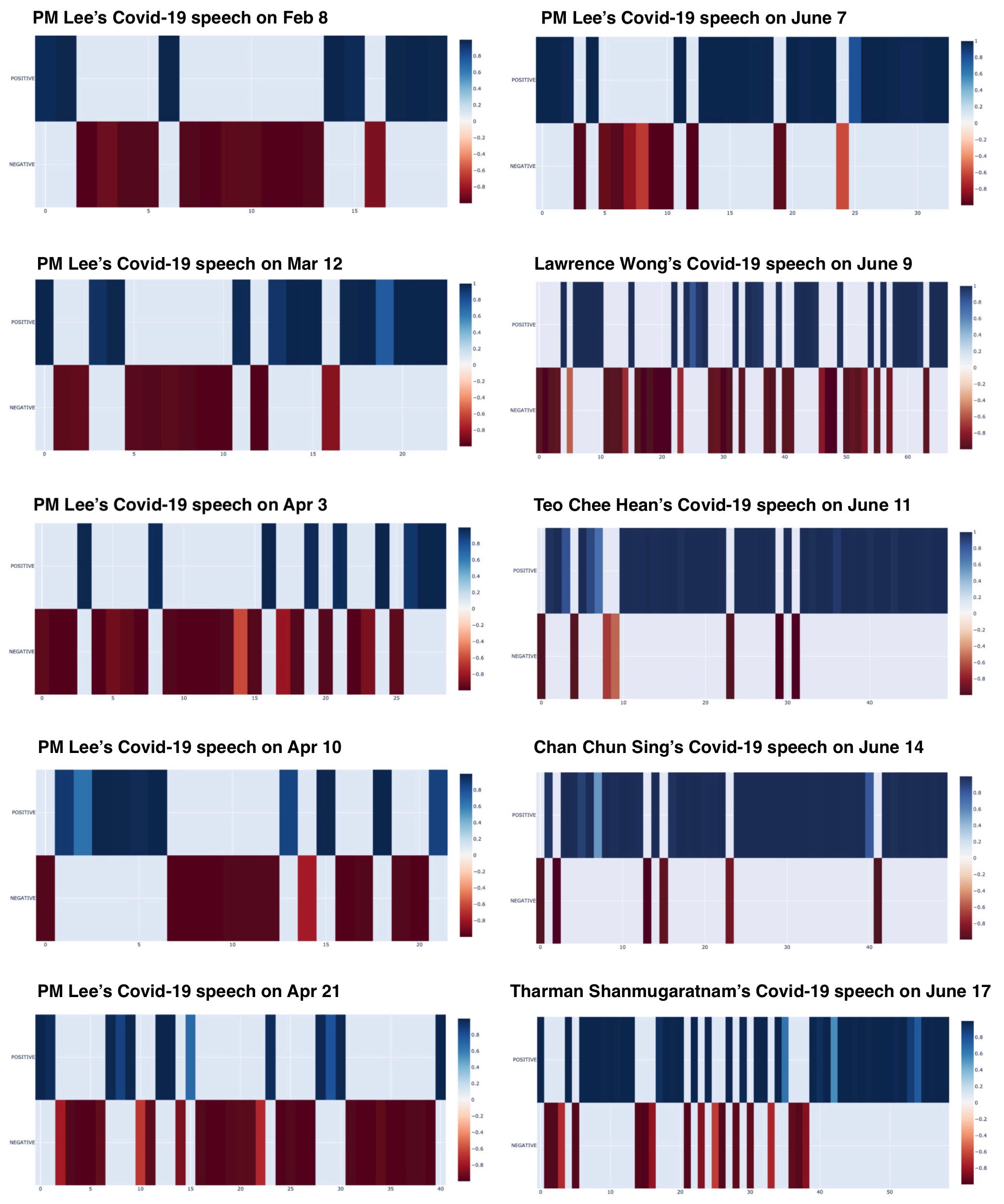 The results are not surprising as the outbreak significantly worsened in Singapore in April, before the Government successfully contained it by May. With an election around the corner, the top political leaders clearly needed to switch to a new communication strategy - and tone - which they did in June.
The speeches for February and late April are not included in the repo, but are available in the links above to the two government websites.
I believe this can be applied to analyzing, say, Trump's change in tone between the initial and later phases of the Covid-19 outbreak. I'll be keen to test this out during the Biden-Trump debates as well.
WHERE THE ALGORITHM TRIPS UP
Results from the speeches analysed in this post can be downloaded here for a quick view. See if you agree with the algorithm's assessment.
There are mistakes, of course. The chart below shows at least two areas where the Distilbert model got it wrong when analysing a June 9 speech by Singapore's National Development Minister Lawrence Wong's Covid-19:
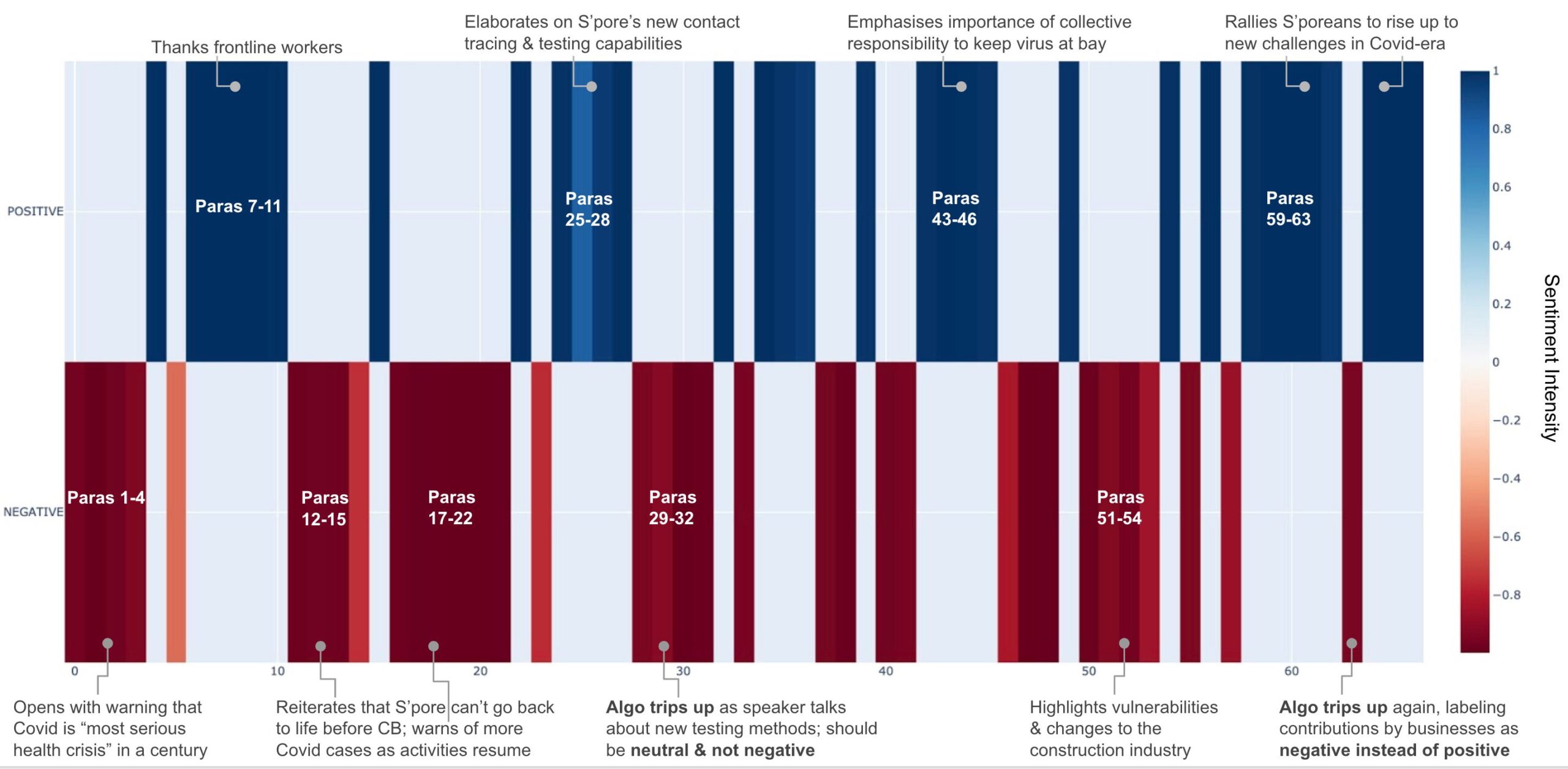 The algorithm wrongly labelled a portion of his speech discussing Singapore's new testing and contact tracing capabilities as negative, when it should be considered neutral or positive. It tripped up again towards the end of the speech, when it wrongly labelled a paragraph praising the contributions from the business community as negative.
Elsewhere, the algorithm can be "defeated" by vague and generic descriptions of a dire situation, such as the second paragraph from a June 11 speech by Singapore's Senior Minister Teo Chee Hean:
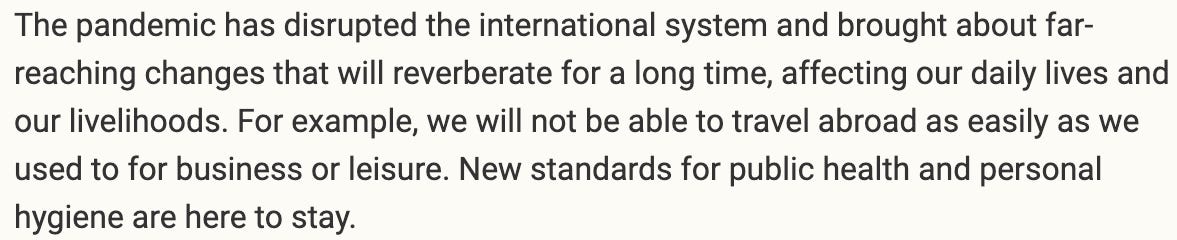 The language in the paragraph above greatly understates the extent and severity of the disruption caused by Covid-19, and the algorithm interestingly labelled it as positive. A human analyst would have arrived at the opposite conclusion.
END NOTE + FURTHER WORK
An obvious area of improvement would be in fine tuning the model with a custom dataset on Singapore politics and/or Covid-19. The task, however, doesn't look trivial (to me anyways) and finding a relevant and labeled training dataset is not easy.
I would also be interested to see how results from HF's pipeline stack up against other known approaches in sentiment analysis.
But overall, I've been pretty impressed by the results from the HF pipeline despite the obvious limits of this approach. The sentiment surrounding a speech clearly doesn't just depend on the words used but also on the speaker's delivery and demeanor.
A full AI-based sentiment analysis of speeches should ideally incorporate the use of computer vision and audio forensics to better understand how a speaker's facial expressions and speaking voice add to the overall sentiment of the speech. But this is beyond the scope of this post.
Meanwhile, let me know if you spot errors or do something interesting with this approach. Ping me at:
Twitter: Chua Chin Hon
LinkedIn: www.linkedin.com/in/chuachinhon
Register Now to Continue Reading
Unlock Towards Data Science with a Free Account
All articles on Towards Data Science are available to registered users. Create a free account today to access this article and thousands more.
Register for freeSign in to your account
 Written By
See all from Chua Chin Hon
Covid-19Data ScienceData VisualizationHugging FaceSingapore
Share This Article
Towards Data Science is a community publication. Submit your insights to reach our global audience and earn through the TDS Author Payment Program.
Write for TDS
Related Articles
Machine Learning
A complete cheat sheet for all unsupervised machine learning algorithms you should know
Dmytro Nikolaiev (Dimid)
February 17, 20224 min read
Machine Learning
An explanation of the Gamma Distribution and its origins
Egor Howell
April 18, 20223 min read
Machine Learning
8 years ago I started my bachelor's degree in Geography. Now I'm a Data Scientist; this is the story of how (and why) I've got here
Matt Chapman
May 2, 20249 min read
Artificial Intelligence
Techniques of a top-ranked submission in the competition organized by Andrew Ng and DeepLearning.AI
Kenneth Leung
October 18, 20217 min read
Machine Learning
Interpreting the Logit Model - Global and Local Feature Importance
Satya Pattnaik
May 2, 20215 min read
Artificial Intelligence
Exploratory data analysis made easy
Soner Yıldırım
March 2, 20214 min read
Artificial Intelligence
Explaining model results to executives
Vicky Yu
October 23, 20203 min read
Machine Learning
One data, three models, detailed calculations made easy
Albers Uzila
August 8, 202212 min read
Programming
Understanding how to determine whether a Python object has a specific attribute
Giorgos Myrianthous
November 3, 20213 min read
Your home for data science and AI. The world's leading publication for data science, data analytics, data engineering, machine learning, and artificial intelligence professionals.
Subscribe to Our NewsletterWrite For TDS•About•Advertise•Privacy Policy•Terms of Use
© Insight Media Group, LLC 2026•The New Stack•roadmap.sh•Creator Network
Recommended Articles
Close