保留正文与补采附件。源页面当前未重新核验;具体限制见交付清单。
 We value your privacy
We use cookies to enhance your browsing experience, serve personalised ads or content, and analyse our traffic. By clicking "Accept All", you consent to our use of cookies.
Customise Reject All Accept All
Customise Consent Preferences
 We use cookies to help you navigate efficiently and perform certain functions. You will find detailed information about all cookies under each consent category below.
The cookies that are categorised as "Necessary" are stored on your browser as they are essential for enabling the basic functionalities of the site. ... Show more
NecessaryAlways Active
Necessary cookies are required to enable the basic features of this site, such as providing secure log-in or adjusting your consent preferences. These cookies do not store any personally identifiable data.
-
Cookie
BCTempID
-
Duration
10 minutes
-
Description
No description available.
-
Cookie
__cf_bm
-
Duration
1 hour
-
Description
This cookie, set by Cloudflare, is used to support Cloudflare Bot Management.
-
Cookie
AWSALBCORS
-
Duration
7 days
-
Description
Amazon Web Services set this cookie for load balancing.
-
Cookie
_cfuvid
-
Duration
session
-
Description
Cloudflare sets this cookie to track users across sessions to optimize user experience by maintaining session consistency and providing personalized services
-
Cookie
li_gc
-
Duration
6 months
-
Description
Linkedin set this cookie for storing visitor's consent regarding using cookies for non-essential purposes.
-
Cookie
__hssrc
-
Duration
session
-
Description
This cookie is set by Hubspot whenever it changes the session cookie. The __hssrc cookie set to 1 indicates that the user has restarted the browser, and if the cookie does not exist, it is assumed to be a new session.
-
Cookie
__hssc
-
Duration
1 hour
-
Description
HubSpot sets this cookie to keep track of sessions and to determine if HubSpot should increment the session number and timestamps in the __hstc cookie.
-
Cookie
wpEmojiSettingsSupports
-
Duration
session
-
Description
WordPress sets this cookie when a user interacts with emojis on a WordPress site. It helps determine if the user's browser can display emojis properly.
-
Cookie
BCSessionID
-
Duration
1 year 1 month 4 days
-
Description
Blueconic sets this cookie as a unique identifier for the BlueConic profile.
-
Cookie
_octo
-
Duration
1 year
-
Description
No description available.
-
Cookie
logged_in
-
Duration
1 year
-
Description
No description available.
-
Cookie
__Secure-YEC
-
Duration
past
-
Description
YouTube sets this cookie to stores the user's video player preferences using embedded YouTube video
-
Cookie
__eoi
-
Duration
6 months
-
Description
Description is currently not available.
-
Cookie
AWSALBTGCORS
-
Duration
7 days
-
Description
No description available.
-
Cookie
login-status-p
-
Duration
past
-
Description
Description is currently not available.
-
Cookie
AWSALBTG
-
Duration
7 days
-
Description
No description available.
-
Cookie
csrf_token
-
Duration
session
-
Description
No description available.
-
Cookie
token_v2
-
Duration
1 day
-
Description
Description is currently not available.
-
Cookie
D
-
Duration
1 year
-
Description
Description is currently not available.
-
Cookie
PHPSESSID
-
Duration
session
-
Description
This cookie is native to PHP applications. The cookie stores and identifies a user's unique session ID to manage user sessions on the website. The cookie is a session cookie and will be deleted when all the browser windows are closed.
-
Cookie
VISITOR_PRIVACY_METADATA
-
Duration
6 months
-
Description
YouTube sets this cookie to store the user's cookie consent state for the current domain.
-
Cookie
cookietest
-
Duration
session
-
Description
The cookietest cookie is typically used to determine whether the user's browser accepts cookies, essential for website functionality and user experience.
-
Cookie
__Host-airtable-session
-
Duration
1 year
-
Description
This cookie is used to enable us to integrate the services of Airtable.
-
Cookie
__Host-airtable-session.sig
-
Duration
1 year
-
Description
This cookie is used to enable us to integrate the services of Airtable.
-
Cookie
m
-
Duration
1 year 1 month 4 days
-
Description
Stripe sets this cookie for fraud prevention purposes. It identifies the device used to access the website, allowing the website to be formatted accordingly.
-
Cookie
BIGipServer*
-
Duration
session
-
Description
Marketo sets this cookie to collect information about the user's online activity and build a profile about their interests to provide advertisements relevant to the user.
-
Cookie
__cfruid
-
Duration
session
-
Description
Cloudflare sets this cookie to identify trusted web traffic.
-
Cookie
_GRECAPTCHA
-
Duration
6 months
-
Description
Google Recaptcha service sets this cookie to identify bots to protect the website against malicious spam attacks.
-
Cookie
__Secure-YNID
-
Duration
6 months
-
Description
Google cookie used to protect user security and prevent fraud, especially during the login process.
-
Cookie
cookieyes-consent
-
Duration
1 year
-
Description
CookieYes sets this cookie to remember users' consent preferences so that their preferences are respected on subsequent visits to this site. It does not collect or store any personal information about the site visitors.
Functional
Functional cookies help perform certain functionalities like sharing the content of the website on social media platforms, collecting feedback, and other third-party features.
-
Cookie
lidc
-
Duration
1 day
-
Description
LinkedIn sets the lidc cookie to facilitate data center selection.
-
Cookie
brw
-
Duration
1 year
-
Description
No description available.
-
Cookie
brwConsent
-
Duration
5 minutes
-
Description
Description is currently not available.
-
Cookie
WMF-Uniq
-
Duration
1 year
-
Description
Description is currently not available.
-
Cookie
loom_anon_comment
-
Duration
1 year
-
Description
No description available.
-
Cookie
loom_referral_video
-
Duration
session
-
Description
Description is currently not available.
-
Cookie
VISITOR_INFO1_LIVE
-
Duration
6 months
-
Description
A cookie set by YouTube to measure bandwidth that determines whether the user gets the new or old player interface.
-
Cookie
yt-remote-connected-devices
-
Duration
Never Expires
-
Description
YouTube sets this cookie to store the user's video preferences using embedded YouTube videos.
-
Cookie
ytidb::LAST_RESULT_ENTRY_KEY
-
Duration
Never Expires
-
Description
The cookie ytidb::LAST_RESULT_ENTRY_KEY is used by YouTube to store the last search result entry that was clicked by the user. This information is used to improve the user experience by providing more relevant search results in the future.
-
Cookie
yt-remote-device-id
-
Duration
Never Expires
-
Description
YouTube sets this cookie to store the user's video preferences using embedded YouTube videos.
-
Cookie
yt-remote-session-name
-
Duration
session
-
Description
The yt-remote-session-name cookie is used by YouTube to store the user's video player preferences using embedded YouTube video.
-
Cookie
yt-remote-fast-check-period
-
Duration
session
-
Description
The yt-remote-fast-check-period cookie is used by YouTube to store the user's video player preferences for embedded YouTube videos.
-
Cookie
yt-remote-session-app
-
Duration
session
-
Description
The yt-remote-session-app cookie is used by YouTube to store user preferences and information about the interface of the embedded YouTube video player.
-
Cookie
yt-remote-cast-available
-
Duration
session
-
Description
The yt-remote-cast-available cookie is used to store the user's preferences regarding whether casting is available on their YouTube video player.
-
Cookie
yt-remote-cast-installed
-
Duration
session
-
Description
The yt-remote-cast-installed cookie is used to store the user's video player preferences using embedded YouTube video.
-
Cookie
cp_session
-
Duration
3 months
-
Description
Codepen sets this cookie for Help systems found in the website.
-
Cookie
loid
-
Duration
1 year 1 month 4 days
-
Description
This cookie is set by the Reddit. The cookie enables the sharing of content from the website onto the social media platform.
Analytics
Analytical cookies are used to understand how visitors interact with the website. These cookies help provide information on metrics such as the number of visitors, bounce rate, traffic source, etc.
-
Cookie
__hstc
-
Duration
6 months
-
Description
Hubspot set this main cookie for tracking visitors. It contains the domain, initial timestamp (first visit), last timestamp (last visit), current timestamp (this visit), and session number (increments for each subsequent session).
-
Cookie
hubspotutk
-
Duration
6 months
-
Description
HubSpot sets this cookie to keep track of the visitors to the website. This cookie is passed to HubSpot on form submission and used when deduplicating contacts.
-
Cookie
_ga
-
Duration
1 year 1 month 4 days
-
Description
Google Analytics sets this cookie to calculate visitor, session and campaign data and track site usage for the site's analytics report. The cookie stores information anonymously and assigns a randomly generated number to recognise unique visitors.
-
Cookie
ga*
-
Duration
1 year 1 month 4 days
-
Description
Google Analytics sets this cookie to store and count page views.
-
Cookie
__Host-psifi.analyticsTrace
-
Duration
6 hours
-
Description
Description is currently not available.
-
Cookie
__Host-psifi.analyticsTraceV2
-
Duration
6 hours
-
Description
Description is currently not available.
-
Cookie
_gh_sess
-
Duration
session
-
Description
GitHub sets this cookie for temporary application and framework state between pages like what step the user is on in a multiple step form.
-
Cookie
YSC
-
Duration
session
-
Description
YSC cookie is set by Youtube and is used to track the views of embedded videos on Youtube pages.
-
Cookie
ajs_anonymous_id
-
Duration
1 year
-
Description
This cookie is set by Segment to count the number of people who visit a certain site by tracking if they have visited before.
-
Cookie
vuid
-
Duration
1 year 1 month 4 days
-
Description
Vimeo installs this cookie to collect tracking information by setting a unique ID to embed videos on the website.
Performance
Performance cookies are used to understand and analyse the key performance indexes of the website which helps in delivering a better user experience for the visitors.
-
Cookie
AWSALB
-
Duration
7 days
-
Description
AWSALB is an application load balancer cookie set by Amazon Web Services to map the session to the target.
-
Cookie
acq
-
Duration
past
-
Description
Description is currently not available.
-
Cookie
acq.sig
-
Duration
past
-
Description
Description is currently not available.
-
Cookie
ptc
-
Duration
2 years
-
Description
No description available.
Advertisement
Advertisement cookies are used to provide visitors with customised advertisements based on the pages you visited previously and to analyse the effectiveness of the ad campaigns.
-
Cookie
muc_ads
-
Duration
1 year 1 month 4 days
-
Description
Twitter sets this cookie to collect user behaviour and interaction data to optimize the website.
-
Cookie
guest_id_marketing
-
Duration
1 year 1 month 4 days
-
Description
Twitter sets this cookie to identify and track the website visitor.
-
Cookie
guest_id_ads
-
Duration
1 year 1 month 4 days
-
Description
Twitter sets this cookie to identify and track the website visitor.
-
Cookie
personalization_id
-
Duration
1 year 1 month 4 days
-
Description
Twitter sets this cookie to integrate and share features for social media and also store information about how the user uses the website, for tracking and targeting.
-
Cookie
guest_id
-
Duration
1 year 1 month 4 days
-
Description
Twitter sets this cookie to identify and track the website visitor. It registers if a user is signed in to the Twitter platform and collects information about ad preferences.
-
Cookie
bcookie
-
Duration
1 year
-
Description
LinkedIn sets this cookie from LinkedIn share buttons and ad tags to recognize browser IDs.
-
Cookie
__Secure-ROLLOUT_TOKEN
-
Duration
6 months
-
Description
YouTube sets this cookie to manage feature rollout and experimentation. It helps Google control which new features or interface changes are shown to users as part of testing and staged rollouts, ensuring consistent experience for a given user during an experiment.
-
Cookie
yt.innertube::nextId
-
Duration
Never Expires
-
Description
YouTube sets this cookie to register a unique ID to store data on what videos from YouTube the user has seen.
-
Cookie
yt.innertube::requests
-
Duration
Never Expires
-
Description
YouTube sets this cookie to register a unique ID to store data on what videos from YouTube the user has seen.
-
Cookie
session_tracker
-
Duration
session
-
Description
This cookie is set by the Reddit. This cookie is used to identify trusted web traffic. It also helps in adverstising on the website.
-
Cookie
edgebucket
-
Duration
session
-
Description
Reddit sets this cookie to save the information about a log-on Reddit user, for the purpose of advertisement recommendations and updating the content.
-
Cookie
did
-
Duration
1 year
-
Description
Arbor sets this cookie to show targeted ads to site visitors.This cookie expires after 2 months or 1 year.
Uncategorised
Other uncategorised cookies are those that are being analysed and have not been classified into a category as yet.
No cookies to display.
Reject All Save My Preferences Accept All
Toggle SearchToggle Mobile Navigation
Publish AI, ML & data-science insights to a global community of data professionals.
Sign inSubmit an Article
LatestEditor's PicksNewsletterShipAI
Write For TDS
LinkedInXToggle Search
Artificial Intelligence
Advanced Dimensionality Reduction Models Made Simple
Learn how to efficiently apply state-of-the-art Dimensionality Reduction methods and boost your Machine Learning models.
Riccardo Andreoni
November 16, 20239 min read
 Image source: unsplash.com.
When approaching a Machine Learning task, have you ever felt stunned by the massive number of features?
Most Data Scientists experience this overwhelming challenge on a daily basis. While adding features enriches data, it often slows the training process and makes it harder to detect hidden patterns , resulting in the (in)famous Curse of Dimensionality.
Moreover, in high-dimensional spaces surprising phenomena happen. To depict this concept with an analogy, think of the novel Flatland, where characters living in a flat (2-dimensional) world find themselves stunned when they encounter a 3-dimensional being. In the same way, we struggle to comprehend that, in high-dimensional spaces, most of the points are outliers , and distances between points are usually larger than expected. All these phenomena, if not treated correctly, may have disastrous implications for our Machine Learning models.
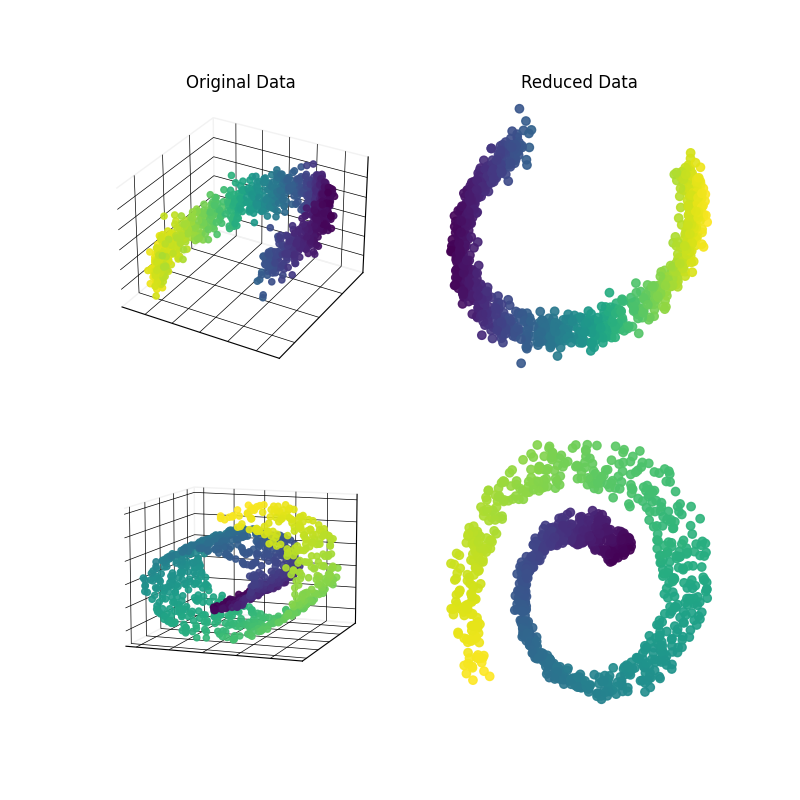 Image by the author.
In this post, I will explain some advanced Dimensionality Reduction techniques used to mitigate this issue.
Learn this step by step with the interactive AI Engineer, AI and Data Scientist, Computer Science and Machine Learning roadmaps.
In my previous post, I introduced the relevance of Dimensionality Reduction in Machine Learning problems, and how to tame the Curse of Dimensionality , and I explained both the theory and Scikit-Learn implementation of the Principal Component Analysis algorithm.
In this follow-up, I will dive into additional Dimensionality Reduction algorithms, like kPCA or LLE, that overcome the limitations of PCA.
Do not worry if you haven't read my Dimensionality Reduction introduction yet. This post is a stand-alone guide as I will detail each concept in simple terms. However, if you prefer to know more about PCA, I'm positive this guide will serve your goal:
Dimensionality Reduction with Scikit-Learn: PCA Theory and Implementation
Curse of Dimensionality
The Curse of Dimensionality is for sure a significant challenge in Data Science, making algorithms computationally intensive. When dimensions in a dataset increase, data points become sparse, leading to non-trivial computational issues.
Humans struggle to conceptualize beyond 3 (or sometimes 2) dimensions, causing unexpected behavior in high-dimensional spaces.
Consider a 2D square: a random point inside it is unlikely to be near a border. However, in higher-dimensional spaces, the probability of a random point to be close to a border grows exponentially. In a 10,000-dimensional hypercube, the probability near a border exceeds 99.99999%. An experiment shows that the average distance between two random points in a 100,000-dimensional hypercube is 129.09, highlighting the vastness of high-dimensional spaces. I will leave you with the code to test these statements yourself.
articles/dimensionality-reduction/curse-of-dimensionality.ipynb at main · andreoniriccardo/articles
For Data Science practitioners, this implies that high-dimensional datasets are incredibly sparse , with training instances far apart, raising the risk of overfitting Machine Learning models.
Adding more training examples isn't practical due to the exponential increase in required points as features grow: To maintain a distance of 0.1 between each training point in a 100-feature dataset, you would need to add more points than the number of atoms in the universe. The only viable solution is Dimensionality Reduction, and I will explore techniques to achieve this without significant information loss.
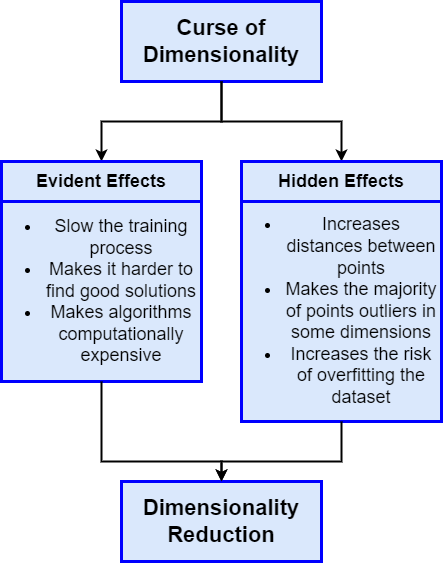 Image by the author.
For a broader introduction to the Curse of Dimensionality topic, I link this article.
Now it's time to present some of the most advanced Dimensionality Reduction algorithms!
Kernel PCA
Indeed the most diffused Dimensionality Reduction model, Principal Component Analysis (PCA), projects the data onto a lower-dimensional hyperplane , lowering the number of dimensions.
This simple concept struggles when dealing with datasets that can't be effectively projected on a plane without losing a considerable portion of the original information.
Take the synthetic Swiss-roll dataset as an example:
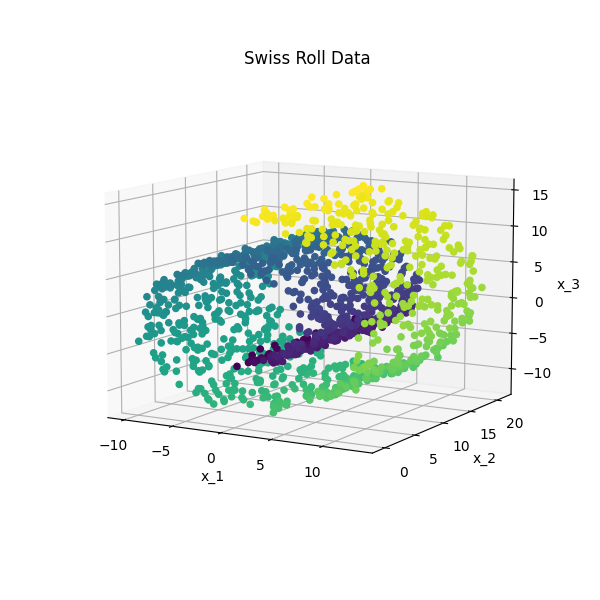 Image by the author.
Projecting data onto a plane is meaningless: the non-linearity component of the original data is lost.
The most straightforward solution for applying the PCA algorithm to a vast variety of dataset is to exploit the Kernel Trick. I presented the Kernel Trick in detail in this post:
Support Vector Machine with Scikit-Learn: A Friendly Introduction
The Kernel Trick maps the data points of a lower-dimensional space to a higher-dimensional one. Support Vector Machine exploits the Kernel Trick to draw linear decision boundaries in high-dimensional spaces, resulting in complex non-linear boundaries in the original feature space.
The same technique can be applied to the PCA algorithm, resulting in the Kernel PCA (kPCA).
Applying the Kernel PCA in Python is easy thanks to the Scikit-learn (sklearn) library. In its simplest form, we just need to instantiate a KernelPCA() object, specify the type of kernel to use, and the output's number of dimensions.
python
# Import required libraries
from sklearn.datasets import make_swiss_roll
from sklearn.decomposition import KernelPCA

# Generate synthetic data
X_swiss, t = make_swiss_roll(n_samples=1500, noise=0.3, random_state=2)

# Instantiate a KernelPCA object, specifying the kernel type
# and the output's dimensions
pca_swiss = KernelPCA(n_components=2, kernel='sigmoid', gamma=1e-3, coef0=1, fit_inverse_transform=True)
# Transform the original data
X_pca_swiss = pca_swiss.fit_transform(X_swiss)

# Plot the original vs. reduced data
As a result, we obtain the following reduced dataset:
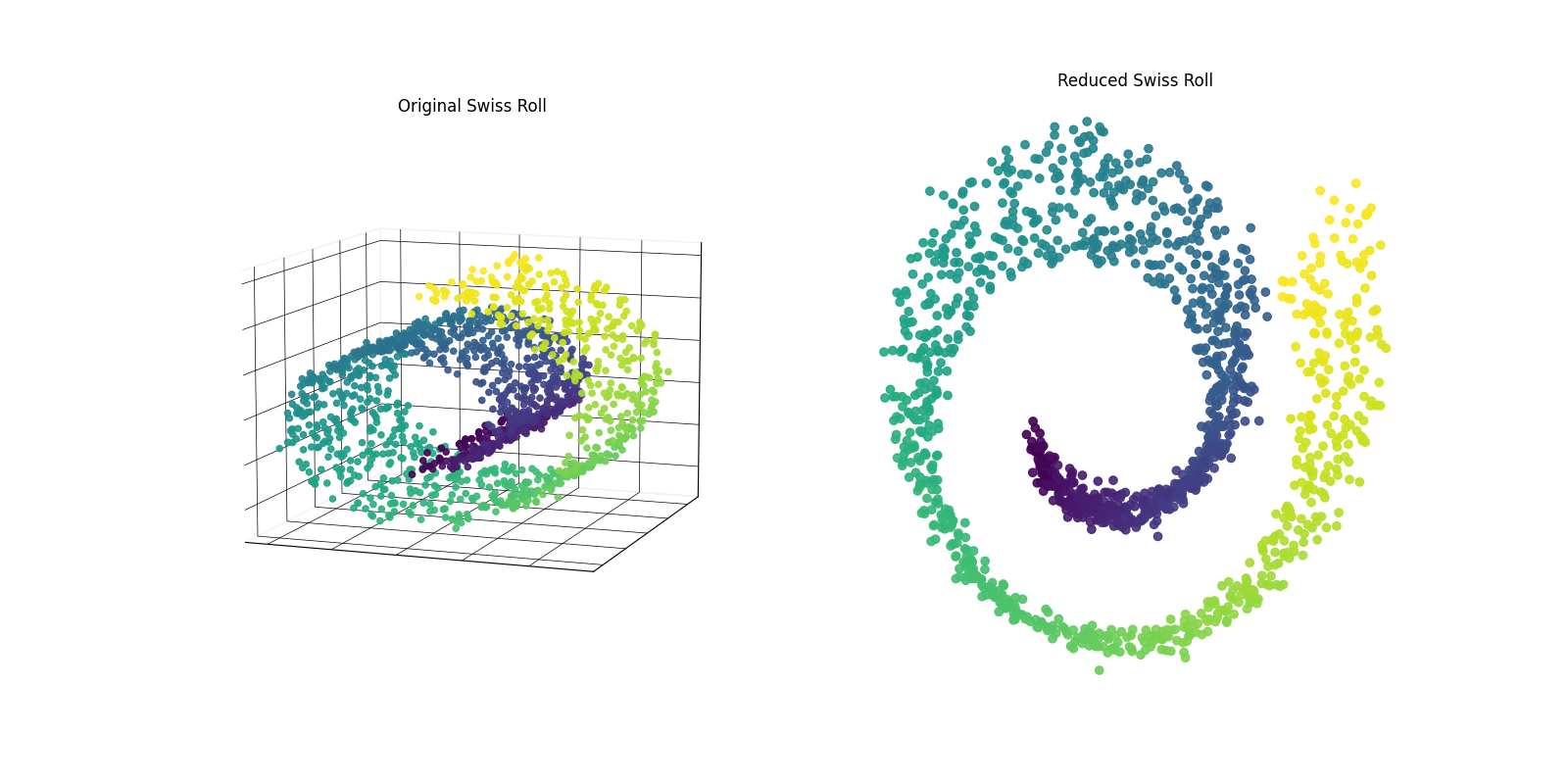 Image by the author.
Based on the type of Kernel we pick, kPCA outputs completely different results:
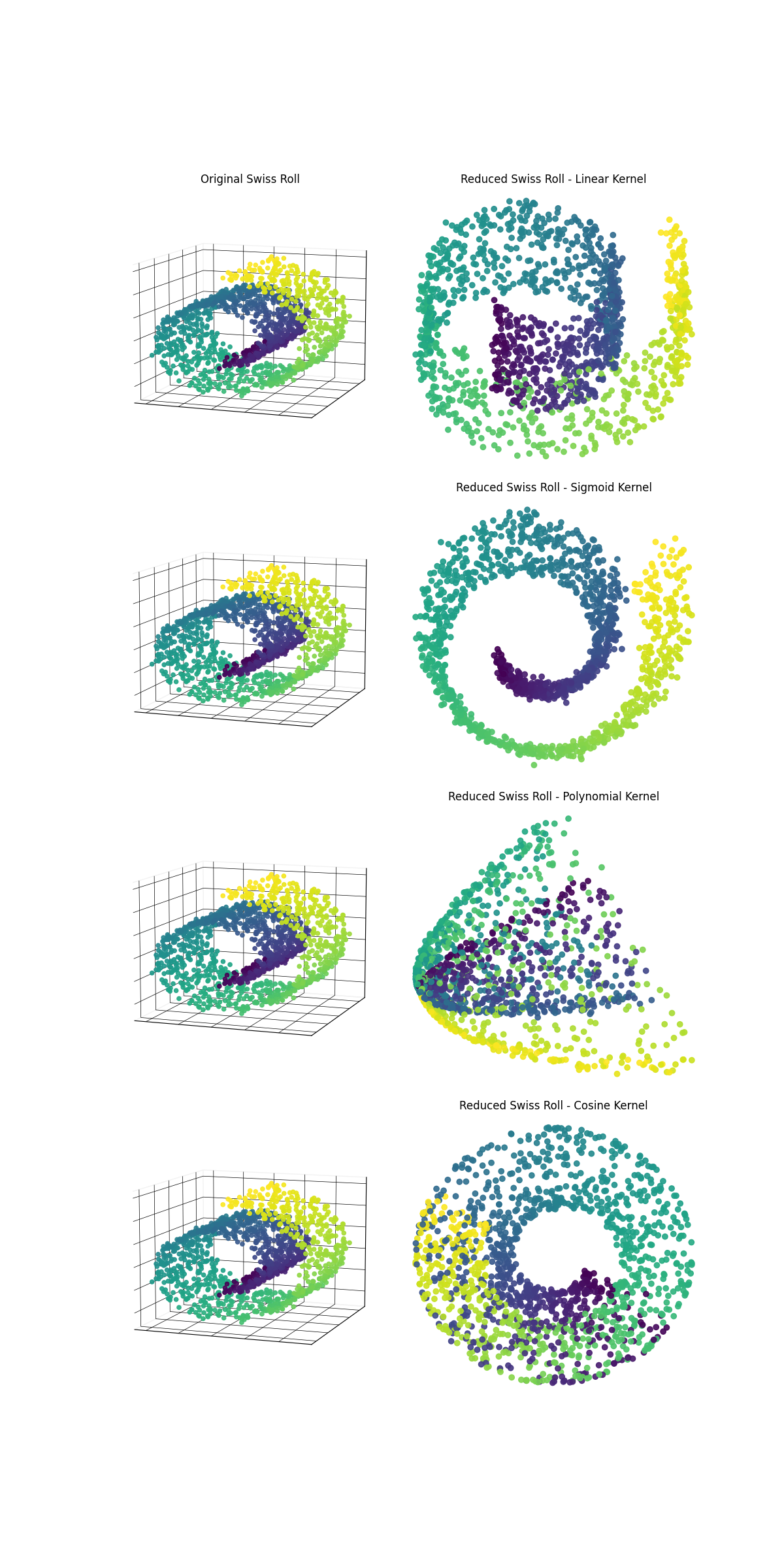 Image by the author.
In this simple example, I experimented with 4 different types of Kernels: Linear, Sigmoid, Polynomial, and Cosine. We can immediately appreciate how the Linear and Sigmoid Kernels produce acceptable results with the provided dataset. The Polynomial and Cosine Kernels appear to be poorly suited for this dataset.
At this point, you might be asking yourself the following question:
Is there a robust method for choosing the right Kernel?
The next section aims to solve this issue!
How to Select the Kernel
Being Kernel PCA an unsupervised learning model , we can't simply employ the Grid Search technique and pick the best hyperparameters based on a performance measure. As a consequence selecting the type of Kernel to use is tricky.
If kPCA is simply a preprocessing step of your Machine Learning algorithm, followed by a classification or regression model, we can indeed opt for a Grid Search approach. The idea is to treat the type of Kernel of kPCA as one of the hyperparameters of the Machine Learning model and pick the one that yields the best performance measure.
If we are treating the kPCA algorithm as a stand-alone model, an alternative consists of choosing the Kernel that yields the lowest reconstruction error.
To do that with Scikit-learn, we can exploit the inverse_transform() method:
python
from sklearn.datasets import make_swiss_roll
from sklearn.metrics import mean_squared_error
from sklearn.decomposition import KernelPCA

X_swiss, t = make_swiss_roll(n_samples=1500, noise=0.3, random_state=2)

kPCA_dict = {
    "linear": KernelPCA(n_components=2, kernel='linear', fit_inverse_transform=True),
    "sigmoid": KernelPCA(n_components=2, kernel='sigmoid', gamma=1e-3, coef0=1, fit_inverse_transform=True)
}

X_pca_swiss = {}
X_preimage = {}

for kernel_type in kPCA_dict.keys():
    X_pca_swiss[kernel_type] = kPCA_dict[kernel_type].fit_transform(X_swiss)
    X_preimage[kernel_type] = kPCA_dict[kernel_type].inverse_transform(X_pca_swiss[kernel_type])
    mse = mean_squared_error(X_swiss, X_preimage[kernel_type])
    print('{} kernel -> MSE: {}'.format(kernel_type, mse))
 We can see how the kPCA with the Sigmoid kernel performs slightly better than the one with the Linear kernel.
LLE
Completely different from what we saw up to this point, there exists a powerful Dimensionality Reduction technique that doesn't rely on projections. Locally Linear Embedding (LLE) focuses on preserving local relationships within the data.
In more simple terms, imagine you have a bunch of datapoints in a high-dimensional space, where each dimension represents a different feature. LLE focuses on small groups of neighbouring points, rather than looking at the entire dataset at once. It tries to represent these nearby points in a lower-dimensional space, while maintaining their relationships.
The consequent question you might ask now is:
What does it mean to maintain the relationships between datapoints?
Without involving complex math, for LLE to preserve relationships between datapoints means maintaining the intrinsic geometric structure of the data in a lower-dimensional space. Imagine you have a high-dimensional dataset, where certain points are close to each other and share some kind of meaningful relationship. The relationship may depend on several factors like proximity, similarity, connectivity, etc. What it matters is that LLE aims to keep these relationships in place when reducing the dimensionality of the data.
As a result, LLE captures the underlying structure of the data , especially when the relationships between points are complex and (or) non-linear.
In order to compare the LLE algorithm with the kPCA, I will apply LLE to the same dataset and plot the results:
python
from sklearn.datasets import make_swiss_roll
from sklearn.manifold import LocallyLinearEmbedding
from sklearn.decomposition import KernelPCA

X_swiss, t = make_swiss_roll(n_samples=1500, noise=0.3, random_state=2)

lle = LocallyLinearEmbedding(n_components=2, n_neighbors=15)
X_pca_swiss_lle = lle.fit_transform(X_swiss)

pca_swiss = KernelPCA(n_components=2, kernel='sigmoid', gamma=1e-3, coef0=1, fit_inverse_transform=True)
X_pca_swiss_pca = pca_swiss.fit_transform(X_swiss)
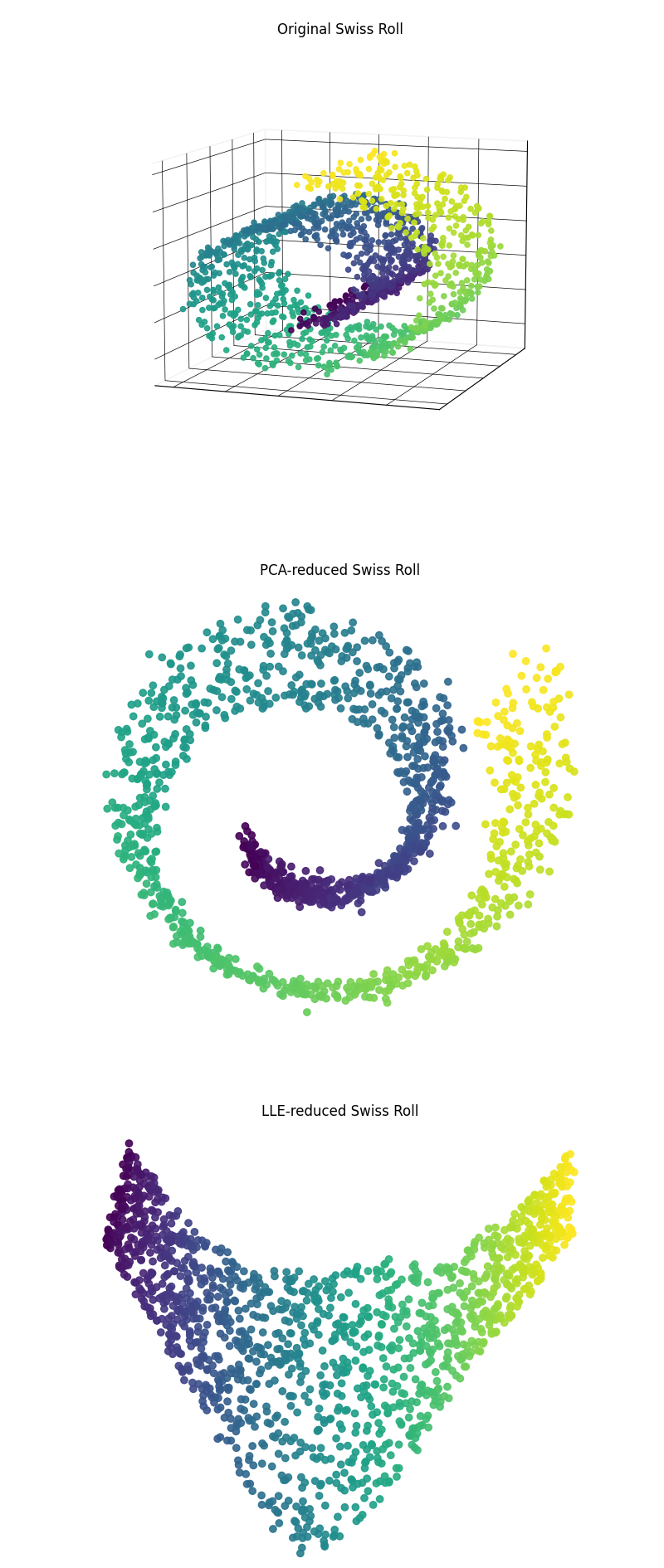 Image by the author.
Differently from kPCA, LLE appears to "understand" better the patterns and relationships of the data and is able to unroll the Swiss Roll dataset.
PCA vs LLE
I want to conclude this post about advanced Dimensionality Reduction techniques by delineating the differences between the most commonly used algorithms, and when it is preferable to apply one instead of the other.
PCA and LLE first diverge on the approaches they use. While LLE scans the dataset under a local perspective, focusing on preserving the relationships only between "adjacent" points, PCA takes a global viewpoint, capturing the overall dataset variance.
The range of application of these two different algorithms also differs. By focusing on a small cluster of data, LLE is able to capture complex and non-linear patterns. Instead, PCA, even with the kPCA variation, may fall short at capturing more intricate patterns like the Swiss Roll example we saw before.
Finally, the way these algorithms are affected by noise is a further aspect of difference. PCA, by considering the entire datapoints, tends to be more heavily impacted by noisy datasets, potentially leading to accuracy losses.
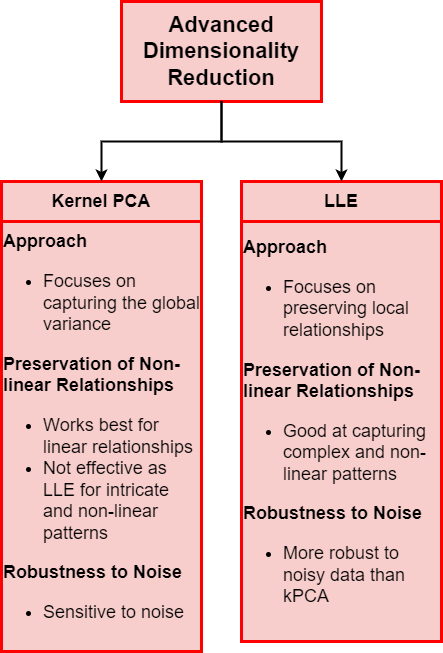 Image by the author.
These distinct features of LLE and PCA make them suited for different sets of tasks and types of datasets. LLE is excellent at capturing intricate local structures. Instead, PCA is preferred when the global representation of the dataset and the preservation of the overall variance is a crucial aspect.
Finally, as the topic of Dimensionality Reduction goes way beyond what a simple Medium post achieves to explain, I recommend diving deeper into this fundamental Machine Learning argument by reading the material I provide in the "Reference" section.
If you liked this story, consider following me to be notified of my upcoming projects and articles!
Here are some of my past projects:
Outlier Detection with Scikit-Learn and Matplotlib: a Practical Guide
Social Network Analysis with NetworkX: A Gentle Introduction
Use Deep Learning to Generate Fantasy Names: Build a Language Model from Scratch
References
- Principal component analysis - Sklearn
- Hands-On Machine Learning with Scikit-Learn, Keras, and TensorFlow, 2nd Edition - Aurélien Géron
- Dive into Deep Learning - Aston Zhang, Zachary C. Lipton, Mu Li, and Alexander J. Smola
- Schölkopf, B., Smola, A., & Müller, K. (1998). Nonlinear component analysis as a kernel eigenvalue problem. Neural Computation, 10(5), 1299–1319.
- Schölkopf, B., & Smola, A. J. (2002). Learning with Kernels: Support Vector Machines, Regularization, Optimization, and Beyond. MIT Press.
- Mika, S., Schölkopf, B., Smola, A., Müller, K. R., Scholz, M., & Rätsch, G. (1999). Kernel PCA and de-noising in feature spaces. Advances in Neural Information Processing Systems, 11.
- Roweis, S. T., & Saul, L. K. (2000). Nonlinear dimensionality reduction by locally linear embedding. Science, 290(5500), 2323–2326.
- Roweis, S. (2002). EM algorithms for PCA and SPCA. Advances in Neural Information Processing Systems, 15.
- Saul, L. K., & Roweis, S. T. (2003). Think globally, fit locally: Unsupervised learning of low dimensional manifolds. Journal of Machine Learning Research, 4(Nov), 119–155.
Register Now to Continue Reading
Unlock Towards Data Science with a Free Account
All articles on Towards Data Science are available to registered users. Create a free account today to access this article and thousands more.
Register for freeSign in to your account
 Written By
See all from Riccardo Andreoni
Artificial IntelligenceData ScienceDimensionality ReductionMachine LearningProgramming
Share This Article
Towards Data Science is a community publication. Submit your insights to reach our global audience and earn through the TDS Author Payment Program.
Write for TDS
Related Articles
Machine Learning
Challenging and realistic datasets for temporal graph learning
Shenyang(Andy) Huang
December 9, 202310 min read
Agentic AI
Understanding how LLMs interact with the world around them, from returning data to taking action
Maria Mouschoutzi
June 21, 202611 min read
Machine Learning
Deep web data is the gold we can't touch, yet
Sabrine Bendimerad
April 8, 20266 min read
Artificial Intelligence
The plots that will enhance your EDA process Line plot is an essential part of...
Soner Yıldırım
May 14, 20215 min read
Software Engineering
A pragmatic approach to data contracts
mehdio
September 9, 20226 min read
Programming
Raspberry Pi programmable IO pitfalls illustrated with a musical example
Carl Kadie
January 30, 202517 min read
Data Science
On-premise and cloud working together to deliver a data product
João Pedro
March 6, 20239 min read
Data Science
Simulating the probability that your singular vote swings the election in November
Jarom Hulet
October 15, 202419 min read
Data Science
As a data scientist we are occasionally faced with situations where we need to model a trend to predict future values. Whilst there is a...
Jimmy Weaver
November 7, 202317 min read
Your home for data science and AI. The world's leading publication for data science, data analytics, data engineering, machine learning, and artificial intelligence professionals.
Subscribe to Our NewsletterWrite For TDS•About•Advertise•Privacy Policy•Terms of Use
© Insight Media Group, LLC 2026•The New Stack•roadmap.sh•Creator Network
Recommended Articles
Close