In this article of our Unsupervised Learning series, we explore another important clustering algorithm that comes right after K-Means in popularity and usefulness — DBSCAN.
While K-Means works very well for many problems, it assumes that clusters are well-shaped and evenly distributed. But real-world data is often messy, noisy, and irregular. This is where DBSCAN becomes extremely powerful.
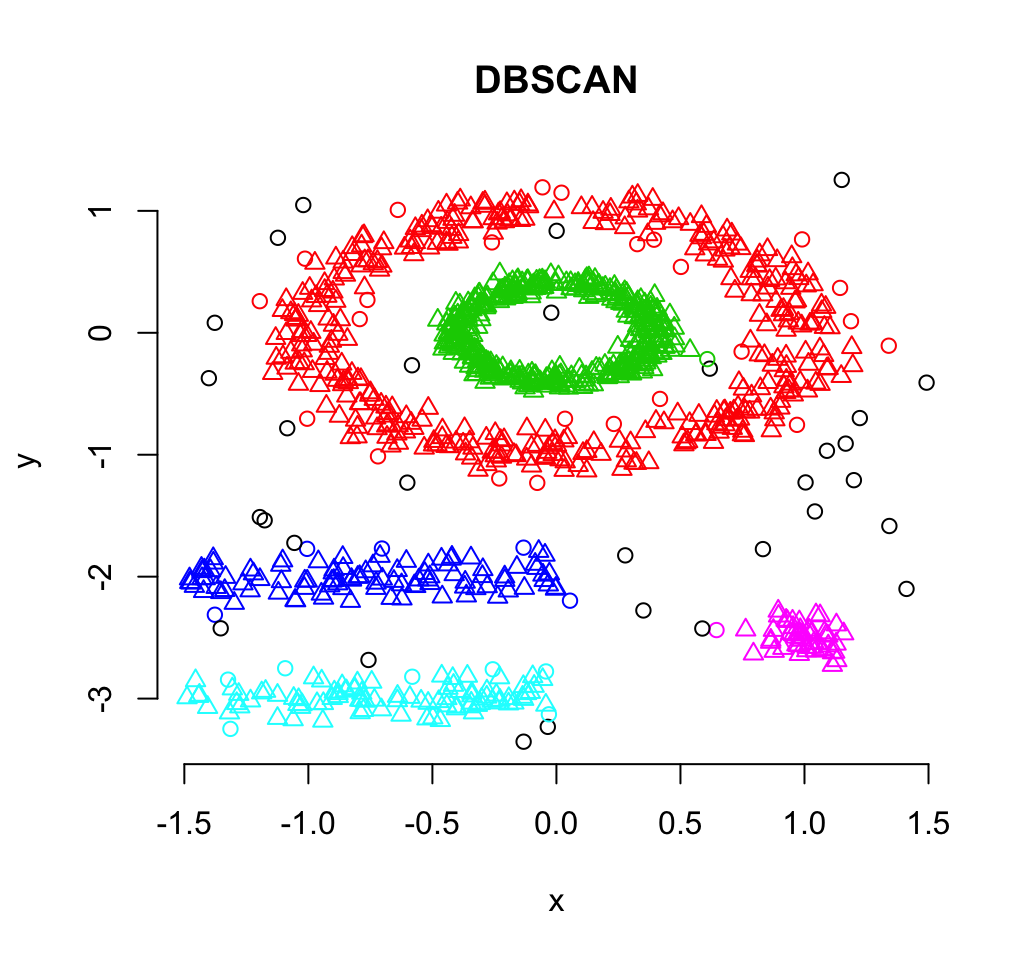
DBSCAN (Density-Based Spatial Clustering of Applications with Noise) is a density-based clustering algorithm. Instead of grouping data points based on distance to a center (like K-Means), DBSCAN:
Groups points that are closely packed together
Identifies isolated points as noise or outliers
DBSCAN finds dense regions in data and treats sparse regions as noise.
In many real-world datasets, clusters are not perfectly circular or evenly distributed, and the data often contains noise or outliers. In such situations, traditional algorithms like K-Means struggle because they assume fixed-shape clusters and require the number of clusters in advance. DBSCAN solves these problems by grouping points based on data density rather than distance to a centroid. It performs especially well when the number of clusters is unknown, clusters have irregular or arbitrary shapes, and the dataset includes noise. This makes DBSCAN a powerful and practical choice for real-world unsupervised learning problems where data is messy and unpredictable.
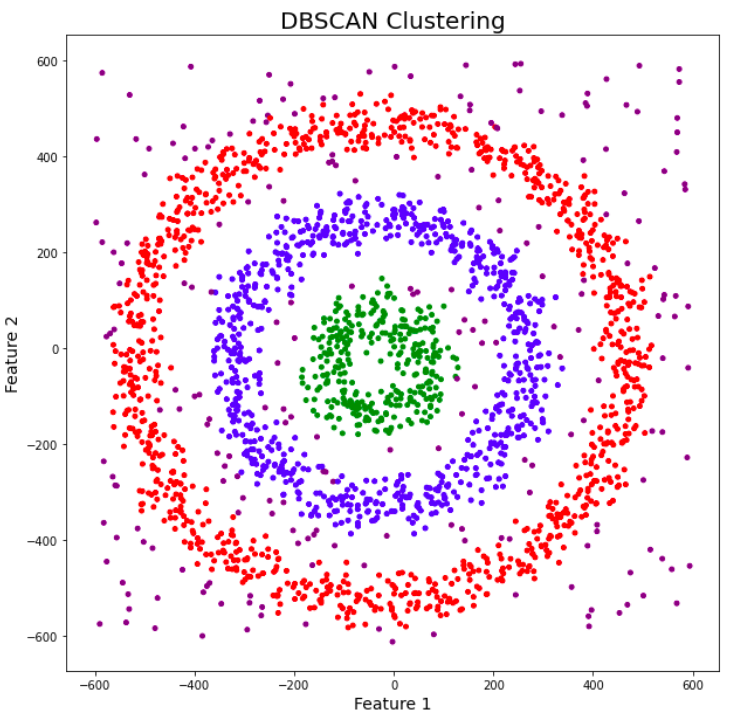
DBSCAN offers several strengths that make it stand out:
Flexible Cluster Shapes: Clusters can be any shape, not just circular or convex.
No Pre-defined Number of Clusters: Unlike K-Means, DBSCAN does not require choosing K.
Noise Handling: Outliers are naturally detected and labeled as noise.
Density-Based Insight: Clusters are formed based on data density, which matches many real-world problems.
DBSCAN forms clusters by analyzing the density of data points in the feature space rather than relying on predefined cluster shapes or centroids.
The idea is simple: regions with a high concentration of points form clusters, while sparse regions are treated as noise.
To achieve this, DBSCAN uses two key parameters: eps (epsilon) and min_samples.
The eps parameter defines the radius of a neighborhood around a data point, and if the distance between two points is less than or equal to eps, they are considered neighbors.
Choosing the right value of eps is crucial—if it is too small, most points will be classified as noise, while if it is too large, distinct clusters may merge incorrectly
A common practical technique for selecting eps is the k-distance graph, which helps identify a suitable cutoff point.
The second important parameter, min_samples (MinPts), specifies the minimum number of points required within the eps radius to form a dense region.
A general rule of thumb is to set min_samples greater than or equal to D + 1, where D is the number of dimensions in the dataset.
In practice, values like 3 or 5 work well for many real-world datasets. Based on these two parameters
DBSCAN classifies each data point into one of three categories.
A core point is a point that has at least min_samples neighbors within the eps radius and forms the backbone of a cluster.
A border point lies close to a core point but does not have enough neighbors to qualify as a core point itself.
Any point that is neither a core point nor a border point is labeled as noise, which allows DBSCAN to naturally detect outliers without any extra steps.
This density-based approach makes DBSCAN especially powerful for datasets with irregular cluster shapes and noisy data.
Anomaly Detection: DBSCAN identifies unusual patterns such as fraud or network intrusions by labeling low-density points as noise.
Geospatial Analysis: It helps discover location-based hotspots like crime areas or popular check-in zones without predefined boundaries.
Customer Segmentation: DBSCAN groups customers based on behavior while naturally filtering out irregular or inactive users.
Image Processing: It clusters pixels or regions with similar properties to assist in image segmentation and object detection.
This dataset is intentionally chosen because K-Means fails on curved clusters, while DBSCAN naturally separates them using density.
# import libraries
import matplotlib.pyplot as plt
from sklearn.datasets import make_moons
from sklearn.cluster import DBSCAN
from sklearn.preprocessing import StandardScaler

# Generate non-linear, real-world like unlabeled data
X, _ = make_moons(
    n_samples=500,
    noise=0.08,
    random_state=42
)

# Feature scaling (important for DBSCAN)
scaler = StandardScaler()
X_scaled = scaler.fit_transform(X)

# Apply DBSCAN
dbscan = DBSCAN(eps=0.3, min_samples=5)
clusters = dbscan.fit_predict(X_scaled)

# Visualizing clusters
plt.figure(figsize=(8, 6))
plt.scatter(
    X_scaled[:, 0],
    X_scaled[:, 1],
    c=clusters,
    cmap='rainbow',
    s=60
)

plt.title("DBSCAN Clustering on Unlabeled Data")
plt.xlabel("Feature 1 (scaled)")
plt.ylabel("Feature 2 (scaled)")
plt.show()
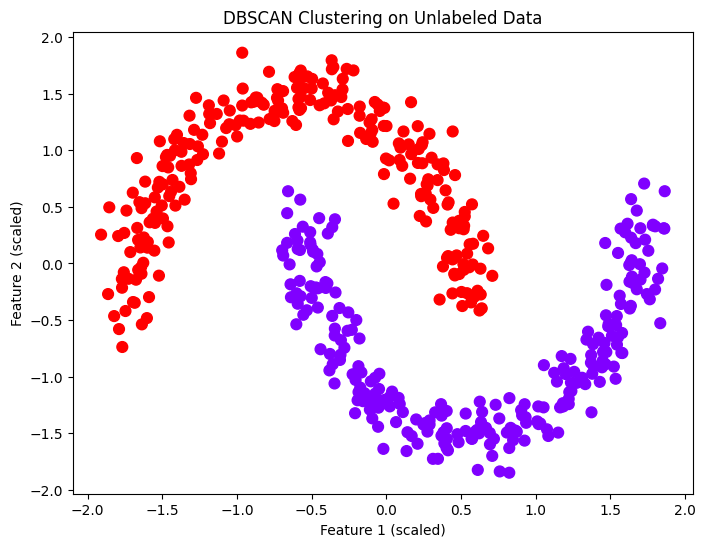
DBSCAN is a powerful unsupervised clustering algorithm that goes beyond the limitations of K-Means by handling irregular cluster shapes and automatically detecting noise. It is especially useful when the number of clusters is unknown and the data is messy or real-world in nature. By focusing on density rather than distance to centroids, DBSCAN provides more natural and meaningful groupings. This makes it an essential tool to understand for anyone learning practical clustering techniques.
Follow us for more ML Diaries by Fahd