保留正文与补采附件。源页面当前未重新核验;具体限制见交付清单。
 We value your privacy
We use cookies to enhance your browsing experience, serve personalised ads or content, and analyse our traffic. By clicking "Accept All", you consent to our use of cookies.
Customise Reject All Accept All
Customise Consent Preferences
 We use cookies to help you navigate efficiently and perform certain functions. You will find detailed information about all cookies under each consent category below.
The cookies that are categorised as "Necessary" are stored on your browser as they are essential for enabling the basic functionalities of the site. ... Show more
NecessaryAlways Active
Necessary cookies are required to enable the basic features of this site, such as providing secure log-in or adjusting your consent preferences. These cookies do not store any personally identifiable data.
-
Cookie
BCTempID
-
Duration
10 minutes
-
Description
No description available.
-
Cookie
__cf_bm
-
Duration
1 hour
-
Description
This cookie, set by Cloudflare, is used to support Cloudflare Bot Management.
-
Cookie
AWSALBCORS
-
Duration
7 days
-
Description
Amazon Web Services set this cookie for load balancing.
-
Cookie
_cfuvid
-
Duration
session
-
Description
Cloudflare sets this cookie to track users across sessions to optimize user experience by maintaining session consistency and providing personalized services
-
Cookie
li_gc
-
Duration
6 months
-
Description
Linkedin set this cookie for storing visitor's consent regarding using cookies for non-essential purposes.
-
Cookie
__hssrc
-
Duration
session
-
Description
This cookie is set by Hubspot whenever it changes the session cookie. The __hssrc cookie set to 1 indicates that the user has restarted the browser, and if the cookie does not exist, it is assumed to be a new session.
-
Cookie
__hssc
-
Duration
1 hour
-
Description
HubSpot sets this cookie to keep track of sessions and to determine if HubSpot should increment the session number and timestamps in the __hstc cookie.
-
Cookie
wpEmojiSettingsSupports
-
Duration
session
-
Description
WordPress sets this cookie when a user interacts with emojis on a WordPress site. It helps determine if the user's browser can display emojis properly.
-
Cookie
BCSessionID
-
Duration
1 year 1 month 4 days
-
Description
Blueconic sets this cookie as a unique identifier for the BlueConic profile.
-
Cookie
_octo
-
Duration
1 year
-
Description
No description available.
-
Cookie
logged_in
-
Duration
1 year
-
Description
No description available.
-
Cookie
__Secure-YEC
-
Duration
past
-
Description
YouTube sets this cookie to stores the user's video player preferences using embedded YouTube video
-
Cookie
__eoi
-
Duration
6 months
-
Description
Description is currently not available.
-
Cookie
AWSALBTGCORS
-
Duration
7 days
-
Description
No description available.
-
Cookie
login-status-p
-
Duration
past
-
Description
Description is currently not available.
-
Cookie
AWSALBTG
-
Duration
7 days
-
Description
No description available.
-
Cookie
csrf_token
-
Duration
session
-
Description
No description available.
-
Cookie
token_v2
-
Duration
1 day
-
Description
Description is currently not available.
-
Cookie
D
-
Duration
1 year
-
Description
Description is currently not available.
-
Cookie
PHPSESSID
-
Duration
session
-
Description
This cookie is native to PHP applications. The cookie stores and identifies a user's unique session ID to manage user sessions on the website. The cookie is a session cookie and will be deleted when all the browser windows are closed.
-
Cookie
VISITOR_PRIVACY_METADATA
-
Duration
6 months
-
Description
YouTube sets this cookie to store the user's cookie consent state for the current domain.
-
Cookie
cookietest
-
Duration
session
-
Description
The cookietest cookie is typically used to determine whether the user's browser accepts cookies, essential for website functionality and user experience.
-
Cookie
__Host-airtable-session
-
Duration
1 year
-
Description
This cookie is used to enable us to integrate the services of Airtable.
-
Cookie
__Host-airtable-session.sig
-
Duration
1 year
-
Description
This cookie is used to enable us to integrate the services of Airtable.
-
Cookie
m
-
Duration
1 year 1 month 4 days
-
Description
Stripe sets this cookie for fraud prevention purposes. It identifies the device used to access the website, allowing the website to be formatted accordingly.
-
Cookie
BIGipServer*
-
Duration
session
-
Description
Marketo sets this cookie to collect information about the user's online activity and build a profile about their interests to provide advertisements relevant to the user.
-
Cookie
__cfruid
-
Duration
session
-
Description
Cloudflare sets this cookie to identify trusted web traffic.
-
Cookie
_GRECAPTCHA
-
Duration
6 months
-
Description
Google Recaptcha service sets this cookie to identify bots to protect the website against malicious spam attacks.
-
Cookie
__Secure-YNID
-
Duration
6 months
-
Description
Google cookie used to protect user security and prevent fraud, especially during the login process.
-
Cookie
cookieyes-consent
-
Duration
1 year
-
Description
CookieYes sets this cookie to remember users' consent preferences so that their preferences are respected on subsequent visits to this site. It does not collect or store any personal information about the site visitors.
Functional
Functional cookies help perform certain functionalities like sharing the content of the website on social media platforms, collecting feedback, and other third-party features.
-
Cookie
lidc
-
Duration
1 day
-
Description
LinkedIn sets the lidc cookie to facilitate data center selection.
-
Cookie
brw
-
Duration
1 year
-
Description
No description available.
-
Cookie
brwConsent
-
Duration
5 minutes
-
Description
Description is currently not available.
-
Cookie
WMF-Uniq
-
Duration
1 year
-
Description
Description is currently not available.
-
Cookie
loom_anon_comment
-
Duration
1 year
-
Description
No description available.
-
Cookie
loom_referral_video
-
Duration
session
-
Description
Description is currently not available.
-
Cookie
VISITOR_INFO1_LIVE
-
Duration
6 months
-
Description
A cookie set by YouTube to measure bandwidth that determines whether the user gets the new or old player interface.
-
Cookie
yt-remote-connected-devices
-
Duration
Never Expires
-
Description
YouTube sets this cookie to store the user's video preferences using embedded YouTube videos.
-
Cookie
ytidb::LAST_RESULT_ENTRY_KEY
-
Duration
Never Expires
-
Description
The cookie ytidb::LAST_RESULT_ENTRY_KEY is used by YouTube to store the last search result entry that was clicked by the user. This information is used to improve the user experience by providing more relevant search results in the future.
-
Cookie
yt-remote-device-id
-
Duration
Never Expires
-
Description
YouTube sets this cookie to store the user's video preferences using embedded YouTube videos.
-
Cookie
yt-remote-session-name
-
Duration
session
-
Description
The yt-remote-session-name cookie is used by YouTube to store the user's video player preferences using embedded YouTube video.
-
Cookie
yt-remote-fast-check-period
-
Duration
session
-
Description
The yt-remote-fast-check-period cookie is used by YouTube to store the user's video player preferences for embedded YouTube videos.
-
Cookie
yt-remote-session-app
-
Duration
session
-
Description
The yt-remote-session-app cookie is used by YouTube to store user preferences and information about the interface of the embedded YouTube video player.
-
Cookie
yt-remote-cast-available
-
Duration
session
-
Description
The yt-remote-cast-available cookie is used to store the user's preferences regarding whether casting is available on their YouTube video player.
-
Cookie
yt-remote-cast-installed
-
Duration
session
-
Description
The yt-remote-cast-installed cookie is used to store the user's video player preferences using embedded YouTube video.
-
Cookie
cp_session
-
Duration
3 months
-
Description
Codepen sets this cookie for Help systems found in the website.
-
Cookie
loid
-
Duration
1 year 1 month 4 days
-
Description
This cookie is set by the Reddit. The cookie enables the sharing of content from the website onto the social media platform.
Analytics
Analytical cookies are used to understand how visitors interact with the website. These cookies help provide information on metrics such as the number of visitors, bounce rate, traffic source, etc.
-
Cookie
__hstc
-
Duration
6 months
-
Description
Hubspot set this main cookie for tracking visitors. It contains the domain, initial timestamp (first visit), last timestamp (last visit), current timestamp (this visit), and session number (increments for each subsequent session).
-
Cookie
hubspotutk
-
Duration
6 months
-
Description
HubSpot sets this cookie to keep track of the visitors to the website. This cookie is passed to HubSpot on form submission and used when deduplicating contacts.
-
Cookie
_ga
-
Duration
1 year 1 month 4 days
-
Description
Google Analytics sets this cookie to calculate visitor, session and campaign data and track site usage for the site's analytics report. The cookie stores information anonymously and assigns a randomly generated number to recognise unique visitors.
-
Cookie
ga*
-
Duration
1 year 1 month 4 days
-
Description
Google Analytics sets this cookie to store and count page views.
-
Cookie
__Host-psifi.analyticsTrace
-
Duration
6 hours
-
Description
Description is currently not available.
-
Cookie
__Host-psifi.analyticsTraceV2
-
Duration
6 hours
-
Description
Description is currently not available.
-
Cookie
_gh_sess
-
Duration
session
-
Description
GitHub sets this cookie for temporary application and framework state between pages like what step the user is on in a multiple step form.
-
Cookie
YSC
-
Duration
session
-
Description
YSC cookie is set by Youtube and is used to track the views of embedded videos on Youtube pages.
-
Cookie
ajs_anonymous_id
-
Duration
1 year
-
Description
This cookie is set by Segment to count the number of people who visit a certain site by tracking if they have visited before.
-
Cookie
vuid
-
Duration
1 year 1 month 4 days
-
Description
Vimeo installs this cookie to collect tracking information by setting a unique ID to embed videos on the website.
Performance
Performance cookies are used to understand and analyse the key performance indexes of the website which helps in delivering a better user experience for the visitors.
-
Cookie
AWSALB
-
Duration
7 days
-
Description
AWSALB is an application load balancer cookie set by Amazon Web Services to map the session to the target.
-
Cookie
acq
-
Duration
past
-
Description
Description is currently not available.
-
Cookie
acq.sig
-
Duration
past
-
Description
Description is currently not available.
-
Cookie
ptc
-
Duration
2 years
-
Description
No description available.
Advertisement
Advertisement cookies are used to provide visitors with customised advertisements based on the pages you visited previously and to analyse the effectiveness of the ad campaigns.
-
Cookie
muc_ads
-
Duration
1 year 1 month 4 days
-
Description
Twitter sets this cookie to collect user behaviour and interaction data to optimize the website.
-
Cookie
guest_id_marketing
-
Duration
1 year 1 month 4 days
-
Description
Twitter sets this cookie to identify and track the website visitor.
-
Cookie
guest_id_ads
-
Duration
1 year 1 month 4 days
-
Description
Twitter sets this cookie to identify and track the website visitor.
-
Cookie
personalization_id
-
Duration
1 year 1 month 4 days
-
Description
Twitter sets this cookie to integrate and share features for social media and also store information about how the user uses the website, for tracking and targeting.
-
Cookie
guest_id
-
Duration
1 year 1 month 4 days
-
Description
Twitter sets this cookie to identify and track the website visitor. It registers if a user is signed in to the Twitter platform and collects information about ad preferences.
-
Cookie
bcookie
-
Duration
1 year
-
Description
LinkedIn sets this cookie from LinkedIn share buttons and ad tags to recognize browser IDs.
-
Cookie
__Secure-ROLLOUT_TOKEN
-
Duration
6 months
-
Description
YouTube sets this cookie to manage feature rollout and experimentation. It helps Google control which new features or interface changes are shown to users as part of testing and staged rollouts, ensuring consistent experience for a given user during an experiment.
-
Cookie
yt.innertube::nextId
-
Duration
Never Expires
-
Description
YouTube sets this cookie to register a unique ID to store data on what videos from YouTube the user has seen.
-
Cookie
yt.innertube::requests
-
Duration
Never Expires
-
Description
YouTube sets this cookie to register a unique ID to store data on what videos from YouTube the user has seen.
-
Cookie
session_tracker
-
Duration
session
-
Description
This cookie is set by the Reddit. This cookie is used to identify trusted web traffic. It also helps in adverstising on the website.
-
Cookie
edgebucket
-
Duration
session
-
Description
Reddit sets this cookie to save the information about a log-on Reddit user, for the purpose of advertisement recommendations and updating the content.
-
Cookie
did
-
Duration
1 year
-
Description
Arbor sets this cookie to show targeted ads to site visitors.This cookie expires after 2 months or 1 year.
Uncategorised
Other uncategorised cookies are those that are being analysed and have not been classified into a category as yet.
No cookies to display.
Reject All Save My Preferences Accept All
Toggle SearchToggle Mobile Navigation
Publish AI, ML & data-science insights to a global community of data professionals.
Sign inSubmit an Article
LatestEditor's PicksNewsletterShipAI
Write For TDS
LinkedInXToggle Search
Deep Learning
Structured State Space Models Visually Explained
Part 2 - Towards Mamba State Space Models for Images, Videos and Time Series
Sascha Kirch
August 22, 202418 min read
 Image by Sascha Kirch.
This is part 2 of my new multi-part series 🐍 Towards Mamba State Space Models for Images, Videos and Time Series.
State space models, known to many disciplines of engineering for decades, are now making their debut in deep learning. On our journey towards Mamba selective state space models and their recent achievements in research, understanding the state space model is crucial. And, as is often the case in engineering, it is the details that make theoretical concepts applicable in practice. In addition to state space models, we must also discuss how to apply them to sequence data, how to handle long-range dependencies, and how to efficiently train them by exploiting certain matrix structures.
Structured state space models build the theoretical foundation for Mamba. However, their connection to system theory and advanced algebra might be one of the obstacles to adopt this new framework. So, let's break it down, ensure we understand the key concepts and visualize them to shed some light onto this new-old theory.
Even if you don't end up using State Space models, understanding some of the tricks like why we need to speed up matrix multiplication and how we can exploit certain structures of matrices for that will certainly level up your skills as an engineer or developer.
Mamba State Space Models for Images, Videos and Time Series
Outline
- State Space Models in a Nutshell 2.1 Continuous Time Representation of the State Space Model 2.2 Discretization of the State Space Model 2.3 The Recurrent and Convolutional Representations of the SSM
- Enabling Long-Range Relationships 3.1 State Size Matters 3.2 The HiPPO Framework
- Impose Structure on State Matrices for Efficiency 4.1 What Are Structured Matrices and Why Do They Matter? 4.2 Putting It All Together - S4: Structured State Space Sequence Models
- Wrapping Up 5.1 Summary 5.2 Limitations of Structured SSMs 5.3 Continue Reading Part 3
1. Where We Left Off in Part 1
Towards Mamba State Space Models for Images, Videos and Time Series
In part 1 we reviewed the strengths and weaknesses of recurrent neuronal networks (RNNs) and Transformers to motivate why we need a new model architecture.
We said RNNs are fast at inference time but slow during training and the Transformer is fast to train but slowly inferred. What we want is to find a model that is fast for both, training and inference, while beeing competititve with the Transformer's performance.
2. State Space Models in a Nutshell
Mamba builds on the idea of using a state space model for deep learning by learning its various matrices. So, let's have a brief primer on state space models before exploring what the "structured" part is all about. A state space model can be defined in continuous time representation to deal with continuous signals or can be discretized to handle discrete sequences of data.
It is the discretized state space model we are mostly interested in, since like recurrent neuronal networks (RNNs) and Transformers, a discrete SSM processes sequences of data., e.g. text tokens or samples of an analog time signal.
2.1 Continuous Time Representation of the State Space Model
A continuous-time state space model describes the relationship between an input signal propagating through a stateful system and the resulting output signal.
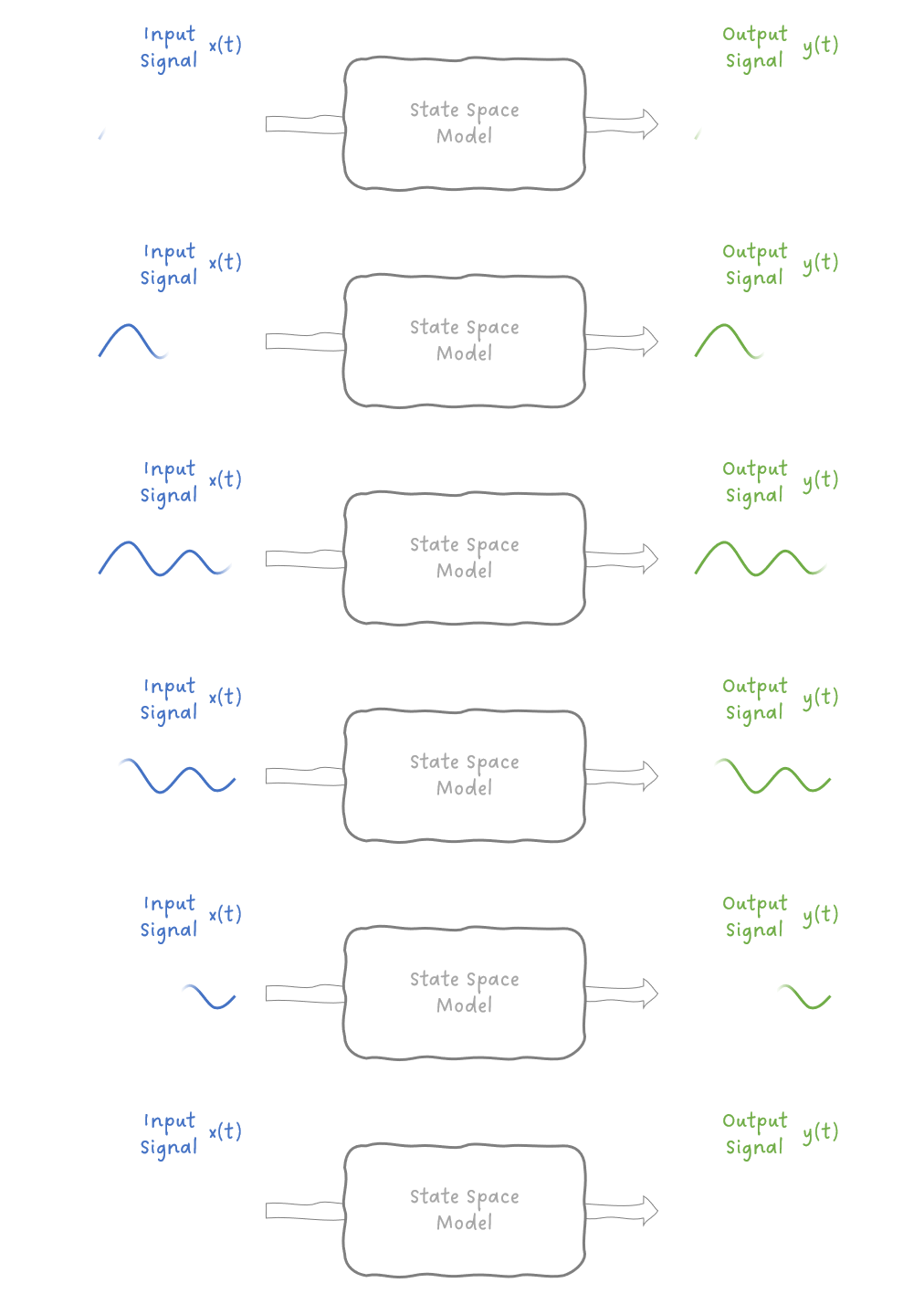 Figure 1: High-level functionality of a state space model. Image by Sascha Kirch.
It is an idea borrowed from system theory. The output depends on the input and on the current state of the system, while the current state depends on the previous state and the input.
This relationship can be formulated efficiently by two simple equations, where A , B , C and D are matrices (which, as we'll see later, will be learned), x(t) is the input signal, y(t) the output signal and h(t) and h'(t) are the current and updated state respectively.
 Equation. 1: State and output equations of the continuous time SSM.
Matrix D transforms the input x(t) and maps it to the output y(t) , which is typically included in the output equation of a classical SSM. However, when applying an SSM to deep learning, we remove this transformation and model it as a simple skip connection, thereby simplifying the SSM.
We can represent those equations in a block diagram that looks something like this:
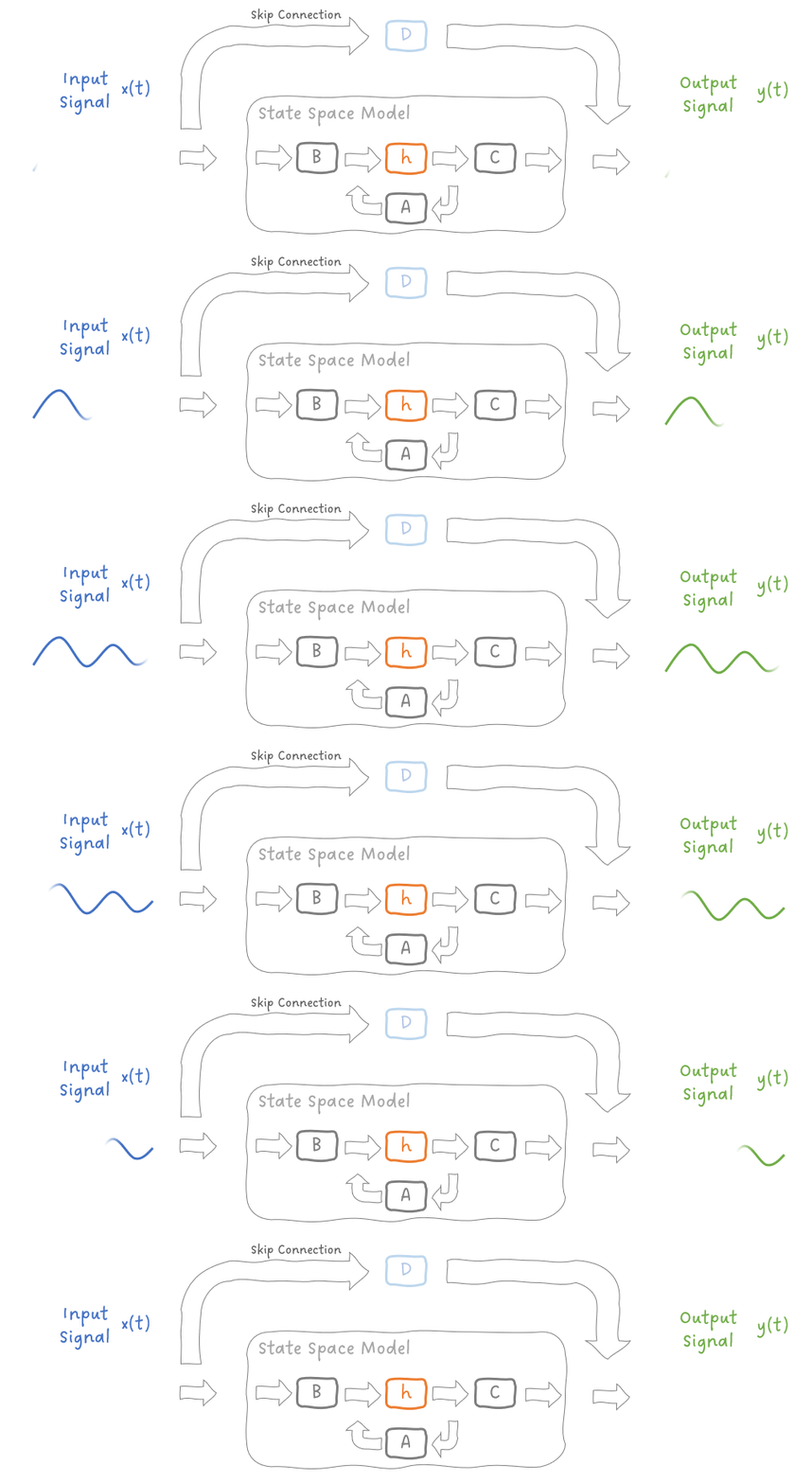 Figure 2: Block diagram of a continuous time state space model. Image by Sascha Kirch.
This is the continuous-time representation of an SSM. There are two difficulties though:
- finding an analytic solution for the state h(t) of the model is challenging and
- since we work on computers we usually work with discrete signals, not continuous ones.
2.2 Discretization of the State Space Model
So, instead of mapping a function x(t) to a function y(t) , we are actually mapping a sequence x[k] to a sequence y[k]. This implies we need a discretized state space model that can handle discrete signals.
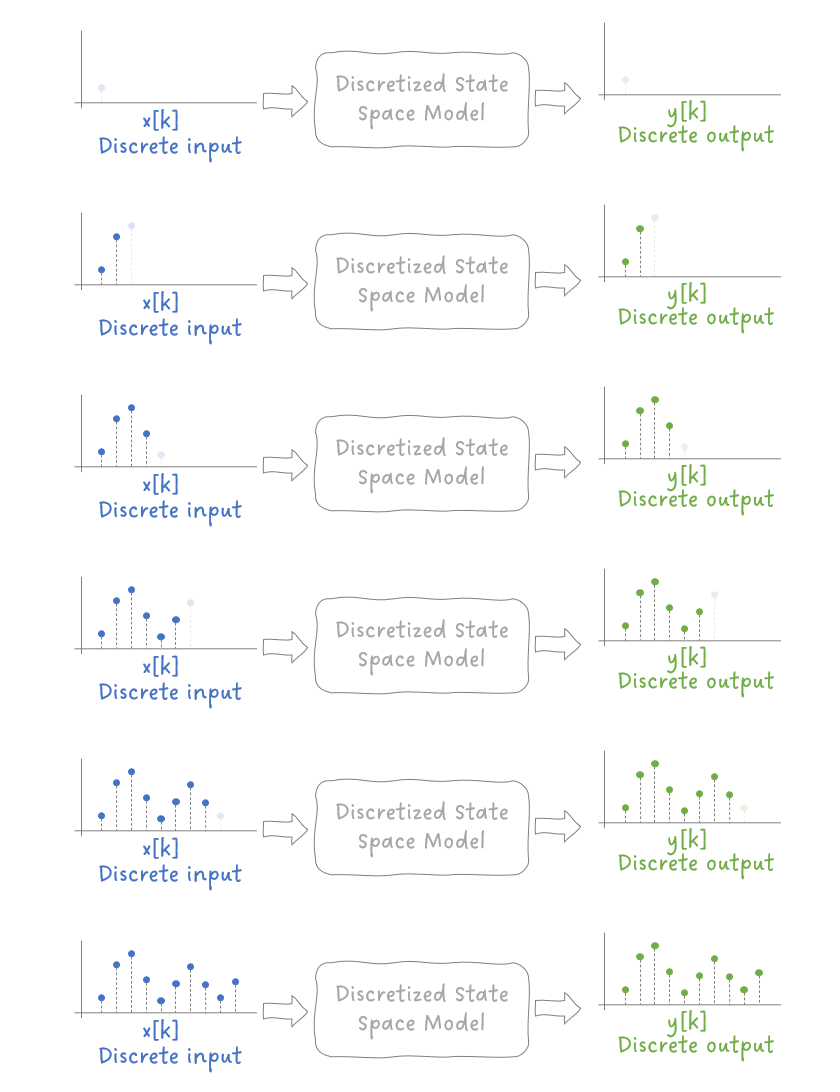 Figure 3: High-level functionality of a discrete state space model. Image by Sascha Kirch.
To do so, we discretize our matrices A and B. This results in the discretized representation of our state space model, now including a discretized state h[k].
 Equation 2: State and output equations of the discretized SSM.
To discretize our state space model, we use yet another trick frequently used in system theory: We use a Zero-Order Hold (ZOH) module to turn our discrete signal x[k] into a continuous time signal x(t) which is then fed into the continuous SSM. The SSM will generate a continuous output y(t) , which we then sample to obtain the discrete output sequence y[k] :
 Figure 4: Block diagram of a discretized state space model. Image by Sascha Kirch.
To discretize the state space model, we must discretize matrices A and B. Initially, most of the first deep learning based state space models like LSSL and S4 used the bilinear discretization, while later ones like the DSS and Mamba use the ZOH discretization. For now, all we care about is that we need to discretize and that there might be more than one way to do so.
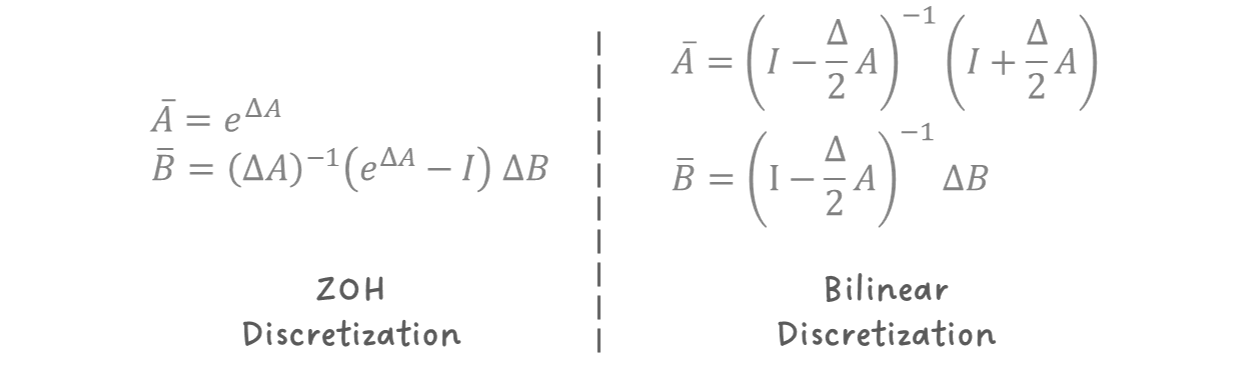 Equation 3: Zero Order Hold (ZOH) discretization vs. bilinear discretization.
A and B are the SSM's continuous-time matrices, I is the identity matrix and Δ is the step size representing the resolution of the input, which in the deep learning setting is learned.
Note that the discretization allows us to use the time-continuous formulation of the SSM and apply it to discrete signals used in a computer. This implies that we become resolution invariant since we learn the underlying time-signal. Check out the S4ND paper for some further reading on that.
Paper Walkthroughs by Sascha Kirch
2.3 The Recurrent and Convolutional Representations of the SSM
Have you noticed the recurrency in the state equation because h[k] depends on h[k-1]? In fact, the state space model is quite like an RNN in that manner:
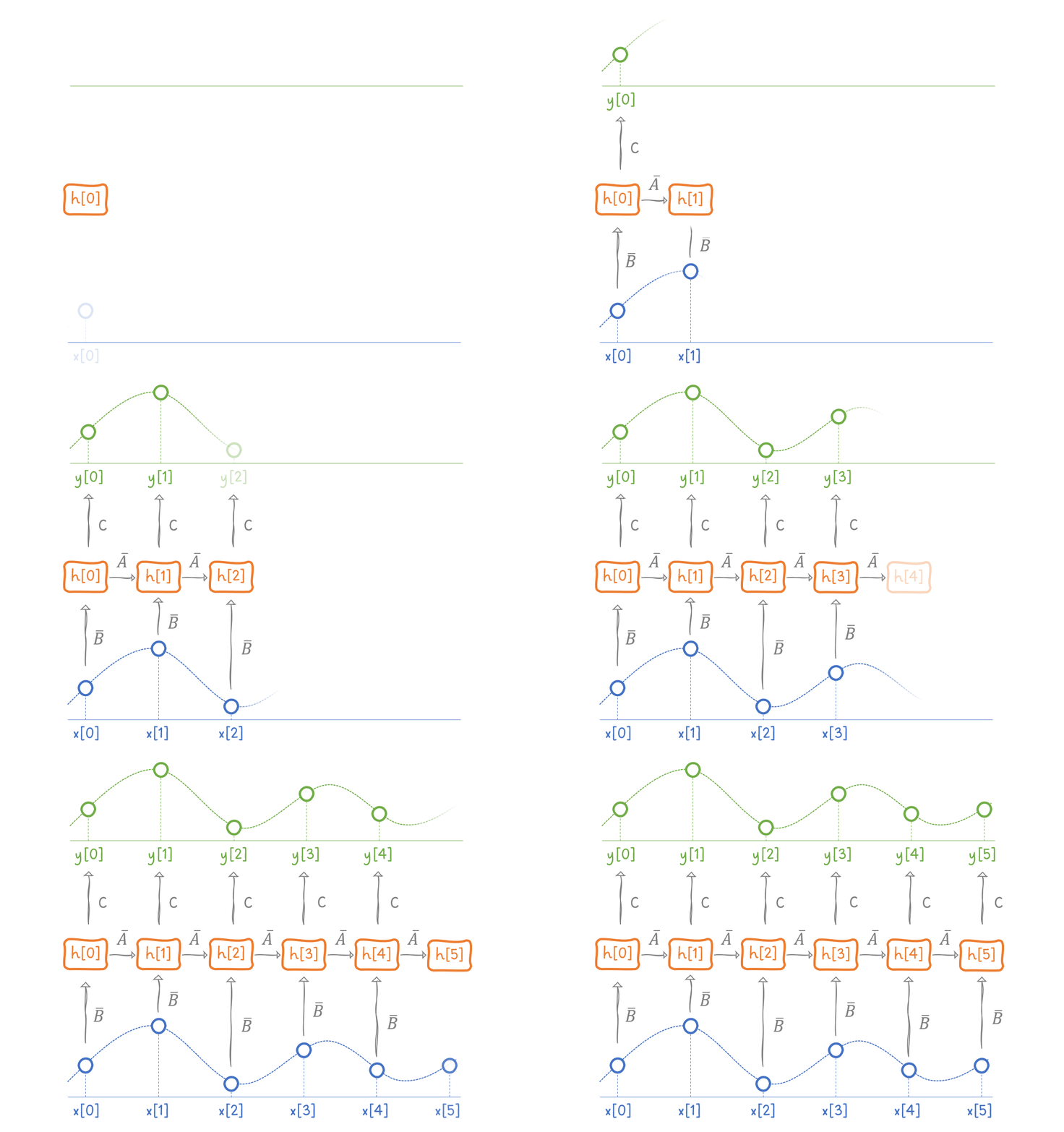 Figure 5: Recurrent representation of a discretized state space model. Image by Sascha Kirch.
The matrices A , B and C are time-invariant. That means that each input and each state is transformed with the same parameters, regardless of the time step. Linear time invariant systems, or short LTI-systems, have a very neat property: they can be represented as a convolution!
 Equation 4: Convolution kernel of the discretized state space model.
The kernel is constructed from the matrix C and the discretized matrices A and B. Note that the kernel has the same length L as the input sequence. The kernel is convolved with the input x to obtain the output y. To end up with the same sequence length at the output as at the input, the input is usually padded.
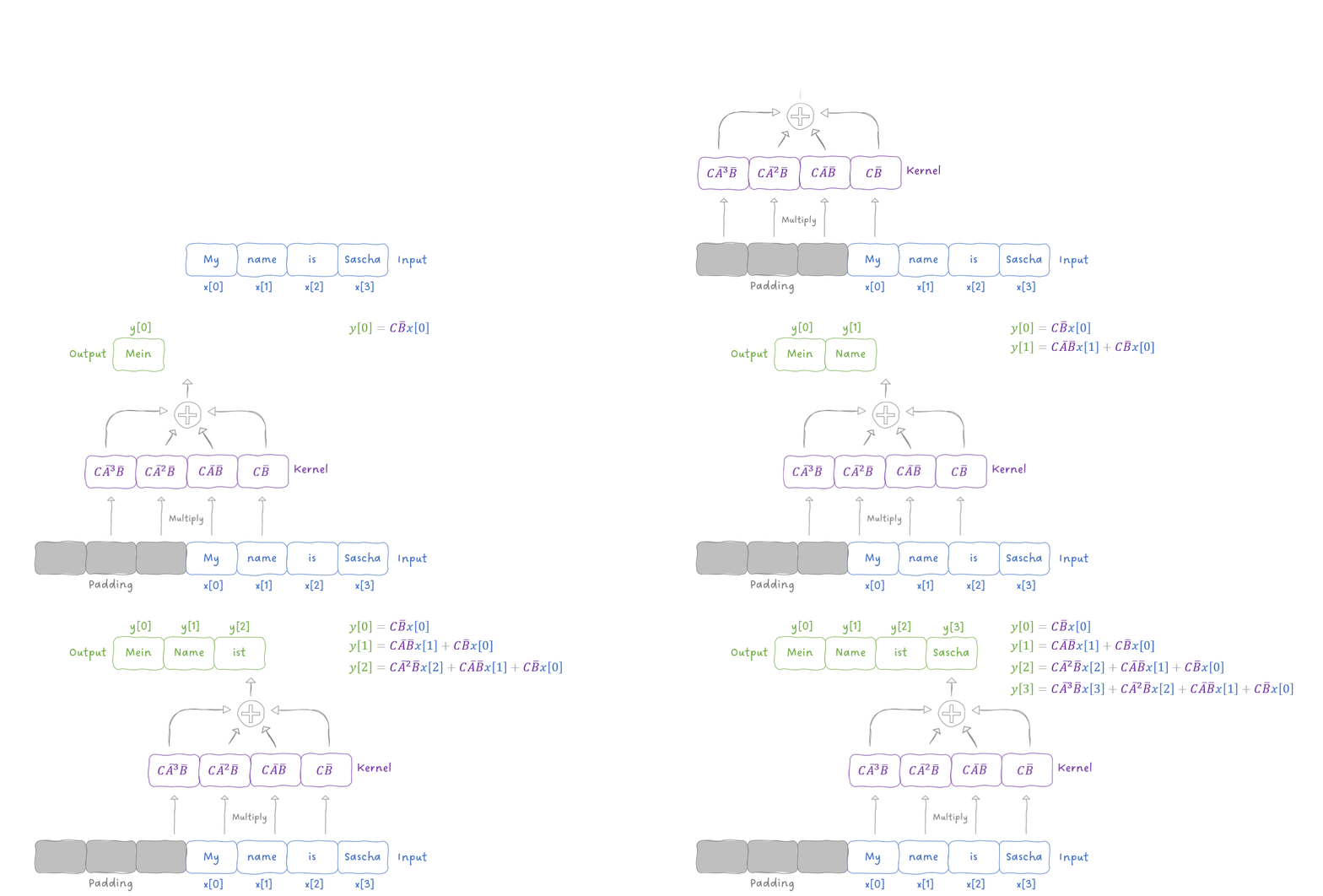 Figure 6: Example of the convolutional representation of a discretized state space model. Image by Sascha Kirch.
That's awesome because we know that convolutions are parallelizable and that GPUs and other HW-accelerators are optimized to calculate them fast.
To conclude this section, leveraging the properties of a L inear T ime I nvariant System, we ended up with 3 different ways to represent the SSM:
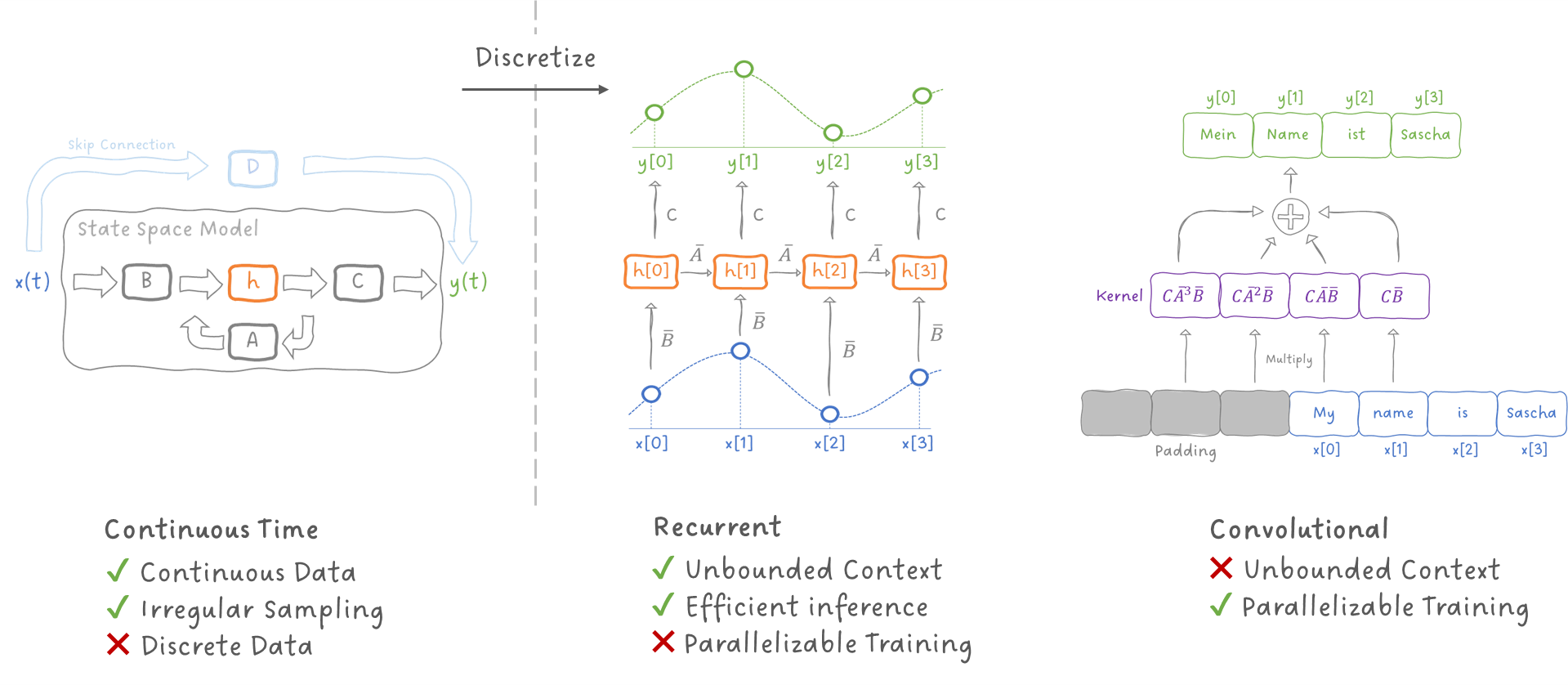 Figure 7: Different representations of state space models. Image by Sascha Kirch.
Both the recurrent and the convolutional representations of the SSM are equal, hence we can decide whether we use one or the other.
During training we would choose the convolutional representation because we have access to the entire sequence x[k] and labels y[k] ahead of time through our training data.
During inference we would choose the recurrent representation because usually we only have access to samples from the past (e.g. autoregressive text generation). **** Note that the inference scales linearly with the sequence length since our next output only depends on the previous state and the current input.
We now have a model with efficient training and efficient inference. Awesome! 😎
It was the LSSL (Linear State Space Layer) paper, that showed that we can train an SSM and that highlighted the connection between the different representations.
Get an email whenever Sascha Kirch publishes 🚀 _Get an email whenever Sascha Kirch publishes 🚀 Looking to learn more about deep learning or simply stay up to dat_e...medium.com
3. Enabling Long-Range Relationships
Matrix A is responsible to create the next state from the previous state. The state of the system is a result of multiple updates considering past states and new inputs. It could be said that the state contains the information of the entire history of inputs. It is not hard to imagine that for very long sequences it might be a difficult task to remember all inputs accurately. So, how can we handle long-range dependencies?
3.1 State-Size Matters
Let's first talk about the state, its compression and the efficiency of inference.
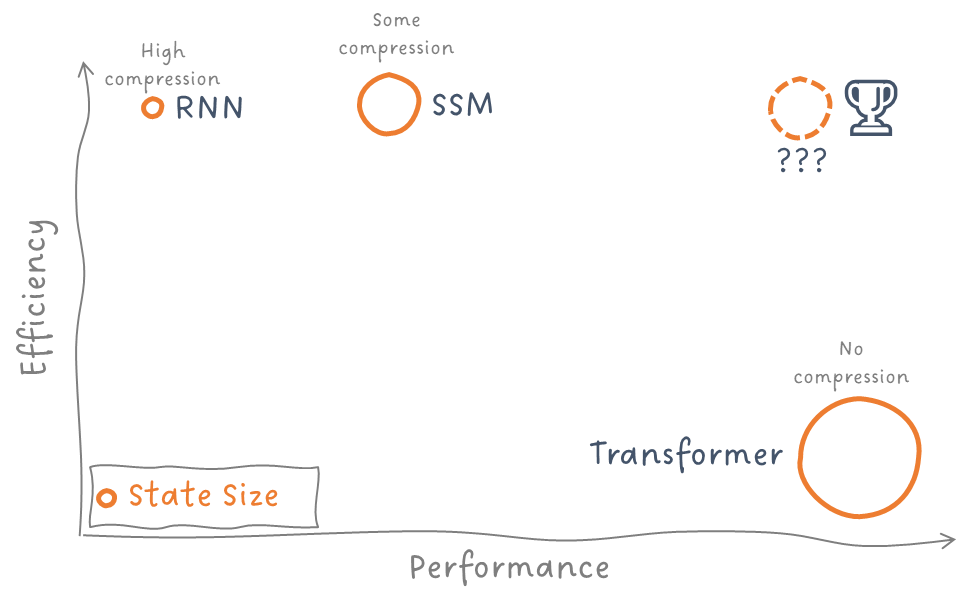 Figure 8: Efficiency vs. performance of the RNN, SSM, Transformer and the desired model. Image by Sascha Kirch.
RNNs and Transformers can both theoretically deal with a never-ending sequence of data (sometimes people say: these models are unbound). The RNN does this by compressing the entire history into a single low-dimensional state. This is very efficient for inference, because now the next state only depends on the previous state and the current input. The performance of the RNN depends on how well the model learns to do this compression. Additionally, for long sequences and especially due to vanishing gradients, this is not an easy task to achieve, even for more advanced RNNs using gating mechanisms like GRUs and LSTMs. The Transformer on the other hand does not compress the history at all. It considers the entire history (and future if not masked like in autoregressive generation) through its attention mechanism. This allows the Transformer being trained in parallel, but at the same time memory and compute requirements explode with increasing sequence lengths during inference.
❓ So, again: how can we handle long-range dependencies with a highly compressed state, without the difficulties during training while achiving high performance?
One Solution: we initialize our matrices using the HiPPO (Hi gh-order P olynomial P rojection O perators) framework.
3.2 The HiPPO Framework
The main idea is to parametrize the matrices A and B from the state equation in such a way that we can reconstruct the history (i.e. the input signal from time t=0 to t=now) at any given point. Specifically, if the state is represented as some coefficients of certain orthogonal polynomials (e.g. the Legendre Polynomial), we can simply evaluate the polynomial to reconstruct the input signal up until the current time.
For example: We have an input function x(t). At any given time step ti , we want to find a reconstruction g(ti) that approximates x(t for t <ti) for all t before ti. The approximation g(ti) is fully described by the coefficients c(ti) that can be inserted into the Legendre Polynomial to reconstruct g(ti).
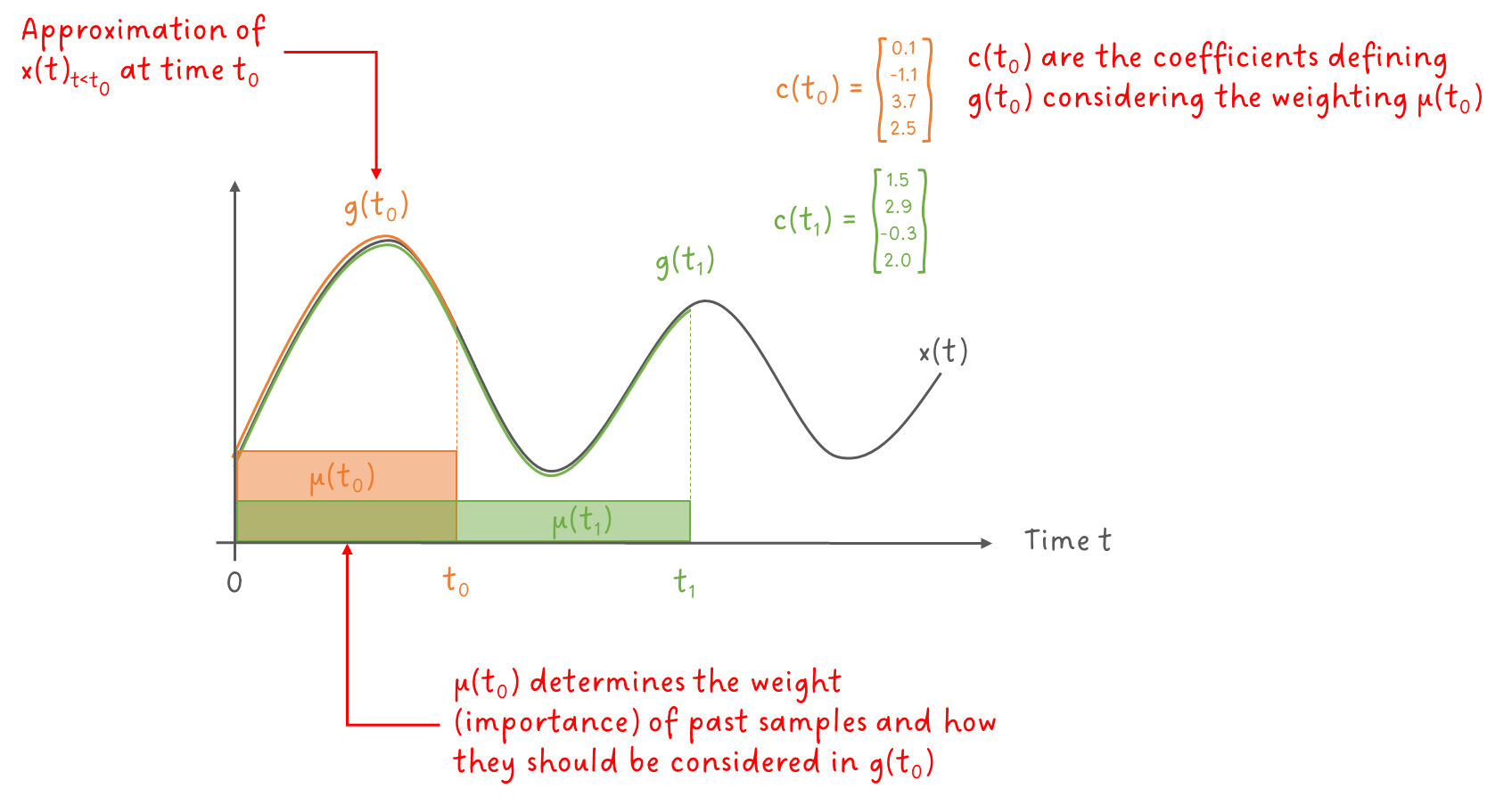 Figure 9: Approximation g(t) of the input function x(t) in the HiPPO framework. Image by Sascha Kirch.
This is important to understand: Instead of having only access to a compressed representation of the input, we can reconstruct the input at any given time. Still, it is a recurrent model with all the benefits of linear complexity.
These coefficients evolve over time, since for every ti , we have different coefficients c(ti). So, how do we get those coefficients? As it turns out, c(t) can be defined as an ordinary differential equation (ODE):
 Equation 5: ODE of the coefficients of the HiPPO framework.
With some mathematical tricks (e.g. assuming orthogonality of x and g) and by choosing a weighting µ(t) of different time steps, this problem is fully defined. We can solve the ODE and obtain A(t) and B(t) that satisfy our choice of weighting and use those in our SSM.
Different HiPPO Matrices have been provided as a solution for different weightings of past samples and different polynomials as a basis.
- LegT: Legendre polynomials with sliding window
- LegS: Legendre polynomials with constant weighting.
- LagT: Laguerre polynomials with exponential decay
LegS is the most prominent one used by follow-up works. Here is the solution for matrix A :
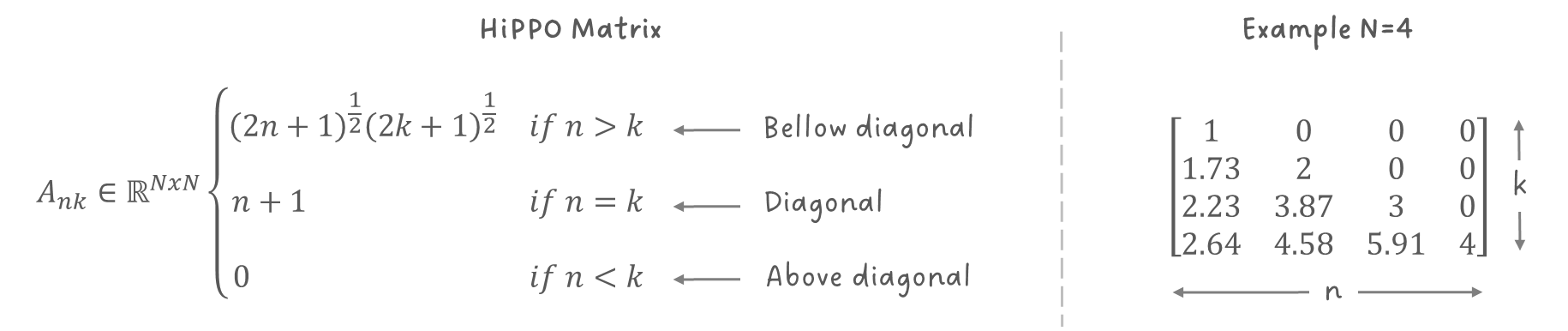 Equation 6: HiPPO matrix definition and example for N=4.
A naive python implementation could look something like this:
python
def get_hippo_A(N:int) -> np.ndarray:
    A = np.zeros((N,N))
    for n in range(N):
        for k in range(N):
            if n > k:
                A[n,k] = (2*n+1)**0.5*(2*k+1)**0.5
            elif n == k:
                A[n,k] = (n+1)
    return A
The LSSL mentioned earlier did show that one can train an SSM if initialized with the HiPPO matrix and it did show that its performance even surpasses those of the Transformer in the shown experiments. However, its expensive computation and memory requirements made the LSSL infeasible as a general sequence model. This hasn't been solved until the introduction of the S4 (Structured State Space Sequen ce) model, which we will address in the next chapter.
4. Impose Structure on State Matrices for Efficiency
It is finally time to talk about what the structure in the structured state space model is all about. We'll first try to gain some very basic intuition what structure is and why it is important, and then we will take a closer look onto the S4 model.
4.1 What Are Structured Matrices and Why Do They Matter?
Let's consider a standard square matrix of NxN elements. We will focus on two aspects:
- how much memory do we need to represent this matrix,
- how fast can we multiply 2 matrices, where fast can be a result of several things, like being able to parallelize the computation, exploiting redundancies, and having less values to deal with in the first place.
How Much memory do we need? Let's start with the memory requirements to store a matrix. We can have different kinds of matrices. Sometimes they are already in a certain form and sometimes we can bring them into a certain form leveraging rules from linear algebra. Let's have a look on some common matrix types:
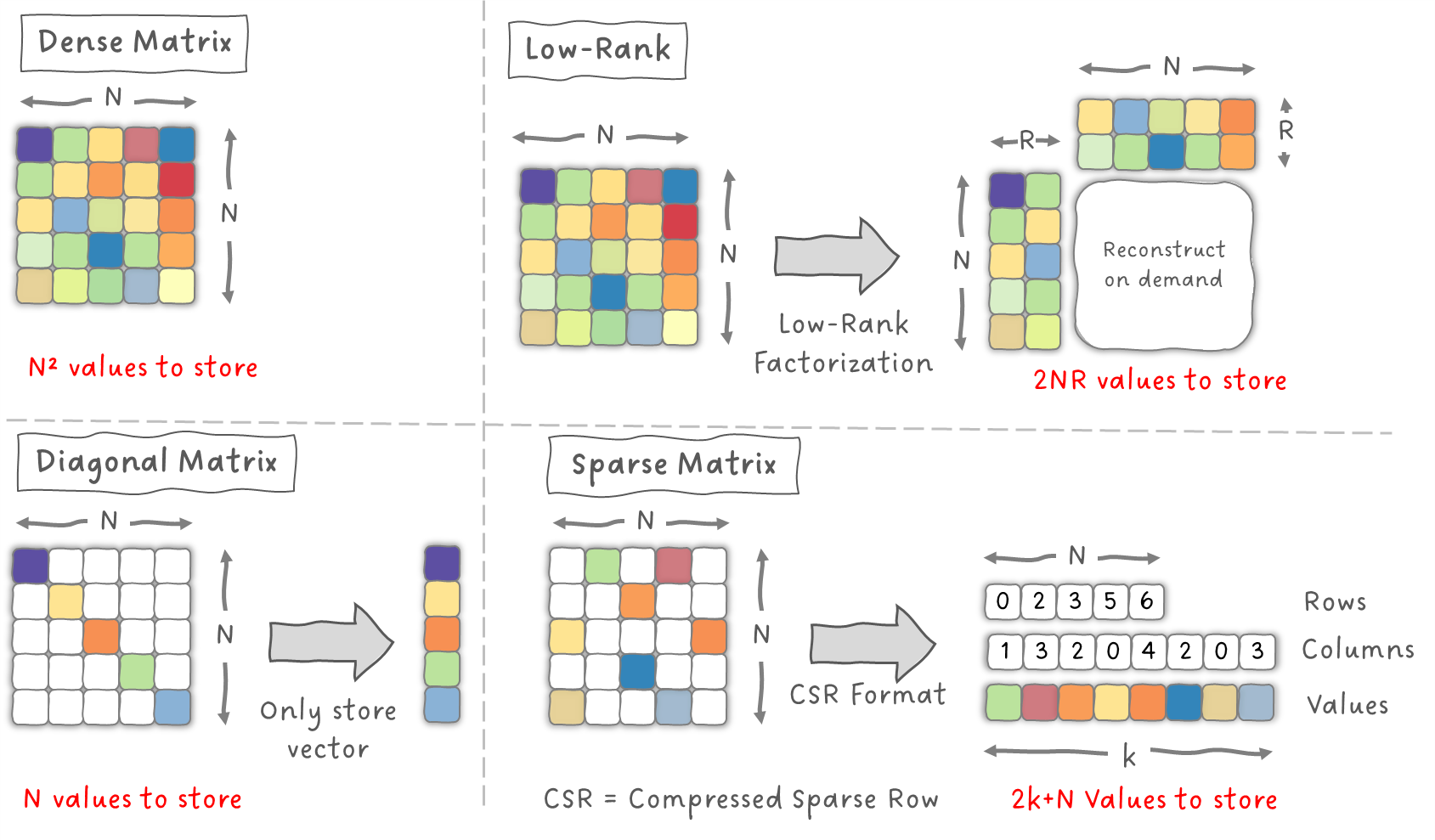 Figure 10: Number of values to store for several common matrix types. Image by Sascha Kirch.
We see that in the worst case for a dense matrix, we need to store N² values in memory. Not only that, but we must also load N² values from the CPU to the GPU, where we then apply certain matrix operations.
Note that there is a difference on how much values we need to store in our memory on CPU side (meaning in RAM or on disk) and how much memory we occupy in the GPU for computations. To make this clear, let's look at the low-rank factorization. Some matrices can be factorized into 2 low-rank matrices of NxR , where R is the rank of these matrices. We now only need to store NR values for each of the two matrices, hence 2NR values. That also means we only need to load 2NR values instead of N² from CPU to GPU. But if we want to make calculations with the original matrix, we first need to reconstruct the original matrix (some say materialize them) inside the GPU, meaning we still need N² values in the cache of the GPU.
Other representations like the diagonal or the sparse matrix on the other hand decrease both: the values stored on disk and the number of values needed to perform matrix operations on the GPU.
How many computations are required? Now let's consider a standard matrix multiplication C=AB , where A and B are either dense or diagonal matrices and C is the result of the matrix multiplication:
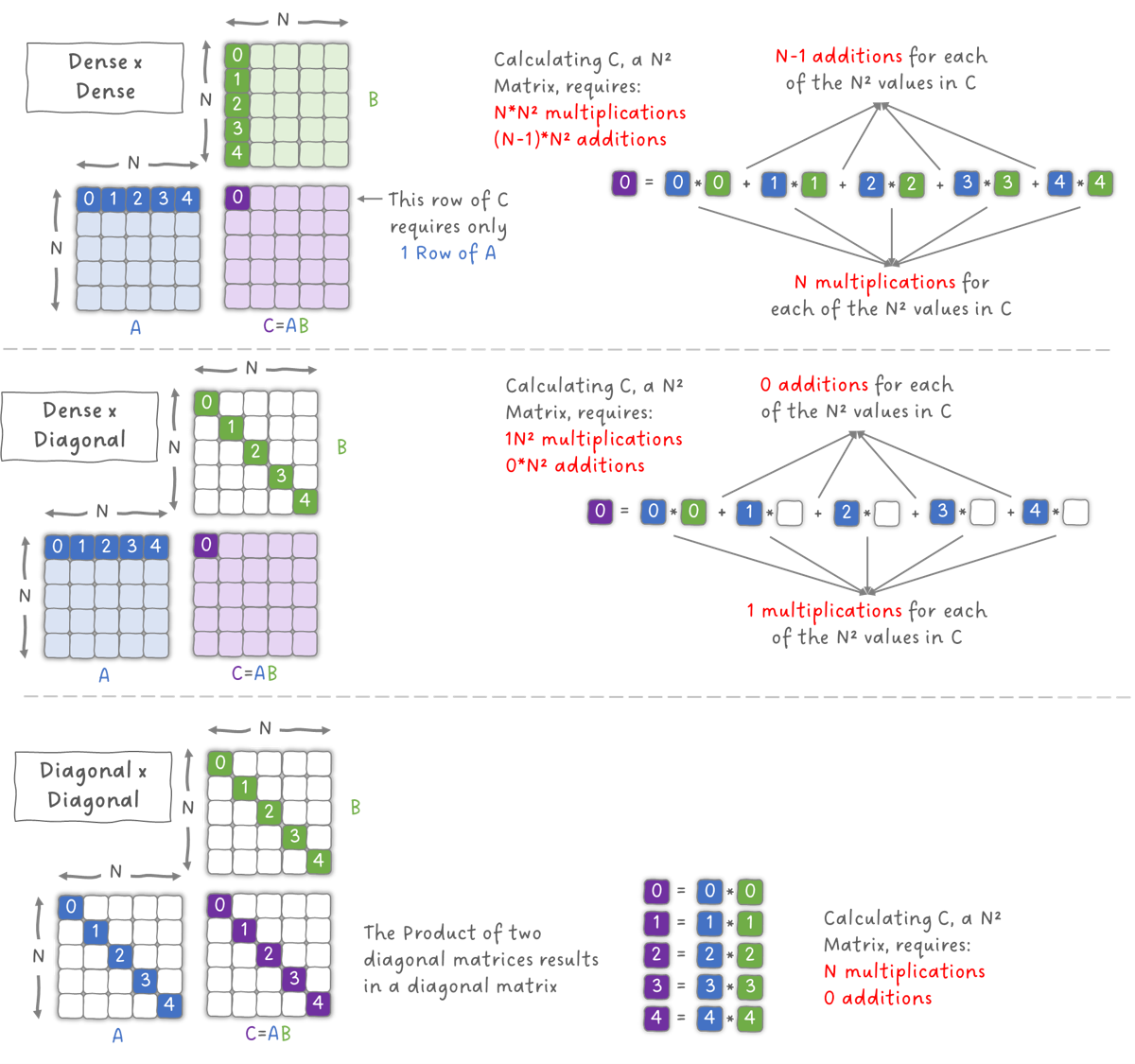 Figure 11: Number of operations for matrix multiplication of different matrix types. Image by Sascha Kirch.
For the case where both are dense matrices , using the standard algorithm we all know for matrix multiplication, we need N³ multiplications and (N-1)N² additions.
In case Ais a dense matrix and Bis a diagonal matrix , this reduces to N² multiplications and 0 additions.
In case both Aand Bare diagonal , we only require N multiplications which are the element-wise multiplications of the entries of the diagonal. While this is desirable in terms of hardware resources, note that a diagonal matrix might be less expressive as a dense matrix, because it has less values. Like everything, it is a trade-off.
Parallelization of Computations If you take a closer look onto the dense matrix multiplication, you might notice that calculating a single row of the output C , involves all values of B , but only a single row of A. Naively, you could speed up the computation by calculating each row of C in parallel on different cores of a GPU. This means each core would only need N² multiplications and (N-1)N additions instead of N³ multiplications and (N-1)N² additions as in the single core case because we now have a vector-matrix product, not a matrix-matrix product.
Long Story Short To conclude, and using the example of a square matrix of NxN , by trying to exploit certain properties of matrices, we want to bring them into a structured form such that we need to store and load less than N² values and that we require less than N³ multiplications and (N-1)N² additions for matrix multiplications.
Of course, there are many other matrix structures that we can exploit all with their own pros and cons. Throughout this series on Mamba state space models we will encounter many of those, and all serve the same purpose: requiring less resources while keeping the best performance possible.
4.2 Putting It All Together - S4: Structured State Space Sequence Models
S4 aims to make SSMs more efficient by enforcing a certain structure upon the involved matrices. By doing so, it can apply well studied rules of algebra to reduce the complexity of the involved computations and save memory, especially for the repeated computation of the kernel K of the convolutional view.
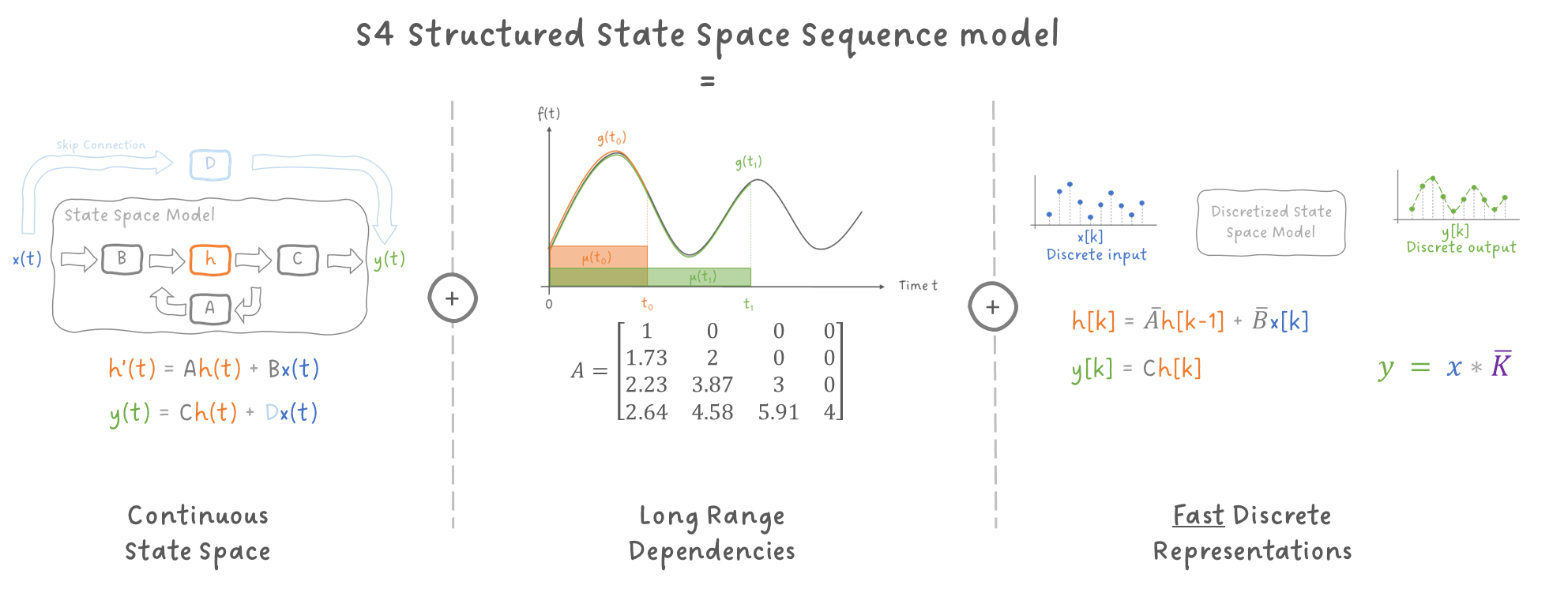 Figure 12: S4 Structured State Sequence Model. Image by Sascha Kirch.
Compared to LSSL, S4 is has been shown to be 30x faster with 400x less memory usage while it also gained a boost in performance.
The S4 paper is involves a lot of advanced linear algebra I will mostly skip in this blog post. If you want to dive deeper into the math and also the code implementation I recommend you to check out The Annotated S4.
Recall that calculating the convolution kernel K for the convolutional representation of the SSM, repeated matrix multiplications of the discretized square matrix A are required. Remember that the kernel has the same length L as the input sequence x and that the power of the matrix A is increased with each entry of the kernel.
Equation 6: Convolutional kernel of the discretized state space model.
To be clear, a sequence of length L=101 would have matrices to the power of 100! And 99 and 98 and... you get the point. Of course, we could reuse previous results, but still this is a lot to compute.
The main goal of S4 is to reduce the number of resources needed to calculate the kernel K , by imposing a certain structure on matrix A.
Ideally, matrix A would be a diagonal matrix because as we saw earlier in Figure 11, multiplying two diagonal matrices result in another diagonal matrix requiring only N multiplications.
Since a HiPPO matrix cannot be diagonalized in a numerically stable manner (as proofed in the S4 paper), the next best thing is to decompose it into a normal plus low-rank (NPLR) form that can then further be simplified into a diagonal plus low-rank (DPLR) form by conjugation. Note that we want to hold on to the HiPPO matrix and do not change it to another diagonalizable matrix, because we need it for dealing with long-range dependencies.
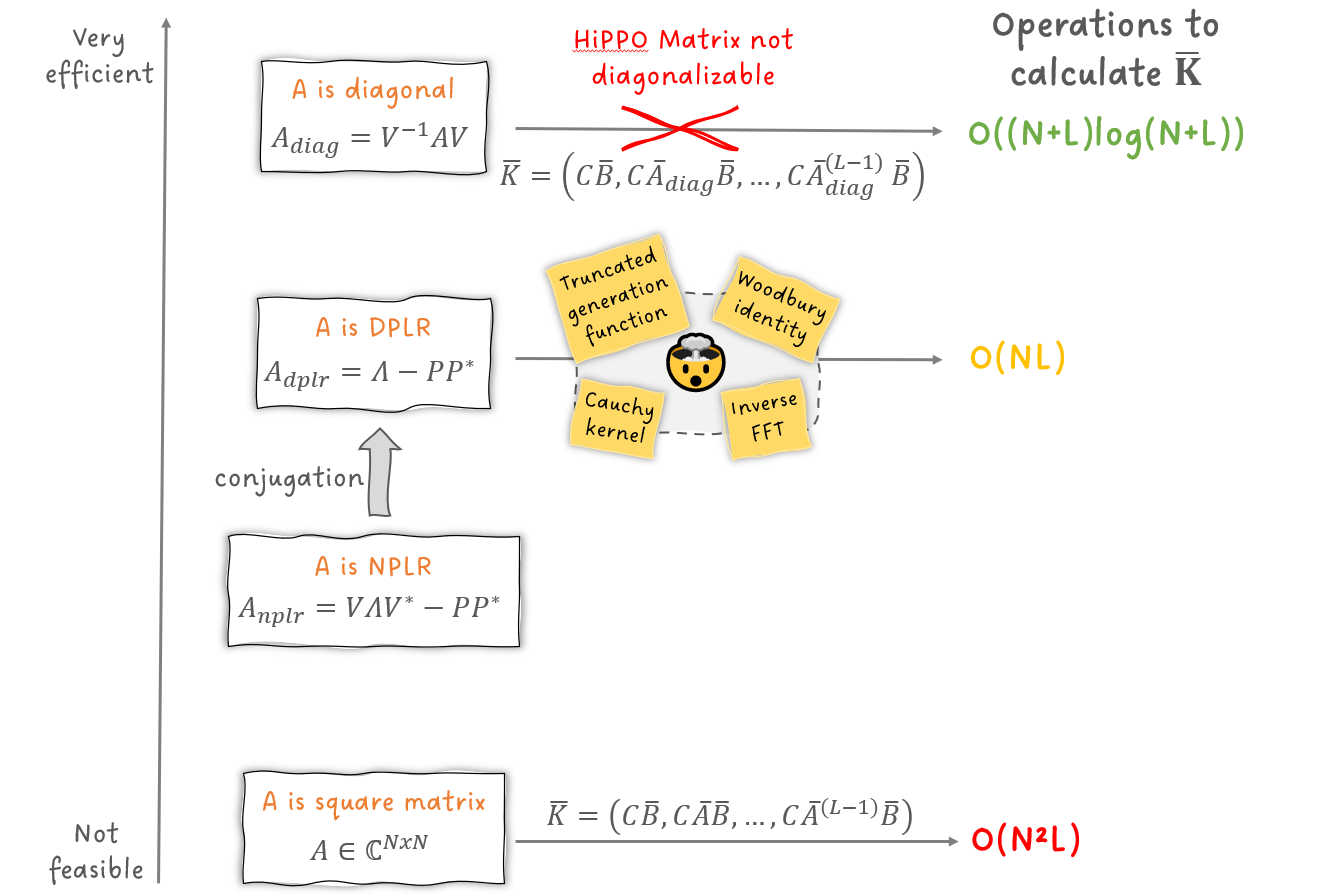 Figure 13: Comparing different representations of matrix A and there resulting complexity to compute the convolution kernel K. Image by Sascha Kirch.
Having matrix A in DPLR form allows us to apply many complicated tricks. In summary, the kernel is calculated in the frequency domain and having the DPLR form allows rearranging the matrices into a Cauchy matrix, for which many hardware optimized algorithms exist.
Further, using the Woodburry identity allows transforming the calculation of multiple powers of A into a single inverse. Finally, the inverse FFT (Fast Fourier Transform) is applied to obtain the final convolutional filter K.
So, the SSM(A,B,C) previously a function of A, B, and C , is now a function _SSM(__Λ-_PP*,B,C) , where _Λ,_P, B and C are learnable parameters of the S4.
If you are interested in the original implementation, here is the dplr() function and the nplr() function of the S4 repository.
5. Wrapping Up
5.1 Summary
- State Space Models (SSMs) are sequence models.
- SSMs can be described as recurrent model or as convolution model
- They are inferred fast in their recurrent representation that scales linearly because they only depend on the current input and the previous state.
- They are trained fast because of their convolutional representation that can be parallelized.
- Since they are an LTI system, each input at any time step is treated equally, meaning transformed by the same matrix.
- Structured state space sequence models aka. S4 use a certain structure on their matrices to make SSMs faster allowing them to be less restrictive with compute and memory requirements.
Thank You!
🤝 I'd like to thank you, t he readers of my stories, for your constant support, clapping for my stories and, following me to never miss any of my latest articles. It is you who motivates me to continue writing, dive deep into complex topics, and become a better engineer/researcher by writing about them. You are awesome!
5.2 Limitations of Structured SSMs
There is one big big issue though: SSMs cannot reason about different inputs at different time steps, since the matrices A , B and C are time invariant meaning the same for all inputs.
5.3 Continue Reading Part 3
Here Comes Mamba: The Selective State Space Model
In Part 3 we will discover how Mamba solves the issue of the structured state space model not differentiating between samples in the input sequence by adding selectivity to the model architecture. ❓ But what do we gain and at which cost?
6. Further Readings & Resources
Mamba State Space Models for Images, Videos and Time Series
Paper Walkthroughs by Sascha Kirch
Blog Posts
Papers:
Code
Register Now to Continue Reading
Unlock Towards Data Science with a Free Account
All articles on Towards Data Science are available to registered users. Create a free account today to access this article and thousands more.
Register for freeSign in to your account
 Written By
See all from Sascha Kirch
Deep DivesDeep LearningLinear AlgebraMambaMamba Image Video Signal
Share This Article
Towards Data Science is a community publication. Submit your insights to reach our global audience and earn through the TDS Author Payment Program.
Write for TDS
Related Articles
Deep Learning
Learn how to easily visualize and evaluate activity classification models from the PyTorchVideo library The...
Eric Hofesmann
May 19, 20218 min read
Artificial Intelligence
Triton is a language compiler to write highly optimized CUDA kernels. Learn the basics of GPU programming and how to use Triton.
Kushajveer Singh
September 12, 20218 min read
Deep Learning
Using neural networks to generate haiku while enforcing the 5-7-5 syllable structure.
Jeremy Neiman
December 29, 20189 min read
Artificial Intelligence
MobileNetV3 with PyTorch — now featuring SE blocks and hard activation functions
Muhammad Ardi Putra
November 2, 202527 min read
Deep Learning
Optimizers are like personal trainers
Pascal Janetzky
October 25, 20216 min read
Large Language Models
Inside disaggregated LLM inference — the architecture shift behind 2-4x cost reduction that most ML teams haven't adopted yet.
Gokul Chandra Purnachandra Reddy
April 15, 202614 min read
Artificial Intelligence
Decoding the Math behind Q-Learning, Action-Value Functions, Bellman Equations, and building them from scratch in Python.
Cristian Leo
February 28, 202434 min read
Artificial Intelligence
Learn how to compare classifiers using hypothesis testing
Marcello Politi
July 6, 20225 min read
Deep Learning
A list of ongoing and annual competitions suitable for getting hands-on practice with reinforcement learning (while winning a prize or...
Joy Zhang
October 28, 20214 min read
Your home for data science and AI. The world's leading publication for data science, data analytics, data engineering, machine learning, and artificial intelligence professionals.
Subscribe to Our NewsletterWrite For TDS•About•Advertise•Privacy Policy•Terms of Use
© Insight Media Group, LLC 2026•The New Stack•roadmap.sh•Creator Network
Recommended Articles
Close
word word word word word word word word word word word word word word word word word word word word word word word word word word word word word word word word word word word word word word word word word word word word word word word word word word word word word word word word word word word word word word word word word word word word word word word word word word word word word word word word word word word word word word word word word word word word word word word word word word word word word word word word word word word word word word word word word word word word word word word word word word word word word word word word word word word word word word word word word word word word word word word word word word word word word word word word word word word word word word word word word word word word word word word word word word word word word word word word word word word word word word word word word word word word word word word word word word word word word word word word
mmMwWLliI0fiflO&1
mmMwWLliI0fiflO&1
mmMwWLliI0fiflO&1
mmMwWLliI0fiflO&1
mmMwWLliI0fiflO&1
mmMwWLliI0fiflO&1
mmMwWLliI0fiflO&1