保留正文与补采附件。源页面当前未重新核验;具体限制见交付清单。
 We value your privacy
We use cookies to enhance your browsing experience, serve personalised ads or content, and analyse our traffic. By clicking "Accept All", you consent to our use of cookies.
Customise Reject All Accept All
Customise Consent Preferences
 We use cookies to help you navigate efficiently and perform certain functions. You will find detailed information about all cookies under each consent category below.
The cookies that are categorised as "Necessary" are stored on your browser as they are essential for enabling the basic functionalities of the site. ... Show more
NecessaryAlways Active
Necessary cookies are required to enable the basic features of this site, such as providing secure log-in or adjusting your consent preferences. These cookies do not store any personally identifiable data.
-
Cookie
BCTempID
-
Duration
10 minutes
-
Description
No description available.
-
Cookie
__cf_bm
-
Duration
1 hour
-
Description
This cookie, set by Cloudflare, is used to support Cloudflare Bot Management.
-
Cookie
AWSALBCORS
-
Duration
7 days
-
Description
Amazon Web Services set this cookie for load balancing.
-
Cookie
_cfuvid
-
Duration
session
-
Description
Cloudflare sets this cookie to track users across sessions to optimize user experience by maintaining session consistency and providing personalized services
-
Cookie
li_gc
-
Duration
6 months
-
Description
Linkedin set this cookie for storing visitor's consent regarding using cookies for non-essential purposes.
-
Cookie
__hssrc
-
Duration
session
-
Description
This cookie is set by Hubspot whenever it changes the session cookie. The __hssrc cookie set to 1 indicates that the user has restarted the browser, and if the cookie does not exist, it is assumed to be a new session.
-
Cookie
__hssc
-
Duration
1 hour
-
Description
HubSpot sets this cookie to keep track of sessions and to determine if HubSpot should increment the session number and timestamps in the __hstc cookie.
-
Cookie
wpEmojiSettingsSupports
-
Duration
session
-
Description
WordPress sets this cookie when a user interacts with emojis on a WordPress site. It helps determine if the user's browser can display emojis properly.
-
Cookie
BCSessionID
-
Duration
1 year 1 month 4 days
-
Description
Blueconic sets this cookie as a unique identifier for the BlueConic profile.
-
Cookie
_octo
-
Duration
1 year
-
Description
No description available.
-
Cookie
logged_in
-
Duration
1 year
-
Description
No description available.
-
Cookie
__Secure-YEC
-
Duration
past
-
Description
YouTube sets this cookie to stores the user's video player preferences using embedded YouTube video
-
Cookie
__eoi
-
Duration
6 months
-
Description
Description is currently not available.
-
Cookie
AWSALBTGCORS
-
Duration
7 days
-
Description
No description available.
-
Cookie
login-status-p
-
Duration
past
-
Description
Description is currently not available.
-
Cookie
AWSALBTG
-
Duration
7 days
-
Description
No description available.
-
Cookie
csrf_token
-
Duration
session
-
Description
No description available.
-
Cookie
token_v2
-
Duration
1 day
-
Description
Description is currently not available.
-
Cookie
D
-
Duration
1 year
-
Description
Description is currently not available.
-
Cookie
PHPSESSID
-
Duration
session
-
Description
This cookie is native to PHP applications. The cookie stores and identifies a user's unique session ID to manage user sessions on the website. The cookie is a session cookie and will be deleted when all the browser windows are closed.
-
Cookie
VISITOR_PRIVACY_METADATA
-
Duration
6 months
-
Description
YouTube sets this cookie to store the user's cookie consent state for the current domain.
-
Cookie
cookietest
-
Duration
session
-
Description
The cookietest cookie is typically used to determine whether the user's browser accepts cookies, essential for website functionality and user experience.
-
Cookie
__Host-airtable-session
-
Duration
1 year
-
Description
This cookie is used to enable us to integrate the services of Airtable.
-
Cookie
__Host-airtable-session.sig
-
Duration
1 year
-
Description
This cookie is used to enable us to integrate the services of Airtable.
-
Cookie
m
-
Duration
1 year 1 month 4 days
-
Description
Stripe sets this cookie for fraud prevention purposes. It identifies the device used to access the website, allowing the website to be formatted accordingly.
-
Cookie
BIGipServer*
-
Duration
session
-
Description
Marketo sets this cookie to collect information about the user's online activity and build a profile about their interests to provide advertisements relevant to the user.
-
Cookie
__cfruid
-
Duration
session
-
Description
Cloudflare sets this cookie to identify trusted web traffic.
-
Cookie
_GRECAPTCHA
-
Duration
6 months
-
Description
Google Recaptcha service sets this cookie to identify bots to protect the website against malicious spam attacks.
-
Cookie
__Secure-YNID
-
Duration
6 months
-
Description
Google cookie used to protect user security and prevent fraud, especially during the login process.
-
Cookie
cookieyes-consent
-
Duration
1 year
-
Description
CookieYes sets this cookie to remember users' consent preferences so that their preferences are respected on subsequent visits to this site. It does not collect or store any personal information about the site visitors.
Functional
Functional cookies help perform certain functionalities like sharing the content of the website on social media platforms, collecting feedback, and other third-party features.
-
Cookie
lidc
-
Duration
1 day
-
Description
LinkedIn sets the lidc cookie to facilitate data center selection.
-
Cookie
brw
-
Duration
1 year
-
Description
No description available.
-
Cookie
brwConsent
-
Duration
5 minutes
-
Description
Description is currently not available.
-
Cookie
WMF-Uniq
-
Duration
1 year
-
Description
Description is currently not available.
-
Cookie
loom_anon_comment
-
Duration
1 year
-
Description
No description available.
-
Cookie
loom_referral_video
-
Duration
session
-
Description
Description is currently not available.
-
Cookie
VISITOR_INFO1_LIVE
-
Duration
6 months
-
Description
A cookie set by YouTube to measure bandwidth that determines whether the user gets the new or old player interface.
-
Cookie
yt-remote-connected-devices
-
Duration
Never Expires
-
Description
YouTube sets this cookie to store the user's video preferences using embedded YouTube videos.
-
Cookie
ytidb::LAST_RESULT_ENTRY_KEY
-
Duration
Never Expires
-
Description
The cookie ytidb::LAST_RESULT_ENTRY_KEY is used by YouTube to store the last search result entry that was clicked by the user. This information is used to improve the user experience by providing more relevant search results in the future.
-
Cookie
yt-remote-device-id
-
Duration
Never Expires
-
Description
YouTube sets this cookie to store the user's video preferences using embedded YouTube videos.
-
Cookie
yt-remote-session-name
-
Duration
session
-
Description
The yt-remote-session-name cookie is used by YouTube to store the user's video player preferences using embedded YouTube video.
-
Cookie
yt-remote-fast-check-period
-
Duration
session
-
Description
The yt-remote-fast-check-period cookie is used by YouTube to store the user's video player preferences for embedded YouTube videos.
-
Cookie
yt-remote-session-app
-
Duration
session
-
Description
The yt-remote-session-app cookie is used by YouTube to store user preferences and information about the interface of the embedded YouTube video player.
-
Cookie
yt-remote-cast-available
-
Duration
session
-
Description
The yt-remote-cast-available cookie is used to store the user's preferences regarding whether casting is available on their YouTube video player.
-
Cookie
yt-remote-cast-installed
-
Duration
session
-
Description
The yt-remote-cast-installed cookie is used to store the user's video player preferences using embedded YouTube video.
-
Cookie
cp_session
-
Duration
3 months
-
Description
Codepen sets this cookie for Help systems found in the website.
-
Cookie
loid
-
Duration
1 year 1 month 4 days
-
Description
This cookie is set by the Reddit. The cookie enables the sharing of content from the website onto the social media platform.
Analytics
Analytical cookies are used to understand how visitors interact with the website. These cookies help provide information on metrics such as the number of visitors, bounce rate, traffic source, etc.
-
Cookie
__hstc
-
Duration
6 months
-
Description
Hubspot set this main cookie for tracking visitors. It contains the domain, initial timestamp (first visit), last timestamp (last visit), current timestamp (this visit), and session number (increments for each subsequent session).
-
Cookie
hubspotutk
-
Duration
6 months
-
Description
HubSpot sets this cookie to keep track of the visitors to the website. This cookie is passed to HubSpot on form submission and used when deduplicating contacts.
-
Cookie
_ga
-
Duration
1 year 1 month 4 days
-
Description
Google Analytics sets this cookie to calculate visitor, session and campaign data and track site usage for the site's analytics report. The cookie stores information anonymously and assigns a randomly generated number to recognise unique visitors.
-
Cookie
ga*
-
Duration
1 year 1 month 4 days
-
Description
Google Analytics sets this cookie to store and count page views.
-
Cookie
__Host-psifi.analyticsTrace
-
Duration
6 hours
-
Description
Description is currently not available.
-
Cookie
__Host-psifi.analyticsTraceV2
-
Duration
6 hours
-
Description
Description is currently not available.
-
Cookie
_gh_sess
-
Duration
session
-
Description
GitHub sets this cookie for temporary application and framework state between pages like what step the user is on in a multiple step form.
-
Cookie
YSC
-
Duration
session
-
Description
YSC cookie is set by Youtube and is used to track the views of embedded videos on Youtube pages.
-
Cookie
ajs_anonymous_id
-
Duration
1 year
-
Description
This cookie is set by Segment to count the number of people who visit a certain site by tracking if they have visited before.
-
Cookie
vuid
-
Duration
1 year 1 month 4 days
-
Description
Vimeo installs this cookie to collect tracking information by setting a unique ID to embed videos on the website.
Performance
Performance cookies are used to understand and analyse the key performance indexes of the website which helps in delivering a better user experience for the visitors.
-
Cookie
AWSALB
-
Duration
7 days
-
Description
AWSALB is an application load balancer cookie set by Amazon Web Services to map the session to the target.
-
Cookie
acq
-
Duration
past
-
Description
Description is currently not available.
-
Cookie
acq.sig
-
Duration
past
-
Description
Description is currently not available.
-
Cookie
ptc
-
Duration
2 years
-
Description
No description available.
Advertisement
Advertisement cookies are used to provide visitors with customised advertisements based on the pages you visited previously and to analyse the effectiveness of the ad campaigns.
-
Cookie
muc_ads
-
Duration
1 year 1 month 4 days
-
Description
Twitter sets this cookie to collect user behaviour and interaction data to optimize the website.
-
Cookie
guest_id_marketing
-
Duration
1 year 1 month 4 days
-
Description
Twitter sets this cookie to identify and track the website visitor.
-
Cookie
guest_id_ads
-
Duration
1 year 1 month 4 days
-
Description
Twitter sets this cookie to identify and track the website visitor.
-
Cookie
personalization_id
-
Duration
1 year 1 month 4 days
-
Description
Twitter sets this cookie to integrate and share features for social media and also store information about how the user uses the website, for tracking and targeting.
-
Cookie
guest_id
-
Duration
1 year 1 month 4 days
-
Description
Twitter sets this cookie to identify and track the website visitor. It registers if a user is signed in to the Twitter platform and collects information about ad preferences.
-
Cookie
bcookie
-
Duration
1 year
-
Description
LinkedIn sets this cookie from LinkedIn share buttons and ad tags to recognize browser IDs.
-
Cookie
__Secure-ROLLOUT_TOKEN
-
Duration
6 months
-
Description
YouTube sets this cookie to manage feature rollout and experimentation. It helps Google control which new features or interface changes are shown to users as part of testing and staged rollouts, ensuring consistent experience for a given user during an experiment.
-
Cookie
yt.innertube::nextId
-
Duration
Never Expires
-
Description
YouTube sets this cookie to register a unique ID to store data on what videos from YouTube the user has seen.
-
Cookie
yt.innertube::requests
-
Duration
Never Expires
-
Description
YouTube sets this cookie to register a unique ID to store data on what videos from YouTube the user has seen.
-
Cookie
session_tracker
-
Duration
session
-
Description
This cookie is set by the Reddit. This cookie is used to identify trusted web traffic. It also helps in adverstising on the website.
-
Cookie
edgebucket
-
Duration
session
-
Description
Reddit sets this cookie to save the information about a log-on Reddit user, for the purpose of advertisement recommendations and updating the content.
-
Cookie
did
-
Duration
1 year
-
Description
Arbor sets this cookie to show targeted ads to site visitors.This cookie expires after 2 months or 1 year.
Uncategorised
Other uncategorised cookies are those that are being analysed and have not been classified into a category as yet.
No cookies to display.
Reject All Save My Preferences Accept All
Toggle SearchToggle Mobile Navigation
Publish AI, ML & data-science insights to a global community of data professionals.
Sign inSubmit an Article
LatestEditor's PicksNewsletterShipAI
Write For TDS
LinkedInXToggle Search
Deep Learning
Activation Functions in Neural Networks: How to Choose the Right One
Introduction to activation functions and an overview of the most famous functions
Niklas Lang
December 12, 202415 min read
 Photo by engin akyurt on Unsplash
Neural networks have become a powerful method in machine learning models in recent years. The activation function is a central component in every neural network, which significantly influences the model's functionality. It determines how strongly a neuron in the network is activated and thus decides which structures are learned from the data. Without the activation functions, the neural networks could only recognize linear relationships and would not be able to produce the impressive results that have kept us in suspense in recent years.
In this article, we look in detail at the properties of an activation function and compare the different functions that are commonly used. We also provide tips on how to find the right activation function for the network architecture and the specific use case to train an optimal model. However, before we can dive into the topic, we should understand how neural networks and more specifically the neurons in them work to see in which system the activation function is embedded.
Learn this step by step with the interactive Machine Learning roadmap.
How does a perceptron work?
The perceptron is originally a mathematical model and was only later used in computer science and machine learning due to its ability to learn complex relationships. In its simplest form, it consists of exactly one neuron, which mimics the structure of the human brain.
The perceptron has several inputs at which it receives numerical information, i.e. numerical values. The number of inputs can vary depending on the application. The inputs have different weights, which indicate how influential the inputs are for the final output. During the learning process, the weights are changed to produce the best possible results.
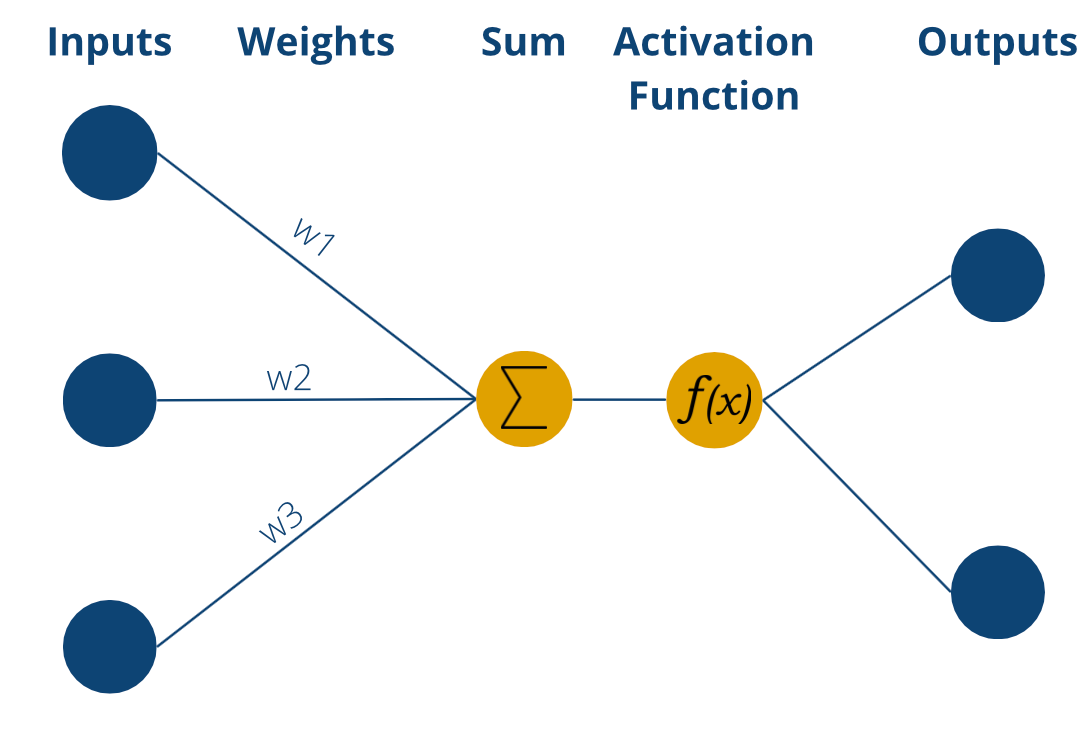 Structure of a Perceptron | Source: Author
The neuron itself then forms the sum of the input values multiplied by the weights of the inputs. This weighted sum is passed on to the so-called activation function, which contains the logic that is learned in the model. In its simplest form, the neuron only has one output, which can assume binary values such as "yes/no" or "active/inactive". The activation function then has the corresponding property of mapping continuous values to 0 or 1. The output is then the prediction of the perceptron.
A neural network consists of millions or even billions of such neurons, which are then organized in different layers. This structure enables them to recognize and learn even more complex relationships in the data.
As an example of how a perceptron works, let's take a closer look at the work of a politician. She is a member of parliament and a new law has to be voted on. The politician must therefore decide whether to approve or reject the proposed law (abstention is not possible in our example). The perceptron therefore has a binary output, namely approval or rejection.
Various sources of information are available to the politician as input for her decision. On the one hand, there is an information paper with background information issued by parliament. Furthermore, the MP can find out about various issues on the Internet or discuss them with other colleagues. The politician weights her input, i.e. her sources of information, according to how trustworthy she considers them to be. For example, she assigns less weight to the parliamentary information paper, as she fears that the research is not detailed enough and should already lean in a certain direction. It then takes the sum of the information available to it, together with the weightings, and passes it on to the activation function.
We can think of this as the politician's head, which uses the inputs to decide whether or not to approve the proposed legislation. Even minor details in the inputs can lead to a massive change in the politician's opinion.
What is an Activation Function?
The activation function is a mathematical function that is used within neural networks and decides whether a neuron is activated or not. It processes the weighted sum of the neuron's inputs and calculates a new value to determine how strongly the signal is passed on to the next layer in the network. In simple terms, the activation function determines the strength of the neuron's response to the weighted input values.
The activation function plays a crucial role in the training of neural networks, as it enables the modeling of non-linear relationships. The choice of the appropriate function for the model architecture and the underlying data has a decisive influence on the final results and is therefore an important component in the creation of a neural network.
What Properties do Activation Functions have?
The activation function has an important influence on the performance of neural networks and should be chosen depending on the complexity of the data and the prediction type. Although there are a variety of functions to choose from, they all share the following properties, which we explain in more detail in this section.
One of the most important properties of activation functions is their non-linearity , which enables the models to learn complex relationships from the data that go beyond simple, linear relationships. Only then can the challenging applications in image or speech processing be mastered. Although non-linear activation functions can also be used, these have some disadvantages, as we will see in the following section.
In addition, all activation functions must be differentiable. In other words, it must be mathematically possible to form the derivative of the function so that the learning process of the neural networks can take place. This process is based on the backpropagation algorithm, in which the gradient, i.e. the derivative in several dimensions, is calculated in each iteration and the weights of the individual neurons are changed based on the results so that the prediction quality increases. Only through this process and the differentiability of the activation function is the model able to learn and continuously improve.
In addition to these positive or at least neutral properties, activation functions also have problematic properties that can lead to challenges during training. Some activation functions, such as Sigmoid or Tanh, have saturation regions in which the gradients become very small and come close to zero. Within these ranges, changes in the input values cause only very small changes in the activation function, so that the training of the network slows down considerably. This so-called vanishing gradient effect occurs above all in the value ranges in which the activation function reaches the minimum or maximum values.
It is important to know these central properties of activation functions.
Which Activation Functions are frequently used?
The selection of a suitable activation function is a key aspect of the successful training of a machine learning model. In this section, we therefore present the most widely used functions that can be used to implement many applications. We will also go into the differences and areas of application in particular.
Linear activation function
As a starting point and for better comparability with later functions, we start with the simplest possible activation function. The linear activation function returns the input value unchanged and is described by the following formula:
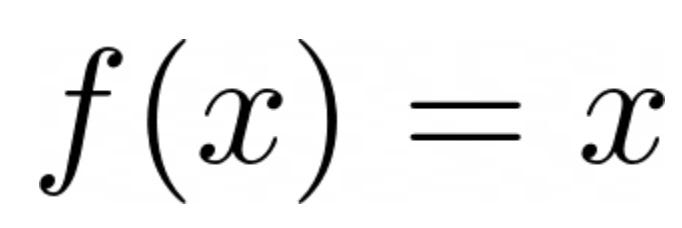 Although it appears that this function does not make any changes to the data, it does have an important influence on how the network functions. It ensures that the neural network can only recognize linear relationships in the data. This limits its performance immensely, as no more complex structures can be learned from the data. For this reason, this simple activation function is rarely used in deep neural networks, but only in simpler, linear models or in the output layer for regressions.
Sigmoid function
The sigmoid function is one of the oldest non-linear activation functions that has been used in the field of machine learning for many years. It is described by the following mathematical formula:
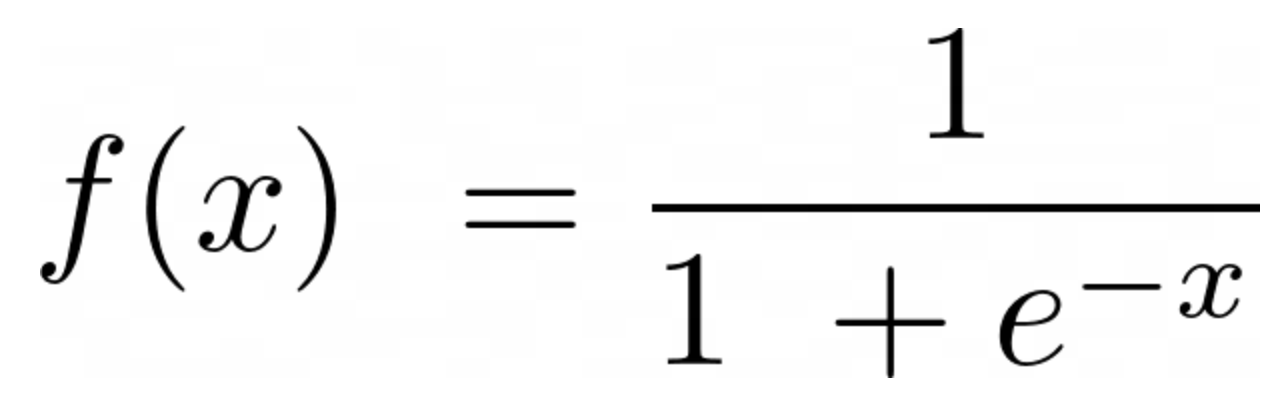 This function ensures that the input value is mapped to a range between 0 and 1. The graph follows the characteristic S-curve, which ensures that small values lie in a range close to 0 and high values are transformed into a range close to 1.
This range of values makes the sigmoid function particularly suitable for applications in which binary values are to be predicted so that the output can then be interpreted as the probability of membership. For this reason, the sigmoid function is primarily used in the last layer of a network if a binary prediction is to be made. This can be useful, for example, in the area of object recognition in images or in medical diagnoses where a patient is to be classified as healthy or ill.
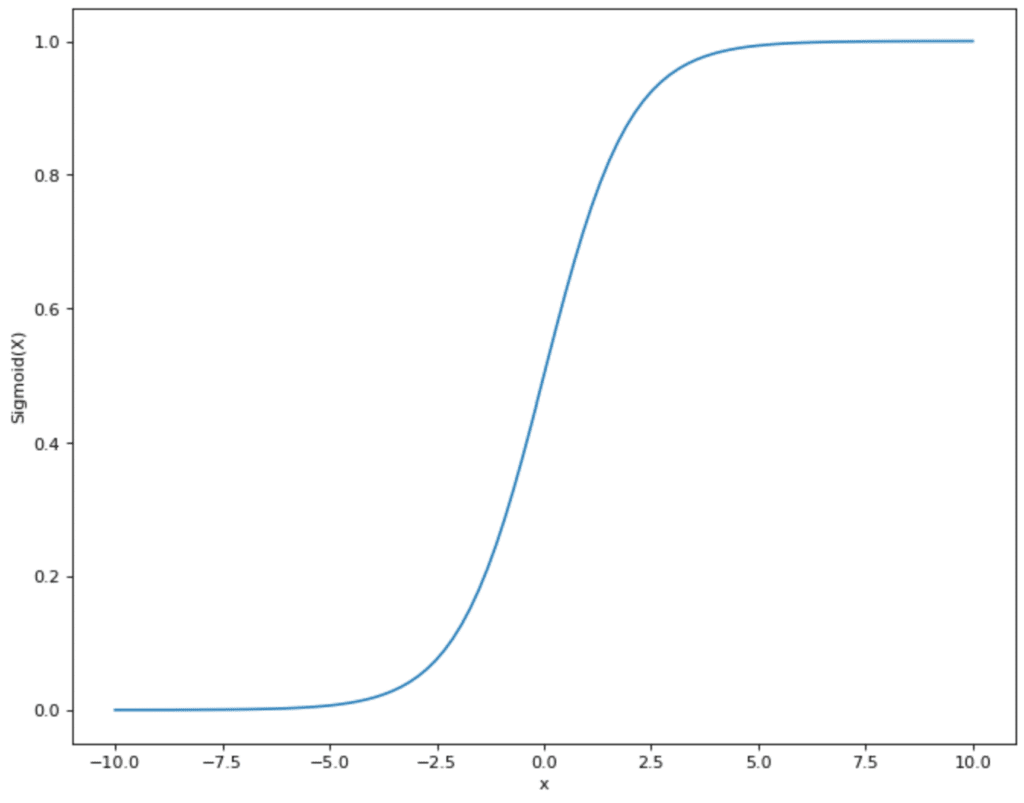 Graph of the Sigmoid Function | Source: Author
The main disadvantage of the sigmoid function is that the so-called vanishing gradient problem can occur. With very large or minimal input values, the gradient value may approach zero during derivation. As a result, the neurons' weights are not adjusted at all or only very slightly during backpropagation, making training slow and inefficient.
It can also lead to problems if the output values of the sigmoid function are not centered around zero, but lie between 0 and 1. This means that both the positive and negative gradients are always in the same direction, which further slows down the convergence of the model.
Due to these disadvantages, the sigmoid function is increasingly being replaced in modern network architectures by other activation functions that enable more efficient training, which is particularly important in deep architectures.
Hyperbolic tangent (Tanh)
The hyperbolic tangent function, or tanh, is another non-linear activation function used in neural networks to learn more complex relationships in the data. It is based on the following mathematical formula:
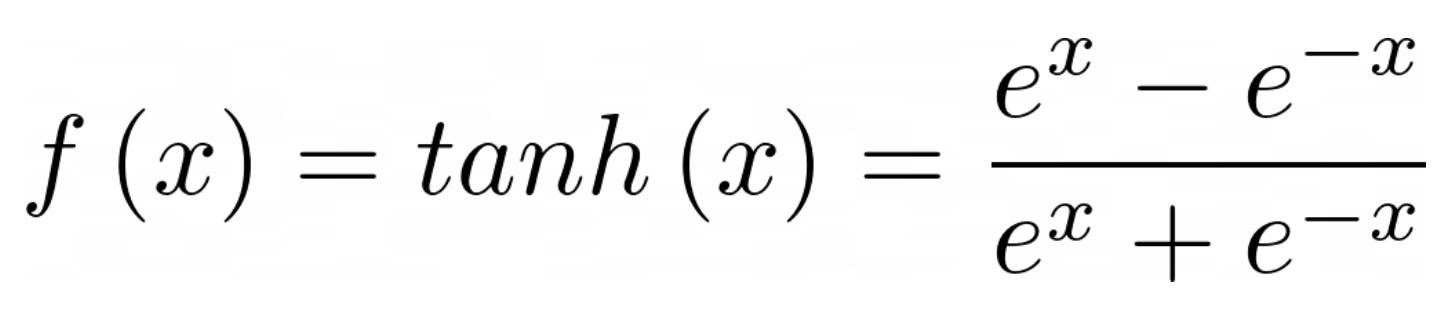 The tanh function transforms the input value into the range between -1 and 1. In contrast to Sigmoid, the values are therefore distributed around zero. This results in some advantages compared to the previously presented activation functions, as the centering around zero helps to improve the training effect and the weight adjustments move faster in the right direction.
It is also advantageous that the tanh function also scales smaller input values more strongly in the output range so that the values can be better separated from each other, especially when the input range is close together.
Due to these properties, the hyperbolic tangent is often used in recurrent neural networks where temporal sequences and dependencies play an important role. By using positive and negative values, the state changes in an RNN can be represented much more precisely.
Compared to the sigmoid function, the hyperbolic tangent also struggles with the same problems. The vanishing gradient problem can also occur with this activation function, especially with extremely large or small values. With very deep neural networks, it then becomes difficult to keep the gradients in the front part of the network strong enough to make sufficient weight adjustments. In addition, saturation effects can also occur in these value ranges, so that the gradient decreases sharply near 1 or -1.
Rectified Linear Unit (ReLU)
The Rectified Linear Unit (ReLU for short) is a linear activation function that was introduced to solve the vanishing gradient problem and has become increasingly popular in recent years. In short, it keeps positive values and sets negative input values equal to zero. Mathematically, this is expressed by the following term:
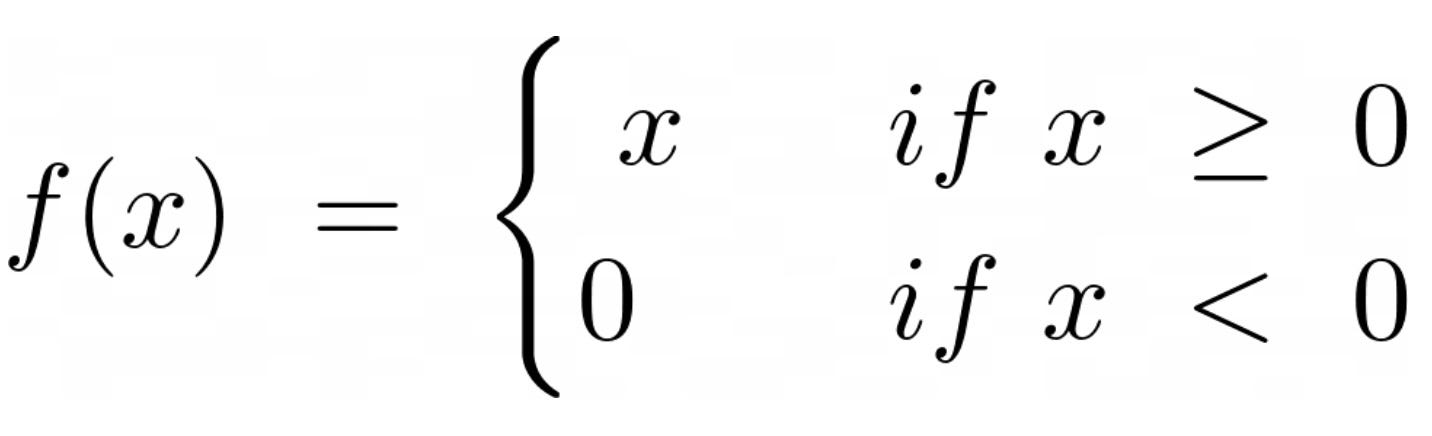 In simpler terms, it can be represented using the max function:
 The ReLU activation function has established itself primarily due to the following advantages:
- Simple calculation : Compared to the other options, the ReLU function is very easy to calculate and therefore saves a lot of computing power, especially for large networks. This is reflected either in lower costs or a shorter training time.
- No vanishing gradient problem : Due to the linear structure, there are no asymptotic points that are parallel to the x-axis. This means that the gradient is not vanishingly small and the error runs through all layers, even with large networks. Finally, it is ensured that the network learns structures and the learning process is significantly accelerated.
- Better results for new model architectures : Compared to the other activation functions, ReLU can set values to zero as soon as they are negative. With the sigmoid, softmax, and tanh functions, on the other hand, the values only approach zero asymptotically, but never become zero. However, this leads to problems in newer models, such as autoencoders, as real zeros are required in the so-called code layer in order to achieve good results.
- Economy : The ability of the activation function to set certain input values to zero makes the model much more economical with computing power. If neurons are permanently given zero values, they "die" and become inactive. This reduces the complexity of the model and can lead to better generalization.
However, there are also problems with this simple activation function. Because negative values are consistently set to zero, it can happen that individual neurons also have a weighting of zero, as they make no contribution to the learning process and therefore "die off". This may not initially be a problem for individual neurons, but it has been shown that in some cases as many as 20–50 % of neurons can "die off" as a result of ReLU.
This problem occurs more frequently if too high a learning rate has been defined so that the weights of the neuron can change in such a way that the neuron only receives negative values. In the long term, these neurons remain dead because they no longer generate a gradient and are no longer capable of learning. This means that models with ReLU as an activation function are also highly dependent on a well-chosen learning rate, which should be carefully considered in advance.
Furthermore, it is problematic that the ReLU function is not limited and can theoretically assume infinitely large, positive values. Particularly in applications where the output range is limited, such as the prediction of probabilities, the ReLU function must then be supplemented with another activation function such as the softmax so that interpretable results are output.
The ReLU function is primarily used in deep neural networks, as convergence can be significantly accelerated due to efficient gradient processing. In addition, computational effort can be saved, increasing the efficiency of the entire model. A central application here is the training of autoencoders, which is used to learn compressed representations of the data. An efficient and compressed representation can be found through the sparse activations.
Leaky ReLU
To eliminate this disadvantage and make the ReLU function more robust, an optimization of the function has been developed, which is known as Leaky ReLU. Compared to the conventional version of the function, negative values are not set to zero but are given an (albeit small) positive slope. Mathematically, this looks like this:
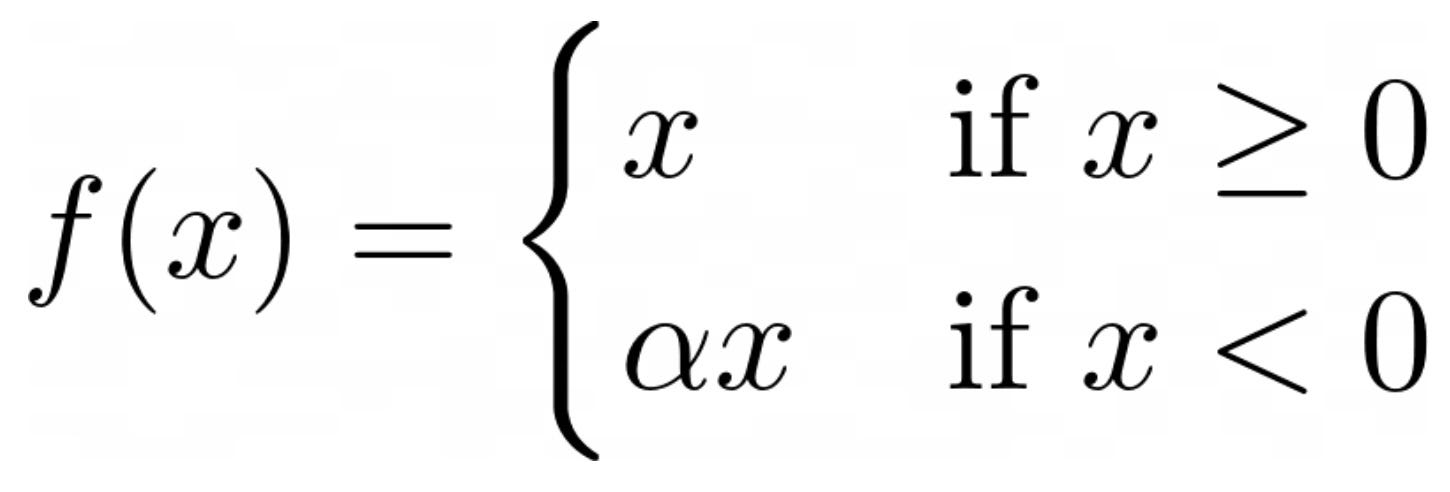 In a more compact form, the function looks like this:
 The parameter α is a positive constant that must be determined before training and can be 0.01, for example. This ensures that even if the neuron receives negative values, it still does not become zero and can therefore still generate a small gradient. This prevents the neurons from dying, as they still make a small contribution to learning.
In addition to this advantage of the Leaky ReLU function, this activation function is also characterized by the fact that the learning ability of the model is increased, as it is possible to learn even with negative values, and their information is not lost. This property can lead to faster convergence, as more neurons remain active and participate in the learning process. In addition, this activation function has the advantage that it can be calculated with similar efficiency despite the small changes to the ReLU.
A possible disadvantage is that α introduces another hyperparameter, which must be determined before training and has a major influence on the quality of the training. A value that is too small can slow down learning, as some neurons do not die, but come close to zero and therefore contribute little to training.
Softmax
The softmax is a mathematical function that takes a vector as input and converts its values into probabilities, depending on their size. A high numerical value leads to a high probability in the resulting vector.
In other words, each value of the vector is divided by the sum of all values of the output vector and stored in the new vector. In purely mathematical terms, this formula looks like this:
 A specific example illustrates how the Softmax function works:
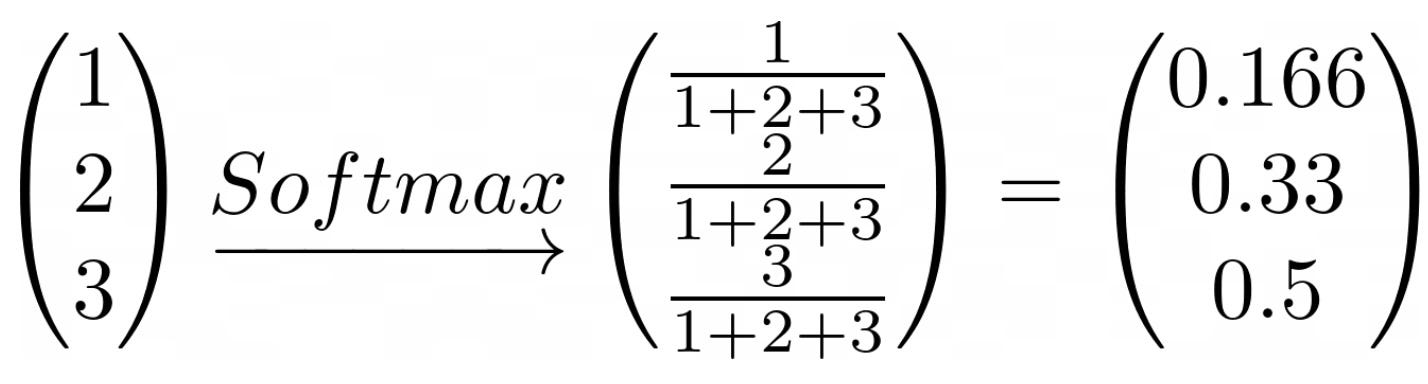 The positive feature of this function is that it ensures that the sum of the output values is always less than or equal to 1. This is particularly advantageous in probability calculations, as it ensures that no summed probability can be greater than 1.
At first glance, the sigmoid and softmax functions appear relatively similar, as both functions map the input value to the numerical range between 0 and 1. Their progression is also almost identical with the difference that the sigmoid function passes through the value 0.5 at x = 0 and the softmax function is still below 0.5 at this point.
 Sigmoid and Softmax function in the range [-4, 4] | Source: Nomidl
The difference between the functions lies in the application. The sigmoid function can be used for binary classifications, i.e. for models in which a decision is to be made between two different classes. Softmax, on the other hand, can also be used for classifications that are to predict more than two classes. The function ensures that the probability of all classes is 1.
The advantages of Softmax are that the outputs are interpretable and represent probabilities, which are particularly helpful in classification problems. In addition, exponential values are used so that the function is numerically stable and can also handle large differences in the input data.
Disadvantages include overconfidence, which describes the property that the predictions are overconfident even though the model is quite uncertain. Therefore, measures for uncertainty assessment should be included to avoid this problem. Furthermore, although Softmax is suitable for multi-class classifications, the number of classes should not increase too much, as the exponential calculation for each class would then be too time-consuming and computationally intensive. In addition, the model may then become unstable as the probabilities for individual classes become too low.
How do you choose the right Activation Function?
The activation function is a crucial building block within a neural network and has an immense influence on the performance of the model. Therefore, the selection of a suitable function is an important step in the creation of the architecture and should be well thought out. The choice should depend primarily on the application and the architecture used, as the activation functions have different properties that can be advantageous or disadvantageous in different situations.
In the hidden layers, the activation function ReLU and its variants have established themselves as they are very efficient to calculate and at the same time avoid the vanishing gradient problem, which is an important factor in this area of architecture. It is also a non-linear activation function, which enables the model to learn more complex relationships. With the help of Leaky ReLU, the network can also avoid the problem of dead neurons and is therefore able to learn even better.
In the output layers, on the other hand, it makes sense to adapt the activation function to the respective application. Softmax and Sigmoid, for example, are suitable for classification problems, as they output a probability value of membership. The Sigmoid function is suitable for applications with only two classes, while the Softmax function is used for multi-class problems, which ensures that the probabilities of all classes add up to 1.
Linear activation functions are suitable for output layers that are to map a linear regression problem, as they do not limit the values and are therefore very well suited for continuous predictions.
The choice of the right activation function has a major influence on the training of a neural network. The ReLU and its variants dominate the hidden layers due to their efficient calculation and the non-existent vanishing gradient problem. In the output layer, on the other hand, it depends on the specific use case which function is most suitable.
This is what you should take with you
- Neural networks consist of so-called perceptrons or individual neurons, which generate one or more outputs from various inputs.
- The activation function of a neuron determines how strongly a neuron is activated by the specific input values.
- The characterizing properties of activation functions include whether they are linear or non-linear, whether they must be differentiable, and whether they have saturation regions in which the vanishing gradient problem can occur.
- Various activation functions have become established in the application, such as the softmax function, the sigmoid, the rectified linear unit, or the leaky ReLU.
- The choice of the right activation function depends primarily on the architecture of the network and the application.
Register Now to Continue Reading
Unlock Towards Data Science with a Free Account
All articles on Towards Data Science are available to registered users. Create a free account today to access this article and thousands more.
Register for freeSign in to your account
 Written By
See all from Niklas Lang
Activation FunctionsDeep LearningGetting StartedMachine LearningRelu Activation Function
Share This Article
Towards Data Science is a community publication. Submit your insights to reach our global audience and earn through the TDS Author Payment Program.
Write for TDS
Related Articles
Artificial Intelligence
Understanding model architectures in keras
Ravindra Sharma
April 5, 20218 min read
Machine Learning
Finding the perfect weights to fit the data in
Samy Baladram
September 10, 202410 min read
Machine Learning
Nowadays, social network and e-commerce is an important part of our life. We buy and sell many things on these platforms, and Vietnam
Linh Tran
October 15, 202012 min read
Artificial Intelligence
Using only the built-in modules
Soner Yıldırım
October 14, 20225 min read
Machine Learning
How to Optimize Data Distribution with SageMaker Distributed Data Parallel
Chaim Rand
September 20, 20227 min read
Machine Learning
Step by step guide on how to structure your first Data Science projects on Kaggle
Rafael Bastos
November 11, 20208 min read
Machine Learning
Use scraping and NLP to extract information from job ads
Raffaele Nolli
July 23, 20208 min read
Deep Learning
An explanatory guide to develop a binary classifier to detect positive and negative news headlines using classic machine learning and deep...
Sultan Al Awar
March 19, 202210 min read
Machine Learning
Exploring a popular approach towards extracting topics from text
Aashish Nair
March 1, 20227 min read
Your home for data science and AI. The world's leading publication for data science, data analytics, data engineering, machine learning, and artificial intelligence professionals.
Subscribe to Our NewsletterWrite For TDS•About•Advertise•Privacy Policy•Terms of Use
© Insight Media Group, LLC 2026•The New Stack•roadmap.sh•Creator Network
Recommended Articles
Close