保留正文与补采附件。源页面当前未重新核验;具体限制见交付清单。
 We value your privacy
We use cookies to enhance your browsing experience, serve personalised ads or content, and analyse our traffic. By clicking "Accept All", you consent to our use of cookies.
Customise Reject All Accept All
Customise Consent Preferences
 We use cookies to help you navigate efficiently and perform certain functions. You will find detailed information about all cookies under each consent category below.
The cookies that are categorised as "Necessary" are stored on your browser as they are essential for enabling the basic functionalities of the site. ... Show more
NecessaryAlways Active
Necessary cookies are required to enable the basic features of this site, such as providing secure log-in or adjusting your consent preferences. These cookies do not store any personally identifiable data.
-
Cookie
BCTempID
-
Duration
10 minutes
-
Description
No description available.
-
Cookie
__cf_bm
-
Duration
1 hour
-
Description
This cookie, set by Cloudflare, is used to support Cloudflare Bot Management.
-
Cookie
AWSALBCORS
-
Duration
7 days
-
Description
Amazon Web Services set this cookie for load balancing.
-
Cookie
_cfuvid
-
Duration
session
-
Description
Cloudflare sets this cookie to track users across sessions to optimize user experience by maintaining session consistency and providing personalized services
-
Cookie
li_gc
-
Duration
6 months
-
Description
Linkedin set this cookie for storing visitor's consent regarding using cookies for non-essential purposes.
-
Cookie
__hssrc
-
Duration
session
-
Description
This cookie is set by Hubspot whenever it changes the session cookie. The __hssrc cookie set to 1 indicates that the user has restarted the browser, and if the cookie does not exist, it is assumed to be a new session.
-
Cookie
__hssc
-
Duration
1 hour
-
Description
HubSpot sets this cookie to keep track of sessions and to determine if HubSpot should increment the session number and timestamps in the __hstc cookie.
-
Cookie
wpEmojiSettingsSupports
-
Duration
session
-
Description
WordPress sets this cookie when a user interacts with emojis on a WordPress site. It helps determine if the user's browser can display emojis properly.
-
Cookie
BCSessionID
-
Duration
1 year 1 month 4 days
-
Description
Blueconic sets this cookie as a unique identifier for the BlueConic profile.
-
Cookie
_octo
-
Duration
1 year
-
Description
No description available.
-
Cookie
logged_in
-
Duration
1 year
-
Description
No description available.
-
Cookie
__Secure-YEC
-
Duration
past
-
Description
YouTube sets this cookie to stores the user's video player preferences using embedded YouTube video
-
Cookie
__eoi
-
Duration
6 months
-
Description
Description is currently not available.
-
Cookie
AWSALBTGCORS
-
Duration
7 days
-
Description
No description available.
-
Cookie
login-status-p
-
Duration
past
-
Description
Description is currently not available.
-
Cookie
AWSALBTG
-
Duration
7 days
-
Description
No description available.
-
Cookie
csrf_token
-
Duration
session
-
Description
No description available.
-
Cookie
token_v2
-
Duration
1 day
-
Description
Description is currently not available.
-
Cookie
D
-
Duration
1 year
-
Description
Description is currently not available.
-
Cookie
PHPSESSID
-
Duration
session
-
Description
This cookie is native to PHP applications. The cookie stores and identifies a user's unique session ID to manage user sessions on the website. The cookie is a session cookie and will be deleted when all the browser windows are closed.
-
Cookie
VISITOR_PRIVACY_METADATA
-
Duration
6 months
-
Description
YouTube sets this cookie to store the user's cookie consent state for the current domain.
-
Cookie
cookietest
-
Duration
session
-
Description
The cookietest cookie is typically used to determine whether the user's browser accepts cookies, essential for website functionality and user experience.
-
Cookie
__Host-airtable-session
-
Duration
1 year
-
Description
This cookie is used to enable us to integrate the services of Airtable.
-
Cookie
__Host-airtable-session.sig
-
Duration
1 year
-
Description
This cookie is used to enable us to integrate the services of Airtable.
-
Cookie
m
-
Duration
1 year 1 month 4 days
-
Description
Stripe sets this cookie for fraud prevention purposes. It identifies the device used to access the website, allowing the website to be formatted accordingly.
-
Cookie
BIGipServer*
-
Duration
session
-
Description
Marketo sets this cookie to collect information about the user's online activity and build a profile about their interests to provide advertisements relevant to the user.
-
Cookie
__cfruid
-
Duration
session
-
Description
Cloudflare sets this cookie to identify trusted web traffic.
-
Cookie
_GRECAPTCHA
-
Duration
6 months
-
Description
Google Recaptcha service sets this cookie to identify bots to protect the website against malicious spam attacks.
-
Cookie
__Secure-YNID
-
Duration
6 months
-
Description
Google cookie used to protect user security and prevent fraud, especially during the login process.
-
Cookie
cookieyes-consent
-
Duration
1 year
-
Description
CookieYes sets this cookie to remember users' consent preferences so that their preferences are respected on subsequent visits to this site. It does not collect or store any personal information about the site visitors.
Functional
Functional cookies help perform certain functionalities like sharing the content of the website on social media platforms, collecting feedback, and other third-party features.
-
Cookie
lidc
-
Duration
1 day
-
Description
LinkedIn sets the lidc cookie to facilitate data center selection.
-
Cookie
brw
-
Duration
1 year
-
Description
No description available.
-
Cookie
brwConsent
-
Duration
5 minutes
-
Description
Description is currently not available.
-
Cookie
WMF-Uniq
-
Duration
1 year
-
Description
Description is currently not available.
-
Cookie
loom_anon_comment
-
Duration
1 year
-
Description
No description available.
-
Cookie
loom_referral_video
-
Duration
session
-
Description
Description is currently not available.
-
Cookie
VISITOR_INFO1_LIVE
-
Duration
6 months
-
Description
A cookie set by YouTube to measure bandwidth that determines whether the user gets the new or old player interface.
-
Cookie
yt-remote-connected-devices
-
Duration
Never Expires
-
Description
YouTube sets this cookie to store the user's video preferences using embedded YouTube videos.
-
Cookie
ytidb::LAST_RESULT_ENTRY_KEY
-
Duration
Never Expires
-
Description
The cookie ytidb::LAST_RESULT_ENTRY_KEY is used by YouTube to store the last search result entry that was clicked by the user. This information is used to improve the user experience by providing more relevant search results in the future.
-
Cookie
yt-remote-device-id
-
Duration
Never Expires
-
Description
YouTube sets this cookie to store the user's video preferences using embedded YouTube videos.
-
Cookie
yt-remote-session-name
-
Duration
session
-
Description
The yt-remote-session-name cookie is used by YouTube to store the user's video player preferences using embedded YouTube video.
-
Cookie
yt-remote-fast-check-period
-
Duration
session
-
Description
The yt-remote-fast-check-period cookie is used by YouTube to store the user's video player preferences for embedded YouTube videos.
-
Cookie
yt-remote-session-app
-
Duration
session
-
Description
The yt-remote-session-app cookie is used by YouTube to store user preferences and information about the interface of the embedded YouTube video player.
-
Cookie
yt-remote-cast-available
-
Duration
session
-
Description
The yt-remote-cast-available cookie is used to store the user's preferences regarding whether casting is available on their YouTube video player.
-
Cookie
yt-remote-cast-installed
-
Duration
session
-
Description
The yt-remote-cast-installed cookie is used to store the user's video player preferences using embedded YouTube video.
-
Cookie
cp_session
-
Duration
3 months
-
Description
Codepen sets this cookie for Help systems found in the website.
-
Cookie
loid
-
Duration
1 year 1 month 4 days
-
Description
This cookie is set by the Reddit. The cookie enables the sharing of content from the website onto the social media platform.
Analytics
Analytical cookies are used to understand how visitors interact with the website. These cookies help provide information on metrics such as the number of visitors, bounce rate, traffic source, etc.
-
Cookie
__hstc
-
Duration
6 months
-
Description
Hubspot set this main cookie for tracking visitors. It contains the domain, initial timestamp (first visit), last timestamp (last visit), current timestamp (this visit), and session number (increments for each subsequent session).
-
Cookie
hubspotutk
-
Duration
6 months
-
Description
HubSpot sets this cookie to keep track of the visitors to the website. This cookie is passed to HubSpot on form submission and used when deduplicating contacts.
-
Cookie
_ga
-
Duration
1 year 1 month 4 days
-
Description
Google Analytics sets this cookie to calculate visitor, session and campaign data and track site usage for the site's analytics report. The cookie stores information anonymously and assigns a randomly generated number to recognise unique visitors.
-
Cookie
ga*
-
Duration
1 year 1 month 4 days
-
Description
Google Analytics sets this cookie to store and count page views.
-
Cookie
__Host-psifi.analyticsTrace
-
Duration
6 hours
-
Description
Description is currently not available.
-
Cookie
__Host-psifi.analyticsTraceV2
-
Duration
6 hours
-
Description
Description is currently not available.
-
Cookie
_gh_sess
-
Duration
session
-
Description
GitHub sets this cookie for temporary application and framework state between pages like what step the user is on in a multiple step form.
-
Cookie
YSC
-
Duration
session
-
Description
YSC cookie is set by Youtube and is used to track the views of embedded videos on Youtube pages.
-
Cookie
ajs_anonymous_id
-
Duration
1 year
-
Description
This cookie is set by Segment to count the number of people who visit a certain site by tracking if they have visited before.
-
Cookie
vuid
-
Duration
1 year 1 month 4 days
-
Description
Vimeo installs this cookie to collect tracking information by setting a unique ID to embed videos on the website.
Performance
Performance cookies are used to understand and analyse the key performance indexes of the website which helps in delivering a better user experience for the visitors.
-
Cookie
AWSALB
-
Duration
7 days
-
Description
AWSALB is an application load balancer cookie set by Amazon Web Services to map the session to the target.
-
Cookie
acq
-
Duration
past
-
Description
Description is currently not available.
-
Cookie
acq.sig
-
Duration
past
-
Description
Description is currently not available.
-
Cookie
ptc
-
Duration
2 years
-
Description
No description available.
Advertisement
Advertisement cookies are used to provide visitors with customised advertisements based on the pages you visited previously and to analyse the effectiveness of the ad campaigns.
-
Cookie
muc_ads
-
Duration
1 year 1 month 4 days
-
Description
Twitter sets this cookie to collect user behaviour and interaction data to optimize the website.
-
Cookie
guest_id_marketing
-
Duration
1 year 1 month 4 days
-
Description
Twitter sets this cookie to identify and track the website visitor.
-
Cookie
guest_id_ads
-
Duration
1 year 1 month 4 days
-
Description
Twitter sets this cookie to identify and track the website visitor.
-
Cookie
personalization_id
-
Duration
1 year 1 month 4 days
-
Description
Twitter sets this cookie to integrate and share features for social media and also store information about how the user uses the website, for tracking and targeting.
-
Cookie
guest_id
-
Duration
1 year 1 month 4 days
-
Description
Twitter sets this cookie to identify and track the website visitor. It registers if a user is signed in to the Twitter platform and collects information about ad preferences.
-
Cookie
bcookie
-
Duration
1 year
-
Description
LinkedIn sets this cookie from LinkedIn share buttons and ad tags to recognize browser IDs.
-
Cookie
__Secure-ROLLOUT_TOKEN
-
Duration
6 months
-
Description
YouTube sets this cookie to manage feature rollout and experimentation. It helps Google control which new features or interface changes are shown to users as part of testing and staged rollouts, ensuring consistent experience for a given user during an experiment.
-
Cookie
yt.innertube::nextId
-
Duration
Never Expires
-
Description
YouTube sets this cookie to register a unique ID to store data on what videos from YouTube the user has seen.
-
Cookie
yt.innertube::requests
-
Duration
Never Expires
-
Description
YouTube sets this cookie to register a unique ID to store data on what videos from YouTube the user has seen.
-
Cookie
session_tracker
-
Duration
session
-
Description
This cookie is set by the Reddit. This cookie is used to identify trusted web traffic. It also helps in adverstising on the website.
-
Cookie
edgebucket
-
Duration
session
-
Description
Reddit sets this cookie to save the information about a log-on Reddit user, for the purpose of advertisement recommendations and updating the content.
-
Cookie
did
-
Duration
1 year
-
Description
Arbor sets this cookie to show targeted ads to site visitors.This cookie expires after 2 months or 1 year.
Uncategorised
Other uncategorised cookies are those that are being analysed and have not been classified into a category as yet.
No cookies to display.
Reject All Save My Preferences Accept All
Toggle SearchToggle Mobile Navigation
Publish AI, ML & data-science insights to a global community of data professionals.
Sign inSubmit an Article
LatestEditor's PicksNewsletterShipAI
Write For TDS
LinkedInXToggle Search
Data Science
Polars + NVIDIA GPU Tutorial
Using Polars with NVIDIA GPU can speed up your data pipelines
Ivo Bernardo
September 17, 20244 min read
 Image by noaa @ Unsplash.com
Dealing with massive datasets inside Python has always been a challenge. The language is not tailored for handling huge amounts of data as native SQL systems or spark.
The most famous library for handling 2-D datasets within Python is, without any question, pandas. Although easy to use and used by every data scientist, Pandas is written in Python and C, making it a bit combersume and slow to perform operations on large data. If you are a data scientist, you've dealt with the pain of waiting 200 years for a group by to finish.
One of the libraries that aims to solve this is polars -an extremely efficient Python package that is able to handle large datasets, mostly for the following reasons:
- It's written in Rust
- It leverages multi-threading automatically
- It defers most calculations by using lazy evaluation
And.. after today, you can now leverage NVIDIA's hardware to maximize polars ' GPU engine capabilities.
In this blog post, we'll see how you can leverage polars+GPU and speed up your data pipelines enormously.
Learn this step by step with the interactive AI and Data Scientist and Machine Learning roadmaps.
Setting Up the Environment
To follow along this blog post, you can check the accompanying notebook here.
First, let's install polars with GPU capabilities by using:
perl
!pip install polars[gpu] --extra-index-url=https://pypi.nvidia.com
We need to bring out the big guns to test our data pipelines. We'll be using a large dataset of Simulated Transactions - a large dataset representing different monetary transactions of customers.
As I'm assuming you are using Google Colab and we want to keep ourselves on the free tier, I'll use a sample of this dataset that only uses 20% of the size:
ruby
!wget https://storage.googleapis.com/rapidsai/polars-demo/transactions-t4-20.parquet -O transactions.parquet
But, if you have your own system and resources that can handle the size of the total data, feel free to download the original file:
ruby
!wget https://storage.googleapis.com/rapidsai/polars-demo/transactions.parquet -O transactions.parquet
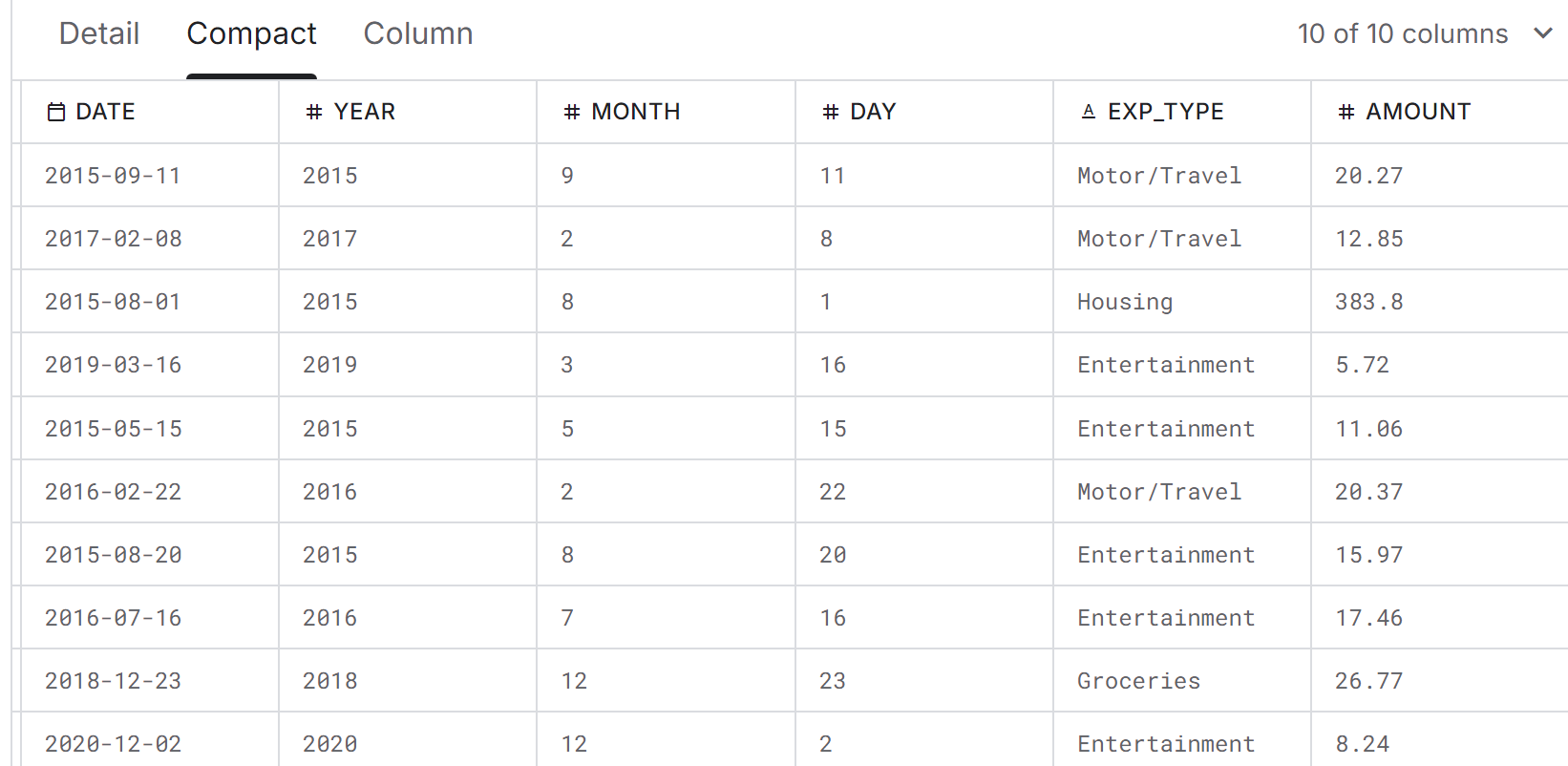 Preview of Transactions Table - Image by Author
Finally, let's load
polars :
javascript
import polars as pl
from polars.testing import assert_frame_equal
Setup is done, time to play around with our dataset!
Simple Calculations
We need to load our dataset into our polarsengine by leveraging the scan_parquet method:
ini
transactions = pl.scan_parquet("transactions.parquet")
We can take a peak at our first 5 transactions using head and collect :
scss
transactions.head(5).collect()
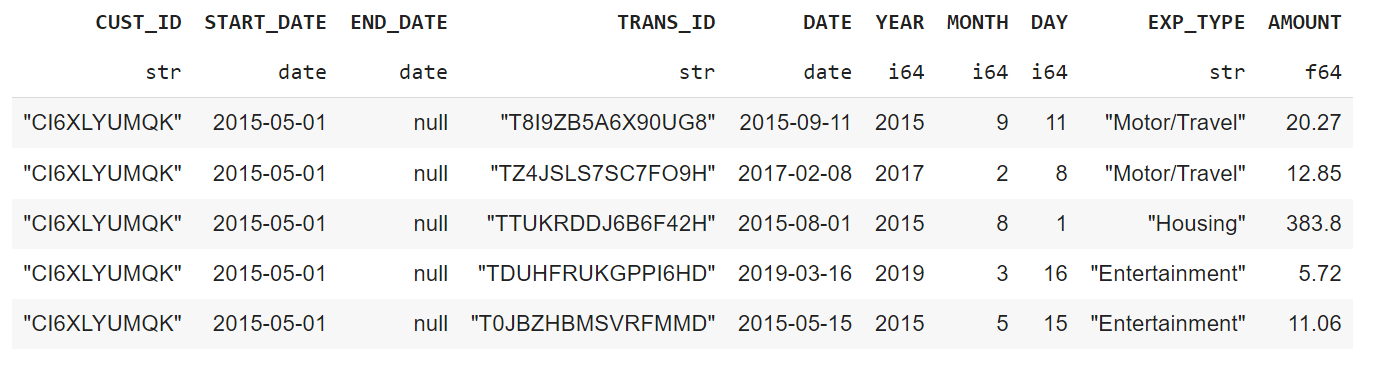 Transactions Table in Pandas - Image by Author
The simples use case we can think of is to perform a simple aggregation of a numerical column. Let's sum the total amount of the transactions on our table using
polarssyntax:
less
%%time
transactions.select(pl.col("AMOUNT").sum()).collect()
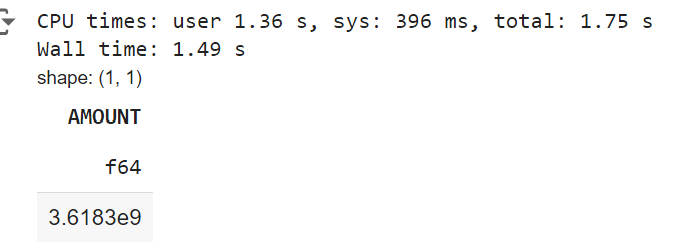 Aggregate Execution - Image by Author
CPU time for this operation was 1.36s on the 52 million rows. We'll keep track of the execution time of our code throughout our experiments for benchmarking purposes.
Let's see how this operation works on the
gpu_engine :
graphql
gpu_engine = pl.GPUEngine(
    device=0,
    raise_on_fail=True,
)
less
%%time
transactions.select(pl.col("AMOUNT").sum()).collect(engine=gpu_engine)
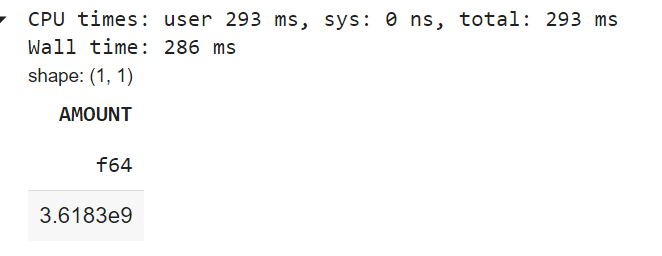 Aggregate Execution with gpu_engine - Image by Author
Nice improvement! CPU time was ~4 times faster. Will this stand for complex calculations?
Using Group By + Aggregations
One common operation we do with 2 dimensional structures is performing group by + any type of aggregation. These types of aggregations typically show up when quick answers are needed for specific business questions or during particular steps in the data wrangling process.
For example, which customers are the highest spenders in our dataset? Let's calculate that using the CPU:
sql
%%time

high_spenders_cpu = (
    transactions
    .group_by("CUST_ID")
    .agg(pl.col("AMOUNT").sum())
    .sort(by="AMOUNT", descending=True)
    .head()
    .collect()
)
high_spenders_cpu
The cpu_time for this operation was (drumroll):
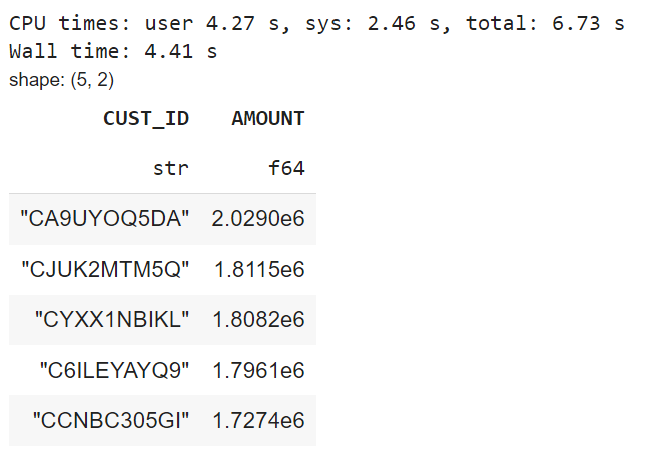 Group By Aggregation Operation - Image by Author
4.27 seconds, not bad. But what if we do this operation on our GPU?
sql
%%time

high_spenders_gpu = (
    transactions
    .group_by("CUST_ID")
    .agg(pl.col("AMOUNT").sum())
    .sort(by="AMOUNT", descending=True)
    .head()
    .collect(engine=gpu_engine)
)
high_spenders_gpu
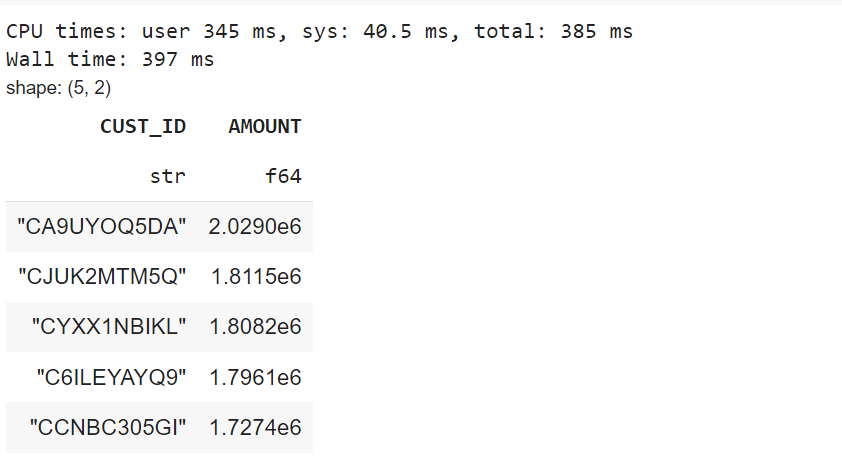 Group By Aggregation Operation on GPU Engine— Image by Author
345 ms for an aggregation on a 52 million row dataframe. That's actually a great result!
And what's nice is that we can also rely on polars
SQL interface to achieve similar results:
python
sql_query = """
SELECT CUST_ID, SUM(AMOUNT) as sum_amt
FROM transactions
GROUP BY CUST_ID
ORDER BY sum_amt desc
LIMIT 5
"""

%time pl.sql(sql_query).collect()
%time pl.sql(sql_query).collect(engine=gpu_engine)
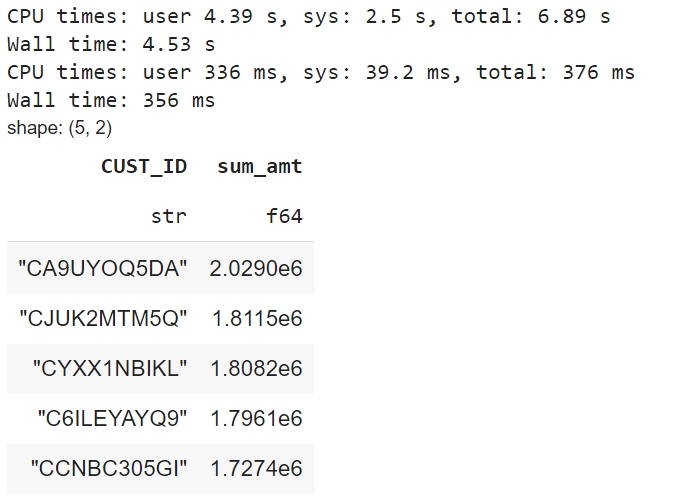 Group By Aggregation Operation with Polars SQL interface— Image by Author
In conclusion, we were able to speed up our execution time in 5x (up to 10x) in aggregation operations by using the GPU capabilities of polars and it was awesome.
Standard polars already shows extremely good results in other benchmarks, but prepping it up with GPU capabilities is totally a new game. In a nutshell:
- The fastest performance for Polars is on NVIDIA GPUs, up to 10x speed up over CPUs
- The Polars GPU engine enables users to process 100s of millions of rows of data in seconds
- Access to the Polars GPU engine requires almost zero code changes to existing Polars code
You can also check more examples and experiments by visiting the official repo.
Last, but not least, thank you to NVIDIA for giving me early access to the package and being able to experiment with this new accelerated version of polars. Looking forward to new developments!
If you want to read / see more content related to AI and DS, subscribe my youtube Channel "The Data Journey ":
 https://www.youtube.com/@TheDataJourney42
[The dataset used in this blog post is under licence CC0: Public Domain]
Register Now to Continue Reading
Unlock Towards Data Science with a Free Account
All articles on Towards Data Science are available to registered users. Create a free account today to access this article and thousands more.
Register for freeSign in to your account
 Written By
See all from Ivo Bernardo
Data ScienceMachine LearningNvidiaPolars DataframePython
Share This Article
Towards Data Science is a community publication. Submit your insights to reach our global audience and earn through the TDS Author Payment Program.
Write for TDS
Related Articles
Deep Learning
Build optimal ensembles of neural networks with PyTorch and NumPy
Dmitry Borisenko
August 14, 202018 min read
Artificial Intelligence
A new milestone in graph data management
Michael Galkin
March 28, 202315 min read
Artificial Intelligence
Develop a deeper understanding of one of the most popular machine learning models
Terence Shin, MSc, MBA
February 5, 20217 min read
Machine Learning
Key to Scaling Data-Driven Organizations
Daniel Marcous
May 22, 202123 min read
This tutorial will be an introduction to the concept of webhooks. We will also build a simple Flask server that can receive GitHub...
Rahul Banerjee
October 27, 20214 min read
Data Engineering
Using Apache Iceberg on AWS with Athena, Glue/Spark and DuckDB
Thomas Reid
December 4, 202512 min read
Physics
How a Japanese e-commerce company published one of the most rigorously engineered cloth simulation papers in recent years, why the logarithmic barrier fails under tight strain limits, and how to replicate the core insight in Python.
Ferran Alia
June 8, 202613 min read
Machine Learning
How to understand if the difference really matters.
Soner Yıldırım
May 10, 20206 min read
Artificial Intelligence
Hands-on tutorial for SQL
Soner Yıldırım
November 28, 20206 min read
Your home for data science and AI. The world's leading publication for data science, data analytics, data engineering, machine learning, and artificial intelligence professionals.
Subscribe to Our NewsletterWrite For TDS•About•Advertise•Privacy Policy•Terms of Use
© Insight Media Group, LLC 2026•The New Stack•roadmap.sh•Creator Network
Recommended Articles
Close