保留正文与补采附件。源页面当前未重新核验;具体限制见交付清单。
 We value your privacy
We use cookies to enhance your browsing experience, serve personalised ads or content, and analyse our traffic. By clicking "Accept All", you consent to our use of cookies.
Customise Reject All Accept All
Customise Consent Preferences
 We use cookies to help you navigate efficiently and perform certain functions. You will find detailed information about all cookies under each consent category below.
The cookies that are categorised as "Necessary" are stored on your browser as they are essential for enabling the basic functionalities of the site. ... Show more
NecessaryAlways Active
Necessary cookies are required to enable the basic features of this site, such as providing secure log-in or adjusting your consent preferences. These cookies do not store any personally identifiable data.
-
Cookie
BCTempID
-
Duration
10 minutes
-
Description
No description available.
-
Cookie
__cf_bm
-
Duration
1 hour
-
Description
This cookie, set by Cloudflare, is used to support Cloudflare Bot Management.
-
Cookie
AWSALBCORS
-
Duration
7 days
-
Description
Amazon Web Services set this cookie for load balancing.
-
Cookie
_cfuvid
-
Duration
session
-
Description
Cloudflare sets this cookie to track users across sessions to optimize user experience by maintaining session consistency and providing personalized services
-
Cookie
li_gc
-
Duration
6 months
-
Description
Linkedin set this cookie for storing visitor's consent regarding using cookies for non-essential purposes.
-
Cookie
__hssrc
-
Duration
session
-
Description
This cookie is set by Hubspot whenever it changes the session cookie. The __hssrc cookie set to 1 indicates that the user has restarted the browser, and if the cookie does not exist, it is assumed to be a new session.
-
Cookie
__hssc
-
Duration
1 hour
-
Description
HubSpot sets this cookie to keep track of sessions and to determine if HubSpot should increment the session number and timestamps in the __hstc cookie.
-
Cookie
wpEmojiSettingsSupports
-
Duration
session
-
Description
WordPress sets this cookie when a user interacts with emojis on a WordPress site. It helps determine if the user's browser can display emojis properly.
-
Cookie
BCSessionID
-
Duration
1 year 1 month 4 days
-
Description
Blueconic sets this cookie as a unique identifier for the BlueConic profile.
-
Cookie
_octo
-
Duration
1 year
-
Description
No description available.
-
Cookie
logged_in
-
Duration
1 year
-
Description
No description available.
-
Cookie
__Secure-YEC
-
Duration
past
-
Description
YouTube sets this cookie to stores the user's video player preferences using embedded YouTube video
-
Cookie
__eoi
-
Duration
6 months
-
Description
Description is currently not available.
-
Cookie
AWSALBTGCORS
-
Duration
7 days
-
Description
No description available.
-
Cookie
login-status-p
-
Duration
past
-
Description
Description is currently not available.
-
Cookie
AWSALBTG
-
Duration
7 days
-
Description
No description available.
-
Cookie
csrf_token
-
Duration
session
-
Description
No description available.
-
Cookie
token_v2
-
Duration
1 day
-
Description
Description is currently not available.
-
Cookie
D
-
Duration
1 year
-
Description
Description is currently not available.
-
Cookie
PHPSESSID
-
Duration
session
-
Description
This cookie is native to PHP applications. The cookie stores and identifies a user's unique session ID to manage user sessions on the website. The cookie is a session cookie and will be deleted when all the browser windows are closed.
-
Cookie
VISITOR_PRIVACY_METADATA
-
Duration
6 months
-
Description
YouTube sets this cookie to store the user's cookie consent state for the current domain.
-
Cookie
cookietest
-
Duration
session
-
Description
The cookietest cookie is typically used to determine whether the user's browser accepts cookies, essential for website functionality and user experience.
-
Cookie
__Host-airtable-session
-
Duration
1 year
-
Description
This cookie is used to enable us to integrate the services of Airtable.
-
Cookie
__Host-airtable-session.sig
-
Duration
1 year
-
Description
This cookie is used to enable us to integrate the services of Airtable.
-
Cookie
m
-
Duration
1 year 1 month 4 days
-
Description
Stripe sets this cookie for fraud prevention purposes. It identifies the device used to access the website, allowing the website to be formatted accordingly.
-
Cookie
BIGipServer*
-
Duration
session
-
Description
Marketo sets this cookie to collect information about the user's online activity and build a profile about their interests to provide advertisements relevant to the user.
-
Cookie
__cfruid
-
Duration
session
-
Description
Cloudflare sets this cookie to identify trusted web traffic.
-
Cookie
_GRECAPTCHA
-
Duration
6 months
-
Description
Google Recaptcha service sets this cookie to identify bots to protect the website against malicious spam attacks.
-
Cookie
__Secure-YNID
-
Duration
6 months
-
Description
Google cookie used to protect user security and prevent fraud, especially during the login process.
-
Cookie
cookieyes-consent
-
Duration
1 year
-
Description
CookieYes sets this cookie to remember users' consent preferences so that their preferences are respected on subsequent visits to this site. It does not collect or store any personal information about the site visitors.
Functional
Functional cookies help perform certain functionalities like sharing the content of the website on social media platforms, collecting feedback, and other third-party features.
-
Cookie
lidc
-
Duration
1 day
-
Description
LinkedIn sets the lidc cookie to facilitate data center selection.
-
Cookie
brw
-
Duration
1 year
-
Description
No description available.
-
Cookie
brwConsent
-
Duration
5 minutes
-
Description
Description is currently not available.
-
Cookie
WMF-Uniq
-
Duration
1 year
-
Description
Description is currently not available.
-
Cookie
loom_anon_comment
-
Duration
1 year
-
Description
No description available.
-
Cookie
loom_referral_video
-
Duration
session
-
Description
Description is currently not available.
-
Cookie
VISITOR_INFO1_LIVE
-
Duration
6 months
-
Description
A cookie set by YouTube to measure bandwidth that determines whether the user gets the new or old player interface.
-
Cookie
yt-remote-connected-devices
-
Duration
Never Expires
-
Description
YouTube sets this cookie to store the user's video preferences using embedded YouTube videos.
-
Cookie
ytidb::LAST_RESULT_ENTRY_KEY
-
Duration
Never Expires
-
Description
The cookie ytidb::LAST_RESULT_ENTRY_KEY is used by YouTube to store the last search result entry that was clicked by the user. This information is used to improve the user experience by providing more relevant search results in the future.
-
Cookie
yt-remote-device-id
-
Duration
Never Expires
-
Description
YouTube sets this cookie to store the user's video preferences using embedded YouTube videos.
-
Cookie
yt-remote-session-name
-
Duration
session
-
Description
The yt-remote-session-name cookie is used by YouTube to store the user's video player preferences using embedded YouTube video.
-
Cookie
yt-remote-fast-check-period
-
Duration
session
-
Description
The yt-remote-fast-check-period cookie is used by YouTube to store the user's video player preferences for embedded YouTube videos.
-
Cookie
yt-remote-session-app
-
Duration
session
-
Description
The yt-remote-session-app cookie is used by YouTube to store user preferences and information about the interface of the embedded YouTube video player.
-
Cookie
yt-remote-cast-available
-
Duration
session
-
Description
The yt-remote-cast-available cookie is used to store the user's preferences regarding whether casting is available on their YouTube video player.
-
Cookie
yt-remote-cast-installed
-
Duration
session
-
Description
The yt-remote-cast-installed cookie is used to store the user's video player preferences using embedded YouTube video.
-
Cookie
cp_session
-
Duration
3 months
-
Description
Codepen sets this cookie for Help systems found in the website.
-
Cookie
loid
-
Duration
1 year 1 month 4 days
-
Description
This cookie is set by the Reddit. The cookie enables the sharing of content from the website onto the social media platform.
Analytics
Analytical cookies are used to understand how visitors interact with the website. These cookies help provide information on metrics such as the number of visitors, bounce rate, traffic source, etc.
-
Cookie
__hstc
-
Duration
6 months
-
Description
Hubspot set this main cookie for tracking visitors. It contains the domain, initial timestamp (first visit), last timestamp (last visit), current timestamp (this visit), and session number (increments for each subsequent session).
-
Cookie
hubspotutk
-
Duration
6 months
-
Description
HubSpot sets this cookie to keep track of the visitors to the website. This cookie is passed to HubSpot on form submission and used when deduplicating contacts.
-
Cookie
_ga
-
Duration
1 year 1 month 4 days
-
Description
Google Analytics sets this cookie to calculate visitor, session and campaign data and track site usage for the site's analytics report. The cookie stores information anonymously and assigns a randomly generated number to recognise unique visitors.
-
Cookie
ga*
-
Duration
1 year 1 month 4 days
-
Description
Google Analytics sets this cookie to store and count page views.
-
Cookie
__Host-psifi.analyticsTrace
-
Duration
6 hours
-
Description
Description is currently not available.
-
Cookie
__Host-psifi.analyticsTraceV2
-
Duration
6 hours
-
Description
Description is currently not available.
-
Cookie
_gh_sess
-
Duration
session
-
Description
GitHub sets this cookie for temporary application and framework state between pages like what step the user is on in a multiple step form.
-
Cookie
YSC
-
Duration
session
-
Description
YSC cookie is set by Youtube and is used to track the views of embedded videos on Youtube pages.
-
Cookie
ajs_anonymous_id
-
Duration
1 year
-
Description
This cookie is set by Segment to count the number of people who visit a certain site by tracking if they have visited before.
-
Cookie
vuid
-
Duration
1 year 1 month 4 days
-
Description
Vimeo installs this cookie to collect tracking information by setting a unique ID to embed videos on the website.
Performance
Performance cookies are used to understand and analyse the key performance indexes of the website which helps in delivering a better user experience for the visitors.
-
Cookie
AWSALB
-
Duration
7 days
-
Description
AWSALB is an application load balancer cookie set by Amazon Web Services to map the session to the target.
-
Cookie
acq
-
Duration
past
-
Description
Description is currently not available.
-
Cookie
acq.sig
-
Duration
past
-
Description
Description is currently not available.
-
Cookie
ptc
-
Duration
2 years
-
Description
No description available.
Advertisement
Advertisement cookies are used to provide visitors with customised advertisements based on the pages you visited previously and to analyse the effectiveness of the ad campaigns.
-
Cookie
muc_ads
-
Duration
1 year 1 month 4 days
-
Description
Twitter sets this cookie to collect user behaviour and interaction data to optimize the website.
-
Cookie
guest_id_marketing
-
Duration
1 year 1 month 4 days
-
Description
Twitter sets this cookie to identify and track the website visitor.
-
Cookie
guest_id_ads
-
Duration
1 year 1 month 4 days
-
Description
Twitter sets this cookie to identify and track the website visitor.
-
Cookie
personalization_id
-
Duration
1 year 1 month 4 days
-
Description
Twitter sets this cookie to integrate and share features for social media and also store information about how the user uses the website, for tracking and targeting.
-
Cookie
guest_id
-
Duration
1 year 1 month 4 days
-
Description
Twitter sets this cookie to identify and track the website visitor. It registers if a user is signed in to the Twitter platform and collects information about ad preferences.
-
Cookie
bcookie
-
Duration
1 year
-
Description
LinkedIn sets this cookie from LinkedIn share buttons and ad tags to recognize browser IDs.
-
Cookie
__Secure-ROLLOUT_TOKEN
-
Duration
6 months
-
Description
YouTube sets this cookie to manage feature rollout and experimentation. It helps Google control which new features or interface changes are shown to users as part of testing and staged rollouts, ensuring consistent experience for a given user during an experiment.
-
Cookie
yt.innertube::nextId
-
Duration
Never Expires
-
Description
YouTube sets this cookie to register a unique ID to store data on what videos from YouTube the user has seen.
-
Cookie
yt.innertube::requests
-
Duration
Never Expires
-
Description
YouTube sets this cookie to register a unique ID to store data on what videos from YouTube the user has seen.
-
Cookie
session_tracker
-
Duration
session
-
Description
This cookie is set by the Reddit. This cookie is used to identify trusted web traffic. It also helps in adverstising on the website.
-
Cookie
edgebucket
-
Duration
session
-
Description
Reddit sets this cookie to save the information about a log-on Reddit user, for the purpose of advertisement recommendations and updating the content.
-
Cookie
did
-
Duration
1 year
-
Description
Arbor sets this cookie to show targeted ads to site visitors.This cookie expires after 2 months or 1 year.
Uncategorised
Other uncategorised cookies are those that are being analysed and have not been classified into a category as yet.
No cookies to display.
Reject All Save My Preferences Accept All
Toggle SearchToggle Mobile Navigation
Publish AI, ML & data-science insights to a global community of data professionals.
Sign inSubmit an Article
LatestEditor's PicksNewsletterShipAI
Write For TDS
LinkedInXToggle Search
Machine Learning
Tensor Quantization: The Untold Story
A close look at the implementation details of quantization in machine learning frameworks
Dhruv Matani
September 8, 20238 min read
 Co-authored with Naresh Singh.
Learn this step by step with the interactive Machine Learning roadmap.
Table Of Contents
Introduction
Throughout the rest of this article, we will try to answer the following questions with concrete examples.
- What do the terms scale and zero-point mean for quantization?
- What are the different types of quantization schemes?
- How to compute scale and zero-point for the different quantization schemes
- Why is zero-point important for quantization?
- How do normalization techniques benefit quantization
What do the terms scale and zero-point mean for quantization?
Scale: When quantizing a floating point range, one would typically represent a floating point range [Fmin..Fmax] in the quantized range [Qmin..Qmax]. In this case, the scale is the ratio of the floating point range and the quantized range.
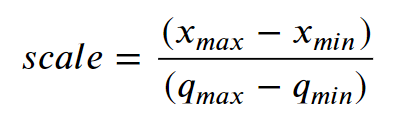 We will see an example of how to compute it later.
Zero-point: The zero-point for quantization is the representation of floating point 0.0 in the quantized range. Specifically, the zero-point is a quantized value, and it represents the floating point value 0.0 for all practical purposes. We shall see how it's computed with examples later, along with why such a representation is of practical interest to us.
Next, let's take a look at the main quantization schemes used in practice and familiarize ourselves with how they are similar and how they differ.
Types of Quantization Schemes
When considering the types of quantization available for use during model compression, there are 2 main types to pick from
- Symmetric quantization : In this case, the zero-point is zero - i.e. 0.0 of the floating point range is the same as 0 in the quantized range. Typically, this is more efficient to compute at runtime but may result in lower accuracy if the floating point range is unequally distributed around the floating point 0.0.
- Affine (or asymmetric) quantization : This is the one that has a zero-point that is non-zero in value.
But before we jump into the details, let's try to define what zero-point means.
Quantization Scale and Zero Point examples
Let's start with a very simple example and build it up.
Example-1: Symmetric uint8 quantization
Let's say we wish to map the floating point range [0.0 .. 1000.0] to the quantized range [0 .. 255]. The range [0 .. 255] is the set of values that can fit in an unsigned 8-bit integer.
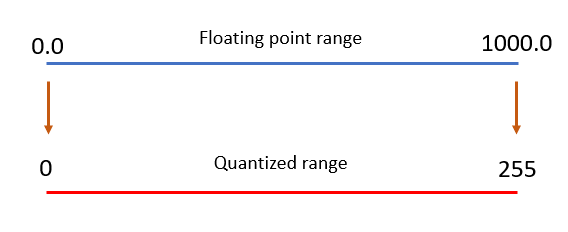 To perform this transformation, we want to rescale the floating point range so that the following is true:
Floating point 0.0 = Quantized 0
Floating point 1000.0 = Quantized 255
This is called symmetric quantization because the floating point 0.0 is quantized 0.
Hence, we define a scale, which is equal to
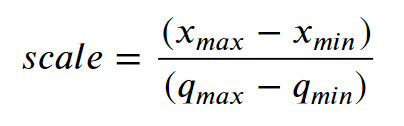 Where,
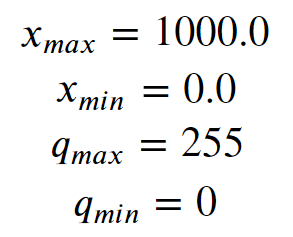 In this case, scale = 3.9215
To convert from a floating point value to a quantized value, we can simply divide the floating point value by the scale. For example, the floating point value 500.0 corresponds to the quantized value
 In this simple example, the 0.0 of the floating point range maps exactly to the 0 in the quantized range. This is called symmetric quantization. Let's see what happens when this is not the case.
Example-2: Affine uint8 quantization
Let's say we wish to map the floating point range [-20.0 .. 1000.0] to the quantized range [0 .. 255].
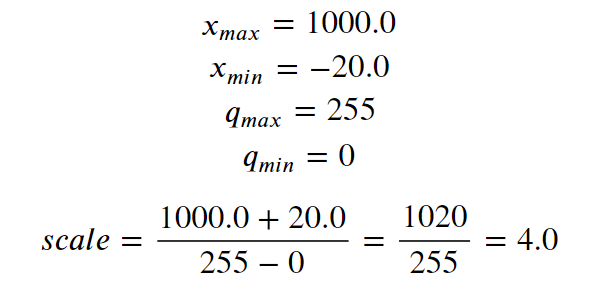
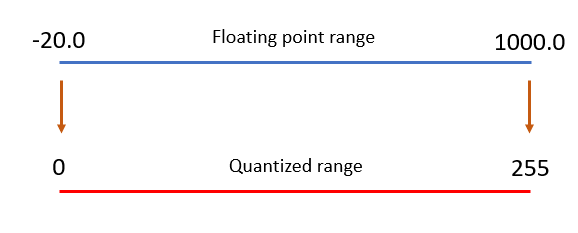 In this case, we have a different scaling factor since our xmin is different.
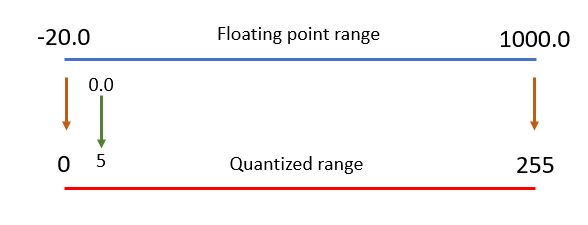
 Let's see what the floating point number 0.0 is represented by in the quantized range if we apply the scaling factor to 0.0
 Well, this doesn't quite seem right since, according to the diagram above, we would have expected the floating point value -20.0 to map to the quantized value 0.
This is where the concept of zero-point comes in. The zero-point acts as a bias for shifting the scaled floating point value and corresponds to the value in the quantized range that represents the floating point value 0.0. In our case, the zero point is the negative of the scaled floating point representation of -20.0, which is -(-5) = 5. The zero point is always the negative of the representation of the minimum floating point value since the minimum will always be negative or zero. We'll find out more about why this is the case in the section that explains example 4.
Whenever we quantize a value, we will always add the zero-point to this scaled value to get the actual quantized value in the valid quantization range. In case we wish to quantize the value -20.0, we compute it as the scaled value of -20.0 plus the zero-point, which is -5 + 5 = 0. Hence, quantized(-20.0, scale=4, zp=5) = 0.

Example-3: Affine int8 quantization
What happens if our quantized range is a signed 8-bit integer instead of an unsigned 8-bit integer? Well, the range is now [-128 .. 127].
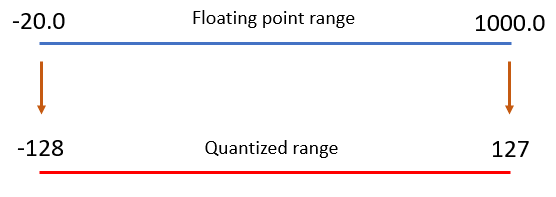 In this case, -20.0 in the float range maps to -128 in the quantized range, and 1000.0 in the float range maps to 127 in the quantized range.
The way we calculate zero point is that we compute it as if the quantized range is [0 .. 255] and then offset it with -128, so the zero point in the new range is
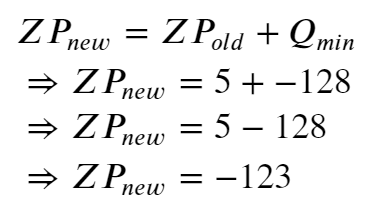
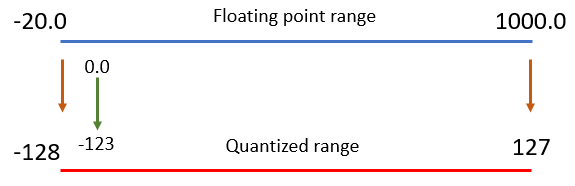 Hence, the zero-point for the new range is -123.
So far, we've looked at examples where the floating point range includes the value 0.0. In the next set of examples, we'll take a look at what happens when the floating point range doesn't include the value 0.0
The importance of 0.0
Why is it important for the floating point value 0.0 to be represented in the floating point range?
When using a padded convolution, we expect the border pixels to be padded using the value 0.0 in the most common case. Hence, it's important for 0.0 to be represented in the floating point range. Similarly, if the value X is going to be used for padding in your network, you need to make sure that the value X is represented in the floating point range and that quantization is aware of this.
Example-4: The untold story - skewed floating point range
Now, let's take a look at what happens if 0.0 isn't part of the floating point range.
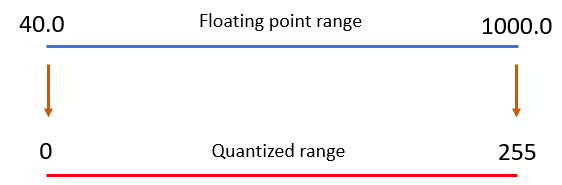 In this example, we're trying to quantize the floating point range [40.0 .. 1000.0] into the quantized range [0 .. 255].
Since we can't represent the value 0.0 in the floating point range, we need to extend the lower limit of the range to 0.0.
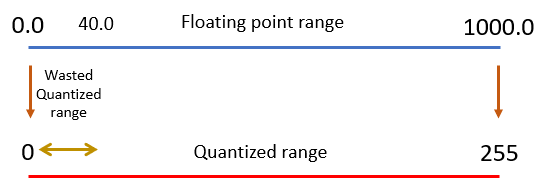 We can see that some part of the quantized range is wasted. To determine how much, let's compute the quantized value that the floating point value 40.0 maps to.
 Hence, we're wasting the range [0 .. 9] in the quantized range, which is about 3.92% of the range. This could significantly affect the model's accuracy post-quantization.
This skewing is necessary if we wish to make sure that the value 0.0 in the floating point range can be represented in the quantized range.
Another reason for including the value 0.0 in the floating point range is that efficiently comparing a quantized value to check if it's 0.0 in the floating point range is very valuable. Think of operators such as ReLU, which clip all values below 0.0 in the floating point range to 0.0.
It is important for us to be able to represent the zero-point using the same data type (signed or unsigned int8) as the quantized values. This enables us to perform these comparisons quickly and efficiently.
Next, let's take a look at how activation normalization helps with model quantization. We'll specifically focus on how the standardization of the activation values allows us to use the entire quantized range effectively.
Quantization and Activation Normalization
Batch/Layer Normalization changes the activation tensor to have zero mean and unit variance per channel or per layer.
Suppose we have an input tensor with a floating point range of [2000.0 .. 4000.0]. This is what the quantized range would look like.
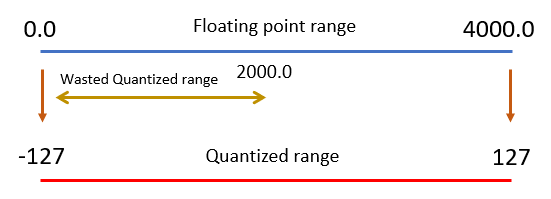 We observe that half of the quantized range [-127 .. -1] is unused. This is problematic since we're quantizing the entire floating point range using just 7 of the available 8 bits. This will undoubtedly result in a higher quantization error and reduced model accuracy. To address this let's apply layer normalization to the activation tensor.
After applying layer normalization to an activation tensor, the activation tensor will have a floating point range of [-2.0 .. 2.0]. This can be represented in the signed int8 range [-128 .. 127]. To ensure symmetry of the distribution, we restrict the quantized range to be [-127 .. 127].
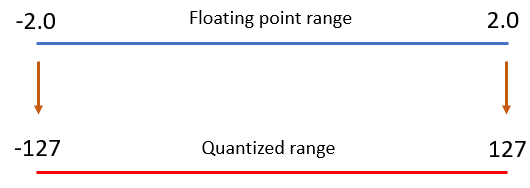 Hence, normalization avoids holes or unused parts in the quantized range.
Conclusion
We saw what affine (asymmetric) and symmetric quantization are and how they differ. We also learned about what scale and zero-point mean and how to compute them for both these types of quantization schemes.
Next, we saw the need to include float 0.0 in the floating point range and why and how this is done in practice. This results in a downside, namely wasted space in the quantized range.
Lastly, we saw how normalization helps quantization by bringing the activations in a fixed range and avoiding wasted space in the quantized range. In fact, the 0 mean based normalization can help convert affine quantization to symmetric quantization, and that can speed things up during inference.
All images in this post are created by the author(s).
References
- Efficient Deep Learning Book, Chapter-2: Introduction to Compression Techniques
- Hugging Face: Quantization
- TensorRT: Quantization
- Neural Network Distiller: Quantization
- Lei Mao: Quantization
- Quantizing floats
Register Now to Continue Reading
Unlock Towards Data Science with a Free Account
All articles on Towards Data Science are available to registered users. Create a free account today to access this article and thousands more.
Register for freeSign in to your account
 Written By
See all from Dhruv Matani
Machine LearningModel QuantizationNormalizationQuantizationZero Point
Share This Article
Towards Data Science is a community publication. Submit your insights to reach our global audience and earn through the TDS Author Payment Program.
Write for TDS
Related Articles
Machine Learning
How to become a data science "unicorn"
Shaw Talebi
April 17, 20248 min read
Artificial Intelligence
Data is important not only for a business or institution, but for every area of life, even for a simple individual.
Onur Okyol
July 30, 20208 min read
Machine Learning
A short overview of the core components of Graph-Nets
Kristof Neys
January 20, 20217 min read
Artificial Intelligence
The namespaces and resolution order help to improve the performance and robustness of Python programming
Christopher Tao
April 22, 20249 min read
Machine Learning
Using machine learning and data science to personalize education
Karun Thankachan
July 5, 20227 min read
Machine Learning
Building a Price Optimization Engine, Piece-by-Piece
Lewis Davies
December 16, 20206 min read
Machine Learning
Ever wondered how much your HDB is worth besides asking your housing agent? Or wondered what are the main features that have a great...
Tan Kah Ming
October 22, 20208 min read
Machine Learning
Understanding the Difference Term
Nikhil Gupta
November 26, 20216 min read
Machine Learning
Discover how a simple distance formula becomes a predictive model, step by step in Excel
Angela and Kezhan Shi
December 1, 202514 min read
Your home for data science and AI. The world's leading publication for data science, data analytics, data engineering, machine learning, and artificial intelligence professionals.
Subscribe to Our NewsletterWrite For TDS•About•Advertise•Privacy Policy•Terms of Use
© Insight Media Group, LLC 2026•The New Stack•roadmap.sh•Creator Network
Recommended Articles
Close