保留正文与补采附件。源页面当前未重新核验;具体限制见交付清单。
 We value your privacy
We use cookies to enhance your browsing experience, serve personalised ads or content, and analyse our traffic. By clicking "Accept All", you consent to our use of cookies.
Customise Reject All Accept All
Customise Consent Preferences
 We use cookies to help you navigate efficiently and perform certain functions. You will find detailed information about all cookies under each consent category below.
The cookies that are categorised as "Necessary" are stored on your browser as they are essential for enabling the basic functionalities of the site. ... Show more
NecessaryAlways Active
Necessary cookies are required to enable the basic features of this site, such as providing secure log-in or adjusting your consent preferences. These cookies do not store any personally identifiable data.
-
Cookie
BCTempID
-
Duration
10 minutes
-
Description
No description available.
-
Cookie
__cf_bm
-
Duration
1 hour
-
Description
This cookie, set by Cloudflare, is used to support Cloudflare Bot Management.
-
Cookie
AWSALBCORS
-
Duration
7 days
-
Description
Amazon Web Services set this cookie for load balancing.
-
Cookie
_cfuvid
-
Duration
session
-
Description
Cloudflare sets this cookie to track users across sessions to optimize user experience by maintaining session consistency and providing personalized services
-
Cookie
li_gc
-
Duration
6 months
-
Description
Linkedin set this cookie for storing visitor's consent regarding using cookies for non-essential purposes.
-
Cookie
__hssrc
-
Duration
session
-
Description
This cookie is set by Hubspot whenever it changes the session cookie. The __hssrc cookie set to 1 indicates that the user has restarted the browser, and if the cookie does not exist, it is assumed to be a new session.
-
Cookie
__hssc
-
Duration
1 hour
-
Description
HubSpot sets this cookie to keep track of sessions and to determine if HubSpot should increment the session number and timestamps in the __hstc cookie.
-
Cookie
wpEmojiSettingsSupports
-
Duration
session
-
Description
WordPress sets this cookie when a user interacts with emojis on a WordPress site. It helps determine if the user's browser can display emojis properly.
-
Cookie
BCSessionID
-
Duration
1 year 1 month 4 days
-
Description
Blueconic sets this cookie as a unique identifier for the BlueConic profile.
-
Cookie
_octo
-
Duration
1 year
-
Description
No description available.
-
Cookie
logged_in
-
Duration
1 year
-
Description
No description available.
-
Cookie
__Secure-YEC
-
Duration
past
-
Description
YouTube sets this cookie to stores the user's video player preferences using embedded YouTube video
-
Cookie
__eoi
-
Duration
6 months
-
Description
Description is currently not available.
-
Cookie
AWSALBTGCORS
-
Duration
7 days
-
Description
No description available.
-
Cookie
login-status-p
-
Duration
past
-
Description
Description is currently not available.
-
Cookie
AWSALBTG
-
Duration
7 days
-
Description
No description available.
-
Cookie
csrf_token
-
Duration
session
-
Description
No description available.
-
Cookie
token_v2
-
Duration
1 day
-
Description
Description is currently not available.
-
Cookie
D
-
Duration
1 year
-
Description
Description is currently not available.
-
Cookie
PHPSESSID
-
Duration
session
-
Description
This cookie is native to PHP applications. The cookie stores and identifies a user's unique session ID to manage user sessions on the website. The cookie is a session cookie and will be deleted when all the browser windows are closed.
-
Cookie
VISITOR_PRIVACY_METADATA
-
Duration
6 months
-
Description
YouTube sets this cookie to store the user's cookie consent state for the current domain.
-
Cookie
cookietest
-
Duration
session
-
Description
The cookietest cookie is typically used to determine whether the user's browser accepts cookies, essential for website functionality and user experience.
-
Cookie
__Host-airtable-session
-
Duration
1 year
-
Description
This cookie is used to enable us to integrate the services of Airtable.
-
Cookie
__Host-airtable-session.sig
-
Duration
1 year
-
Description
This cookie is used to enable us to integrate the services of Airtable.
-
Cookie
m
-
Duration
1 year 1 month 4 days
-
Description
Stripe sets this cookie for fraud prevention purposes. It identifies the device used to access the website, allowing the website to be formatted accordingly.
-
Cookie
BIGipServer*
-
Duration
session
-
Description
Marketo sets this cookie to collect information about the user's online activity and build a profile about their interests to provide advertisements relevant to the user.
-
Cookie
__cfruid
-
Duration
session
-
Description
Cloudflare sets this cookie to identify trusted web traffic.
-
Cookie
_GRECAPTCHA
-
Duration
6 months
-
Description
Google Recaptcha service sets this cookie to identify bots to protect the website against malicious spam attacks.
-
Cookie
__Secure-YNID
-
Duration
6 months
-
Description
Google cookie used to protect user security and prevent fraud, especially during the login process.
-
Cookie
cookieyes-consent
-
Duration
1 year
-
Description
CookieYes sets this cookie to remember users' consent preferences so that their preferences are respected on subsequent visits to this site. It does not collect or store any personal information about the site visitors.
Functional
Functional cookies help perform certain functionalities like sharing the content of the website on social media platforms, collecting feedback, and other third-party features.
-
Cookie
lidc
-
Duration
1 day
-
Description
LinkedIn sets the lidc cookie to facilitate data center selection.
-
Cookie
brw
-
Duration
1 year
-
Description
No description available.
-
Cookie
brwConsent
-
Duration
5 minutes
-
Description
Description is currently not available.
-
Cookie
WMF-Uniq
-
Duration
1 year
-
Description
Description is currently not available.
-
Cookie
loom_anon_comment
-
Duration
1 year
-
Description
No description available.
-
Cookie
loom_referral_video
-
Duration
session
-
Description
Description is currently not available.
-
Cookie
VISITOR_INFO1_LIVE
-
Duration
6 months
-
Description
A cookie set by YouTube to measure bandwidth that determines whether the user gets the new or old player interface.
-
Cookie
yt-remote-connected-devices
-
Duration
Never Expires
-
Description
YouTube sets this cookie to store the user's video preferences using embedded YouTube videos.
-
Cookie
ytidb::LAST_RESULT_ENTRY_KEY
-
Duration
Never Expires
-
Description
The cookie ytidb::LAST_RESULT_ENTRY_KEY is used by YouTube to store the last search result entry that was clicked by the user. This information is used to improve the user experience by providing more relevant search results in the future.
-
Cookie
yt-remote-device-id
-
Duration
Never Expires
-
Description
YouTube sets this cookie to store the user's video preferences using embedded YouTube videos.
-
Cookie
yt-remote-session-name
-
Duration
session
-
Description
The yt-remote-session-name cookie is used by YouTube to store the user's video player preferences using embedded YouTube video.
-
Cookie
yt-remote-fast-check-period
-
Duration
session
-
Description
The yt-remote-fast-check-period cookie is used by YouTube to store the user's video player preferences for embedded YouTube videos.
-
Cookie
yt-remote-session-app
-
Duration
session
-
Description
The yt-remote-session-app cookie is used by YouTube to store user preferences and information about the interface of the embedded YouTube video player.
-
Cookie
yt-remote-cast-available
-
Duration
session
-
Description
The yt-remote-cast-available cookie is used to store the user's preferences regarding whether casting is available on their YouTube video player.
-
Cookie
yt-remote-cast-installed
-
Duration
session
-
Description
The yt-remote-cast-installed cookie is used to store the user's video player preferences using embedded YouTube video.
-
Cookie
cp_session
-
Duration
3 months
-
Description
Codepen sets this cookie for Help systems found in the website.
-
Cookie
loid
-
Duration
1 year 1 month 4 days
-
Description
This cookie is set by the Reddit. The cookie enables the sharing of content from the website onto the social media platform.
Analytics
Analytical cookies are used to understand how visitors interact with the website. These cookies help provide information on metrics such as the number of visitors, bounce rate, traffic source, etc.
-
Cookie
__hstc
-
Duration
6 months
-
Description
Hubspot set this main cookie for tracking visitors. It contains the domain, initial timestamp (first visit), last timestamp (last visit), current timestamp (this visit), and session number (increments for each subsequent session).
-
Cookie
hubspotutk
-
Duration
6 months
-
Description
HubSpot sets this cookie to keep track of the visitors to the website. This cookie is passed to HubSpot on form submission and used when deduplicating contacts.
-
Cookie
_ga
-
Duration
1 year 1 month 4 days
-
Description
Google Analytics sets this cookie to calculate visitor, session and campaign data and track site usage for the site's analytics report. The cookie stores information anonymously and assigns a randomly generated number to recognise unique visitors.
-
Cookie
ga*
-
Duration
1 year 1 month 4 days
-
Description
Google Analytics sets this cookie to store and count page views.
-
Cookie
__Host-psifi.analyticsTrace
-
Duration
6 hours
-
Description
Description is currently not available.
-
Cookie
__Host-psifi.analyticsTraceV2
-
Duration
6 hours
-
Description
Description is currently not available.
-
Cookie
_gh_sess
-
Duration
session
-
Description
GitHub sets this cookie for temporary application and framework state between pages like what step the user is on in a multiple step form.
-
Cookie
YSC
-
Duration
session
-
Description
YSC cookie is set by Youtube and is used to track the views of embedded videos on Youtube pages.
-
Cookie
ajs_anonymous_id
-
Duration
1 year
-
Description
This cookie is set by Segment to count the number of people who visit a certain site by tracking if they have visited before.
-
Cookie
vuid
-
Duration
1 year 1 month 4 days
-
Description
Vimeo installs this cookie to collect tracking information by setting a unique ID to embed videos on the website.
Performance
Performance cookies are used to understand and analyse the key performance indexes of the website which helps in delivering a better user experience for the visitors.
-
Cookie
AWSALB
-
Duration
7 days
-
Description
AWSALB is an application load balancer cookie set by Amazon Web Services to map the session to the target.
-
Cookie
acq
-
Duration
past
-
Description
Description is currently not available.
-
Cookie
acq.sig
-
Duration
past
-
Description
Description is currently not available.
-
Cookie
ptc
-
Duration
2 years
-
Description
No description available.
Advertisement
Advertisement cookies are used to provide visitors with customised advertisements based on the pages you visited previously and to analyse the effectiveness of the ad campaigns.
-
Cookie
muc_ads
-
Duration
1 year 1 month 4 days
-
Description
Twitter sets this cookie to collect user behaviour and interaction data to optimize the website.
-
Cookie
guest_id_marketing
-
Duration
1 year 1 month 4 days
-
Description
Twitter sets this cookie to identify and track the website visitor.
-
Cookie
guest_id_ads
-
Duration
1 year 1 month 4 days
-
Description
Twitter sets this cookie to identify and track the website visitor.
-
Cookie
personalization_id
-
Duration
1 year 1 month 4 days
-
Description
Twitter sets this cookie to integrate and share features for social media and also store information about how the user uses the website, for tracking and targeting.
-
Cookie
guest_id
-
Duration
1 year 1 month 4 days
-
Description
Twitter sets this cookie to identify and track the website visitor. It registers if a user is signed in to the Twitter platform and collects information about ad preferences.
-
Cookie
bcookie
-
Duration
1 year
-
Description
LinkedIn sets this cookie from LinkedIn share buttons and ad tags to recognize browser IDs.
-
Cookie
__Secure-ROLLOUT_TOKEN
-
Duration
6 months
-
Description
YouTube sets this cookie to manage feature rollout and experimentation. It helps Google control which new features or interface changes are shown to users as part of testing and staged rollouts, ensuring consistent experience for a given user during an experiment.
-
Cookie
yt.innertube::nextId
-
Duration
Never Expires
-
Description
YouTube sets this cookie to register a unique ID to store data on what videos from YouTube the user has seen.
-
Cookie
yt.innertube::requests
-
Duration
Never Expires
-
Description
YouTube sets this cookie to register a unique ID to store data on what videos from YouTube the user has seen.
-
Cookie
session_tracker
-
Duration
session
-
Description
This cookie is set by the Reddit. This cookie is used to identify trusted web traffic. It also helps in adverstising on the website.
-
Cookie
edgebucket
-
Duration
session
-
Description
Reddit sets this cookie to save the information about a log-on Reddit user, for the purpose of advertisement recommendations and updating the content.
-
Cookie
did
-
Duration
1 year
-
Description
Arbor sets this cookie to show targeted ads to site visitors.This cookie expires after 2 months or 1 year.
Uncategorised
Other uncategorised cookies are those that are being analysed and have not been classified into a category as yet.
No cookies to display.
Reject All Save My Preferences Accept All
Toggle SearchToggle Mobile Navigation
Publish AI, ML & data-science insights to a global community of data professionals.
Sign inSubmit an Article
LatestEditor's PicksNewsletterShipAI
Write For TDS
LinkedInXToggle Search
Data Science
How I Studied LLMs in Two Weeks: A Comprehensive Roadmap
A day-by-day detailed LLM roadmap from beginner to advanced, plus some study tips
Hesam Sheikh
October 18, 20247 min read
 Image created by Midjourney.
Stuck behind a paywall? Read for Free!
Understanding how LLMs operate under the hood is becoming an essential skill in machine learning. Whether you're choosing the right model for your application, looking for a general knowledge of the field, or following discussions about LLMs and their potential to understand , create , or lead to AGI, the first step is understanding what they are.
In this article, I am going to share my learning experience, and the resources I found most helpful in learning about the fundamentals of LLMs in about 14 days, and how you can do this in a relatively short time. This roadmap could help you learn almost all the essentials:
 ℏεsam
@Hesamation
·Follow
here is my list of all the essentials of llms: - token embeddings - positional embeddings - self-attention - transformers - intuitive understanding of Q, K, V - causal and multi-head attention - temperature, top-k, top-p - classification & instruction fine-tuning - rotaryShow more
4:25 PM · Oct 12, 2024
1.4KReplyCopy link
Read 16 replies
Learn this step by step with the interactive AI and Data Scientist, Computer Science, AI Engineer and Machine Learning roadmaps.
Why I Started This Journey
I am obsessed with going deeper into concepts, even if I already know them. I could already read and understand the research on LLMs, I could build agents or fine-tune models. But it didn't seem enough to me.
I wanted to know how large language models work mathematically and intuitively, and why they behave the way they do.
I was already familiar with this field, so I knew my knowledge gaps exactly. The fact that I have a background in machine learning and this field specifically has helped me big time in doing this in two weeks , otherwise this would take more than a month.
My Learning Material
I wanted to do this learning journey not just for LLMs, but many other topics in my interest (Quantum Machine Learning, Jax, etc.) So to document all this and keep it tidy, I started my **ml-retreat**GitHub repository. The idea was that sometimes we need to sit back from our typical work and reflect on the things we think we know and fill in the gaps.
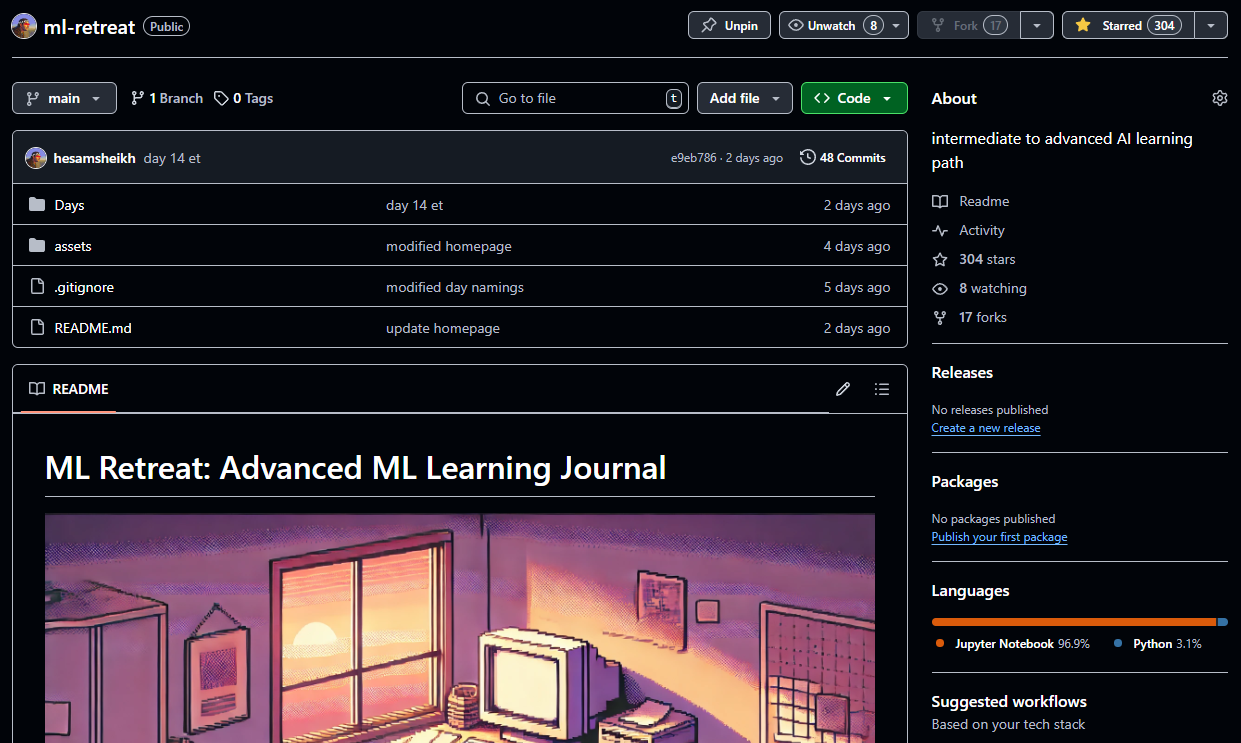 ml-retreat Repository.
The repository was received much more positively than I expected. At the time of writing this article, it has been starred ⭐ 330 times and increasing. There were many people out there looking for something I noticed, a single comprehensive roadmap of all the best resources out there.
All of the materials I used so far are free, you don't need to pay anything.
I studied LLMs majorly in three steps :
This would conclude the fundamentals of language models. Token and positional embeddings, self-attention, transformer architectures, the original "Attention is All You Need" paper and the basics of fine-tuning. While I have used numerous resources for each topic, a crucial resource for this was Build a Large Language Model (From Scratch) by Sebastian Raschka (you can read it for free online). The book beautifully uncovers each of these topics to make them as accessible as possible.
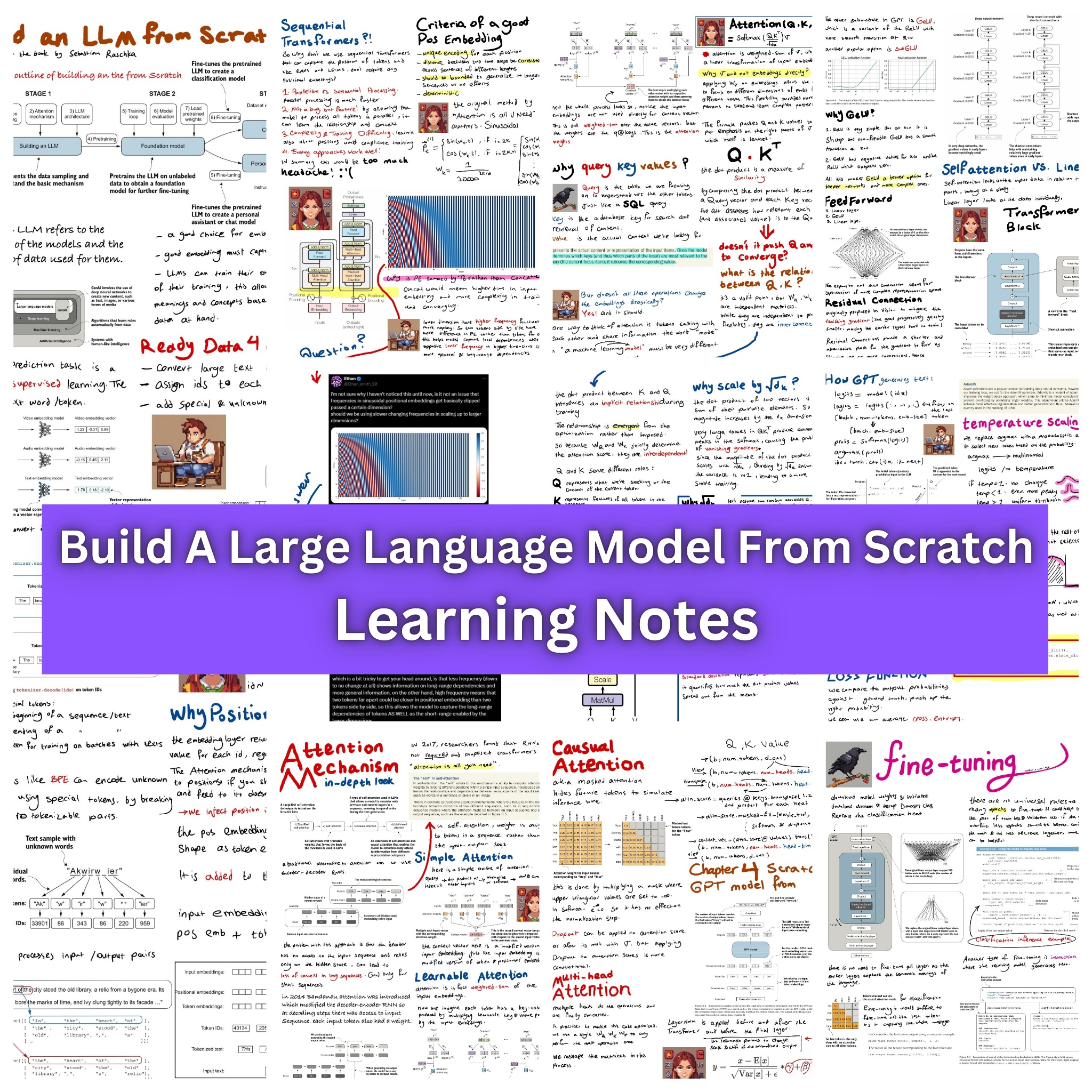 My notes on the fundamentals of LLMs. (Source)
The Challenge of this stage in my opinion was self-attention - not what it is, but how it works. How does self-attention map the context of each token in relation to other tokens? What do Q uery, K ey, and V alue represent, and why are they crucial? I suggest taking as much time as needed for this part, as it is essentially the core of how LLMs function.
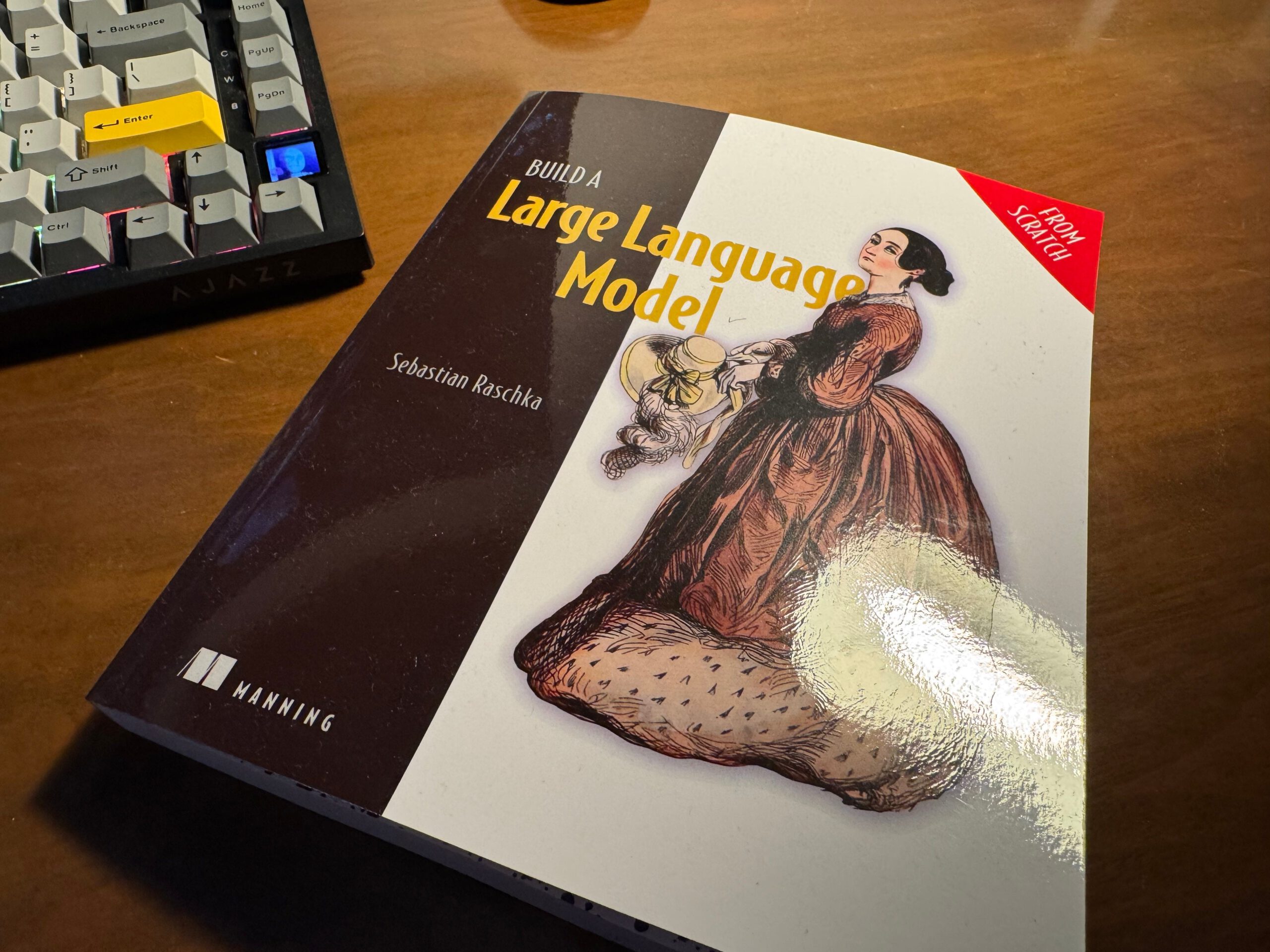 Image by Author.
For the second part of my studies, I wanted to understand what hallucination is and why LLMs hallucinate. This was more of a personal question lurking in my mind, but it also enabled me to understand some aspects of the language models.
I learned about positional bias where LLMs favor the closer tokens and forget about the tokens further away. I learned about exposure bias which implies in the inference phase, predicting a wrong token could derail the generation process for the next tokens like a snowball effect. I also learned how Data , Training , and Inference each contribute to this hallucination dilemma.
 My notes on LLM Hallucination. (Source)
Hallucination is a big pain in the head for both researchers and those who build applications with LLM. I strongly suggest you take the time to study why this happens and also methods to mitigate it.
The last two stages show you how LLMs work. There are some techniques however that are not so basic but have become mainstream in building LLMs. So I studied:
- Pause tokens that give LLMs more time to "think".
- Infini-attention which allows LLMs to have very big context windows (like Gemini's 1M context window) by leveraging a sort of memory of previous tokens.
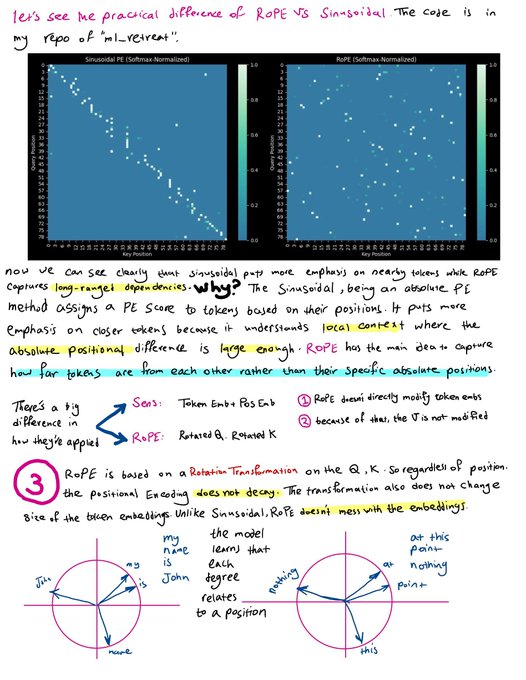
- RoPE (Rotary Positional Embedding), a relative positional embedding method used in Llama and many other LLMs that gives the benefit of attending to tokens far away in the sequence.
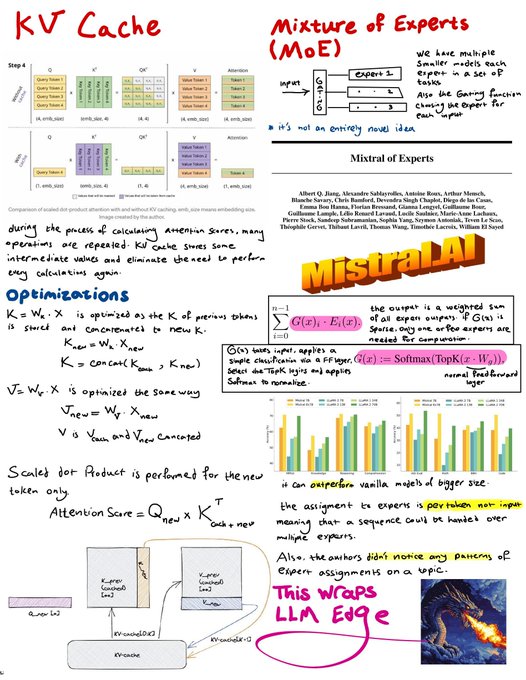
- KV Cache to speed up generation by eliminating calculations repeated in generating previous tokens.
- Mixture of Experts (MoE) , which incorporates several smaller LLMs instead of a big one. This technique was popularized in language models by Mistral. Their 8 models of size 7B could outperform Llama 2 70B on some tasks, so it really is impressive!
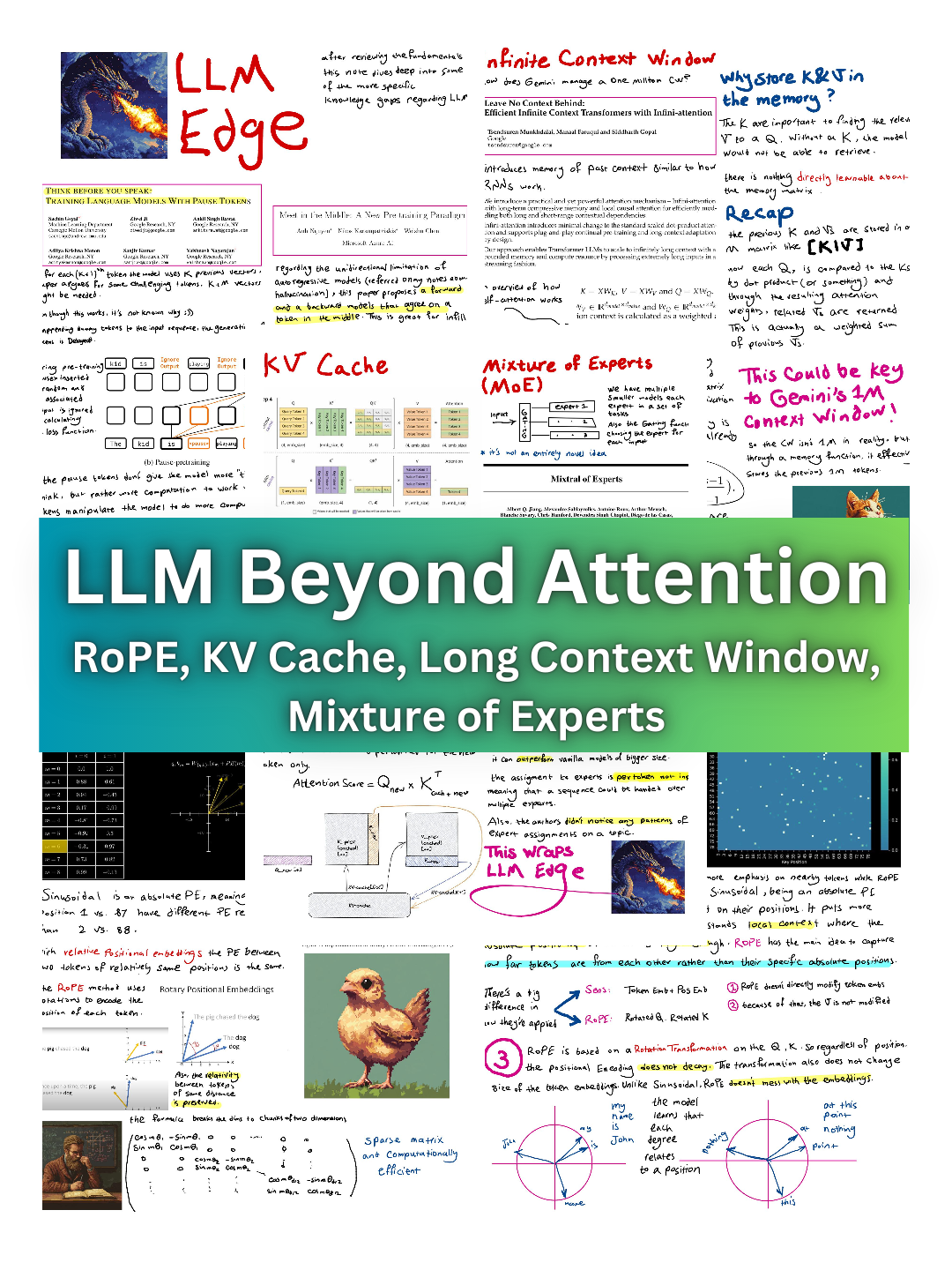 My notes on some popular LLM techniques. (Source)
To recap these subjects, I studied the architecture and code of Meta's Llama which encapsulates many of the subjects I mentioned. The resource for this is again, on my repository.
My Learning Resources
I didn't use a single resource to learn these subjects.
For the basics of LLMs, I used Build a Large Language Model (From Scratch).
I also read many papers. Reading papers could seem difficult, but they add so much value. Especially those that first proposed a technique (like the original transformer paper) and also the survey papers that digest many papers and give you the TL;DR.
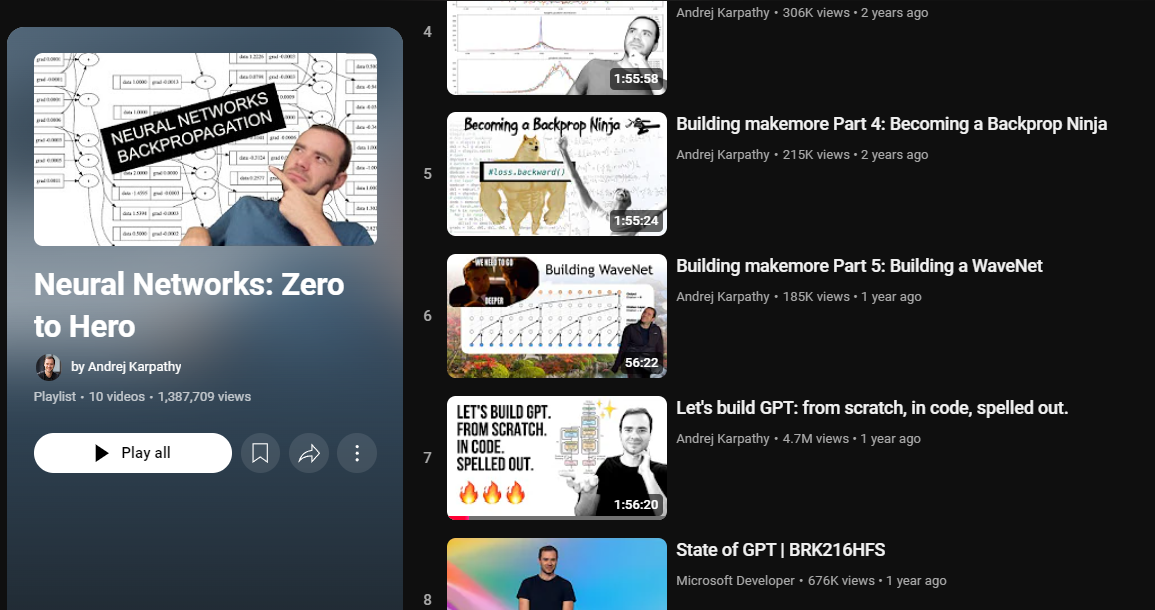 Andrej Karpathy's Playlist. (Source)
YouTube videos are especially very helpful. I watched YT as my first step in studying many of these materials, just to warm myself up and have a perspective. I highly suggest watching Andrej Karpathy 's playlist which contains mostly videos about language modeling and LLMs. What is better than having a genius explain to you LLMs from zero to hero!
Prerequisites To Begin
Learning about LLMs is not complex , but it's not exactly beginner-friendly either. A foundational understanding of machine learning and related subjects will make the learning process smoother.
Mathematics
- Linear Algebra : Vectors and matrices, matrix multiplication
- Probability and Statistics : Basics of probability, random variables and distributions, expectation and variance, maximum likelihood estimation (MLE)
- Calculus : Differentiation and integration (especially for backpropagation), partial derivatives (for gradient-based optimization)
- Optimization : Gradient descent, stochastic gradient descent (SGD), advanced optimizers (e.g. Adam)
Programming and Frameworks
- Python: Familiarity with libraries such as NumPy and Pandas
- Deep Learning Frameworks : TensorFlow or PyTorch, familiarity with model training, debugging, and evaluation
Deep Learning Concepts
- Understanding of perceptrons, activation functions, and layers. Backpropagation and gradient descent. Loss functions (Cross-Entropy, MSE)
- Convolutional Neural Networks (CNNs) (Optional but helpful): Useful for understanding how layers in models operate
Naturally, you may not know some of these. But it doesn't mean you shouldn't start the learning. Just know that if you struggle at certain times, it's expected, and you come back to learn them in more depth later on.
Some Bonus Tips ✨
Some things I learned along the way or could help you in your study:
Enjoy the Process
I did mention I learned these subjects in two weeks. They're not super complex, but I only mentioned time to emphasize this is not too difficult to do. I suggest that you don't care about learning these materials by a strict deadline. Of course, when I started this I had no intention of doing this in 14 days. I just did. But it could last 1 month easily and I would have no problem, as long as I could have the pleasure of finding things out.
Don't Follow My Roadmap
It might sound strange, but my learning path is my learning path. Don't feel like you need to follow my exact roadmap. It did fantastic for me, but there's no guarantee it would be likewise for you.
Learning is a very personal experience. What you learn is a product of what you know, and what you want to know. This is different for anybody. So please don't follow my roadmap, but simply pick the good parts you are interested in. And this is the same case for any other roadmaps you see and hear out there. No single book, resource, or roadmap is the best, so don't limit yourself to one single thing.
Don't Finish Everything
When you pick up a book, YouTube video, or paper to study any of these materials, you aren't sworn by blood to finish it. You're just there to pick up what you came for and leave. Papers especially can be so time-consuming to read. So here's my advice:
Before reading any of these materials, identify the question that you have in your mind, and look specifically for the answer. This saves you from wasting your time on unrelated content that may be great, but not relevant.
Wrap Up
I am blown away by the community's support both for my repository and me sharing my learning path. I will continue to study more subjects, Omni models, ViT, GNN, Quantum Machine Learning , and many more are on my list. So don't miss out on my X posts where I share the digest of my notes.
ℏεsam
@Hesamation
·Follow
ML GRIND DAY 13 > rotary positional embedding (RoPE) > learned about KV Cache > Mixture of Experts (MoE) > llama-2 architecture > @karpathy 's let's build a GPT that's a wrap on llm essentials 🫡

 9:50 PM · Oct 11, 2024
432ReplyCopy link
Read 6 replies
Also, my GitHub repository
ml-retreat is where I shared all of the materials I have shared so far:
GitHub - hesamsheikh/ml-retreat: intermediate to advanced AI learning path
Thank you for reading through this article. If you're interested in a further read, here are my suggestions :)
What We Still Don't Understand About Machine Learning
The Smarter Way of Using AI in Programming
 Image created by Midjourney.
Register Now to Continue Reading
Unlock Towards Data Science with a Free Account
All articles on Towards Data Science are available to registered users. Create a free account today to access this article and thousands more.
Register for freeSign in to your account
 Written By
See all from Hesam Sheikh
Data ScienceLarge Language ModelsLlmMachine LearningProgramming
Share This Article
Towards Data Science is a community publication. Submit your insights to reach our global audience and earn through the TDS Author Payment Program.
Write for TDS
Related Articles
Data Science
A gentle introduction to the amazing field of optimization
Jarom Hulet
June 26, 202412 min read
Programming
In this tutorial, you will learn one of the basic and important concepts in python known as operators, their syntax along with examples.
Tanu N Prabhu
June 5, 202010 min read
Programming
How to analyse pharmaceutical sales data using Python, Pandas, Matplotlib and regression models
Przemyslaw Jarzynski
September 6, 20209 min read
Deep Learning
A short survey on implicit data augmentation techniques and future research directions
Liu Peng
December 21, 20217 min read
Artificial Intelligence
How to use the format() method and f-strings in python
Luay Matalka
October 10, 20204 min read
Machine Learning
Realities of company and cloud complexities require new levels of control and autonomy to meet business goals at scale
Jeff Chou
September 10, 20239 min read
Machine Learning
How Graphics Processing Units are Changing the Game in Machine Learning
Niklas Lang
December 9, 20228 min read
Programming
Explained with examples.
Soner Yıldırım
June 10, 20234 min read
Programming
It might be difficult, but it's not impossible. In today's world, no matter what field...
Sara A. Metwalli
May 25, 20216 min read
Your home for data science and AI. The world's leading publication for data science, data analytics, data engineering, machine learning, and artificial intelligence professionals.
Subscribe to Our NewsletterWrite For TDS•About•Advertise•Privacy Policy•Terms of Use
© Insight Media Group, LLC 2026•The New Stack•roadmap.sh•Creator Network
Recommended Articles
Close