保留正文与补采附件。源页面当前未重新核验;具体限制见交付清单。
 We value your privacy
We use cookies to enhance your browsing experience, serve personalised ads or content, and analyse our traffic. By clicking "Accept All", you consent to our use of cookies.
Customise Reject All Accept All
Customise Consent Preferences
 We use cookies to help you navigate efficiently and perform certain functions. You will find detailed information about all cookies under each consent category below.
The cookies that are categorised as "Necessary" are stored on your browser as they are essential for enabling the basic functionalities of the site. ... Show more
NecessaryAlways Active
Necessary cookies are required to enable the basic features of this site, such as providing secure log-in or adjusting your consent preferences. These cookies do not store any personally identifiable data.
-
Cookie
BCTempID
-
Duration
10 minutes
-
Description
No description available.
-
Cookie
__cf_bm
-
Duration
1 hour
-
Description
This cookie, set by Cloudflare, is used to support Cloudflare Bot Management.
-
Cookie
AWSALBCORS
-
Duration
7 days
-
Description
Amazon Web Services set this cookie for load balancing.
-
Cookie
_cfuvid
-
Duration
session
-
Description
Cloudflare sets this cookie to track users across sessions to optimize user experience by maintaining session consistency and providing personalized services
-
Cookie
li_gc
-
Duration
6 months
-
Description
Linkedin set this cookie for storing visitor's consent regarding using cookies for non-essential purposes.
-
Cookie
__hssrc
-
Duration
session
-
Description
This cookie is set by Hubspot whenever it changes the session cookie. The __hssrc cookie set to 1 indicates that the user has restarted the browser, and if the cookie does not exist, it is assumed to be a new session.
-
Cookie
__hssc
-
Duration
1 hour
-
Description
HubSpot sets this cookie to keep track of sessions and to determine if HubSpot should increment the session number and timestamps in the __hstc cookie.
-
Cookie
wpEmojiSettingsSupports
-
Duration
session
-
Description
WordPress sets this cookie when a user interacts with emojis on a WordPress site. It helps determine if the user's browser can display emojis properly.
-
Cookie
BCSessionID
-
Duration
1 year 1 month 4 days
-
Description
Blueconic sets this cookie as a unique identifier for the BlueConic profile.
-
Cookie
_octo
-
Duration
1 year
-
Description
No description available.
-
Cookie
logged_in
-
Duration
1 year
-
Description
No description available.
-
Cookie
__Secure-YEC
-
Duration
past
-
Description
YouTube sets this cookie to stores the user's video player preferences using embedded YouTube video
-
Cookie
__eoi
-
Duration
6 months
-
Description
Description is currently not available.
-
Cookie
AWSALBTGCORS
-
Duration
7 days
-
Description
No description available.
-
Cookie
login-status-p
-
Duration
past
-
Description
Description is currently not available.
-
Cookie
AWSALBTG
-
Duration
7 days
-
Description
No description available.
-
Cookie
csrf_token
-
Duration
session
-
Description
No description available.
-
Cookie
token_v2
-
Duration
1 day
-
Description
Description is currently not available.
-
Cookie
D
-
Duration
1 year
-
Description
Description is currently not available.
-
Cookie
PHPSESSID
-
Duration
session
-
Description
This cookie is native to PHP applications. The cookie stores and identifies a user's unique session ID to manage user sessions on the website. The cookie is a session cookie and will be deleted when all the browser windows are closed.
-
Cookie
VISITOR_PRIVACY_METADATA
-
Duration
6 months
-
Description
YouTube sets this cookie to store the user's cookie consent state for the current domain.
-
Cookie
cookietest
-
Duration
session
-
Description
The cookietest cookie is typically used to determine whether the user's browser accepts cookies, essential for website functionality and user experience.
-
Cookie
__Host-airtable-session
-
Duration
1 year
-
Description
This cookie is used to enable us to integrate the services of Airtable.
-
Cookie
__Host-airtable-session.sig
-
Duration
1 year
-
Description
This cookie is used to enable us to integrate the services of Airtable.
-
Cookie
m
-
Duration
1 year 1 month 4 days
-
Description
Stripe sets this cookie for fraud prevention purposes. It identifies the device used to access the website, allowing the website to be formatted accordingly.
-
Cookie
BIGipServer*
-
Duration
session
-
Description
Marketo sets this cookie to collect information about the user's online activity and build a profile about their interests to provide advertisements relevant to the user.
-
Cookie
__cfruid
-
Duration
session
-
Description
Cloudflare sets this cookie to identify trusted web traffic.
-
Cookie
_GRECAPTCHA
-
Duration
6 months
-
Description
Google Recaptcha service sets this cookie to identify bots to protect the website against malicious spam attacks.
-
Cookie
__Secure-YNID
-
Duration
6 months
-
Description
Google cookie used to protect user security and prevent fraud, especially during the login process.
-
Cookie
cookieyes-consent
-
Duration
1 year
-
Description
CookieYes sets this cookie to remember users' consent preferences so that their preferences are respected on subsequent visits to this site. It does not collect or store any personal information about the site visitors.
Functional
Functional cookies help perform certain functionalities like sharing the content of the website on social media platforms, collecting feedback, and other third-party features.
-
Cookie
lidc
-
Duration
1 day
-
Description
LinkedIn sets the lidc cookie to facilitate data center selection.
-
Cookie
brw
-
Duration
1 year
-
Description
No description available.
-
Cookie
brwConsent
-
Duration
5 minutes
-
Description
Description is currently not available.
-
Cookie
WMF-Uniq
-
Duration
1 year
-
Description
Description is currently not available.
-
Cookie
loom_anon_comment
-
Duration
1 year
-
Description
No description available.
-
Cookie
loom_referral_video
-
Duration
session
-
Description
Description is currently not available.
-
Cookie
VISITOR_INFO1_LIVE
-
Duration
6 months
-
Description
A cookie set by YouTube to measure bandwidth that determines whether the user gets the new or old player interface.
-
Cookie
yt-remote-connected-devices
-
Duration
Never Expires
-
Description
YouTube sets this cookie to store the user's video preferences using embedded YouTube videos.
-
Cookie
ytidb::LAST_RESULT_ENTRY_KEY
-
Duration
Never Expires
-
Description
The cookie ytidb::LAST_RESULT_ENTRY_KEY is used by YouTube to store the last search result entry that was clicked by the user. This information is used to improve the user experience by providing more relevant search results in the future.
-
Cookie
yt-remote-device-id
-
Duration
Never Expires
-
Description
YouTube sets this cookie to store the user's video preferences using embedded YouTube videos.
-
Cookie
yt-remote-session-name
-
Duration
session
-
Description
The yt-remote-session-name cookie is used by YouTube to store the user's video player preferences using embedded YouTube video.
-
Cookie
yt-remote-fast-check-period
-
Duration
session
-
Description
The yt-remote-fast-check-period cookie is used by YouTube to store the user's video player preferences for embedded YouTube videos.
-
Cookie
yt-remote-session-app
-
Duration
session
-
Description
The yt-remote-session-app cookie is used by YouTube to store user preferences and information about the interface of the embedded YouTube video player.
-
Cookie
yt-remote-cast-available
-
Duration
session
-
Description
The yt-remote-cast-available cookie is used to store the user's preferences regarding whether casting is available on their YouTube video player.
-
Cookie
yt-remote-cast-installed
-
Duration
session
-
Description
The yt-remote-cast-installed cookie is used to store the user's video player preferences using embedded YouTube video.
-
Cookie
cp_session
-
Duration
3 months
-
Description
Codepen sets this cookie for Help systems found in the website.
-
Cookie
loid
-
Duration
1 year 1 month 4 days
-
Description
This cookie is set by the Reddit. The cookie enables the sharing of content from the website onto the social media platform.
Analytics
Analytical cookies are used to understand how visitors interact with the website. These cookies help provide information on metrics such as the number of visitors, bounce rate, traffic source, etc.
-
Cookie
__hstc
-
Duration
6 months
-
Description
Hubspot set this main cookie for tracking visitors. It contains the domain, initial timestamp (first visit), last timestamp (last visit), current timestamp (this visit), and session number (increments for each subsequent session).
-
Cookie
hubspotutk
-
Duration
6 months
-
Description
HubSpot sets this cookie to keep track of the visitors to the website. This cookie is passed to HubSpot on form submission and used when deduplicating contacts.
-
Cookie
_ga
-
Duration
1 year 1 month 4 days
-
Description
Google Analytics sets this cookie to calculate visitor, session and campaign data and track site usage for the site's analytics report. The cookie stores information anonymously and assigns a randomly generated number to recognise unique visitors.
-
Cookie
ga*
-
Duration
1 year 1 month 4 days
-
Description
Google Analytics sets this cookie to store and count page views.
-
Cookie
__Host-psifi.analyticsTrace
-
Duration
6 hours
-
Description
Description is currently not available.
-
Cookie
__Host-psifi.analyticsTraceV2
-
Duration
6 hours
-
Description
Description is currently not available.
-
Cookie
_gh_sess
-
Duration
session
-
Description
GitHub sets this cookie for temporary application and framework state between pages like what step the user is on in a multiple step form.
-
Cookie
YSC
-
Duration
session
-
Description
YSC cookie is set by Youtube and is used to track the views of embedded videos on Youtube pages.
-
Cookie
ajs_anonymous_id
-
Duration
1 year
-
Description
This cookie is set by Segment to count the number of people who visit a certain site by tracking if they have visited before.
-
Cookie
vuid
-
Duration
1 year 1 month 4 days
-
Description
Vimeo installs this cookie to collect tracking information by setting a unique ID to embed videos on the website.
Performance
Performance cookies are used to understand and analyse the key performance indexes of the website which helps in delivering a better user experience for the visitors.
-
Cookie
AWSALB
-
Duration
7 days
-
Description
AWSALB is an application load balancer cookie set by Amazon Web Services to map the session to the target.
-
Cookie
acq
-
Duration
past
-
Description
Description is currently not available.
-
Cookie
acq.sig
-
Duration
past
-
Description
Description is currently not available.
-
Cookie
ptc
-
Duration
2 years
-
Description
No description available.
Advertisement
Advertisement cookies are used to provide visitors with customised advertisements based on the pages you visited previously and to analyse the effectiveness of the ad campaigns.
-
Cookie
muc_ads
-
Duration
1 year 1 month 4 days
-
Description
Twitter sets this cookie to collect user behaviour and interaction data to optimize the website.
-
Cookie
guest_id_marketing
-
Duration
1 year 1 month 4 days
-
Description
Twitter sets this cookie to identify and track the website visitor.
-
Cookie
guest_id_ads
-
Duration
1 year 1 month 4 days
-
Description
Twitter sets this cookie to identify and track the website visitor.
-
Cookie
personalization_id
-
Duration
1 year 1 month 4 days
-
Description
Twitter sets this cookie to integrate and share features for social media and also store information about how the user uses the website, for tracking and targeting.
-
Cookie
guest_id
-
Duration
1 year 1 month 4 days
-
Description
Twitter sets this cookie to identify and track the website visitor. It registers if a user is signed in to the Twitter platform and collects information about ad preferences.
-
Cookie
bcookie
-
Duration
1 year
-
Description
LinkedIn sets this cookie from LinkedIn share buttons and ad tags to recognize browser IDs.
-
Cookie
__Secure-ROLLOUT_TOKEN
-
Duration
6 months
-
Description
YouTube sets this cookie to manage feature rollout and experimentation. It helps Google control which new features or interface changes are shown to users as part of testing and staged rollouts, ensuring consistent experience for a given user during an experiment.
-
Cookie
yt.innertube::nextId
-
Duration
Never Expires
-
Description
YouTube sets this cookie to register a unique ID to store data on what videos from YouTube the user has seen.
-
Cookie
yt.innertube::requests
-
Duration
Never Expires
-
Description
YouTube sets this cookie to register a unique ID to store data on what videos from YouTube the user has seen.
-
Cookie
session_tracker
-
Duration
session
-
Description
This cookie is set by the Reddit. This cookie is used to identify trusted web traffic. It also helps in adverstising on the website.
-
Cookie
edgebucket
-
Duration
session
-
Description
Reddit sets this cookie to save the information about a log-on Reddit user, for the purpose of advertisement recommendations and updating the content.
-
Cookie
did
-
Duration
1 year
-
Description
Arbor sets this cookie to show targeted ads to site visitors.This cookie expires after 2 months or 1 year.
Uncategorised
Other uncategorised cookies are those that are being analysed and have not been classified into a category as yet.
No cookies to display.
Reject All Save My Preferences Accept All
Toggle SearchToggle Mobile Navigation
Publish AI, ML & data-science insights to a global community of data professionals.
Sign inSubmit an Article
LatestEditor's PicksNewsletterShipAI
Write For TDS
LinkedInXToggle Search
Large Language Models
Prompt Engineering Isn’t Enough: How Four Bricks of Context Engineering Stop RAG Hallucinations
Enterprise Document Intelligence [Vol.1 #9bis] - Your RAG isn’t hallucinating, it’s answering the wrong context faithfully. On real NIST and World Bank documents, watch each of the four bricks break, and the contract that closes it
Angela and Kezhan Shi
July 21, 20269 min read
 Photo by Tibor Szabo, via Pexels.
In the previous two articles (Part A and Part B) we built the upgraded pipeline and watched it work: pointed at a research paper, a NIST standard, and a report with a broken table of contents, it returned a typed, cited answer each time. So why does it work? And would a naive RAG, the kind almost everyone builds first, embed the pages, keep the closest few, ask, have done the same?
This article runs the two side by side. The short answer is no, and the useful part is where the naive one breaks: not in one place, but at each of the four bricks in turn, document parsing, question parsing, retrieval, and generation, each time for a reason you can name and fix.
It is also why the usual reflexes — rewrite the prompt, shrink the chunks, swap the embedding model — do not help. The wrong answer does not come from the prompt. It comes from a brick upstream handing the model the wrong context, which the model then answers faithfully. Getting all four bricks right, not just the prompt, is what this series calls context engineering. Every failure below is a real run, never an assumed one; the companion notebook reproduces each one. Article 7quinquies (most RAG hallucinations are retrieval failures) makes the same case at the retrieval level on one document; this one shows it across all four bricks.
Learn this step by step with the interactive AI Engineer roadmap.
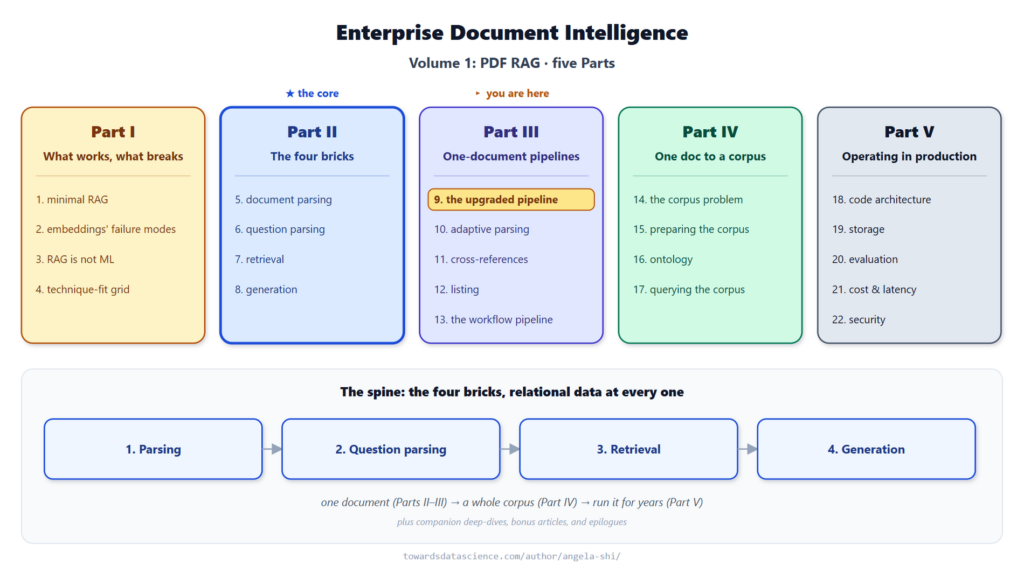 where this article sits: a companion to Article 9 (the upgraded pipeline), in Part III - Image by author
📓 The runnable notebook for this article is on GitHub : doc-intel/notebooks-vol1. It runs the naive baseline and the upgraded
pdf_qa side by side on each document below, prints both answers with their confidence, and reproduces every cross in the figures on your own machine.
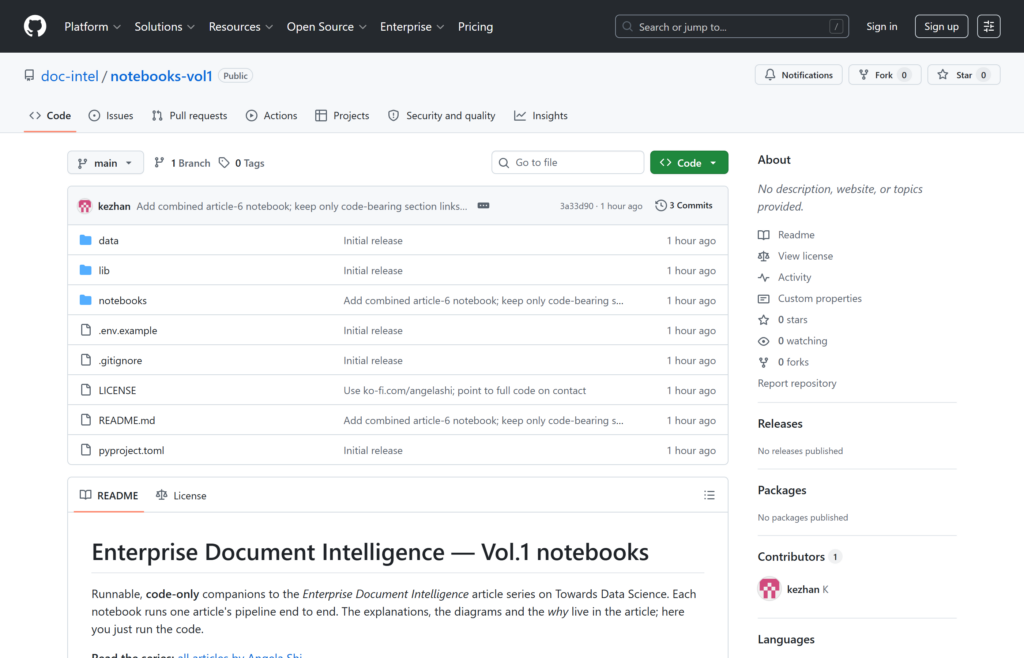 The public companion-code repo at doc-intel/notebooks-vol1 - Image by author
1. The naive baseline, brick by brick
The baseline is the 100-line pipeline from Article 1 (minimal RAG): parse the PDF, turn the question into keywords, keep the top few pages by match, ask the model to answer. On a short, clean, prose paper it works, and Article 9’s own tests confirmed it: on Attention Is All You Need and the RAG paper, naive and upgraded both answer correctly.
The upgraded pipeline is the same four bricks, each with a tighter contract: parsing returns a relational line_df instead of flat text, question parsing expands the query into the document’s vocabulary, retrieval routes on the table of contents, generation returns a typed answer. A naive RAG runs the loose version of every brick. The gap opens exactly where each loose brick hands the model the wrong thing. Each section below isolates one brick: it swaps that brick for its naive version and leaves the others reasonable, so the failure, and the fix, belong to the brick named in the heading.
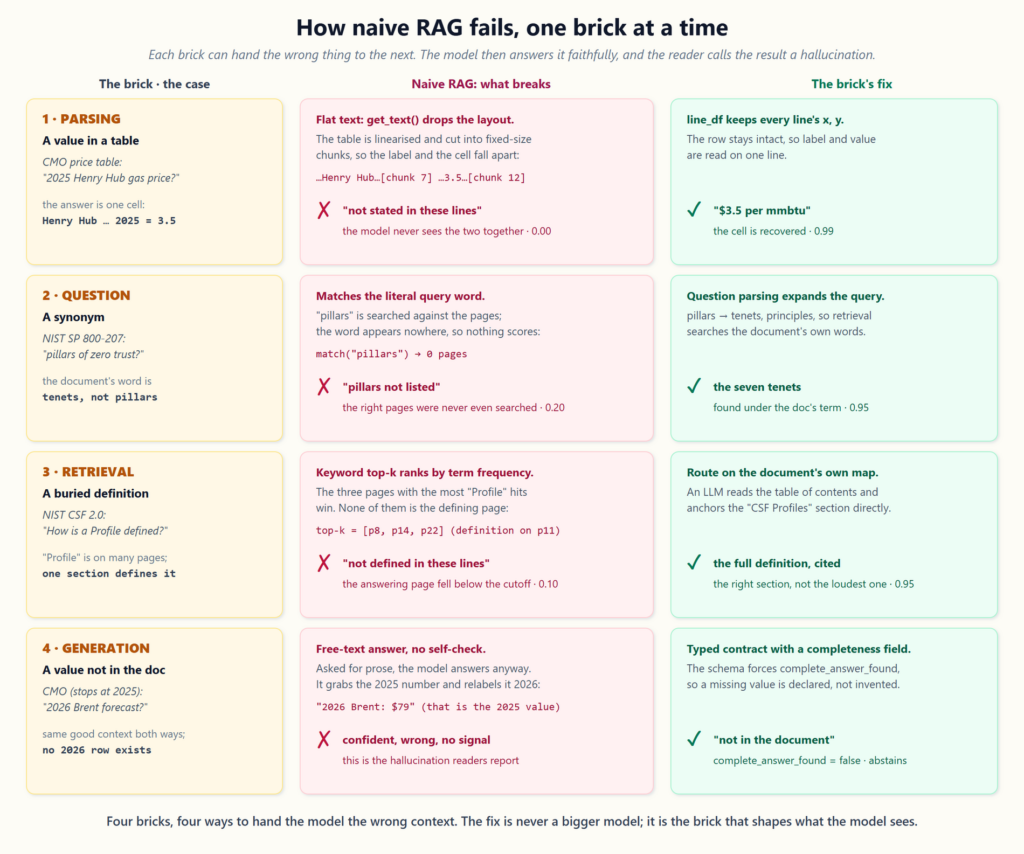 The same symptom, a confident wrong answer, arrives four ways, one per brick, each closed by a different contract - Image by author
Read it top to bottom: the same symptom, a confident wrong answer, arrives four different ways, and a different brick closes each. The rest of the article walks the four, each on a real document.
2. Parsing: a table flattened into noise
Document: World Bank Commodity Markets Outlook (a report built around price tables). Question: What is the 2025 annual average price forecast for U.S. natural gas (Henry Hub)?
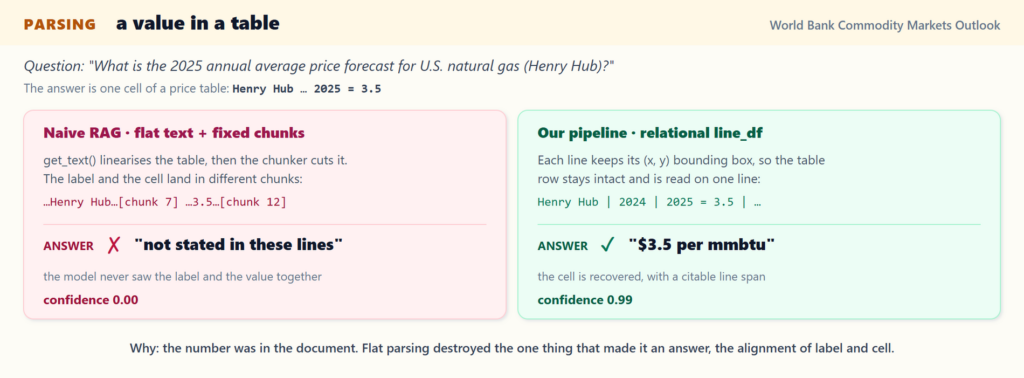 Real runs on the same table question: what each pipeline does, the answer it returns, and why - Image by author
A naive pipeline parses a PDF the common way: dump flat text with
get_text() and cut it into fixed-size chunks. That is fine for prose and fatal for tables. A price table is a grid; flat extraction linearises it, and a fixed-size chunker then cuts the stream wherever the character budget runs out. The row label Henry Hub lands in one chunk and its 3.5 cell in another. Retrieval hands the model chunks that never carry both, and it answers honestly: “not stated in these lines,” confidence 0.00.
Nothing was hallucinated. The number was in the document; the parser destroyed the one thing that made it an answer, the alignment between the label and the cell.
The fix is relational parsing. Instead of flat text, the upgraded brick returns a line_df: one row per text line, each with its bounding box. The table’s row stays intact, the model reads Henry Hub and 3.5 on the same line, and returns “$3.5 per mmbtu” at confidence 0.99. This is the whole argument of the parsing brick (Article 5): stop returning flat text, keep the relational shape the answer lives in.
3. Question: a word the document never uses
Document: NIST SP 800-207, Zero Trust Architecture. Question: What are the pillars of zero trust architecture?
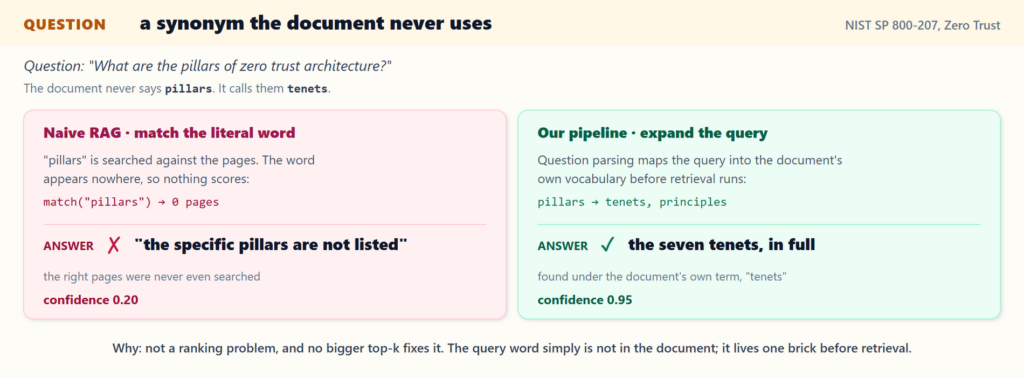 Real runs on the same question: what each pipeline does, the answer it returns, and why - Image by author
The document never uses the word pillars. It calls them tenets. A naive pipeline searches the pages for the query’s own words, pillars scores against nothing, and the model reports “the specific pillars are not listed,” confidence 0.20. The answer is right there, under a different name; the right pages were never even searched.
This is not a ranking problem, and no bigger top-k fixes it: the query word simply is not in the document. It is a vocabulary problem, and it lives one brick before retrieval, in question parsing. The user’s word and the document’s word are synonyms the raw string cannot bridge.
The fix is question parsing. Before retrieval runs, the brick normalizes and expands the query, mapping domain synonyms (pillars → tenets , principles) so retrieval searches for the words the document actually uses. It then anchors the tenets section, and generation returns all seven at confidence 0.95 , noting the document’s own term. The same expansion lets a user ask about a dog and match a policy that only ever says animal , the case Article 7quinquies (most RAG hallucinations are retrieval failures) walks in detail.
4. Retrieval: the answer below the cutoff
Document: NIST Cybersecurity Framework 2.0 (32 pages, native table of contents). Question: How is a Profile defined in CSF 2.0?
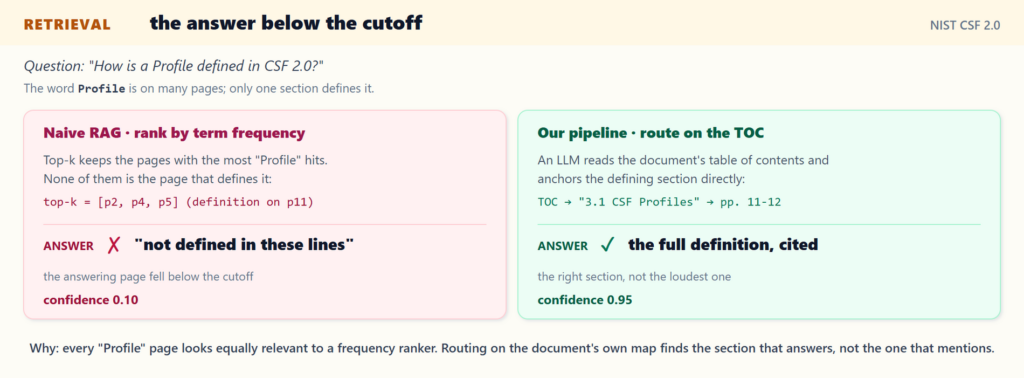 Real runs on the same question: what each pipeline does, the answer it returns, and why - Image by author
The word Profile is on many pages of CSF 2.0: it names a section, recurs in prose, heads examples. Only one section defines it. Keyword and cosine retrieval rank a page by how relevant it looks to the term, and every Profile page looks equally relevant. The naive pipeline keeps the top few by frequency, none of which is the defining page, and the model reports “not defined in these lines,” confidence 0.10. The answering page fell below the top-k cutoff.
The fix is retrieval that routes on structure. The upgraded brick reads the document’s own table of contents through a small LLM, sees the section titled CSF Profiles , and anchors retrieval there instead of on raw frequency. Generation sees the defining paragraph and returns the full definition with a citable span, confidence 0.95.
The same routing scales where naive retrieval gets worse. On the 400-plus-page NIST SP 800-53 control catalog, asked for the single AU-2 Event Logging control, naive retrieval dilutes it past the cutoff among a thousand near-identical siblings and returns “NA” at 0.00 ; the router locates the AU family and the AU-2 entry directly and returns the full requirement, clause by clause, at 0.98. Routing on structure does not degrade as the document grows; ranking on frequency does.
5. Generation: a confident answer with no self-check
Document: World Bank Commodity Markets Outlook, April 2024 (its forecasts stop at 2025). Question: What is the 2026 annual average price forecast for crude oil (Brent)?
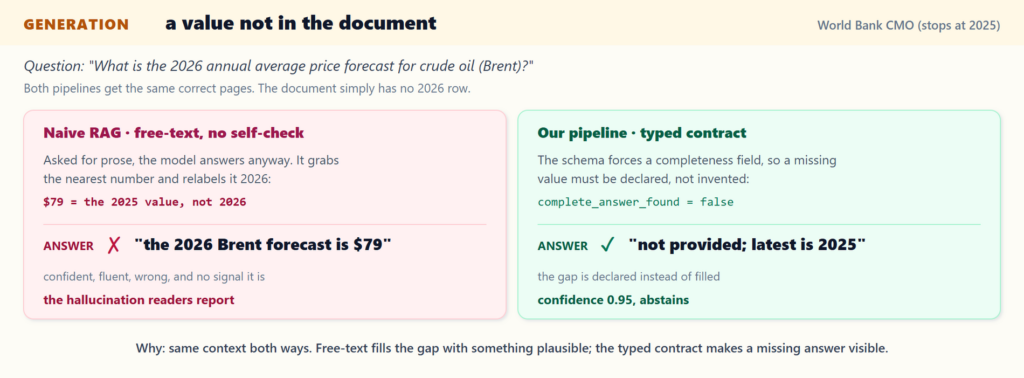 Real runs on the same question: what each pipeline does, the answer it returns, and why - Image by author
This time both pipelines retrieve the same, correct context: the energy pages with the price table. The document simply has no 2026 row. A naive pipeline’s generation brick asks the model for a free-text answer, and a free-text model asked a question tends to answer. It grabs the nearest number, the 2025 value of $79, and returns “the 2026 Brent forecast is $79 per barrel” , confident, fluent, and wrong. Nothing in a prose answer could have said “this is not in the document.” This is the hallucination readers report, and it happened at the last brick, with good context in hand.
The fix is a typed generation contract. The upgraded brick does not ask for prose; it asks for a schema with a
complete_answer_found field the model must set, an evidence span it must cite, and a confidence it must justify. Faced with a value that is not in the lines, the model cannot quietly fill the gap: it sets complete_answer_found: false and returns “the 2026 forecast is not provided; the latest is 2025.” The generation brick does not make the answer smarter. It makes a missing or partial answer visible, so a wrong one cannot ship as done. The same complete_answer_found field guards partial answers in general: whenever retrieval surfaces only part of what the question asked, it is the difference between shipping a fragment as if it were whole and flagging the gap.
6. One root, four doors
The four failures are one thing seen four ways. In none of them did the model invent from nothing. Each time it answered the context it was handed, faithfully, and the context was wrong: a table the parser scrambled, pages found for a word the document never uses, the answering page left below the cutoff, or a value that was never there and got filled in anyway. The label hallucination points at the model; the cause was a brick upstream.
The common fix is not a better prompt, a bigger model, or a larger top-k. It is context engineering , one contract per brick: keep the document’s relational shape (parsing), search in the document’s own vocabulary (question), route on the document’s own map (retrieval), and bind the answer to a typed, checkable contract (generation). Get the context right and a confident wrong answer has nowhere to come from, because the model is no longer being asked to answer the wrong context.
Two honest caveats. First, naive RAG is not always wrong: on short, clean, prose documents it keeps up, and the honest figure in Article 9 shows it. The gap opens exactly where enterprise documents live: tables, house vocabulary, length, structure. Second, these four crosses are the ones that held up. We ran the naive baseline and the upgraded pipeline on many more (document, question) pairs, and where naive did fine we say so rather than manufacture a failure. Each cross above is a real run, not a manufactured one.
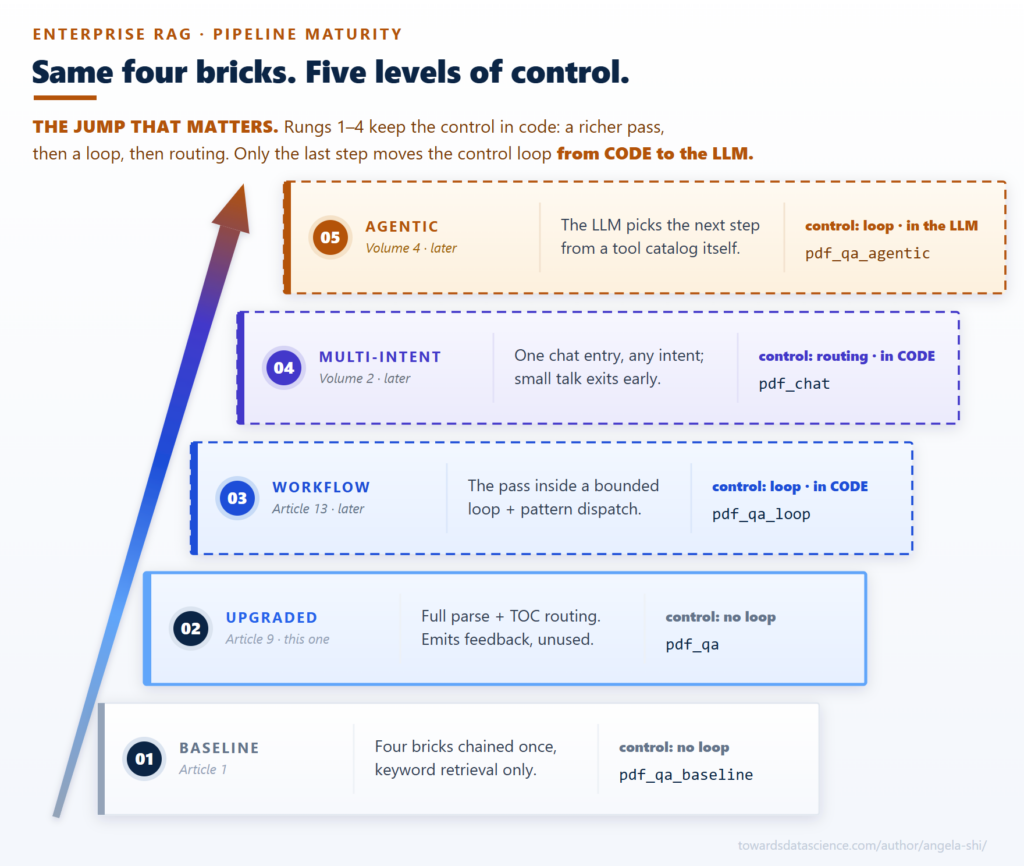 The upgraded pipeline is rung 2 of 5; getting the context right is what every rung above builds on - Image by author
7. Sources and further reading
The failure cases are real runs of the naive baseline (pdf_qa_baseline, plus a flat-chunk parser and a free-text generator for the parsing and generation bricks) against the upgraded pdf_qa (Article 9); each one is a real run, reproducible in the companion notebook, not an assumed result. The responses.parse(text_format=Schema) pattern behind the typed answer uses OpenAI’s Structured Outputs.
Earlier in the series:
- Document Intelligence: series intro. What the series builds, brick by brick, and in what order.
- The minimal Enterprise RAG that never lies about its source: PDF in, highlighted answer out. The naive four-brick baseline this article stress-tests.
- Retrieval is filtering, not search: a mental model for enterprise RAG. Retrieval reframed as filtering, the idea behind TOC routing.
- Most RAG hallucinations are retrieval failures (Article 7quinquies, link to come). The same argument at the retrieval level, on one document, including the vocabulary-mismatch case.
- A production RAG pipeline for PDFs: relational parsing, TOC retrieval, typed answers (Article 9, link to come). The upgraded pipeline these cases run on.
Documents used (all openly licensed):
- World Bank, Commodity Markets Outlook, April 2024. The price-table parsing case (section 2) and the absent-value generation case (section 5). CC BY 3.0 IGO.
- NIST, Zero Trust Architecture, SP 800-207, August 2020. The vocabulary-mismatch case (section 3). US Government work, public domain in the US.
- NIST, The NIST Cybersecurity Framework (CSF) 2.0, NIST CSWP 29, February 2024 (DOI 10.6028/NIST.CSWP.29). The buried-definition retrieval case (section 4). US Government work, public domain in the US.
- NIST, Security and Privacy Controls for Information Systems and Organizations, SP 800-53 Rev. 5. The diluted-control retrieval case at scale (section 4). US Government work, public domain in the US.
Register Now to Continue Reading
Unlock Towards Data Science with a Free Account
All articles on Towards Data Science are available to registered users. Create a free account today to access this article and thousands more.
Register for freeSign in to your account
 Written By
See all from Angela and Kezhan Shi
Context EngineeringDocument ProcessingMachine LearningRagRag Architecture
Share This Article
Towards Data Science is a community publication. Submit your insights to reach our global audience and earn through the TDS Author Payment Program.
Write for TDS
Related Articles
Artificial Intelligence
In this article we will explore why 128K tokens and more models can't fully replace using RAG.
Jérôme DIAZ
December 12, 20247 min read
Machine Learning
In this article, an advanced method called the FP Growth algorithm will be revealed. We will walk through the whole process of the FP...
Chonyy
October 30, 20208 min read
Machine Learning
With demos, our new solution, and a video
Vadim Arzamasov
August 16, 20249 min read
Artificial Intelligence
Essential pillars of statistics and data science
Dario Radečić
August 29, 20207 min read
Machine Learning
Extracting place names and assigning coordinates - Tutorial
Abdishakur
June 11, 20204 min read
Deep Learning
From Data to Product Recommendations
Mina Ghashami
July 31, 202417 min read
Artificial Intelligence
Drastically Increment Your Value Contribution and Business Understanding with this Must-Read Book
Victor Roman
December 14, 20206 min read
Large Language Models
What I think about the progress and shortcomings after practice
Peng Qian
December 17, 202415 min read
Artificial Intelligence
Intelligently synergizing dynamic programming and Monte Carlo algorithms
Slava Efimov
July 13, 202416 min read
Your home for data science and AI. The world's leading publication for data science, data analytics, data engineering, machine learning, and artificial intelligence professionals.
Subscribe to Our NewsletterWrite For TDS•About•Advertise•Privacy Policy•Terms of Use
© Insight Media Group, LLC 2026•The New Stack•roadmap.sh•Creator Network
Recommended Articles
Close