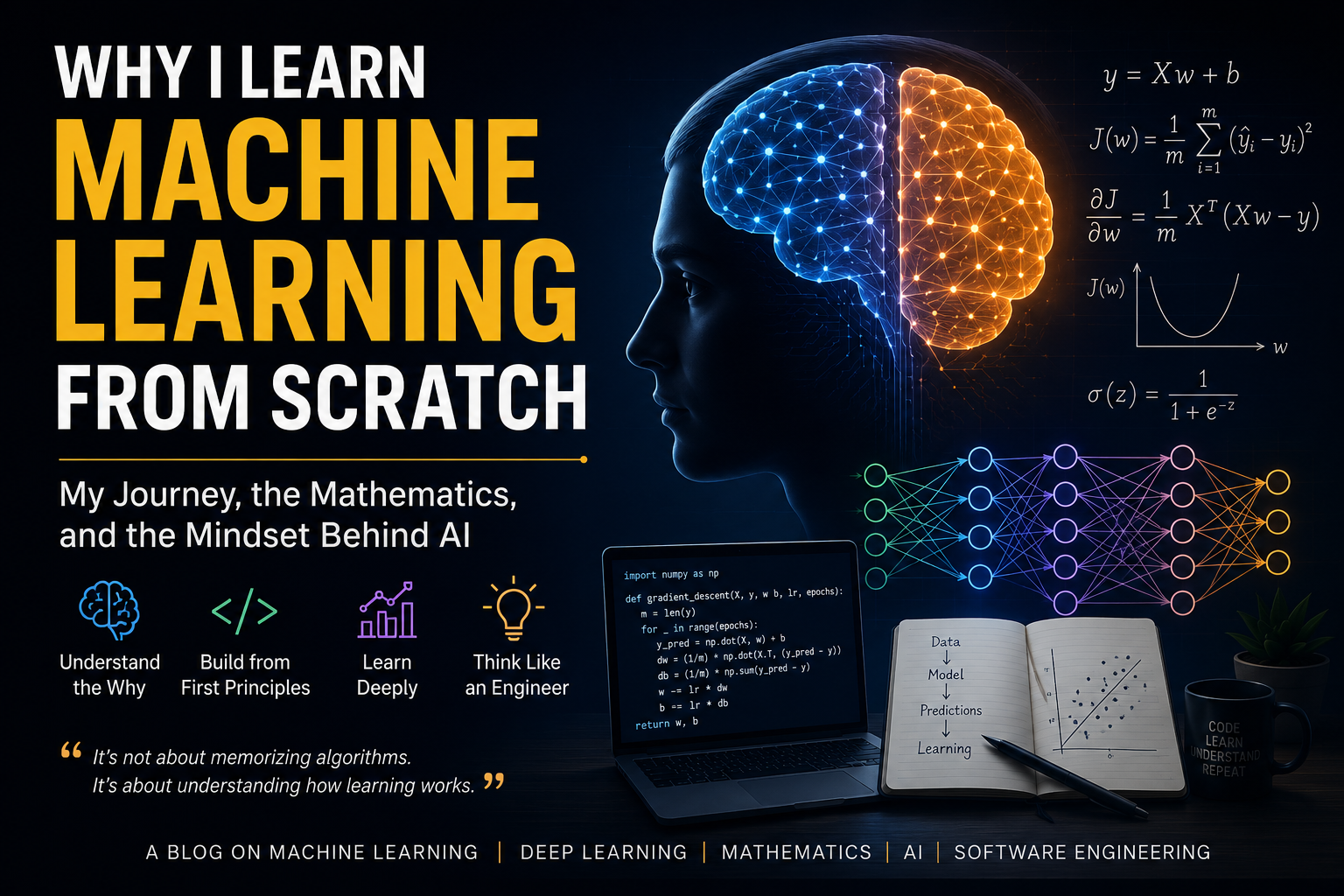
"Why am I learning all this mathematics?"
That question haunted me every time I sat down to learn Machine Learning.
I wasn't intimidated by Python. I enjoyed writing code, experimenting with libraries, and building small projects. But every tutorial seemed to begin with something I wasn't prepared for—linear algebra, calculus, probability, optimization, gradients, vectors, and matrices.
I kept wondering:
"Do I really need all of this just to build AI?"
If you've ever started learning Machine Learning, you've probably had the same thought.
You open a tutorial expecting to teach a computer how to think.
Instead, you're greeted by pages of mathematical equations that seem completely disconnected from the code you're trying to write.
Somewhere between the mathematics and the implementation, the excitement begins to fade.
I know that feeling because I lived it.
Like many beginners, I believed that learning Machine Learning meant learning frameworks. I spent countless hours working with Python, NumPy, Pandas, scikit-learn, and TensorFlow. My code executed successfully. My models trained. The predictions looked reasonable.
From the outside, everything seemed to be working.
But there was one problem.
If someone had stopped me and asked,
"How does a machine actually learn?"
I wouldn't have known how to answer.
I could build models.
I could follow tutorials.
I could reproduce projects.
But I couldn't explain why any of it worked.
That realization was frustrating.
Every course taught me what to write.
Very few taught me why I was writing it.
Without realizing it, I had fallen into a common trap.
I wasn't learning Machine Learning.
I was learning how to use Machine Learning.
There's a huge difference.
Eventually, I stopped learning altogether.
Not because Machine Learning was too difficult.
But because I felt like I was building something I didn't truly understand.
Months later, I decided to start over.
This time, I made myself one promise.
I wouldn't memorize another algorithm until I understood why it existed.
Instead of asking,
"How do I implement this algorithm?"
I started asking a completely different question:
"If I were a computer, how would I learn from experience?"
That single question changed everything.
Rather than looking at Machine Learning as lines of Python code, I started comparing it with something I experience every day—the human brain.
Suddenly, concepts that once felt overwhelming became surprisingly intuitive.
Our experiences became training data.
Our memories became stored knowledge.
Our mistakes became feedback.
Every decision we make is influenced by patterns we've learned throughout our lives, just as Machine Learning models improve by learning patterns from data.
For the first time, Machine Learning no longer felt like magic.
It felt like a mathematical explanation of how learning itself works.
Then came an even bigger realization.
For years, I believed mathematics was just another academic subject—a collection of formulas I'd memorize for an exam and forget a few weeks later.
I couldn't have been more wrong.
Machine Learning showed me that mathematics isn't just something we study.
It's the language we use to describe intelligence.
Every recommendation on YouTube.
Every face recognized by your phone.
Every movie suggested by Netflix.
Every translated sentence.
Every AI-generated image.
Every prediction made by a Machine Learning model.
Behind each of these is mathematics quietly describing patterns hidden inside data.
The formulas I once tried to avoid suddenly had purpose.
I stopped memorizing equations.
I started understanding ideas.
And that changed everything.
It transformed the way I approach Machine Learning, Software Engineering, and learning itself.
It also inspired me to build Machine Learning algorithms from scratch.
Not because libraries like TensorFlow, PyTorch, or scikit-learn aren't incredible—they absolutely are.
But because rebuilding the fundamentals forces you to understand why every neuron, every weight, every activation function, every loss function, and every optimization step exists.
When you understand the foundations, frameworks stop feeling like magic.
They become tools.
That philosophy became the foundation of this blog.
This isn't a place where I'll simply show you how to use another library or copy code from a tutorial.
Instead, we'll explore the intuition behind Machine Learning.
We'll build algorithms from scratch.
We'll connect mathematics with real-world ideas.
We'll break complex concepts into simple, understandable pieces.
And most importantly, we'll always ask "Why?" before "How?"
Whether you're taking your first steps into AI or you're an experienced engineer who enjoys understanding systems from first principles, I hope you'll find something valuable here.
Because learning Machine Learning isn't just about teaching computers to learn.
It's about learning how to think differently yourself.
Welcome to the journey.