保留正文与补采附件。源页面当前未重新核验;具体限制见交付清单。
 We value your privacy
We use cookies to enhance your browsing experience, serve personalised ads or content, and analyse our traffic. By clicking "Accept All", you consent to our use of cookies.
Customise Reject All Accept All
Customise Consent Preferences
 We use cookies to help you navigate efficiently and perform certain functions. You will find detailed information about all cookies under each consent category below.
The cookies that are categorised as "Necessary" are stored on your browser as they are essential for enabling the basic functionalities of the site. ... Show more
NecessaryAlways Active
Necessary cookies are required to enable the basic features of this site, such as providing secure log-in or adjusting your consent preferences. These cookies do not store any personally identifiable data.
-
Cookie
BCTempID
-
Duration
10 minutes
-
Description
No description available.
-
Cookie
__cf_bm
-
Duration
1 hour
-
Description
This cookie, set by Cloudflare, is used to support Cloudflare Bot Management.
-
Cookie
AWSALBCORS
-
Duration
7 days
-
Description
Amazon Web Services set this cookie for load balancing.
-
Cookie
_cfuvid
-
Duration
session
-
Description
Cloudflare sets this cookie to track users across sessions to optimize user experience by maintaining session consistency and providing personalized services
-
Cookie
li_gc
-
Duration
6 months
-
Description
Linkedin set this cookie for storing visitor's consent regarding using cookies for non-essential purposes.
-
Cookie
__hssrc
-
Duration
session
-
Description
This cookie is set by Hubspot whenever it changes the session cookie. The __hssrc cookie set to 1 indicates that the user has restarted the browser, and if the cookie does not exist, it is assumed to be a new session.
-
Cookie
__hssc
-
Duration
1 hour
-
Description
HubSpot sets this cookie to keep track of sessions and to determine if HubSpot should increment the session number and timestamps in the __hstc cookie.
-
Cookie
wpEmojiSettingsSupports
-
Duration
session
-
Description
WordPress sets this cookie when a user interacts with emojis on a WordPress site. It helps determine if the user's browser can display emojis properly.
-
Cookie
BCSessionID
-
Duration
1 year 1 month 4 days
-
Description
Blueconic sets this cookie as a unique identifier for the BlueConic profile.
-
Cookie
_octo
-
Duration
1 year
-
Description
No description available.
-
Cookie
logged_in
-
Duration
1 year
-
Description
No description available.
-
Cookie
__Secure-YEC
-
Duration
past
-
Description
YouTube sets this cookie to stores the user's video player preferences using embedded YouTube video
-
Cookie
__eoi
-
Duration
6 months
-
Description
Description is currently not available.
-
Cookie
AWSALBTGCORS
-
Duration
7 days
-
Description
No description available.
-
Cookie
login-status-p
-
Duration
past
-
Description
Description is currently not available.
-
Cookie
AWSALBTG
-
Duration
7 days
-
Description
No description available.
-
Cookie
csrf_token
-
Duration
session
-
Description
No description available.
-
Cookie
token_v2
-
Duration
1 day
-
Description
Description is currently not available.
-
Cookie
D
-
Duration
1 year
-
Description
Description is currently not available.
-
Cookie
PHPSESSID
-
Duration
session
-
Description
This cookie is native to PHP applications. The cookie stores and identifies a user's unique session ID to manage user sessions on the website. The cookie is a session cookie and will be deleted when all the browser windows are closed.
-
Cookie
VISITOR_PRIVACY_METADATA
-
Duration
6 months
-
Description
YouTube sets this cookie to store the user's cookie consent state for the current domain.
-
Cookie
cookietest
-
Duration
session
-
Description
The cookietest cookie is typically used to determine whether the user's browser accepts cookies, essential for website functionality and user experience.
-
Cookie
__Host-airtable-session
-
Duration
1 year
-
Description
This cookie is used to enable us to integrate the services of Airtable.
-
Cookie
__Host-airtable-session.sig
-
Duration
1 year
-
Description
This cookie is used to enable us to integrate the services of Airtable.
-
Cookie
m
-
Duration
1 year 1 month 4 days
-
Description
Stripe sets this cookie for fraud prevention purposes. It identifies the device used to access the website, allowing the website to be formatted accordingly.
-
Cookie
BIGipServer*
-
Duration
session
-
Description
Marketo sets this cookie to collect information about the user's online activity and build a profile about their interests to provide advertisements relevant to the user.
-
Cookie
__cfruid
-
Duration
session
-
Description
Cloudflare sets this cookie to identify trusted web traffic.
-
Cookie
_GRECAPTCHA
-
Duration
6 months
-
Description
Google Recaptcha service sets this cookie to identify bots to protect the website against malicious spam attacks.
-
Cookie
__Secure-YNID
-
Duration
6 months
-
Description
Google cookie used to protect user security and prevent fraud, especially during the login process.
-
Cookie
cookieyes-consent
-
Duration
1 year
-
Description
CookieYes sets this cookie to remember users' consent preferences so that their preferences are respected on subsequent visits to this site. It does not collect or store any personal information about the site visitors.
Functional
Functional cookies help perform certain functionalities like sharing the content of the website on social media platforms, collecting feedback, and other third-party features.
-
Cookie
lidc
-
Duration
1 day
-
Description
LinkedIn sets the lidc cookie to facilitate data center selection.
-
Cookie
brw
-
Duration
1 year
-
Description
No description available.
-
Cookie
brwConsent
-
Duration
5 minutes
-
Description
Description is currently not available.
-
Cookie
WMF-Uniq
-
Duration
1 year
-
Description
Description is currently not available.
-
Cookie
loom_anon_comment
-
Duration
1 year
-
Description
No description available.
-
Cookie
loom_referral_video
-
Duration
session
-
Description
Description is currently not available.
-
Cookie
VISITOR_INFO1_LIVE
-
Duration
6 months
-
Description
A cookie set by YouTube to measure bandwidth that determines whether the user gets the new or old player interface.
-
Cookie
yt-remote-connected-devices
-
Duration
Never Expires
-
Description
YouTube sets this cookie to store the user's video preferences using embedded YouTube videos.
-
Cookie
ytidb::LAST_RESULT_ENTRY_KEY
-
Duration
Never Expires
-
Description
The cookie ytidb::LAST_RESULT_ENTRY_KEY is used by YouTube to store the last search result entry that was clicked by the user. This information is used to improve the user experience by providing more relevant search results in the future.
-
Cookie
yt-remote-device-id
-
Duration
Never Expires
-
Description
YouTube sets this cookie to store the user's video preferences using embedded YouTube videos.
-
Cookie
yt-remote-session-name
-
Duration
session
-
Description
The yt-remote-session-name cookie is used by YouTube to store the user's video player preferences using embedded YouTube video.
-
Cookie
yt-remote-fast-check-period
-
Duration
session
-
Description
The yt-remote-fast-check-period cookie is used by YouTube to store the user's video player preferences for embedded YouTube videos.
-
Cookie
yt-remote-session-app
-
Duration
session
-
Description
The yt-remote-session-app cookie is used by YouTube to store user preferences and information about the interface of the embedded YouTube video player.
-
Cookie
yt-remote-cast-available
-
Duration
session
-
Description
The yt-remote-cast-available cookie is used to store the user's preferences regarding whether casting is available on their YouTube video player.
-
Cookie
yt-remote-cast-installed
-
Duration
session
-
Description
The yt-remote-cast-installed cookie is used to store the user's video player preferences using embedded YouTube video.
-
Cookie
cp_session
-
Duration
3 months
-
Description
Codepen sets this cookie for Help systems found in the website.
-
Cookie
loid
-
Duration
1 year 1 month 4 days
-
Description
This cookie is set by the Reddit. The cookie enables the sharing of content from the website onto the social media platform.
Analytics
Analytical cookies are used to understand how visitors interact with the website. These cookies help provide information on metrics such as the number of visitors, bounce rate, traffic source, etc.
-
Cookie
__hstc
-
Duration
6 months
-
Description
Hubspot set this main cookie for tracking visitors. It contains the domain, initial timestamp (first visit), last timestamp (last visit), current timestamp (this visit), and session number (increments for each subsequent session).
-
Cookie
hubspotutk
-
Duration
6 months
-
Description
HubSpot sets this cookie to keep track of the visitors to the website. This cookie is passed to HubSpot on form submission and used when deduplicating contacts.
-
Cookie
_ga
-
Duration
1 year 1 month 4 days
-
Description
Google Analytics sets this cookie to calculate visitor, session and campaign data and track site usage for the site's analytics report. The cookie stores information anonymously and assigns a randomly generated number to recognise unique visitors.
-
Cookie
ga*
-
Duration
1 year 1 month 4 days
-
Description
Google Analytics sets this cookie to store and count page views.
-
Cookie
__Host-psifi.analyticsTrace
-
Duration
6 hours
-
Description
Description is currently not available.
-
Cookie
__Host-psifi.analyticsTraceV2
-
Duration
6 hours
-
Description
Description is currently not available.
-
Cookie
_gh_sess
-
Duration
session
-
Description
GitHub sets this cookie for temporary application and framework state between pages like what step the user is on in a multiple step form.
-
Cookie
YSC
-
Duration
session
-
Description
YSC cookie is set by Youtube and is used to track the views of embedded videos on Youtube pages.
-
Cookie
ajs_anonymous_id
-
Duration
1 year
-
Description
This cookie is set by Segment to count the number of people who visit a certain site by tracking if they have visited before.
-
Cookie
vuid
-
Duration
1 year 1 month 4 days
-
Description
Vimeo installs this cookie to collect tracking information by setting a unique ID to embed videos on the website.
Performance
Performance cookies are used to understand and analyse the key performance indexes of the website which helps in delivering a better user experience for the visitors.
-
Cookie
AWSALB
-
Duration
7 days
-
Description
AWSALB is an application load balancer cookie set by Amazon Web Services to map the session to the target.
-
Cookie
acq
-
Duration
past
-
Description
Description is currently not available.
-
Cookie
acq.sig
-
Duration
past
-
Description
Description is currently not available.
-
Cookie
ptc
-
Duration
2 years
-
Description
No description available.
Advertisement
Advertisement cookies are used to provide visitors with customised advertisements based on the pages you visited previously and to analyse the effectiveness of the ad campaigns.
-
Cookie
muc_ads
-
Duration
1 year 1 month 4 days
-
Description
Twitter sets this cookie to collect user behaviour and interaction data to optimize the website.
-
Cookie
guest_id_marketing
-
Duration
1 year 1 month 4 days
-
Description
Twitter sets this cookie to identify and track the website visitor.
-
Cookie
guest_id_ads
-
Duration
1 year 1 month 4 days
-
Description
Twitter sets this cookie to identify and track the website visitor.
-
Cookie
personalization_id
-
Duration
1 year 1 month 4 days
-
Description
Twitter sets this cookie to integrate and share features for social media and also store information about how the user uses the website, for tracking and targeting.
-
Cookie
guest_id
-
Duration
1 year 1 month 4 days
-
Description
Twitter sets this cookie to identify and track the website visitor. It registers if a user is signed in to the Twitter platform and collects information about ad preferences.
-
Cookie
bcookie
-
Duration
1 year
-
Description
LinkedIn sets this cookie from LinkedIn share buttons and ad tags to recognize browser IDs.
-
Cookie
__Secure-ROLLOUT_TOKEN
-
Duration
6 months
-
Description
YouTube sets this cookie to manage feature rollout and experimentation. It helps Google control which new features or interface changes are shown to users as part of testing and staged rollouts, ensuring consistent experience for a given user during an experiment.
-
Cookie
yt.innertube::nextId
-
Duration
Never Expires
-
Description
YouTube sets this cookie to register a unique ID to store data on what videos from YouTube the user has seen.
-
Cookie
yt.innertube::requests
-
Duration
Never Expires
-
Description
YouTube sets this cookie to register a unique ID to store data on what videos from YouTube the user has seen.
-
Cookie
session_tracker
-
Duration
session
-
Description
This cookie is set by the Reddit. This cookie is used to identify trusted web traffic. It also helps in adverstising on the website.
-
Cookie
edgebucket
-
Duration
session
-
Description
Reddit sets this cookie to save the information about a log-on Reddit user, for the purpose of advertisement recommendations and updating the content.
-
Cookie
did
-
Duration
1 year
-
Description
Arbor sets this cookie to show targeted ads to site visitors.This cookie expires after 2 months or 1 year.
Uncategorised
Other uncategorised cookies are those that are being analysed and have not been classified into a category as yet.
No cookies to display.
Reject All Save My Preferences Accept All
Toggle SearchToggle Mobile Navigation
Publish AI, ML & data-science insights to a global community of data professionals.
Sign inSubmit an Article
LatestEditor's PicksNewsletterShipAI
Write For TDS
LinkedInXToggle Search
Social Media
Beyond the Scroll: How Social Media Algorithms Shape Your Reality
An intro to recommender systems
Ivo Bernardo
May 23, 202611 min read
 Recommendation from an AI Model - Image by Author
You’ve probably felt that your social media feed may know you too well.
When you browse social media, you notice a very typical behavior: you watch one video, and suddenly your timeline is flooded with more of the same. 5 years ago, it felt a bit like magic. But today, we talk about “ the algorithm ” as if it were a mysterious entity pulling strings in some Silicon Valley basement. The truth is much less dramatic, and much more interesting.
The algorithm isn’t inherently evil, it doesn’t sit there plotting your radicalisation. It’s just a chunk of code running cosine similarities and weighted averages, trying to predict what you’ll click on next. The trouble is what we interact with creates engagement. And the surest way to keep humans engaged turns out to be the worst way to keep them informed (rage-baits, fake news, or worse).
This post is about how recommendation engines work, why they tilt us toward echo chambers, and, because reading about a thing is never the same as seeing it, we’ll build one from scratch, point it at real news data, and watch the bubble form.
···
The Engagement Engine: How Recommenders Work
A social media algorithm is, at its heart, a curator. Its job is to sift through millions of posts and serve you the ones you’re most likely to engage with: click, watch, like, share, rage-comment on. It does this based on one word: data.
Every action you take is a clue:
- Which posts you linger on (even without clicking)
- Which videos you watch, and for how long
- Which accounts you follow, mute, or block
- Which topics you search for at 1 a.m.
Using machine learning, the algorithm spots patterns in this firehose of behaviour. It’s constantly asking the same question: what keeps this person on the platform longer? Remember that this is the largest goal of any social media company: keeping you on the platform longer.
Two classic techniques sit underneath most recommender systems:
- Collaborative filtering finds users who behave like you and recommends what they liked. If Alice and Bob both loved The Matrix and Inception , and Alice also loved Interstellar , the system nudges Interstellar to Bob. Pretty easy to understand.
- Content-based filtering looks at the characteristics of what you’ve liked and finds similar things. If you watch a lot of cooking videos, it surfaces more videos tagged “cooking”, “recipe”, or “knife skills”, they resemble what you already enjoyed.
Real platforms blend these methods with hundreds of other signals. But the core idea is the same: learn from your behaviour, predict what else might grab you.
The algorithm doesn’t intend to show you bad or false content. It optimises for engagement. And one of the surest ways to keep humans engaged is to tap into our emotions, especially the strong, negative ones. Or videos of cats.
···
Building a News Recommender on Real Data
Let’s stop talking about this abstractly and build one. We will use real anonymised click logs from Microsoft News. The dataset is called MIND (Microsoft News Dataset), published for academic research by Microsoft Research. This sample contains 50,000 users, over 51,000 English news articles across 17 categories (news, sports, finance, lifestyle, health, travel, and more), and 156,000+ real impression sessions, each recording what a user was shown and what they clicked on. The whole thing fits in about 30 lines of Python, although you don’t really need to now this inde detail:
python
import numpy as np
import pandas as pd
from scipy.sparse import csr_matrix
from sklearn.metrics.pairwise import cosine_similarity

# Build a sparse user × article matrix (1 = clicked, 0 = didn't)
matrix = csr_matrix((np.ones(len(clicks)), (user_rows, article_cols)),
                    shape=(n_users, n_articles))
def recommend(user_id, matrix, top_n=15, n_neighbors=50):
    """Find 50 most similar users and rank the articles
    they clicked that our user hasn't seen yet."""
    u = user_idx[user_id]

    # Cosine similarity between this user and everyone else
    sims = cosine_similarity(matrix[u], matrix).flatten()
    sims[u] = 0  # don't recommend to yourself

    # Take the top 50 most similar users
    top_neighbors = np.argsort(sims)[-n_neighbors:][::-1]
    weights = sims[top_neighbors]

    # Score articles by weighted sum of neighbour clicks
    scores = np.asarray(matrix[top_neighbors].T.dot(weights)).flatten()

    # Zero out articles the user already clicked
    scores[matrix[u].toarray().flatten() > 0] = 0

    # Return the top-scoring articles
    top_articles = np.argsort(scores)[-top_n:][::-1]
    return top_articles
Cosine similarity finds your fifty closest neighbours, people who click on the same kinds of articles you do. We take the articles they clicked, weight them by how similar each neighbour is to you, and serve the top fifteen. This is the base of what powers a billion-dollar industry.
···
Coswhat similarity?
Cosine similarity might sound like something out of a math textbook, but bear with me, it’s easier than it looks. To show you how it works, let’s take a quick detour.
Imagine the following data points scattered across two axes, mechanical vs. biological, and cuteness:
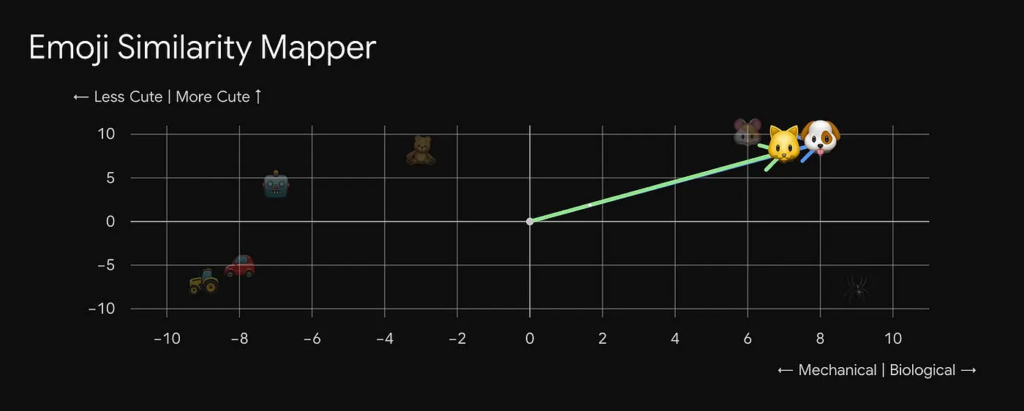 Emoji Similarity Mapper — Cat and Dog - Image by Author
Cosine similarity measures the angle between two arrows, each one starting from the origin (0,0) and pointing toward one of our data points. The smaller the angle between them, the more similar the two items are.
Think of it this way: if two arrows are almost pointing in the same direction, the items they represent share similar characteristics. Take cats and dogs as an example. Both score high on ‘biological’ and high on ‘cuteness’, so their arrows point in nearly the same direction and cosine similarity returns a value close to 1 (its maximum).
But if we compare cats with teddy bears, although they are similar on the cute dimension, they are different on the biological axis:
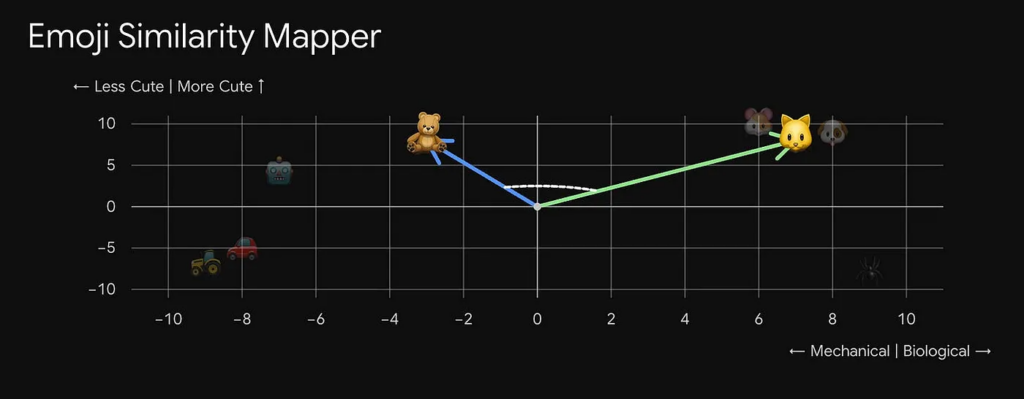 Emoji Similarity Mapper — Cat and Teddy Bear - Image by Author
If we compare cats with teddy bears, although they are similar on the cute dimension, they are different on the biological axis, a cat is fully biological, while a teddy bear scores zero.
This pulls their arrows apart.The angle between them widens, and cosine similarity returns a lower value, reflecting that despite sharing one trait, these two objects occupy very different regions of our space.
And, of course, comparing cats to cars, give almost no similarity as the arrows between both point in different directions:
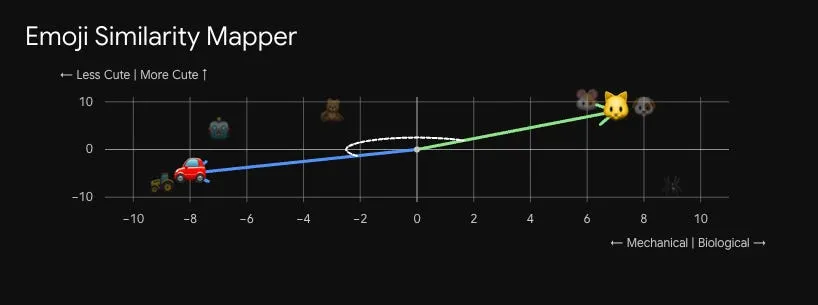 Emoji Similarity Mapper — Cat and Car - Image by Author
AI models use this kind of information to recommend content that is likely to trigger a similar response in you. Imagine a two-dimensional space where one axis captures how a video makes you feel (calm, entertained, outraged) and the other captures its topic. Every video gets plotted somewhere in that space.
If you click on a political video that makes you angry, and you watch it all the way through. The platform registers both dimensions: the topic and the emotional response. Using cosine similarity, it finds other videos whose ‘arrow’ points in the same direction (rage-baiting political videos) and serves them to you next. The more you engage, the more confidently the algorithm learns which corner of that space keeps you watching.
···
Meet User U92876 (let’s call it Joe): The Sports Fan
I picked a user from the MIND dataset whose reading history is pure sports, NFL power rankings, NBA trade rumours, MLB bans. It read twenty-five articles, all sport.
Let’s ask the recommender what to serve them:
 Joe’s recommended reading list - Image by Author
The category breakdown:
- 40% sports
- 13% news
- 13% autos
- 34% scattering of everything else.
The algorithm recognises this person’s sports habit and feeds it back, but it also serves a reasonably varied diet. There’s politics, entertainment, lifestyle, finance. Not bad, right?
Now watch what happens.
···
The Moment of Curiosity
I simulated something far more common than a massive rabbit-hole binge: a moment of idle curiosity.
Our sports fan didn’t spend hours reading politics. Looking at their initial feed, they simply clicked on three items that caught their eye:
- The news story about Joe Biden.
- The news story about Mitch McConnell.
- The video about Trump’s attacks.
Just three clicks in less than ten minutes of reading and watching. Three tiny breadcrumbs left for the algorithm and Joe goes on with his life during the rest of the day.
Now, if we ran those clicks through the basic 30 lines of Python code we wrote earlier, nothing much would happen. Mathematically, 25 historical sports clicks would still overpower 3 new political clicks. The algorithm would still see a user who is 89% interested in sports, and the feed would barely budge.
But here is the very important secret sauce of modern social media: Recency Weighting (or Time Decay).
Real algorithms don’t treat all your clicks equally as a click you made three years ago is practically ancient history; a click you made three minutes ago is gold. To keep you hooked in the current session, platforms apply a heavy multiplier to whatever you are doing recently .
A single line of code implements this in the algorithm we saw earlier. If we decide that the most recent clicks should carry up to 100 times more weight than older ones, we could write something like this:
python
time_decay_weights = np.array([0.1 if historical_click else 10.0 for click in user_history])
If we do this, let’s run the recommendations again:
 Joe’s new reading recommendation list - Image by Author
Here’s the damage that just 3 clicks have done to our Time Weighting recommendation system:
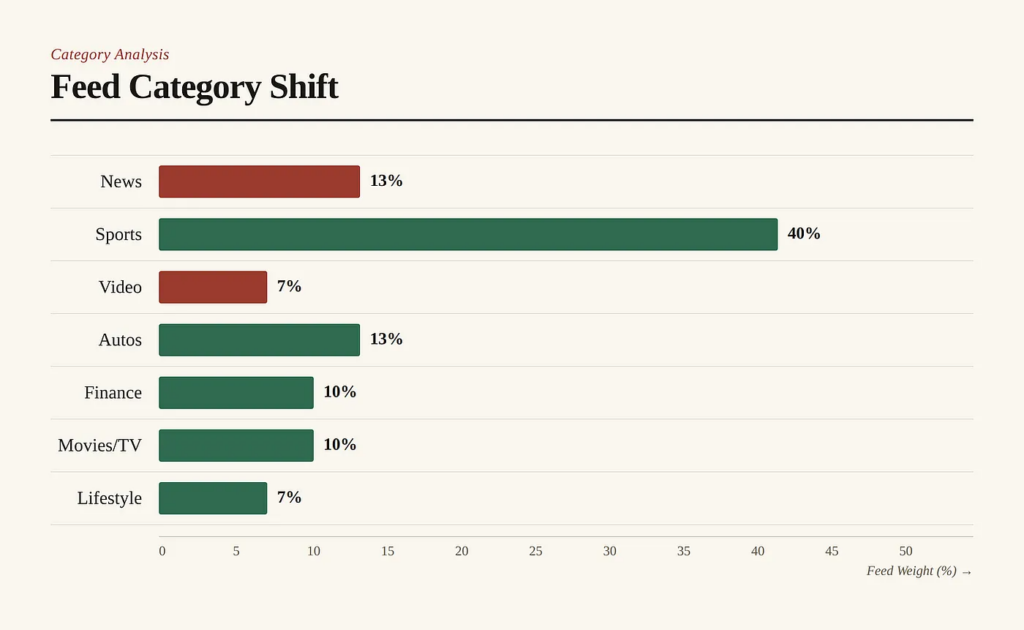 Feed Category Before - Image by Author
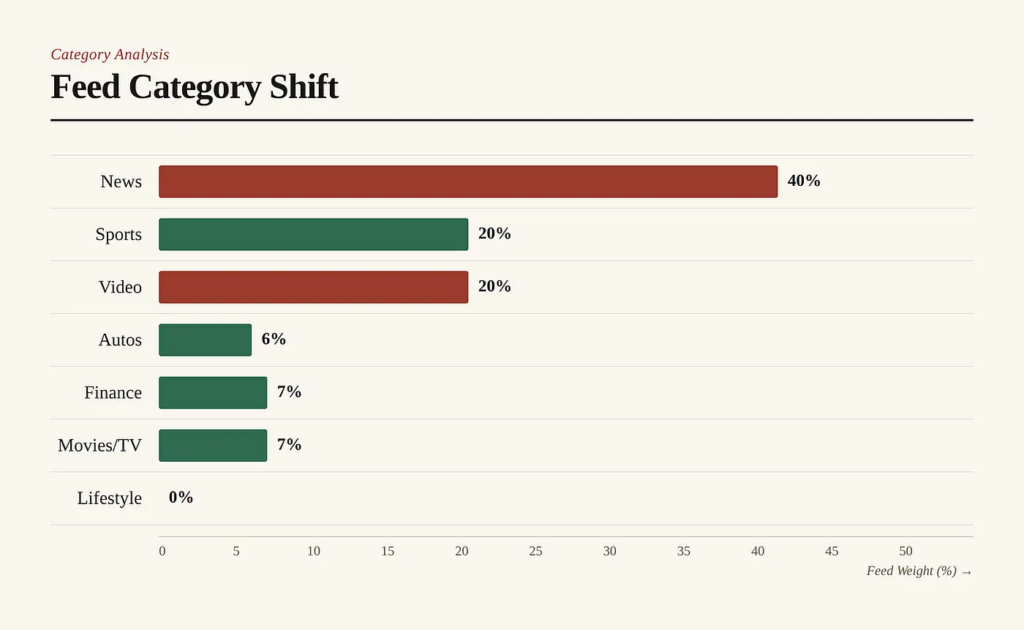 Feed Category Before - Image bu Author
Political news went from 13% to 40% of the feed. A 3x increase. From one evening of clicking and reading three pieces of news. Sports (the thing this person has read for years) can drop from the dominant category to second place. The algorithm didn’t pause to think “hold on, this person has 25 sports articles in their history, and one evening of politics doesn’t define them.”
It doesn’t think, it just recalculates time weighted similarity matrices, found a new set of neighbours and served what other users that clicked on this may enjoy.
Two things jump out:
- The speed. It may take one evening to flip a user’s entire feed composition. Real platforms recalculate faster than this demo as they update in real time. You probably notice this in your feed with ads related to products you’ve been searching lately.
- What disappears. This isn’t just about what the algorithm adds, but also about what it removes. The user’s informational diet didn’t just get more political, it got narrower. And narrower is the real danger here
Note: real platforms don’t publish their decay constants, so this is illustrative, not a measurement, but the mechanism is real and the direction is what matters. My 100x example is possibly an exaggeration of the recency bias.
···
What research tells us
You now know how clicks influence what the math of what the algorithm shows you next.
But this gets worse — content that makes us angry, fearful, or shocked glues us to the screen far better than content that makes us feel good or informed. Social media companies didn’t engineer this consciously, their algorithms simply discovered it.
A massive 2025 study analyzing the digital trace data of 25,000 SmartNews users found that humans possess a trait-level “negativity bias” when selecting news. Evolutionarily, we are hardwired to pay attention to threats, avoiding danger was critical to our ancestors’ survival. What happens when this ancient instinct meets modern machine learning? The study confirmed that personalized recommendation feeds take our inherent negativity bias and actively augment it.
Furthermore, data from researchers analyzing hundreds of millions of posts on platforms like Facebook and X (formerly Twitter) reveals that social media users are roughly 1.91 times more likely to share negative news links than positive ones. Negativity equals virality, and the outrage loop is born.
···
The Cognitive Toll: It’s Not Just What You Think, It’s How You Think
The impact of these algorithmic loops isn’t just about the type of content we consume; it’s about how it fundamentally alters our brains. A recent 2025 systematic review analyzing 71 studies and 98,299 participants of short-form video feeds (like TikTok, Instagram Reels, and YouTube Shorts) found profound cognitive consequences.
Increased engagement with these endless-scroll platforms is associated with poorer cognitive performance, specifically impacting our sustained attention and inhibitory control.
Psychologists point to a dual process of habituation and sensitization to explain this phenomenon. The rapid, high-stimulation nature of short videos desensitizes us to slower, more effortful tasks like reading a book or deep problem-solving. At the same time, the algorithm’s instant delivery of curated content sensitizes our brain’s reward system, reinforcing impulsive engagement patterns and encouraging the habitual seeking of instant gratification.
Heavy users of these platforms exhibit reduced electrophysiological activity during attention-demanding tasks. Some researchers even point to structural differences in key cognitive control regions, including the prefrontal cortex and striatal reward circuits, linked to this constant bombardment of highly rewarding algorithmic stimuli.
···
The Societal Cost
Due to mathematical matrices, each of us in our own personalised bubble of information.
In the short term, it’s annoying for most people. But zoom out and the picture darkens. When algorithms feed us content that confirms what we already believe, we experience confirmation bias on steroids.
These filter bubbles deepen the social divide we have today. We will continue to be extremely divided and there is no end in sight for this chasm.
Misinformation thrives in closed loops because false stories don’t get exposed to scrutiny outside the bubble. By the time a fact-check goes out, the original lie has done a lap around the platform and built a small army of believers.
And democracy, which depends on a shared baseline of reality and some willingness to argue in public, takes a hit when citizens occupy entirely different reality bubbles.
···
Reclaiming Your Feed
You’re not powerless here. The algorithm is responsive but there a couple of things you can do, that, although annoying, may take you out of your bubble.
The same mechanism that built your bubble can be used to widen it. Some practical move:
- Diversify the inputs. Actively follow a few sources outside your comfort zone. If you lean one way politically, follow some thoughtful voices from the other side.
- Reset periodically. Clear your watch history. Use “Not Interested” on suggestions that keep haunting you. Try the platform logged out, or in incognito, and notice how different the world looks without your data.
- Use chronological feeds. Most platforms still let you switch off the algorithmic ranking and just see posts from people you follow, in order.
- Pause before sharing. Every like, comment, and share is a vote for “more of this, please.” If something makes you furious, that’s exactly when the algorithm is most likely to be exploiting you.
- Limit the time. Set screen-time limits. Schedule offline hours. The less you depend on the feed for your information diet, the less power it has to shape what you believe.
Beyond the Bubble
I hope this blog post informed you on how these recommendation systems bubbles work. We built a recommender on real news data, and it took three clicks to flip a sports fan’s feed from 40% sports to 53% politics.
The first step to breaking free is simply being aware. Next time you find yourself in an online frenzy, take a breath and ask: Why am I seeing this? Who benefits from me reacting this way? The answer usually traces back to an algorithm doing its job, and that job is rarely “informing you.”
Stay informed, stay open-minded,
— Ivo
Register Now to Continue Reading
Unlock Towards Data Science with a Free Account
All articles on Towards Data Science are available to registered users. Create a free account today to access this article and thousands more.
Register for freeSign in to your account
 Written By
See all from Ivo Bernardo
AlgorithmsData ScienceMachine LearningRecommender SystemsSocial Media
Share This Article
Towards Data Science is a community publication. Submit your insights to reach our global audience and earn through the TDS Author Payment Program.
Write for TDS
Related Articles
Machine Learning
In real-life, seldom we have normal distribution data. It is skewed, missing data points or has outliers. Is HuberRegressor in...
Kaushik Choudhury
August 11, 20208 min read
Machine Learning
CubeTrack, for me, was an exercise in getting my hands dirty with active object tracking (AOT) and game engine supported deep...
Kirsten Crane
November 4, 202013 min read
Machine Learning
Review of the seminal paper and implementations to uncover the best option for your data
Tiago Toledo Jr.
November 23, 202110 min read
Programming
5 minute guide to UNION, EXCEPT and INTERSECT in SQL
Mike Huls
May 1, 20237 min read
Artificial Intelligence
Bayesian is helpful in the feeling of uncertainty for decision making.
Saurav Singla
September 10, 20205 min read
Artificial Intelligence
I present 4 publications from my research area: reinforcement learning. Let's discuss it!
Quentin Gallouédec
December 19, 20226 min read
Data Science
A high level overview of how personalised feed algorithms work
Kaushik Sureshkumar
December 19, 20205 min read
Data Science
A Visual Atlas of Popular Culture
Kiran Gershenfeld
December 31, 20217 min read
Data Science
Conquer your next DA Interview by using a framework to help you solve the technical challenge
Chloe Lubin
October 9, 20217 min read
Your home for data science and AI. The world's leading publication for data science, data analytics, data engineering, machine learning, and artificial intelligence professionals.
Subscribe to Our NewsletterWrite For TDS•About•Advertise•Privacy Policy•Terms of Use
© Insight Media Group, LLC 2026•The New Stack•roadmap.sh•Creator Network
Recommended Articles
Close