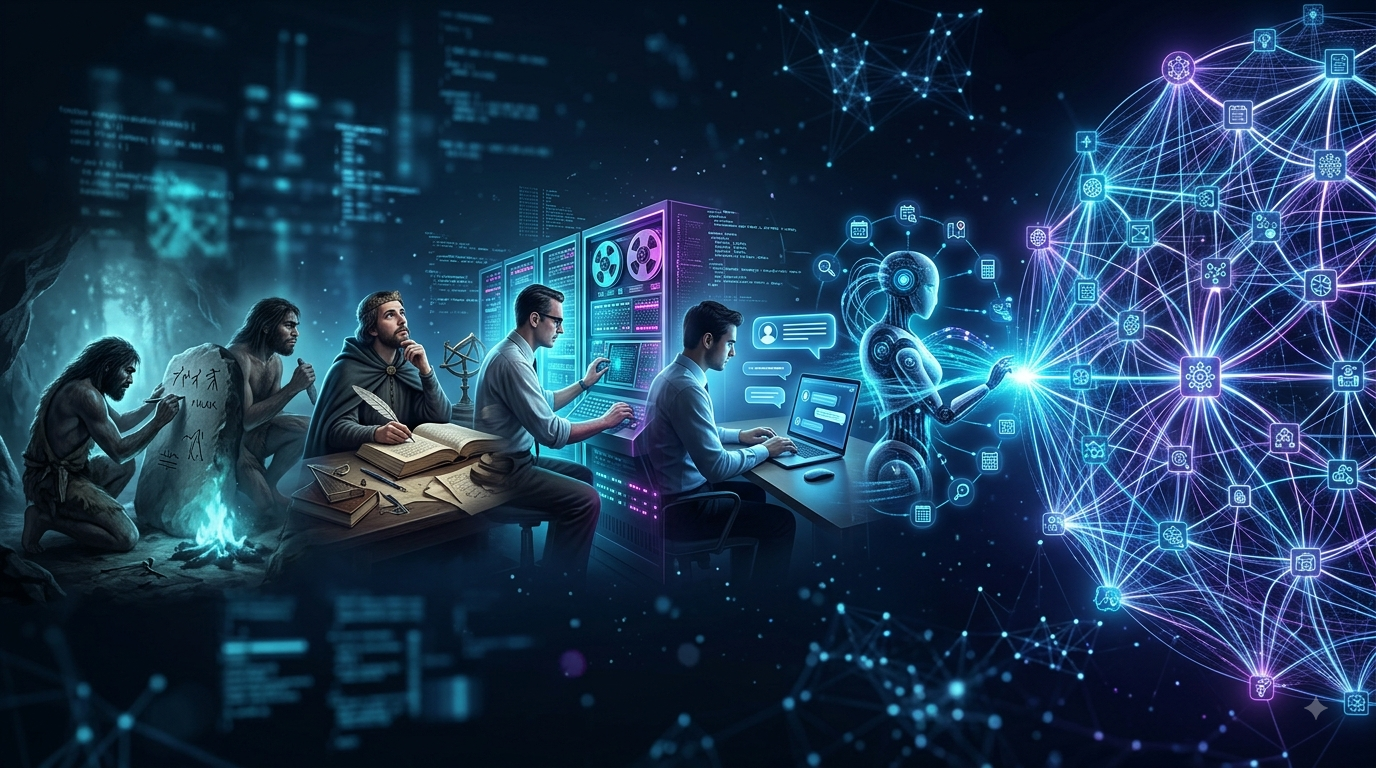
Prompt Engineering taught us how to talk to AI. Graph Engineering teaches us how to organize it.
Everyone is talking about prompts. The smartest teams are designing systems.
Prompt engineering is not actually dead.
In fact, prompt engineering remains an important skill.
But if you've spent any time building production AI systems, you've probably noticed something interesting.
The difference between a demo and a product is rarely the prompt.
The difference is the workflow.
And that is precisely why Graph Engineering is becoming one of the most important concepts in modern AI engineering.
This article is not about a new framework.
It is not about a new model. It is not about a new buzzword. It is about a shift in thinking.
A shift from asking:
How do I get the AI to answer better?
To asking:
How do I design the work around the AI?
That question changes everything.
The AI industry moves in waves.
In one year, everybody becomes obsessed with model size.
In another year, everybody becomes obsessed with prompts.
Then everyone discovers RAG.
Then agents.
Then MCP.
Then memory.
Then tool calling.
Then the next acronym arrives and the cycle repeats.
If you've been on LinkedIn recently, you've almost certainly seen a post that says something like:
I discovered a secret prompt that improves AI performance by 437%.
The prompt usually looks longer than a mortgage agreement.
It often starts with:
You are the world's leading expert...
Apparently, the fastest way to improve an LLM is through aggressive flattery.
The reality is usually less dramatic.
Great prompts help.
But the most successful AI applications are not successful because someone discovered a magic sentence.
They are successful because engineers designed reliable workflows around inherently probabilistic systems.
And that's a very different skill.
The first generation of AI applications was beautifully simple.
User
  ↓
LLM
  ↓
Answer
The main challenge was:
How do I ask better questions?
The community responded with:
Role prompting
Chain of thought
Few-shot prompting
XML outputs
JSON outputs
Deliberate reasoning instructions
Prompt engineering had a massive impact.
For the first time, engineers had a lever.
The wording genuinely mattered.
But prompt engineering has a ceiling.
You cannot prompt a model into knowing information it has never seen.
You cannot prompt your way out of missing context.
You cannot prompt your way out of yesterday's meeting notes if those notes aren't available.
Eventually we ran into the limitations of prompting.
And that led to the next era.
The industry realized something important.
Maybe the problem isn't intelligence.
Maybe the problem is information.
And that realization triggered the rise of Context Engineering.
User
  ↓
Retriever
  ↓
LLM
  ↓
Answer
Suddenly everyone was talking about:
Vector databases
Embeddings
RAG
Enterprise search
AI search
Long-term memory
Semantic retrieval
The question changed from:
How do I ask better questions?
To:
How do I give the AI better information?
This was a huge leap forward.
Applications could now answer questions using company data.
Policies.
Reports.
Knowledge bases.
Contracts.
Meeting summaries.
But eventually another limitation appeared.
Having information isn't the same thing as knowing what to do with it.
Imagine giving a junior analyst access to every document in your company.
Does that automatically make every decision correct?
Of course not.
Information is necessary but process is equally important.
Which brings us to the next era.
Graph Engineering asks a fundamentally different question.
Not:
How should I prompt?
Not:
What context should I retrieve?
But:
How should work flow through the system?
That might sound subtle.
It isn't.
It is the difference between building a chatbot and building an organization.
Consider this graph.
Question
      ↓
Planner
      ↓
 ┌───────────────┬───────────────┬───────────────┐
 Researcher A    Researcher B    Researcher C
 └───────────────┴───────────────┴───────────────┘
      ↓
Validator
      ↓
Reviewer
      ↓
Human Approval
      ↓
Final Answer
Notice something.
The model is no longer the product.
The workflow is the product.
That shift is the entire point.
Imagine opening a restaurant.
You hire one employee.
Then tell them to:
Cook
Serve
Manage inventory
Process payments
Handle complaints
Clean tables
Run marketing campaigns
You would never do this.
Yet this is exactly how many AI systems are architected.
User
 ↓
Super Agent
 ↓
Everything
We've effectively built the world's smartest overworked employee.
And then we wonder why things occasionally go wrong.
Real organizations scale through specialization.
Graph Engineering is essentially applying organizational thinking to AI systems.
One reason Graph Engineering feels intuitive to experienced engineers is because we have already lived through a similar evolution.
Years ago we built giant monoliths.
All business logic in one place.
One deployment. One application. One giant headache.
Then complexity grew.
The answer became:
Modules
APIs
Service boundaries
Microservices
Event-driven architectures
Graph Engineering feels remarkably similar.
The giant AI agent is basically the monolith of agentic systems.
It works..... Until the complexity becomes overwhelming.
Almost every project starts like this.
Version 1.
User
 ↓
LLM
 ↓
Answer
Then the business arrives.
Suddenly they want:
Permission controls
Citation validation
Confidence scoring
Audit logs
Memory
Escalation workflows
Governance
Now your architecture becomes:
Question
      ↓
Classifier
      ↓
Policy Check
      ↓
Retriever
      ↓
Answer Generator
      ↓
Citation Validator
      ↓
Confidence Checker
      ↓
Formatter
      ↓
Final Response
Congratulations.
You're not building a chatbot anymore.
You're building a workflow.
Let's imagine a CEO asks:
Should we launch a new AI product?
A single LLM can attempt to answer.
Or you can distribute responsibility.
Planner.
Market Research Agent.
Competitor Analysis Agent.
Finance Agent.
Risk Agent.
Reviewer Agent.
Human Decision Maker.
Notice how similar this structure is to an actual company. That's not an accident. Organizations evolved into specialized teams because specialization improves outcomes.
Graph Engineering applies that same logic to AI.
People often assume better models create better systems.
Sometimes they do.
But often the biggest improvement comes from workflow design.
Consider two scenarios.
Scenario A - A genius working completely alone.
Scenario B - A competent team with:
Planning
Review
Collaboration
Validation
Quality control
Who wins?
In many organizations, the team wins.
Not because any individual is smarter.
Because the system is stronger.
A well-designed graph can outperform a dramatically more complex prompt.
This is one of the biggest lessons in AI engineering.
Demos optimise for success. Production systems optimise for failure handling.
Demos ask:
Can it work?
Production asks:
What happens when it doesn't?
Examples:
Retrieval returns nothing.
The tool fails.
A database times out.
The confidence score is low.
A user asks an ambiguous question.
The model hallucinates.
Production systems must handle all of these.
Graph Engineering forces engineers to explicitly model failure paths.
And that makes systems significantly more reliable.
User
 ↓
Router
 ↓
Agent A | Agent B | Agent C
Best when requests belong to different domains.
Supervisor
     ↓
Workers
     ↓
Supervisor
Useful when coordination is required.
Task
 ↓
Worker Worker Worker Worker
 ↓
Merger
Excellent for research and summarization.
Draft
 ↓
Critic
 ↓
Improved Draft
Ideal for quality improvements.
Agent
 ↓
Human Approval
 ↓
Action
Critical for high-risk decisions.
These patterns often deliver far more value than endlessly improving prompts.
Now let's discuss the opposite problem.
Too many agents.
I've seen workflows that resemble someone losing a fight against a diagramming tool.
Planner
 ↓
Router
 ↓
Reasoner
 ↓
Researcher
 ↓
Reviewer
 ↓
Reflector
 ↓
Meta-Reflector
 ↓
Verifier
 ↓
Meta-Verifier
All for:
Summarize this PDF.
Congratulations.
You have successfully recreated enterprise bureaucracy inside a computer.
A useful rule.
Build the smallest graph that meaningfully improves quality.
More agents does not automatically mean better systems.
Sometimes it just means more places to fail.
Most companies are not training frontier models.
They're using the same foundation models as everyone else.
If everyone has access to similar intelligence, where does advantage come from?
The answer is workflow design.
Your moat becomes:
Processes
Validation
Governance
Retrieval strategy
Human oversight
Institutional knowledge
The model is increasingly becoming a commodity.
The workflow is becoming the differentiator.
I believe the future AI engineer will look less like a prompt writer and more like a systems architect.
They will think about:
Information flow
State
Memory
Orchestration
Human approvals
Observability
Evaluation
Instead of asking:
What's the perfect prompt?
They'll ask:
What's the right workflow?
That's a much more interesting question.
And frankly, a much harder one.
Not at all.
Prompt Engineering matters.
Context Engineering matters.
Graph Engineering matters.
Think of them as layers.
How you communicate.
What information is available.
How work moves.
You need all three.
But the center of gravity is shifting.
The future belongs to engineers who understand systems, not just prompts.
The AI industry spent years obsessed with answers.
Now we need to become obsessed with processes.
The winners of the next wave of AI will not necessarily have the smartest model.
They will have the smartest workflow.
Because intelligence alone is useful.
But intelligence combined with:
Planning
Validation
Memory
Coordination
Specialization
Human oversight
becomes transformative.
Graph Engineering is not really about making AI smarter.
It's about making AI work.
And after building software systems for years, one lesson keeps appearing again and again:
A good process often beats a brilliant individual.
Even when that individual happens to be an LLM.
[Why Graph Engineering Will 10x Your Claude/Codex](https://www.youtube.com/watchents\](https://www.anthropic.com/engineering/building-effectives://langchain-ai.github.ioon.langchain.com/)
[Microsoft AutoGengithub.io/autogen/]
[Crew://docs.crewai.com/]
[Prompt Engineering Guidee.ai/]
[Semantic Kernel Documentation](ntic-kernel)
[Retrieval-Augmented Generation (RAG) ps://arxiv.org/abs/2210.03629]
[Tree://arxiv.org/abs/2305.10601]
I write about Agentic AI, LangGraph, MCP, RAG systems, enterprise AI architecture, and the lessons learned from building real-world AI applications beyond demos.
#AIEngineering #AgenticAI #GraphEngineering #LangGraph #LLMs #RAG #SoftwareArchitecture #GenerativeAI