保留正文与补采附件。源页面当前未重新核验;具体限制见交付清单。
 We value your privacy
We use cookies to enhance your browsing experience, serve personalised ads or content, and analyse our traffic. By clicking "Accept All", you consent to our use of cookies.
Customise Reject All Accept All
Customise Consent Preferences
 We use cookies to help you navigate efficiently and perform certain functions. You will find detailed information about all cookies under each consent category below.
The cookies that are categorised as "Necessary" are stored on your browser as they are essential for enabling the basic functionalities of the site. ... Show more
NecessaryAlways Active
Necessary cookies are required to enable the basic features of this site, such as providing secure log-in or adjusting your consent preferences. These cookies do not store any personally identifiable data.
-
Cookie
BCTempID
-
Duration
10 minutes
-
Description
No description available.
-
Cookie
__cf_bm
-
Duration
1 hour
-
Description
This cookie, set by Cloudflare, is used to support Cloudflare Bot Management.
-
Cookie
AWSALBCORS
-
Duration
7 days
-
Description
Amazon Web Services set this cookie for load balancing.
-
Cookie
_cfuvid
-
Duration
session
-
Description
Cloudflare sets this cookie to track users across sessions to optimize user experience by maintaining session consistency and providing personalized services
-
Cookie
li_gc
-
Duration
6 months
-
Description
Linkedin set this cookie for storing visitor's consent regarding using cookies for non-essential purposes.
-
Cookie
__hssrc
-
Duration
session
-
Description
This cookie is set by Hubspot whenever it changes the session cookie. The __hssrc cookie set to 1 indicates that the user has restarted the browser, and if the cookie does not exist, it is assumed to be a new session.
-
Cookie
__hssc
-
Duration
1 hour
-
Description
HubSpot sets this cookie to keep track of sessions and to determine if HubSpot should increment the session number and timestamps in the __hstc cookie.
-
Cookie
wpEmojiSettingsSupports
-
Duration
session
-
Description
WordPress sets this cookie when a user interacts with emojis on a WordPress site. It helps determine if the user's browser can display emojis properly.
-
Cookie
BCSessionID
-
Duration
1 year 1 month 4 days
-
Description
Blueconic sets this cookie as a unique identifier for the BlueConic profile.
-
Cookie
_octo
-
Duration
1 year
-
Description
No description available.
-
Cookie
logged_in
-
Duration
1 year
-
Description
No description available.
-
Cookie
__Secure-YEC
-
Duration
past
-
Description
YouTube sets this cookie to stores the user's video player preferences using embedded YouTube video
-
Cookie
__eoi
-
Duration
6 months
-
Description
Description is currently not available.
-
Cookie
AWSALBTGCORS
-
Duration
7 days
-
Description
No description available.
-
Cookie
login-status-p
-
Duration
past
-
Description
Description is currently not available.
-
Cookie
AWSALBTG
-
Duration
7 days
-
Description
No description available.
-
Cookie
csrf_token
-
Duration
session
-
Description
No description available.
-
Cookie
token_v2
-
Duration
1 day
-
Description
Description is currently not available.
-
Cookie
D
-
Duration
1 year
-
Description
Description is currently not available.
-
Cookie
PHPSESSID
-
Duration
session
-
Description
This cookie is native to PHP applications. The cookie stores and identifies a user's unique session ID to manage user sessions on the website. The cookie is a session cookie and will be deleted when all the browser windows are closed.
-
Cookie
VISITOR_PRIVACY_METADATA
-
Duration
6 months
-
Description
YouTube sets this cookie to store the user's cookie consent state for the current domain.
-
Cookie
cookietest
-
Duration
session
-
Description
The cookietest cookie is typically used to determine whether the user's browser accepts cookies, essential for website functionality and user experience.
-
Cookie
__Host-airtable-session
-
Duration
1 year
-
Description
This cookie is used to enable us to integrate the services of Airtable.
-
Cookie
__Host-airtable-session.sig
-
Duration
1 year
-
Description
This cookie is used to enable us to integrate the services of Airtable.
-
Cookie
m
-
Duration
1 year 1 month 4 days
-
Description
Stripe sets this cookie for fraud prevention purposes. It identifies the device used to access the website, allowing the website to be formatted accordingly.
-
Cookie
BIGipServer*
-
Duration
session
-
Description
Marketo sets this cookie to collect information about the user's online activity and build a profile about their interests to provide advertisements relevant to the user.
-
Cookie
__cfruid
-
Duration
session
-
Description
Cloudflare sets this cookie to identify trusted web traffic.
-
Cookie
_GRECAPTCHA
-
Duration
6 months
-
Description
Google Recaptcha service sets this cookie to identify bots to protect the website against malicious spam attacks.
-
Cookie
__Secure-YNID
-
Duration
6 months
-
Description
Google cookie used to protect user security and prevent fraud, especially during the login process.
-
Cookie
cookieyes-consent
-
Duration
1 year
-
Description
CookieYes sets this cookie to remember users' consent preferences so that their preferences are respected on subsequent visits to this site. It does not collect or store any personal information about the site visitors.
Functional
Functional cookies help perform certain functionalities like sharing the content of the website on social media platforms, collecting feedback, and other third-party features.
-
Cookie
lidc
-
Duration
1 day
-
Description
LinkedIn sets the lidc cookie to facilitate data center selection.
-
Cookie
brw
-
Duration
1 year
-
Description
No description available.
-
Cookie
brwConsent
-
Duration
5 minutes
-
Description
Description is currently not available.
-
Cookie
WMF-Uniq
-
Duration
1 year
-
Description
Description is currently not available.
-
Cookie
loom_anon_comment
-
Duration
1 year
-
Description
No description available.
-
Cookie
loom_referral_video
-
Duration
session
-
Description
Description is currently not available.
-
Cookie
VISITOR_INFO1_LIVE
-
Duration
6 months
-
Description
A cookie set by YouTube to measure bandwidth that determines whether the user gets the new or old player interface.
-
Cookie
yt-remote-connected-devices
-
Duration
Never Expires
-
Description
YouTube sets this cookie to store the user's video preferences using embedded YouTube videos.
-
Cookie
ytidb::LAST_RESULT_ENTRY_KEY
-
Duration
Never Expires
-
Description
The cookie ytidb::LAST_RESULT_ENTRY_KEY is used by YouTube to store the last search result entry that was clicked by the user. This information is used to improve the user experience by providing more relevant search results in the future.
-
Cookie
yt-remote-device-id
-
Duration
Never Expires
-
Description
YouTube sets this cookie to store the user's video preferences using embedded YouTube videos.
-
Cookie
yt-remote-session-name
-
Duration
session
-
Description
The yt-remote-session-name cookie is used by YouTube to store the user's video player preferences using embedded YouTube video.
-
Cookie
yt-remote-fast-check-period
-
Duration
session
-
Description
The yt-remote-fast-check-period cookie is used by YouTube to store the user's video player preferences for embedded YouTube videos.
-
Cookie
yt-remote-session-app
-
Duration
session
-
Description
The yt-remote-session-app cookie is used by YouTube to store user preferences and information about the interface of the embedded YouTube video player.
-
Cookie
yt-remote-cast-available
-
Duration
session
-
Description
The yt-remote-cast-available cookie is used to store the user's preferences regarding whether casting is available on their YouTube video player.
-
Cookie
yt-remote-cast-installed
-
Duration
session
-
Description
The yt-remote-cast-installed cookie is used to store the user's video player preferences using embedded YouTube video.
-
Cookie
cp_session
-
Duration
3 months
-
Description
Codepen sets this cookie for Help systems found in the website.
-
Cookie
loid
-
Duration
1 year 1 month 4 days
-
Description
This cookie is set by the Reddit. The cookie enables the sharing of content from the website onto the social media platform.
Analytics
Analytical cookies are used to understand how visitors interact with the website. These cookies help provide information on metrics such as the number of visitors, bounce rate, traffic source, etc.
-
Cookie
__hstc
-
Duration
6 months
-
Description
Hubspot set this main cookie for tracking visitors. It contains the domain, initial timestamp (first visit), last timestamp (last visit), current timestamp (this visit), and session number (increments for each subsequent session).
-
Cookie
hubspotutk
-
Duration
6 months
-
Description
HubSpot sets this cookie to keep track of the visitors to the website. This cookie is passed to HubSpot on form submission and used when deduplicating contacts.
-
Cookie
_ga
-
Duration
1 year 1 month 4 days
-
Description
Google Analytics sets this cookie to calculate visitor, session and campaign data and track site usage for the site's analytics report. The cookie stores information anonymously and assigns a randomly generated number to recognise unique visitors.
-
Cookie
ga*
-
Duration
1 year 1 month 4 days
-
Description
Google Analytics sets this cookie to store and count page views.
-
Cookie
__Host-psifi.analyticsTrace
-
Duration
6 hours
-
Description
Description is currently not available.
-
Cookie
__Host-psifi.analyticsTraceV2
-
Duration
6 hours
-
Description
Description is currently not available.
-
Cookie
_gh_sess
-
Duration
session
-
Description
GitHub sets this cookie for temporary application and framework state between pages like what step the user is on in a multiple step form.
-
Cookie
YSC
-
Duration
session
-
Description
YSC cookie is set by Youtube and is used to track the views of embedded videos on Youtube pages.
-
Cookie
ajs_anonymous_id
-
Duration
1 year
-
Description
This cookie is set by Segment to count the number of people who visit a certain site by tracking if they have visited before.
-
Cookie
vuid
-
Duration
1 year 1 month 4 days
-
Description
Vimeo installs this cookie to collect tracking information by setting a unique ID to embed videos on the website.
Performance
Performance cookies are used to understand and analyse the key performance indexes of the website which helps in delivering a better user experience for the visitors.
-
Cookie
AWSALB
-
Duration
7 days
-
Description
AWSALB is an application load balancer cookie set by Amazon Web Services to map the session to the target.
-
Cookie
acq
-
Duration
past
-
Description
Description is currently not available.
-
Cookie
acq.sig
-
Duration
past
-
Description
Description is currently not available.
-
Cookie
ptc
-
Duration
2 years
-
Description
No description available.
Advertisement
Advertisement cookies are used to provide visitors with customised advertisements based on the pages you visited previously and to analyse the effectiveness of the ad campaigns.
-
Cookie
muc_ads
-
Duration
1 year 1 month 4 days
-
Description
Twitter sets this cookie to collect user behaviour and interaction data to optimize the website.
-
Cookie
guest_id_marketing
-
Duration
1 year 1 month 4 days
-
Description
Twitter sets this cookie to identify and track the website visitor.
-
Cookie
guest_id_ads
-
Duration
1 year 1 month 4 days
-
Description
Twitter sets this cookie to identify and track the website visitor.
-
Cookie
personalization_id
-
Duration
1 year 1 month 4 days
-
Description
Twitter sets this cookie to integrate and share features for social media and also store information about how the user uses the website, for tracking and targeting.
-
Cookie
guest_id
-
Duration
1 year 1 month 4 days
-
Description
Twitter sets this cookie to identify and track the website visitor. It registers if a user is signed in to the Twitter platform and collects information about ad preferences.
-
Cookie
bcookie
-
Duration
1 year
-
Description
LinkedIn sets this cookie from LinkedIn share buttons and ad tags to recognize browser IDs.
-
Cookie
__Secure-ROLLOUT_TOKEN
-
Duration
6 months
-
Description
YouTube sets this cookie to manage feature rollout and experimentation. It helps Google control which new features or interface changes are shown to users as part of testing and staged rollouts, ensuring consistent experience for a given user during an experiment.
-
Cookie
yt.innertube::nextId
-
Duration
Never Expires
-
Description
YouTube sets this cookie to register a unique ID to store data on what videos from YouTube the user has seen.
-
Cookie
yt.innertube::requests
-
Duration
Never Expires
-
Description
YouTube sets this cookie to register a unique ID to store data on what videos from YouTube the user has seen.
-
Cookie
session_tracker
-
Duration
session
-
Description
This cookie is set by the Reddit. This cookie is used to identify trusted web traffic. It also helps in adverstising on the website.
-
Cookie
edgebucket
-
Duration
session
-
Description
Reddit sets this cookie to save the information about a log-on Reddit user, for the purpose of advertisement recommendations and updating the content.
-
Cookie
did
-
Duration
1 year
-
Description
Arbor sets this cookie to show targeted ads to site visitors.This cookie expires after 2 months or 1 year.
Uncategorised
Other uncategorised cookies are those that are being analysed and have not been classified into a category as yet.
No cookies to display.
Reject All Save My Preferences Accept All
Toggle SearchToggle Mobile Navigation
Publish AI, ML & data-science insights to a global community of data professionals.
Sign inSubmit an Article
LatestEditor's PicksNewsletterShipAI
Write For TDS
LinkedInXToggle Search
Data Science
Topic Modeling in Python: Latent Dirichlet Allocation (LDA)
How to get started with topic modeling using LDA in Python
Shashank Kapadia
April 14, 20196 min read
 ···
Preface: This article aims to provide consolidated information on the underlying topic and is not to be considered as the original work. The information and the code are repurposed through several online articles, research papers, books, and open-source code
···
Introduction
Topic Models, in a nutshell, are a type of statistical language models used for uncovering hidden structure in a collection of texts. In a practical and more intuitively, you can think of it as a task of:
Dimensionality Reduction , where rather than representing a text T in its feature space as {Word_i: count(Word_i, T) for Word_i in Vocabulary}, you can represent it in a topic space as {Topic_i: Weight(Topic_i, T) for Topic_i in Topics}
Unsupervised Learning , where it can be compared to clustering, as in the case of clustering, the number of topics, like the number of clusters, is an output parameter. By doing topic modeling, we build clusters of words rather than clusters of texts. A text is thus a mixture of all the topics, each having a specific weight
Tagging , abstract “topics” that occur in a collection of documents that best represents the information in them.
There are several existing algorithms you can use to perform the topic modeling. The most common of it are, Latent Semantic Analysis (LSA/LSI), Probabilistic Latent Semantic Analysis (pLSA), and Latent Dirichlet Allocation (LDA)
In this article, we’ll take a closer look at LDA, and implement our first topic model using the sklearn implementation in python 2.7
Learn this step by step with the interactive AI and Data Scientist roadmap.
Theoretical Overview
LDA is a generative probabilistic model that assumes each topic is a mixture over an underlying set of words, and each document is a mixture of over a set of topic probabilities.
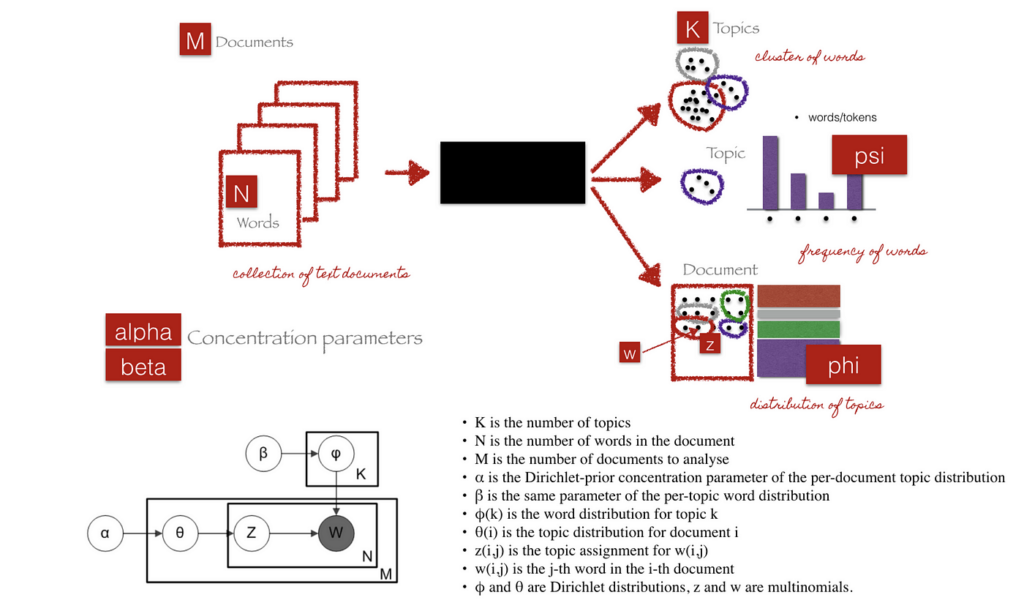 http://chdoig.github.io/pytexas2015-topic-modeling/#/3/4
We can describe the generative process of LDA as, given the M number of documents, N number of words, and prior K number of topics, the model trains to output:
psi , the distribution of words for each topic K
phi , the distribution of topics for each document i
Parameters of LDA
Alpha parameter is Dirichlet prior concentration parameter that represents document-topic density — with a higher alpha, documents are assumed to be made up of more topics and result in more specific topic distribution per document.
Beta parameter is the same prior concentration parameter that represents topic-word density — with high beta, topics are assumed to made of up most of the words and result in a more specific word distribution per topic.
···
LDA Implementation
The complete code is available as a Jupyter Notebook on GitHub
- Loading data
- Data cleaning
- Exploratory analysis
- Preparing data for LDA analysis
- LDA model training
- Analyzing LDA model results
Loading data
For this tutorial, we’ll use the dataset of papers published in NeurIPS (NIPS) conference which is one of the most prestigious yearly events in the machine learning community. The CSV data file contains information on the different NeurIPS papers that were published from 1987 until 2016 (29 years!). These papers discuss a wide variety of topics in machine learning, from neural networks to optimization methods, and many more.
Let’s start by looking at the content of the file
python
# Importing modules
import pandas as pd
import os

os.chdir('..')

# Read data into papers
papers = pd.read_csv('./data/NIPS Papers/papers.csv')

# Print head
papers.head()
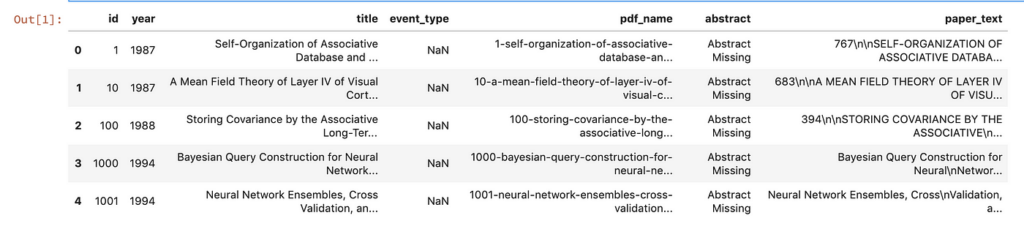 Sample of raw data
Data Cleaning
Since the goal of this analysis is to perform topic modeling, let’s focus only on the text data from each paper, and drop other metadata columns. Also, for the demonstration, we’ll only look at 100 papers
python
# Remove the columns
papers = papers.drop(columns=['id', 'event_type', 'pdf_name'],
axis=1).sample(100)

# Print out the first rows of papers
papers.head()
 Remove punctuation/lower casing
Next, let’s perform a simple preprocessing on the content of paper_text column to make them more amenable for analysis, and reliable results. To do that, we’ll use a regular expression to remove any punctuation, and then lowercase the text
python
# Load the regular expression library
import re

# Remove punctuation
papers['paper_text_processed'] = \
papers['paper_text'].map(lambda x: re.sub('[,\.!?]', '', x))

# Convert the titles to lowercase
papers['paper_text_processed'] = \
papers['paper_text_processed'].map(lambda x: x.lower())

# Print out the first rows of papers
papers['paper_text_processed'].head()

Exploratory Analysis
To verify whether the preprocessing, we’ll make a word cloud using the wordcloud package to get a visual representation of most common words. It is key to understanding the data and ensuring we are on the right track, and if any more preprocessing is necessary before training the model.
python
# Import the wordcloud library
from wordcloud import WordCloud

# Join the different processed titles together.
long_string = ','.join(list(papers['paper_text_processed'].values))

# Create a WordCloud object
wordcloud = WordCloud(background_color="white", max_words=5000, contour_width=3, contour_color='steelblue')

# Generate a word cloud
wordcloud.generate(long_string)

# Visualize the word cloud
wordcloud.to_image()
Prepare data for LDA Analysis
Next, let’s work to transform the textual data in a format that will serve as an input for training LDA model. We start by tokenizing the text and removing stopwords. Next, we convert the tokenized object into a corpus and dictionary.
python
import gensim
from gensim.utils import simple_preprocess
import nltk
nltk.download('stopwords')
from nltk.corpus import stopwords

stop_words = stopwords.words('english')
stop_words.extend(['from', 'subject', 're', 'edu', 'use'])

def sent_to_words(sentences):
    for sentence in sentences:
        # deacc=True removes punctuations
        yield(gensim.utils.simple_preprocess(str(sentence), deacc=True))

def remove_stopwords(texts):
    return [[word for word in simple_preprocess(str(doc))
             if word not in stop_words] for doc in texts]

data = papers.paper_text_processed.values.tolist()
data_words = list(sent_to_words(data))

# remove stop words
data_words = remove_stopwords(data_words)

print(data_words[:1][0][:30])
 python
import gensim.corpora as corpora

# Create Dictionary
id2word = corpora.Dictionary(data_words)

# Create Corpus
texts = data_words

# Term Document Frequency
corpus = [id2word.doc2bow(text) for text in texts]

# View
print(corpus[:1][0][:30])

LDA model training
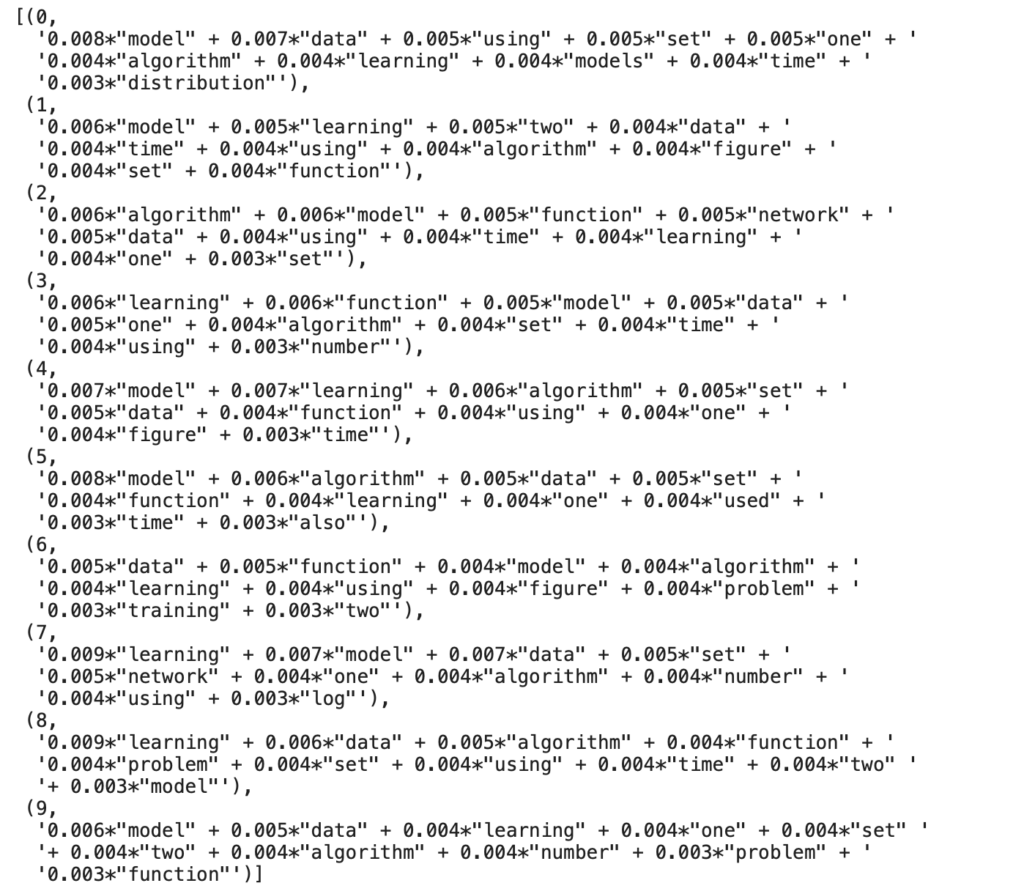
To keep things simple, we’ll keep all the parameters to default except for inputting the number of topics. For this tutorial, we will build a model with 10 topics where each topic is a combination of keywords, and each keyword contributes a certain weightage to the topic.
python
from pprint import pprint

# number of topics
num_topics = 10

# Build LDA model
lda_model = gensim.models.LdaMulticore(corpus=corpus,
                                       id2word=id2word,
                                       num_topics=num_topics)# Print the Keyword in the 10 topics
pprint(lda_model.print_topics())
doc_lda = lda_model[corpus]
Analyzing LDA model results
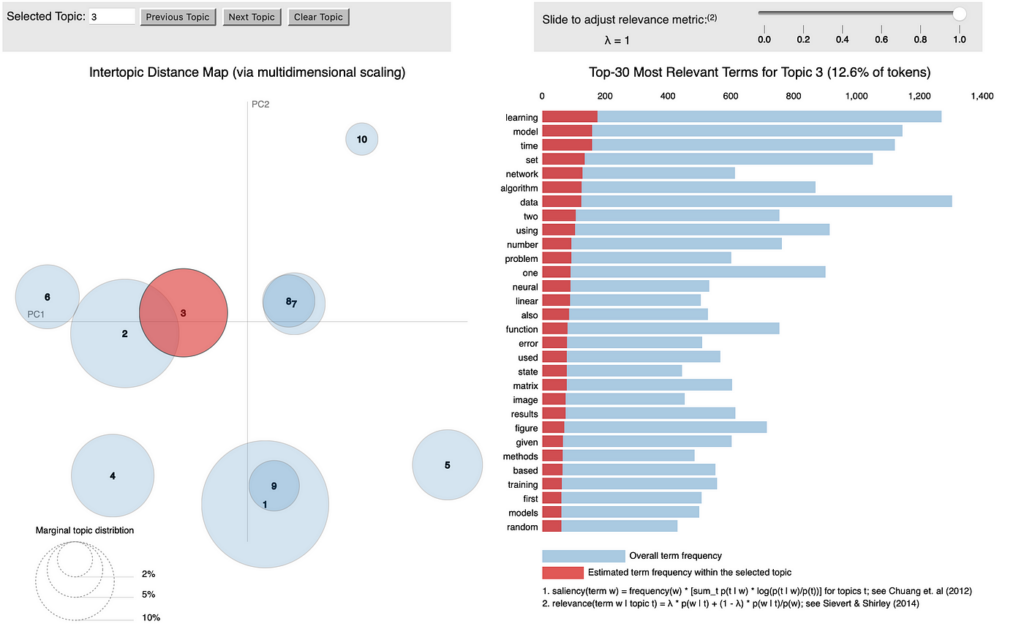
Now that we have a trained model let’s visualize the topics for interpretability. To do so, we’ll use a popular visualization package, pyLDAvis which is designed to help interactively with:
- Better understanding and interpreting individual topics, and
- Better understanding the relationships between the topics.
For (1), you can manually select each topic to view its top most frequent and/or “relevant” terms, using different values of the λ parameter. This can help when you’re trying to assign a human interpretable name or “meaning” to each topic.
For (2), exploring the Intertopic Distance Plot can help you learn about how topics relate to each other, including potential higher-level structure between groups of topics.
python
import pyLDAvis.gensim
import pickle
import pyLDAvis

# Visualize the topics
pyLDAvis.enable_notebook()

LDAvis_data_filepath =
os.path.join('./results/ldavis_prepared_'+str(num_topics))

# # this is a bit time consuming - make the if statement True
# # if you want to execute visualization prep yourself
if 1 == 1:
    LDAvis_prepared = pyLDAvis.gensim.prepare(lda_model, corpus, id2word)
    with open(LDAvis_data_filepath, 'wb') as f:
        pickle.dump(LDAvis_prepared, f)

# load the pre-prepared pyLDAvis data from disk
with open(LDAvis_data_filepath, 'rb') as f:
    LDAvis_prepared = pickle.load(f)

pyLDAvis.save_html(LDAvis_prepared, './results/ldavis_prepared_'+ str(num_topics) +'.html')

LDAvis_prepared
Closing Notes
Machine learning has become increasingly popular over the past decade, and recent advances in computational availability have led to exponential growth to people looking for ways how new methods can be incorporated to advance the field of Natural Language Processing.
Often, we treat topic models as black-box algorithms, but hopefully, this article addressed to shed light on the underlying math, and intuitions behind it, and high-level code to get you started with any textual data.
In the next article, we’ll go one step deeper into understanding how you can evaluate the performance of topic models, tune its hyper-parameters to get more intuitive and reliable results.
References:
[1] Topic model — Wikipedia. https://en.wikipedia.org/wiki/Topic_model
[2] Distributed Strategies for Topic Modeling. https://www.ideals.illinois.edu/bitstream/handle/2142/46405/ParallelTopicModels.pdf?sequence=2&isAllowed=y
[3] Topic Mapping — Software — Resources — Amaral Lab. https://amaral.northwestern.edu/resources/software/topic-mapping
[4] A Survey of Topic Modeling in Text Mining. https://thesai.org/Downloads/Volume6No1/Paper_21-A_Survey_of_Topic_Modeling_in_Text_Mining.pdf
Thanks for reading. If you have any feedback, please feel to reach out by commenting on this post, messaging me on LinkedIn , or shooting me an email (shmkapadia[at]gmail.com).
Register Now to Continue Reading
Unlock Towards Data Science with a Free Account
All articles on Towards Data Science are available to registered users. Create a free account today to access this article and thousands more.
Register for freeSign in to your account
SK
Written By
See all from Shashank Kapadia
Data ScienceIn Depth AnalysisLatent Dirichlet AllocationPythonTopic Modeling
Share This Article
Towards Data Science is a community publication. Submit your insights to reach our global audience and earn through the TDS Author Payment Program.
Write for TDS
Related Articles
Programming
How to Identify and Index Duplicates in a List
Tonichi Edeza
February 21, 20214 min read
Artificial Intelligence
Easy feature selection for your model creation
Cornellius Wijaya
November 29, 20206 min read
Data Science
Manipulate Pandas data frames from the comfort of your own browser!
Patty C
July 1, 20214 min read
Data Science
How to Accelerate Decision-Making with Low Volume Data
Zachary Raicik
August 29, 20248 min read
Encryption
Introducing an ExcelHelper class which allows you to encrypt Excel files with a strong password or a password of your choice
Ji Wei Liew
June 12, 20237 min read
Deep Learning
Using the no-code diagrams.net tool to showcase your deep learning models with diagram visualizations
Kenneth Leung
August 23, 20214 min read
Programming
Take Your SQL Skills to the Next Level with These Essential Commands
Niklas Lang
November 14, 20224 min read
Data Science
Most frequently asked questions in data scientist interviews
Tessa Xie
May 16, 20225 min read
Artificial Intelligence
What actually works with AI agents inside enterprise organizations?
Weiwei Hu
June 6, 202510 min read
Your home for data science and AI. The world's leading publication for data science, data analytics, data engineering, machine learning, and artificial intelligence professionals.
Subscribe to Our NewsletterWrite For TDS•About•Advertise•Privacy Policy•Terms of Use
© Insight Media Group, LLC 2026•The New Stack•roadmap.sh•Creator Network
Recommended Articles
Close