保留正文与补采附件。源页面当前未重新核验;具体限制见交付清单。
 We value your privacy
We use cookies to enhance your browsing experience, serve personalised ads or content, and analyse our traffic. By clicking "Accept All", you consent to our use of cookies.
Customise Reject All Accept All
Customise Consent Preferences
 We use cookies to help you navigate efficiently and perform certain functions. You will find detailed information about all cookies under each consent category below.
The cookies that are categorised as "Necessary" are stored on your browser as they are essential for enabling the basic functionalities of the site. ... Show more
NecessaryAlways Active
Necessary cookies are required to enable the basic features of this site, such as providing secure log-in or adjusting your consent preferences. These cookies do not store any personally identifiable data.
-
Cookie
BCTempID
-
Duration
10 minutes
-
Description
No description available.
-
Cookie
__cf_bm
-
Duration
1 hour
-
Description
This cookie, set by Cloudflare, is used to support Cloudflare Bot Management.
-
Cookie
AWSALBCORS
-
Duration
7 days
-
Description
Amazon Web Services set this cookie for load balancing.
-
Cookie
_cfuvid
-
Duration
session
-
Description
Cloudflare sets this cookie to track users across sessions to optimize user experience by maintaining session consistency and providing personalized services
-
Cookie
li_gc
-
Duration
6 months
-
Description
Linkedin set this cookie for storing visitor's consent regarding using cookies for non-essential purposes.
-
Cookie
__hssrc
-
Duration
session
-
Description
This cookie is set by Hubspot whenever it changes the session cookie. The __hssrc cookie set to 1 indicates that the user has restarted the browser, and if the cookie does not exist, it is assumed to be a new session.
-
Cookie
__hssc
-
Duration
1 hour
-
Description
HubSpot sets this cookie to keep track of sessions and to determine if HubSpot should increment the session number and timestamps in the __hstc cookie.
-
Cookie
wpEmojiSettingsSupports
-
Duration
session
-
Description
WordPress sets this cookie when a user interacts with emojis on a WordPress site. It helps determine if the user's browser can display emojis properly.
-
Cookie
BCSessionID
-
Duration
1 year 1 month 4 days
-
Description
Blueconic sets this cookie as a unique identifier for the BlueConic profile.
-
Cookie
_octo
-
Duration
1 year
-
Description
No description available.
-
Cookie
logged_in
-
Duration
1 year
-
Description
No description available.
-
Cookie
__Secure-YEC
-
Duration
past
-
Description
YouTube sets this cookie to stores the user's video player preferences using embedded YouTube video
-
Cookie
__eoi
-
Duration
6 months
-
Description
Description is currently not available.
-
Cookie
AWSALBTGCORS
-
Duration
7 days
-
Description
No description available.
-
Cookie
login-status-p
-
Duration
past
-
Description
Description is currently not available.
-
Cookie
AWSALBTG
-
Duration
7 days
-
Description
No description available.
-
Cookie
csrf_token
-
Duration
session
-
Description
No description available.
-
Cookie
token_v2
-
Duration
1 day
-
Description
Description is currently not available.
-
Cookie
D
-
Duration
1 year
-
Description
Description is currently not available.
-
Cookie
PHPSESSID
-
Duration
session
-
Description
This cookie is native to PHP applications. The cookie stores and identifies a user's unique session ID to manage user sessions on the website. The cookie is a session cookie and will be deleted when all the browser windows are closed.
-
Cookie
VISITOR_PRIVACY_METADATA
-
Duration
6 months
-
Description
YouTube sets this cookie to store the user's cookie consent state for the current domain.
-
Cookie
cookietest
-
Duration
session
-
Description
The cookietest cookie is typically used to determine whether the user's browser accepts cookies, essential for website functionality and user experience.
-
Cookie
__Host-airtable-session
-
Duration
1 year
-
Description
This cookie is used to enable us to integrate the services of Airtable.
-
Cookie
__Host-airtable-session.sig
-
Duration
1 year
-
Description
This cookie is used to enable us to integrate the services of Airtable.
-
Cookie
m
-
Duration
1 year 1 month 4 days
-
Description
Stripe sets this cookie for fraud prevention purposes. It identifies the device used to access the website, allowing the website to be formatted accordingly.
-
Cookie
BIGipServer*
-
Duration
session
-
Description
Marketo sets this cookie to collect information about the user's online activity and build a profile about their interests to provide advertisements relevant to the user.
-
Cookie
__cfruid
-
Duration
session
-
Description
Cloudflare sets this cookie to identify trusted web traffic.
-
Cookie
_GRECAPTCHA
-
Duration
6 months
-
Description
Google Recaptcha service sets this cookie to identify bots to protect the website against malicious spam attacks.
-
Cookie
__Secure-YNID
-
Duration
6 months
-
Description
Google cookie used to protect user security and prevent fraud, especially during the login process.
-
Cookie
cookieyes-consent
-
Duration
1 year
-
Description
CookieYes sets this cookie to remember users' consent preferences so that their preferences are respected on subsequent visits to this site. It does not collect or store any personal information about the site visitors.
Functional
Functional cookies help perform certain functionalities like sharing the content of the website on social media platforms, collecting feedback, and other third-party features.
-
Cookie
lidc
-
Duration
1 day
-
Description
LinkedIn sets the lidc cookie to facilitate data center selection.
-
Cookie
brw
-
Duration
1 year
-
Description
No description available.
-
Cookie
brwConsent
-
Duration
5 minutes
-
Description
Description is currently not available.
-
Cookie
WMF-Uniq
-
Duration
1 year
-
Description
Description is currently not available.
-
Cookie
loom_anon_comment
-
Duration
1 year
-
Description
No description available.
-
Cookie
loom_referral_video
-
Duration
session
-
Description
Description is currently not available.
-
Cookie
VISITOR_INFO1_LIVE
-
Duration
6 months
-
Description
A cookie set by YouTube to measure bandwidth that determines whether the user gets the new or old player interface.
-
Cookie
yt-remote-connected-devices
-
Duration
Never Expires
-
Description
YouTube sets this cookie to store the user's video preferences using embedded YouTube videos.
-
Cookie
ytidb::LAST_RESULT_ENTRY_KEY
-
Duration
Never Expires
-
Description
The cookie ytidb::LAST_RESULT_ENTRY_KEY is used by YouTube to store the last search result entry that was clicked by the user. This information is used to improve the user experience by providing more relevant search results in the future.
-
Cookie
yt-remote-device-id
-
Duration
Never Expires
-
Description
YouTube sets this cookie to store the user's video preferences using embedded YouTube videos.
-
Cookie
yt-remote-session-name
-
Duration
session
-
Description
The yt-remote-session-name cookie is used by YouTube to store the user's video player preferences using embedded YouTube video.
-
Cookie
yt-remote-fast-check-period
-
Duration
session
-
Description
The yt-remote-fast-check-period cookie is used by YouTube to store the user's video player preferences for embedded YouTube videos.
-
Cookie
yt-remote-session-app
-
Duration
session
-
Description
The yt-remote-session-app cookie is used by YouTube to store user preferences and information about the interface of the embedded YouTube video player.
-
Cookie
yt-remote-cast-available
-
Duration
session
-
Description
The yt-remote-cast-available cookie is used to store the user's preferences regarding whether casting is available on their YouTube video player.
-
Cookie
yt-remote-cast-installed
-
Duration
session
-
Description
The yt-remote-cast-installed cookie is used to store the user's video player preferences using embedded YouTube video.
-
Cookie
cp_session
-
Duration
3 months
-
Description
Codepen sets this cookie for Help systems found in the website.
-
Cookie
loid
-
Duration
1 year 1 month 4 days
-
Description
This cookie is set by the Reddit. The cookie enables the sharing of content from the website onto the social media platform.
Analytics
Analytical cookies are used to understand how visitors interact with the website. These cookies help provide information on metrics such as the number of visitors, bounce rate, traffic source, etc.
-
Cookie
__hstc
-
Duration
6 months
-
Description
Hubspot set this main cookie for tracking visitors. It contains the domain, initial timestamp (first visit), last timestamp (last visit), current timestamp (this visit), and session number (increments for each subsequent session).
-
Cookie
hubspotutk
-
Duration
6 months
-
Description
HubSpot sets this cookie to keep track of the visitors to the website. This cookie is passed to HubSpot on form submission and used when deduplicating contacts.
-
Cookie
_ga
-
Duration
1 year 1 month 4 days
-
Description
Google Analytics sets this cookie to calculate visitor, session and campaign data and track site usage for the site's analytics report. The cookie stores information anonymously and assigns a randomly generated number to recognise unique visitors.
-
Cookie
ga*
-
Duration
1 year 1 month 4 days
-
Description
Google Analytics sets this cookie to store and count page views.
-
Cookie
__Host-psifi.analyticsTrace
-
Duration
6 hours
-
Description
Description is currently not available.
-
Cookie
__Host-psifi.analyticsTraceV2
-
Duration
6 hours
-
Description
Description is currently not available.
-
Cookie
_gh_sess
-
Duration
session
-
Description
GitHub sets this cookie for temporary application and framework state between pages like what step the user is on in a multiple step form.
-
Cookie
YSC
-
Duration
session
-
Description
YSC cookie is set by Youtube and is used to track the views of embedded videos on Youtube pages.
-
Cookie
ajs_anonymous_id
-
Duration
1 year
-
Description
This cookie is set by Segment to count the number of people who visit a certain site by tracking if they have visited before.
-
Cookie
vuid
-
Duration
1 year 1 month 4 days
-
Description
Vimeo installs this cookie to collect tracking information by setting a unique ID to embed videos on the website.
Performance
Performance cookies are used to understand and analyse the key performance indexes of the website which helps in delivering a better user experience for the visitors.
-
Cookie
AWSALB
-
Duration
7 days
-
Description
AWSALB is an application load balancer cookie set by Amazon Web Services to map the session to the target.
-
Cookie
acq
-
Duration
past
-
Description
Description is currently not available.
-
Cookie
acq.sig
-
Duration
past
-
Description
Description is currently not available.
-
Cookie
ptc
-
Duration
2 years
-
Description
No description available.
Advertisement
Advertisement cookies are used to provide visitors with customised advertisements based on the pages you visited previously and to analyse the effectiveness of the ad campaigns.
-
Cookie
muc_ads
-
Duration
1 year 1 month 4 days
-
Description
Twitter sets this cookie to collect user behaviour and interaction data to optimize the website.
-
Cookie
guest_id_marketing
-
Duration
1 year 1 month 4 days
-
Description
Twitter sets this cookie to identify and track the website visitor.
-
Cookie
guest_id_ads
-
Duration
1 year 1 month 4 days
-
Description
Twitter sets this cookie to identify and track the website visitor.
-
Cookie
personalization_id
-
Duration
1 year 1 month 4 days
-
Description
Twitter sets this cookie to integrate and share features for social media and also store information about how the user uses the website, for tracking and targeting.
-
Cookie
guest_id
-
Duration
1 year 1 month 4 days
-
Description
Twitter sets this cookie to identify and track the website visitor. It registers if a user is signed in to the Twitter platform and collects information about ad preferences.
-
Cookie
bcookie
-
Duration
1 year
-
Description
LinkedIn sets this cookie from LinkedIn share buttons and ad tags to recognize browser IDs.
-
Cookie
__Secure-ROLLOUT_TOKEN
-
Duration
6 months
-
Description
YouTube sets this cookie to manage feature rollout and experimentation. It helps Google control which new features or interface changes are shown to users as part of testing and staged rollouts, ensuring consistent experience for a given user during an experiment.
-
Cookie
yt.innertube::nextId
-
Duration
Never Expires
-
Description
YouTube sets this cookie to register a unique ID to store data on what videos from YouTube the user has seen.
-
Cookie
yt.innertube::requests
-
Duration
Never Expires
-
Description
YouTube sets this cookie to register a unique ID to store data on what videos from YouTube the user has seen.
-
Cookie
session_tracker
-
Duration
session
-
Description
This cookie is set by the Reddit. This cookie is used to identify trusted web traffic. It also helps in adverstising on the website.
-
Cookie
edgebucket
-
Duration
session
-
Description
Reddit sets this cookie to save the information about a log-on Reddit user, for the purpose of advertisement recommendations and updating the content.
-
Cookie
did
-
Duration
1 year
-
Description
Arbor sets this cookie to show targeted ads to site visitors.This cookie expires after 2 months or 1 year.
Uncategorised
Other uncategorised cookies are those that are being analysed and have not been classified into a category as yet.
No cookies to display.
Reject All Save My Preferences Accept All
Toggle SearchToggle Mobile Navigation
Publish AI, ML & data-science insights to a global community of data professionals.
Sign inSubmit an Article
LatestEditor's PicksNewsletterShipAI
Write For TDS
LinkedInXToggle Search
Deep Learning
Overcoming the Hidden Performance Traps of Variable-Shaped Tensors: Efficient Data Sampling in PyTorch
PyTorch Model Performance Analysis and Optimization — Part 11
Chaim Rand
December 3, 20259 min read
 Photo by National Cancer Institute on Unsplash
This is the eleventh part of a series of posts on the topic of analyzing and optimizing PyTorch models. Throughout the series, we have advocated for using the PyTorch Profiler in AI model development and demonstrated the potential impact of performance optimization on the speed and cost of running AI/ML workloads. One common phenomenon we have seen is how seemingly innocent code can hamper runtime performance. In this post, we explore some of the penalties associated with the naive use of variable-shaped tensors — tensors whose shape is dependent on preceding computations and/or inputs. While not applicable to all situations, there are times when the use of variable-shaped tensors can be avoided — although this may come at the expense of additional compute and/or memory. We will demonstrate the tradeoffs of these alternatives on a toy implementation of data sampling in PyTorch.
Three Downsides of Variable Shaped Tensors
We motivate the discussion by presenting three disadvantages to the use of variable-shaped tensors:
Learn this step by step with the interactive Machine Learning roadmap.
Host-Device Sync Events
In an ideal scenario, the CPU and GPU are able to run in parallel in an asynchronous manner, with the CPU continuously feeding the GPU with input samples, allocating required GPU memory, and loading GPU compute kernels, and the GPU executing the loaded kernels on the provided inputs using the allocated memory. The presence of dynamic-shaped tensors throws a wrench into this parallelism. In order to allocate the appropriate amount memory, the CPU must wait for the GPU to report the tensor’s shape, and then the GPU must wait for the CPU to allocate the memory and proceed with the kernel loading. The overhead of this sync event can cause a drop in the GPU utilization and slow runtime performance.
We saw an example of this in part three of this series when we studied a naive implementation of the common cross-entropy loss that included calls to torch.nonzero and torch.unique. Both APIs return tensors with shapes that are dynamic and dependent on the contents of the input. When these functions are run on the GPU, a host-device synchronization event occurs. In the case of the cross-entropy loss, we discovered the inefficiency through the use of PyTorch Profiler and were able to easily overcome it with an alternative implementation that avoided the use of variable-shaped tensors and demonstrated much better runtime performance.
Graph Compilation
In a recent post we explored the performance benefits of applying just-in-time (JIT) compilation using the torch.compile operator. One of our observations was that graph compilation provided much better results when the graph was static. The presence of dynamic shapes in the graph limits the extent of the optimization via compilation: In some cases, it fails completely; in others it results in lower performance gains. The same implications also apply to other forms of graph compilation, such as XLA, ONNX, OpenVINO, and TensorRT.
Data Batching
Another optimization we have encountered in several of our posts (e.g., here) is sample-batching. Batching improves performance in two primary ways:
- Reducing overhead of kernel loading : Rather than loading the GPU kernels required for the computation pipeline once per input sample, the CPU can load the kernels once per batch.
- Maximizing parallelization across compute units : GPUs are highly parallel compute engines. The more we are able to parallelize computation, the more we can saturate the GPU and increase its utilization. By batching we can potentially increase the degree of parallelization by a factor of the batch size.
Despite their downsides, the use of variable-shaped tensors is often unavoidable. But sometimes we can modify our model implementation to circumvent them. Sometimes these changes will be straightforward (as in the cross-entropy loss example). Other times they may require some creativity in coming up with a different sequence of fixed-shape PyTorch APIs that provide the same numerical result. Often, this effort can deliver meaningful rewards in runtime and costs.
In the next sections, we will study the use of variable-shaped tensors in the context of the data sampling operation. We will start with a trivial implementation and analyze its performance. We will then propose a GPU-friendly alternative that avoids the use of variable-shaped tensors.
To compare our implementations, we will use an Amazon EC2 g6e.xlarge with an NVIDIA L40S running an AWS Deep Learning AMI (DLAMI) with PyTorch (2.8). The code we will share is intended for demonstration purposes. Please do not rely on it for accuracy or optimality. Please do not interpret our mention of any framework, library, or platform and an endorsement of its use.
Sampling in AI Model Workloads
In the context of this post, sampling refers to the selection of a subset of items from a large set of candidates for the purposes of computational efficiency, balancing of datatypes, or regularization. Sampling is common in many AI/ML models, such as detection, ranking, and contrastive learning systems.
We define a simple variation of the sampling problem: Given a list of N tensors each with a binary label, we are asked to return a subset of K tensors containing both positive and negative examples, in random order. If the input list contains enough samples of each label (K/2), the returned subset should be evenly split. If it is lacking samples of one type, these should be filled with random samples of the second type.
The code block below contains a PyTorch implementation of our sampling function. The implementation is inspired by the popular Detectron2 library (e.g., see here and here). For the experiments in this post, we will fix the sampling ratio to 1:10.
python
import torch

INPUT_SAMPLES = 10000
SUB_SAMPLE = INPUT_SAMPLES // 10
FEATURE_DIM = 16

def sample_data(input_array, labels):
    device = labels.device
    positive = torch.nonzero(labels == 1, as_tuple=True)[0]
    negative = torch.nonzero(labels == 0, as_tuple=True)[0]
    num_pos = min(positive.numel(), SUB_SAMPLE//2)
    num_neg = min(negative.numel(), SUB_SAMPLE//2)
    if num_neg < SUB_SAMPLE//2:
        num_pos = SUB_SAMPLE - num_neg
    elif num_pos < SUB_SAMPLE//2:
        num_neg = SUB_SAMPLE - num_pos

    # randomly select positive and negative examples
    perm1 = torch.randperm(positive.numel(), device=device)[:num_pos]
    perm2 = torch.randperm(negative.numel(), device=device)[:num_neg]

    pos_idxs = positive[perm1]
    neg_idxs = negative[perm2]

    sampled_idxs = torch.cat([pos_idxs, neg_idxs], dim=0)
    rand_perm = torch.randperm(SUB_SAMPLE, device=labels.device)
    sampled_idxs = sampled_idxs[rand_perm]
    return input_array[sampled_idxs], labels[sampled_idxs]
Performance Analysis With PyTorch Profiler
Even when not immediately obvious, the use of dynamic shapes is easily identifiable in the PyTorch Profiler Trace view. We use the following function to enable PyTorch Profiler:
python
def profile(fn, input, labels):

    def export_trace(p):
        p.export_chrome_trace(f"{fn.__name__}.json")

    with torch.profiler.profile(
            activities=[torch.profiler.ProfilerActivity.CPU,
                        torch.profiler.ProfilerActivity.CUDA],
            with_stack=True,
            schedule=torch.profiler.schedule(wait=0, warmup=10, active=5),
            on_trace_ready=export_trace
    ) as prof:
        for _ in range(20):
            fn(input, labels)
            torch.cuda.synchronize()  # explicit sync for trace readability
            prof.step()

# create random input
input_samples = torch.randn((INPUT_SAMPLES, FEATURE_DIM), device='cuda')
labels = torch.randint(0, 2, (INPUT_SAMPLES,),
                       device='cuda', dtype=torch.int64)

# run with profiler
profile(sample_data, input_samples, labels)
The image below was captured for the value of ten million input samples. It clearly shows the presence of sync events coming from the torch.nonzero call, as well as the corresponding drops in GPU utilization:
 Profiler Trace of Sampler (by Author)
The use of torch.nonzero in our implementation is not ideal, but can it be avoided?
A GPU-Friendly Data Sampler
We propose an alternative implementation of our sampling function that replaces the dynamic torch.nonzero function with a creative combination of the static torch.count_nonzero, torch.topk, and other APIs:
python
def opt_sample_data(input, labels):
    pos_mask = labels == 1
    neg_mask = labels == 0
    num_pos_idxs = torch.count_nonzero(pos_mask, dim=-1)
    num_neg_idxs = torch.count_nonzero(neg_mask, dim=-1)
    half_samples = labels.new_full((), SUB_SAMPLE // 2)
    num_pos = torch.minimum(num_pos_idxs, half_samples)
    num_neg = torch.minimum(num_neg_idxs, half_samples)
    num_pos = torch.where(
        num_neg < SUB_SAMPLE // 2,
        SUB_SAMPLE - num_neg,
        num_pos
    )
    num_neg = SUB_SAMPLE - num_pos

    # create random ordering on pos and neg entries
    rand = torch.rand_like(labels, dtype=torch.float32)
    pos_rand = torch.where(pos_mask, rand, -1)
    neg_rand = torch.where(neg_mask, rand, -1)

    # select top pos entries and invalidate others
    # since CPU doesn't know num_pos, we assume maximum to avoid sync
    top_pos_rand, top_pos_idx = torch.topk(pos_rand, k=SUB_SAMPLE)
    arange = torch.arange(SUB_SAMPLE, device=labels.device)
    if num_pos.numel() > 1:
        # unsqueeze to support batched input
        arange = arange.unsqueeze(0)
        num_pos = num_pos.unsqueeze(-1)
        num_neg = num_neg.unsqueeze(-1)
    top_pos_rand = torch.where(arange >= num_pos, -1, top_pos_rand)

    # repeat for neg entries
    top_neg_rand, top_neg_idx = torch.topk(neg_rand, k=SUB_SAMPLE)
    top_neg_rand = torch.where(arange >= num_neg, -1, top_neg_rand)

    # combine and mix together positive and negative idxs
    cat_rand = torch.cat([top_pos_rand, top_neg_rand], dim=-1)
    cat_idx = torch.cat([top_pos_idx, top_neg_idx], dim=-1)
    topk_rand_idx = torch.topk(cat_rand, k=SUB_SAMPLE)[1]
    sampled_idxs = torch.gather(cat_idx, dim=-1, index=topk_rand_idx)
    sampled_input = torch.gather(input, dim=-2,
                                 index=sampled_idxs.unsqueeze(-1))
    sampled_labels = torch.gather(labels, dim=-1, index=sampled_idxs)
    return sampled_input, sampled_labels
Clearly, this function requires more memory and more operations than our first implementation. The question is: Do the performance benefits of a static, synchronization-free implementation outweigh the extra cost in memory and compute?
To assess the tradeoffs between the two implementations, we introduce the following benchmarking utility:
python
def benchmark(fn, input, labels):
    # warm-up
    for _ in range(20):
        _ = fn(input, labels)

    iters = 100
    start = torch.cuda.Event(enable_timing=True)
    end = torch.cuda.Event(enable_timing=True)
    torch.cuda.synchronize()
    start.record()
    for _ in range(iters):
        _ = fn(input, labels)
    end.record()
    torch.cuda.synchronize()
    avg_time = start.elapsed_time(end) / iters

    print(f"{fn.__name__} average step time: {(avg_time):.4f} ms")

benchmark(sample_data, input_samples, labels)
benchmark(opt_sample_data, input_samples, labels)
The following table compares the average runtime of each of the implementations for a variety of input sample sizes:
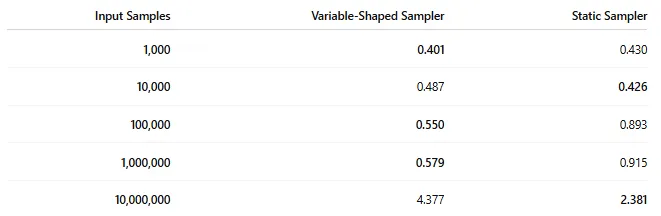 Comparative Step Time Performance — Lower is Better (by Author)
For most of the input sample sizes, the overhead of the host-device sync event is either comparable or lower than the additional compute of the static implementation. Disappointingly, we only see a major benefit from the sync-free alternative when the input sample size reaches ten million. Sample sizes that large are uncommon in AI/ML settings. But it’s not our tendency to give up so easily. As noted above, the static implementation enables other optimizations like graph compilation and input batching.
Graph Compilation
Contrary to the original function — which fails to compile — our static implementation is fully compatible with torch.compile:
python
benchmark(torch.compile(opt_sample_data), input_samples, labels)
The following table includes the runtimes of our compiled function:
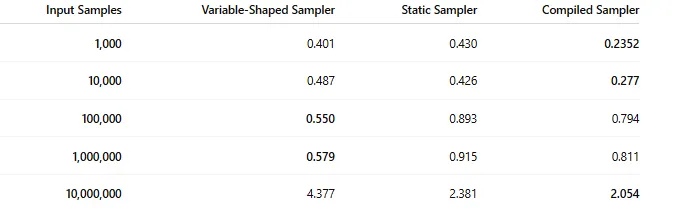 Comparative Step Time Performance — Lower is Better (by Author)
The results are significantly better — providing a 70–75 percent boost over the original sampler implementation in the 1–10 thousand range. But we still have one more optimization up our sleeve.
Maximizing Performance with Batched Input
Because the original implementation contains variable-shaped operations, it cannot handle batched input directly. To process a batch, we have no choice but to apply it to each input individually, in a Python loop:
python
BATCH_SIZE = 32

def batched_sample_data(inputs, labels):
    sampled_inputs = []
    sampled_labels = []
    for i in range(inputs.size(0)):
        inp, lab = sample_data(inputs[i], labels[i])
        sampled_inputs.append(inp)
        sampled_labels.append(lab)
    return torch.stack(sampled_inputs), torch.stack(sampled_labels)
In contrast, our optimized function supports batched inputs as is — no changes necessary.
python
input_batch = torch.randn((BATCH_SIZE, INPUT_SAMPLES, FEATURE_DIM),
                          device='cuda')
labels = torch.randint(0, 2, (BATCH_SIZE, INPUT_SAMPLES),
                       device='cuda', dtype=torch.int64)

benchmark(batched_sample_data, input_batch, labels)
benchmark(opt_sample_data, input_batch, labels)
benchmark(torch.compile(opt_sample_data), input_batch, labels)
The table below compares the step times of our sampling functions on a batch size of 32:
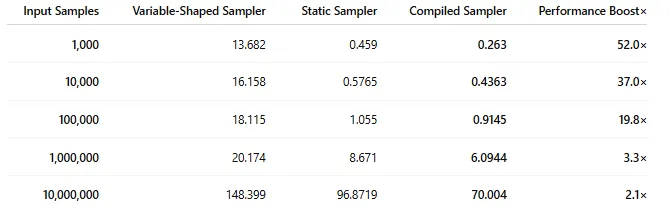 Step Time Performance on Batched Input — Lower is Better (by Author)
Now the results are definitive: By using a static implementation of the data sampler, we are able to boost performance by 2X–52X(!!) the variable-shaped option, depending on the input sample size.
Note that although our experiments were run on a GPU device, the model compilation and input batching optimizations also apply to a CPU environment. Thus, avoiding variable shapes could have implications on AI/ML model performance on CPU, as well.
Summary
The optimization process we demonstrated in this post generalizes beyond the specific case of data sampling:
- Discovery via Performance Profiling: Using the PyTorch Profiler we were able to identify drops in GPU utilization and discover their source: the presence of variable-shaped tensors resulting from the torch.nonzero operation.
- An Alternate Implementation: Our profiling findings allowed us to develop an alternative implementation that accomplished the same goal while avoiding the use of variable-shaped tensors. However, this step came at the cost of additional compute and memory overhead. As seen in our initial benchmarks, the sync-free alternative demonstrated worse performance on common input sizes.
- Unlocking Further Potential for Optimization: The true breakthrough came because the static-shaped implementation was compilation-friendly and supported batching. These optimizations provided performance gains that dwarfed the initial overhead, leading to a 2x to 52x speedup over the original implementation.
Naturally, not all stories will end as happily as ours. In many cases, we may come across PyTorch code that performs poorly on the GPU but does not have an alternative implementation, or it may have one that requires significantly more compute resources. However, given the potential for meaningful gains in performance and reductions in cost, the process of identifying runtime inefficiencies and exploring alternative implementations is an essential part of AI/ML development.
Register Now to Continue Reading
Unlock Towards Data Science with a Free Account
All articles on Towards Data Science are available to registered users. Create a free account today to access this article and thousands more.
Register for freeSign in to your account
 Written By
See all from Chaim Rand
Editor's PicksArtificial IntelligenceData SamplingMachine LearningPytorch
Share This Article
Towards Data Science is a community publication. Submit your insights to reach our global audience and earn through the TDS Author Payment Program.
Write for TDS
Related Articles
Large Language Models
Here’s how less than 100 lines of code can build you an LLM app that converts your resume into your job-specific cover letter
Piero Paialunga
February 5, 202513 min read
Artificial Intelligence
We explore the limits of what vision-language models get about language in our Oral Paper at ICLR 2023
Federico Bianchi
March 21, 20239 min read
Artificial Intelligence
Most common hyperparameter optimization methodologies to boost machine learning outcomes.
Farzad Nobar
March 13, 202310 min read
Artificial Intelligence
Practice Pandas while providing valuable insights into past elections.
Soner Yıldırım
October 18, 20205 min read
Artificial Intelligence
This is how you contribute to a project
Soner Yıldırım
July 18, 20214 min read
Artificial Intelligence
A five-step framework for building rigorous, reproducible AI search benchmarks — before you make six-figure infrastructure decisions
Zairah Mustahsan
March 9, 20266 min read
Machine Learning
We have seen methods such as fit(), transform(), and fit_transform() in a lot of SciKit's libraries. And almost all tutorials, including...
Sunny Srinidhi
December 3, 20193 min read
Data Science
So you want to be promoted? So does everyone else. How can you stand out from your peers?
Tessa Xie
May 24, 20226 min read
Data Science
This series was written together with Ibukun Aribilola and Valdrin Jonuzi as part of the Data Science for Social Good tutorial.
Ang Li-Lian
April 22, 202211 min read
Your home for data science and AI. The world's leading publication for data science, data analytics, data engineering, machine learning, and artificial intelligence professionals.
Subscribe to Our NewsletterWrite For TDS•About•Advertise•Privacy Policy•Terms of Use
© Insight Media Group, LLC 2026•The New Stack•roadmap.sh•Creator Network
Recommended Articles
Close