A clear, no-fluff breakdown of what MCP and Agent Skills actually do, why people confuse them, and exactly when to use each.
Last time, I wrote about Agent Skills and how they stopped my AI agent from guessing wrong. A few of you came back with the same question: "Wait, isn't that what MCP does?" Totally fair. Let me fix that.
If you landed here without reading the first post, no worries. This one stands completely on its own.
There's a debate going on in AI circles right now framing MCP and Agent Skills as rivals. Pick a side. One will win. The other will die.
I've built with both. That framing is completely wrong, and believing it will make you build worse agents.
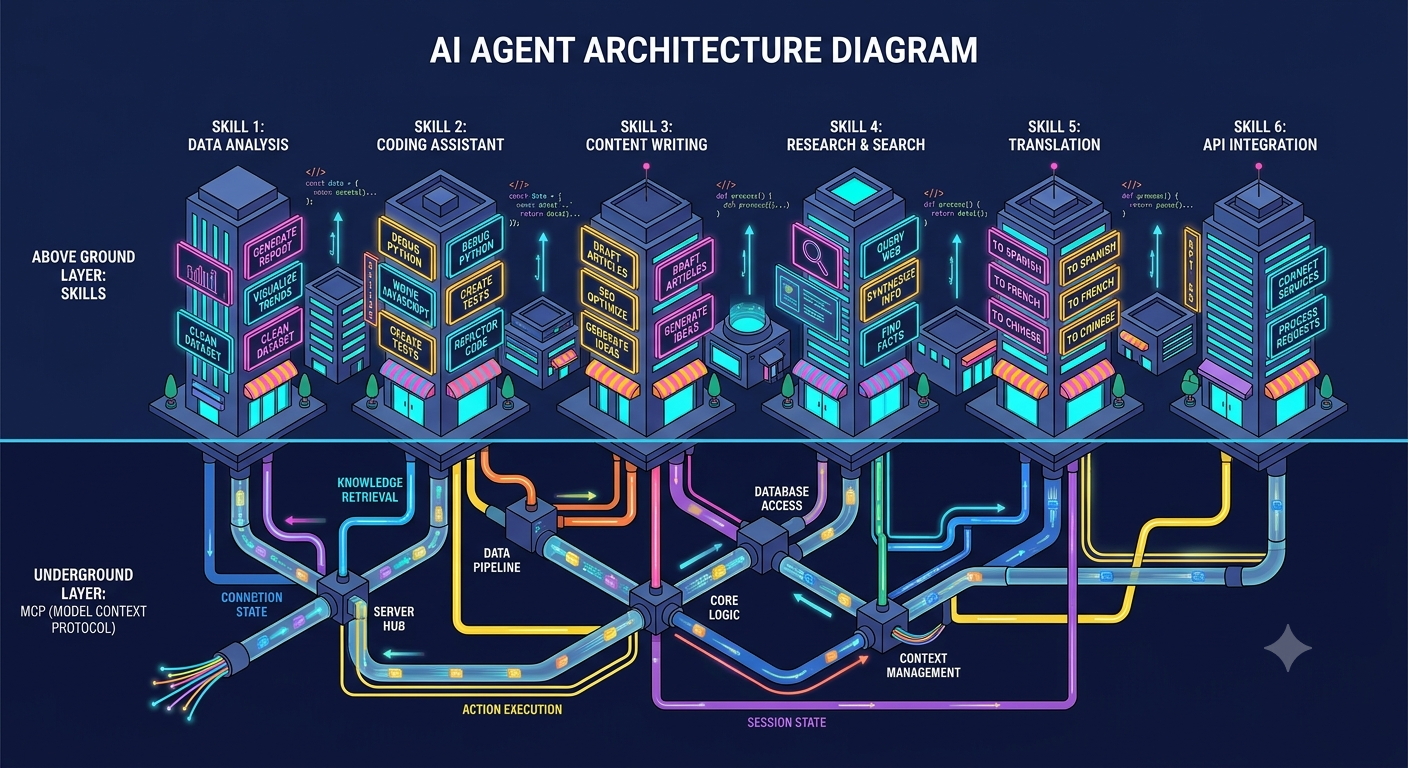
MCP and Agent Skills operate at different layers of your agent stack entirely. Conflating them is like arguing whether your car needs an engine or a GPS. Mate, it needs both. For different reasons.
Let me break this down properly.
The Model Context Protocol (MCP) is an open standard introduced by Anthropic in November 2024 to standardize the way AI systems like LLMs integrate and share data with external tools, systems, and data sources.
Think of it as USB-C for AI agents.
Before USB-C, every device needed its own cable. Before MCP, every AI integration needed its own custom code. Want your agent to talk to GitHub? Write a GitHub integration. Slack? Write a Slack integration. Postgres? Write a Postgres integration. Each one different. Each one maintained separately.
MCP solves what Anthropic identified as the "N×M integration problem" — when integrating N tools with M model frontends, you'd otherwise need N×M custom integrations. MCP replaces that with a single protocol: one standard interface for any tool.
Here's the architecture in plain English:
MCP Server — the tool side. GitHub, Notion, your database (anything that exposes capabilities through MCP).
MCP Client — the agent side. Claude, Cursor, Copilot (anything that consumes those capabilities).
The protocol — the agreed-upon language they speak. JSON-RPC based, stateful, structured.
MCP exposes three things: resources (data the agent can read), tools (actions the agent can execute), and prompts (reusable templates for LLM-server communication).
So, when your agent queries a database, creates a GitHub issue, or searches through your Notion workspace, that's MCP doing its job. It's the nervous system that connects your agent to the outside world.
Very. Embarrassingly big for something most people outside of AI engineering circles haven't heard of.
In just one year, MCP became one of the fastest-growing open-source projects in AI history — over 97 million monthly SDK downloads, 10,000 active servers, and first-class client support across Claude, ChatGPT, Cursor, Gemini, Microsoft Copilot, and Visual Studio Code. (Source: MCP Blog)
And then in December 2025, something that almost never happens in tech: Anthropic donated MCP to the Linux Foundation as a founding project of the newly created Agentic AI Foundation (AAIF), alongside Block's goose and OpenAI's AGENTS.md — with AWS, Google, Microsoft, Cloudflare, and Bloomberg signing on as supporting members. (Source: Linux Foundation)
Competitors. Sharing plumbing. Voluntarily.
MCP grew from roughly 2 million downloads at launch to 97 million monthly in just 16 months, which interestingly is one of the fastest open-source protocol adoption curves in history. For context, Kubernetes took nearly four years to reach comparable deployment density.
MCP is no longer Anthropic's protocol. It's the industry's protocol.
A Skill is a folder containing a SKILL.md file — structured metadata plus instructions that an agent loads when relevant to the current task. Skills can also bundle additional reference files and executable scripts that run deterministically.
If MCP is the nervous system connecting your agent to the world, Skills are the playbooks that tell your agent what to do once it gets there.
Here's the gap Skills fill: MCP gives your agent access to tools. But it doesn't give your agent judgment about how to use those tools in your specific context.
Your agent might have MCP access to your file system. But it still doesn't know:
Which libraries are installed in your environment?
Where exactly should output files go?
What naming conventions does your team follow?
What are the three things that always go wrong with this particular task?
Skills give the agent judgment like instructions, templates, and quality checks for how to approach a task. Use a Skill for workflow logic, output formatting, and anything tool-agnostic. They cost near-zero context until triggered.
The beautiful part? Skills are not system prompts. A system prompt is static text loaded once at session start. A Skill is a file-based module the agent discovers, evaluates for relevance, and loads dynamically, including code it can actually execute. (Source: Verdent)
Imagine you hire a brilliant new engineer. A fresher from a top university, who knows everything about software. You give them:
MCP is a key card. Access to your codebase, your Slack, your databases, your deployment tools. They can reach everything.
Agent Skills are your team's internal wiki. How you name branches. Which linter settings you use. The three gotchas in your legacy payment module. The unwritten rules that took your team two years to figure out.
The key card without the wiki? They'll break things. Not because they're not smart, but because they don't know your world specifically.
The wiki without the key card? Useless. They know how to do things but can't reach anything to do them.
You need both.
The confusion comes from a surface-level similarity: both MCP and Skills can "connect an agent to external services." So people assume they're competing.
The architectural split is this: MCPs expose capabilities, while Skills encode repeatable workflows. MCP tool definitions compete for context space — one analysis found that a Claude Code session can have 24% or more of its context window consumed by MCP tool definitions before a single conversation message is sent. Skills avoid that entirely by staying lightweight until needed. (Source: BetterClaw)
Anthropic addressed the MCP context problem in January 2026 with MCP Tool Search — which dynamically loads MCP tools on-demand when they would consume more than 10% of context. This helps, but the underlying tension remains: MCP tool definitions compete for context space, which is why Skills use a different approach entirely. (Source: Damian Galarza)
Also worth noting: MCP servers often run in their own container or service. Skills run in the agent's own environment with no extra infrastructure. Skills are lightweight by design. MCP is infrastructure.
Here's the clearest way I can put it:
Reach for MCP when:
Your agent needs live, bidirectional access to an external system
You need authentication, session management, or state across calls
You're connecting to a database, API, SaaS tool, or any live data source
Multiple agents or users need to share the same connection
The problem is about connectivity. Claude needs to reach something external, and you want that connection available across sessions without manual setup
Reach for Agent Skills when:
Your agent needs to know how to do something in your specific environment
You're encoding workflow logic, output formats, or team conventions
The capability is instruction-based and doesn't need live external access
You want reusable, portable knowledge that travels across tools
If a capability can be a Skill — instruction-based, no external access needed — making it a Skill instead of an MCP server reduces your attack surface
Use both when:
You're building anything production-grade
Your agent needs to both access live systems AND know how to behave once it gets there
The most successful AI architects in 2026 use the hybrid approach: MCP to give the agent a standardized nervous system to touch the world, and Skills to give the agent the mental playbooks to know what to do once it gets there. If you aren't using both, you're building half an agent. (Source: Analytics Vidhya)
Say you're building an agent that generates weekly financial reports from your company's database and saves them as formatted .docx files.
MCP handles:
Connecting to your Postgres database
Authenticating securely
Querying the right tables with the right permissions
Returning structured data to your agent
Agent Skills handles:
Which Python library to use for .docx generation (python-docx, not docx2pdf — not installed)
Where exactly to save the output file (/reports/weekly/, not the desktop)
The naming convention (report_YYYY-MM-DD_finance.docx)
The formatting rules your CFO actually cares about
The three edge cases that always break the report on the last day of the month
MCP gets the data. Skills make the output actually correct.
Both of these standards came from Anthropic. Both went open. Both got adopted by the whole industry. That's not a coincidence, it's a pattern.
MCP is the infrastructure that scales your systems. Agent Skills scale your agent's behaviour. They operate at different layers, solve different problems, and complement each other perfectly.
The teams building reliable agents in 2026 aren't debating which one to use. They're using both, understanding which job each one does, and building systems that don't break when the environment changes.
That's the whole game right now.
| MCP | Agent Skills | |
|---|---|---|
| What it is | A protocol for connecting agents to external systems | A file-based knowledge format for agent behavior |
| Analogy | Key card (gives access) | Team wiki (gives judgment) |
| Lives in | Its own server/container | Your filesystem (SKILL.md) |
| Best for | Live data, APIs, databases, auth | Workflow logic, formatting, environment rules |
| Context cost | Higher — tool schemas loaded upfront | Near-zero until triggered |
| Adopted by | Claude, ChatGPT, Cursor, Copilot, Gemini, VS Code | Claude Code, Copilot Studio, Cursor, Gemini CLI, 30+ tools |
| Governed by | Linux Foundation (AAIF) | Open standard (agentskills.io) |
| Use when | Agent needs to reach something | Agent needs to know something |
The answer to "MCP or Skills?" is almost always: both.
I'm an AI engineer documenting what I build, what breaks, and what actually works. If this cleared up the confusion, the next post goes deeper into building production agent systems end to end. Follow along.
References