保留正文与补采附件。源页面当前未重新核验;具体限制见交付清单。
 We value your privacy
We use cookies to enhance your browsing experience, serve personalised ads or content, and analyse our traffic. By clicking "Accept All", you consent to our use of cookies.
Customise Reject All Accept All
Customise Consent Preferences
 We use cookies to help you navigate efficiently and perform certain functions. You will find detailed information about all cookies under each consent category below.
The cookies that are categorised as "Necessary" are stored on your browser as they are essential for enabling the basic functionalities of the site. ... Show more
NecessaryAlways Active
Necessary cookies are required to enable the basic features of this site, such as providing secure log-in or adjusting your consent preferences. These cookies do not store any personally identifiable data.
-
Cookie
BCTempID
-
Duration
10 minutes
-
Description
No description available.
-
Cookie
__cf_bm
-
Duration
1 hour
-
Description
This cookie, set by Cloudflare, is used to support Cloudflare Bot Management.
-
Cookie
AWSALBCORS
-
Duration
7 days
-
Description
Amazon Web Services set this cookie for load balancing.
-
Cookie
_cfuvid
-
Duration
session
-
Description
Cloudflare sets this cookie to track users across sessions to optimize user experience by maintaining session consistency and providing personalized services
-
Cookie
li_gc
-
Duration
6 months
-
Description
Linkedin set this cookie for storing visitor's consent regarding using cookies for non-essential purposes.
-
Cookie
__hssrc
-
Duration
session
-
Description
This cookie is set by Hubspot whenever it changes the session cookie. The __hssrc cookie set to 1 indicates that the user has restarted the browser, and if the cookie does not exist, it is assumed to be a new session.
-
Cookie
__hssc
-
Duration
1 hour
-
Description
HubSpot sets this cookie to keep track of sessions and to determine if HubSpot should increment the session number and timestamps in the __hstc cookie.
-
Cookie
wpEmojiSettingsSupports
-
Duration
session
-
Description
WordPress sets this cookie when a user interacts with emojis on a WordPress site. It helps determine if the user's browser can display emojis properly.
-
Cookie
BCSessionID
-
Duration
1 year 1 month 4 days
-
Description
Blueconic sets this cookie as a unique identifier for the BlueConic profile.
-
Cookie
_octo
-
Duration
1 year
-
Description
No description available.
-
Cookie
logged_in
-
Duration
1 year
-
Description
No description available.
-
Cookie
__Secure-YEC
-
Duration
past
-
Description
YouTube sets this cookie to stores the user's video player preferences using embedded YouTube video
-
Cookie
__eoi
-
Duration
6 months
-
Description
Description is currently not available.
-
Cookie
AWSALBTGCORS
-
Duration
7 days
-
Description
No description available.
-
Cookie
login-status-p
-
Duration
past
-
Description
Description is currently not available.
-
Cookie
AWSALBTG
-
Duration
7 days
-
Description
No description available.
-
Cookie
csrf_token
-
Duration
session
-
Description
No description available.
-
Cookie
token_v2
-
Duration
1 day
-
Description
Description is currently not available.
-
Cookie
D
-
Duration
1 year
-
Description
Description is currently not available.
-
Cookie
PHPSESSID
-
Duration
session
-
Description
This cookie is native to PHP applications. The cookie stores and identifies a user's unique session ID to manage user sessions on the website. The cookie is a session cookie and will be deleted when all the browser windows are closed.
-
Cookie
VISITOR_PRIVACY_METADATA
-
Duration
6 months
-
Description
YouTube sets this cookie to store the user's cookie consent state for the current domain.
-
Cookie
cookietest
-
Duration
session
-
Description
The cookietest cookie is typically used to determine whether the user's browser accepts cookies, essential for website functionality and user experience.
-
Cookie
__Host-airtable-session
-
Duration
1 year
-
Description
This cookie is used to enable us to integrate the services of Airtable.
-
Cookie
__Host-airtable-session.sig
-
Duration
1 year
-
Description
This cookie is used to enable us to integrate the services of Airtable.
-
Cookie
m
-
Duration
1 year 1 month 4 days
-
Description
Stripe sets this cookie for fraud prevention purposes. It identifies the device used to access the website, allowing the website to be formatted accordingly.
-
Cookie
BIGipServer*
-
Duration
session
-
Description
Marketo sets this cookie to collect information about the user's online activity and build a profile about their interests to provide advertisements relevant to the user.
-
Cookie
__cfruid
-
Duration
session
-
Description
Cloudflare sets this cookie to identify trusted web traffic.
-
Cookie
_GRECAPTCHA
-
Duration
6 months
-
Description
Google Recaptcha service sets this cookie to identify bots to protect the website against malicious spam attacks.
-
Cookie
__Secure-YNID
-
Duration
6 months
-
Description
Google cookie used to protect user security and prevent fraud, especially during the login process.
-
Cookie
cookieyes-consent
-
Duration
1 year
-
Description
CookieYes sets this cookie to remember users' consent preferences so that their preferences are respected on subsequent visits to this site. It does not collect or store any personal information about the site visitors.
Functional
Functional cookies help perform certain functionalities like sharing the content of the website on social media platforms, collecting feedback, and other third-party features.
-
Cookie
lidc
-
Duration
1 day
-
Description
LinkedIn sets the lidc cookie to facilitate data center selection.
-
Cookie
brw
-
Duration
1 year
-
Description
No description available.
-
Cookie
brwConsent
-
Duration
5 minutes
-
Description
Description is currently not available.
-
Cookie
WMF-Uniq
-
Duration
1 year
-
Description
Description is currently not available.
-
Cookie
loom_anon_comment
-
Duration
1 year
-
Description
No description available.
-
Cookie
loom_referral_video
-
Duration
session
-
Description
Description is currently not available.
-
Cookie
VISITOR_INFO1_LIVE
-
Duration
6 months
-
Description
A cookie set by YouTube to measure bandwidth that determines whether the user gets the new or old player interface.
-
Cookie
yt-remote-connected-devices
-
Duration
Never Expires
-
Description
YouTube sets this cookie to store the user's video preferences using embedded YouTube videos.
-
Cookie
ytidb::LAST_RESULT_ENTRY_KEY
-
Duration
Never Expires
-
Description
The cookie ytidb::LAST_RESULT_ENTRY_KEY is used by YouTube to store the last search result entry that was clicked by the user. This information is used to improve the user experience by providing more relevant search results in the future.
-
Cookie
yt-remote-device-id
-
Duration
Never Expires
-
Description
YouTube sets this cookie to store the user's video preferences using embedded YouTube videos.
-
Cookie
yt-remote-session-name
-
Duration
session
-
Description
The yt-remote-session-name cookie is used by YouTube to store the user's video player preferences using embedded YouTube video.
-
Cookie
yt-remote-fast-check-period
-
Duration
session
-
Description
The yt-remote-fast-check-period cookie is used by YouTube to store the user's video player preferences for embedded YouTube videos.
-
Cookie
yt-remote-session-app
-
Duration
session
-
Description
The yt-remote-session-app cookie is used by YouTube to store user preferences and information about the interface of the embedded YouTube video player.
-
Cookie
yt-remote-cast-available
-
Duration
session
-
Description
The yt-remote-cast-available cookie is used to store the user's preferences regarding whether casting is available on their YouTube video player.
-
Cookie
yt-remote-cast-installed
-
Duration
session
-
Description
The yt-remote-cast-installed cookie is used to store the user's video player preferences using embedded YouTube video.
-
Cookie
cp_session
-
Duration
3 months
-
Description
Codepen sets this cookie for Help systems found in the website.
-
Cookie
loid
-
Duration
1 year 1 month 4 days
-
Description
This cookie is set by the Reddit. The cookie enables the sharing of content from the website onto the social media platform.
Analytics
Analytical cookies are used to understand how visitors interact with the website. These cookies help provide information on metrics such as the number of visitors, bounce rate, traffic source, etc.
-
Cookie
__hstc
-
Duration
6 months
-
Description
Hubspot set this main cookie for tracking visitors. It contains the domain, initial timestamp (first visit), last timestamp (last visit), current timestamp (this visit), and session number (increments for each subsequent session).
-
Cookie
hubspotutk
-
Duration
6 months
-
Description
HubSpot sets this cookie to keep track of the visitors to the website. This cookie is passed to HubSpot on form submission and used when deduplicating contacts.
-
Cookie
_ga
-
Duration
1 year 1 month 4 days
-
Description
Google Analytics sets this cookie to calculate visitor, session and campaign data and track site usage for the site's analytics report. The cookie stores information anonymously and assigns a randomly generated number to recognise unique visitors.
-
Cookie
ga*
-
Duration
1 year 1 month 4 days
-
Description
Google Analytics sets this cookie to store and count page views.
-
Cookie
__Host-psifi.analyticsTrace
-
Duration
6 hours
-
Description
Description is currently not available.
-
Cookie
__Host-psifi.analyticsTraceV2
-
Duration
6 hours
-
Description
Description is currently not available.
-
Cookie
_gh_sess
-
Duration
session
-
Description
GitHub sets this cookie for temporary application and framework state between pages like what step the user is on in a multiple step form.
-
Cookie
YSC
-
Duration
session
-
Description
YSC cookie is set by Youtube and is used to track the views of embedded videos on Youtube pages.
-
Cookie
ajs_anonymous_id
-
Duration
1 year
-
Description
This cookie is set by Segment to count the number of people who visit a certain site by tracking if they have visited before.
-
Cookie
vuid
-
Duration
1 year 1 month 4 days
-
Description
Vimeo installs this cookie to collect tracking information by setting a unique ID to embed videos on the website.
Performance
Performance cookies are used to understand and analyse the key performance indexes of the website which helps in delivering a better user experience for the visitors.
-
Cookie
AWSALB
-
Duration
7 days
-
Description
AWSALB is an application load balancer cookie set by Amazon Web Services to map the session to the target.
-
Cookie
acq
-
Duration
past
-
Description
Description is currently not available.
-
Cookie
acq.sig
-
Duration
past
-
Description
Description is currently not available.
-
Cookie
ptc
-
Duration
2 years
-
Description
No description available.
Advertisement
Advertisement cookies are used to provide visitors with customised advertisements based on the pages you visited previously and to analyse the effectiveness of the ad campaigns.
-
Cookie
muc_ads
-
Duration
1 year 1 month 4 days
-
Description
Twitter sets this cookie to collect user behaviour and interaction data to optimize the website.
-
Cookie
guest_id_marketing
-
Duration
1 year 1 month 4 days
-
Description
Twitter sets this cookie to identify and track the website visitor.
-
Cookie
guest_id_ads
-
Duration
1 year 1 month 4 days
-
Description
Twitter sets this cookie to identify and track the website visitor.
-
Cookie
personalization_id
-
Duration
1 year 1 month 4 days
-
Description
Twitter sets this cookie to integrate and share features for social media and also store information about how the user uses the website, for tracking and targeting.
-
Cookie
guest_id
-
Duration
1 year 1 month 4 days
-
Description
Twitter sets this cookie to identify and track the website visitor. It registers if a user is signed in to the Twitter platform and collects information about ad preferences.
-
Cookie
bcookie
-
Duration
1 year
-
Description
LinkedIn sets this cookie from LinkedIn share buttons and ad tags to recognize browser IDs.
-
Cookie
__Secure-ROLLOUT_TOKEN
-
Duration
6 months
-
Description
YouTube sets this cookie to manage feature rollout and experimentation. It helps Google control which new features or interface changes are shown to users as part of testing and staged rollouts, ensuring consistent experience for a given user during an experiment.
-
Cookie
yt.innertube::nextId
-
Duration
Never Expires
-
Description
YouTube sets this cookie to register a unique ID to store data on what videos from YouTube the user has seen.
-
Cookie
yt.innertube::requests
-
Duration
Never Expires
-
Description
YouTube sets this cookie to register a unique ID to store data on what videos from YouTube the user has seen.
-
Cookie
session_tracker
-
Duration
session
-
Description
This cookie is set by the Reddit. This cookie is used to identify trusted web traffic. It also helps in adverstising on the website.
-
Cookie
edgebucket
-
Duration
session
-
Description
Reddit sets this cookie to save the information about a log-on Reddit user, for the purpose of advertisement recommendations and updating the content.
-
Cookie
did
-
Duration
1 year
-
Description
Arbor sets this cookie to show targeted ads to site visitors.This cookie expires after 2 months or 1 year.
Uncategorised
Other uncategorised cookies are those that are being analysed and have not been classified into a category as yet.
No cookies to display.
Reject All Save My Preferences Accept All
Toggle SearchToggle Mobile Navigation
Publish AI, ML & data-science insights to a global community of data professionals.
Sign inSubmit an Article
LatestEditor's PicksNewsletterShipAI
Write For TDS
LinkedInXToggle Search
Artificial Intelligence
Explainable AI and the Focus on Human Curiosity
and concentrating on the top few factors and counterfactuals
Tirthajyoti Sarkar
January 24, 20228 min read
Explainable AI is hard
Explainable AI - or "xAI" as it is called sometimes - is hard - both figuratively and computationally.
Figuratively because the scope, purpose, and effectiveness of explainability are often hard to anticipate precisely and formalize in a problem definition or a user case study. These attributes take on a fluid form and spread out rather quickly and unpredictably.
The computational challenge of xAI comes from the mechanics of calculating metrics like Shapley values (for a large number of possible combinations of input features even if not for the entire power set). This is primarily a side effect of the fact that the most successful - and, therefore, important to offer explainability - machine learning models tend to have a large parameter space and deal with a bagful of features (or high-dimensional data type like images or natural language).
There are a good number of high-quality articles written about these. Exciting startups are working hard to address many of these problems.
In this article, we just want to focus on one aspect - how anticipating the user curiosity may help guide the xAI system design effort.
Learn this step by step with the interactive AI Engineer, AI and Data Scientist, Computer Science and Machine Learning roadmaps.
Two definitions - one to avoid
There is a landmark paper in this domain by Tim Miller: "Explanation in Artificial Intelligence: Insights from the Social Sciences" (2017). It has, sort of, two (non-mathematical) definitions for "Machine Learning Interpretability".
One definition is - Interpretability is the degree to which a human can understand the cause of a decision.
Another goes by - Interpretability is the degree to which a human can consistently predict the model's result.
Depending on human prediction is tricky
I would argue that the second definition should be avoided, even if it is straightforward and tempting to follow.
Why tempting to follow? Because between the two, this one has clearer mechanics for measurement. And, measurement is important for designing engineering systems. One can test the interpretability of an ML system by employing human evaluators and measure how consistently they can predict the model's results.
This also parallels the famous "Human-level performance " benchmark that all deep learning models and their designers talk about.
Please accept cookies to access this content
But, let's not overlook the prickly fact that depending on the human mind for consistently predicting structured results - essentially mimicking a sophisticated computer program - is not always a wise choice. That's why this definition of ML interpretability should be avoided.
Let me show you an example - right here in this article.
A demonstration
I wrote an article about building a single utility function to train a complete convolutional neural net model from just one input of the training images storage location.
A single function to streamline image classification with Keras
Here is the notebook. One of the examples was about classification between "cup" or "crab" from the famous Caltech-101 dataset. Let me ask you - the reader - to classify the test images.
What is it? A cup or a crab?
How much time did it take you to classify? Less than 100 milliseconds, maybe?
What about this one?
Again, instant recognition, isn't it? Now, what about this one?
You had a chuckle, didn't you? "A tricky one for the machine, " you thought silently.
So, as a human evaluator, you did pretty well.
But, comparing your performance to an ML algorithm - purely from an interpretability point of view - will be very hard in this exercise. Because a 5-layer convolutional neural net is sort of a black box whose inner working will be hard to explain to anyone. You will never be satisfied with the comparison and reconcile with the fact that your thinking is in the same line as that of the ML model.
You just won't know what that 'line of thinking for the ML model is!
Now, consider this example.
Let's say you have built a logistic regression model of a chemical process for your manufacturing plant to predict the quality - good or bad - based on input process parameters (measured by sophisticated sensors).
Here is a snapshot of the test data (think of it as parallel to the test images you saw above).
I have hidden the "Target" column partially because that's what you will not see but will be evaluated on.
What's your chance of predicting the right targets on this one looking at those maze of numbers? What's the chance that you can rattle off correct predictions under 100 milliseconds?
The grand scheme of using human evaluators as the metric of ML interpretability will fail spectacularly for this model. The irony, however, is that the choice of a simple binary logistic classification is perfect from an interpretability point of view. It is, indeed, an interpretable model. Just not the way we pitted a human evaluator against it.
Human brains have not evolved to deal with tabular data
Tabular data, in a nicely written form, is a recent development in human history. Sumerian or Assyrian cuneiforms were some of the earliest examples of written scripts and they were developed out of the need for record-keeping - land sales, agriculture output, tax revenue.
A bronze age version of Microsoft Excel!
But, it's only the bronze age. Just around the agricultural revolution, whose impact on food production, population density, and urbanization, led to this kind of tabular dataset.
Human cognitive revolution has been taking place for a long time - much before that. Here is an approximate timeline.
And, this chart above does not even cover the timeline of the evolution of the most amazing visual cortex and the human eye. That biology was shaped by the need to survive in the African savannah - classifying a predator from prey, a safe berry to eat from a poisonous one.
Hans Moravec, an Austria-born American roboticist and computer scientist, and presently, an adjunct faculty member of the Robotics Institute of Carnegie Mellon University, put it in a slightly different way - "it is comparatively easy to make computers exhibit adult level performance on intelligence tests or playing checkers, and difficult or impossible to give them the skills of a one-year-old when it comes to perception and mobility ".
Why math is easy for AI but gardening is not: Moravec's paradox
All this is to say - human evaluators will do fine with an object classification work but fail miserably with a binary classification using a tabular dataset.
Although the common ML models used for these tasks will be exactly opposite from the interpretability point of view - a hard-to-interpret neural net and a relatively easier logistic regression.
Go with the curiosity
For interpretable AI/ML systems, therefore, it makes sense, not to pit humans against the machine to see if the system predictions align with the human-generated ones.
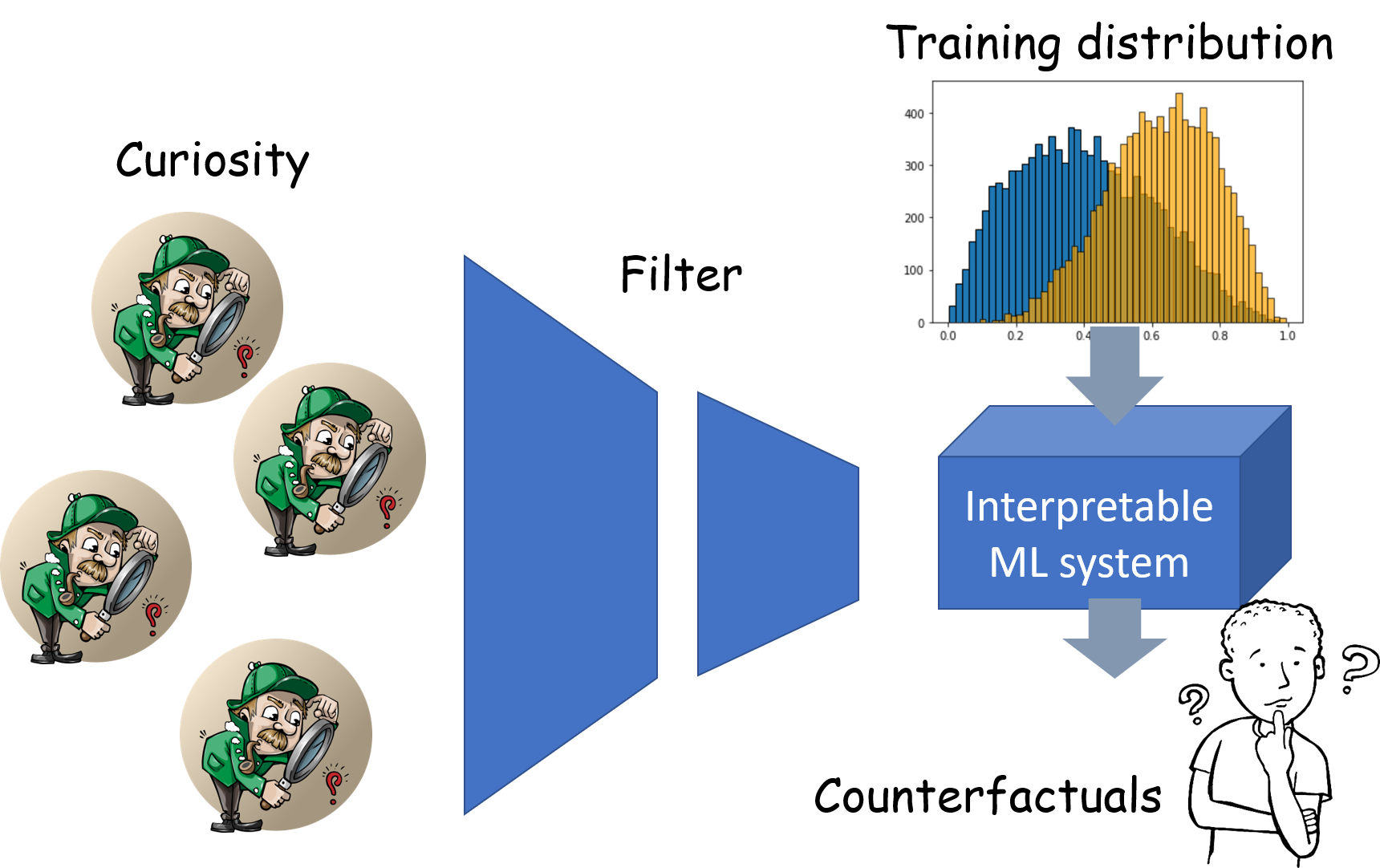
Instead, those systems need to be designed - from the ground up - by looking at the variety and nature of the natural curiosity of human users.
The Why's and the "What-if's
Human thinking needs to be respected. This include - "why " and "what if ".
- I am not testing myself against the prediction
- I am just curious about the top-3 factors which led to this prediction
- I also wonder if (how) the prediction would be different if one or more of these factors changed
Top-3 or Top-4 is sufficient and advisable
The top-3 (or 4) factor is important to note. A well-designed interpretable ML system should not try to overwhelm the user with all the strong patterns in the data that led to the model prediction.
This is, again, intimately related to our biology. We are good only with a small set of numbers. The short-term working memory of the human brain is around 7–8 items/numbers.
Therefore, a good system will focus on showing only a few visual concepts or charts for explaining an ML model. UX/UI design assumes a critical role.
This goes for general data analytics problems too. Here is an example from my article. For a correlation problem involving multiple similar machines, build a simple bar chart clearly highlighting the outlier machines instead of showing the actual correlation plots.
Counterfactuals
The what-if questions are often non-trivial and involve uncovering scenarios that had not happened but could have had. If we have a given model, you may think this is easy to do - just throw an exhaustive combination of input to the model, note down all the responses, and present them nicely.
But who decides that combination? How to assign priority to the list of stimuli that the model will be tested with for the first time? Here again, user (human) curiosity will be the key to deciding the priority and filtering the list. Additionally, we have to be careful about not testing the model with scenarios that are not too wildly different than the distribution of the training cases it has seen.
Curiosity changes with the domain
It is critical to remember that curiosity changes with the domain and level of the user within that domain. For a manufacturing organization, various stakeholders will be curious about various aspects of the ML model predictions,
Therefore, a good interpretable ML system must strive for covering as much base as possible with well-proven common design patterns e.g. visual analytics that has been proven to be effective (for their explanation power) for a large cross-section of users.
The explainability may come from a different layer
Human curiosity knows no bounds and it is prone to cross boundaries in a fluid manner. Most ML-powered systems are not just a single ML box. More often than not, they have other layers wrapping around the ML model and external users only see the recommendation or suggestions from this outer layer.
The human curiosity will be drawn to ask questions more pertaining to the structure of this outer layer. Interpretable ML systems should be ready to tackle this as they have to correctly identify the sub-system that the user's curiosity has tapped into.
Summary
Explainable AI is a great field that will drive the adoption of AI/ML systems as true aids to human endeavors. To succeed, apart from the design and computational challenges, anticipating the variety and subtlety of human curiosity will be key. Domain knowledge and an experimental attitude (to design the most appealing UI for example) will also be key ingredients for success.
Citation for Caltech-101 dataset
L. Fei-Fei, R. Fergus and P. Perona. "Learning generative visual models from few training examples: an incremental Bayesian approach tested on 101 object categories" IEEE. CVPR 2004, Workshop on Generative-Model Based Vision. 2004.
Loved the article? Become a Medium member to continue learning without limits . I'll receive a portion of your membership fee if you use the following link,__with no extra cost to you .
Join Medium with my referral link - Tirthajyoti Sarkar
Register Now to Continue Reading
Unlock Towards Data Science with a Free Account
All articles on Towards Data Science are available to registered users. Create a free account today to access this article and thousands more.
Register for freeSign in to your account
 Written By
See all from Tirthajyoti Sarkar
Artificial IntelligenceData ScienceExplainable AiMachine LearningTechnology
Share This Article
Towards Data Science is a community publication. Submit your insights to reach our global audience and earn through the TDS Author Payment Program.
Write for TDS
Related Articles
Data Science
Thoughts and Theory, Machine Learning A quantitative approach based on estimation accuracy What is the...
Gabriel de Longeaux
June 4, 20216 min read
Machine Learning
Ten or fewer takeaways on using FedJAX for federated learning research
Andrei
November 6, 20216 min read
Machine Learning
Take the red pill and learn about matrix calculus!
Vincent Mueller
September 6, 20216 min read
Artificial Intelligence
How to evaluate and compare Huggingface NLP models with Sagemaker Experiments
Heiko Hotz
July 7, 20213 min read
Machine Learning
Illustrations with code implementation, applied to TSP as an example
James Koh, PhD
November 7, 20238 min read
Machine Learning
A brief guide to run your model everywhere Application of machine learning are, nowadays, endless....
Filippo Valle
May 5, 20214 min read
Artificial Intelligence
Forecasting with deep neural networks
Vitor Cerqueira
February 14, 20236 min read
Data Science
Why do marketers turn to spreadsheets and how to close this gap
João António Sousa
January 20, 20245 min read
Machine Learning
Our task is to apply a supervised/semi-supervised technique like ULMFit (Ruder et al, 2018) to the Twitter US Airlines sentiment analysis...
Aadit Kapoor
August 15, 20209 min read
Your home for data science and AI. The world's leading publication for data science, data analytics, data engineering, machine learning, and artificial intelligence professionals.
Subscribe to Our NewsletterWrite For TDS•About•Advertise•Privacy Policy•Terms of Use
© Insight Media Group, LLC 2026•The New Stack•roadmap.sh•Creator Network