
Exploring the Naive Bayes Classifier: A Simple but Powerful Algorithm

Machine Learning algorithms come in all forms where some rely on distances, some on trees, and some on probabilities. Naive Bayes Classifier belongs to the last group as it predicts categories based on probability and prior knowledge.
Let’s understand what makes it “Naive,” how it uses Bayes’ Theorem, and why it still performs surprisingly well in practice.
What is Naive Bayes Classifier?
Naive Bayes is a machine learning classification algorithm that predicts the category (class) of a data point using probabilities. It is called “Naive” because it assumes that all features in the dataset are independent — that is, the presence or absence of one feature doesn’t affect another.
The “Bayes” part comes from its mathematical foundation — Bayes’ Theorem, which updates probabilities as more information becomes available.
In simple words:
Naive Bayes predicts a class for new data based on how strongly that data matches each class, given the prior probabilities.

Bayes’ Theorem Refresher
At the core of the algorithm is Bayes’ Theorem:

Where:
P(A|B) → Probability of class A given feature B (posterior probability)
P(B|A) → Probability of feature B given class A (likelihood)
P(A) → Prior probability of class A
P(B) → Probability of feature B (evidence)
The classifier picks the class with the highest posterior probability
How Naive Bayes Works (Step by Step)
Calculate Prior Probabilities (P(Class)) : Determine the probability of each class based on training data.
Calculate Likelihood (P(Feature|Class)) : For every feature, compute how likely it is to appear given each class.
Apply Bayes’ Theorem: Combine these probabilities for all features to calculate P(Class|Features).
Make Prediction: Choose the class with the highest posterior probability as the final prediction.
Example Weather & Playing Crickey
Imagine you want to predict whether your friend will play cricket based on the weather. You have past data showing different conditions (Sunny, Rainy, Overcast) and whether your friend played or not. Naive Bayes uses probability to make this decision. It first calculates how often each outcome (“Yes” or “No”) happens — that’s the prior probability. Then, for a new situation (say, the weather is Sunny and Cool), it calculates how likely those conditions are for both classes — how often “Sunny” and “Cool” appear when your friend does play and when they don’t. Using Bayes’ theorem, it multiplies these probabilities for each class. The one with the higher result is the prediction. In this case, even though both are close, the probability of “Yes” is slightly higher than “No”, so the model predicts your friend will play cricket. Essentially, Naive Bayes compares which outcome is more probable based on previous patterns — it doesn’t memorize examples, it reasons through likelihood.
Key points
Naive Bayes works on probability rather than distance or splits.
It assumes feature independence, which makes calculations simple.
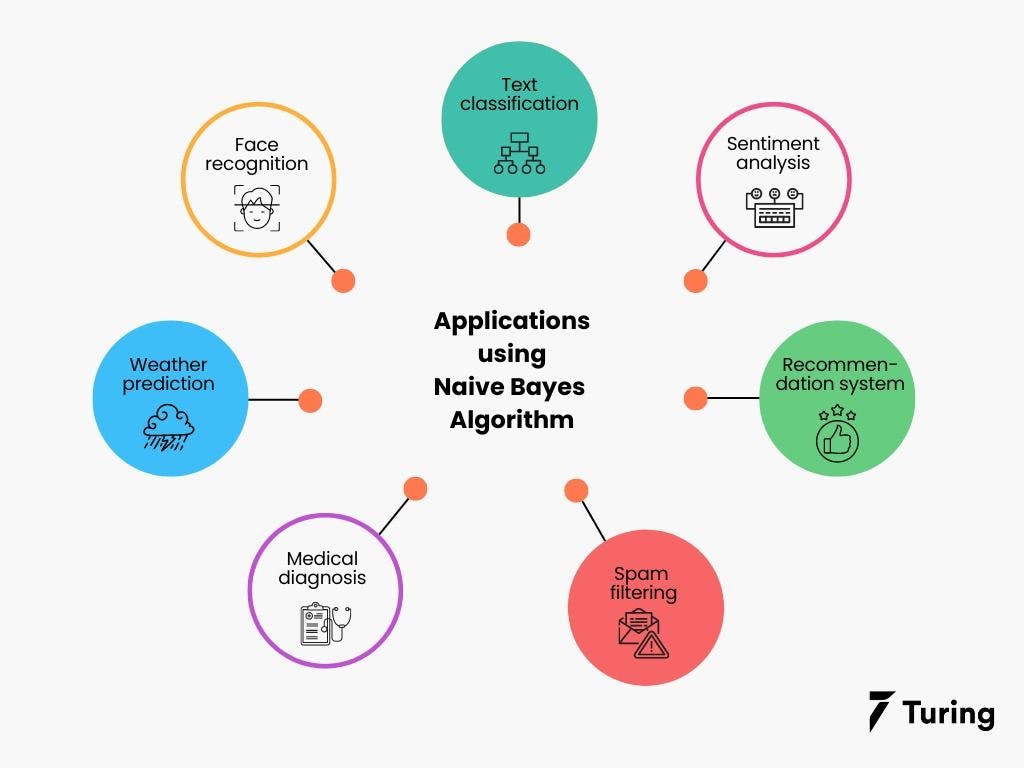
It’s very effective for text classification, spam detection, and sentiment analysis.
It’s fast, easy to interpret, and surprisingly powerful for its simplicity.
Assumptions of Naive Bayes
Feature Independence: Each feature contributes independently to the outcome.
(E.g., “discount” and “offer” are treated as separate factors.)Equal Importance: All features are assumed to be equally important in determining the output.
Types of Naive Bayes Classifier
Gaussian Naive Bayes: Used when features are continuous (numerical) and follow a normal distribution.
Multinomial Naive Bayes: Commonly used for text classification — works well with word counts or frequency features (like in spam detection).
Bernoulli Naive Bayes: Designed for binary/boolean features, such as “word present or not” in text data.
Advantages of Naive Bayes Classifier
Simple & Fast: Easy to implement and computationally efficient.
Scalable: Works well with a large number of features.
Performs Well on Small Datasets: Even limited data can give good results.
Effective for Categorical Features: Especially in NLP and document classification.
Handles Missing Data gracefully due to its probabilistic nature.
Applications That use Naive Bayes
Python Implementation Example
Here’s a tiny implementation using Scikit-learn on a simple dataset:
from sklearn.model_selection import train_test_split
from sklearn.naive_bayes import GaussianNB
from sklearn.metrics import accuracy_score

# Sample dataset
import pandas as pd

data = {
    'Outlook': ['Sunny','Sunny','Overcast','Rainy','Rainy','Rainy','Overcast','Sunny','Sunny','Rainy','Sunny','Overcast','Overcast','Rainy'],
    'Temperature': ['Hot','Hot','Hot','Mild','Cool','Cool','Cool','Mild','Cool','Mild','Mild','Mild','Hot','Mild'],
    'Play': ['No','No','Yes','Yes','Yes','No','Yes','No','Yes','Yes','Yes','Yes','Yes','No']
}

df = pd.DataFrame(data)

# Encode categorical values
from sklearn.preprocessing import LabelEncoder
le = LabelEncoder()
df_encoded = df.apply(le.fit_transform)

X = df_encoded[['Outlook','Temperature']]
y = df_encoded['Play']

X_train, X_test, y_train, y_test = train_test_split(X, y, test_size=0.2)

model = GaussianNB()
model.fit(X_train, y_train)

pred = model.predict(X_test)
print("Accuracy:", accuracy_score(y_test, pred))
Final Thoughts
Despite its simplicity, Naive Bayes Classifier is a surprisingly powerful and reliable algorithm, especially for text and classification problems. It’s often the first model data scientists try before moving to complex ones — because it’s fast, interpretable, and effective.
It’s often used as a baseline model — because if Naive Bayes performs well, it tells you your data has clear probabilistic structure.
Simple assumptions. Powerful results. That’s the magic of Naive Bayes.
For more in-depth you can read the following tutorial


