保留正文与补采附件。源页面当前未重新核验;具体限制见交付清单。
 We value your privacy
We use cookies to enhance your browsing experience, serve personalised ads or content, and analyse our traffic. By clicking "Accept All", you consent to our use of cookies.
Customise Reject All Accept All
Customise Consent Preferences
 We use cookies to help you navigate efficiently and perform certain functions. You will find detailed information about all cookies under each consent category below.
The cookies that are categorised as "Necessary" are stored on your browser as they are essential for enabling the basic functionalities of the site. ... Show more
NecessaryAlways Active
Necessary cookies are required to enable the basic features of this site, such as providing secure log-in or adjusting your consent preferences. These cookies do not store any personally identifiable data.
-
Cookie
BCTempID
-
Duration
10 minutes
-
Description
No description available.
-
Cookie
__cf_bm
-
Duration
1 hour
-
Description
This cookie, set by Cloudflare, is used to support Cloudflare Bot Management.
-
Cookie
AWSALBCORS
-
Duration
7 days
-
Description
Amazon Web Services set this cookie for load balancing.
-
Cookie
_cfuvid
-
Duration
session
-
Description
Cloudflare sets this cookie to track users across sessions to optimize user experience by maintaining session consistency and providing personalized services
-
Cookie
li_gc
-
Duration
6 months
-
Description
Linkedin set this cookie for storing visitor's consent regarding using cookies for non-essential purposes.
-
Cookie
__hssrc
-
Duration
session
-
Description
This cookie is set by Hubspot whenever it changes the session cookie. The __hssrc cookie set to 1 indicates that the user has restarted the browser, and if the cookie does not exist, it is assumed to be a new session.
-
Cookie
__hssc
-
Duration
1 hour
-
Description
HubSpot sets this cookie to keep track of sessions and to determine if HubSpot should increment the session number and timestamps in the __hstc cookie.
-
Cookie
wpEmojiSettingsSupports
-
Duration
session
-
Description
WordPress sets this cookie when a user interacts with emojis on a WordPress site. It helps determine if the user's browser can display emojis properly.
-
Cookie
BCSessionID
-
Duration
1 year 1 month 4 days
-
Description
Blueconic sets this cookie as a unique identifier for the BlueConic profile.
-
Cookie
_octo
-
Duration
1 year
-
Description
No description available.
-
Cookie
logged_in
-
Duration
1 year
-
Description
No description available.
-
Cookie
__Secure-YEC
-
Duration
past
-
Description
YouTube sets this cookie to stores the user's video player preferences using embedded YouTube video
-
Cookie
__eoi
-
Duration
6 months
-
Description
Description is currently not available.
-
Cookie
AWSALBTGCORS
-
Duration
7 days
-
Description
No description available.
-
Cookie
login-status-p
-
Duration
past
-
Description
Description is currently not available.
-
Cookie
AWSALBTG
-
Duration
7 days
-
Description
No description available.
-
Cookie
csrf_token
-
Duration
session
-
Description
No description available.
-
Cookie
token_v2
-
Duration
1 day
-
Description
Description is currently not available.
-
Cookie
D
-
Duration
1 year
-
Description
Description is currently not available.
-
Cookie
PHPSESSID
-
Duration
session
-
Description
This cookie is native to PHP applications. The cookie stores and identifies a user's unique session ID to manage user sessions on the website. The cookie is a session cookie and will be deleted when all the browser windows are closed.
-
Cookie
VISITOR_PRIVACY_METADATA
-
Duration
6 months
-
Description
YouTube sets this cookie to store the user's cookie consent state for the current domain.
-
Cookie
cookietest
-
Duration
session
-
Description
The cookietest cookie is typically used to determine whether the user's browser accepts cookies, essential for website functionality and user experience.
-
Cookie
__Host-airtable-session
-
Duration
1 year
-
Description
This cookie is used to enable us to integrate the services of Airtable.
-
Cookie
__Host-airtable-session.sig
-
Duration
1 year
-
Description
This cookie is used to enable us to integrate the services of Airtable.
-
Cookie
m
-
Duration
1 year 1 month 4 days
-
Description
Stripe sets this cookie for fraud prevention purposes. It identifies the device used to access the website, allowing the website to be formatted accordingly.
-
Cookie
BIGipServer*
-
Duration
session
-
Description
Marketo sets this cookie to collect information about the user's online activity and build a profile about their interests to provide advertisements relevant to the user.
-
Cookie
__cfruid
-
Duration
session
-
Description
Cloudflare sets this cookie to identify trusted web traffic.
-
Cookie
_GRECAPTCHA
-
Duration
6 months
-
Description
Google Recaptcha service sets this cookie to identify bots to protect the website against malicious spam attacks.
-
Cookie
__Secure-YNID
-
Duration
6 months
-
Description
Google cookie used to protect user security and prevent fraud, especially during the login process.
-
Cookie
cookieyes-consent
-
Duration
1 year
-
Description
CookieYes sets this cookie to remember users' consent preferences so that their preferences are respected on subsequent visits to this site. It does not collect or store any personal information about the site visitors.
Functional
Functional cookies help perform certain functionalities like sharing the content of the website on social media platforms, collecting feedback, and other third-party features.
-
Cookie
lidc
-
Duration
1 day
-
Description
LinkedIn sets the lidc cookie to facilitate data center selection.
-
Cookie
brw
-
Duration
1 year
-
Description
No description available.
-
Cookie
brwConsent
-
Duration
5 minutes
-
Description
Description is currently not available.
-
Cookie
WMF-Uniq
-
Duration
1 year
-
Description
Description is currently not available.
-
Cookie
loom_anon_comment
-
Duration
1 year
-
Description
No description available.
-
Cookie
loom_referral_video
-
Duration
session
-
Description
Description is currently not available.
-
Cookie
VISITOR_INFO1_LIVE
-
Duration
6 months
-
Description
A cookie set by YouTube to measure bandwidth that determines whether the user gets the new or old player interface.
-
Cookie
yt-remote-connected-devices
-
Duration
Never Expires
-
Description
YouTube sets this cookie to store the user's video preferences using embedded YouTube videos.
-
Cookie
ytidb::LAST_RESULT_ENTRY_KEY
-
Duration
Never Expires
-
Description
The cookie ytidb::LAST_RESULT_ENTRY_KEY is used by YouTube to store the last search result entry that was clicked by the user. This information is used to improve the user experience by providing more relevant search results in the future.
-
Cookie
yt-remote-device-id
-
Duration
Never Expires
-
Description
YouTube sets this cookie to store the user's video preferences using embedded YouTube videos.
-
Cookie
yt-remote-session-name
-
Duration
session
-
Description
The yt-remote-session-name cookie is used by YouTube to store the user's video player preferences using embedded YouTube video.
-
Cookie
yt-remote-fast-check-period
-
Duration
session
-
Description
The yt-remote-fast-check-period cookie is used by YouTube to store the user's video player preferences for embedded YouTube videos.
-
Cookie
yt-remote-session-app
-
Duration
session
-
Description
The yt-remote-session-app cookie is used by YouTube to store user preferences and information about the interface of the embedded YouTube video player.
-
Cookie
yt-remote-cast-available
-
Duration
session
-
Description
The yt-remote-cast-available cookie is used to store the user's preferences regarding whether casting is available on their YouTube video player.
-
Cookie
yt-remote-cast-installed
-
Duration
session
-
Description
The yt-remote-cast-installed cookie is used to store the user's video player preferences using embedded YouTube video.
-
Cookie
cp_session
-
Duration
3 months
-
Description
Codepen sets this cookie for Help systems found in the website.
-
Cookie
loid
-
Duration
1 year 1 month 4 days
-
Description
This cookie is set by the Reddit. The cookie enables the sharing of content from the website onto the social media platform.
Analytics
Analytical cookies are used to understand how visitors interact with the website. These cookies help provide information on metrics such as the number of visitors, bounce rate, traffic source, etc.
-
Cookie
__hstc
-
Duration
6 months
-
Description
Hubspot set this main cookie for tracking visitors. It contains the domain, initial timestamp (first visit), last timestamp (last visit), current timestamp (this visit), and session number (increments for each subsequent session).
-
Cookie
hubspotutk
-
Duration
6 months
-
Description
HubSpot sets this cookie to keep track of the visitors to the website. This cookie is passed to HubSpot on form submission and used when deduplicating contacts.
-
Cookie
_ga
-
Duration
1 year 1 month 4 days
-
Description
Google Analytics sets this cookie to calculate visitor, session and campaign data and track site usage for the site's analytics report. The cookie stores information anonymously and assigns a randomly generated number to recognise unique visitors.
-
Cookie
ga*
-
Duration
1 year 1 month 4 days
-
Description
Google Analytics sets this cookie to store and count page views.
-
Cookie
__Host-psifi.analyticsTrace
-
Duration
6 hours
-
Description
Description is currently not available.
-
Cookie
__Host-psifi.analyticsTraceV2
-
Duration
6 hours
-
Description
Description is currently not available.
-
Cookie
_gh_sess
-
Duration
session
-
Description
GitHub sets this cookie for temporary application and framework state between pages like what step the user is on in a multiple step form.
-
Cookie
YSC
-
Duration
session
-
Description
YSC cookie is set by Youtube and is used to track the views of embedded videos on Youtube pages.
-
Cookie
ajs_anonymous_id
-
Duration
1 year
-
Description
This cookie is set by Segment to count the number of people who visit a certain site by tracking if they have visited before.
-
Cookie
vuid
-
Duration
1 year 1 month 4 days
-
Description
Vimeo installs this cookie to collect tracking information by setting a unique ID to embed videos on the website.
Performance
Performance cookies are used to understand and analyse the key performance indexes of the website which helps in delivering a better user experience for the visitors.
-
Cookie
AWSALB
-
Duration
7 days
-
Description
AWSALB is an application load balancer cookie set by Amazon Web Services to map the session to the target.
-
Cookie
acq
-
Duration
past
-
Description
Description is currently not available.
-
Cookie
acq.sig
-
Duration
past
-
Description
Description is currently not available.
-
Cookie
ptc
-
Duration
2 years
-
Description
No description available.
Advertisement
Advertisement cookies are used to provide visitors with customised advertisements based on the pages you visited previously and to analyse the effectiveness of the ad campaigns.
-
Cookie
muc_ads
-
Duration
1 year 1 month 4 days
-
Description
Twitter sets this cookie to collect user behaviour and interaction data to optimize the website.
-
Cookie
guest_id_marketing
-
Duration
1 year 1 month 4 days
-
Description
Twitter sets this cookie to identify and track the website visitor.
-
Cookie
guest_id_ads
-
Duration
1 year 1 month 4 days
-
Description
Twitter sets this cookie to identify and track the website visitor.
-
Cookie
personalization_id
-
Duration
1 year 1 month 4 days
-
Description
Twitter sets this cookie to integrate and share features for social media and also store information about how the user uses the website, for tracking and targeting.
-
Cookie
guest_id
-
Duration
1 year 1 month 4 days
-
Description
Twitter sets this cookie to identify and track the website visitor. It registers if a user is signed in to the Twitter platform and collects information about ad preferences.
-
Cookie
bcookie
-
Duration
1 year
-
Description
LinkedIn sets this cookie from LinkedIn share buttons and ad tags to recognize browser IDs.
-
Cookie
__Secure-ROLLOUT_TOKEN
-
Duration
6 months
-
Description
YouTube sets this cookie to manage feature rollout and experimentation. It helps Google control which new features or interface changes are shown to users as part of testing and staged rollouts, ensuring consistent experience for a given user during an experiment.
-
Cookie
yt.innertube::nextId
-
Duration
Never Expires
-
Description
YouTube sets this cookie to register a unique ID to store data on what videos from YouTube the user has seen.
-
Cookie
yt.innertube::requests
-
Duration
Never Expires
-
Description
YouTube sets this cookie to register a unique ID to store data on what videos from YouTube the user has seen.
-
Cookie
session_tracker
-
Duration
session
-
Description
This cookie is set by the Reddit. This cookie is used to identify trusted web traffic. It also helps in adverstising on the website.
-
Cookie
edgebucket
-
Duration
session
-
Description
Reddit sets this cookie to save the information about a log-on Reddit user, for the purpose of advertisement recommendations and updating the content.
-
Cookie
did
-
Duration
1 year
-
Description
Arbor sets this cookie to show targeted ads to site visitors.This cookie expires after 2 months or 1 year.
Uncategorised
Other uncategorised cookies are those that are being analysed and have not been classified into a category as yet.
No cookies to display.
Reject All Save My Preferences Accept All
Toggle SearchToggle Mobile Navigation
Publish AI, ML & data-science insights to a global community of data professionals.
Sign inSubmit an Article
LatestEditor's PicksNewsletterShipAI
Write For TDS
LinkedInXToggle Search
Artificial Intelligence
How to Find the Best Multilingual Embedding Model for Your RAG
Optimize the Embedding Space for Improving RAG
Iulia Brezeanu
January 27, 20248 min read
 Image by author. AI generated.
Embeddings are vector representations that capture the semantic meaning of words or sentences. Besides having quality data, choosing a good embedding model is the most important and underrated step for optimizing your RAG application. Multilingual models are especially challenging as most are pre-trained on English data. The right embeddings make a huge difference - don't just grab the first model you see!
The semantic space determines the relationships between words and concepts. An accurate semantic space improves retrieval performance. Inaccurate embeddings lead to irrelevant chunks or missing information. A better model directly improves your RAG system's capabilities.
In this article, we will create a question-answer dataset from PDF documents in order to find the best model for our task and language. During RAG, if the expected answer is retrieved, it means the embedding model positioned the question and answer close enough in the semantic space.
While we focus on French and Italian, the process can be adapted to any language because the best embeddings might differ.
Learn this step by step with the interactive AI Engineer and AI and Data Scientist roadmaps.
Embedding Models
There are two main types of embedding models: static and dynamic. Static embeddings like word2vec generate a vector for each word. The vectors are combined, often by averaging, to create a final embedding. These types of embeddings are not often used in production anymore because they don't consider how a word's meaning can change in function to the surrounding words.
Dynamic embeddings are based on Transformers like BERT, which incorporate context awareness through self-attention layers, allowing them to represent words based on the surrounding context.
Most current fine-tuned models use contrastive learning. The model learns semantic similarity by seeing both positive and negative text pairs during training.
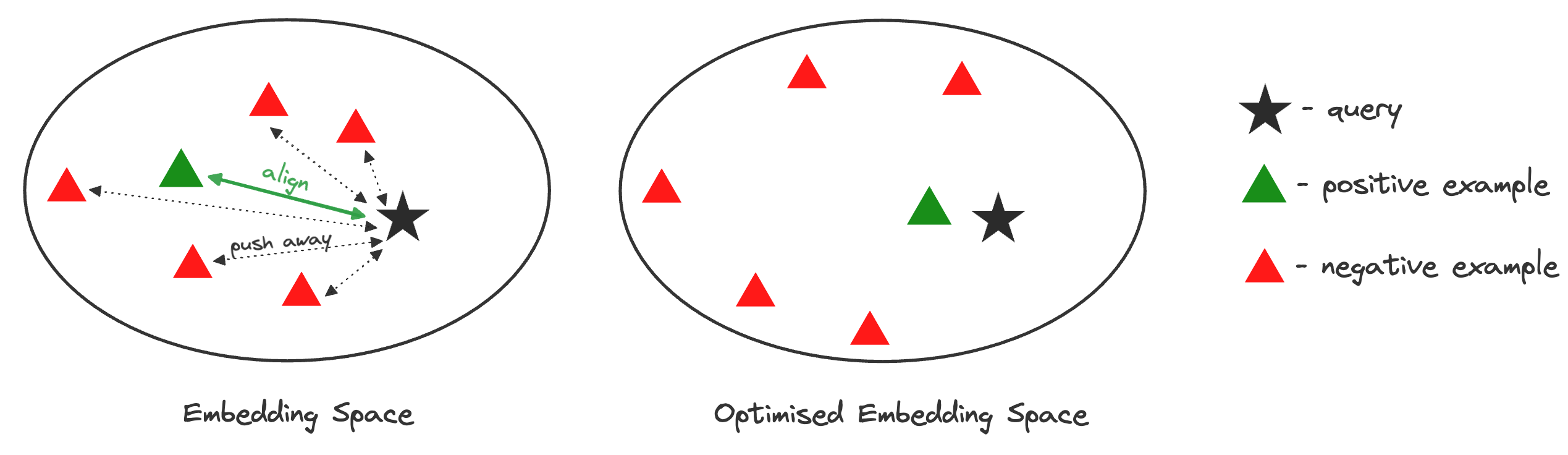 Process of optimizing the Embedding Space. Image by author.
In an accurate semantic space, words, and phrases with similar meanings are close together, while contradicting ones are far apart. Below, you can see a two-dimensional PCA of sentences embedded using bge-base-en-v1.5-angle. The original embeddings had 768 dimensions, and PCA reduced it to 2 dimensions.
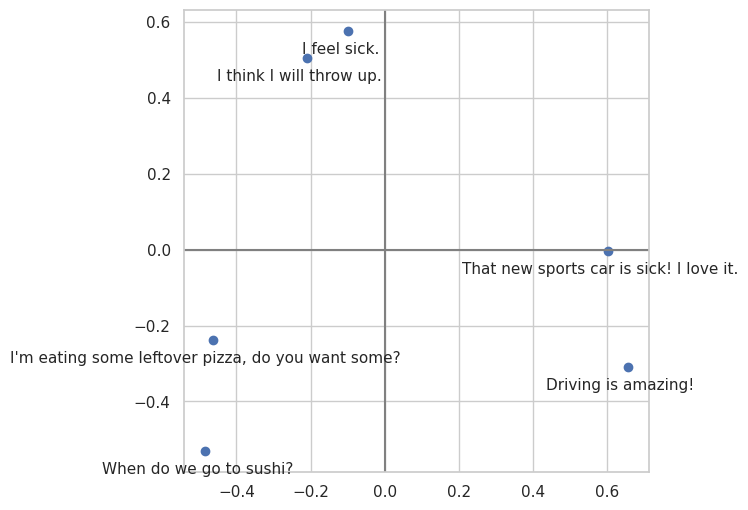 Example of 2D PCA of Sentence Embeddings. Image by author.
The graph demonstrates how the semantic space organizes sentences with related meanings close together.
Note how the sentences That new sports car is sick! and I feel sick , which have positive and negative connotations of the word sick , are positioned far apart. The embedding model understands the meaning of the word from the surrounding context.
During RAG, the retrieval mechanism uses semantic similarity to identify documents close to the user query. So, an inaccurate semantic space that causes irrelevant documents to be in the vicinity of the query would lead to poor answers.
The wide range of pre-trained transformers has created many possible text embedding models to explore. It's not easy to determine the optimal model for specific needs.
Massive Text Embedding Benchmark
 An overview of tasks and datasets in MTEB. Multilingual datasets are marked with a purple shade. [3]
Massive Text Embedding Benchmark (MTEB) evaluates embedding models across 8 tasks and 58 datasets. 10 of these datasets are multilingual, covering 112 languages. The tasks are bitext mining, classification, clustering, pair classification, reranking, retrieval, semantic textual similarity (STS), and summarization.
We focus only on the retrieval task because it is the most relevant for RAG. In order to evaluate it, each dataset has a corpus, queries, and query-document mappings. The queries and corpus are embedded to find relevant documents using cosine similarity.
Model performance is measured by Normalized Discounted Cumulative Gain at 10 (nDCG@10). This metric accounts for the position of relevant documents in the ranking. We won't go into too much detail about nDCG, but we recommend this in-depth article if you want to read more.
Unfortunately, the initial MTEB retrieval datasets were only in English. Recently, some were added in Polish and Swedish, but multilingual support is still limited [2].
 MTEB Leaderboard [1]
We will evaluate the current top 5 multilingual embedding models from the MTEB Leaderboard against a baseline Sentence Transformers model. This analysis will reveal which models perform best for retrieval across French and Italian, but you can customize the evaluation easily for any language.
First, let's look at some key model properties: sequence length and embedding dimensions. The sequence length refers to the maximum number of tokens the model can process at once. Anything longer than the context window gets truncated. The embedding dimension refers to the vector size. Larger vectors can capture more meaning from sentences but may be less storage-efficient.
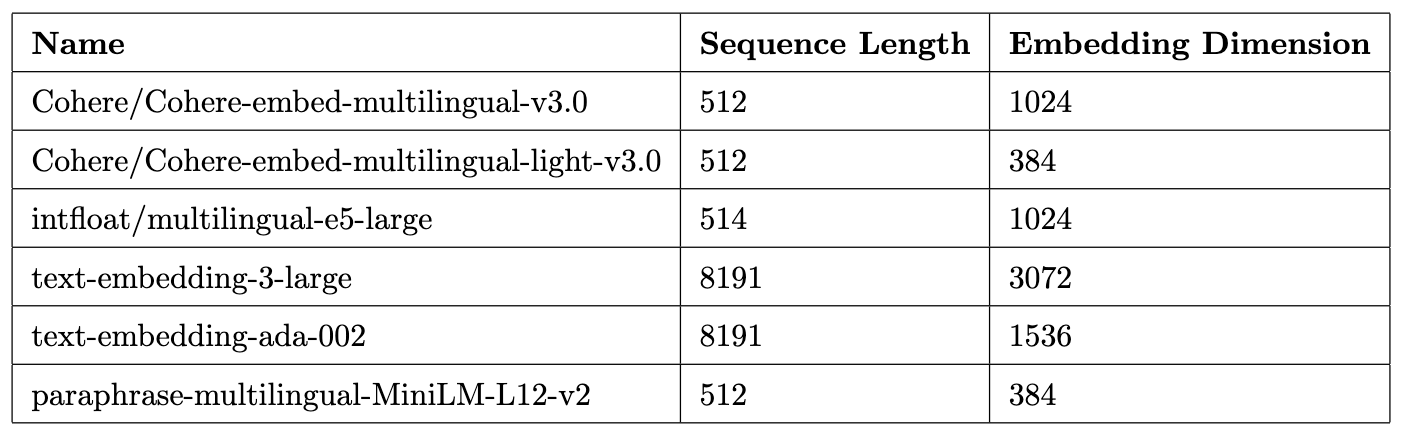 Comparison of Embedding Models Specifications. Image by author.
Cohere-embed-multilingual-v3.0 & light-v3.0
Cohere offers a proprietary embedding model accessible through an API at the cost of $0.10/1M tokens, which is the same price as for ada-002. Besides embedding, the model can rank the most relevant documents at the top during retrieval by assessing how well a query matches a document's topic. They also implemented compression-aware training for more efficient storage [4].
The light version of the multilingual Cohere model has an embedding dimension of only 384 [7].
intfloat/multilingual-e5-large
The E5 family of models was trained using weak supervision in a contrastive manner using the CCPair dataset [5]. The dataset was created by extracting text pairs from various sources, including Reddit, StackExchange, Wikipedia, scientific papers, Common Crawl, and news articles. The authors compiled text pairs consisting of a query q and a corresponding passage p , as shown below.
 CCPairs (Colossal Clean text Pairs) [5]
text-embedding-3-large
OpenAI claims that this is their most performant model with higher multilingual performance than ada-002. An interesting improvement is adding the possibility of reducing the embedding dimensions from 3072 to as low as you want. While there is an accuracy-cost tradeoff associated with lower dimensionality, having the flexibility to use smaller embeddings can provide helpful savings on memory and storage requirements [6].
sentence-transformers/paraphrase-multilingual-MiniLM-L12-v2
We consider this model as a baseline because it's one of the most downloaded Sentence Transformers models from Hugging Face.
 sentence-transformers/paraphrase-multilingual-MiniLM-L12-v2 number of downloads [8]
It is based on the SBERT architecture, which introduced the idea of a triple network structure. The network takes three inputs - an anchor, a positive example, and a negative example. Then, it is trained so that the anchor is closer to the positive than the negative example in the embedding space.
Generating QA pairs
In order to have as little bias between languages as possible, our chosen documents are the 2023 European Semester Country Reports for France and Italy [9]. They have the same number of pages and a very similar structure, being official reports from the European Commission.
We provide each text chunk from the corpus as context to GPT-3.5-turbo and prompt it to generate a question based on that context. LLMs typically respond more accurately when both the prompt and the desired response are in the same language, so I translated the prompts into Italian and French.
python
prompt_it = """
Le informazioni sul contesto sono riportate di seguito.

---------------------
{context_str}
---------------------

Date le informazioni sul contesto e non le conoscenze pregresse.
generare solo domande basate sulla domanda seguente.

Siete un insegnante/professore. Il vostro compito è quello di impostare
{num_questions_per_chunk} per un prossimo quiz.
Le domande devono essere di natura diversa nel documento.
Limitare le domande alle informazioni di contesto fornite.
Le domande devono essere in italiano."
"""

prompt_fr = """
Les informations contextuelles se trouvent ci-dessous.

---------------------
{context_str}
---------------------

Compte tenu des informations contextuelles et sans connaissances préalables, générer uniquement des questions basées sur la requête ci-dessous.

Vous êtes enseignant/professeur. Votre tâche consiste à mettre en place
{num_questions_per_chunk} pour un quiz à venir.
Les questions doivent être de nature variée sur l'ensemble du document.
Limitez les questions aux informations contextuelles fournies.
Les questions doivent être en français."
"""
We already split the text into chunks of 1000 characters and ingested them into nodes, so now we go straight to creating the dataset.
makefile
fr_dataset = generate_qa_embedding_pairs(
    llm=OpenAI(model="gpt-3.5-turbo"), nodes=fr_nodes, qa_generate_prompt_tmpl = prompt_fr
)
fr_dataset.save_json("fr_dataset.json")

it_dataset = generate_qa_embedding_pairs(
    llm=OpenAI(model="gpt-3.5-turbo"), nodes=it_nodes, qa_generate_prompt_tmpl = prompt_it
)

it_dataset.save_json("it_dataset.json")
The resulting dataset has 4 keys: queries, corpus, relevant_docs, and mode equal to text. Each query ID has an associated relevant document node ID. This is an example of a query from the Italian dataset and the corresponding text chunk.
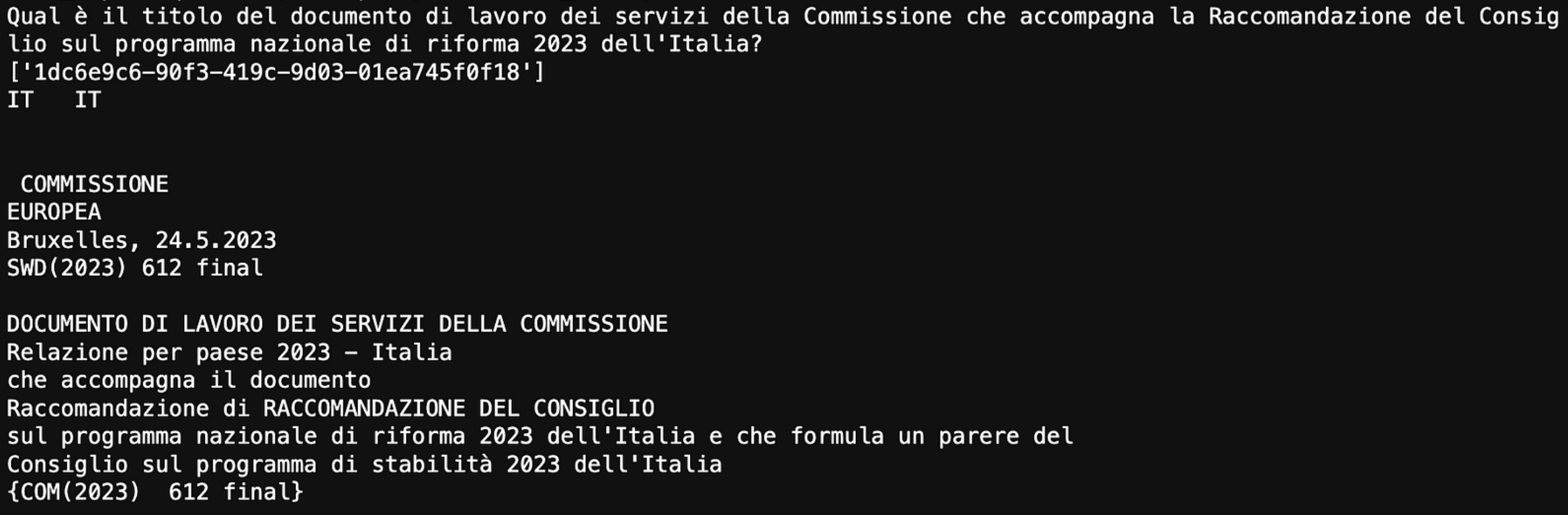 First query from the Italian dataset. Image by author.
Evaluation metrics
We'll retrieve the top 5 documents and evaluate their relevance using Hit Rate and MRR. The Hit Rate checks whether the expected relevant document is among the top 5. So, the overall value would be the proportion of queries for which we have a hit.
MRR is calculated as the reciprocal of the rank at which the relevant document is found (1/rank). If the relevant document is not found, MRR is 0 for that query. The final MRR would be the average of the MRR values calculated for each query.
Models' performance
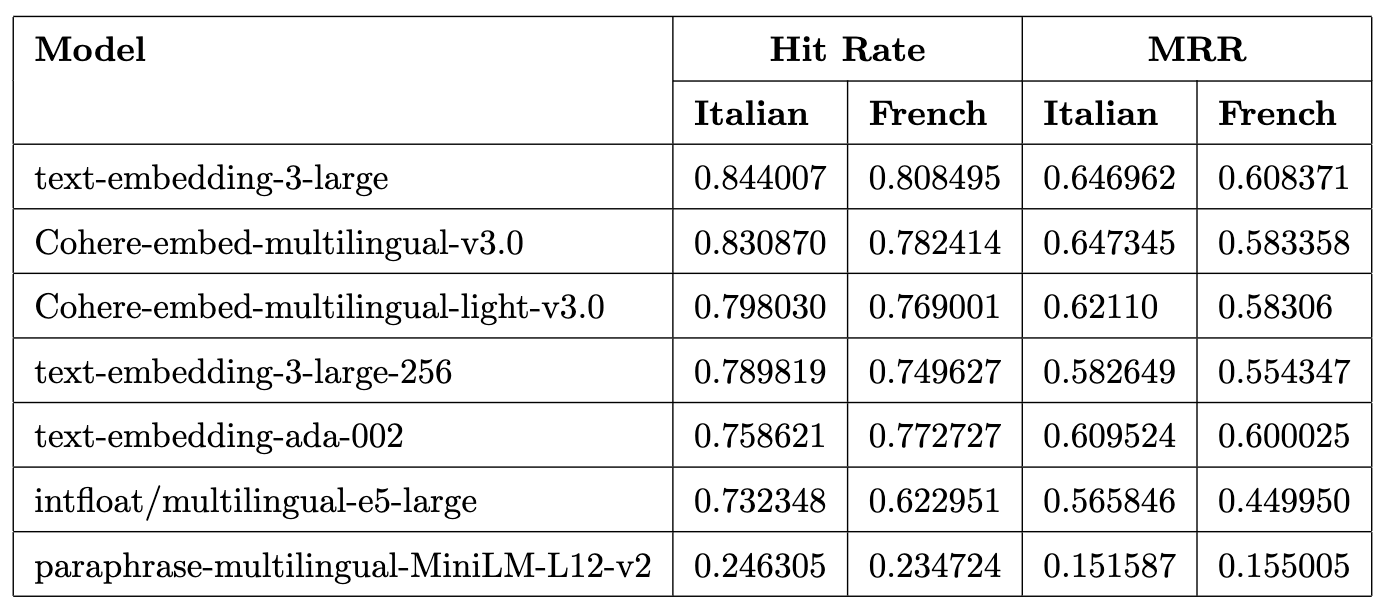 Models' performance. Image by author.
The newest model from OpenAI achieved the top score, which is expected since it was also the highest-performing multilingual model on the MTEB benchmark. The second place was taken by another proprietary system from Cohere. Their normal and light versions had similar results on the French dataset, but the normal version greatly outperformed the light one on the Italian dataset.
We also tried to reduce the embeddings of text-embedding-3-large to 256, and the performance was pretty impressive, considering the small dimension.
The other embedding model from OpenAI, ada-002 , scored considerably lower than their newest one, showing that the update brought impressive improvements.
Intfloat's open-source multilingual-e5-large is the best open-source model, with significantly higher scores on the Italian dataset than on the French one.
The results from paraphrase-multilingual-MiniLM-L12-v2 are disappointing. While it was very fast, we had hoped for a better performance.
Conclusion
The MTEB leaderboard offers a good initial benchmark for evaluating multilingual models. However, in order to improve retrieval, it is better to customize the evaluation to your needs.
As we've seen, model performance varies significantly across languages. That's why it is important to have a system to quickly evaluate embedding models using one's own documents.
. . .
If you enjoyed this article, join Text Generation - our newsletter has two weekly posts with the latest insights on Generative AI and Large Language Models.
You can find the full code for this project on GitHub .
You can also find me on LinkedIn .
. . .
References
- https://huggingface.co/spaces/mteb/leaderboard
- https://github.com/embeddings-benchmark/mteb?tab=readme-ov-file
- MTEB: Massive Text Embedding Benchmark
- https://txt.cohere.com/introducing-embed-v3/
- https://huggingface.co/intfloat/multilingual-e5-large
- https://openai.com/blog/new-and-improved-embedding-model
- https://huggingface.co/Cohere/Cohere-embed-multilingual-light-v3.0
- https://huggingface.co/sentence-transformers/paraphrase-multilingual-MiniLM-L12-v2
- https://economy-finance.ec.europa.eu/publications/2023-european-semester-country-reports_en
Register Now to Continue Reading
Unlock Towards Data Science with a Free Account
All articles on Towards Data Science are available to registered users. Create a free account today to access this article and thousands more.
Register for freeSign in to your account
 Written By
See all from Iulia Brezeanu
Artificial IntelligenceData ScienceGenaiLarge Language ModelsLlm
Share This Article
Towards Data Science is a community publication. Submit your insights to reach our global audience and earn through the TDS Author Payment Program.
Write for TDS
Related Articles
Programming
Hypothesis testing is the bread and butter of data science. We demo the concept using simple real-life examples using Python.
Tirthajyoti Sarkar
September 6, 201910 min read
Agentic AI
A practical LangChain tutorial for data scientists to inspect CSVs
Sarah Schürch
September 9, 202517 min read
Machine Learning
An introduction to neural machine translation
Kaixuan Chen
January 24, 202613 min read
Data Science
A possible approach to reconcile data scientists and management behind the same objective
Alexandre Allouin
September 19, 20227 min read
Machine Learning
Customizable, comprehensive indicators for Machine-learning and statistical algorithms
Modishubham
October 21, 20203 min read
Artificial Intelligence
How to debug occurrences of a NaN loss in your training project
Chaim Rand
March 9, 202213 min read
Artificial Intelligence
Weighted boxes fusion has become the new SOTA to optimize object detection models
Mostafa Ibrahim
March 17, 20216 min read
Data Visualization
A simple and powerful guide to using color for more impactful data stories.
Murtaza Ali
October 8, 20257 min read
Machine Learning
Learn how to efficiently detect outliers!
Eryk Lewinson
July 2, 20186 min read
Your home for data science and AI. The world's leading publication for data science, data analytics, data engineering, machine learning, and artificial intelligence professionals.
Subscribe to Our NewsletterWrite For TDS•About•Advertise•Privacy Policy•Terms of Use
© Insight Media Group, LLC 2026•The New Stack•roadmap.sh•Creator Network
Recommended Articles
Close