保留正文与补采附件。源页面当前未重新核验;具体限制见交付清单。
 We value your privacy
We use cookies to enhance your browsing experience, serve personalised ads or content, and analyse our traffic. By clicking "Accept All", you consent to our use of cookies.
Customise Reject All Accept All
Customise Consent Preferences
 We use cookies to help you navigate efficiently and perform certain functions. You will find detailed information about all cookies under each consent category below.
The cookies that are categorised as "Necessary" are stored on your browser as they are essential for enabling the basic functionalities of the site. ... Show more
NecessaryAlways Active
Necessary cookies are required to enable the basic features of this site, such as providing secure log-in or adjusting your consent preferences. These cookies do not store any personally identifiable data.
-
Cookie
BCTempID
-
Duration
10 minutes
-
Description
No description available.
-
Cookie
__cf_bm
-
Duration
1 hour
-
Description
This cookie, set by Cloudflare, is used to support Cloudflare Bot Management.
-
Cookie
AWSALBCORS
-
Duration
7 days
-
Description
Amazon Web Services set this cookie for load balancing.
-
Cookie
_cfuvid
-
Duration
session
-
Description
Cloudflare sets this cookie to track users across sessions to optimize user experience by maintaining session consistency and providing personalized services
-
Cookie
li_gc
-
Duration
6 months
-
Description
Linkedin set this cookie for storing visitor's consent regarding using cookies for non-essential purposes.
-
Cookie
__hssrc
-
Duration
session
-
Description
This cookie is set by Hubspot whenever it changes the session cookie. The __hssrc cookie set to 1 indicates that the user has restarted the browser, and if the cookie does not exist, it is assumed to be a new session.
-
Cookie
__hssc
-
Duration
1 hour
-
Description
HubSpot sets this cookie to keep track of sessions and to determine if HubSpot should increment the session number and timestamps in the __hstc cookie.
-
Cookie
wpEmojiSettingsSupports
-
Duration
session
-
Description
WordPress sets this cookie when a user interacts with emojis on a WordPress site. It helps determine if the user's browser can display emojis properly.
-
Cookie
BCSessionID
-
Duration
1 year 1 month 4 days
-
Description
Blueconic sets this cookie as a unique identifier for the BlueConic profile.
-
Cookie
_octo
-
Duration
1 year
-
Description
No description available.
-
Cookie
logged_in
-
Duration
1 year
-
Description
No description available.
-
Cookie
__Secure-YEC
-
Duration
past
-
Description
YouTube sets this cookie to stores the user's video player preferences using embedded YouTube video
-
Cookie
__eoi
-
Duration
6 months
-
Description
Description is currently not available.
-
Cookie
AWSALBTGCORS
-
Duration
7 days
-
Description
No description available.
-
Cookie
login-status-p
-
Duration
past
-
Description
Description is currently not available.
-
Cookie
AWSALBTG
-
Duration
7 days
-
Description
No description available.
-
Cookie
csrf_token
-
Duration
session
-
Description
No description available.
-
Cookie
token_v2
-
Duration
1 day
-
Description
Description is currently not available.
-
Cookie
D
-
Duration
1 year
-
Description
Description is currently not available.
-
Cookie
PHPSESSID
-
Duration
session
-
Description
This cookie is native to PHP applications. The cookie stores and identifies a user's unique session ID to manage user sessions on the website. The cookie is a session cookie and will be deleted when all the browser windows are closed.
-
Cookie
VISITOR_PRIVACY_METADATA
-
Duration
6 months
-
Description
YouTube sets this cookie to store the user's cookie consent state for the current domain.
-
Cookie
cookietest
-
Duration
session
-
Description
The cookietest cookie is typically used to determine whether the user's browser accepts cookies, essential for website functionality and user experience.
-
Cookie
__Host-airtable-session
-
Duration
1 year
-
Description
This cookie is used to enable us to integrate the services of Airtable.
-
Cookie
__Host-airtable-session.sig
-
Duration
1 year
-
Description
This cookie is used to enable us to integrate the services of Airtable.
-
Cookie
m
-
Duration
1 year 1 month 4 days
-
Description
Stripe sets this cookie for fraud prevention purposes. It identifies the device used to access the website, allowing the website to be formatted accordingly.
-
Cookie
BIGipServer*
-
Duration
session
-
Description
Marketo sets this cookie to collect information about the user's online activity and build a profile about their interests to provide advertisements relevant to the user.
-
Cookie
__cfruid
-
Duration
session
-
Description
Cloudflare sets this cookie to identify trusted web traffic.
-
Cookie
_GRECAPTCHA
-
Duration
6 months
-
Description
Google Recaptcha service sets this cookie to identify bots to protect the website against malicious spam attacks.
-
Cookie
__Secure-YNID
-
Duration
6 months
-
Description
Google cookie used to protect user security and prevent fraud, especially during the login process.
-
Cookie
cookieyes-consent
-
Duration
1 year
-
Description
CookieYes sets this cookie to remember users' consent preferences so that their preferences are respected on subsequent visits to this site. It does not collect or store any personal information about the site visitors.
Functional
Functional cookies help perform certain functionalities like sharing the content of the website on social media platforms, collecting feedback, and other third-party features.
-
Cookie
lidc
-
Duration
1 day
-
Description
LinkedIn sets the lidc cookie to facilitate data center selection.
-
Cookie
brw
-
Duration
1 year
-
Description
No description available.
-
Cookie
brwConsent
-
Duration
5 minutes
-
Description
Description is currently not available.
-
Cookie
WMF-Uniq
-
Duration
1 year
-
Description
Description is currently not available.
-
Cookie
loom_anon_comment
-
Duration
1 year
-
Description
No description available.
-
Cookie
loom_referral_video
-
Duration
session
-
Description
Description is currently not available.
-
Cookie
VISITOR_INFO1_LIVE
-
Duration
6 months
-
Description
A cookie set by YouTube to measure bandwidth that determines whether the user gets the new or old player interface.
-
Cookie
yt-remote-connected-devices
-
Duration
Never Expires
-
Description
YouTube sets this cookie to store the user's video preferences using embedded YouTube videos.
-
Cookie
ytidb::LAST_RESULT_ENTRY_KEY
-
Duration
Never Expires
-
Description
The cookie ytidb::LAST_RESULT_ENTRY_KEY is used by YouTube to store the last search result entry that was clicked by the user. This information is used to improve the user experience by providing more relevant search results in the future.
-
Cookie
yt-remote-device-id
-
Duration
Never Expires
-
Description
YouTube sets this cookie to store the user's video preferences using embedded YouTube videos.
-
Cookie
yt-remote-session-name
-
Duration
session
-
Description
The yt-remote-session-name cookie is used by YouTube to store the user's video player preferences using embedded YouTube video.
-
Cookie
yt-remote-fast-check-period
-
Duration
session
-
Description
The yt-remote-fast-check-period cookie is used by YouTube to store the user's video player preferences for embedded YouTube videos.
-
Cookie
yt-remote-session-app
-
Duration
session
-
Description
The yt-remote-session-app cookie is used by YouTube to store user preferences and information about the interface of the embedded YouTube video player.
-
Cookie
yt-remote-cast-available
-
Duration
session
-
Description
The yt-remote-cast-available cookie is used to store the user's preferences regarding whether casting is available on their YouTube video player.
-
Cookie
yt-remote-cast-installed
-
Duration
session
-
Description
The yt-remote-cast-installed cookie is used to store the user's video player preferences using embedded YouTube video.
-
Cookie
cp_session
-
Duration
3 months
-
Description
Codepen sets this cookie for Help systems found in the website.
-
Cookie
loid
-
Duration
1 year 1 month 4 days
-
Description
This cookie is set by the Reddit. The cookie enables the sharing of content from the website onto the social media platform.
Analytics
Analytical cookies are used to understand how visitors interact with the website. These cookies help provide information on metrics such as the number of visitors, bounce rate, traffic source, etc.
-
Cookie
__hstc
-
Duration
6 months
-
Description
Hubspot set this main cookie for tracking visitors. It contains the domain, initial timestamp (first visit), last timestamp (last visit), current timestamp (this visit), and session number (increments for each subsequent session).
-
Cookie
hubspotutk
-
Duration
6 months
-
Description
HubSpot sets this cookie to keep track of the visitors to the website. This cookie is passed to HubSpot on form submission and used when deduplicating contacts.
-
Cookie
_ga
-
Duration
1 year 1 month 4 days
-
Description
Google Analytics sets this cookie to calculate visitor, session and campaign data and track site usage for the site's analytics report. The cookie stores information anonymously and assigns a randomly generated number to recognise unique visitors.
-
Cookie
ga*
-
Duration
1 year 1 month 4 days
-
Description
Google Analytics sets this cookie to store and count page views.
-
Cookie
__Host-psifi.analyticsTrace
-
Duration
6 hours
-
Description
Description is currently not available.
-
Cookie
__Host-psifi.analyticsTraceV2
-
Duration
6 hours
-
Description
Description is currently not available.
-
Cookie
_gh_sess
-
Duration
session
-
Description
GitHub sets this cookie for temporary application and framework state between pages like what step the user is on in a multiple step form.
-
Cookie
YSC
-
Duration
session
-
Description
YSC cookie is set by Youtube and is used to track the views of embedded videos on Youtube pages.
-
Cookie
ajs_anonymous_id
-
Duration
1 year
-
Description
This cookie is set by Segment to count the number of people who visit a certain site by tracking if they have visited before.
-
Cookie
vuid
-
Duration
1 year 1 month 4 days
-
Description
Vimeo installs this cookie to collect tracking information by setting a unique ID to embed videos on the website.
Performance
Performance cookies are used to understand and analyse the key performance indexes of the website which helps in delivering a better user experience for the visitors.
-
Cookie
AWSALB
-
Duration
7 days
-
Description
AWSALB is an application load balancer cookie set by Amazon Web Services to map the session to the target.
-
Cookie
acq
-
Duration
past
-
Description
Description is currently not available.
-
Cookie
acq.sig
-
Duration
past
-
Description
Description is currently not available.
-
Cookie
ptc
-
Duration
2 years
-
Description
No description available.
Advertisement
Advertisement cookies are used to provide visitors with customised advertisements based on the pages you visited previously and to analyse the effectiveness of the ad campaigns.
-
Cookie
muc_ads
-
Duration
1 year 1 month 4 days
-
Description
Twitter sets this cookie to collect user behaviour and interaction data to optimize the website.
-
Cookie
guest_id_marketing
-
Duration
1 year 1 month 4 days
-
Description
Twitter sets this cookie to identify and track the website visitor.
-
Cookie
guest_id_ads
-
Duration
1 year 1 month 4 days
-
Description
Twitter sets this cookie to identify and track the website visitor.
-
Cookie
personalization_id
-
Duration
1 year 1 month 4 days
-
Description
Twitter sets this cookie to integrate and share features for social media and also store information about how the user uses the website, for tracking and targeting.
-
Cookie
guest_id
-
Duration
1 year 1 month 4 days
-
Description
Twitter sets this cookie to identify and track the website visitor. It registers if a user is signed in to the Twitter platform and collects information about ad preferences.
-
Cookie
bcookie
-
Duration
1 year
-
Description
LinkedIn sets this cookie from LinkedIn share buttons and ad tags to recognize browser IDs.
-
Cookie
__Secure-ROLLOUT_TOKEN
-
Duration
6 months
-
Description
YouTube sets this cookie to manage feature rollout and experimentation. It helps Google control which new features or interface changes are shown to users as part of testing and staged rollouts, ensuring consistent experience for a given user during an experiment.
-
Cookie
yt.innertube::nextId
-
Duration
Never Expires
-
Description
YouTube sets this cookie to register a unique ID to store data on what videos from YouTube the user has seen.
-
Cookie
yt.innertube::requests
-
Duration
Never Expires
-
Description
YouTube sets this cookie to register a unique ID to store data on what videos from YouTube the user has seen.
-
Cookie
session_tracker
-
Duration
session
-
Description
This cookie is set by the Reddit. This cookie is used to identify trusted web traffic. It also helps in adverstising on the website.
-
Cookie
edgebucket
-
Duration
session
-
Description
Reddit sets this cookie to save the information about a log-on Reddit user, for the purpose of advertisement recommendations and updating the content.
-
Cookie
did
-
Duration
1 year
-
Description
Arbor sets this cookie to show targeted ads to site visitors.This cookie expires after 2 months or 1 year.
Uncategorised
Other uncategorised cookies are those that are being analysed and have not been classified into a category as yet.
No cookies to display.
Reject All Save My Preferences Accept All
Toggle SearchToggle Mobile Navigation
Publish AI, ML & data-science insights to a global community of data professionals.
Sign inSubmit an Article
LatestEditor's PicksNewsletterShipAI
Write For TDS
LinkedInXToggle Search
Deep Learning
Why Batch Normalization Matters for Deep Learning
Discover the role of batch normalization in streamlining neural network training and improving model performance
Niklas Lang
November 25, 202411 min read
 Photo by Petra Reid on Unsplash
Batch normalization has become a very important technique for training neural networks in recent years. It makes training much more efficient and stable, which is a crucial factor, especially for large and deep networks. It was originally introduced to solve the problem of internal covariance shift.
This article will examine the problems involved in training neural networks and how batch normalization can solve them. We will describe the process in detail and show how batch normalization can be implemented in Python and integrated into existing models. We will also consider the advantages and disadvantages of this method to determine whether it makes sense to use it.
What Problems arise when training Deep Neural Networks?
When training a deep neural network, backpropagation occurs after each run. The prediction error runs through the network layer by layer from behind. During this process, the weights of the individual neurons are then changed so that the error is reduced as quickly as possible. This changes the weights assuming that all other layers remain the same. In practice, however, these conditions only apply to a limited extent, as all layers are changed quickly during backpropagation. The paper "Batch Normalization: Accelerating Deep Network Training by Reducing Internal Covariate Shift" describes this core problem in more detail.
The problem with this fact is that the statistical key figures of the value distribution also change with each change in the weightings. This means that after each run, the weights in a layer have a new distribution with a different mean value and a new standard deviation. This problem is known as an internal covariance shift and leads to more difficult training, as the subsequent layers cannot optimally process the changed distribution.
To still have successful training, lower learning rates must be used to minimize the fluctuations in the weight changes. However, this means that the model takes significantly longer to converge and training is slowed down overall.
Learn this step by step with the interactive Machine Learning roadmap.
What is Normalization?
The normalization of data is a process that is often used in the preparation of data sets for machine learning. The aim is to bring the numerical values of different attributes onto a common scale. For example, you can divide all numerical values in a data series by the maximum value of the data series to obtain a new data series that lies in the range from 0 to 1.
Suppose you want to train a model to learn different marketing activities and their effect on sales and the quantity sold. You could simply calculate the sum of the quantity sold and the turnover as the dependent variable. However, this can quickly lead to distorted results, for example, if you have a product series in which many products are sold, but these have a relatively low unit price. In a second series, it can be the other way around, i.e. the products are not sold as often, but have a high unit price.
A marketing campaign that leads to 100,000 additional products being sold, for example, is rated worse in the product series with low unit prices than in the product series with high unit prices. Similar problems also arise in other fields, for example when looking at the private expenditure of individuals. For two different people, food expenditure of €200 can be very different when set concerning monthly income. Normalization therefore helps to bring the data onto a neutral and comparable basis.
What is Batch Normalization?
Batch normalization was introduced to mitigate the problem of internal covariance shifts. Batches are used for this purpose, i.e. certain subsets of the data set with a fixed size, which contain a random selection of the data set in a training run. The main idea is that the activations of each layer within a batch are normalized so that they have a constant mean value of 0 and a constant standard deviation of 1. This additional step reduces the shift of the activation distributions so that the model learns faster and converges better.
How does Batch Normalization work?
When training neural networks, the entire data set is divided into so-called batches. These contain a random selection of data of a certain size and are used for a training run. In most cases, a so-called batch size of 32 or 64 is used, i.e. there are 32 or 64 individual data points in a batch.
The data that arrives in the input layer of the network is already normalized during regular data preprocessing. This means that all numerical values have been brought to a uniform scale and a common distribution and are therefore comparable. In most cases, the data then has a mean value of 0 and a standard deviation of 1.
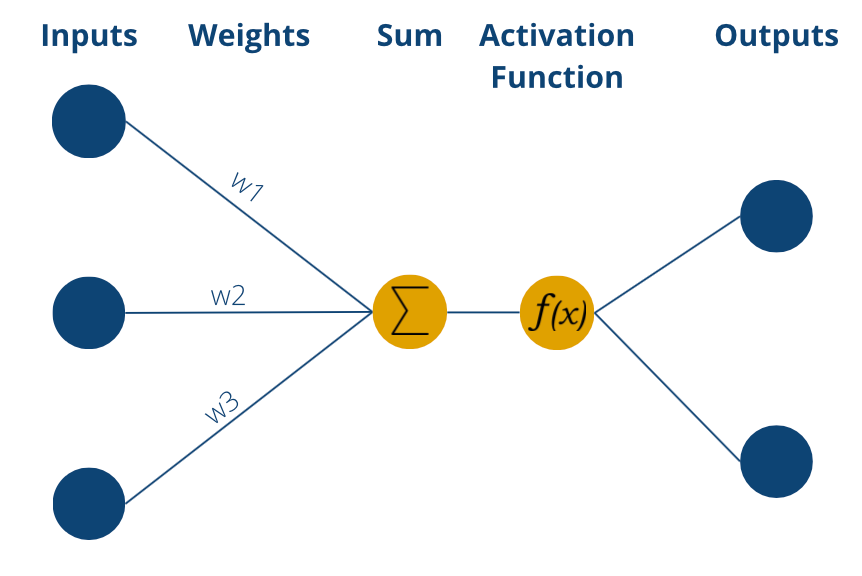 Single Layer Perceptron | Source: Author
After the first layer, however, the values have already passed through the so-called activation function, which leads to a shift in the distribution and thus denormalizes the values again. An activation function is run through again with each layer in the network and the numbers are no longer normalized in the output layer. This process is also called "internal covariate shift " in the technical literature (Batch Normalization: Accelerating Deep Network Training by Reducing Internal Covariate Shift).
For this reason, the values are normalized again before each activation function during batch normalization. The following steps are carried out for this purpose.
1. Calculation of the Mean Value and the Variance per Mini-Batch
First, the mean value and the variance for the entire mini-batch are calculated for each activation in a specific layer. If 𝑥ᵢ stands for any activation value of a neuron for a data point i , then the mean μ __ and the variance σ² are calculated as follows:

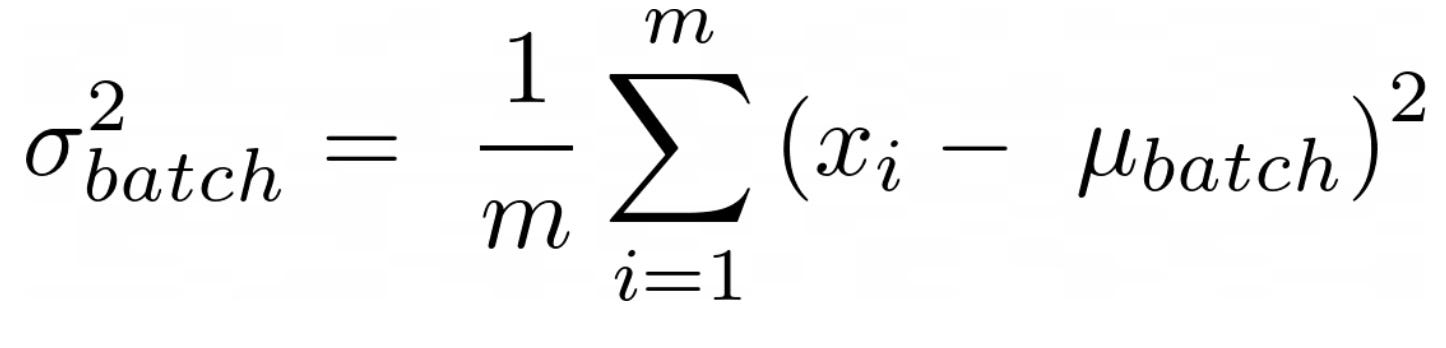 Here, m is the number of data points in a mini-batch. As these key figures are recalculated for each layer, this ensures that the batch normalization can react flexibly to the different distributions.
2. Normalization of the Activations
In this step, the activations are normalized so that they have a mean value of 0 and a standard deviation of 1. This is done by subtracting the mean of the batch from each activation and dividing it by the standard deviation. To avoid dividing by 0, a small value is added to the variance. This then results in the following formula:
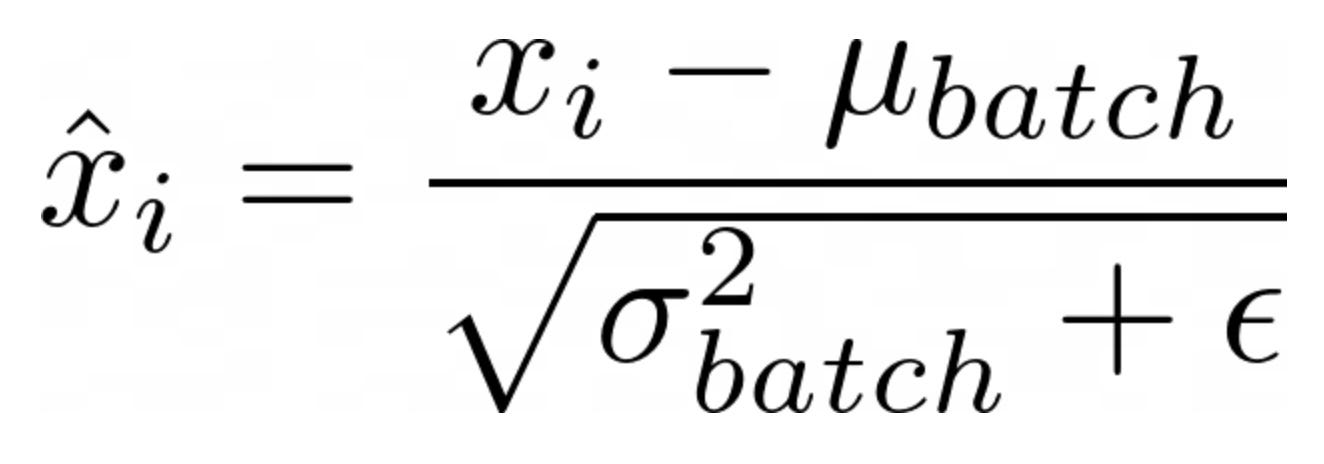 Here x̂ᵢ is the normalized activation value for the data point i.
3 Scaling and Shifting the Normalized Activations
After the normalization has taken place, a further step is carried out to give the model more flexibility. Two learnable parameters γ and β are added to scale and shift the normalized values. This allows the model to reverse the normalization if the original distribution of the data was reasonable. The final transformed activation parameters are then calculated as follows:
 Here, γ is the scaling parameter that determines how strongly the normalized values are scaled, and β is the shift parameter that can shift the values along the y-axis.
The process of batch normalization ensures that the activations in the different layers of the neural network are optimally scaled and that the training is therefore stable. These calculations take place thousands or even millions of times during training, which is why it is very good that we can use simple functionalities in Python for the implementation and do not have to perform these calculations manually. In the next section, we will therefore take a closer look at how this procedure can be implemented in Python.
How can Batch Normalization be implemented in Python?
To implement batch normalization in Python, we can use the TensorFlow library, which already has a built-in function tf.keras.layers.BatchNormalization and can be built directly into a model. As an example, we take a simple Convolutional Neural Network, which we train on the MNIST dataset. We apply the batch normalization after each convolutional or dense layer to stabilize the activations:
As you can see, batch normalization is simply inserted into the model after each activation layer. No hyperparameters need to be determined, as the function calculates the mean and variance automatically and then adjusts the learnable parameters automatically.
What are the Advantages and Disadvantages of Batch Normalization?
Batch normalization has many advantages, especially when training deep neural networks, as it speeds up training and makes it more stable. However, it is not always the optimal choice for every architecture. Therefore, it is important to know the advantages and disadvantages, which we will explain in more detail in this section.
Advantages:
- Faster convergence : Batch Normalization stabilizes the distribution of activations and thus enables a faster learning process so that fewer epochs are needed to achieve a good result. In addition, higher learning rates can be used, which in turn lead to faster training.
- Bypassing the internal covariate shift : As already described, the internal covariate shift can at least be mitigated by normalizing the batch. This occurs, for example, in image classifications in which a distinction is to be made between different classes, such as dogs and cats. The different coat colors can lead to different distributions of the image data, which can be smoothed out using batch normalization.
- Less dependence on weight initialization : Without batch normalization, the choice of initial weights can have a strong influence on the training result and process. This is prevented by continuous normalization, making the training more robust even if the initialization is not optimal.
- Preventingoverfitting: Without normalization, outliers in training data can lead to a strong adjustment of the model, so that it delivers good results for the training data but generalizes poorly. It also reduces the need for other regularization methods, such as a dropout layer.
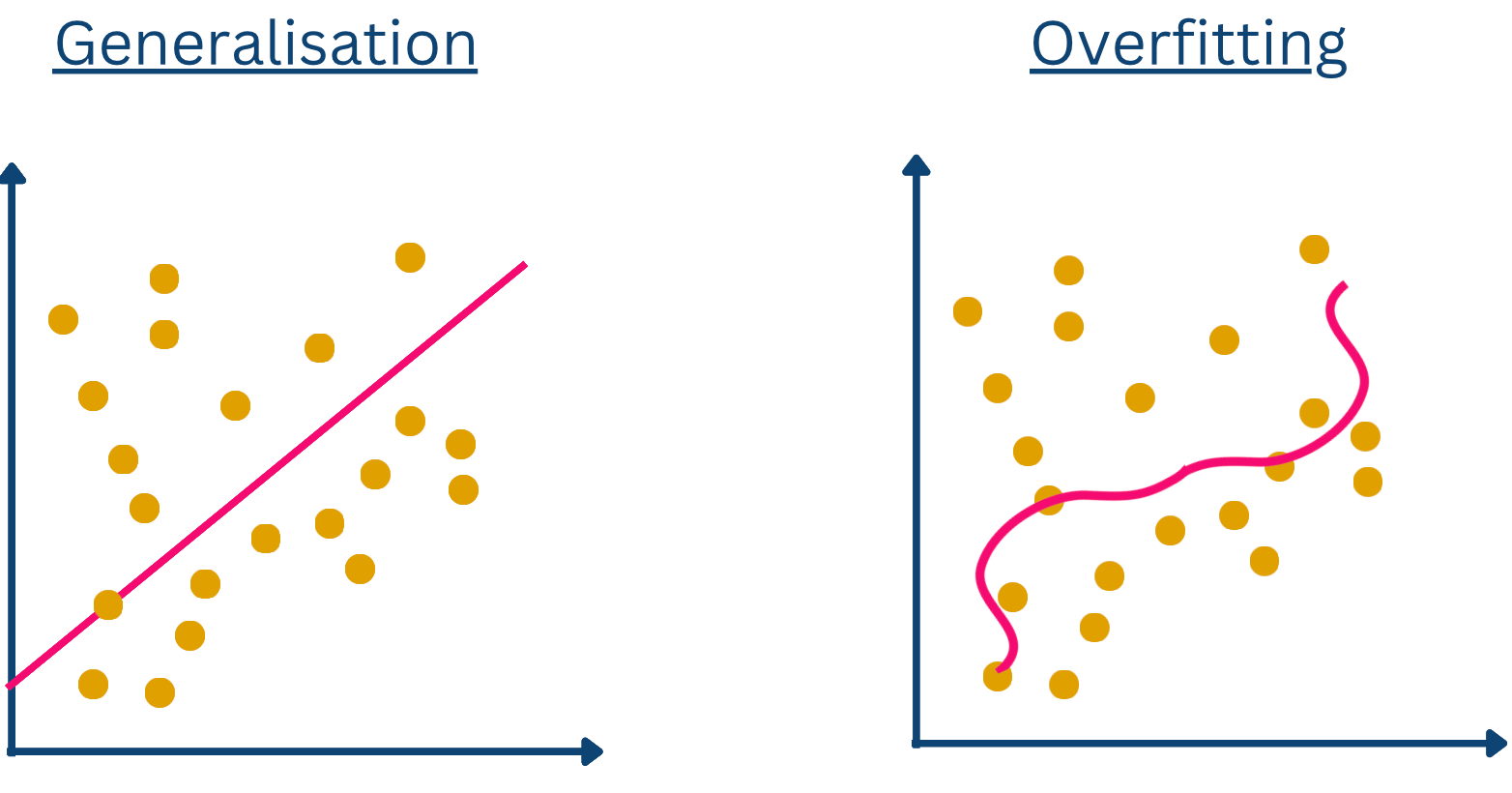 Overfitting Example | Source: Author
- Different network types possible : Batch normalization can be used with different types of neural networks and often leads to good results. For example, a normalization layer can be built into convolutional or feedforward neural networks.
Disadvantages:
- Dependence on batch size : For the estimates for the variance and mean to be sufficiently accurate, you need a large amount of data in the batch. However, it can happen in various applications that the batch size is very small, for example, if the data is memory-intensive or for small devices, and therefore the statistical estimates are too unstable.
- Difficulties with predictions : During the training phase, the statistical estimates can simply be calculated from the mini-batches. When predicting new data, however, these batches are missing, since there is only one instance and not a whole batch. This is why fixed values calculated during training must be used. In some cases, this can lead to discrepancies between the model performance during training and interference.
- Limited applicability of recurrent networks : Recurrent neural networks are characterized by the fact that they process input sequences with varying lengths. This makes it difficult to calculate batch statistics across sequences. For this reason, variants of batch normalization are often used for such models, which have been specially adapted for this purpose.
- Increased computational effort : The introduction of batch normalization means that more calculations have to be carried out during training, which means additional computational complexity. In most cases, this is offset by the faster convergence and the computing power saved, but depending on the model architecture and the training data, it can also lead to increased computational effort compared to a model without batch normalization.
How should the model be structured?
There are a few things to consider when building a model with a batch normalization layer. Among other things, the learning rate should be increased by including the normalization layer. Normalization makes the model more stable, which is why it can change the weightings more quickly and still converge.
At the same time, the use of a dropout layer should be avoided. On the one hand, normalization already provides an additional degree of generalization, which is why the dropout layer may not even be necessary. On the other hand, it can even worsen the result, as noise is generated by the normalization and the simultaneous omission of neurons.
Finally, it may be useful to vary the position of the batch normalization and to test both the normalization before and after the activation function. Depending on the structure of the model, this can lead to better results.
What Variants and Extensions of Batch Normalization are there?
For most neural network architectures, batch normalization has proven to be a useful tool for circumventing the internal covariance shift and achieving faster convergence. However, problems can also arise with recurrent neural networks or small batch sizes. For this reason, different variants of the model have been developed over the years to overcome these disadvantages.
1. Layer Normalization
This method normalizes the activations within a layer and not within a batch. For each input example, the neurons in a layer are normalized separately and must be recalculated in each step. This property makes layer normalization particularly suitable for recurrent neural networks, as it is not only well suited for sequential data but also acts independently of the batch size. Due to these properties, it is often used in the field of natural language processing or for sequential tasks.
2. Group Normalization
With this method, the activations are divided into different groups and then normalized within the groups. It is therefore particularly suitable for image processing, where only small batch sizes are possible because the image files often require a lot of storage space. Group Normalization strikes a balance between dependency on batch size and flexibility in handling different amounts of data.
3. Batch Renormalization
This approach is an extension of Batch Normalization, which was developed to better handle small batch sizes. It introduces additional parameters that strengthen the estimation of the mean and variance, even if the batch statistics are unstable. This enables stable training with fast convergence even for small batch sizes.
These variants enable the use of batch normalization in different application scenarios, so that the disadvantages can be overcome even with demanding models and stable training can be carried out.
This is what you should take with you
- Batch normalization is used in deep neural networks to avoid the so-called internal covariance shift. This refers to the phenomenon that training takes place more slowly because the distribution of the data changes after each activation.
- Batch normalization avoids this by splitting the data set into batches and normalizing them again after each activation so that a mean value of 0 and a standard deviation of 1 is achieved.
- In Python, the TensorFlow library can be used to incorporate this method into an existing network. It should be tested whether it is added before or after a layer.
- When using batch normalization, some factors should be considered when building a deep neural network such as leaving out a dropout layer which could otherwise have a bad influence on the results.
- For use in recurrent neural networks or with smaller batches, different variants of batch normalization have emerged over the years that compensate for the disadvantages of the conventional method.
Register Now to Continue Reading
Unlock Towards Data Science with a Free Account
All articles on Towards Data Science are available to registered users. Create a free account today to access this article and thousands more.
Register for freeSign in to your account
 Written By
See all from Niklas Lang
Batch NormalizationDeep LearningDropout LayerNeural NetworksRecurrent Neural Network
Share This Article
Towards Data Science is a community publication. Submit your insights to reach our global audience and earn through the TDS Author Payment Program.
Write for TDS
Related Articles
Deep Learning
And how metrics change in different scenarios
Aniruddha Karajgi
November 1, 202112 min read
Deep Learning
This month: PDE and deep learning to build up brain's 🧠 connectome🔗, brain-computer 💻 interface for hand prosthesis and finally a new...
Stefano Bosisio
April 19, 20228 min read
Deep Learning
M1 Macs vs. Google Colab for basic deep learning tasks.
Dario Radečić
January 25, 20215 min read
Artificial Intelligence
In this post we'll discuss the YOLO detection network and its versions 1, 2 and especially 3.
Uri Almog
October 9, 202013 min read
Machine Learning
Modelling dynamical systems with recurrent neural networks
Kirill Tsyganov
April 3, 20216 min read
Deep Learning
Using blockchain data to extract insights about network coverage and "suspicious" hotspots
Evan Diewald
October 6, 20218 min read
Artificial Intelligence
Spoiler, it will take longer than 3 months
Egor Howell
March 29, 202610 min read
Artificial Intelligence
Apply best practices and learn to use GitHub Actions to build robust code
Marcello Politi
December 20, 20237 min read
Deep Learning
A case study of colorizing images coming from an old-school video game using Deep Learning in Python
Eryk Lewinson
April 17, 202016 min read
Your home for data science and AI. The world's leading publication for data science, data analytics, data engineering, machine learning, and artificial intelligence professionals.
Subscribe to Our NewsletterWrite For TDS•About•Advertise•Privacy Policy•Terms of Use
© Insight Media Group, LLC 2026•The New Stack•roadmap.sh•Creator Network
Recommended Articles
Close