保留正文与补采附件。源页面当前未重新核验;具体限制见交付清单。
 We value your privacy
We use cookies to enhance your browsing experience, serve personalised ads or content, and analyse our traffic. By clicking "Accept All", you consent to our use of cookies.
Customise Reject All Accept All
Customise Consent Preferences
 We use cookies to help you navigate efficiently and perform certain functions. You will find detailed information about all cookies under each consent category below.
The cookies that are categorised as "Necessary" are stored on your browser as they are essential for enabling the basic functionalities of the site. ... Show more
NecessaryAlways Active
Necessary cookies are required to enable the basic features of this site, such as providing secure log-in or adjusting your consent preferences. These cookies do not store any personally identifiable data.
-
Cookie
BCTempID
-
Duration
10 minutes
-
Description
No description available.
-
Cookie
__cf_bm
-
Duration
1 hour
-
Description
This cookie, set by Cloudflare, is used to support Cloudflare Bot Management.
-
Cookie
AWSALBCORS
-
Duration
7 days
-
Description
Amazon Web Services set this cookie for load balancing.
-
Cookie
_cfuvid
-
Duration
session
-
Description
Cloudflare sets this cookie to track users across sessions to optimize user experience by maintaining session consistency and providing personalized services
-
Cookie
li_gc
-
Duration
6 months
-
Description
Linkedin set this cookie for storing visitor's consent regarding using cookies for non-essential purposes.
-
Cookie
__hssrc
-
Duration
session
-
Description
This cookie is set by Hubspot whenever it changes the session cookie. The __hssrc cookie set to 1 indicates that the user has restarted the browser, and if the cookie does not exist, it is assumed to be a new session.
-
Cookie
__hssc
-
Duration
1 hour
-
Description
HubSpot sets this cookie to keep track of sessions and to determine if HubSpot should increment the session number and timestamps in the __hstc cookie.
-
Cookie
wpEmojiSettingsSupports
-
Duration
session
-
Description
WordPress sets this cookie when a user interacts with emojis on a WordPress site. It helps determine if the user's browser can display emojis properly.
-
Cookie
BCSessionID
-
Duration
1 year 1 month 4 days
-
Description
Blueconic sets this cookie as a unique identifier for the BlueConic profile.
-
Cookie
_octo
-
Duration
1 year
-
Description
No description available.
-
Cookie
logged_in
-
Duration
1 year
-
Description
No description available.
-
Cookie
__Secure-YEC
-
Duration
past
-
Description
YouTube sets this cookie to stores the user's video player preferences using embedded YouTube video
-
Cookie
__eoi
-
Duration
6 months
-
Description
Description is currently not available.
-
Cookie
AWSALBTGCORS
-
Duration
7 days
-
Description
No description available.
-
Cookie
login-status-p
-
Duration
past
-
Description
Description is currently not available.
-
Cookie
AWSALBTG
-
Duration
7 days
-
Description
No description available.
-
Cookie
csrf_token
-
Duration
session
-
Description
No description available.
-
Cookie
token_v2
-
Duration
1 day
-
Description
Description is currently not available.
-
Cookie
D
-
Duration
1 year
-
Description
Description is currently not available.
-
Cookie
PHPSESSID
-
Duration
session
-
Description
This cookie is native to PHP applications. The cookie stores and identifies a user's unique session ID to manage user sessions on the website. The cookie is a session cookie and will be deleted when all the browser windows are closed.
-
Cookie
VISITOR_PRIVACY_METADATA
-
Duration
6 months
-
Description
YouTube sets this cookie to store the user's cookie consent state for the current domain.
-
Cookie
cookietest
-
Duration
session
-
Description
The cookietest cookie is typically used to determine whether the user's browser accepts cookies, essential for website functionality and user experience.
-
Cookie
__Host-airtable-session
-
Duration
1 year
-
Description
This cookie is used to enable us to integrate the services of Airtable.
-
Cookie
__Host-airtable-session.sig
-
Duration
1 year
-
Description
This cookie is used to enable us to integrate the services of Airtable.
-
Cookie
m
-
Duration
1 year 1 month 4 days
-
Description
Stripe sets this cookie for fraud prevention purposes. It identifies the device used to access the website, allowing the website to be formatted accordingly.
-
Cookie
BIGipServer*
-
Duration
session
-
Description
Marketo sets this cookie to collect information about the user's online activity and build a profile about their interests to provide advertisements relevant to the user.
-
Cookie
__cfruid
-
Duration
session
-
Description
Cloudflare sets this cookie to identify trusted web traffic.
-
Cookie
_GRECAPTCHA
-
Duration
6 months
-
Description
Google Recaptcha service sets this cookie to identify bots to protect the website against malicious spam attacks.
-
Cookie
__Secure-YNID
-
Duration
6 months
-
Description
Google cookie used to protect user security and prevent fraud, especially during the login process.
-
Cookie
cookieyes-consent
-
Duration
1 year
-
Description
CookieYes sets this cookie to remember users' consent preferences so that their preferences are respected on subsequent visits to this site. It does not collect or store any personal information about the site visitors.
Functional
Functional cookies help perform certain functionalities like sharing the content of the website on social media platforms, collecting feedback, and other third-party features.
-
Cookie
lidc
-
Duration
1 day
-
Description
LinkedIn sets the lidc cookie to facilitate data center selection.
-
Cookie
brw
-
Duration
1 year
-
Description
No description available.
-
Cookie
brwConsent
-
Duration
5 minutes
-
Description
Description is currently not available.
-
Cookie
WMF-Uniq
-
Duration
1 year
-
Description
Description is currently not available.
-
Cookie
loom_anon_comment
-
Duration
1 year
-
Description
No description available.
-
Cookie
loom_referral_video
-
Duration
session
-
Description
Description is currently not available.
-
Cookie
VISITOR_INFO1_LIVE
-
Duration
6 months
-
Description
A cookie set by YouTube to measure bandwidth that determines whether the user gets the new or old player interface.
-
Cookie
yt-remote-connected-devices
-
Duration
Never Expires
-
Description
YouTube sets this cookie to store the user's video preferences using embedded YouTube videos.
-
Cookie
ytidb::LAST_RESULT_ENTRY_KEY
-
Duration
Never Expires
-
Description
The cookie ytidb::LAST_RESULT_ENTRY_KEY is used by YouTube to store the last search result entry that was clicked by the user. This information is used to improve the user experience by providing more relevant search results in the future.
-
Cookie
yt-remote-device-id
-
Duration
Never Expires
-
Description
YouTube sets this cookie to store the user's video preferences using embedded YouTube videos.
-
Cookie
yt-remote-session-name
-
Duration
session
-
Description
The yt-remote-session-name cookie is used by YouTube to store the user's video player preferences using embedded YouTube video.
-
Cookie
yt-remote-fast-check-period
-
Duration
session
-
Description
The yt-remote-fast-check-period cookie is used by YouTube to store the user's video player preferences for embedded YouTube videos.
-
Cookie
yt-remote-session-app
-
Duration
session
-
Description
The yt-remote-session-app cookie is used by YouTube to store user preferences and information about the interface of the embedded YouTube video player.
-
Cookie
yt-remote-cast-available
-
Duration
session
-
Description
The yt-remote-cast-available cookie is used to store the user's preferences regarding whether casting is available on their YouTube video player.
-
Cookie
yt-remote-cast-installed
-
Duration
session
-
Description
The yt-remote-cast-installed cookie is used to store the user's video player preferences using embedded YouTube video.
-
Cookie
cp_session
-
Duration
3 months
-
Description
Codepen sets this cookie for Help systems found in the website.
-
Cookie
loid
-
Duration
1 year 1 month 4 days
-
Description
This cookie is set by the Reddit. The cookie enables the sharing of content from the website onto the social media platform.
Analytics
Analytical cookies are used to understand how visitors interact with the website. These cookies help provide information on metrics such as the number of visitors, bounce rate, traffic source, etc.
-
Cookie
__hstc
-
Duration
6 months
-
Description
Hubspot set this main cookie for tracking visitors. It contains the domain, initial timestamp (first visit), last timestamp (last visit), current timestamp (this visit), and session number (increments for each subsequent session).
-
Cookie
hubspotutk
-
Duration
6 months
-
Description
HubSpot sets this cookie to keep track of the visitors to the website. This cookie is passed to HubSpot on form submission and used when deduplicating contacts.
-
Cookie
_ga
-
Duration
1 year 1 month 4 days
-
Description
Google Analytics sets this cookie to calculate visitor, session and campaign data and track site usage for the site's analytics report. The cookie stores information anonymously and assigns a randomly generated number to recognise unique visitors.
-
Cookie
ga*
-
Duration
1 year 1 month 4 days
-
Description
Google Analytics sets this cookie to store and count page views.
-
Cookie
__Host-psifi.analyticsTrace
-
Duration
6 hours
-
Description
Description is currently not available.
-
Cookie
__Host-psifi.analyticsTraceV2
-
Duration
6 hours
-
Description
Description is currently not available.
-
Cookie
_gh_sess
-
Duration
session
-
Description
GitHub sets this cookie for temporary application and framework state between pages like what step the user is on in a multiple step form.
-
Cookie
YSC
-
Duration
session
-
Description
YSC cookie is set by Youtube and is used to track the views of embedded videos on Youtube pages.
-
Cookie
ajs_anonymous_id
-
Duration
1 year
-
Description
This cookie is set by Segment to count the number of people who visit a certain site by tracking if they have visited before.
-
Cookie
vuid
-
Duration
1 year 1 month 4 days
-
Description
Vimeo installs this cookie to collect tracking information by setting a unique ID to embed videos on the website.
Performance
Performance cookies are used to understand and analyse the key performance indexes of the website which helps in delivering a better user experience for the visitors.
-
Cookie
AWSALB
-
Duration
7 days
-
Description
AWSALB is an application load balancer cookie set by Amazon Web Services to map the session to the target.
-
Cookie
acq
-
Duration
past
-
Description
Description is currently not available.
-
Cookie
acq.sig
-
Duration
past
-
Description
Description is currently not available.
-
Cookie
ptc
-
Duration
2 years
-
Description
No description available.
Advertisement
Advertisement cookies are used to provide visitors with customised advertisements based on the pages you visited previously and to analyse the effectiveness of the ad campaigns.
-
Cookie
muc_ads
-
Duration
1 year 1 month 4 days
-
Description
Twitter sets this cookie to collect user behaviour and interaction data to optimize the website.
-
Cookie
guest_id_marketing
-
Duration
1 year 1 month 4 days
-
Description
Twitter sets this cookie to identify and track the website visitor.
-
Cookie
guest_id_ads
-
Duration
1 year 1 month 4 days
-
Description
Twitter sets this cookie to identify and track the website visitor.
-
Cookie
personalization_id
-
Duration
1 year 1 month 4 days
-
Description
Twitter sets this cookie to integrate and share features for social media and also store information about how the user uses the website, for tracking and targeting.
-
Cookie
guest_id
-
Duration
1 year 1 month 4 days
-
Description
Twitter sets this cookie to identify and track the website visitor. It registers if a user is signed in to the Twitter platform and collects information about ad preferences.
-
Cookie
bcookie
-
Duration
1 year
-
Description
LinkedIn sets this cookie from LinkedIn share buttons and ad tags to recognize browser IDs.
-
Cookie
__Secure-ROLLOUT_TOKEN
-
Duration
6 months
-
Description
YouTube sets this cookie to manage feature rollout and experimentation. It helps Google control which new features or interface changes are shown to users as part of testing and staged rollouts, ensuring consistent experience for a given user during an experiment.
-
Cookie
yt.innertube::nextId
-
Duration
Never Expires
-
Description
YouTube sets this cookie to register a unique ID to store data on what videos from YouTube the user has seen.
-
Cookie
yt.innertube::requests
-
Duration
Never Expires
-
Description
YouTube sets this cookie to register a unique ID to store data on what videos from YouTube the user has seen.
-
Cookie
session_tracker
-
Duration
session
-
Description
This cookie is set by the Reddit. This cookie is used to identify trusted web traffic. It also helps in adverstising on the website.
-
Cookie
edgebucket
-
Duration
session
-
Description
Reddit sets this cookie to save the information about a log-on Reddit user, for the purpose of advertisement recommendations and updating the content.
-
Cookie
did
-
Duration
1 year
-
Description
Arbor sets this cookie to show targeted ads to site visitors.This cookie expires after 2 months or 1 year.
Uncategorised
Other uncategorised cookies are those that are being analysed and have not been classified into a category as yet.
No cookies to display.
Reject All Save My Preferences Accept All
Toggle SearchToggle Mobile Navigation
Publish AI, ML & data-science insights to a global community of data professionals.
Sign inSubmit an Article
LatestEditor's PicksNewsletterShipAI
Write For TDS
LinkedInXToggle Search
Data Science
Avoid Overfitting in Neural Networks: a Deep Dive
Learn how to implement regularization techniques to boost performances and prevent Neural Network overfitting.
Riccardo Andreoni
November 30, 20239 min read
Learn how to implement regularization techniques to boost performances and prevent Neural Network overfitting
 Image source: unsplash.com.
When training a deep neural network, it's often troublesome to achieve the same performances on both the training and validation sets. A considerably higher error on the validation set is a clear flag for overfitting : the network has become too specialized in the training data. In this article, I provide a comprehensive guide on how to bypass this issue.
Learn this step by step with the interactive AI and Data Scientist, Computer Science and Machine Learning roadmaps.
Overfitting Neural Networks
When dealing with any machine learning application, it's important to have a clear understanding of the bias and variance of the model. In traditional machine learning algorithms, we talk about the bias vs. variance tradeoff, which consists of the struggle of minimizing both the variance and the bias of a model.
In order to reduce the bias of a model (i.e. its error from erroneous assumptions), we need a more complex model. On the contrary, reducing the model's variance (the sensitivity of the model in capturing the variations of the training data), implies a more simple model. It is straightforward that the bias vs. variance tradeoff, in traditional machine learning, derives from the conflict of necessitating both a more complex and a simpler model at the same time.
In the Deep Learning era, we have tools to reduce just the model's variance without hurting the model's bias or, on the contrary, to reduce the bias without increasing the variance.
Before exploring the different techniques used to prevent the overfitting of a neural network, it's important to clarify what high variance or high bias means.
Consider a common neural network task such as image recognition, and think over a neural network that recognizes the presence of pandas in a picture. We can confidently assess that a human can carry out this task with a near 0% error. As a consequence, this is a reasonable benchmark for the accuracy of the image recognition network. After training the neural network on the training set and evaluating its performances on both the training and validation sets, we may come up with these different results:
- Train Error = 20% and Validation Error = 22%
- Train Error = 1% and Validation Error = 15%
- Train Error = 0.5% and Validation Error = 1%
- Train Error = 20% and Validation Error = 30%
The first example is a typical instance of high bias : the error is large on both the train and validation sets. Conversely, the second example suffers from high variance , having a much lower accuracy when dealing with data the model didn't learn from. The third result represents low variance and bias , the model can be considered valid. Finally, the fourth example shows a case of both high bias and variance : not only the training error is large when compared with the benchmark, but the validation error is also higher.
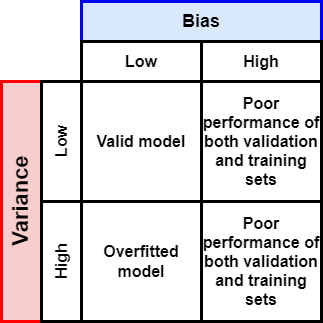 Image by the author.
From now on, I will present several techniques of regularization, used to reduce the model's overfitting to the training data. They are beneficial for cases 2. and 4. of the previous example.
L1 and L2 Regularization
Similar to classical regression algorithms (linear, logistic, polynomial, etc.), L1 and L2 regularizations are also employed to prevent overfitting in high-variance neural networks. In order to keep this article short and on-point, I won't recall how L1 and L2 regularizations work on regression algorithms, but you can check this article for additional information.
The idea behind the L1 and L2 regularization techniques is to constrain the model's weights to be smaller or to shrink some of them to 0.
Consider the cost function J of a classical deep neural network:
 The cost function J is, of course, a function of the weights and biases of each layer 1, ..., L. m is the number of training examples and ℒ is the loss function.
L1 Regularization
In L1 Regularization we add the following term to the cost function J:
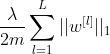 where the matrix norm is the sum of the absolute value of the weights for each layer 1, ..., L of the network:
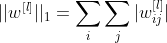 λ is the regularization term. It's a hyperparameter that must be carefully tuned. λ directly controls the impact of the regularization: as λ increases, the effects on the weights shrinking are more severe.
The complete cost function under L1 Regularization becomes:
 For λ=0, the effects of L1 Regularization are null. Instead, choosing a value of λ which is too big, will over-simplify the model, probably resulting in an underfitting network.
L1 Regularization can be considered as a sort of neuron selection process because it would bring to zero the weights of some hidden neurons.
L2 Regularization
In L2 Regularization, the term we add to the cost function is the following:
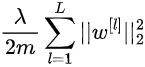 In this case, the regularization term is the squared norm of the weights of each network's layer. This matrix norm is called Frobenius norm and, explicitly, it's computed as follows:
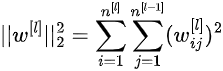 Please note that the weight matrix relative to layer l has n^{[l]} rows and n^{[l-1]} columns.
Finally, the complete cost function under L2 Regularization becomes:
 Again, λ is the regularization term and for λ=0 the effects of L2 Regularization are null.
L2 Regularization brings towards zero the values of the weights, resulting in a more simple model.
How do L1 and L2 Regularization reduce overfitting?
L1 and L2 Regularization techniques have positive effects on overfitting to the training data for two reasons:
- The weights of some hidden units become closer (or equal) to 0. As a consequence, their effect is weakened and the resulting network is simpler because it's closer to a smaller network. As stated in the introduction, a simpler network is less prone to overfitting.
- For smaller weights, also the input z of the activation function of a hidden neuron becomes smaller. For values close to 0, many activation functions behave linearly.
The second reason is not trivial and deserves an expansion. Consider a hyperbolic tangent (tanh) activation function, whose graph is the following:
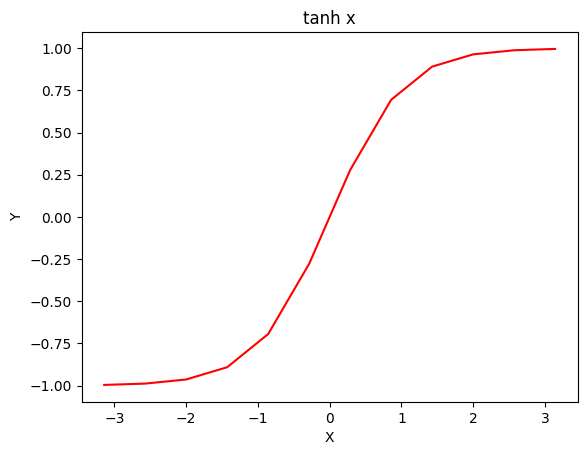 Image by the author.
From the function plot we can see that if the input value x is small, the function tanh(x) behaves almost linearly. When tanh is used as the activation function of a neural network's hidden layers, the input value is:
 which for small weights w is also close to zero.
If each layer of the neural network is linear, we can prove that the whole network behaves linearly. Thus, constraining some of the hidden units to mimic linear functions, leads to a simpler network and, as a consequence, helps to prevent overfitting.
A simpler model often is not capable to capture the noise in the training data and therefore, overfitting is less frequent.
Dropout
The idea of dropout regularization is to randomly remove some nodes in the network. Before the training process, we set a probability (suppose p = 50%) for each node of the network. During the training phase, each node has a p probability of being turned off. The dropout process is random, and it is performed separately for each training example. As a consequence, each training example might be trained on a different network.
As for L2 Regularization, the result of dropout regularization is a simpler network, and a simpler network leads to a less complex model.
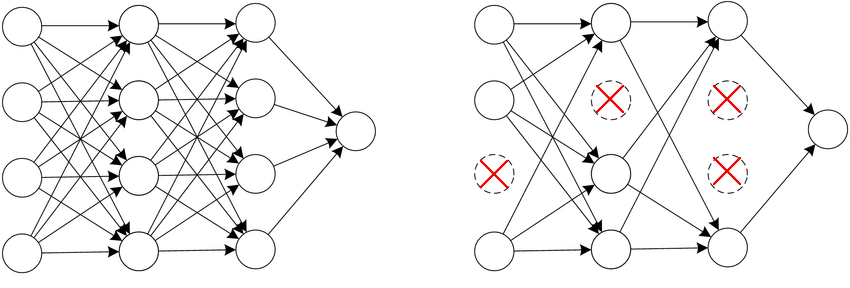 The effect of dropout on a simple network. Image by the author.
Dropout in practice
In this brief section, I show how to implement Dropout regularization in practice. I will go through a few simple lines of code (python). If you are only interested in the general theory of regularization, you can easily skip this section.
Suppose we have stored the activation values of the network's layer 4 in the NumPy array a4. First, we create the auxiliary vector d4:
python
# Set the keeping probability
keep_prob = 0.7
python
# Create auxiliary vector for layer 4
d4 = np.random.rand(a4.shape[0], a3.shape[1]) < keep_prob
The vector d4 has the same dimensions as a4 and contains the values True or False based on the probability keep_prob. If we set a keeping probability of 70%, that is the probability that a given hidden unit is kept, and therefore, the probability of having True value on a given element of d4.
We apply the auxiliary vector d4 to the activations a4:
python
# Apply the auxiliary vector d4 to the activation a4
a4 = np.multiply(a4,d4)
Finally, we need to scale the modified vector a4 by the keep_prob value:
python
# Scale the modified vector a4
a4 /= keep_prob
This last operation is needed to compensate for the reduction of units in the layer. Carrying out this operation during the training process allows us not to apply dropout during the test phase.
How does dropout reduce overfitting?
Dropout has the effect of temporarily transforming the network into a smaller one , and we know that smaller networks are less complex and less prone to overfitting.
Consider the network illustrated above, and focus on the first unit of the second layer. Because some of its inputs may be temporarily shut down due to dropout, the unit can't always rely on them during the training phase. As a consequence, the hidden unit is encouraged to spread its weights across its inputs. Spreading the weights has the effect of decreasing the squared norm of the weight matrix, resulting in a sort of L2 regularization.
Setting the keeping probability is a fundamental step for an effective dropout regularization. Typically, the keeping probability is set separately for each layer of the neural network. For layers with a large weight matrix, we usually set a smaller keeping probability because, at each step, we want to conserve proportionally fewer weights with respect to smaller layers.
Other Regularization Techniques
In addition to L1/L2 regularization and dropout, there exist other regularization techniques. Two of them are data augmentation and early stopping.
From the theory, we know that training a network on more data has positive effects on reducing high variance. As getting more data is often a demanding task, data augmentation is a technique that, for some applications, allows machine learning practitioners to get more data almost for free. In computer vision, data augmentation provides a larger training set by flipping, zooming, and translating the original images. In the case of digit recognition, we can also impose distortion on the images.
Early stopping , as the name suggests, involves stopping the training phase before the initially defined number of iterations. If we plot the cost function on both the training set and the validation set as a function of the iterations, we can experience that, for an overfitting model, the training error always keeps decreasing but the validation error might start to increase after a certain number of iterations. When the validation error stops decreasing, that is exactly the time to stop the training process. By stopping the training process earlier, we force the model to be simpler, thus reducing overfitting.
Conclusion
In conclusion, the L1 and L2 regularization techniques are indispensable tools in addressing overfitting within neural networks.
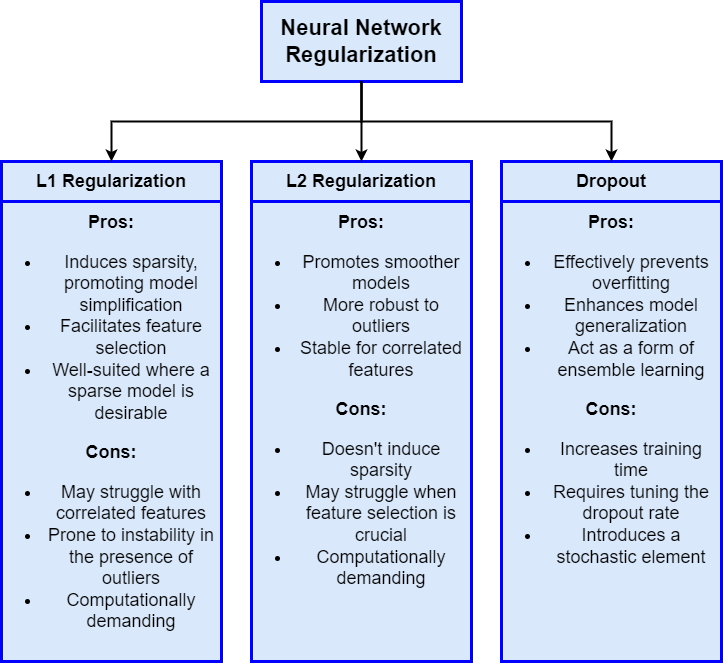 Image by the author.
L1 regularization, with its ability to induce sparsity by penalizing irrelevant features , proves effective in simplifying models. On the other hand, L2 regularization, by penalizing the squared magnitude of weights, promotes smoother models , reducing the risk of extreme values.
Dropout, a dynamic technique involving randomly deactivating neurons during the training phase, enhances model generalization. It prevents over-reliance on specific neurons, promoting a more robust network.
However, these techniques come with tradeoffs. While regularization methods effectively mitigate overfitting, they may inadvertently restrict the model's ability to capture intricate patterns in the data. The real challenge is choosing the right balance between regularization strength and model complexity.
For further insights, I will fill the Reference section with amazing resources. I highly suggest checking them out to refine your understanding of the subject.
If you liked this story, consider following me to be notified of my upcoming projects and articles!
Here are some of my past projects:
Advanced Dimensionality Reduction Models Made Simple
Use Deep Learning to Generate Fantasy Names: Build a Language Model from Scratch
Outlier Detection with Scikit-Learn and Matplotlib: a Practical Guide
References
Register Now to Continue Reading
Unlock Towards Data Science with a Free Account
All articles on Towards Data Science are available to registered users. Create a free account today to access this article and thousands more.
Register for freeSign in to your account
 Written By
See all from Riccardo Andreoni
Data ScienceMachine LearningNeural NetworksOverfittingProgramming
Share This Article
Towards Data Science is a community publication. Submit your insights to reach our global audience and earn through the TDS Author Payment Program.
Write for TDS
Related Articles
Machine Learning
part 1 of a 5-sequence, brief articles that provide a comprehensive introduction; no prior knowledge assumed
Ahmar Shah, PhD (Oxford)
March 7, 20216 min read
Machine Learning
Your daily dose of data science
TDS Editors
January 19, 20211 min read
Machine Learning
How to eliminate padding overhead and accelerate LLM inference at the hardware level.
Anubhab Banerjee
June 3, 202627 min read
Data Science
Which opportunities could the data show?
Shaiala Marques
September 14, 20209 min read
Artificial Intelligence
Recent advancements and hot trends, August 2023 edition
Michael Galkin
August 6, 202315 min read
Machine Learning
The "hello-world" of machine learning
Pan Cretan
September 8, 20237 min read
Machine Learning
The math behind two of the most used activation functions in Machine Learning
Gabriel Furnieles
September 8, 20225 min read
Programming
Spark's Lazy Evaluation and Why You Should Care
Amal Hasni
September 14, 20225 min read
Data Science
Nowadays, with big data becomes reality, people now focus on how to use the data to realize commercial values. One area which is much more...
Annie Wang
January 28, 20218 min read
Your home for data science and AI. The world's leading publication for data science, data analytics, data engineering, machine learning, and artificial intelligence professionals.
Subscribe to Our NewsletterWrite For TDS•About•Advertise•Privacy Policy•Terms of Use
© Insight Media Group, LLC 2026•The New Stack•roadmap.sh•Creator Network
Recommended Articles
Close