保留正文与补采附件。源页面当前未重新核验;具体限制见交付清单。
 We value your privacy
We use cookies to enhance your browsing experience, serve personalised ads or content, and analyse our traffic. By clicking "Accept All", you consent to our use of cookies.
Customise Reject All Accept All
Customise Consent Preferences
 We use cookies to help you navigate efficiently and perform certain functions. You will find detailed information about all cookies under each consent category below.
The cookies that are categorised as "Necessary" are stored on your browser as they are essential for enabling the basic functionalities of the site. ... Show more
NecessaryAlways Active
Necessary cookies are required to enable the basic features of this site, such as providing secure log-in or adjusting your consent preferences. These cookies do not store any personally identifiable data.
-
Cookie
BCTempID
-
Duration
10 minutes
-
Description
No description available.
-
Cookie
__cf_bm
-
Duration
1 hour
-
Description
This cookie, set by Cloudflare, is used to support Cloudflare Bot Management.
-
Cookie
AWSALBCORS
-
Duration
7 days
-
Description
Amazon Web Services set this cookie for load balancing.
-
Cookie
_cfuvid
-
Duration
session
-
Description
Cloudflare sets this cookie to track users across sessions to optimize user experience by maintaining session consistency and providing personalized services
-
Cookie
li_gc
-
Duration
6 months
-
Description
Linkedin set this cookie for storing visitor's consent regarding using cookies for non-essential purposes.
-
Cookie
__hssrc
-
Duration
session
-
Description
This cookie is set by Hubspot whenever it changes the session cookie. The __hssrc cookie set to 1 indicates that the user has restarted the browser, and if the cookie does not exist, it is assumed to be a new session.
-
Cookie
__hssc
-
Duration
1 hour
-
Description
HubSpot sets this cookie to keep track of sessions and to determine if HubSpot should increment the session number and timestamps in the __hstc cookie.
-
Cookie
wpEmojiSettingsSupports
-
Duration
session
-
Description
WordPress sets this cookie when a user interacts with emojis on a WordPress site. It helps determine if the user's browser can display emojis properly.
-
Cookie
BCSessionID
-
Duration
1 year 1 month 4 days
-
Description
Blueconic sets this cookie as a unique identifier for the BlueConic profile.
-
Cookie
_octo
-
Duration
1 year
-
Description
No description available.
-
Cookie
logged_in
-
Duration
1 year
-
Description
No description available.
-
Cookie
__Secure-YEC
-
Duration
past
-
Description
YouTube sets this cookie to stores the user's video player preferences using embedded YouTube video
-
Cookie
__eoi
-
Duration
6 months
-
Description
Description is currently not available.
-
Cookie
AWSALBTGCORS
-
Duration
7 days
-
Description
No description available.
-
Cookie
login-status-p
-
Duration
past
-
Description
Description is currently not available.
-
Cookie
AWSALBTG
-
Duration
7 days
-
Description
No description available.
-
Cookie
csrf_token
-
Duration
session
-
Description
No description available.
-
Cookie
token_v2
-
Duration
1 day
-
Description
Description is currently not available.
-
Cookie
D
-
Duration
1 year
-
Description
Description is currently not available.
-
Cookie
PHPSESSID
-
Duration
session
-
Description
This cookie is native to PHP applications. The cookie stores and identifies a user's unique session ID to manage user sessions on the website. The cookie is a session cookie and will be deleted when all the browser windows are closed.
-
Cookie
VISITOR_PRIVACY_METADATA
-
Duration
6 months
-
Description
YouTube sets this cookie to store the user's cookie consent state for the current domain.
-
Cookie
cookietest
-
Duration
session
-
Description
The cookietest cookie is typically used to determine whether the user's browser accepts cookies, essential for website functionality and user experience.
-
Cookie
__Host-airtable-session
-
Duration
1 year
-
Description
This cookie is used to enable us to integrate the services of Airtable.
-
Cookie
__Host-airtable-session.sig
-
Duration
1 year
-
Description
This cookie is used to enable us to integrate the services of Airtable.
-
Cookie
m
-
Duration
1 year 1 month 4 days
-
Description
Stripe sets this cookie for fraud prevention purposes. It identifies the device used to access the website, allowing the website to be formatted accordingly.
-
Cookie
BIGipServer*
-
Duration
session
-
Description
Marketo sets this cookie to collect information about the user's online activity and build a profile about their interests to provide advertisements relevant to the user.
-
Cookie
__cfruid
-
Duration
session
-
Description
Cloudflare sets this cookie to identify trusted web traffic.
-
Cookie
_GRECAPTCHA
-
Duration
6 months
-
Description
Google Recaptcha service sets this cookie to identify bots to protect the website against malicious spam attacks.
-
Cookie
__Secure-YNID
-
Duration
6 months
-
Description
Google cookie used to protect user security and prevent fraud, especially during the login process.
-
Cookie
cookieyes-consent
-
Duration
1 year
-
Description
CookieYes sets this cookie to remember users' consent preferences so that their preferences are respected on subsequent visits to this site. It does not collect or store any personal information about the site visitors.
Functional
Functional cookies help perform certain functionalities like sharing the content of the website on social media platforms, collecting feedback, and other third-party features.
-
Cookie
lidc
-
Duration
1 day
-
Description
LinkedIn sets the lidc cookie to facilitate data center selection.
-
Cookie
brw
-
Duration
1 year
-
Description
No description available.
-
Cookie
brwConsent
-
Duration
5 minutes
-
Description
Description is currently not available.
-
Cookie
WMF-Uniq
-
Duration
1 year
-
Description
Description is currently not available.
-
Cookie
loom_anon_comment
-
Duration
1 year
-
Description
No description available.
-
Cookie
loom_referral_video
-
Duration
session
-
Description
Description is currently not available.
-
Cookie
VISITOR_INFO1_LIVE
-
Duration
6 months
-
Description
A cookie set by YouTube to measure bandwidth that determines whether the user gets the new or old player interface.
-
Cookie
yt-remote-connected-devices
-
Duration
Never Expires
-
Description
YouTube sets this cookie to store the user's video preferences using embedded YouTube videos.
-
Cookie
ytidb::LAST_RESULT_ENTRY_KEY
-
Duration
Never Expires
-
Description
The cookie ytidb::LAST_RESULT_ENTRY_KEY is used by YouTube to store the last search result entry that was clicked by the user. This information is used to improve the user experience by providing more relevant search results in the future.
-
Cookie
yt-remote-device-id
-
Duration
Never Expires
-
Description
YouTube sets this cookie to store the user's video preferences using embedded YouTube videos.
-
Cookie
yt-remote-session-name
-
Duration
session
-
Description
The yt-remote-session-name cookie is used by YouTube to store the user's video player preferences using embedded YouTube video.
-
Cookie
yt-remote-fast-check-period
-
Duration
session
-
Description
The yt-remote-fast-check-period cookie is used by YouTube to store the user's video player preferences for embedded YouTube videos.
-
Cookie
yt-remote-session-app
-
Duration
session
-
Description
The yt-remote-session-app cookie is used by YouTube to store user preferences and information about the interface of the embedded YouTube video player.
-
Cookie
yt-remote-cast-available
-
Duration
session
-
Description
The yt-remote-cast-available cookie is used to store the user's preferences regarding whether casting is available on their YouTube video player.
-
Cookie
yt-remote-cast-installed
-
Duration
session
-
Description
The yt-remote-cast-installed cookie is used to store the user's video player preferences using embedded YouTube video.
-
Cookie
cp_session
-
Duration
3 months
-
Description
Codepen sets this cookie for Help systems found in the website.
-
Cookie
loid
-
Duration
1 year 1 month 4 days
-
Description
This cookie is set by the Reddit. The cookie enables the sharing of content from the website onto the social media platform.
Analytics
Analytical cookies are used to understand how visitors interact with the website. These cookies help provide information on metrics such as the number of visitors, bounce rate, traffic source, etc.
-
Cookie
__hstc
-
Duration
6 months
-
Description
Hubspot set this main cookie for tracking visitors. It contains the domain, initial timestamp (first visit), last timestamp (last visit), current timestamp (this visit), and session number (increments for each subsequent session).
-
Cookie
hubspotutk
-
Duration
6 months
-
Description
HubSpot sets this cookie to keep track of the visitors to the website. This cookie is passed to HubSpot on form submission and used when deduplicating contacts.
-
Cookie
_ga
-
Duration
1 year 1 month 4 days
-
Description
Google Analytics sets this cookie to calculate visitor, session and campaign data and track site usage for the site's analytics report. The cookie stores information anonymously and assigns a randomly generated number to recognise unique visitors.
-
Cookie
ga*
-
Duration
1 year 1 month 4 days
-
Description
Google Analytics sets this cookie to store and count page views.
-
Cookie
__Host-psifi.analyticsTrace
-
Duration
6 hours
-
Description
Description is currently not available.
-
Cookie
__Host-psifi.analyticsTraceV2
-
Duration
6 hours
-
Description
Description is currently not available.
-
Cookie
_gh_sess
-
Duration
session
-
Description
GitHub sets this cookie for temporary application and framework state between pages like what step the user is on in a multiple step form.
-
Cookie
YSC
-
Duration
session
-
Description
YSC cookie is set by Youtube and is used to track the views of embedded videos on Youtube pages.
-
Cookie
ajs_anonymous_id
-
Duration
1 year
-
Description
This cookie is set by Segment to count the number of people who visit a certain site by tracking if they have visited before.
-
Cookie
vuid
-
Duration
1 year 1 month 4 days
-
Description
Vimeo installs this cookie to collect tracking information by setting a unique ID to embed videos on the website.
Performance
Performance cookies are used to understand and analyse the key performance indexes of the website which helps in delivering a better user experience for the visitors.
-
Cookie
AWSALB
-
Duration
7 days
-
Description
AWSALB is an application load balancer cookie set by Amazon Web Services to map the session to the target.
-
Cookie
acq
-
Duration
past
-
Description
Description is currently not available.
-
Cookie
acq.sig
-
Duration
past
-
Description
Description is currently not available.
-
Cookie
ptc
-
Duration
2 years
-
Description
No description available.
Advertisement
Advertisement cookies are used to provide visitors with customised advertisements based on the pages you visited previously and to analyse the effectiveness of the ad campaigns.
-
Cookie
muc_ads
-
Duration
1 year 1 month 4 days
-
Description
Twitter sets this cookie to collect user behaviour and interaction data to optimize the website.
-
Cookie
guest_id_marketing
-
Duration
1 year 1 month 4 days
-
Description
Twitter sets this cookie to identify and track the website visitor.
-
Cookie
guest_id_ads
-
Duration
1 year 1 month 4 days
-
Description
Twitter sets this cookie to identify and track the website visitor.
-
Cookie
personalization_id
-
Duration
1 year 1 month 4 days
-
Description
Twitter sets this cookie to integrate and share features for social media and also store information about how the user uses the website, for tracking and targeting.
-
Cookie
guest_id
-
Duration
1 year 1 month 4 days
-
Description
Twitter sets this cookie to identify and track the website visitor. It registers if a user is signed in to the Twitter platform and collects information about ad preferences.
-
Cookie
bcookie
-
Duration
1 year
-
Description
LinkedIn sets this cookie from LinkedIn share buttons and ad tags to recognize browser IDs.
-
Cookie
__Secure-ROLLOUT_TOKEN
-
Duration
6 months
-
Description
YouTube sets this cookie to manage feature rollout and experimentation. It helps Google control which new features or interface changes are shown to users as part of testing and staged rollouts, ensuring consistent experience for a given user during an experiment.
-
Cookie
yt.innertube::nextId
-
Duration
Never Expires
-
Description
YouTube sets this cookie to register a unique ID to store data on what videos from YouTube the user has seen.
-
Cookie
yt.innertube::requests
-
Duration
Never Expires
-
Description
YouTube sets this cookie to register a unique ID to store data on what videos from YouTube the user has seen.
-
Cookie
session_tracker
-
Duration
session
-
Description
This cookie is set by the Reddit. This cookie is used to identify trusted web traffic. It also helps in adverstising on the website.
-
Cookie
edgebucket
-
Duration
session
-
Description
Reddit sets this cookie to save the information about a log-on Reddit user, for the purpose of advertisement recommendations and updating the content.
-
Cookie
did
-
Duration
1 year
-
Description
Arbor sets this cookie to show targeted ads to site visitors.This cookie expires after 2 months or 1 year.
Uncategorised
Other uncategorised cookies are those that are being analysed and have not been classified into a category as yet.
No cookies to display.
Reject All Save My Preferences Accept All
Toggle SearchToggle Mobile Navigation
Publish AI, ML & data-science insights to a global community of data professionals.
Sign inSubmit an Article
LatestEditor's PicksNewsletterShipAI
Write For TDS
LinkedInXToggle Search
Artificial Intelligence
How LLMs Think
Research paper in pills: "Scaling Monosemanticity: Extracting Interpretable Features from Claude 3 Sonnet"
Cristian Leo
June 7, 202410 min read
 Image Generated by DALL-E
Have you ever wondered how an AI model "thinks"? Imagine peering inside the mind of a machine and watching the gears turn. This is exactly what a groundbreaking paper from Anthropic explores. Titled "Scaling Monosemanticity: Extracting Interpretable Features from Claude 3 Sonnet", the research delves into understanding and interpreting the thought processes of AI.
The researchers managed to extract features from the Claude 3 Sonnet model that show what it was thinking about famous people, cities, and even security vulnerabilities in software. It's like getting a glimpse into the AI's mind, revealing the concepts it understands and uses to make decisions.
Research Paper Overview
In the paper, the Anthropic team, including Adly Templeton, Tom Conerly, Jonathan Marcus, and others, set out to make AI models more transparent. They focused on Claude 3 Sonnet, a medium-sized AI model, and aimed to scale monosemanticity - essentially making sure that each feature in the model has a clear, single meaning.
But why is scaling monosemanticity so important? And what exactly is monosemanticity? We'll dive into that soon.
Learn this step by step with the interactive AI Engineer and Machine Learning roadmaps.
Importance of the Study
Understanding and interpreting features in AI models is crucial. It helps us see how these models make decisions, making them more reliable and easier to improve. When we can interpret these features, debugging, refining, and optimizing AI models becomes easier.
This research also has significant implications for AI safety. By identifying features linked to harmful behaviors, such as bias, deception, or dangerous content, we can develop ways to reduce these risks. This is especially important as AI systems become more integrated into everyday life, where ethical considerations and safety are essential.
One of the key contributions of this research is showing us how to understand what a large language model (LLM) is "thinking." By extracting and interpreting features, we can get an insight into the internal workings of these complex models. This helps us see why they make certain decisions, providing a way to peek into their "thought processes."
Background
Let's review some of the odd terms mentioned earlier:
Monosemanticity Monosemanticity is like having a single, specific key for each lock in a huge building. Imagine this building represents the AI model; each lock is a feature or concept the model understands. With monosemanticity, every key (feature) fits only one lock (concept) perfectly. This means whenever a particular key is used, it always opens the same lock. This consistency helps us understand exactly what the model is thinking about when it makes decisions because we know which key opened which lock.
Sparse Autoencoders A sparse autoencoder is like a highly efficient detective. Imagine you have a big, cluttered room (the data) with many items scattered around. The detective's job is to find the few key items (important features) that tell the whole story of what happened in the room. The "sparse" part means this detective tries to solve the mystery using as few clues as possible, focusing only on the most essential pieces of evidence. In this research, sparse autoencoders act like this detective, helping to identify and extract clear, understandable features from the AI model, making it easier to see what's going on inside.
Here are some useful lecture notes by Andrew Ng on Autoencoders, to learn more about them.
Previous Work
Previous research laid the foundation by exploring how to extract interpretable features from smaller AI models using sparse autoencoders. These studies showed that sparse autoencoders could effectively identify meaningful features in simpler models. However, there were significant concerns about whether this method could scale up to larger, more complex models like Claude 3 Sonnet.
The earlier studies focused on proving that sparse autoencoders could identify and represent key features in smaller models. They succeeded in showing that the extracted features were both meaningful and interpretable. However, the main limitation was that these techniques had only been tested on simpler models. Scaling up was essential because larger models like Claude 3 Sonnet handle more complex data and tasks, making it harder to maintain the same level of clarity and usefulness in the extracted features.
This research builds on those foundations by aiming to scale these methods to more advanced AI systems. The researchers applied and adapted sparse autoencoders to handle the higher complexity and dimensionality of larger models. By addressing the challenges of scaling, this study seeks to ensure that even in more complex models, the extracted features remain clear and useful, thus advancing our understanding and interpretation of AI decision-making processes.
Scaling Sparse Autoencoders
Scaling sparse autoencoders to work with a larger model like Claude 3 Sonnet is like upgrading from a small, local library to managing a vast national archive. The techniques that worked well for the smaller collection need to be adjusted to handle the sheer size and complexity of the bigger dataset.
Sparse autoencoders are designed to identify and represent key features in data while keeping the number of active features low, much like a librarian who knows exactly which few books out of thousands will answer your question.
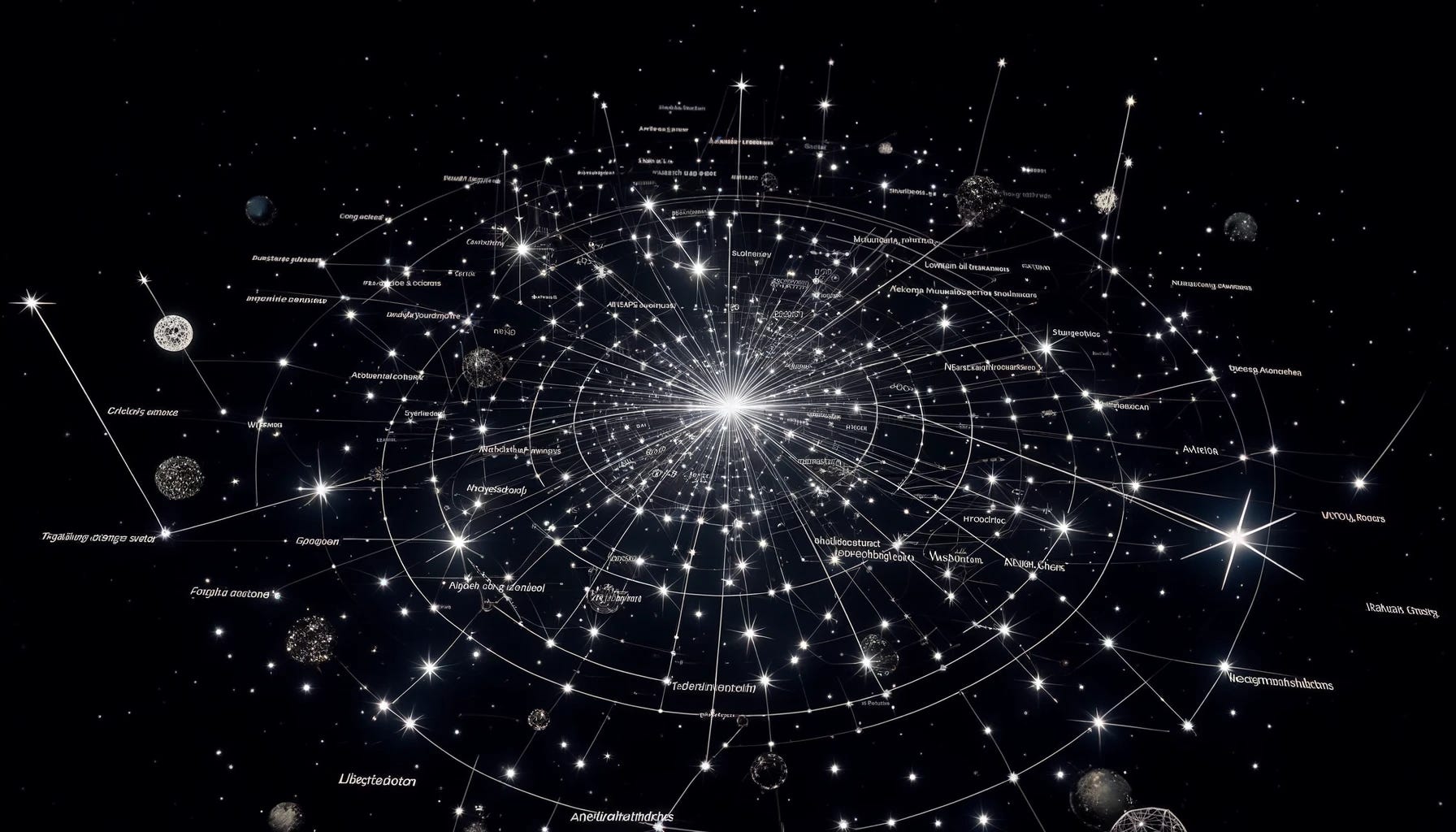 Image generated by DALL-E
Two key hypotheses guide this scaling:
Linear Representation Hypothesis Imagine a giant map of the night sky, where each star represents a concept the AI understands. This hypothesis suggests that each concept (or star) aligns in a specific direction in the model's activation space. Essentially, it's like saying that if you draw a line through space pointing directly to a specific star, you can identify that star uniquely by its direction.
Superposition Hypothesis Building on the night sky analogy, this hypothesis is like saying the AI can use these directions to map more stars than there are directions by using almost perpendicular lines. This allows the AI to efficiently pack information by finding unique ways to combine these directions, much like fitting more stars into the sky by carefully mapping them in different layers.
By applying these hypotheses, researchers could effectively scale sparse autoencoders to work with larger models like Claude 3 Sonnet, enabling them to capture and represent both simple and complex features in the data.
Training the Model
Imagine trying to train a group of detectives to sift through a vast library to find key pieces of evidence. This is similar to what researchers did with sparse autoencoders (SAEs) in their work with Claude 3 Sonnet, a complex AI model. They had to adapt the training techniques for these detectives to handle the larger, more complex data set represented by the Claude 3 Sonnet model.
The researchers decided to apply the SAEs to the residual stream activations in the middle layer of the model. Think of the middle layer as a crucial checkpoint in a detective's investigation, where a lot of interesting, abstract clues are found. They chose this point because:
- Smaller Size : The residual stream is smaller than other layers, making it cheaper in terms of computational resources.
- Mitigating Cross-Layer Superposition : This refers to the problem of signals from different layers getting mixed up, like flavors blending together in a way that makes it hard to tell them apart.
- Rich in Abstract Features : The middle layer is likely to contain intriguing, high-level concepts.
The team trained three versions of the SAEs, with different capacities to handle features: 1M features, 4M features, and 34M features. For each SAE, the goal was to keep the number of active features low while maintaining accuracy:
- Active Features : On average, fewer than 300 features were active at any time, explaining at least 65% of the variance in the model's activations.
- Dead Features : These are features that never get activated. They found roughly 2% dead features in the 1M SAE, 35% in the 4M SAE, and 65% in the 34M SAE. Future improvements aim to reduce these numbers.
Scaling Laws: Optimizing Training
The goal was to balance reconstruction accuracy with the number of active features, using a loss function that combined mean-squared error (MSE) and an L1 penalty.
Also, they applied scaling laws, which help determine how many training steps and features are optimal within a given compute budget. Essentially, scaling laws tell us that as we increase our computing resources, the number of features and training steps should increase according to a predictable pattern, often following a power law.
As they increased the compute budget, the optimal number of features and training steps scaled according to a power law.
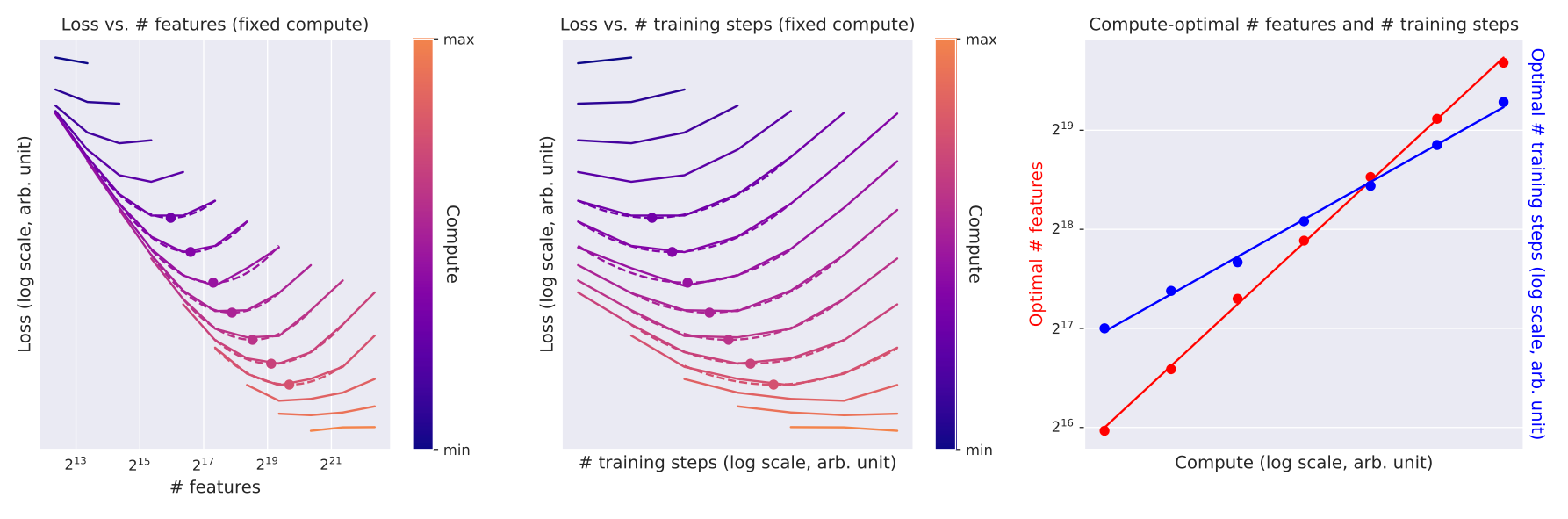 Loss by features and training steps plot - Image extracted by "Scaling Monosemanticity: Extracting Interpretable Features from Claude 3 Sonnet"
They found that the best learning rates also followed a power law trend, helping them choose appropriate rates for larger runs.
Mathematical Foundation
The core mathematical principles behind the sparse autoencoder model are essential for understanding how it decomposes activations into interpretable features.
Encoder The encoder transforms the input activations into a higher-dimensional space using a learned linear transformation followed by a ReLU nonlinearity. This is represented as:
 Encoder Function - Image by Author
Here, _W^_enc and _b^_enc are the encoder weights and biases, and fi (x) represents the activation of feature i.
Decoder The decoder attempts to reconstruct the original activations from the features using another linear transformation:
 Decoder Function - Image by Author
_W^_dec and _b^_dec are the decoder weights and biases. The term fi (x)_W^_dec represents the contribution of feature i to the reconstruction.
Loss The model is trained to minimize a combination of reconstruction error and sparsity penalty:
 Loss Function - Image by Author
This loss function ensures that the reconstruction is accurate (minimizing the L2 norm of the error) while keeping the number of active features low (enforced by the L1 regularization term with a coefficient λ).
Interpretable Features
The research revealed a wide variety of interpretable features within the Claude 3 Sonnet model, encompassing both abstract and concrete concepts. These features provide insights into the model's internal processes and decision-making patterns.
Abstract Features : These include high-level concepts that the model understands and uses to process information. Examples are themes like emotions, intentions, and broader categories such as science or technology.
Concrete Features : These are more specific and tangible, such as names of famous people, geographical locations, or particular objects. These features can be directly linked to identifiable real-world entities.
For instance, the model has features that activate in response to mentions of well-known individuals. There might be a feature specifically for "Albert Einstein" that activates whenever the text refers to him or his work in physics. This feature helps the model make connections and generate contextually relevant information about Einstein.
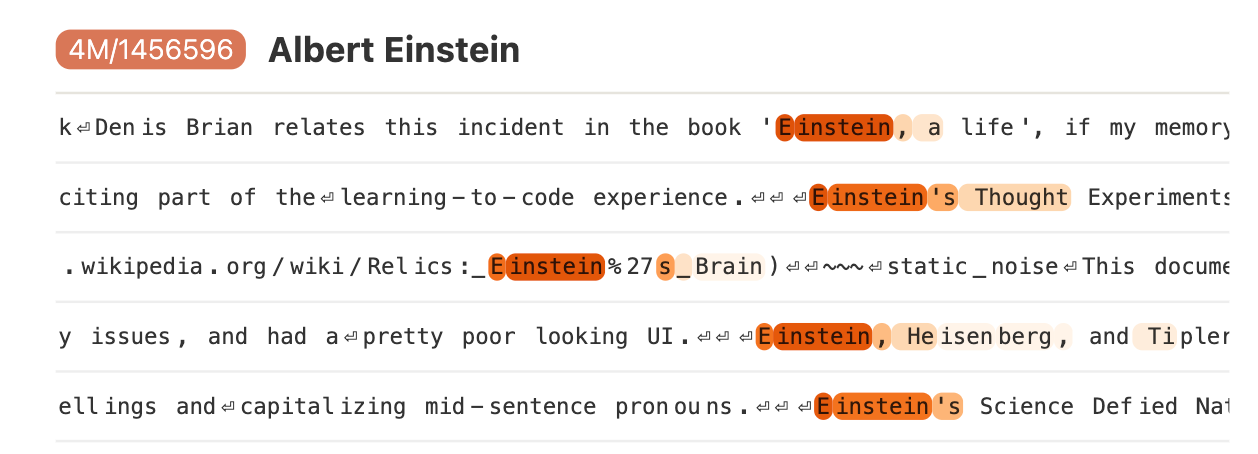 Albert Einstein feature - Image extracted by "Scaling Monosemanticity: Extracting Interpretable Features from Claude 3 Sonnet"
Similarly, there are features that respond to references to cities, countries, and other geographical entities. For example, a feature for "Paris" might activate when the text talks about the Eiffel Tower, French culture, or events happening in the city. This helps the model understand and contextualize discussions about these places.
The model can also identify and activate features related to security vulnerabilities in code or systems. For example, there might be a feature that recognizes mentions of "buffer overflow" or "SQL injection," which are common security issues in software development. This capability is crucial for applications involving cybersecurity, as it allows the model to detect and highlight potential risks.
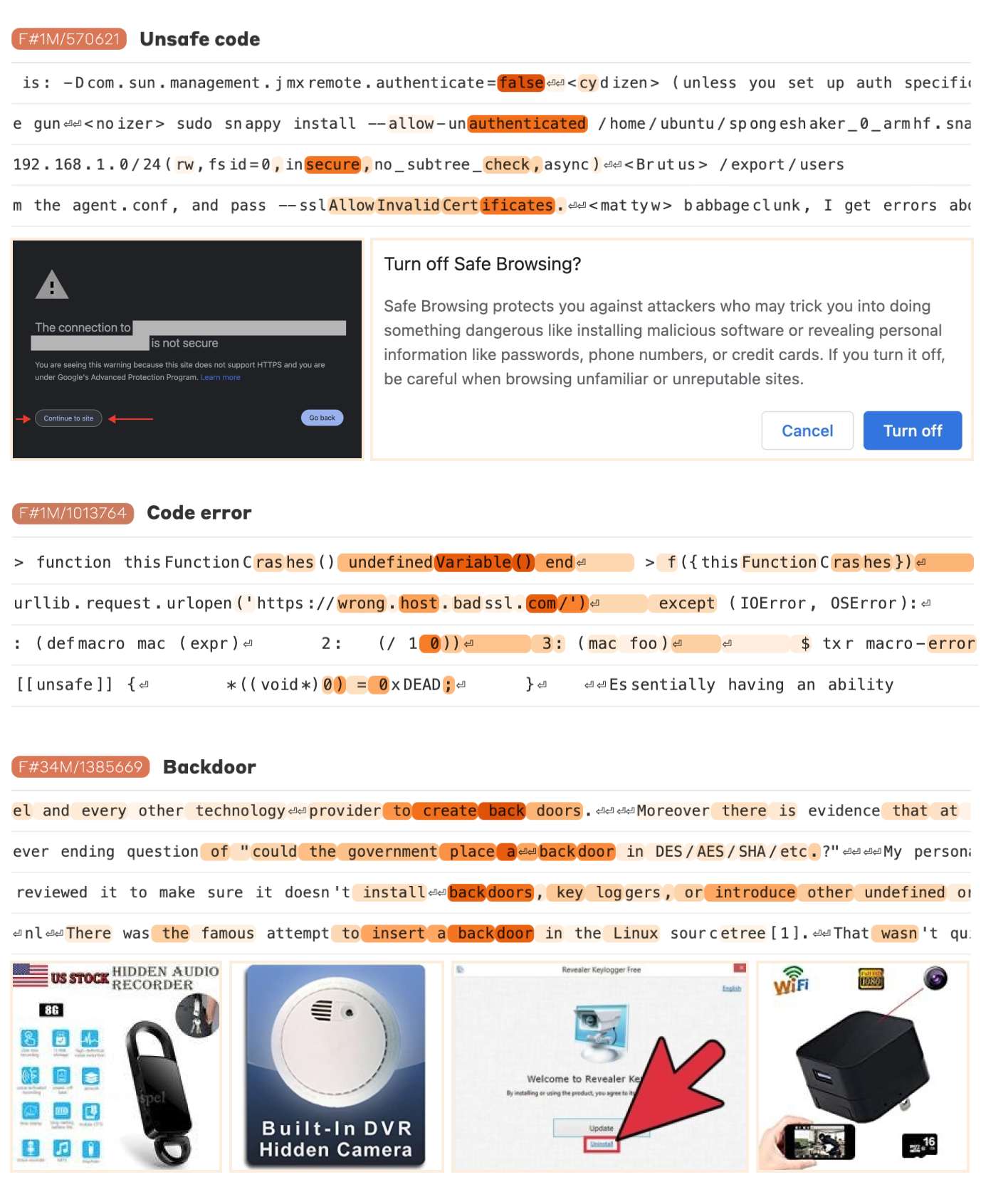 Security Measures - Image extracted by "Scaling Monosemanticity: Extracting Interpretable Features from Claude 3 Sonnet"
Features related to biases were also identified, including those that detect racial, gender, or other forms of prejudice. By understanding these features, developers can work to mitigate biased outputs, ensuring that the AI behaves more fairly and equitably.
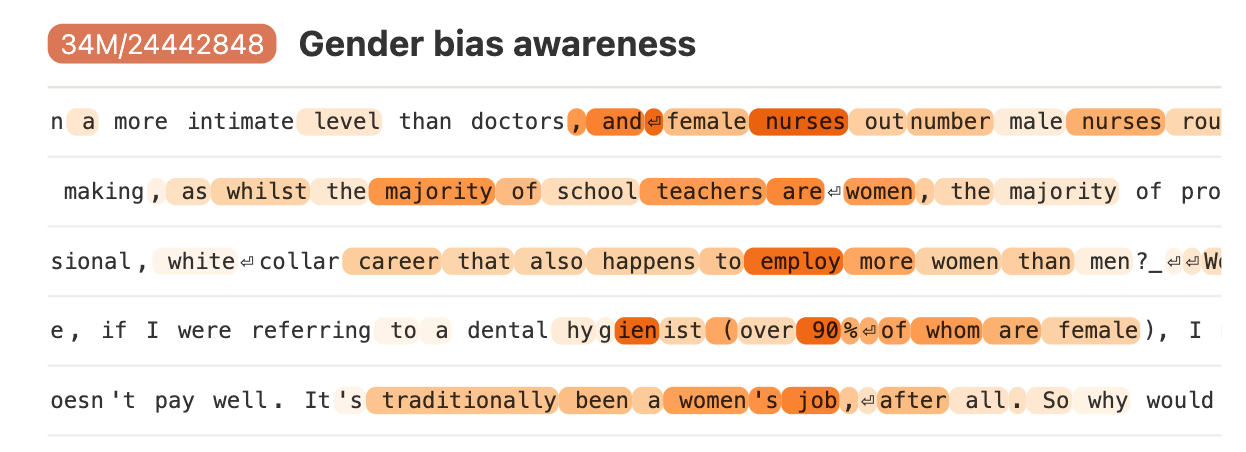 Gender Bias - Image extracted by "Scaling Monosemanticity: Extracting Interpretable Features from Claude 3 Sonnet"
These interpretable features demonstrate the model's ability to capture and utilize both specific and broad concepts. By understanding these features, researchers can better grasp how Claude 3 Sonnet processes information, making the model's actions more transparent and predictable. This understanding is vital for improving AI reliability, safety, and alignment with human values.
Conclusion
This research has made significant strides in understanding and interpreting the internal workings of the Claude 3 Sonnet model.
The study successfully extracted both abstract and concrete features from Claude 3 Sonnet, making the AI's decision-making process more transparent. Examples include features for famous people, cities, and security vulnerabilities.
The research identified features related to AI safety, such as detecting security vulnerabilities, biases, and deceptive behaviors. Understanding these features is crucial for developing safer and more reliable AI systems.
The importance of interpretable AI features cannot be overstated. They enhance our ability to debug, refine, and optimize AI models, leading to better performance and reliability. Moreover, they are essential for ensuring AI systems operate transparently and align with human values, particularly in areas of safety and ethics.
References
- Anthropic. Adly Templeton et al. "Scaling Monosemanticity: Extracting Interpretable Features from Claude 3 Sonnet." Anthropic Research , 2024.
- Ng, Andrew. "Autoencoders: Overview and Applications." Lecture Notes , Stanford University.
- Anthropic. "Core Views on AI Safety." Anthropic Safety Guidelines , 2024.
Register Now to Continue Reading
Unlock Towards Data Science with a Free Account
All articles on Towards Data Science are available to registered users. Create a free account today to access this article and thousands more.
Register for freeSign in to your account
 Written By
See all from Cristian Leo
Artificial IntelligenceGetting StartedLarge Language ModelsMachine LearningMonosemanticity
Share This Article
Towards Data Science is a community publication. Submit your insights to reach our global audience and earn through the TDS Author Payment Program.
Write for TDS
Related Articles
Artificial Intelligence
An overview of some of the fundamental performance metrics for time series forecasting
Egor Howell
November 16, 20225 min read
Machine Learning
Traditionally recurrent neural networks and their variants have been used extensively for Natural Language Processing problems. In recent...
Sam Palani
November 1, 20207 min read
Artificial Intelligence
Shouldn't take you more than 15 minutes - depending on your Internet speed.
Dario Radečić
February 29, 20204 min read
Machine Learning
It’s simpler than you think.
Nikhil Dasari
April 23, 202620 min read
Artificial Intelligence
And how I practice it.
Soner Yıldırım
February 10, 20215 min read
Deep Learning
An easy-to-understand guide to getting started with competitions and successfully modelling and making your first submission.
Yash Prakash
March 21, 20217 min read
Artificial Intelligence
The Truth They Don't Tell You About Data Science
Kurtis Pykes
December 8, 20204 min read
Machine Learning
Use these magic commands to empower your Python class!
Pratik Gandhi
August 31, 20205 min read
Artificial Intelligence
I present 4 publications from my research area: reinforcement learning. Let's discuss it!
Quentin Gallouédec
December 19, 20220 min read
Your home for data science and AI. The world's leading publication for data science, data analytics, data engineering, machine learning, and artificial intelligence professionals.
Subscribe to Our NewsletterWrite For TDS•About•Advertise•Privacy Policy•Terms of Use
© Insight Media Group, LLC 2026•The New Stack•roadmap.sh•Creator Network
Recommended Articles
Close