保留正文与补采附件。源页面当前未重新核验;具体限制见交付清单。
 We value your privacy
We use cookies to enhance your browsing experience, serve personalised ads or content, and analyse our traffic. By clicking "Accept All", you consent to our use of cookies.
Customise Reject All Accept All
Customise Consent Preferences
 We use cookies to help you navigate efficiently and perform certain functions. You will find detailed information about all cookies under each consent category below.
The cookies that are categorised as "Necessary" are stored on your browser as they are essential for enabling the basic functionalities of the site. ... Show more
NecessaryAlways Active
Necessary cookies are required to enable the basic features of this site, such as providing secure log-in or adjusting your consent preferences. These cookies do not store any personally identifiable data.
-
Cookie
BCTempID
-
Duration
10 minutes
-
Description
No description available.
-
Cookie
__cf_bm
-
Duration
1 hour
-
Description
This cookie, set by Cloudflare, is used to support Cloudflare Bot Management.
-
Cookie
AWSALBCORS
-
Duration
7 days
-
Description
Amazon Web Services set this cookie for load balancing.
-
Cookie
_cfuvid
-
Duration
session
-
Description
Cloudflare sets this cookie to track users across sessions to optimize user experience by maintaining session consistency and providing personalized services
-
Cookie
li_gc
-
Duration
6 months
-
Description
Linkedin set this cookie for storing visitor's consent regarding using cookies for non-essential purposes.
-
Cookie
__hssrc
-
Duration
session
-
Description
This cookie is set by Hubspot whenever it changes the session cookie. The __hssrc cookie set to 1 indicates that the user has restarted the browser, and if the cookie does not exist, it is assumed to be a new session.
-
Cookie
__hssc
-
Duration
1 hour
-
Description
HubSpot sets this cookie to keep track of sessions and to determine if HubSpot should increment the session number and timestamps in the __hstc cookie.
-
Cookie
wpEmojiSettingsSupports
-
Duration
session
-
Description
WordPress sets this cookie when a user interacts with emojis on a WordPress site. It helps determine if the user's browser can display emojis properly.
-
Cookie
BCSessionID
-
Duration
1 year 1 month 4 days
-
Description
Blueconic sets this cookie as a unique identifier for the BlueConic profile.
-
Cookie
_octo
-
Duration
1 year
-
Description
No description available.
-
Cookie
logged_in
-
Duration
1 year
-
Description
No description available.
-
Cookie
__Secure-YEC
-
Duration
past
-
Description
YouTube sets this cookie to stores the user's video player preferences using embedded YouTube video
-
Cookie
__eoi
-
Duration
6 months
-
Description
Description is currently not available.
-
Cookie
AWSALBTGCORS
-
Duration
7 days
-
Description
No description available.
-
Cookie
login-status-p
-
Duration
past
-
Description
Description is currently not available.
-
Cookie
AWSALBTG
-
Duration
7 days
-
Description
No description available.
-
Cookie
csrf_token
-
Duration
session
-
Description
No description available.
-
Cookie
token_v2
-
Duration
1 day
-
Description
Description is currently not available.
-
Cookie
D
-
Duration
1 year
-
Description
Description is currently not available.
-
Cookie
PHPSESSID
-
Duration
session
-
Description
This cookie is native to PHP applications. The cookie stores and identifies a user's unique session ID to manage user sessions on the website. The cookie is a session cookie and will be deleted when all the browser windows are closed.
-
Cookie
VISITOR_PRIVACY_METADATA
-
Duration
6 months
-
Description
YouTube sets this cookie to store the user's cookie consent state for the current domain.
-
Cookie
cookietest
-
Duration
session
-
Description
The cookietest cookie is typically used to determine whether the user's browser accepts cookies, essential for website functionality and user experience.
-
Cookie
__Host-airtable-session
-
Duration
1 year
-
Description
This cookie is used to enable us to integrate the services of Airtable.
-
Cookie
__Host-airtable-session.sig
-
Duration
1 year
-
Description
This cookie is used to enable us to integrate the services of Airtable.
-
Cookie
m
-
Duration
1 year 1 month 4 days
-
Description
Stripe sets this cookie for fraud prevention purposes. It identifies the device used to access the website, allowing the website to be formatted accordingly.
-
Cookie
BIGipServer*
-
Duration
session
-
Description
Marketo sets this cookie to collect information about the user's online activity and build a profile about their interests to provide advertisements relevant to the user.
-
Cookie
__cfruid
-
Duration
session
-
Description
Cloudflare sets this cookie to identify trusted web traffic.
-
Cookie
_GRECAPTCHA
-
Duration
6 months
-
Description
Google Recaptcha service sets this cookie to identify bots to protect the website against malicious spam attacks.
-
Cookie
__Secure-YNID
-
Duration
6 months
-
Description
Google cookie used to protect user security and prevent fraud, especially during the login process.
-
Cookie
cookieyes-consent
-
Duration
1 year
-
Description
CookieYes sets this cookie to remember users' consent preferences so that their preferences are respected on subsequent visits to this site. It does not collect or store any personal information about the site visitors.
Functional
Functional cookies help perform certain functionalities like sharing the content of the website on social media platforms, collecting feedback, and other third-party features.
-
Cookie
lidc
-
Duration
1 day
-
Description
LinkedIn sets the lidc cookie to facilitate data center selection.
-
Cookie
brw
-
Duration
1 year
-
Description
No description available.
-
Cookie
brwConsent
-
Duration
5 minutes
-
Description
Description is currently not available.
-
Cookie
WMF-Uniq
-
Duration
1 year
-
Description
Description is currently not available.
-
Cookie
loom_anon_comment
-
Duration
1 year
-
Description
No description available.
-
Cookie
loom_referral_video
-
Duration
session
-
Description
Description is currently not available.
-
Cookie
VISITOR_INFO1_LIVE
-
Duration
6 months
-
Description
A cookie set by YouTube to measure bandwidth that determines whether the user gets the new or old player interface.
-
Cookie
yt-remote-connected-devices
-
Duration
Never Expires
-
Description
YouTube sets this cookie to store the user's video preferences using embedded YouTube videos.
-
Cookie
ytidb::LAST_RESULT_ENTRY_KEY
-
Duration
Never Expires
-
Description
The cookie ytidb::LAST_RESULT_ENTRY_KEY is used by YouTube to store the last search result entry that was clicked by the user. This information is used to improve the user experience by providing more relevant search results in the future.
-
Cookie
yt-remote-device-id
-
Duration
Never Expires
-
Description
YouTube sets this cookie to store the user's video preferences using embedded YouTube videos.
-
Cookie
yt-remote-session-name
-
Duration
session
-
Description
The yt-remote-session-name cookie is used by YouTube to store the user's video player preferences using embedded YouTube video.
-
Cookie
yt-remote-fast-check-period
-
Duration
session
-
Description
The yt-remote-fast-check-period cookie is used by YouTube to store the user's video player preferences for embedded YouTube videos.
-
Cookie
yt-remote-session-app
-
Duration
session
-
Description
The yt-remote-session-app cookie is used by YouTube to store user preferences and information about the interface of the embedded YouTube video player.
-
Cookie
yt-remote-cast-available
-
Duration
session
-
Description
The yt-remote-cast-available cookie is used to store the user's preferences regarding whether casting is available on their YouTube video player.
-
Cookie
yt-remote-cast-installed
-
Duration
session
-
Description
The yt-remote-cast-installed cookie is used to store the user's video player preferences using embedded YouTube video.
-
Cookie
cp_session
-
Duration
3 months
-
Description
Codepen sets this cookie for Help systems found in the website.
-
Cookie
loid
-
Duration
1 year 1 month 4 days
-
Description
This cookie is set by the Reddit. The cookie enables the sharing of content from the website onto the social media platform.
Analytics
Analytical cookies are used to understand how visitors interact with the website. These cookies help provide information on metrics such as the number of visitors, bounce rate, traffic source, etc.
-
Cookie
__hstc
-
Duration
6 months
-
Description
Hubspot set this main cookie for tracking visitors. It contains the domain, initial timestamp (first visit), last timestamp (last visit), current timestamp (this visit), and session number (increments for each subsequent session).
-
Cookie
hubspotutk
-
Duration
6 months
-
Description
HubSpot sets this cookie to keep track of the visitors to the website. This cookie is passed to HubSpot on form submission and used when deduplicating contacts.
-
Cookie
_ga
-
Duration
1 year 1 month 4 days
-
Description
Google Analytics sets this cookie to calculate visitor, session and campaign data and track site usage for the site's analytics report. The cookie stores information anonymously and assigns a randomly generated number to recognise unique visitors.
-
Cookie
ga*
-
Duration
1 year 1 month 4 days
-
Description
Google Analytics sets this cookie to store and count page views.
-
Cookie
__Host-psifi.analyticsTrace
-
Duration
6 hours
-
Description
Description is currently not available.
-
Cookie
__Host-psifi.analyticsTraceV2
-
Duration
6 hours
-
Description
Description is currently not available.
-
Cookie
_gh_sess
-
Duration
session
-
Description
GitHub sets this cookie for temporary application and framework state between pages like what step the user is on in a multiple step form.
-
Cookie
YSC
-
Duration
session
-
Description
YSC cookie is set by Youtube and is used to track the views of embedded videos on Youtube pages.
-
Cookie
ajs_anonymous_id
-
Duration
1 year
-
Description
This cookie is set by Segment to count the number of people who visit a certain site by tracking if they have visited before.
-
Cookie
vuid
-
Duration
1 year 1 month 4 days
-
Description
Vimeo installs this cookie to collect tracking information by setting a unique ID to embed videos on the website.
Performance
Performance cookies are used to understand and analyse the key performance indexes of the website which helps in delivering a better user experience for the visitors.
-
Cookie
AWSALB
-
Duration
7 days
-
Description
AWSALB is an application load balancer cookie set by Amazon Web Services to map the session to the target.
-
Cookie
acq
-
Duration
past
-
Description
Description is currently not available.
-
Cookie
acq.sig
-
Duration
past
-
Description
Description is currently not available.
-
Cookie
ptc
-
Duration
2 years
-
Description
No description available.
Advertisement
Advertisement cookies are used to provide visitors with customised advertisements based on the pages you visited previously and to analyse the effectiveness of the ad campaigns.
-
Cookie
muc_ads
-
Duration
1 year 1 month 4 days
-
Description
Twitter sets this cookie to collect user behaviour and interaction data to optimize the website.
-
Cookie
guest_id_marketing
-
Duration
1 year 1 month 4 days
-
Description
Twitter sets this cookie to identify and track the website visitor.
-
Cookie
guest_id_ads
-
Duration
1 year 1 month 4 days
-
Description
Twitter sets this cookie to identify and track the website visitor.
-
Cookie
personalization_id
-
Duration
1 year 1 month 4 days
-
Description
Twitter sets this cookie to integrate and share features for social media and also store information about how the user uses the website, for tracking and targeting.
-
Cookie
guest_id
-
Duration
1 year 1 month 4 days
-
Description
Twitter sets this cookie to identify and track the website visitor. It registers if a user is signed in to the Twitter platform and collects information about ad preferences.
-
Cookie
bcookie
-
Duration
1 year
-
Description
LinkedIn sets this cookie from LinkedIn share buttons and ad tags to recognize browser IDs.
-
Cookie
__Secure-ROLLOUT_TOKEN
-
Duration
6 months
-
Description
YouTube sets this cookie to manage feature rollout and experimentation. It helps Google control which new features or interface changes are shown to users as part of testing and staged rollouts, ensuring consistent experience for a given user during an experiment.
-
Cookie
yt.innertube::nextId
-
Duration
Never Expires
-
Description
YouTube sets this cookie to register a unique ID to store data on what videos from YouTube the user has seen.
-
Cookie
yt.innertube::requests
-
Duration
Never Expires
-
Description
YouTube sets this cookie to register a unique ID to store data on what videos from YouTube the user has seen.
-
Cookie
session_tracker
-
Duration
session
-
Description
This cookie is set by the Reddit. This cookie is used to identify trusted web traffic. It also helps in adverstising on the website.
-
Cookie
edgebucket
-
Duration
session
-
Description
Reddit sets this cookie to save the information about a log-on Reddit user, for the purpose of advertisement recommendations and updating the content.
-
Cookie
did
-
Duration
1 year
-
Description
Arbor sets this cookie to show targeted ads to site visitors.This cookie expires after 2 months or 1 year.
Uncategorised
Other uncategorised cookies are those that are being analysed and have not been classified into a category as yet.
No cookies to display.
Reject All Save My Preferences Accept All
Toggle SearchToggle Mobile Navigation
Publish AI, ML & data-science insights to a global community of data professionals.
Sign inSubmit an Article
LatestEditor's PicksNewsletterShipAI
Write For TDS
LinkedInXToggle Search
Machine Learning
The Machine Learning “Advent Calendar” Day 22: Embeddings in Excel
Understanding text embeddings through simple models and Excel
Angela and Kezhan Shi
December 22, 20257 min read
 Embeddings in Excel
For the remaining days of this series, we will talk about deep learning.
And when people talk about deep learning, we immediately think of these images of deep neural networks architectures, with many layers, neurons, and parameters.
In practice, the real shift introduced by deep learning is elsewhere.
It is about learning data representations.
In this article, we focus on text embeddings , explain their role in the machine learning landscape, and show how they can be understood and explored in Excel.
1. Classic Machine earning vs. Deep learning
We will discuss, in this part, why embedding is introduced.
Learn this step by step with the interactive Machine Learning roadmap.
1.1 Where does deep learning fit?
To understand embeddings, we first need to clarify the place of deep learning.
We will use the term classic machine learning to describe methods that do not rely on deep architectures.
All the previous articles deal with classic machine learning, that can be described in two complementary ways.
Learning paradigms
- Supervised learning
- Unsupervised learning
Model families
- Distance-based models
- Tree-based models
- Weight-based models
Across this series, we have already studied the learning algorithms behind these models. In particular, we have seen that gradient descent applies to all weight-based models, from linear regression to neural networks.
Deep learning is often reduced to neural networks with many layers.
But this explanation is incomplete.
From an optimization point of view, deep learning does not introduce a new learning rule.
So what does it introduce?
1.2 Deep learning as data representation learning
Deep learning is about how features are created.
Instead of manually designing features, deep learning learns representations automatically , often through multiple successive transformations.
This also raises an important conceptual question:
Where is the boundary between feature engineering and model learning?
Some examples make this clearer:
- Polynomial regression is still a linear model, but the features are polynomial
- Kernel methods project data into a high-dimensional feature space
- Density-based methods implicitly transform the data before learning
Deep learning continues this idea, but at scale.
From this perspective, deep learning belongs to:
- the feature engineering philosophy , for representation
- the weight-based model family , for learning
1.3 Images and convolutional neural networks
Images are represented as pixels.
From a technical point of view, image data is already numerical and structured: a grid of numbers. However, the information contained in these pixels is not structured in a way that classical models can easily exploit.
Pixels do not explicitly encode: edges, shapes, textures, or objects.
Convolutional Neural Networks (CNNs) are designed to create information from pixels. They apply filters to detect local patterns, then progressively combine them into higher-level representations.
I have published a this article showing how CNNs can be implemented in Excel to make this process explicit.
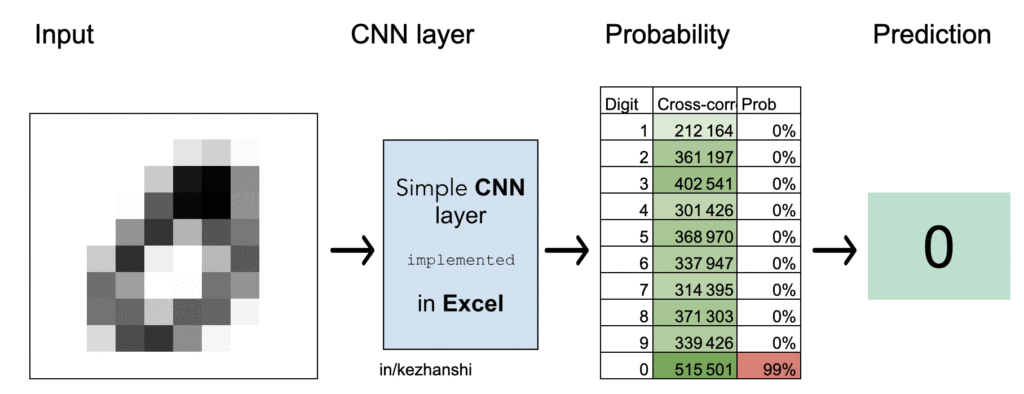 CNN in Excel - all images by author
For images, the challenge is not to make the data numerical, but to extract meaningful representations from already numerical data.
1.4 Text data: a different problem
Text presents a fundamentally different challenge.
Unlike images, text is not numerical by nature.
Before modeling context or order, the first problem is more basic:
How do we represent words numerically?
Creating a numerical representation for text the first step.
In deep learning for text, this step is handled by embeddings.
Embeddings transform discrete symbols (words) into vectors that models can work with. Once embeddings exist, we can then model: context, order and relationships between words.
In this article, we focus on this first and essential step:
how embeddings create numerical representations for text , and how this process can be explored in Excel.
2. Two ways to learn text embeddings
In this article, we will use the IMDB movie reviews dataset to illustrate both approaches. The dataset is distributed under the Apache License 2.0.
There are two main ways to learn embeddings for text, and we will do both with this dataset:
- supervised: we will create embeddings to predict the sentiment
- unsupervised or self-supervised: we will use word2vec algorithm
In both cases, the goal is the same:
to transform words into numerical vectors that can be used by machine learning models.
If you test UNDERSTAND_ML, you may notice a difference.
Before comparing these two approaches, we first need to clarify what embeddings are and how they relate to classic machine learning.
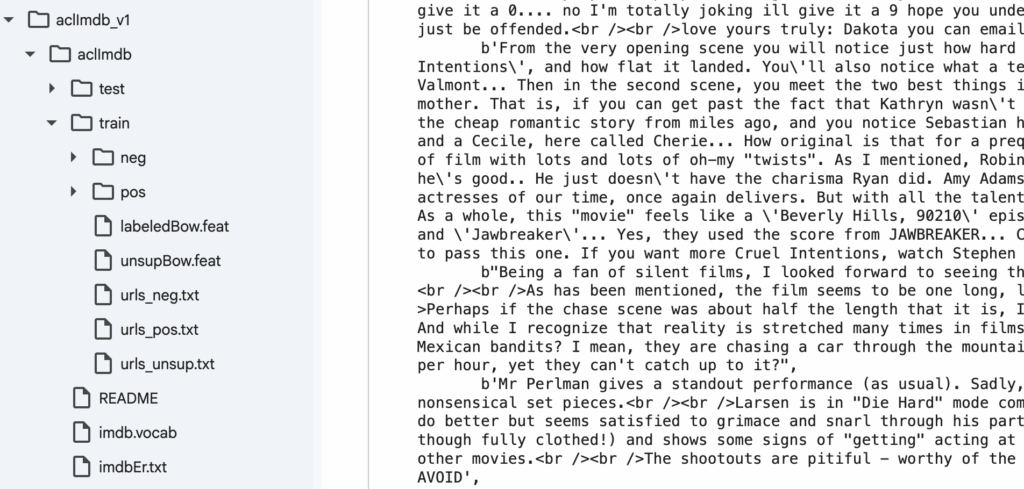 IMDB dataset image by author -Apache License 2.0
2.1 Embeddings and classic machine learning
In classic machine learning, categorical data is usually handled with:
- label encoding , which assigns fixed integers but introduces artificial order
- one-hot encoding , which removes order but produces high-dimensional sparse vectors
How they can be used depend on the nature of the models.
Distance-based models cannot effectively use one-hot encoding, because all categories end up being equally distant from each other. Label encoding could work only if we can attribute meaningful numerical values for the categories, which is generally not the case in classic models.
Weight-based models can use one-hot encoding, because the model learns a weight for each category. In contrast, with label encoding, the numerical values are fixed and cannot be adjusted to represent meaningful relationships.
Tree-based models treat all variables as categorical splits rather than numerical magnitudes, which makes label encoding acceptable in practice. However, most implementations, including scikit-learn, still require numerical inputs. As a result, categories must be converted to numbers, either through label encoding or one-hot encoding. If the numerical values carried semantic meaning, this would again be beneficial.
Overall, this highlights a limitation of classic approaches:
category values are fixed and not learned.
Embeddings extend this idea by learning the representation itself.
Each word is associated with a trainable vector, turning the representation of categories into a learning problem rather than a preprocessing step.
2.2 Supervised embeddings
In supervised learning, embeddings are learned as part of a prediction task.
For example, the IMDB dataset has labels about the in sentiment analysis. So we can create a very simple architecture:
In our case, we can use a very simple architecture: each word is mapped to a one-dimensional embedding
This is possible because the objective is binary sentiment classification.
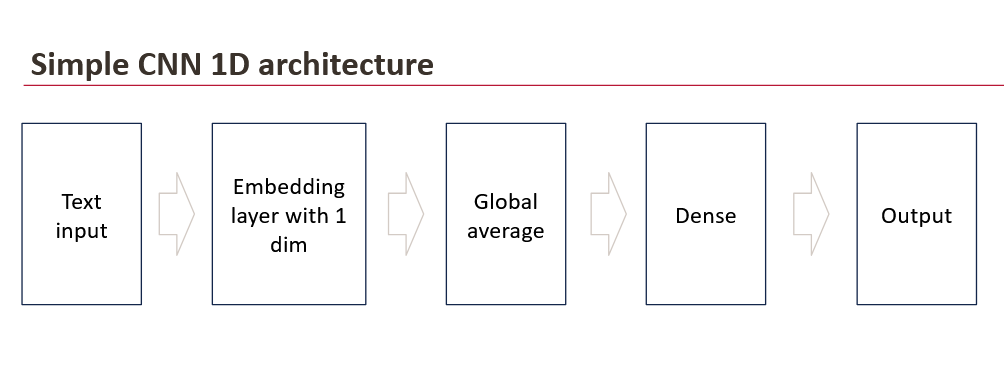 Once training is complete, we can export the embeddings and explore them in Excel.
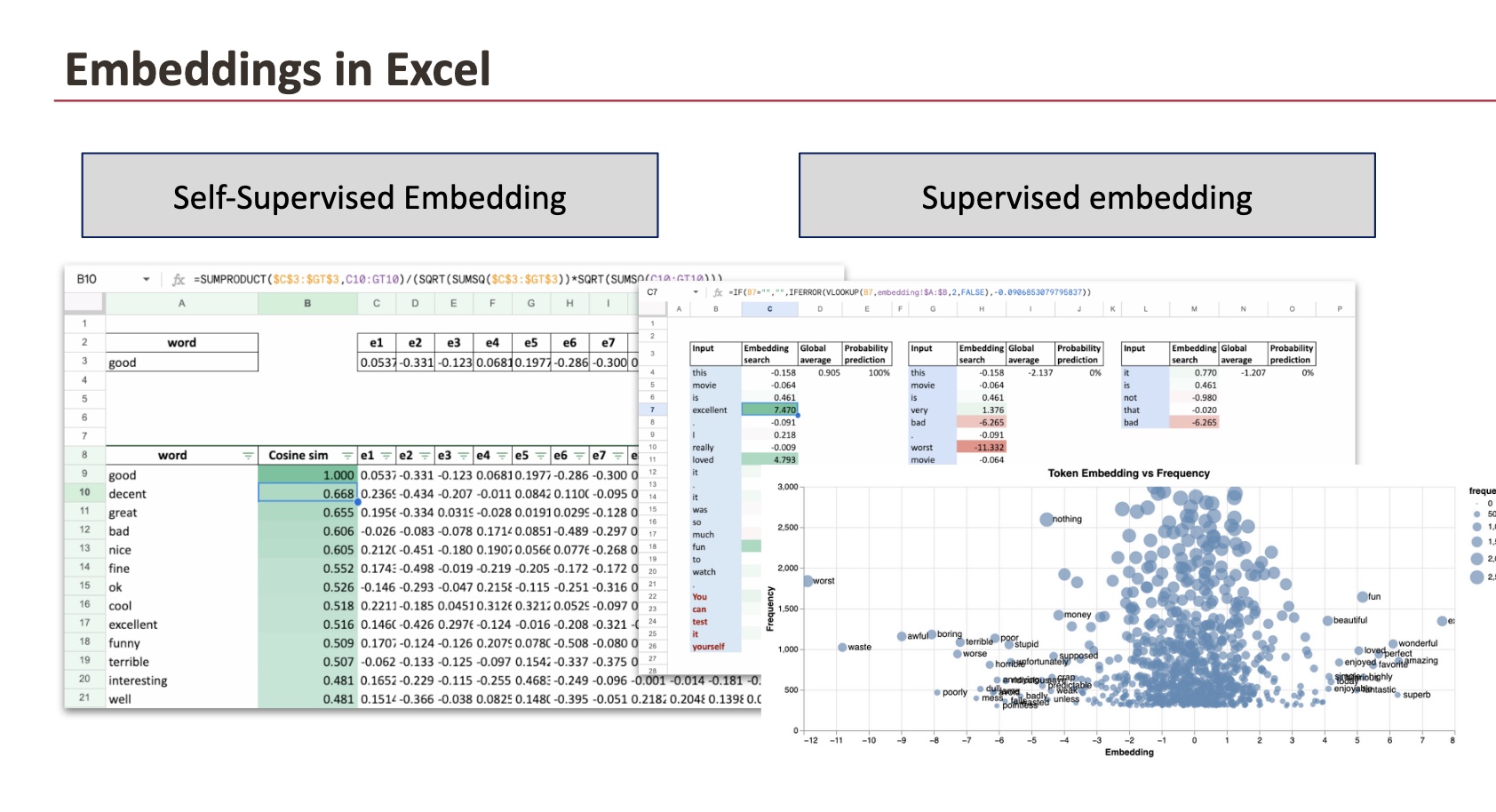
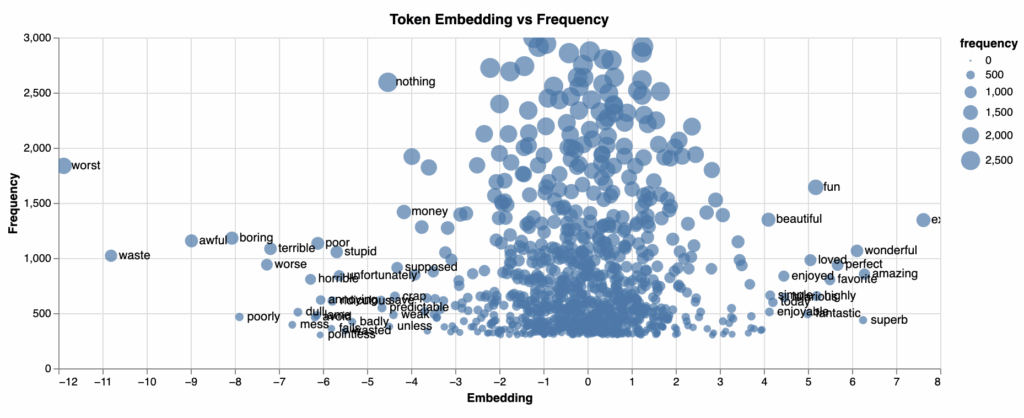
When plotting the embeddings on the x-axis and word frequency on the y-axis, a clear pattern appears:
- positive values are associated with words such as excellent or wonderful ,
- negative values are associated with words such as worst or waste
Depending on the initialization, the sign can be inverted, since the logistic regression layer also has parameters that influence the final prediction.
 Finally, in Excel, we reconstruct the full pipeline that corresponds to the architecture we define early.
Input column
The input text (a review) is cut into words, and each row corresponds to one word.
Embedding search
Using a lookup function, the embedding value associated with each word is retrieved from the embedding table learned during training.
Global average
The global average embedding is computed by averaging the embeddings of all words seen so far. This corresponds to a very simple sentence representation: the mean of word vectors.
Probability prediction
The averaged embedding is then passed through a logistic function to produce a sentiment probability.
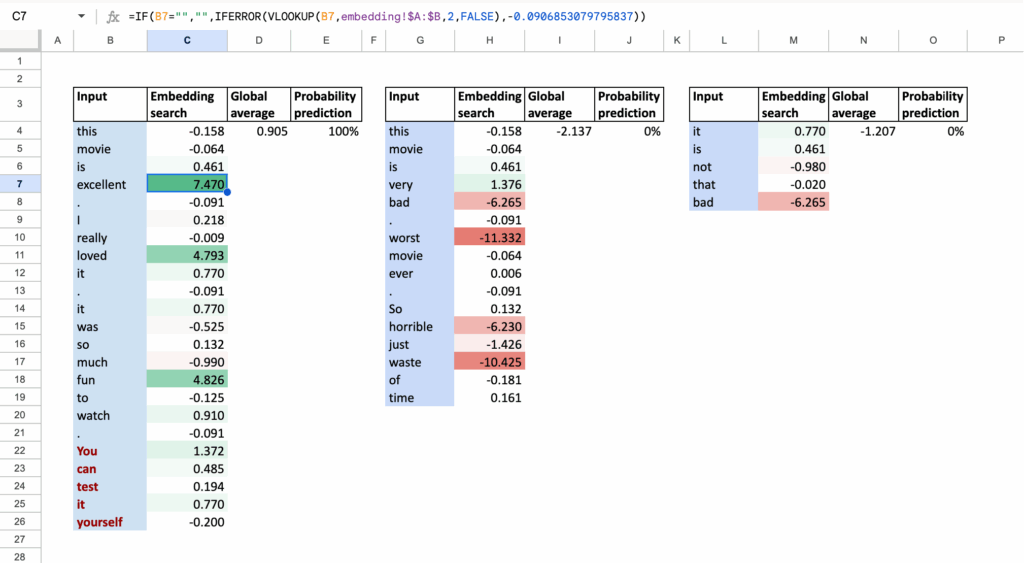 What we observe
- Words with strongly positive embeddings (for example excellent , love , fun) push the average upward.
- Words with strongly negative embeddings (for example worst , horrible , waste) pull the average downward.
- Neutral or weakly weighted words have little influence.
As more words are added, the global average embedding stabilizes, and the sentiment prediction becomes more confident.
2.3 Word2Vec: embeddings from co-occurrence
In Word2Vec, similarity does not mean that two words have the same meaning.
It means that they appear in similar contexts.
Word2Vec learns word embeddings by looking at which words tend to co-occur within a fixed window in the text. Two words are considered similar if they often appear around the same neighboring words , even if their meanings are opposite.
As shown in the Excel sheet below, we compute the cosine similarity for the word good and retrieve the most similar words.
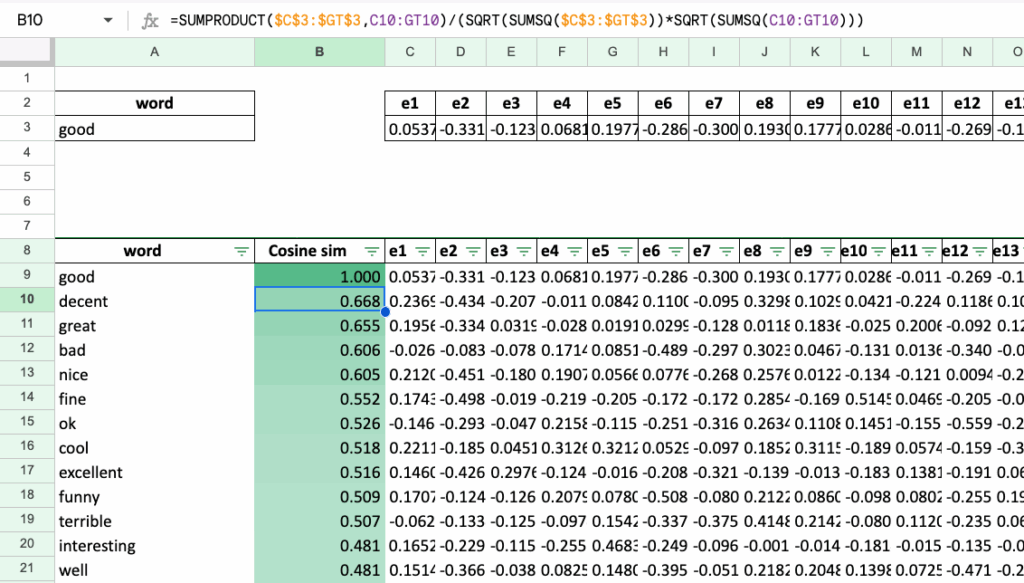 From the model’s perspective, the surrounding words are almost identical. The only thing that changes is the adjective itself.
As a result, Word2Vec learns that “good” and “bad” play a similar role in language , even though their meanings are opposite.
So, Word2Vec captures distributional similarity , not semantic polarity.
A useful way to think about it is:
Words are close if they are used in the same places.
2.4 How embeddings are used
In modern systems such as RAG (Retrieval-Augmented Generation) , embeddings are often used to retrieve documents or passages for question answering.
However, this approach has limitations.
Most commonly used embeddings are trained in a self-supervised way, based on co-occurrence or contextual prediction objectives. As a result, they capture general language similarity, not task-specific meaning.
This means that:
- embeddings may retrieve text that is linguistically similar but not relevant
- semantic proximity does not guarantee answer correctness
Other embedding strategies can be used, including task-adapted or supervised embeddings, but they often remain self-supervised at their core.
Understanding how embeddings are created, what they encode, and what they do not encode is therefore essential before using them in downstream systems such as RAG.
Conclusion
Embeddings are learned numerical representations of words that make similarity measurable.
Whether learned through supervision or through co-occurrence, embeddings map words to vectors based on how they are used in data. By exporting them to Excel, we can inspect these representations directly, compute similarities, and understand what they capture and what they do not.
This makes embeddings less mysterious and clarifies their role as a foundation for more complex systems such as retrieval or RAG.
···
All the Excel files are available through this Kofi link. Your support means a lot to me. The price will increase during the month, so early supporters get the best value.
 All Excel/Google sheet files for ML and DL
Register Now to Continue Reading
Unlock Towards Data Science with a Free Account
All articles on Towards Data Science are available to registered users. Create a free account today to access this article and thousands more.
Register for freeSign in to your account
 Written By
See all from Angela and Kezhan Shi
Artificial IntelligenceData ScienceDeep LearningText Embedding
Share This Article
Towards Data Science is a community publication. Submit your insights to reach our global audience and earn through the TDS Author Payment Program.
Write for TDS
Related Articles
Machine Learning
Day 2 of #100DaysOfMLCode
Durgesh Samariya
July 30, 20204 min read
Data Science
Understanding the Connections Between Variables: A Comprehensive Guide to Correlation Matrices and Their Applications
Niklas Lang
November 13, 202414 min read
Data Science
Open Data Barcelona is Barcelona´s data service which contains around 400 datasets, covering a wide rage of topics such as population...
Amanda Iglesias Moreno
September 1, 20199 min read
Deep Learning
For the longest time, I had not completely understood Cross-Entropy loss. Why did we take exponents (softmax)? Why did we then take the...
Akash Shastri
October 6, 20206 min read
Artificial Intelligence
Scientists have just set up a roadmap for the future of ML applied to chemistry and material sciences, in an article that also tracks the...
Luciano Abriata
September 8, 202214 min read
Artificial Intelligence
An introduction to image data processing and feature extraction
Aditya Mehta
November 7, 20205 min read
Data Science
Out with the old, in with the new!
Zvonimir Boban
May 20, 20236 min read
Machine Learning
Using Polars with NVIDIA GPU can speed up your data pipelines
Ivo Bernardo
September 17, 20244 min read
Machine Learning
1a Decision Trees Decision trees and random forests are two commonly used algorithms in predictive...
Dick Brown
May 6, 202110 min read
Your home for data science and AI. The world's leading publication for data science, data analytics, data engineering, machine learning, and artificial intelligence professionals.
Subscribe to Our NewsletterWrite For TDS•About•Advertise•Privacy Policy•Terms of Use
© Insight Media Group, LLC 2026•The New Stack•roadmap.sh•Creator Network
Recommended Articles
Close