保留正文与补采附件。源页面当前未重新核验;具体限制见交付清单。
 We value your privacy
We use cookies to enhance your browsing experience, serve personalised ads or content, and analyse our traffic. By clicking "Accept All", you consent to our use of cookies.
Customise Reject All Accept All
Customise Consent Preferences
 We use cookies to help you navigate efficiently and perform certain functions. You will find detailed information about all cookies under each consent category below.
The cookies that are categorised as "Necessary" are stored on your browser as they are essential for enabling the basic functionalities of the site. ... Show more
NecessaryAlways Active
Necessary cookies are required to enable the basic features of this site, such as providing secure log-in or adjusting your consent preferences. These cookies do not store any personally identifiable data.
-
Cookie
BCTempID
-
Duration
10 minutes
-
Description
No description available.
-
Cookie
__cf_bm
-
Duration
1 hour
-
Description
This cookie, set by Cloudflare, is used to support Cloudflare Bot Management.
-
Cookie
AWSALBCORS
-
Duration
7 days
-
Description
Amazon Web Services set this cookie for load balancing.
-
Cookie
_cfuvid
-
Duration
session
-
Description
Cloudflare sets this cookie to track users across sessions to optimize user experience by maintaining session consistency and providing personalized services
-
Cookie
li_gc
-
Duration
6 months
-
Description
Linkedin set this cookie for storing visitor's consent regarding using cookies for non-essential purposes.
-
Cookie
__hssrc
-
Duration
session
-
Description
This cookie is set by Hubspot whenever it changes the session cookie. The __hssrc cookie set to 1 indicates that the user has restarted the browser, and if the cookie does not exist, it is assumed to be a new session.
-
Cookie
__hssc
-
Duration
1 hour
-
Description
HubSpot sets this cookie to keep track of sessions and to determine if HubSpot should increment the session number and timestamps in the __hstc cookie.
-
Cookie
wpEmojiSettingsSupports
-
Duration
session
-
Description
WordPress sets this cookie when a user interacts with emojis on a WordPress site. It helps determine if the user's browser can display emojis properly.
-
Cookie
BCSessionID
-
Duration
1 year 1 month 4 days
-
Description
Blueconic sets this cookie as a unique identifier for the BlueConic profile.
-
Cookie
_octo
-
Duration
1 year
-
Description
No description available.
-
Cookie
logged_in
-
Duration
1 year
-
Description
No description available.
-
Cookie
__Secure-YEC
-
Duration
past
-
Description
YouTube sets this cookie to stores the user's video player preferences using embedded YouTube video
-
Cookie
__eoi
-
Duration
6 months
-
Description
Description is currently not available.
-
Cookie
AWSALBTGCORS
-
Duration
7 days
-
Description
No description available.
-
Cookie
login-status-p
-
Duration
past
-
Description
Description is currently not available.
-
Cookie
AWSALBTG
-
Duration
7 days
-
Description
No description available.
-
Cookie
csrf_token
-
Duration
session
-
Description
No description available.
-
Cookie
token_v2
-
Duration
1 day
-
Description
Description is currently not available.
-
Cookie
D
-
Duration
1 year
-
Description
Description is currently not available.
-
Cookie
PHPSESSID
-
Duration
session
-
Description
This cookie is native to PHP applications. The cookie stores and identifies a user's unique session ID to manage user sessions on the website. The cookie is a session cookie and will be deleted when all the browser windows are closed.
-
Cookie
VISITOR_PRIVACY_METADATA
-
Duration
6 months
-
Description
YouTube sets this cookie to store the user's cookie consent state for the current domain.
-
Cookie
cookietest
-
Duration
session
-
Description
The cookietest cookie is typically used to determine whether the user's browser accepts cookies, essential for website functionality and user experience.
-
Cookie
__Host-airtable-session
-
Duration
1 year
-
Description
This cookie is used to enable us to integrate the services of Airtable.
-
Cookie
__Host-airtable-session.sig
-
Duration
1 year
-
Description
This cookie is used to enable us to integrate the services of Airtable.
-
Cookie
m
-
Duration
1 year 1 month 4 days
-
Description
Stripe sets this cookie for fraud prevention purposes. It identifies the device used to access the website, allowing the website to be formatted accordingly.
-
Cookie
BIGipServer*
-
Duration
session
-
Description
Marketo sets this cookie to collect information about the user's online activity and build a profile about their interests to provide advertisements relevant to the user.
-
Cookie
__cfruid
-
Duration
session
-
Description
Cloudflare sets this cookie to identify trusted web traffic.
-
Cookie
_GRECAPTCHA
-
Duration
6 months
-
Description
Google Recaptcha service sets this cookie to identify bots to protect the website against malicious spam attacks.
-
Cookie
__Secure-YNID
-
Duration
6 months
-
Description
Google cookie used to protect user security and prevent fraud, especially during the login process.
-
Cookie
cookieyes-consent
-
Duration
1 year
-
Description
CookieYes sets this cookie to remember users' consent preferences so that their preferences are respected on subsequent visits to this site. It does not collect or store any personal information about the site visitors.
Functional
Functional cookies help perform certain functionalities like sharing the content of the website on social media platforms, collecting feedback, and other third-party features.
-
Cookie
lidc
-
Duration
1 day
-
Description
LinkedIn sets the lidc cookie to facilitate data center selection.
-
Cookie
brw
-
Duration
1 year
-
Description
No description available.
-
Cookie
brwConsent
-
Duration
5 minutes
-
Description
Description is currently not available.
-
Cookie
WMF-Uniq
-
Duration
1 year
-
Description
Description is currently not available.
-
Cookie
loom_anon_comment
-
Duration
1 year
-
Description
No description available.
-
Cookie
loom_referral_video
-
Duration
session
-
Description
Description is currently not available.
-
Cookie
VISITOR_INFO1_LIVE
-
Duration
6 months
-
Description
A cookie set by YouTube to measure bandwidth that determines whether the user gets the new or old player interface.
-
Cookie
yt-remote-connected-devices
-
Duration
Never Expires
-
Description
YouTube sets this cookie to store the user's video preferences using embedded YouTube videos.
-
Cookie
ytidb::LAST_RESULT_ENTRY_KEY
-
Duration
Never Expires
-
Description
The cookie ytidb::LAST_RESULT_ENTRY_KEY is used by YouTube to store the last search result entry that was clicked by the user. This information is used to improve the user experience by providing more relevant search results in the future.
-
Cookie
yt-remote-device-id
-
Duration
Never Expires
-
Description
YouTube sets this cookie to store the user's video preferences using embedded YouTube videos.
-
Cookie
yt-remote-session-name
-
Duration
session
-
Description
The yt-remote-session-name cookie is used by YouTube to store the user's video player preferences using embedded YouTube video.
-
Cookie
yt-remote-fast-check-period
-
Duration
session
-
Description
The yt-remote-fast-check-period cookie is used by YouTube to store the user's video player preferences for embedded YouTube videos.
-
Cookie
yt-remote-session-app
-
Duration
session
-
Description
The yt-remote-session-app cookie is used by YouTube to store user preferences and information about the interface of the embedded YouTube video player.
-
Cookie
yt-remote-cast-available
-
Duration
session
-
Description
The yt-remote-cast-available cookie is used to store the user's preferences regarding whether casting is available on their YouTube video player.
-
Cookie
yt-remote-cast-installed
-
Duration
session
-
Description
The yt-remote-cast-installed cookie is used to store the user's video player preferences using embedded YouTube video.
-
Cookie
cp_session
-
Duration
3 months
-
Description
Codepen sets this cookie for Help systems found in the website.
-
Cookie
loid
-
Duration
1 year 1 month 4 days
-
Description
This cookie is set by the Reddit. The cookie enables the sharing of content from the website onto the social media platform.
Analytics
Analytical cookies are used to understand how visitors interact with the website. These cookies help provide information on metrics such as the number of visitors, bounce rate, traffic source, etc.
-
Cookie
__hstc
-
Duration
6 months
-
Description
Hubspot set this main cookie for tracking visitors. It contains the domain, initial timestamp (first visit), last timestamp (last visit), current timestamp (this visit), and session number (increments for each subsequent session).
-
Cookie
hubspotutk
-
Duration
6 months
-
Description
HubSpot sets this cookie to keep track of the visitors to the website. This cookie is passed to HubSpot on form submission and used when deduplicating contacts.
-
Cookie
_ga
-
Duration
1 year 1 month 4 days
-
Description
Google Analytics sets this cookie to calculate visitor, session and campaign data and track site usage for the site's analytics report. The cookie stores information anonymously and assigns a randomly generated number to recognise unique visitors.
-
Cookie
ga*
-
Duration
1 year 1 month 4 days
-
Description
Google Analytics sets this cookie to store and count page views.
-
Cookie
__Host-psifi.analyticsTrace
-
Duration
6 hours
-
Description
Description is currently not available.
-
Cookie
__Host-psifi.analyticsTraceV2
-
Duration
6 hours
-
Description
Description is currently not available.
-
Cookie
_gh_sess
-
Duration
session
-
Description
GitHub sets this cookie for temporary application and framework state between pages like what step the user is on in a multiple step form.
-
Cookie
YSC
-
Duration
session
-
Description
YSC cookie is set by Youtube and is used to track the views of embedded videos on Youtube pages.
-
Cookie
ajs_anonymous_id
-
Duration
1 year
-
Description
This cookie is set by Segment to count the number of people who visit a certain site by tracking if they have visited before.
-
Cookie
vuid
-
Duration
1 year 1 month 4 days
-
Description
Vimeo installs this cookie to collect tracking information by setting a unique ID to embed videos on the website.
Performance
Performance cookies are used to understand and analyse the key performance indexes of the website which helps in delivering a better user experience for the visitors.
-
Cookie
AWSALB
-
Duration
7 days
-
Description
AWSALB is an application load balancer cookie set by Amazon Web Services to map the session to the target.
-
Cookie
acq
-
Duration
past
-
Description
Description is currently not available.
-
Cookie
acq.sig
-
Duration
past
-
Description
Description is currently not available.
-
Cookie
ptc
-
Duration
2 years
-
Description
No description available.
Advertisement
Advertisement cookies are used to provide visitors with customised advertisements based on the pages you visited previously and to analyse the effectiveness of the ad campaigns.
-
Cookie
muc_ads
-
Duration
1 year 1 month 4 days
-
Description
Twitter sets this cookie to collect user behaviour and interaction data to optimize the website.
-
Cookie
guest_id_marketing
-
Duration
1 year 1 month 4 days
-
Description
Twitter sets this cookie to identify and track the website visitor.
-
Cookie
guest_id_ads
-
Duration
1 year 1 month 4 days
-
Description
Twitter sets this cookie to identify and track the website visitor.
-
Cookie
personalization_id
-
Duration
1 year 1 month 4 days
-
Description
Twitter sets this cookie to integrate and share features for social media and also store information about how the user uses the website, for tracking and targeting.
-
Cookie
guest_id
-
Duration
1 year 1 month 4 days
-
Description
Twitter sets this cookie to identify and track the website visitor. It registers if a user is signed in to the Twitter platform and collects information about ad preferences.
-
Cookie
bcookie
-
Duration
1 year
-
Description
LinkedIn sets this cookie from LinkedIn share buttons and ad tags to recognize browser IDs.
-
Cookie
__Secure-ROLLOUT_TOKEN
-
Duration
6 months
-
Description
YouTube sets this cookie to manage feature rollout and experimentation. It helps Google control which new features or interface changes are shown to users as part of testing and staged rollouts, ensuring consistent experience for a given user during an experiment.
-
Cookie
yt.innertube::nextId
-
Duration
Never Expires
-
Description
YouTube sets this cookie to register a unique ID to store data on what videos from YouTube the user has seen.
-
Cookie
yt.innertube::requests
-
Duration
Never Expires
-
Description
YouTube sets this cookie to register a unique ID to store data on what videos from YouTube the user has seen.
-
Cookie
session_tracker
-
Duration
session
-
Description
This cookie is set by the Reddit. This cookie is used to identify trusted web traffic. It also helps in adverstising on the website.
-
Cookie
edgebucket
-
Duration
session
-
Description
Reddit sets this cookie to save the information about a log-on Reddit user, for the purpose of advertisement recommendations and updating the content.
-
Cookie
did
-
Duration
1 year
-
Description
Arbor sets this cookie to show targeted ads to site visitors.This cookie expires after 2 months or 1 year.
Uncategorised
Other uncategorised cookies are those that are being analysed and have not been classified into a category as yet.
No cookies to display.
Reject All Save My Preferences Accept All
Toggle SearchToggle Mobile Navigation
Publish AI, ML & data-science insights to a global community of data professionals.
Sign inSubmit an Article
LatestEditor's PicksNewsletterShipAI
Write For TDS
LinkedInXToggle Search
Agentic AI
LangChain vs LangGraph: 4 Key Differences and When to Use Each
A practical guide to choose the proper tool for your agentic workflows and systems
Soner Yıldırım
August 13, 20265 min read
 Photo by Mika Baumeister on Unsplash
LangChain came to our lives long before LangGraph. This is a clear indication of LangGraph closing a gap. In other words, LangGraph does things that are more complicated or not possible to do with LangChain.
In this article, we'll go over 4 key differences between LangChain and LangGraph, and how they impact the code we write to build agentic workflows.
Let's first mention that these are not competing tools. LangGraph is part of the LangChain ecosystem. It is kind of an extension built on top of LangChain.
1. Pipeline vs Loops
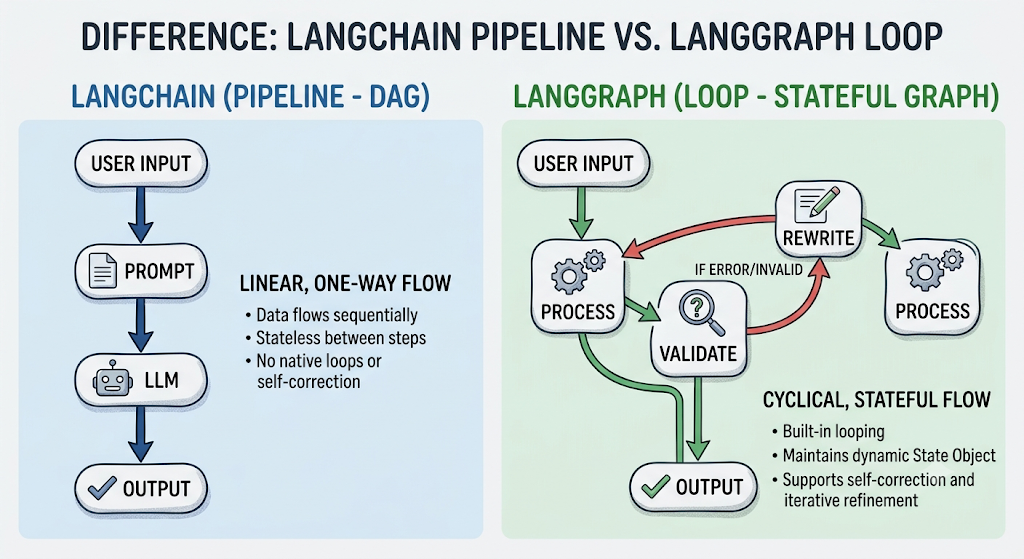 LangChain is a pipeline with a clear direction:
Learn this step by step with the interactive AI Agents roadmap.
 We chain components together but in one direction, which looks like this in code:
python
chain = prompt | model | parser
output = chain.invoke(input)
We can still branch, run steps in parallel, and construct DAGs, but the default abstraction is data being moved forward through a pipeline.
This structure is enough for solving many problems such as
- Retrieve documents, then generate an answer
- Extract fields, then save them
- Summarize text, then classify it
However, when it comes to sending backward, we need to write an outer Python loop. Hence, the application handles the rest, not LangChain.
On the other hand, LangGraph treats loops as part of the workflow itself. It is basically a graph with nodes and edges.
- A node performs a particular task.
- A normal edge defines fixed transitions between nodes.
- A conditional edge decides where to go next.
Thanks to the normal and conditional edges, we can route back to earlier nodes without a hustle. Here is the diagram of a customer service agent I built with LangGraph:
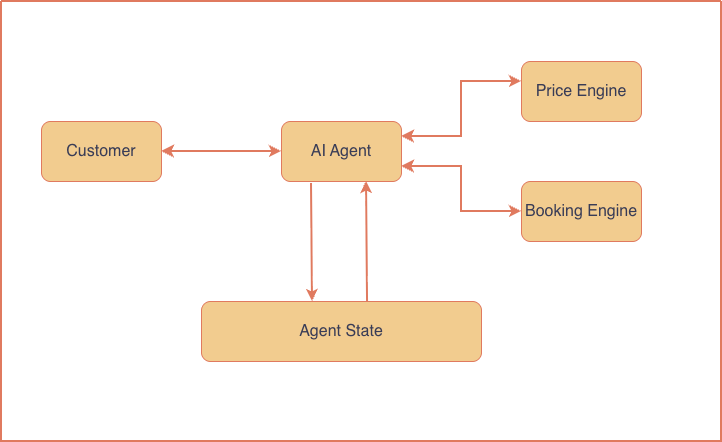 Customer represents the input node, AI Agent is the model, price and booking engines are the other nodes. We can go back and forth between nodes.
2. Stateless vs Stateful
A LangChain pipeline does not hold a state within itself. Each runnable usually receives an input and returns an output. State is passed forward in the form of a dictionary, message, or a custom object.
This is enough when each step needs only the previous step’s result. However, once we have a more complex workflow with loops or branches, it is on us to track the current draft, validation errors, conversation history, retry counts, etc.
We can manage all of that writing extra Python code but, as we mentioned earlier, it's not part of the chain.
LangGraph creates stateful agents so the state is part of the graph. We declare a schema for the state, usually in the form of a TypedDict . For example, here is the state object of my customer service agent:
python
class AgentState(TypedDict):
    messages: Annotated[list[AnyMessage], add_messages]
    booking_details: BookingDetails
    calculated_price: NotRequired[float | None]
    time_options: NotRequired[list[TimeOption]]
    selected_slot: NotRequired[TimeOption | None]
    status: BookingStatus
    booking_id: NotRequired[str | None]
A node does not have to reconstruct the entire state. It can do partial updates and LangGraph handles it smoothly. In this agent, we have a price engine node, which only updates the calculated_price in the agent state:
python
def calculate_price_node(state: AgentState) -> dict[str, Any]:
    return {"calculated_price": calculate_price(state["booking_details"])}
LangGraph then merges that update into the existing state.
State fields can also have reduces for values written by multiple nodes or same node multiple times. For example, the messages field of the customer service agent state is updated after every customer message so we have a reduced (add_messages ) for this field ( messages: Annotated[list[AnyMessage], add_messages]).
Without a reducer, a new value normally replaces the old value, which is something we should avoid when keeping track of chat history.
3. Human-breaks-the-loop vs Human-in-the-loop
We've witnessed agents making crucial mistakes. So, especially for some critical tasks, we may want to intervene with agents operations.
Suppose an agent prepares a database migration, refund, or production deployment. We may want a human-in-the-loop to approve it before agent actually executes.
With a conventional LangChain pipeline, the common approach is to build that pause into the application surrounding the pipeline. A typical approach would be:
- Run the chain until it proposes an action.
- Save the proposal somewhere.
- Return control to an API or job queue.
- Wait for an approval event.
- Reconstruct the required context.
- Start the next portion of the workflow.
This approach works but requires a lot of work. It sounds more like a human-breaks-the-loop and reconstructs it.
On the other hand, LangGraph provides dynamic interrupt() calls inside nodes. Interrupts allow us to pause graph execution at specific points and wait for external input to continue.
When we trigger an interrupt, LangGraph saves the graph state so we don't need to worry about losing information or data.
Dynamic interrupts can include a payload and resume with a human response. Here is an example:
python
from langgraph.types import interrupt

def approval_node(state: State):
    approved = interrupt({
        "question": "Run this migration?",
        "sql": state["sql"],
    })
    return {"approved": approved}
4. Restarts vs Resume
When a step in a normal chain fails, the simplest way to recover is often to invoke the chain again. This can be an expensive option because preceding model calls, retrieval queries, transformations, other tool calls need to be repeated.
We can add caching and write custom resume logic but those would not be part of the chain. Similar to our discussing in previous points, these are handled on the application level, not in LangChain.
LangGraph has something called checkpointer, which is a state persistence layer that saves a snapshot of an agent's graph state at every step of execution.
In order to activate it, we just need compile the graph with a checkpointer:
python
graph.compile(checkpointer=checkpointer)
Checkpoints allows for resuming after a failure rather than restarting the entire workflow. This saves us the cost (both time and money) of executing the successful operations again.
We can also inspect the state before a problematic code or restart execution from any of the earlier checkpoints.
When to use which
We can stick with LangChain pipelines when the workflow is mostly predictable and forward-moving such as:
- Standard RAG pipelines,
- Simple question-answering bots,
- Document extraction and classification tasks,
- Summarization
If the control flow is complex and constitutes the major part of our agentic system, we should consider using LangGraph.
A typical use case would be coding assistants that generate, test, and repair code.
LangGraph is also a better fit for workflows with repeated planning and evaluating actions.
As we mentioned in the "restarts vs resume" section, applications that require pause, persist, and resume can advantage from the stateful LangGraph agents.
Use LangChain when your application is best understood as a pipeline. Use LangGraph when it is better understood as a stateful system.
Thank you for reading!
Register Now to Continue Reading
Unlock Towards Data Science with a Free Account
All articles on Towards Data Science are available to registered users. Create a free account today to access this article and thousands more.
Register for freeSign in to your account
 Written By
See all from Soner Yıldırım
Agentic AiArtificial IntelligenceData Science
Share This Article
Towards Data Science is a community publication. Submit your insights to reach our global audience and earn through the TDS Author Payment Program.
Write for TDS
Related Articles
Agentic AI
Understanding how LLMs interact with the world around them, from returning data to taking action
Maria Mouschoutzi
June 21, 202611 min read
Agentic AI
Cross-provider PR review with Codex in GitHub Actions, and why a second opinion from a different lab beats any self-review
Ruben Broekx
July 15, 202622 min read
Machine Learning
How to install, activate, and use a virtual environment for machine learning and data science-related tasks
Andrea D'Agostino
April 28, 20224 min read
Data Science
Given the recent release of two House of Cards season 5 trailers and the impending release of season 5 of the binge-worthy Netflix series...
Matt Brems (he/him)
May 22, 20178 min read
Agentic AI
When Codex is the right shape for the problem, when Claude Code is, and how I split 5 specialist agents between them on dense AI capacity work.
Naveen Goel
September 14, 202616 min read
Machine Learning
Test Statistical Significance in any Context Without Assumptions
Marco Cerliani
January 10, 20236 min read
Machine Learning
Debate Analysis using Data Science: Using YouTube Comments to find the true intent of voters
Aadit Kapoor
October 24, 20205 min read
Agentic AI
Building knowledge graphs to power autonomous agents
Russell Jurney
September 14, 202518 min read
Agentic AI
The case against pre-built tools in Agentic Architectures
Partha Sarkar
February 4, 20268 min read
Your home for data science and AI. The world's leading publication for data science, data analytics, data engineering, machine learning, and artificial intelligence professionals.
Subscribe to Our NewsletterWrite For TDS•About•Advertise•Privacy Policy•Terms of Use
© Insight Media Group, LLC 2026•The New Stack•roadmap.sh•Creator Network
Recommended Articles
Close