保留正文与补采附件。源页面当前未重新核验;具体限制见交付清单。
 We value your privacy
We use cookies to enhance your browsing experience, serve personalised ads or content, and analyse our traffic. By clicking "Accept All", you consent to our use of cookies.
Customise Reject All Accept All
Customise Consent Preferences
 We use cookies to help you navigate efficiently and perform certain functions. You will find detailed information about all cookies under each consent category below.
The cookies that are categorised as "Necessary" are stored on your browser as they are essential for enabling the basic functionalities of the site. ... Show more
NecessaryAlways Active
Necessary cookies are required to enable the basic features of this site, such as providing secure log-in or adjusting your consent preferences. These cookies do not store any personally identifiable data.
-
Cookie
BCTempID
-
Duration
10 minutes
-
Description
No description available.
-
Cookie
__cf_bm
-
Duration
1 hour
-
Description
This cookie, set by Cloudflare, is used to support Cloudflare Bot Management.
-
Cookie
AWSALBCORS
-
Duration
7 days
-
Description
Amazon Web Services set this cookie for load balancing.
-
Cookie
_cfuvid
-
Duration
session
-
Description
Cloudflare sets this cookie to track users across sessions to optimize user experience by maintaining session consistency and providing personalized services
-
Cookie
li_gc
-
Duration
6 months
-
Description
Linkedin set this cookie for storing visitor's consent regarding using cookies for non-essential purposes.
-
Cookie
__hssrc
-
Duration
session
-
Description
This cookie is set by Hubspot whenever it changes the session cookie. The __hssrc cookie set to 1 indicates that the user has restarted the browser, and if the cookie does not exist, it is assumed to be a new session.
-
Cookie
__hssc
-
Duration
1 hour
-
Description
HubSpot sets this cookie to keep track of sessions and to determine if HubSpot should increment the session number and timestamps in the __hstc cookie.
-
Cookie
wpEmojiSettingsSupports
-
Duration
session
-
Description
WordPress sets this cookie when a user interacts with emojis on a WordPress site. It helps determine if the user's browser can display emojis properly.
-
Cookie
BCSessionID
-
Duration
1 year 1 month 4 days
-
Description
Blueconic sets this cookie as a unique identifier for the BlueConic profile.
-
Cookie
_octo
-
Duration
1 year
-
Description
No description available.
-
Cookie
logged_in
-
Duration
1 year
-
Description
No description available.
-
Cookie
__Secure-YEC
-
Duration
past
-
Description
YouTube sets this cookie to stores the user's video player preferences using embedded YouTube video
-
Cookie
__eoi
-
Duration
6 months
-
Description
Description is currently not available.
-
Cookie
AWSALBTGCORS
-
Duration
7 days
-
Description
No description available.
-
Cookie
login-status-p
-
Duration
past
-
Description
Description is currently not available.
-
Cookie
AWSALBTG
-
Duration
7 days
-
Description
No description available.
-
Cookie
csrf_token
-
Duration
session
-
Description
No description available.
-
Cookie
token_v2
-
Duration
1 day
-
Description
Description is currently not available.
-
Cookie
D
-
Duration
1 year
-
Description
Description is currently not available.
-
Cookie
PHPSESSID
-
Duration
session
-
Description
This cookie is native to PHP applications. The cookie stores and identifies a user's unique session ID to manage user sessions on the website. The cookie is a session cookie and will be deleted when all the browser windows are closed.
-
Cookie
VISITOR_PRIVACY_METADATA
-
Duration
6 months
-
Description
YouTube sets this cookie to store the user's cookie consent state for the current domain.
-
Cookie
cookietest
-
Duration
session
-
Description
The cookietest cookie is typically used to determine whether the user's browser accepts cookies, essential for website functionality and user experience.
-
Cookie
__Host-airtable-session
-
Duration
1 year
-
Description
This cookie is used to enable us to integrate the services of Airtable.
-
Cookie
__Host-airtable-session.sig
-
Duration
1 year
-
Description
This cookie is used to enable us to integrate the services of Airtable.
-
Cookie
m
-
Duration
1 year 1 month 4 days
-
Description
Stripe sets this cookie for fraud prevention purposes. It identifies the device used to access the website, allowing the website to be formatted accordingly.
-
Cookie
BIGipServer*
-
Duration
session
-
Description
Marketo sets this cookie to collect information about the user's online activity and build a profile about their interests to provide advertisements relevant to the user.
-
Cookie
__cfruid
-
Duration
session
-
Description
Cloudflare sets this cookie to identify trusted web traffic.
-
Cookie
_GRECAPTCHA
-
Duration
6 months
-
Description
Google Recaptcha service sets this cookie to identify bots to protect the website against malicious spam attacks.
-
Cookie
__Secure-YNID
-
Duration
6 months
-
Description
Google cookie used to protect user security and prevent fraud, especially during the login process.
-
Cookie
cookieyes-consent
-
Duration
1 year
-
Description
CookieYes sets this cookie to remember users' consent preferences so that their preferences are respected on subsequent visits to this site. It does not collect or store any personal information about the site visitors.
Functional
Functional cookies help perform certain functionalities like sharing the content of the website on social media platforms, collecting feedback, and other third-party features.
-
Cookie
lidc
-
Duration
1 day
-
Description
LinkedIn sets the lidc cookie to facilitate data center selection.
-
Cookie
brw
-
Duration
1 year
-
Description
No description available.
-
Cookie
brwConsent
-
Duration
5 minutes
-
Description
Description is currently not available.
-
Cookie
WMF-Uniq
-
Duration
1 year
-
Description
Description is currently not available.
-
Cookie
loom_anon_comment
-
Duration
1 year
-
Description
No description available.
-
Cookie
loom_referral_video
-
Duration
session
-
Description
Description is currently not available.
-
Cookie
VISITOR_INFO1_LIVE
-
Duration
6 months
-
Description
A cookie set by YouTube to measure bandwidth that determines whether the user gets the new or old player interface.
-
Cookie
yt-remote-connected-devices
-
Duration
Never Expires
-
Description
YouTube sets this cookie to store the user's video preferences using embedded YouTube videos.
-
Cookie
ytidb::LAST_RESULT_ENTRY_KEY
-
Duration
Never Expires
-
Description
The cookie ytidb::LAST_RESULT_ENTRY_KEY is used by YouTube to store the last search result entry that was clicked by the user. This information is used to improve the user experience by providing more relevant search results in the future.
-
Cookie
yt-remote-device-id
-
Duration
Never Expires
-
Description
YouTube sets this cookie to store the user's video preferences using embedded YouTube videos.
-
Cookie
yt-remote-session-name
-
Duration
session
-
Description
The yt-remote-session-name cookie is used by YouTube to store the user's video player preferences using embedded YouTube video.
-
Cookie
yt-remote-fast-check-period
-
Duration
session
-
Description
The yt-remote-fast-check-period cookie is used by YouTube to store the user's video player preferences for embedded YouTube videos.
-
Cookie
yt-remote-session-app
-
Duration
session
-
Description
The yt-remote-session-app cookie is used by YouTube to store user preferences and information about the interface of the embedded YouTube video player.
-
Cookie
yt-remote-cast-available
-
Duration
session
-
Description
The yt-remote-cast-available cookie is used to store the user's preferences regarding whether casting is available on their YouTube video player.
-
Cookie
yt-remote-cast-installed
-
Duration
session
-
Description
The yt-remote-cast-installed cookie is used to store the user's video player preferences using embedded YouTube video.
-
Cookie
cp_session
-
Duration
3 months
-
Description
Codepen sets this cookie for Help systems found in the website.
-
Cookie
loid
-
Duration
1 year 1 month 4 days
-
Description
This cookie is set by the Reddit. The cookie enables the sharing of content from the website onto the social media platform.
Analytics
Analytical cookies are used to understand how visitors interact with the website. These cookies help provide information on metrics such as the number of visitors, bounce rate, traffic source, etc.
-
Cookie
__hstc
-
Duration
6 months
-
Description
Hubspot set this main cookie for tracking visitors. It contains the domain, initial timestamp (first visit), last timestamp (last visit), current timestamp (this visit), and session number (increments for each subsequent session).
-
Cookie
hubspotutk
-
Duration
6 months
-
Description
HubSpot sets this cookie to keep track of the visitors to the website. This cookie is passed to HubSpot on form submission and used when deduplicating contacts.
-
Cookie
_ga
-
Duration
1 year 1 month 4 days
-
Description
Google Analytics sets this cookie to calculate visitor, session and campaign data and track site usage for the site's analytics report. The cookie stores information anonymously and assigns a randomly generated number to recognise unique visitors.
-
Cookie
ga*
-
Duration
1 year 1 month 4 days
-
Description
Google Analytics sets this cookie to store and count page views.
-
Cookie
__Host-psifi.analyticsTrace
-
Duration
6 hours
-
Description
Description is currently not available.
-
Cookie
__Host-psifi.analyticsTraceV2
-
Duration
6 hours
-
Description
Description is currently not available.
-
Cookie
_gh_sess
-
Duration
session
-
Description
GitHub sets this cookie for temporary application and framework state between pages like what step the user is on in a multiple step form.
-
Cookie
YSC
-
Duration
session
-
Description
YSC cookie is set by Youtube and is used to track the views of embedded videos on Youtube pages.
-
Cookie
ajs_anonymous_id
-
Duration
1 year
-
Description
This cookie is set by Segment to count the number of people who visit a certain site by tracking if they have visited before.
-
Cookie
vuid
-
Duration
1 year 1 month 4 days
-
Description
Vimeo installs this cookie to collect tracking information by setting a unique ID to embed videos on the website.
Performance
Performance cookies are used to understand and analyse the key performance indexes of the website which helps in delivering a better user experience for the visitors.
-
Cookie
AWSALB
-
Duration
7 days
-
Description
AWSALB is an application load balancer cookie set by Amazon Web Services to map the session to the target.
-
Cookie
acq
-
Duration
past
-
Description
Description is currently not available.
-
Cookie
acq.sig
-
Duration
past
-
Description
Description is currently not available.
-
Cookie
ptc
-
Duration
2 years
-
Description
No description available.
Advertisement
Advertisement cookies are used to provide visitors with customised advertisements based on the pages you visited previously and to analyse the effectiveness of the ad campaigns.
-
Cookie
muc_ads
-
Duration
1 year 1 month 4 days
-
Description
Twitter sets this cookie to collect user behaviour and interaction data to optimize the website.
-
Cookie
guest_id_marketing
-
Duration
1 year 1 month 4 days
-
Description
Twitter sets this cookie to identify and track the website visitor.
-
Cookie
guest_id_ads
-
Duration
1 year 1 month 4 days
-
Description
Twitter sets this cookie to identify and track the website visitor.
-
Cookie
personalization_id
-
Duration
1 year 1 month 4 days
-
Description
Twitter sets this cookie to integrate and share features for social media and also store information about how the user uses the website, for tracking and targeting.
-
Cookie
guest_id
-
Duration
1 year 1 month 4 days
-
Description
Twitter sets this cookie to identify and track the website visitor. It registers if a user is signed in to the Twitter platform and collects information about ad preferences.
-
Cookie
bcookie
-
Duration
1 year
-
Description
LinkedIn sets this cookie from LinkedIn share buttons and ad tags to recognize browser IDs.
-
Cookie
__Secure-ROLLOUT_TOKEN
-
Duration
6 months
-
Description
YouTube sets this cookie to manage feature rollout and experimentation. It helps Google control which new features or interface changes are shown to users as part of testing and staged rollouts, ensuring consistent experience for a given user during an experiment.
-
Cookie
yt.innertube::nextId
-
Duration
Never Expires
-
Description
YouTube sets this cookie to register a unique ID to store data on what videos from YouTube the user has seen.
-
Cookie
yt.innertube::requests
-
Duration
Never Expires
-
Description
YouTube sets this cookie to register a unique ID to store data on what videos from YouTube the user has seen.
-
Cookie
session_tracker
-
Duration
session
-
Description
This cookie is set by the Reddit. This cookie is used to identify trusted web traffic. It also helps in adverstising on the website.
-
Cookie
edgebucket
-
Duration
session
-
Description
Reddit sets this cookie to save the information about a log-on Reddit user, for the purpose of advertisement recommendations and updating the content.
-
Cookie
did
-
Duration
1 year
-
Description
Arbor sets this cookie to show targeted ads to site visitors.This cookie expires after 2 months or 1 year.
Uncategorised
Other uncategorised cookies are those that are being analysed and have not been classified into a category as yet.
No cookies to display.
Reject All Save My Preferences Accept All
Toggle SearchToggle Mobile Navigation
Publish AI, ML & data-science insights to a global community of data professionals.
Sign inSubmit an Article
LatestEditor's PicksNewsletterShipAI
Write For TDS
LinkedInXToggle Search
Deep Learning
The Evolution of Text to Video Models
Simplifying the neural nets behind Generative Video Diffusion
Avishek Biswas
September 19, 20249 min read
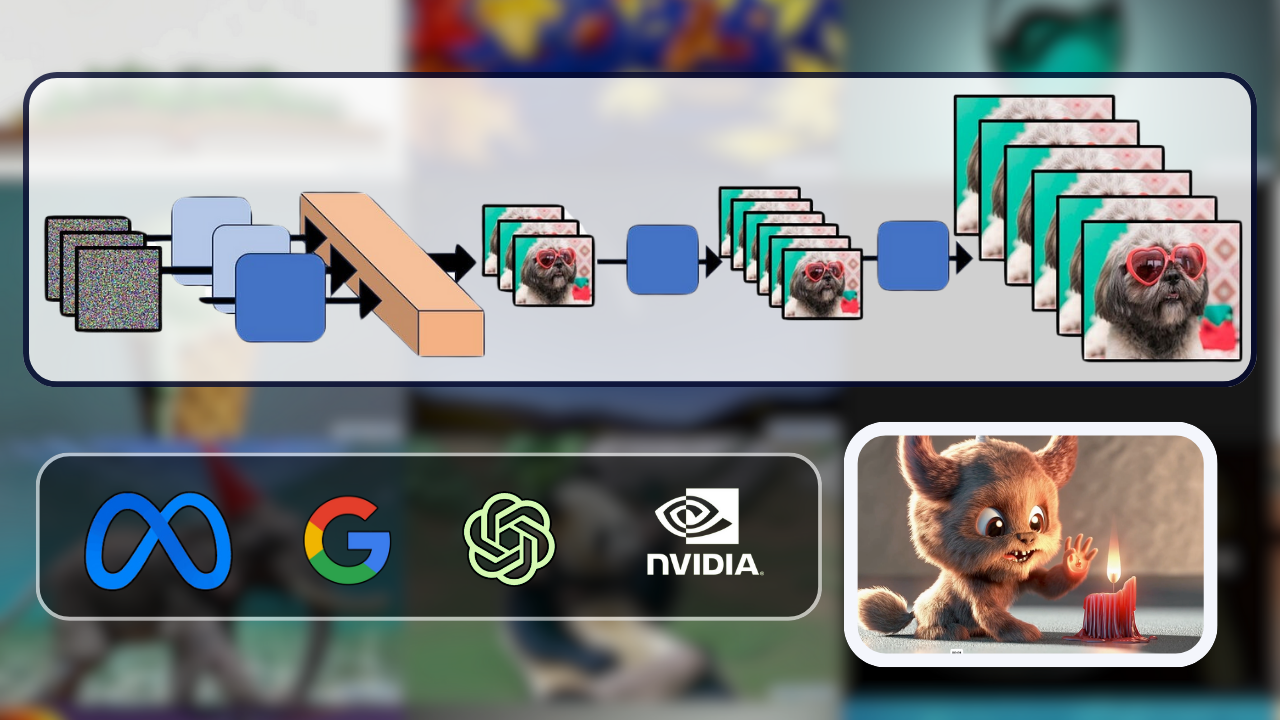 Let's learn Video Diffusion!
We've witnessed remarkable strides in AI image generation. But what happens when we add the dimension of time? Videos are moving images, after all.
Text-to-video generation is a complex task that requires AI to understand not just what things look like, but how they move and interact over time. It is an order of magnitude more complex than text-to-image.
To produce a coherent video, a neural network must:
- Comprehend the input prompt
- Understand how the world works
- Know how objects move and how physics applies
- Generate a sequence of frames that make sense spatially, temporally, and logically
Despite these challenges, today's diffusion neural networks are making impressive progress in this field. In this article, we will cover the main ideas behind video diffusion models - main challenges, approaches, and the seminal papers in the field.
Also, this article is based on this larger YouTube video I made. If you enjoy this read, you will enjoy watching the video too.
Learn this step by step with the interactive Machine Learning roadmap.
Text to Image Overview
To understand text-to-video generation, we need to start with its predecessor: text-to-image diffusion models. These models have a singular goal - to transform random noise and a text prompt into a coherent image. In general, all generative image models do this - Variational Autoencoders (VAE), Generative Adversarial Neural Nets (GANs), and yes, Diffusion too.
 The basic goal of all image generation models is to convert random noise into an image, often conditioned on additional conditioning prompts (like text). [Image by Author]
Diffusion, in particular, relies on a gradual denoising process to generate images.
- Start with a randomly generated noisy image
- Use a neural network to progressively remove noise
- Condition the denoising process on text input
- Repeat until a clear image emerges
 How Diffusion Models generate images - A neural network progressively removes noise from a pure noise image conditioned on a text prompt, eventually revealing a clear image. [Illustration by Author] (Image generated by a neural network)
But how are these denoising neural networks trained?
During training, we start with real images and progressively add noise to it in small steps - this is called forward diffusion. This generates a lot of samples of clear image and their slightly noisier versions. The neural network is then trained to reverse this process by inputting the noisy image and predicting how much noise to remove to retrieve the clearer version. In text-conditional models, we train attention layers to attend to the inputted prompt for guided denoising.
 During training, we add noise to clear images (left) - this is called Forward Diffusion. The neural network is trained to reverse this noise addition process - a process known as Reverse Diffusion. Images generated using a neural network. [Image by Author]
This iterative approach allows for the generation of highly detailed and diverse images. You can watch the following YouTube video where I explain text to image in much more detail - concepts like Forward and Reverse Diffusion, U-Net, CLIP models, and how I implemented them in Python and Pytorch from scratch.
Please accept cookies to access this content
If you are comfortable with the core concepts of Text-to-Image Conditional Diffusion, let's move to videos next.
The Temporal Dimension: A New Frontier
In theory, we could follow the same conditioned noise-removal idea to do text-to-video diffusion. However, adding time into the equation introduces several new challenges:
- Temporal Consistency: Ensuring objects, backgrounds, and motions remain coherent across frames.
- Computational Demands : Generating multiple frames per second instead of a single image.
- Data Scarcity : While large image-text datasets are readily available, high-quality video-text datasets are scarce.
 Some commonly used video-text datasets [Image by Author]
The Evolution of Video Diffusion
Because of the lack of high quality datasets, text-to-video cannot rely just on supervised training. And that is why people usually also combine two more data sources to train video diffusion models - one - paired image-text data , which is much more readily available, and two - unlabelled video data , which are super-abundant and contains lots of information about how the world works. Several groundbreaking models have emerged to tackle these challenges. Let's discuss some of the important milestone papers one by one.
_We are about to get into the technical nitty gritty!_If you find the material ahead difficult, feel free to watch this companion video as a visual side-by-side guide while reading the next section.
Please accept cookies to access this content
Video Diffusion Model (VDM) - 2022
VDM Uses a 3D U-Net architecture with factorized spatio-temporal convolution layers. Each term is explained in the picture below.
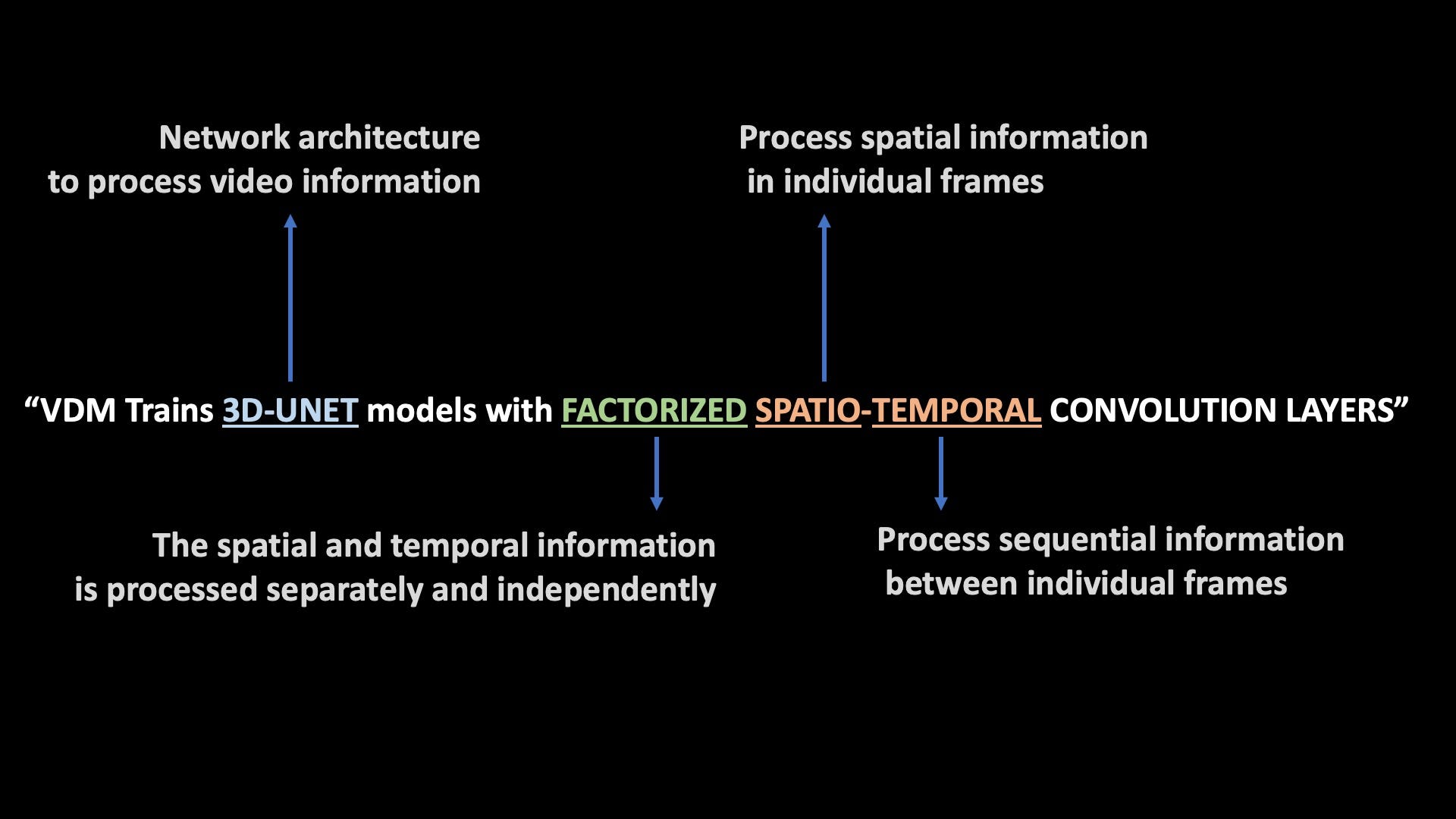 What each of the terms mean (Image by Author)
VDM is jointly trained on both image and video data. VDM replaces the 2D UNets from Image Diffusion models with 3D UNet models. The video is input into the model as a time sequence of 2D frames. The term Factorized basically means that the spatial and temporal layers are decoupled and processed separately from each other. This makes the computations much more efficient.
What is a 3D-UNet?
3D U-Net is a unique computer vision neural network that first downsamples the video through a series of these factorized spatio-temporal convolutional layers, basically extracting video features at different resolutions. Then, there is an upsampling path that expands the low-dimensional features back to the shape of the original video. While upsampling, skip connections are used to reuse the generated features during the downsampling path.
 The 3D Factorized UNet Architecture [Image by Author]
Remember in any convolutional neural network, the earlier layers always capture detailed information about local sections of the image, while latter layers pick up global level pattern by accessing larger sections - so by using skip connections, U-Net combines local details with global features to be a super-awesome network for feature learning and denoising.
VDM is jointly trained on paired image-text and video-text datasets. While it's a great proof of concept, VDM generates quite low-resolution videos for today's standards.
You can read more about VDM here.
Make-A-Video (Meta AI) - 2022
Make-A-Video by Meta AI takes the bold approach of claiming that we don't necessarily need labeled-video data to train video diffusion models. WHHAAA?! Yes, you read that right.
Adding temporal layers to Image Diffusion
Make A Video first trains a regular text-to-image diffusion model, just like Dall-E or Stable Diffusion with paired image-text data. Next, unsupervised learning is done on unlabelled video data to teach the model temporal relationships. The additional layers of the network are trained using a technique called masked spatio-temporal decoding, where the network learns to generate missing frames by processing the visible frames. Note that no labelled video data is needed in this pipeline (although further video-text fine-tuning is possible as an additional third step), because the model learns spatio-temporal relationships with paired text-image and raw unlabelled video data.
 Make-A-Video in a nutshell [Image by Author]
The video outputted by the above model is 64x64 with 16 frames. This video is then upsampled along the time and pixel axis using separate neural networks called Temporal Super Resolution or TSR (insert new frames between existing frames to increase frames-per-second (fps)), and Spatial Super Resolution or SSR (super-scale the individual frames of the video to be higher resolution). After these steps, Make-A-Video outputs 256x256 videos with 76 frames.
You can learn more about Make-A-Video right here.
Imagen Video (Google) - 2022
Imagen video employs a cascade of seven models for video generation and enhancement. The process starts with a base video generation model that creates low-resolution video clips. This is followed by a series of super-resolution models - three SSR (Spatial Super Resolution) models for spatial upscaling and three TSR (Temporal Super Resolution) models for temporal upscaling. This cascaded approach allows Imagen Video to generate high-quality, high-resolution videos with impressive temporal consistency. Generates high-quality, high-resolution videos with impressive temporal consistency
 The Imagen workflow [Source: Imagen paper: https://imagen.research.google/video/paper.pdf]
VideoLDM (NVIDIA) - 2023
Models like Nvidia's VideoLDM tries to address the temporal consistency issue by using latent diffusion modelling. First they train a latent diffusion image generator. The basic idea is to train a Variational Autoencoder or VAE. The VAE consists of an encoder network that can compress input frames into a low dimensional latent space and another decoder network that can reconstruct it back to the original images. The diffusion process is done entirely on this low dimensional space instead of the full pixel-space, making it much more computationally efficient and semantically powerful.
 A typical Autoencoder. The input frames are individually downsampled into a low dimensional compressed latent space. A Decoder network then learns to reconstruct the image back from this low resolution space. [Image by Author]
What are Latent Diffusion Models?
The diffusion model is trained entirely in the low dimensional latent space, i.e. the diffusion model learns to denoise the low dimensional latent space images instead of the full resolution frames. This is why we call it Latent Diffusion Models. The resulting latent space outputs is then pass through the VAE decoder to convert it back to pixel-space.
The decoder of the VAE is enhanced by adding new temporal layers in between it's spatial layers. These temporal layers are fine-tuned on video data, making the VAE produce temporally consistent and flicker-free videos from the latents generated by the image diffusion model. This is done by freezing the spatial layers of the decoder and adding new trainable temporal layers that are conditioned on previously generated frames.
 The VAE Decoder is finetuned with temporal information so that it can produce consistent videos from the latents generated by the Latent Diffusion Model (LDM) [Source: Video LDM Paper https://arxiv.org/abs/2304.08818]
You can learn more about Video LDMs here.
SORA (OpenAI) - 2024
While Video LDM compresses individual frames of the video to train an LDM, SORA compresses video both spatially and temporally. Recent papers like CogVideoX have demonstrated that 3D Causal VAEs are great at compressing videos making diffusion training computationally efficient, and able to generate flicker-free consistent videos.
 3D VAEs compress videos spatio-temporally to generate compressed 4D representations of video data [Image by Author]
Transformers for Diffusion
A transformer model is used as the diffusion network instead of the more traditional UNEt model. Of course, transformers need the input data to be presented as a sequence of tokens. That's why the compressed video encodings are flattened into a sequence of patches. Observe that each patch and its location in the sequence represents a spatio-temporal feature of the original video.
 OpenAI SORA Video Preprocessing [Source: OpenAI (https://openai.com/index/sora/)] (License: Free)
It is speculated that OpenAI has collected a rather large annotation dataset of video-text data which they are using to train conditional video generation models.
Combining all the strengths listed below, plus more tricks that the ironically-named OpenAI may never disclose, SORA promises to be a giant leap in video generation AI models.
- Massive video-text annotated dataset + pretraining techniques with image-text data and unlabelled data
- General architectures of Transformers
- Huge compute investment (thanks Microsoft)
- The representation power of Latent Diffusion Modeling.
What's next
The future of AI is easy to predict. In 2024, Data + Compute = Intelligence. Large corporations will invest computing resources to train large diffusion transformers. They will hire annotators to label high-quality video-text data. Large-scale text-video datasets probably already exist in the closed-source domain (looking at you OpenAI), and they may become open-source within the next 2–3 years, especially with recent advancements in AI video understanding. It remains to be seen if the upcoming huge computing and financial investments could on their own solve video generation. Or will further architectural and algorithmic advancements be needed from the research community?
Links
Author's Youtube Channel: https://www.youtube.com/@avb_fj
Video on this topic: https://youtu.be/KRTEOkYftUY
15-step Zero-to-Hero on Conditional Image Diffusion: https://youtu.be/w8YQc
Papers and Articles
Video Diffusion Models: https://arxiv.org/abs/2204.03458
Imagen: https://imagen.research.google/video/
Make A Video: https://makeavideo.studio/
Video LDM: https://research.nvidia.com/labs/toronto-ai/VideoLDM/index.html
CogVideoX: https://arxiv.org/abs/2408.06072
OpenAI SORA article: https://openai.com/index/sora/
Diffusion Transformers: https://arxiv.org/abs/2212.09748
Useful article: https://lilianweng.github.io/posts/2024-04-12-diffusion-video/
Register Now to Continue Reading
Unlock Towards Data Science with a Free Account
All articles on Towards Data Science are available to registered users. Create a free account today to access this article and thousands more.
Register for freeSign in to your account
 Written By
See all from Avishek Biswas
Computer VisionDeep LearningDiffusion ModelsGenerative AiText To Video
Share This Article
Towards Data Science is a community publication. Submit your insights to reach our global audience and earn through the TDS Author Payment Program.
Write for TDS
Related Articles
Artificial Intelligence
TensorDash - An app to remotely monitor your Machine Learning models
Arun
October 21, 20204 min read
Artificial Intelligence
The Mindset of an Elite Data Scientist
Kurtis Pykes
October 23, 20208 min read
Deep Learning
Understanding the obstacles that faces us when building deep neural networks
Kurtis Pykes
May 17, 20204 min read
Deep Learning
My argument against homemade solutions and an alternative proposal
Amine Elhattami
March 24, 20226 min read
Artificial Intelligence
An illustrated and intuitive guide on the inner workings of an RNN and the Softmax Activation Function
Shreya Rao
June 11, 202415 min read
Artificial Intelligence
Here's how to replicate the PowerPoint AI using Machine Learning and Python
Piero Paialunga
January 24, 20225 min read
Deep Learning
AI that can paint images
Nour Islam Mokhtari
December 6, 20214 min read
Artificial Intelligence
An intuitive guide to exploring design choices and technicalities of neural style transfer networks
Thushan Ganegedara
January 8, 201910 min read
Deep Learning
A step-by-step tutorial
Nicolo Cosimo Albanese
August 23, 20221 min read
Your home for data science and AI. The world's leading publication for data science, data analytics, data engineering, machine learning, and artificial intelligence professionals.
Subscribe to Our NewsletterWrite For TDS•About•Advertise•Privacy Policy•Terms of Use
© Insight Media Group, LLC 2026•The New Stack•roadmap.sh•Creator Network
Recommended Articles
Close