保留正文与补采附件。源页面当前未重新核验;具体限制见交付清单。
 We value your privacy
We use cookies to enhance your browsing experience, serve personalised ads or content, and analyse our traffic. By clicking "Accept All", you consent to our use of cookies.
Customise Reject All Accept All
Customise Consent Preferences
 We use cookies to help you navigate efficiently and perform certain functions. You will find detailed information about all cookies under each consent category below.
The cookies that are categorised as "Necessary" are stored on your browser as they are essential for enabling the basic functionalities of the site. ... Show more
NecessaryAlways Active
Necessary cookies are required to enable the basic features of this site, such as providing secure log-in or adjusting your consent preferences. These cookies do not store any personally identifiable data.
-
Cookie
BCTempID
-
Duration
10 minutes
-
Description
No description available.
-
Cookie
__cf_bm
-
Duration
1 hour
-
Description
This cookie, set by Cloudflare, is used to support Cloudflare Bot Management.
-
Cookie
AWSALBCORS
-
Duration
7 days
-
Description
Amazon Web Services set this cookie for load balancing.
-
Cookie
_cfuvid
-
Duration
session
-
Description
Cloudflare sets this cookie to track users across sessions to optimize user experience by maintaining session consistency and providing personalized services
-
Cookie
li_gc
-
Duration
6 months
-
Description
Linkedin set this cookie for storing visitor's consent regarding using cookies for non-essential purposes.
-
Cookie
__hssrc
-
Duration
session
-
Description
This cookie is set by Hubspot whenever it changes the session cookie. The __hssrc cookie set to 1 indicates that the user has restarted the browser, and if the cookie does not exist, it is assumed to be a new session.
-
Cookie
__hssc
-
Duration
1 hour
-
Description
HubSpot sets this cookie to keep track of sessions and to determine if HubSpot should increment the session number and timestamps in the __hstc cookie.
-
Cookie
wpEmojiSettingsSupports
-
Duration
session
-
Description
WordPress sets this cookie when a user interacts with emojis on a WordPress site. It helps determine if the user's browser can display emojis properly.
-
Cookie
BCSessionID
-
Duration
1 year 1 month 4 days
-
Description
Blueconic sets this cookie as a unique identifier for the BlueConic profile.
-
Cookie
_octo
-
Duration
1 year
-
Description
No description available.
-
Cookie
logged_in
-
Duration
1 year
-
Description
No description available.
-
Cookie
__Secure-YEC
-
Duration
past
-
Description
YouTube sets this cookie to stores the user's video player preferences using embedded YouTube video
-
Cookie
__eoi
-
Duration
6 months
-
Description
Description is currently not available.
-
Cookie
AWSALBTGCORS
-
Duration
7 days
-
Description
No description available.
-
Cookie
login-status-p
-
Duration
past
-
Description
Description is currently not available.
-
Cookie
AWSALBTG
-
Duration
7 days
-
Description
No description available.
-
Cookie
csrf_token
-
Duration
session
-
Description
No description available.
-
Cookie
token_v2
-
Duration
1 day
-
Description
Description is currently not available.
-
Cookie
D
-
Duration
1 year
-
Description
Description is currently not available.
-
Cookie
PHPSESSID
-
Duration
session
-
Description
This cookie is native to PHP applications. The cookie stores and identifies a user's unique session ID to manage user sessions on the website. The cookie is a session cookie and will be deleted when all the browser windows are closed.
-
Cookie
VISITOR_PRIVACY_METADATA
-
Duration
6 months
-
Description
YouTube sets this cookie to store the user's cookie consent state for the current domain.
-
Cookie
cookietest
-
Duration
session
-
Description
The cookietest cookie is typically used to determine whether the user's browser accepts cookies, essential for website functionality and user experience.
-
Cookie
__Host-airtable-session
-
Duration
1 year
-
Description
This cookie is used to enable us to integrate the services of Airtable.
-
Cookie
__Host-airtable-session.sig
-
Duration
1 year
-
Description
This cookie is used to enable us to integrate the services of Airtable.
-
Cookie
m
-
Duration
1 year 1 month 4 days
-
Description
Stripe sets this cookie for fraud prevention purposes. It identifies the device used to access the website, allowing the website to be formatted accordingly.
-
Cookie
BIGipServer*
-
Duration
session
-
Description
Marketo sets this cookie to collect information about the user's online activity and build a profile about their interests to provide advertisements relevant to the user.
-
Cookie
__cfruid
-
Duration
session
-
Description
Cloudflare sets this cookie to identify trusted web traffic.
-
Cookie
_GRECAPTCHA
-
Duration
6 months
-
Description
Google Recaptcha service sets this cookie to identify bots to protect the website against malicious spam attacks.
-
Cookie
__Secure-YNID
-
Duration
6 months
-
Description
Google cookie used to protect user security and prevent fraud, especially during the login process.
-
Cookie
cookieyes-consent
-
Duration
1 year
-
Description
CookieYes sets this cookie to remember users' consent preferences so that their preferences are respected on subsequent visits to this site. It does not collect or store any personal information about the site visitors.
Functional
Functional cookies help perform certain functionalities like sharing the content of the website on social media platforms, collecting feedback, and other third-party features.
-
Cookie
lidc
-
Duration
1 day
-
Description
LinkedIn sets the lidc cookie to facilitate data center selection.
-
Cookie
brw
-
Duration
1 year
-
Description
No description available.
-
Cookie
brwConsent
-
Duration
5 minutes
-
Description
Description is currently not available.
-
Cookie
WMF-Uniq
-
Duration
1 year
-
Description
Description is currently not available.
-
Cookie
loom_anon_comment
-
Duration
1 year
-
Description
No description available.
-
Cookie
loom_referral_video
-
Duration
session
-
Description
Description is currently not available.
-
Cookie
VISITOR_INFO1_LIVE
-
Duration
6 months
-
Description
A cookie set by YouTube to measure bandwidth that determines whether the user gets the new or old player interface.
-
Cookie
yt-remote-connected-devices
-
Duration
Never Expires
-
Description
YouTube sets this cookie to store the user's video preferences using embedded YouTube videos.
-
Cookie
ytidb::LAST_RESULT_ENTRY_KEY
-
Duration
Never Expires
-
Description
The cookie ytidb::LAST_RESULT_ENTRY_KEY is used by YouTube to store the last search result entry that was clicked by the user. This information is used to improve the user experience by providing more relevant search results in the future.
-
Cookie
yt-remote-device-id
-
Duration
Never Expires
-
Description
YouTube sets this cookie to store the user's video preferences using embedded YouTube videos.
-
Cookie
yt-remote-session-name
-
Duration
session
-
Description
The yt-remote-session-name cookie is used by YouTube to store the user's video player preferences using embedded YouTube video.
-
Cookie
yt-remote-fast-check-period
-
Duration
session
-
Description
The yt-remote-fast-check-period cookie is used by YouTube to store the user's video player preferences for embedded YouTube videos.
-
Cookie
yt-remote-session-app
-
Duration
session
-
Description
The yt-remote-session-app cookie is used by YouTube to store user preferences and information about the interface of the embedded YouTube video player.
-
Cookie
yt-remote-cast-available
-
Duration
session
-
Description
The yt-remote-cast-available cookie is used to store the user's preferences regarding whether casting is available on their YouTube video player.
-
Cookie
yt-remote-cast-installed
-
Duration
session
-
Description
The yt-remote-cast-installed cookie is used to store the user's video player preferences using embedded YouTube video.
-
Cookie
cp_session
-
Duration
3 months
-
Description
Codepen sets this cookie for Help systems found in the website.
-
Cookie
loid
-
Duration
1 year 1 month 4 days
-
Description
This cookie is set by the Reddit. The cookie enables the sharing of content from the website onto the social media platform.
Analytics
Analytical cookies are used to understand how visitors interact with the website. These cookies help provide information on metrics such as the number of visitors, bounce rate, traffic source, etc.
-
Cookie
__hstc
-
Duration
6 months
-
Description
Hubspot set this main cookie for tracking visitors. It contains the domain, initial timestamp (first visit), last timestamp (last visit), current timestamp (this visit), and session number (increments for each subsequent session).
-
Cookie
hubspotutk
-
Duration
6 months
-
Description
HubSpot sets this cookie to keep track of the visitors to the website. This cookie is passed to HubSpot on form submission and used when deduplicating contacts.
-
Cookie
_ga
-
Duration
1 year 1 month 4 days
-
Description
Google Analytics sets this cookie to calculate visitor, session and campaign data and track site usage for the site's analytics report. The cookie stores information anonymously and assigns a randomly generated number to recognise unique visitors.
-
Cookie
ga*
-
Duration
1 year 1 month 4 days
-
Description
Google Analytics sets this cookie to store and count page views.
-
Cookie
__Host-psifi.analyticsTrace
-
Duration
6 hours
-
Description
Description is currently not available.
-
Cookie
__Host-psifi.analyticsTraceV2
-
Duration
6 hours
-
Description
Description is currently not available.
-
Cookie
_gh_sess
-
Duration
session
-
Description
GitHub sets this cookie for temporary application and framework state between pages like what step the user is on in a multiple step form.
-
Cookie
YSC
-
Duration
session
-
Description
YSC cookie is set by Youtube and is used to track the views of embedded videos on Youtube pages.
-
Cookie
ajs_anonymous_id
-
Duration
1 year
-
Description
This cookie is set by Segment to count the number of people who visit a certain site by tracking if they have visited before.
-
Cookie
vuid
-
Duration
1 year 1 month 4 days
-
Description
Vimeo installs this cookie to collect tracking information by setting a unique ID to embed videos on the website.
Performance
Performance cookies are used to understand and analyse the key performance indexes of the website which helps in delivering a better user experience for the visitors.
-
Cookie
AWSALB
-
Duration
7 days
-
Description
AWSALB is an application load balancer cookie set by Amazon Web Services to map the session to the target.
-
Cookie
acq
-
Duration
past
-
Description
Description is currently not available.
-
Cookie
acq.sig
-
Duration
past
-
Description
Description is currently not available.
-
Cookie
ptc
-
Duration
2 years
-
Description
No description available.
Advertisement
Advertisement cookies are used to provide visitors with customised advertisements based on the pages you visited previously and to analyse the effectiveness of the ad campaigns.
-
Cookie
muc_ads
-
Duration
1 year 1 month 4 days
-
Description
Twitter sets this cookie to collect user behaviour and interaction data to optimize the website.
-
Cookie
guest_id_marketing
-
Duration
1 year 1 month 4 days
-
Description
Twitter sets this cookie to identify and track the website visitor.
-
Cookie
guest_id_ads
-
Duration
1 year 1 month 4 days
-
Description
Twitter sets this cookie to identify and track the website visitor.
-
Cookie
personalization_id
-
Duration
1 year 1 month 4 days
-
Description
Twitter sets this cookie to integrate and share features for social media and also store information about how the user uses the website, for tracking and targeting.
-
Cookie
guest_id
-
Duration
1 year 1 month 4 days
-
Description
Twitter sets this cookie to identify and track the website visitor. It registers if a user is signed in to the Twitter platform and collects information about ad preferences.
-
Cookie
bcookie
-
Duration
1 year
-
Description
LinkedIn sets this cookie from LinkedIn share buttons and ad tags to recognize browser IDs.
-
Cookie
__Secure-ROLLOUT_TOKEN
-
Duration
6 months
-
Description
YouTube sets this cookie to manage feature rollout and experimentation. It helps Google control which new features or interface changes are shown to users as part of testing and staged rollouts, ensuring consistent experience for a given user during an experiment.
-
Cookie
yt.innertube::nextId
-
Duration
Never Expires
-
Description
YouTube sets this cookie to register a unique ID to store data on what videos from YouTube the user has seen.
-
Cookie
yt.innertube::requests
-
Duration
Never Expires
-
Description
YouTube sets this cookie to register a unique ID to store data on what videos from YouTube the user has seen.
-
Cookie
session_tracker
-
Duration
session
-
Description
This cookie is set by the Reddit. This cookie is used to identify trusted web traffic. It also helps in adverstising on the website.
-
Cookie
edgebucket
-
Duration
session
-
Description
Reddit sets this cookie to save the information about a log-on Reddit user, for the purpose of advertisement recommendations and updating the content.
-
Cookie
did
-
Duration
1 year
-
Description
Arbor sets this cookie to show targeted ads to site visitors.This cookie expires after 2 months or 1 year.
Uncategorised
Other uncategorised cookies are those that are being analysed and have not been classified into a category as yet.
No cookies to display.
Reject All Save My Preferences Accept All
Toggle SearchToggle Mobile Navigation
Publish AI, ML & data-science insights to a global community of data professionals.
Sign inSubmit an Article
LatestEditor's PicksNewsletterShipAI
Write For TDS
LinkedInXToggle Search
Data Science
Bigram Word Cloud Animates Your Data Stories
Hands-on tutorial explaining how to create an Animated Word Cloud of bigram frequencies to display a text dataset in an MP4 video
Petr Koráb
May 8, 20245 min read
Hands-on tutorial explaining how to create an Animated Word Cloud of bigram frequencies to display a text dataset in an MP4 video
 Source: AnimatedWordCloud library. Image by Author.
Animated word cloud displays n-gram frequencies (words and consequent words in a text corpus) over time as a sequence of images in a video file. **** I** tgives greater importance to words that appear more frequently in a source text, but it scales the dataset to work with different datasets. The original visualization method uses the intuitive logic of classicword cloudsand adds a time dimension to the graph. It has been designed to explore text datasets collected over multiple periods (referred to as __ "time-series text data"**).
Michael Kane developed the core framework for animating word frequencies, and the AnimatedWordCloud (AWC) library implemented the visualization method into practice. __ The new release brings important updates:
- data scaling : it now works better with text datasets of different sizes and word frequencies
- extending the _n gram parameter ( = 2) to generate bigram word clouds
- efficiency improvements (saving now 220 frames for each period, improved Y axis, etc.).
This article will give a glimpse of how to create a bigram-animated word cloud from a text dataset of product reviews. Read my main framework and unigram tutorials to learn more about animated word clouds.
2. Use cases
Earlier releases of the AWC were already used to tell the stories of:
- Economic research trends : research published in A-class Economics journals since 1900.
Please accept cookies to access this content
- European Central Bank (ECB) communication : public speeches of economists and researchers of the ECB since the Eurozone launch.
Please accept cookies to access this content
3. Bigram Animated Word Cloud
3.1. How to install the library
Install the library in a new Python 3.8 virtual environment to avoid dependence conflicts. It relies on Python 3.8 because of its visualization requirements. To install using pip, use:
python
pip install AnimatedWordCloud
3.2. Data
For the AWC bigram exercise, we'll use the Amazon Dog Food Reviews dataset from the Hugging Face , released under the Apache-2.0 license. The example subset covers 305 reviews from 2020-01-01 to 2021-04-16 and can be downloaded from here.
Here is what the data looks like:
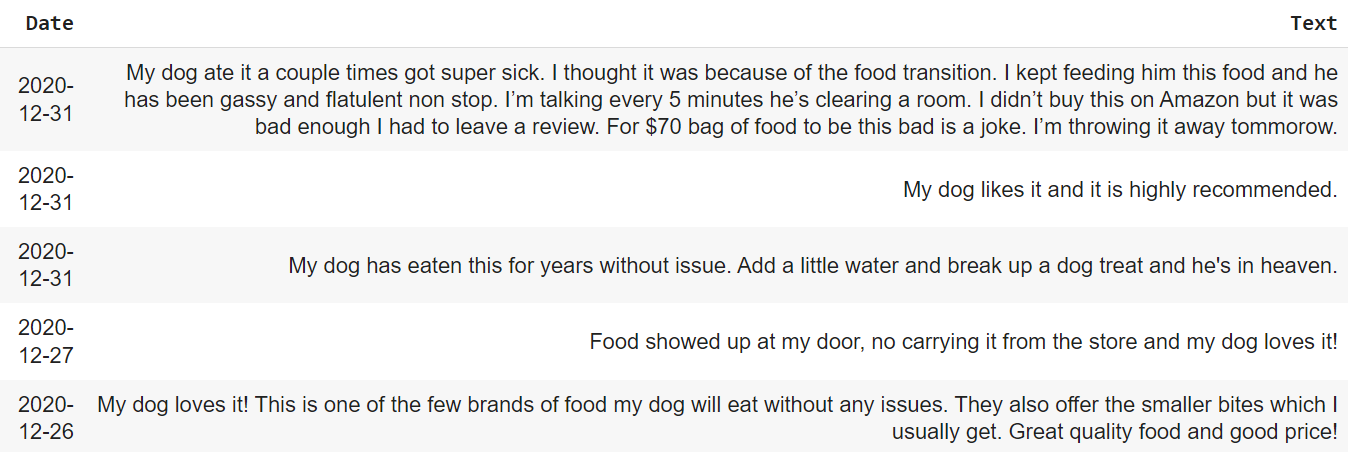 Image 3. Amazon dog food reviews dataset
3.3. Product review analysis
Product reviews are very useful sources of information for companies because they contain qualitative information about the customers' satisfaction with products (or services).
Text mining analysis can reveal bigrams with positive and negative meanings , and also bigrams that indicate important factors of product satisfaction. Read my previous TDS article about customer satisfaction measurement with n-gram and sentiment analysis to learn more.
Finding a high frequency of bigrams with positive meanings, e.g., "highly satisfied", "fast delivery," or "great service" and bigrams with negative meanings, e.g., "poor quality" or "damaged products" might indicate import problems hampering the company's growth.
Now, let's generate a Bigram animated word cloud for the text reviews in monthly frequency , cleaning data from English stopwords and also cutting out other redundant strings ('years old', 'year old', 'every day', 'Amazon'):
The code creates 200 PNG word cloud images per period. The frames are stored in the working directory in the newly created _.post processing/frames folder.
Next, download the ffmpeg folder and the frames2video.bat file from here and place them into the postprocessing folder. Running the frames2video.bat generates a wordSwarmOut.mp4 video file. The video is on my YouTube:
Please accept cookies to access this content
The brand associated with the reviews appears to be Blue Buffalo. We can see large frequencies of bigrams with positive meanings - "dog loves ", "dog likes ", and "love food " until Oct 2020. The associated qualities are price ("good price ") and product quality ("life protection ").
Since Dec 2020, there seem to be negative health effects of the products ("bloody vomit ", "vomit stool, " "heart disease ," "vomiting diarrhea "). In this situation, the company should check the production line and the delivery process to find out the reasons.
Conclusions
Animated Word Cloud is an original text visualization method for datasets with time variability. The library is a result of applied text-mining research. Originally developed by Michael Kane, the Python implementation relies on the preprocessing of the Arabica library, which is now forthcoming in the Journal of Open Source Software (Koráb, Poměnková, 2024).
The library is still under development. Let's mention several drawbacks of using the AWC for time-series text visualization:
- Every video generation is a random visualization exercise. This means that:
Color, word positions, and other parameters are generated for each trial . In certain trials, the words might overlap, lowering the quality of the data story. Therefore, it is helpful to create a couple of videos, compare the visuals, and select the nicest one.
- The video keeps relative differences in n-gram frequencies over the whole time period. However, it is scaled by several constants to work with different types of text datasets.
The library has been tested and optimized to work with datasets of various sizes, periods, and word frequencies, but it is still under development. If you find any visualization issues that hamper the video quality, please open an issue here to get it improved.
- The skip parameter cuts out raw strings but not tokens. Consider adding another preprocessing step if the text dataset is just too noisy.
Skip removes strings as they are and does not consider tokenization of the dataset. Removing strings such as "Mar" might lead to a bias because a bigram "Mario Braghi" then might become "io Braghi". In practical situations, it is useful to use the skip parameter to remove complicated strings such as:_skip = ['https://1236578995.org/@789', '@JaayZen/']_
If you enjoy my work, you can invite me for coffee and support my writing. You can also subscribe to my email list to get notified about my new articles. Thanks!
References
[1] Koráb, & Poměnková. (2024). Arabica: A Python package for exploratory analysis of text data. Journal of Open Source Software, 9(97), 6186. https://doi.org/10.21105/joss.06186.
Register Now to Continue Reading
Unlock Towards Data Science with a Free Account
All articles on Towards Data Science are available to registered users. Create a free account today to access this article and thousands more.
Register for freeSign in to your account
 Written By
See all from Petr Koráb
Animated Word CloudData SciencePythonText MiningWord Cloud
Share This Article
Towards Data Science is a community publication. Submit your insights to reach our global audience and earn through the TDS Author Payment Program.
Write for TDS
Related Articles
Machine Learning
Let's get the basics covered. Source code included.
Dario Radečić
March 26, 20206 min read
Data Science
Tips/Resources for making the career change in your Undergraduate After spending two years as a...
Ram Vegiraju
June 2, 20216 min read
Machine Learning
Naively choosing the best number for all of your prediction
Samy Baladram
September 25, 20247 min read
Artificial Intelligence
How much difference does $10 make? We did the tests. You do the reading.
Dario Radečić
May 20, 20205 min read
Data Science
Learning the basics of XML and how to deal with it in Python
Niklas Lang
August 20, 20225 min read
Machine Learning
How intuition can help make us better data scientists
Brandon Cosley
August 16, 20215 min read
Machine Learning
An in-depth approach on how Yemego NGO uses machine learning techniques to improve donations
Jindu Kwentua
August 13, 20218 min read
Data Science
Reading pdf file, utilizing regular expressions, exporting to Excel and Word document, and converting it back to pdf format
Himalaya Bir Shrestha
January 25, 202310 min read
Machine Learning
In this exclusive interview, Apache Pig spoke about his role in the Hadoop ecosystem and elaborated on his use cases and his differences...
Meraldo Antonio
September 24, 201915 min read
Your home for data science and AI. The world's leading publication for data science, data analytics, data engineering, machine learning, and artificial intelligence professionals.
Subscribe to Our NewsletterWrite For TDS•About•Advertise•Privacy Policy•Terms of Use
© Insight Media Group, LLC 2026•The New Stack•roadmap.sh•Creator Network
Recommended Articles
Close