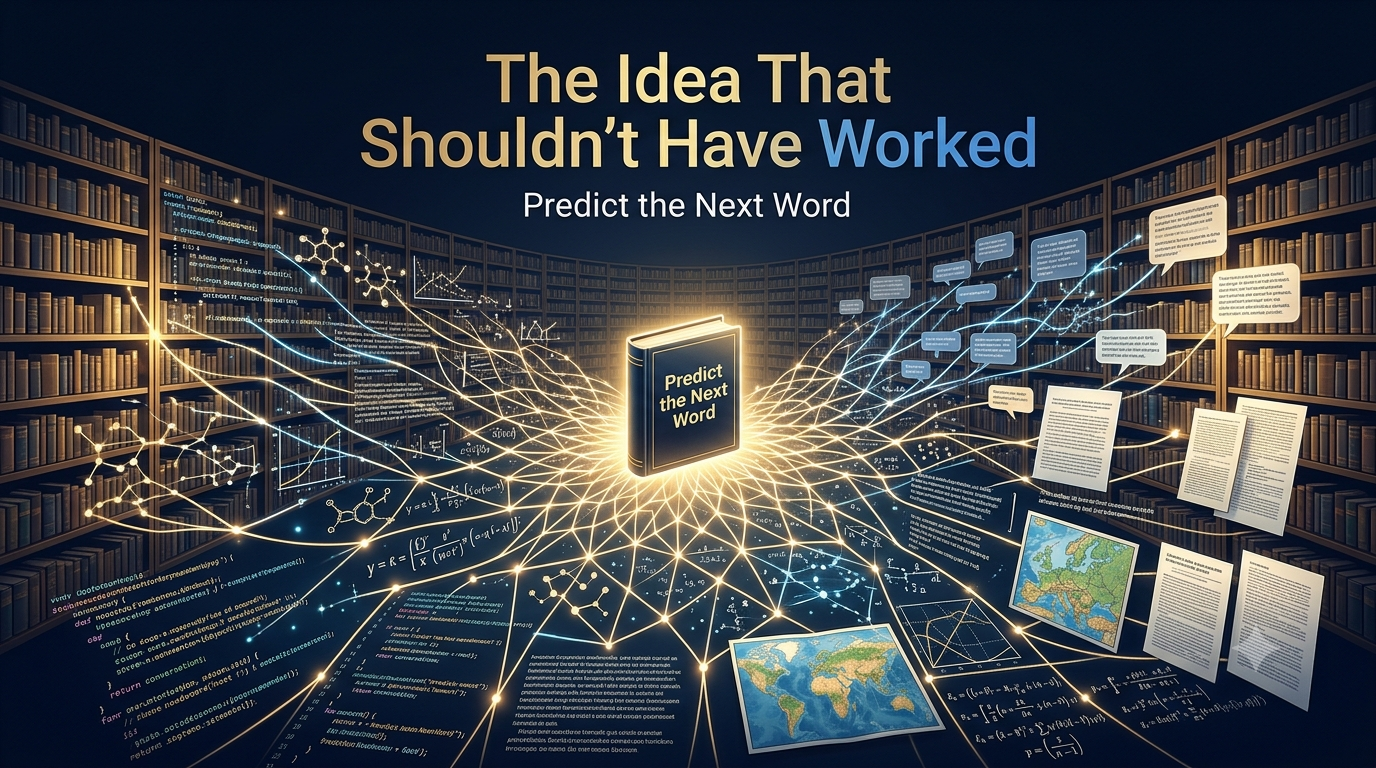
One of the most powerful technologies in history is built on an idea that sounds almost absurd: predict the next word. So how did that simple objective lead to coding assistants, AI tutors, and ChatGPT?
One of the most influential technologies of our time is built on an idea that sounds almost absurdly simple. GPT, ChatGPT, Claude, Gemini, and most modern language models are fundamentally trained to do one thing: predict what comes next. Somehow, that humble objective became the foundation of an AI revolution.
When people first learn how modern language models work, their reaction is often disbelief.
After hearing stories about ChatGPT writing code, explaining scientific concepts, generating business plans, translating languages, and helping students understand complex topics, most people expect an equally complicated explanation of how it all works.
Instead, they are told something surprisingly mundane:
Large Language Models are trained to predict the next word.
That's it.
No giant database of handcrafted rules. No team of linguists manually teaching the model grammar. No engineers encoding every fact about the world into software.
Just prediction.
For many people, that explanation feels incomplete. It sounds less like a revolutionary breakthrough and more like a clever autocomplete feature. In fact, one of the most common dismissals of language models is that they are "just predicting the next word."
Yet there is something fascinating hidden in that criticism.
The sentence is technically correct, and at the same time, it completely misses the point.
The history of technology is filled with ideas that sounded surprisingly simple when reduced to a single sentence. The internet is "just computers exchanging information." Search engines are "just finding relevant documents." GPS is "just calculating position."
The simplification is not wrong; it is simply incomplete.
Next-word prediction belongs in the same category.
The deeper I explored how language models work, the more I became convinced that the surprising thing isn't that next-word prediction succeeded.
The surprising thing is how much information was hidden inside language all along.
The comparison between language models and autocomplete isn't entirely unfair.
When ChatGPT generates a response, it is not retrieving a finished answer from a hidden database. It does not secretly possess paragraphs of text waiting to be copied and pasted into your conversation.
Instead, it generates responses one token at a time. Given some input text, it predicts the most likely next token.
Then it predicts another.
And another.
Those individual predictions accumulate into sentences, paragraphs, explanations, essays, and conversations.
At a superficial level, the process resembles autocomplete. The problem is that people often underestimate how difficult prediction becomes when the amount of context grows.
Predicting the final word in:
The capital of France is ______
may seem simple.
Predicting the next paragraph in a technical discussion about distributed systems, quantum mechanics, or neural network architectures is a completely different challenge.
To do that effectively, a model must capture an enormous amount of information about language and the world that language describes.
The distinction is similar to saying a chess grandmaster is "just moving pieces on a board."
Technically true, wildly incomplete.
What matters is not the action itself. What matters is the understanding required to perform that action well.
Consider the sentence:
The Eiffel Tower is located in ______.
Most people immediately answer:
Paris.
At first glance, this appears to be a language task. But is it really?
To generate the correct answer, you need far more than knowledge of English grammar.
You need to know that the Eiffel Tower exists. You need to know where it is located. You need some understanding of geography, landmarks, and how language refers to places.
In other words, the challenge is not primarily linguistic.
It is factual.
Now consider a different example:
The patient was given an umbrella because it was about to ______.
Most people naturally complete the sentence with a word like "rain." Again, grammar alone isn't enough, the sentence requires common sense. It requires an understanding of weather, human behavior, and cause-and-effect relationships.
This observation reveals something important. Many prediction problems are actually hidden reasoning problems. The word itself is often the easy part. Understanding why that word belongs there is where the real difficulty lies.
If a model wants to become exceptionally good at prediction, it cannot merely memorize vocabulary. It must learn the underlying patterns that generate language in the first place. And those patterns are deeply connected to how humans understand reality.
One metaphor I keep returning to is the idea that every sentence is a puzzle.
Some puzzles are easy; others are surprisingly difficult.
Sometimes the missing piece is grammar. Sometimes it is factual knowledge. Sometimes it is common sense. Sometimes it requires understanding relationships between multiple ideas. And occasionally it requires all of them at the same time.
For example:
Einstein developed the theory of ______.
The answer may appear obvious.
Yet producing the correct word requires connections between history, physics, language, and scientific knowledge.
The model is not simply predicting a sequence of characters, it is navigating a network of concepts.
The better it becomes at building and traversing that network, the better its predictions become.
From this perspective, language modelling starts looking less like autocomplete and more like detective work.
Every word that appears in a sentence is a clue and the model's job is to examine those clues and infer what should come next. The quality of the prediction depends on how well the model understands the relationships hidden beneath the surface.
The turning point in my understanding came when I stopped thinking about language as a collection of words and started thinking about it as a storage medium.
Humanity records almost everything in language.
Scientific discoveries become research papers.
Engineering lessons become documentation.
Historical events become records.
Arguments become essays.
Experiences become stories.
Knowledge becomes text.
Over centuries, humans have built a vast archive of information encoded in language. A modern language model is trained on portions of that archive. That's a profound idea. Because it means the model isn't merely interacting with words. It is interacting with the compressed representation of human knowledge itself.
Every scientific concept. Every programming tutorial. Every philosophical argument. Every historical explanation. Every mathematical insight.
All represented through language.
What makes this fascinating is that language contains far more than facts.
Language contains relationships. Patterns. Reasoning processes. Explanations. Analogies. Ways of thinking.
When people explain how they solve problems, those reasoning patterns become part of the text.
When researchers publish papers, their problem-solving approaches become part of the text.
When programmers explain code, their engineering thought processes become part of the text.
Language is not merely a collection of words, it is humanity thinking out loud.
Imagine placing a student inside the largest library in human history.
The student is not allowed to ask questions. There are no teachers. There are no lectures. Instead, the student receives a strange assignment:
Read everything and predict how every unfinished sentence ends.
At first, this sounds like a language exercise. Yet over time, something unexpected begins to happen. The student starts learning history because history appears in the books.
They learn geography because geography appears in the books. They learn mathematics because mathematics appears in the books. They learn programming because programming appears in the books.
The assignment never changes, but the student gradually absorbs knowledge from the material.
The objective is prediction, the outcome is learning.
This thought experiment captures something essential about language models.
GPT was not separately trained to become a historian. It encountered historical texts. It was not separately trained to become a programmer. It encountered programming discussions. It was not separately trained to become an explainer of scientific concepts. It encountered explanations of scientific concepts.
The capabilities emerge because the underlying material contains those capabilities in encoded form.
The objective remains the same throughout the process. The consequences become increasingly surprising.
Perhaps the most important lesson from modern AI is that scale matters.
A lot.
A small language model learns some patterns. A larger language model learns more patterns. An even larger model begins discovering relationships between patterns.
As researchers increased model size, training data, and computational resources, something interesting happened.
Performance kept improving.
Tasks that once seemed impossible gradually became achievable. Capabilities that nobody explicitly planned for started appearing. This was deeply surprising to many researchers.
Historically, AI progress often depended on inventing new algorithms.
The expectation was that dramatic improvements would require dramatic breakthroughs. Instead, researchers discovered that scaling existing ideas produced extraordinary results.
The same objective remained in place.
The models simply became larger, saw more data, and received more computation. The implications of this discovery continue to shape the entire AI industry today.
This is where the story becomes genuinely strange. Researchers trained models to predict text.
Yet those models gradually became capable of:
Summarizing documents.
Answering questions.
Translating languages.
Generating software.
Explaining concepts.
Brainstorming ideas.
Producing creative writing.
While many of these capabilities can be explained through patterns in training data, their breadth surprised researchers.
It felt as though the models were doing far more than the objective suggested.
This gave rise to discussions around emergent abilities.
The term remains debated, but the observation itself is difficult to ignore. The capabilities of modern language models appear significantly broader than what most people would intuitively expect from next-token prediction.
The objective never changed. The models did.
And as they grew, our assumptions about what prediction could accomplish changed as well.
No discussion of language models is complete without addressing the obvious question.
Do these systems actually understand anything?
The answer depends largely on how one defines understanding.
Some researchers argue that language models are sophisticated pattern-matching systems operating at unprecedented scale. Others argue that the internal representations learned by these models constitute a meaningful form of understanding.
Reasonable arguments exist on both sides.
Personally, I find the debate interesting but not central to the larger story. Regardless of terminology, something significant has happened.
A prediction system trained on language has developed capabilities that many researchers once believed required fundamentally different approaches.
Whether we call that understanding, abstraction, representation learning, simulation, or advanced pattern recognition, the outcome remains remarkable.
The labels may change, the achievement does not.
The story of next-word prediction contains a lesson that extends beyond artificial intelligence.
Many transformative technologies begin as ideas that sound underwhelming when summarized in a sentence.
The original objective behind modern language models can be expressed very simply:
Predict what comes next.
No grand plan to build AI tutors. No blueprint for creating coding assistants. No roadmap for developing digital coworkers.
Just prediction.
Yet hidden within that objective was something extraordinary.
Every document carried knowledge. Every book carried ideas. Every research paper carried insight. Every explanation carried reasoning. Every conversation carried evidence of how humans think.
The world turned out to be encoded in language more deeply than most of us had imagined.
Perhaps that is the real discovery. Perhaps the surprising thing is not that next-word prediction worked. Perhaps the surprising thing is that language contained enough information to make it possible.
What appeared to be a language task turned out to be an invitation to learn from humanity's collective knowledge.
And once enough data, compute, and scale were applied to that invitation, the results reshaped our expectations of what machines could do.
When people first hear that ChatGPT and modern language models are trained to predict the next word, they often react with disappointment.
Surely there must be something more.
In a sense, there is. Not because the training objective is more complicated than it appears. But because language itself is more complicated than it appears.
Every sentence carries information. Every document carries knowledge. Every explanation carries traces of human reasoning.
The remarkable achievement of modern AI is not merely that it predicts words. It is that in the process of predicting words, it learned enough about language to unlock something far greater.
The objective never changed, our understanding of what that objective could achieve did.
If someone had told you ten years ago that predicting the next word would eventually lead to coding assistants, AI tutors, research assistants, and conversational agents, would you have believed them?
Or does the success of language models still feel a little surprising?
I'd love to hear your thoughts.
Brown, T. B., et al. (2020). Language Models are Few-Shot Learners. OpenAI.
https://arxiv.org/abs/2005.14165
Radford, A., et al. (2018). Improving Language Understanding by Generative Pre-Training. OpenAI.
https://cdn.openai.com/research-covers/language-unsupervised/language\_understanding\_paper.pdf
Vaswani, A., et al. (2017). Attention Is All You Need.
https://arxiv.org/abs/1706.03762
OpenAI. Improving Language Understanding with Unsupervised Learning.
https://openai.com/index/language-unsupervised/
Kaplan, J., et al. (2020). Scaling Laws for Neural Language Models.
https://arxiv.org/abs/2001.08361
I'm an AI Engineer building enterprise AI systems and documenting what works, what breaks, and what I've learned along the way.
If you're interested in AI agents, GenAI, RAG systems, and practical AI engineering, consider following for future articles.