保留正文与补采附件。源页面当前未重新核验;具体限制见交付清单。
 We value your privacy
We use cookies to enhance your browsing experience, serve personalised ads or content, and analyse our traffic. By clicking "Accept All", you consent to our use of cookies.
Customise Reject All Accept All
Customise Consent Preferences
 We use cookies to help you navigate efficiently and perform certain functions. You will find detailed information about all cookies under each consent category below.
The cookies that are categorised as "Necessary" are stored on your browser as they are essential for enabling the basic functionalities of the site. ... Show more
NecessaryAlways Active
Necessary cookies are required to enable the basic features of this site, such as providing secure log-in or adjusting your consent preferences. These cookies do not store any personally identifiable data.
-
Cookie
BCTempID
-
Duration
10 minutes
-
Description
No description available.
-
Cookie
__cf_bm
-
Duration
1 hour
-
Description
This cookie, set by Cloudflare, is used to support Cloudflare Bot Management.
-
Cookie
AWSALBCORS
-
Duration
7 days
-
Description
Amazon Web Services set this cookie for load balancing.
-
Cookie
_cfuvid
-
Duration
session
-
Description
Cloudflare sets this cookie to track users across sessions to optimize user experience by maintaining session consistency and providing personalized services
-
Cookie
li_gc
-
Duration
6 months
-
Description
Linkedin set this cookie for storing visitor's consent regarding using cookies for non-essential purposes.
-
Cookie
__hssrc
-
Duration
session
-
Description
This cookie is set by Hubspot whenever it changes the session cookie. The __hssrc cookie set to 1 indicates that the user has restarted the browser, and if the cookie does not exist, it is assumed to be a new session.
-
Cookie
__hssc
-
Duration
1 hour
-
Description
HubSpot sets this cookie to keep track of sessions and to determine if HubSpot should increment the session number and timestamps in the __hstc cookie.
-
Cookie
wpEmojiSettingsSupports
-
Duration
session
-
Description
WordPress sets this cookie when a user interacts with emojis on a WordPress site. It helps determine if the user's browser can display emojis properly.
-
Cookie
BCSessionID
-
Duration
1 year 1 month 4 days
-
Description
Blueconic sets this cookie as a unique identifier for the BlueConic profile.
-
Cookie
_octo
-
Duration
1 year
-
Description
No description available.
-
Cookie
logged_in
-
Duration
1 year
-
Description
No description available.
-
Cookie
__Secure-YEC
-
Duration
past
-
Description
YouTube sets this cookie to stores the user's video player preferences using embedded YouTube video
-
Cookie
__eoi
-
Duration
6 months
-
Description
Description is currently not available.
-
Cookie
AWSALBTGCORS
-
Duration
7 days
-
Description
No description available.
-
Cookie
login-status-p
-
Duration
past
-
Description
Description is currently not available.
-
Cookie
AWSALBTG
-
Duration
7 days
-
Description
No description available.
-
Cookie
csrf_token
-
Duration
session
-
Description
No description available.
-
Cookie
token_v2
-
Duration
1 day
-
Description
Description is currently not available.
-
Cookie
D
-
Duration
1 year
-
Description
Description is currently not available.
-
Cookie
PHPSESSID
-
Duration
session
-
Description
This cookie is native to PHP applications. The cookie stores and identifies a user's unique session ID to manage user sessions on the website. The cookie is a session cookie and will be deleted when all the browser windows are closed.
-
Cookie
VISITOR_PRIVACY_METADATA
-
Duration
6 months
-
Description
YouTube sets this cookie to store the user's cookie consent state for the current domain.
-
Cookie
cookietest
-
Duration
session
-
Description
The cookietest cookie is typically used to determine whether the user's browser accepts cookies, essential for website functionality and user experience.
-
Cookie
__Host-airtable-session
-
Duration
1 year
-
Description
This cookie is used to enable us to integrate the services of Airtable.
-
Cookie
__Host-airtable-session.sig
-
Duration
1 year
-
Description
This cookie is used to enable us to integrate the services of Airtable.
-
Cookie
m
-
Duration
1 year 1 month 4 days
-
Description
Stripe sets this cookie for fraud prevention purposes. It identifies the device used to access the website, allowing the website to be formatted accordingly.
-
Cookie
BIGipServer*
-
Duration
session
-
Description
Marketo sets this cookie to collect information about the user's online activity and build a profile about their interests to provide advertisements relevant to the user.
-
Cookie
__cfruid
-
Duration
session
-
Description
Cloudflare sets this cookie to identify trusted web traffic.
-
Cookie
_GRECAPTCHA
-
Duration
6 months
-
Description
Google Recaptcha service sets this cookie to identify bots to protect the website against malicious spam attacks.
-
Cookie
__Secure-YNID
-
Duration
6 months
-
Description
Google cookie used to protect user security and prevent fraud, especially during the login process.
-
Cookie
cookieyes-consent
-
Duration
1 year
-
Description
CookieYes sets this cookie to remember users' consent preferences so that their preferences are respected on subsequent visits to this site. It does not collect or store any personal information about the site visitors.
Functional
Functional cookies help perform certain functionalities like sharing the content of the website on social media platforms, collecting feedback, and other third-party features.
-
Cookie
lidc
-
Duration
1 day
-
Description
LinkedIn sets the lidc cookie to facilitate data center selection.
-
Cookie
brw
-
Duration
1 year
-
Description
No description available.
-
Cookie
brwConsent
-
Duration
5 minutes
-
Description
Description is currently not available.
-
Cookie
WMF-Uniq
-
Duration
1 year
-
Description
Description is currently not available.
-
Cookie
loom_anon_comment
-
Duration
1 year
-
Description
No description available.
-
Cookie
loom_referral_video
-
Duration
session
-
Description
Description is currently not available.
-
Cookie
VISITOR_INFO1_LIVE
-
Duration
6 months
-
Description
A cookie set by YouTube to measure bandwidth that determines whether the user gets the new or old player interface.
-
Cookie
yt-remote-connected-devices
-
Duration
Never Expires
-
Description
YouTube sets this cookie to store the user's video preferences using embedded YouTube videos.
-
Cookie
ytidb::LAST_RESULT_ENTRY_KEY
-
Duration
Never Expires
-
Description
The cookie ytidb::LAST_RESULT_ENTRY_KEY is used by YouTube to store the last search result entry that was clicked by the user. This information is used to improve the user experience by providing more relevant search results in the future.
-
Cookie
yt-remote-device-id
-
Duration
Never Expires
-
Description
YouTube sets this cookie to store the user's video preferences using embedded YouTube videos.
-
Cookie
yt-remote-session-name
-
Duration
session
-
Description
The yt-remote-session-name cookie is used by YouTube to store the user's video player preferences using embedded YouTube video.
-
Cookie
yt-remote-fast-check-period
-
Duration
session
-
Description
The yt-remote-fast-check-period cookie is used by YouTube to store the user's video player preferences for embedded YouTube videos.
-
Cookie
yt-remote-session-app
-
Duration
session
-
Description
The yt-remote-session-app cookie is used by YouTube to store user preferences and information about the interface of the embedded YouTube video player.
-
Cookie
yt-remote-cast-available
-
Duration
session
-
Description
The yt-remote-cast-available cookie is used to store the user's preferences regarding whether casting is available on their YouTube video player.
-
Cookie
yt-remote-cast-installed
-
Duration
session
-
Description
The yt-remote-cast-installed cookie is used to store the user's video player preferences using embedded YouTube video.
-
Cookie
cp_session
-
Duration
3 months
-
Description
Codepen sets this cookie for Help systems found in the website.
-
Cookie
loid
-
Duration
1 year 1 month 4 days
-
Description
This cookie is set by the Reddit. The cookie enables the sharing of content from the website onto the social media platform.
Analytics
Analytical cookies are used to understand how visitors interact with the website. These cookies help provide information on metrics such as the number of visitors, bounce rate, traffic source, etc.
-
Cookie
__hstc
-
Duration
6 months
-
Description
Hubspot set this main cookie for tracking visitors. It contains the domain, initial timestamp (first visit), last timestamp (last visit), current timestamp (this visit), and session number (increments for each subsequent session).
-
Cookie
hubspotutk
-
Duration
6 months
-
Description
HubSpot sets this cookie to keep track of the visitors to the website. This cookie is passed to HubSpot on form submission and used when deduplicating contacts.
-
Cookie
_ga
-
Duration
1 year 1 month 4 days
-
Description
Google Analytics sets this cookie to calculate visitor, session and campaign data and track site usage for the site's analytics report. The cookie stores information anonymously and assigns a randomly generated number to recognise unique visitors.
-
Cookie
ga*
-
Duration
1 year 1 month 4 days
-
Description
Google Analytics sets this cookie to store and count page views.
-
Cookie
__Host-psifi.analyticsTrace
-
Duration
6 hours
-
Description
Description is currently not available.
-
Cookie
__Host-psifi.analyticsTraceV2
-
Duration
6 hours
-
Description
Description is currently not available.
-
Cookie
_gh_sess
-
Duration
session
-
Description
GitHub sets this cookie for temporary application and framework state between pages like what step the user is on in a multiple step form.
-
Cookie
YSC
-
Duration
session
-
Description
YSC cookie is set by Youtube and is used to track the views of embedded videos on Youtube pages.
-
Cookie
ajs_anonymous_id
-
Duration
1 year
-
Description
This cookie is set by Segment to count the number of people who visit a certain site by tracking if they have visited before.
-
Cookie
vuid
-
Duration
1 year 1 month 4 days
-
Description
Vimeo installs this cookie to collect tracking information by setting a unique ID to embed videos on the website.
Performance
Performance cookies are used to understand and analyse the key performance indexes of the website which helps in delivering a better user experience for the visitors.
-
Cookie
AWSALB
-
Duration
7 days
-
Description
AWSALB is an application load balancer cookie set by Amazon Web Services to map the session to the target.
-
Cookie
acq
-
Duration
past
-
Description
Description is currently not available.
-
Cookie
acq.sig
-
Duration
past
-
Description
Description is currently not available.
-
Cookie
ptc
-
Duration
2 years
-
Description
No description available.
Advertisement
Advertisement cookies are used to provide visitors with customised advertisements based on the pages you visited previously and to analyse the effectiveness of the ad campaigns.
-
Cookie
muc_ads
-
Duration
1 year 1 month 4 days
-
Description
Twitter sets this cookie to collect user behaviour and interaction data to optimize the website.
-
Cookie
guest_id_marketing
-
Duration
1 year 1 month 4 days
-
Description
Twitter sets this cookie to identify and track the website visitor.
-
Cookie
guest_id_ads
-
Duration
1 year 1 month 4 days
-
Description
Twitter sets this cookie to identify and track the website visitor.
-
Cookie
personalization_id
-
Duration
1 year 1 month 4 days
-
Description
Twitter sets this cookie to integrate and share features for social media and also store information about how the user uses the website, for tracking and targeting.
-
Cookie
guest_id
-
Duration
1 year 1 month 4 days
-
Description
Twitter sets this cookie to identify and track the website visitor. It registers if a user is signed in to the Twitter platform and collects information about ad preferences.
-
Cookie
bcookie
-
Duration
1 year
-
Description
LinkedIn sets this cookie from LinkedIn share buttons and ad tags to recognize browser IDs.
-
Cookie
__Secure-ROLLOUT_TOKEN
-
Duration
6 months
-
Description
YouTube sets this cookie to manage feature rollout and experimentation. It helps Google control which new features or interface changes are shown to users as part of testing and staged rollouts, ensuring consistent experience for a given user during an experiment.
-
Cookie
yt.innertube::nextId
-
Duration
Never Expires
-
Description
YouTube sets this cookie to register a unique ID to store data on what videos from YouTube the user has seen.
-
Cookie
yt.innertube::requests
-
Duration
Never Expires
-
Description
YouTube sets this cookie to register a unique ID to store data on what videos from YouTube the user has seen.
-
Cookie
session_tracker
-
Duration
session
-
Description
This cookie is set by the Reddit. This cookie is used to identify trusted web traffic. It also helps in adverstising on the website.
-
Cookie
edgebucket
-
Duration
session
-
Description
Reddit sets this cookie to save the information about a log-on Reddit user, for the purpose of advertisement recommendations and updating the content.
-
Cookie
did
-
Duration
1 year
-
Description
Arbor sets this cookie to show targeted ads to site visitors.This cookie expires after 2 months or 1 year.
Uncategorised
Other uncategorised cookies are those that are being analysed and have not been classified into a category as yet.
No cookies to display.
Reject All Save My Preferences Accept All
Toggle SearchToggle Mobile Navigation
Publish AI, ML & data-science insights to a global community of data professionals.
Sign inSubmit an Article
LatestEditor's PicksNewsletterShipAI
Write For TDS
LinkedInXToggle Search
Machine Learning
Practical Introduction to Transformer Models: BERT
Hands-on tutorial on how to build your first sentiment analysis model using BERT
Shashank Kapadia
July 17, 20236 min read
 Photo by Alex Padurariu on Unsplash
Preface: This article presents a summary of information about the given topic. It should not be considered original research. The information and code included in this article may have been influenced by things I have read or seen in the past from various online articles, research papers, books, and open-source code.
Table of contents
In NLP, the transformer model architecture has been a revolutionary model architecture that greatly enhanced the ability to understand and generate textual information.
In this tutorial, we are going to dig deep into BERT, a well-known transformer-based model, and provide an hands-on example to fine-tune the base BERT model for sentiment analysis.
Introduction to BERT
BERT, introduced by researchers at Google in 2018, is a powerful language model that uses transformer architecture. Pushing the boundaries of earlier model architecture, such as LSTM and GRU, that were either unidirectional or sequentially bi-directional, BERT considers context from both past and future simultaneously. This is due to the innovative “attention mechanism,” which allows the model to weigh the importance of words in a sentence when generating representations.
Learn this step by step with the interactive Machine Learning roadmap.
The BERT model is pre-trained on the following two NLP tasks:
- Masked Language Model (MLM)
- Next Sentence Prediction (NSP)
and is generally used as the base model for various downstream NLP tasks, such as sentiment analysis, which we will cover in this tutorial.
Pre-training and fine-tuning
The power of BERT comes from its two-step process:
- Pre-training is the phase where BERT is trained on large amounts of data. As a result, it learns to predict masked words in a sentence (MLM task) and to predict if a sentence follows another one (NSP task). The output of this stage is a pre-trained NLP model with a general-purpose “understanding” of the language
- Fine-tuning is where the pre-trained BERT model is further trained on a specific task. The model is initialized with the pre-trained parameters, and the entire model is trained on a downstream task, allowing BERT to fine-tune its understanding of language to the specifics of the task at hand.
Hands on: Using BERT for sentiment analysis
The complete code is available as a Jupyter Notebook on GitHub
In this hands-on exercise, we will train the sentiment analysis model on the IMDB movie reviews dataset [4] (license: Apache 2.0), which comes labeled whether a review is positive or negative. We will also load the model using the Hugging Face’s transformers library.
Let’s load all the libraries:
python
import pandas as pd
import seaborn as sns
import matplotlib.pyplot as plt
from sklearn.metrics import confusion_matrix, roc_curve, auc
from datasets import load_dataset
from transformers import AutoTokenizer, AutoModelForSequenceClassification, TrainingArguments, Trainer

# Variables to set the number of epochs and samples
num_epochs = 10
num_samples = 100  # set this to -1 to use all data
First, we need to load the dataset and the model tokenizer.
python
# Step 1: Load dataset and model tokenizer
dataset = load_dataset('imdb')
tokenizer = AutoTokenizer.from_pretrained('bert-base-uncased')
Next, we’ll create a plot to see the distribution of the positive and negative classes.
python
# Data Exploration
train_df = pd.DataFrame(dataset["train"])
sns.countplot(x='label', data=train_df)
plt.title('Class distribution')
plt.show()
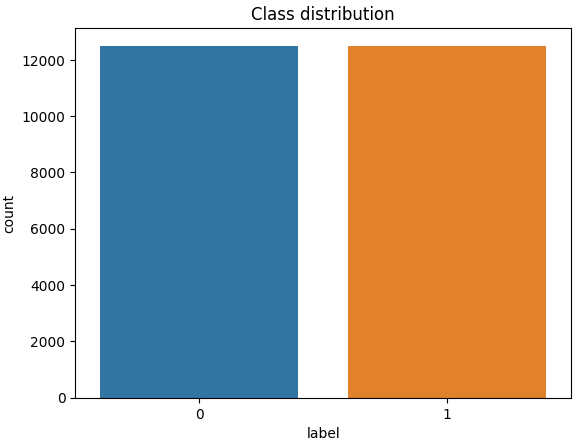 Fig 1. Class distribution of the training dataset
Next, we preprocess our dataset by tokenizing the texts. We use BERT’s tokenizer, which will convert the text into tokens that correspond to BERT’s vocabulary.
python
# Step 2: Preprocess the dataset
def tokenize_function(examples):
    return tokenizer(examples["text"], padding="max_length", truncation=True)

tokenized_datasets = dataset.map(tokenize_function, batched=True)
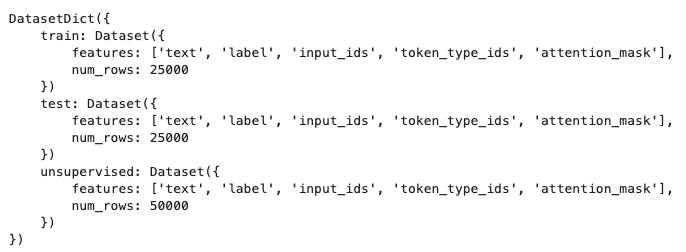 After that, we prepare our training and evaluation datasets. Remember, if you want to use all the data, you can set the
num_samples variable to -1.
python
if num_samples == -1:
    small_train_dataset = tokenized_datasets["train"].shuffle(seed=42)
    small_eval_dataset = tokenized_datasets["test"].shuffle(seed=42)
else:
    small_train_dataset = tokenized_datasets["train"].shuffle(seed=42).select(range(num_samples))
    small_eval_dataset = tokenized_datasets["test"].shuffle(seed=42).select(range(num_samples))
Then, we load the pre-trained BERT model. We’ll use the AutoModelForSequenceClassification class, a BERT model designed for classification tasks.
For this tutorial, we use the ‘bert-base-uncased’ version of BERT, which is trained on lower-case English text, is used for this tutorial.
python
# Step 3: Load pre-trained model
model = AutoModelForSequenceClassification.from_pretrained('bert-base-uncased', num_labels=2)
Now, we’re ready to define our training arguments and create a Trainerinstance to train our model.
python
# Step 4: Define training arguments
training_args = TrainingArguments("test_trainer", evaluation_strategy="epoch", no_cuda=True, num_train_epochs=num_epochs)

# Step 5: Create Trainer instance and train
trainer = Trainer(
    model=model, args=training_args, train_dataset=small_train_dataset, eval_dataset=small_eval_dataset
)

trainer.train()
Interpreting results
Having trained our model, let’s evaluate it. We’ll calculate the confusion matrix and the ROC curve to understand how well our model performs.
python
# Step 6: Evaluation
predictions = trainer.predict(small_eval_dataset)

# Confusion matrix
cm = confusion_matrix(small_eval_dataset['label'], predictions.predictions.argmax(-1))
sns.heatmap(cm, annot=True, fmt='d')
plt.title('Confusion Matrix')
plt.show()

# ROC Curve
fpr, tpr, _ = roc_curve(small_eval_dataset['label'], predictions.predictions[:, 1])
roc_auc = auc(fpr, tpr)

plt.figure(figsize=(1.618 * 5, 5))
plt.plot(fpr, tpr, color='darkorange', lw=2, label='ROC curve (area = %0.2f)' % roc_auc)
plt.plot([0, 1], [0, 1], color='navy', lw=2, linestyle='--')
plt.xlim([0.0, 1.0])
plt.ylim([0.0, 1.05])
plt.xlabel('False Positive Rate')
plt.ylabel('True Positive Rate')
plt.title('Receiver operating characteristic')
plt.legend(loc="lower right")
plt.show()
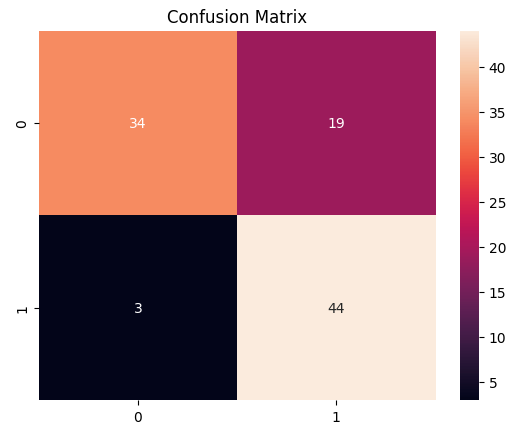 Fig 2. Confusion Matrix
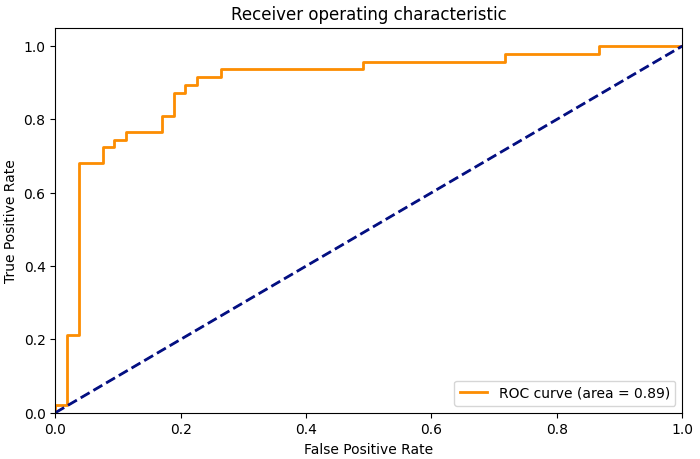 Fig 3. ROC curve
The confusion matrix gives a detailed breakdown of how our predictions measure up to the actual labels, while the ROC curve shows us the trade-off between the true positive rate (sensitivity) and the false positive rate (1 — specificity) at various threshold settings.
Finally, to see our model in action, let’s use it to infer the sentiment of a sample text.
python
# Step 7: Inference on a new sample
sample_text = "This is a fantastic movie. I really enjoyed it."
sample_inputs = tokenizer(sample_text, padding="max_length", truncation=True, max_length=512, return_tensors="pt")

# Move inputs to device (if GPU available)
sample_inputs.to(training_args.device)

# Make prediction
predictions = model(**sample_inputs)
predicted_class = predictions.logits.argmax(-1).item()

if predicted_class == 1:
    print("Positive sentiment")
else:
    print("Negative sentiment")

Closing thoughts
By walking through an example of sentiment analysis on IMDb movie reviews, I hope you’ve gained a clear understanding of how to apply BERT to real-world NLP problems. The Python code I’ve included here can be adjusted and extended to tackle different tasks and datasets, paving the way for even more sophisticated and accurate language models.
References
[1] Devlin, J., Chang, M. W., Lee, K., & Toutanova, K. (2018). BERT: Pre-training of Deep Bidirectional Transformers for Language Understanding. arXiv preprint arXiv:1810.04805
[2] Vaswani, A., Shazeer, N., Parmar, N., Uszkoreit, J., Jones, L., Gomez, A. N., … & Polosukhin, I. (2017). Attention is all you need. In Advances in neural information processing systems (pp. 5998–6008).
[3] Wolf, T., Debut, L., Sanh, V., Chaumond, J., Delangue, C., Moi, A., … & Rush, A. M. (2019). Huggingface’s transformers: State-of-the-art natural language processing. ArXiv, abs/1910.03771.
[4] Lhoest, Q., Villanova del Moral, A., Jernite, Y., Thakur, A., von Platen, P., Patil, S., Chaumond, J., Drame, M., Plu, J., Tunstall, L., Davison, J., Šaško, M., Chhablani, G., Malik, B., Brandeis, S., Le Scao, T., Sanh, V., Xu, C., Patry, N., McMillan-Major, A., Schmid, P., Gugger, S., Delangue, C., Matussière, T., Debut, L., Bekman, S., Cistac, P., Goehringer, T., Mustar, V., Lagunas, F., Rush, A., & Wolf, T. (2021). Datasets: A Community Library for Natural Language Processing. In Proceedings of the 2021 Conference on Empirical Methods in Natural Language Processing: System Demonstrations (pp. 175–184). Online and Punta Cana, Dominican Republic: Association for Computational Linguistics. Retrieved from https://aclanthology.org/2021.emnlp-demo.21
Thanks for reading. If you have any feedback, please feel to reach out by messaging me on LinkedIn or shooting me an email (smhkapadia[at]gmail.com).
Register Now to Continue Reading
Unlock Towards Data Science with a Free Account
All articles on Towards Data Science are available to registered users. Create a free account today to access this article and thousands more.
Register for freeSign in to your account
SK
Written By
See all from Shashank Kapadia
BertHugging FaceNLPTransformer ModelTransformers
Share This Article
Towards Data Science is a community publication. Submit your insights to reach our global audience and earn through the TDS Author Payment Program.
Write for TDS
Related Articles
Machine Learning
What are Google's machine learning algorithms, and how do they help to get higher positions in SERP
Diana Ford
August 17, 20216 min read
Machine Learning
Four methods to find the maximum (or minimum) of your black box objective function
Piero Paialunga
September 4, 202413 min read
Machine Learning
A New Immigrant's Guide to settling in the City of Toronto
Jessica Ayodele
November 27, 20205 min read
Machine Learning
Tame the Curse of Dimensionality! Learn Dimensionality Reduction (PCA) and implement it with Python and Scikit-Learn.
Riccardo Andreoni
February 7, 202411 min read
Machine Learning
Monitoring streaming data with Kafka and whylogs The importance of data in making informed decisions...
Felipe Adachi
May 4, 202115 min read
Machine Learning
How word embeddings are trained
Jon Gimpel
July 26, 202215 min read
Artificial Intelligence
I checked dozens of free and paid facial recognition services. Here's what I learned
Serhii Pospielov
March 11, 202111 min read
Artificial Intelligence
Hi there. I mentioned in past articles that I am working intensely on cognitive computing for enterprise datasets. This is that.
Daniel Shapiro, PhD
December 5, 20177 min read
NLP
I'm a poet-turned-programmer who has just begun learning about the wonderful world of natural language processing. In this post, I'll be...
Jianna Park
July 24, 202010 min read
Your home for data science and AI. The world's leading publication for data science, data analytics, data engineering, machine learning, and artificial intelligence professionals.
Subscribe to Our NewsletterWrite For TDS•About•Advertise•Privacy Policy•Terms of Use
© Insight Media Group, LLC 2026•The New Stack•roadmap.sh•Creator Network
Recommended Articles
Close