保留正文与补采附件。源页面当前未重新核验;具体限制见交付清单。
 We value your privacy
We use cookies to enhance your browsing experience, serve personalised ads or content, and analyse our traffic. By clicking "Accept All", you consent to our use of cookies.
Customise Reject All Accept All
Customise Consent Preferences
 We use cookies to help you navigate efficiently and perform certain functions. You will find detailed information about all cookies under each consent category below.
The cookies that are categorised as "Necessary" are stored on your browser as they are essential for enabling the basic functionalities of the site. ... Show more
NecessaryAlways Active
Necessary cookies are required to enable the basic features of this site, such as providing secure log-in or adjusting your consent preferences. These cookies do not store any personally identifiable data.
-
Cookie
BCTempID
-
Duration
10 minutes
-
Description
No description available.
-
Cookie
__cf_bm
-
Duration
1 hour
-
Description
This cookie, set by Cloudflare, is used to support Cloudflare Bot Management.
-
Cookie
AWSALBCORS
-
Duration
7 days
-
Description
Amazon Web Services set this cookie for load balancing.
-
Cookie
_cfuvid
-
Duration
session
-
Description
Cloudflare sets this cookie to track users across sessions to optimize user experience by maintaining session consistency and providing personalized services
-
Cookie
li_gc
-
Duration
6 months
-
Description
Linkedin set this cookie for storing visitor's consent regarding using cookies for non-essential purposes.
-
Cookie
__hssrc
-
Duration
session
-
Description
This cookie is set by Hubspot whenever it changes the session cookie. The __hssrc cookie set to 1 indicates that the user has restarted the browser, and if the cookie does not exist, it is assumed to be a new session.
-
Cookie
__hssc
-
Duration
1 hour
-
Description
HubSpot sets this cookie to keep track of sessions and to determine if HubSpot should increment the session number and timestamps in the __hstc cookie.
-
Cookie
wpEmojiSettingsSupports
-
Duration
session
-
Description
WordPress sets this cookie when a user interacts with emojis on a WordPress site. It helps determine if the user's browser can display emojis properly.
-
Cookie
BCSessionID
-
Duration
1 year 1 month 4 days
-
Description
Blueconic sets this cookie as a unique identifier for the BlueConic profile.
-
Cookie
_octo
-
Duration
1 year
-
Description
No description available.
-
Cookie
logged_in
-
Duration
1 year
-
Description
No description available.
-
Cookie
__Secure-YEC
-
Duration
past
-
Description
YouTube sets this cookie to stores the user's video player preferences using embedded YouTube video
-
Cookie
__eoi
-
Duration
6 months
-
Description
Description is currently not available.
-
Cookie
AWSALBTGCORS
-
Duration
7 days
-
Description
No description available.
-
Cookie
login-status-p
-
Duration
past
-
Description
Description is currently not available.
-
Cookie
AWSALBTG
-
Duration
7 days
-
Description
No description available.
-
Cookie
csrf_token
-
Duration
session
-
Description
No description available.
-
Cookie
token_v2
-
Duration
1 day
-
Description
Description is currently not available.
-
Cookie
D
-
Duration
1 year
-
Description
Description is currently not available.
-
Cookie
PHPSESSID
-
Duration
session
-
Description
This cookie is native to PHP applications. The cookie stores and identifies a user's unique session ID to manage user sessions on the website. The cookie is a session cookie and will be deleted when all the browser windows are closed.
-
Cookie
VISITOR_PRIVACY_METADATA
-
Duration
6 months
-
Description
YouTube sets this cookie to store the user's cookie consent state for the current domain.
-
Cookie
cookietest
-
Duration
session
-
Description
The cookietest cookie is typically used to determine whether the user's browser accepts cookies, essential for website functionality and user experience.
-
Cookie
__Host-airtable-session
-
Duration
1 year
-
Description
This cookie is used to enable us to integrate the services of Airtable.
-
Cookie
__Host-airtable-session.sig
-
Duration
1 year
-
Description
This cookie is used to enable us to integrate the services of Airtable.
-
Cookie
m
-
Duration
1 year 1 month 4 days
-
Description
Stripe sets this cookie for fraud prevention purposes. It identifies the device used to access the website, allowing the website to be formatted accordingly.
-
Cookie
BIGipServer*
-
Duration
session
-
Description
Marketo sets this cookie to collect information about the user's online activity and build a profile about their interests to provide advertisements relevant to the user.
-
Cookie
__cfruid
-
Duration
session
-
Description
Cloudflare sets this cookie to identify trusted web traffic.
-
Cookie
_GRECAPTCHA
-
Duration
6 months
-
Description
Google Recaptcha service sets this cookie to identify bots to protect the website against malicious spam attacks.
-
Cookie
__Secure-YNID
-
Duration
6 months
-
Description
Google cookie used to protect user security and prevent fraud, especially during the login process.
-
Cookie
cookieyes-consent
-
Duration
1 year
-
Description
CookieYes sets this cookie to remember users' consent preferences so that their preferences are respected on subsequent visits to this site. It does not collect or store any personal information about the site visitors.
Functional
Functional cookies help perform certain functionalities like sharing the content of the website on social media platforms, collecting feedback, and other third-party features.
-
Cookie
lidc
-
Duration
1 day
-
Description
LinkedIn sets the lidc cookie to facilitate data center selection.
-
Cookie
brw
-
Duration
1 year
-
Description
No description available.
-
Cookie
brwConsent
-
Duration
5 minutes
-
Description
Description is currently not available.
-
Cookie
WMF-Uniq
-
Duration
1 year
-
Description
Description is currently not available.
-
Cookie
loom_anon_comment
-
Duration
1 year
-
Description
No description available.
-
Cookie
loom_referral_video
-
Duration
session
-
Description
Description is currently not available.
-
Cookie
VISITOR_INFO1_LIVE
-
Duration
6 months
-
Description
A cookie set by YouTube to measure bandwidth that determines whether the user gets the new or old player interface.
-
Cookie
yt-remote-connected-devices
-
Duration
Never Expires
-
Description
YouTube sets this cookie to store the user's video preferences using embedded YouTube videos.
-
Cookie
ytidb::LAST_RESULT_ENTRY_KEY
-
Duration
Never Expires
-
Description
The cookie ytidb::LAST_RESULT_ENTRY_KEY is used by YouTube to store the last search result entry that was clicked by the user. This information is used to improve the user experience by providing more relevant search results in the future.
-
Cookie
yt-remote-device-id
-
Duration
Never Expires
-
Description
YouTube sets this cookie to store the user's video preferences using embedded YouTube videos.
-
Cookie
yt-remote-session-name
-
Duration
session
-
Description
The yt-remote-session-name cookie is used by YouTube to store the user's video player preferences using embedded YouTube video.
-
Cookie
yt-remote-fast-check-period
-
Duration
session
-
Description
The yt-remote-fast-check-period cookie is used by YouTube to store the user's video player preferences for embedded YouTube videos.
-
Cookie
yt-remote-session-app
-
Duration
session
-
Description
The yt-remote-session-app cookie is used by YouTube to store user preferences and information about the interface of the embedded YouTube video player.
-
Cookie
yt-remote-cast-available
-
Duration
session
-
Description
The yt-remote-cast-available cookie is used to store the user's preferences regarding whether casting is available on their YouTube video player.
-
Cookie
yt-remote-cast-installed
-
Duration
session
-
Description
The yt-remote-cast-installed cookie is used to store the user's video player preferences using embedded YouTube video.
-
Cookie
cp_session
-
Duration
3 months
-
Description
Codepen sets this cookie for Help systems found in the website.
-
Cookie
loid
-
Duration
1 year 1 month 4 days
-
Description
This cookie is set by the Reddit. The cookie enables the sharing of content from the website onto the social media platform.
Analytics
Analytical cookies are used to understand how visitors interact with the website. These cookies help provide information on metrics such as the number of visitors, bounce rate, traffic source, etc.
-
Cookie
__hstc
-
Duration
6 months
-
Description
Hubspot set this main cookie for tracking visitors. It contains the domain, initial timestamp (first visit), last timestamp (last visit), current timestamp (this visit), and session number (increments for each subsequent session).
-
Cookie
hubspotutk
-
Duration
6 months
-
Description
HubSpot sets this cookie to keep track of the visitors to the website. This cookie is passed to HubSpot on form submission and used when deduplicating contacts.
-
Cookie
_ga
-
Duration
1 year 1 month 4 days
-
Description
Google Analytics sets this cookie to calculate visitor, session and campaign data and track site usage for the site's analytics report. The cookie stores information anonymously and assigns a randomly generated number to recognise unique visitors.
-
Cookie
ga*
-
Duration
1 year 1 month 4 days
-
Description
Google Analytics sets this cookie to store and count page views.
-
Cookie
__Host-psifi.analyticsTrace
-
Duration
6 hours
-
Description
Description is currently not available.
-
Cookie
__Host-psifi.analyticsTraceV2
-
Duration
6 hours
-
Description
Description is currently not available.
-
Cookie
_gh_sess
-
Duration
session
-
Description
GitHub sets this cookie for temporary application and framework state between pages like what step the user is on in a multiple step form.
-
Cookie
YSC
-
Duration
session
-
Description
YSC cookie is set by Youtube and is used to track the views of embedded videos on Youtube pages.
-
Cookie
ajs_anonymous_id
-
Duration
1 year
-
Description
This cookie is set by Segment to count the number of people who visit a certain site by tracking if they have visited before.
-
Cookie
vuid
-
Duration
1 year 1 month 4 days
-
Description
Vimeo installs this cookie to collect tracking information by setting a unique ID to embed videos on the website.
Performance
Performance cookies are used to understand and analyse the key performance indexes of the website which helps in delivering a better user experience for the visitors.
-
Cookie
AWSALB
-
Duration
7 days
-
Description
AWSALB is an application load balancer cookie set by Amazon Web Services to map the session to the target.
-
Cookie
acq
-
Duration
past
-
Description
Description is currently not available.
-
Cookie
acq.sig
-
Duration
past
-
Description
Description is currently not available.
-
Cookie
ptc
-
Duration
2 years
-
Description
No description available.
Advertisement
Advertisement cookies are used to provide visitors with customised advertisements based on the pages you visited previously and to analyse the effectiveness of the ad campaigns.
-
Cookie
muc_ads
-
Duration
1 year 1 month 4 days
-
Description
Twitter sets this cookie to collect user behaviour and interaction data to optimize the website.
-
Cookie
guest_id_marketing
-
Duration
1 year 1 month 4 days
-
Description
Twitter sets this cookie to identify and track the website visitor.
-
Cookie
guest_id_ads
-
Duration
1 year 1 month 4 days
-
Description
Twitter sets this cookie to identify and track the website visitor.
-
Cookie
personalization_id
-
Duration
1 year 1 month 4 days
-
Description
Twitter sets this cookie to integrate and share features for social media and also store information about how the user uses the website, for tracking and targeting.
-
Cookie
guest_id
-
Duration
1 year 1 month 4 days
-
Description
Twitter sets this cookie to identify and track the website visitor. It registers if a user is signed in to the Twitter platform and collects information about ad preferences.
-
Cookie
bcookie
-
Duration
1 year
-
Description
LinkedIn sets this cookie from LinkedIn share buttons and ad tags to recognize browser IDs.
-
Cookie
__Secure-ROLLOUT_TOKEN
-
Duration
6 months
-
Description
YouTube sets this cookie to manage feature rollout and experimentation. It helps Google control which new features or interface changes are shown to users as part of testing and staged rollouts, ensuring consistent experience for a given user during an experiment.
-
Cookie
yt.innertube::nextId
-
Duration
Never Expires
-
Description
YouTube sets this cookie to register a unique ID to store data on what videos from YouTube the user has seen.
-
Cookie
yt.innertube::requests
-
Duration
Never Expires
-
Description
YouTube sets this cookie to register a unique ID to store data on what videos from YouTube the user has seen.
-
Cookie
session_tracker
-
Duration
session
-
Description
This cookie is set by the Reddit. This cookie is used to identify trusted web traffic. It also helps in adverstising on the website.
-
Cookie
edgebucket
-
Duration
session
-
Description
Reddit sets this cookie to save the information about a log-on Reddit user, for the purpose of advertisement recommendations and updating the content.
-
Cookie
did
-
Duration
1 year
-
Description
Arbor sets this cookie to show targeted ads to site visitors.This cookie expires after 2 months or 1 year.
Uncategorised
Other uncategorised cookies are those that are being analysed and have not been classified into a category as yet.
No cookies to display.
Reject All Save My Preferences Accept All
Toggle SearchToggle Mobile Navigation
Publish AI, ML & data-science insights to a global community of data professionals.
Sign inSubmit an Article
LatestEditor's PicksNewsletterShipAI
Write For TDS
LinkedInXToggle Search
Deep Learning
Understanding Kolmogorov-Arnold Networks (KAN)
Why KANs are a potential alternative to MPLs and the current landscape of Machine Learning. Let's go through the paper to find out.
Hesam Sheikh
May 7, 202410 min read
Understanding Kolmogorov–Arnold Networks (KAN)
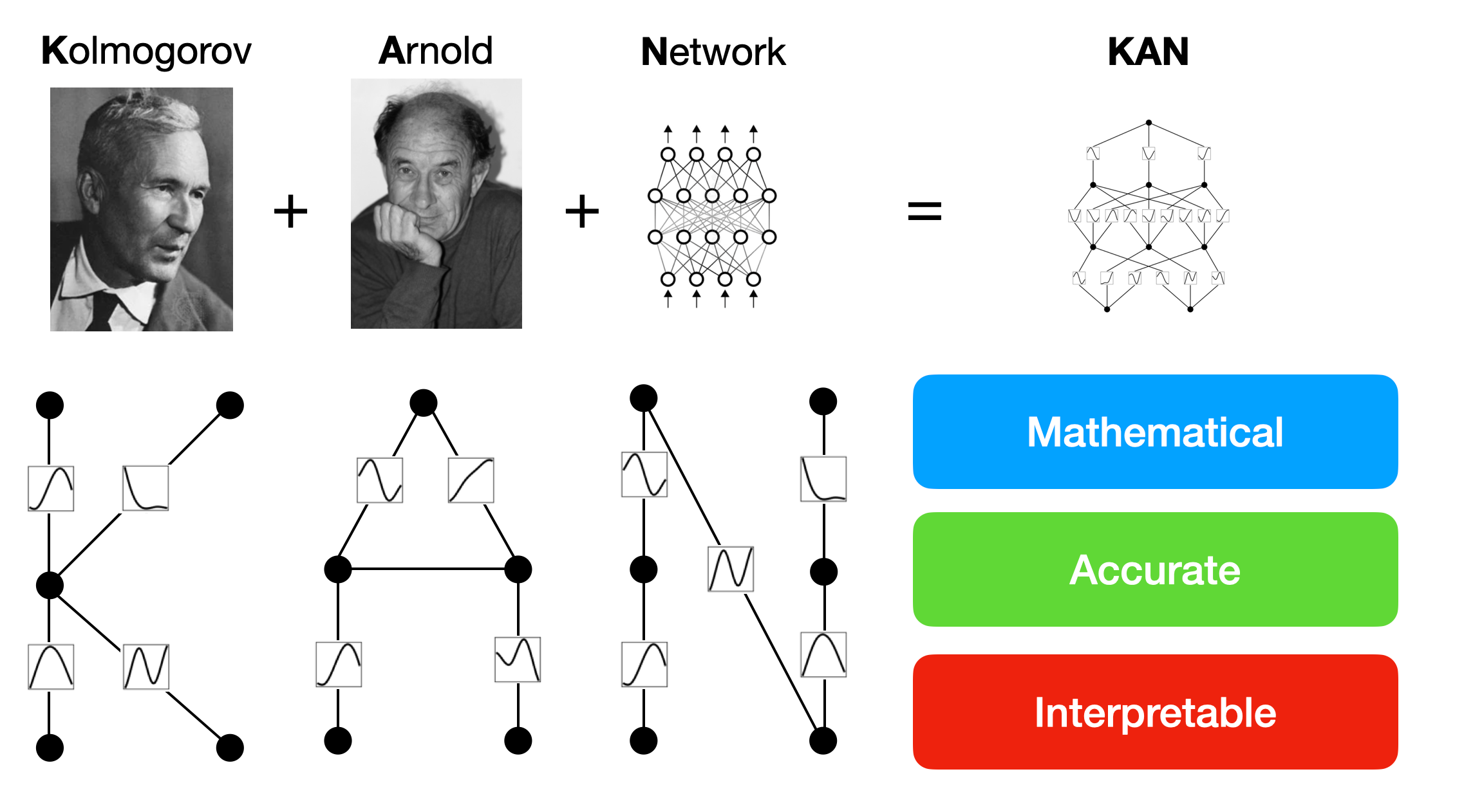 A new research paper titled KAN: Kolmogorov–Arnold Network has stirred excitement in the Machine Learning community. It presents a fresh perspective on Neural Networks and suggests a possible alternative to Multi-Layer Perceptrons (MLPs), a cornerstone of current Machine Learning.
✨This is a paid article. If you're not a Medium member, you can read this for free in my newsletter:Qiubyte .
Inspired by the Kolmogorov-Arnold representation theorem, KANs diverge from traditional Multi-Layer Perceptrons (MLPs) by replacing fixed activation functions with learnable functions , effectively eliminating the need for linear weight matrices.
I strongly recommend reading through this paper if you're interested in the finer details and experiments. However, if you prefer a concise introduction, I've prepared this article to explain the essentials of KANs.
- Note: The source of the images/figures used in this article is the "KAN: Kolmogorov–Arnold Network" paper unless stated otherwise.
Learn this step by step with the interactive Machine Learning roadmap.
The Theory
The theoretical pillar of these new networks is a theory developed by two Soviet mathematicians, Vladimir Arnold and Andrey Kolmogorov.
While a student of Andrey Kolmogorov at Moscow State University and still a teenager, Arnold showed in 1957 that any continuous function of several variables can be constructed with a finite number of two-variable functions, thereby solving Hilbert's thirteenth problem. (source: Wikipedia)
The theory that they worked on and eventually developed was based on the concept of multivariate continuous functions. According to this theory, any multivariate continuous function f can be written as a finite composition of continuous functions of a single variable, summed together.
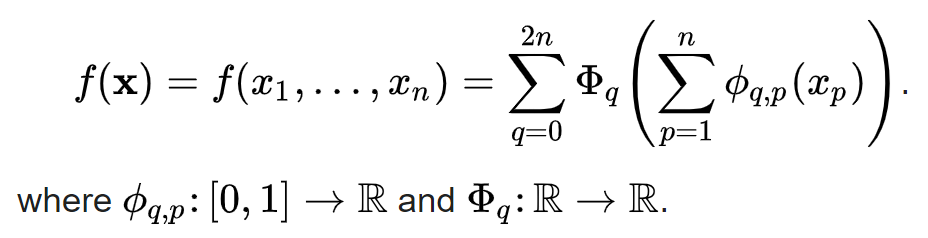 The mathematical formula of the Kolmogorov–Arnold representation theorem. (source: Wikipedia)
How Does This Theorem Fit into Machine Learning?
In machine learning, the ability to efficiently and accurately approximate complex functions is an important subject, especially as the dimensionality of data increases. Current mainstream models such as Multi-Layer Perceptrons (MLPs) often struggle with high-dimensional data - a phenomenon known as the curse of dimensionality.
The Kolmogorov-Arnold theorem, however, provides a theoretical foundation for building networks (like KANs) that can overcome this challenge.
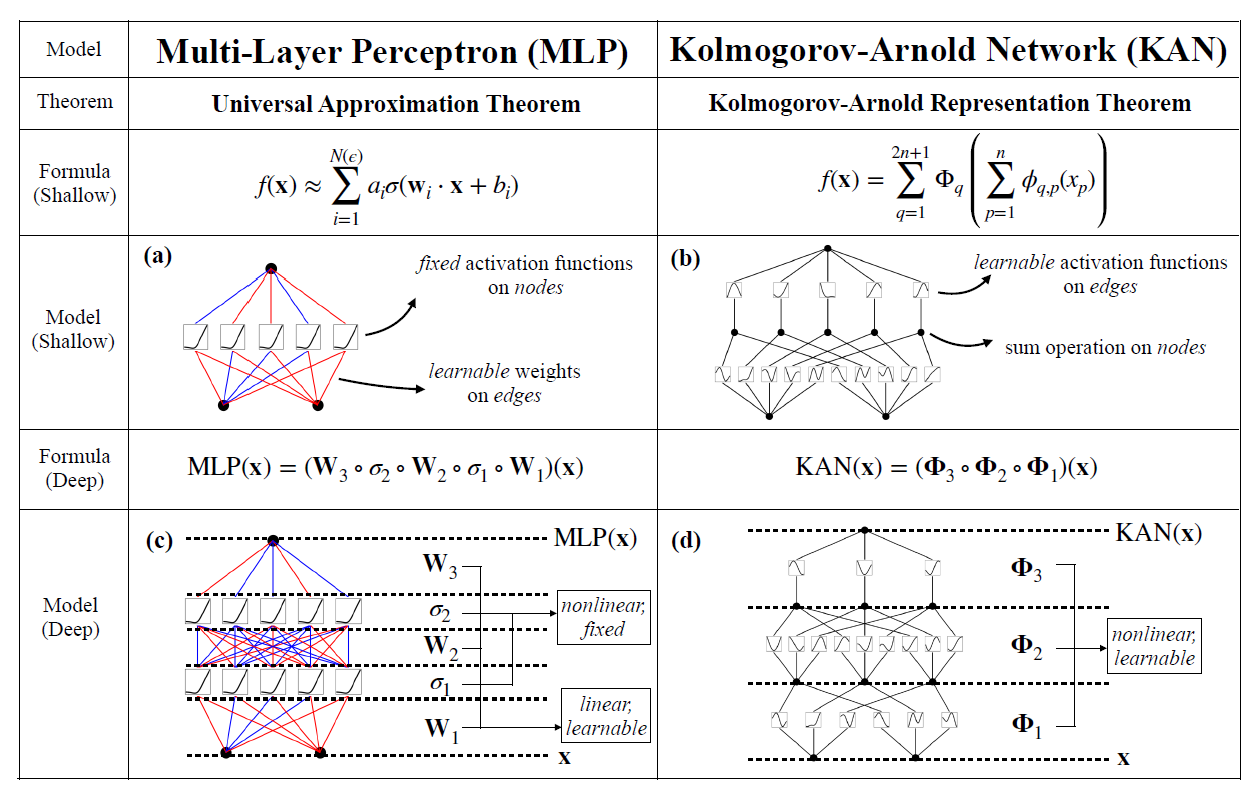 An overview comparison of MLP and KAN.
How can KAN avoid the curse of dimensionality?
This theorem allows for the decomposition of complex high-dimensional functions into compositions of simpler one-dimensional functions. By focusing on optimizing these one-dimensional functions rather than the entire multivariate space, KANs reduce the complexity and the number of parameters needed to achieve accurate modeling. Furthermore, Because of working with simpler one-dimensional functions, KANs can be simple and interpretable models.
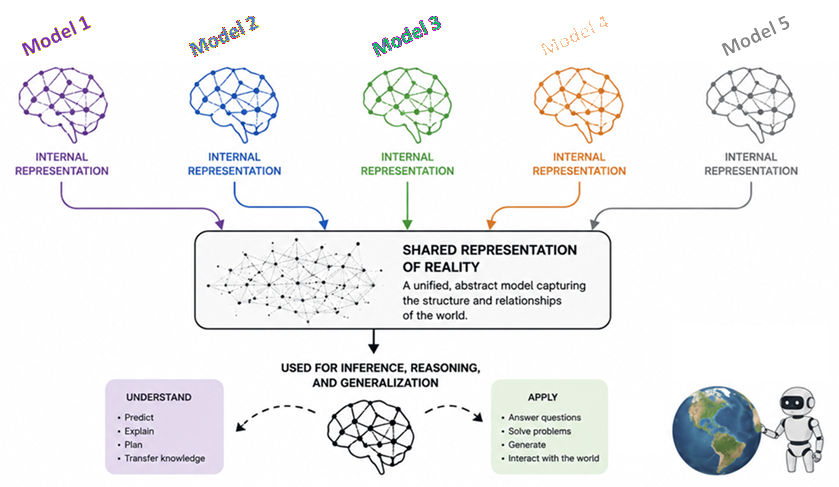
Platonic Representation: Are AI Deep Network Models Converging?
What Are Kolmogorov–Arnold Networks (KAN)?
Kolmogorov-Arnold Networks, a.k.a KANs, is a type of neural network architecture inspired by the Kolmogorov-Arnold representation theorem. Unlike traditional neural networks that use fixed activation functions , KANs employ learnable activation functions on the edges of the network. This allows every weight parameter in a KAN to be replaced by a univariate function, typically parameterized as a spline , making them highly flexible and capable of modeling complex functions with potentially fewer parameters and enhanced interpretability.
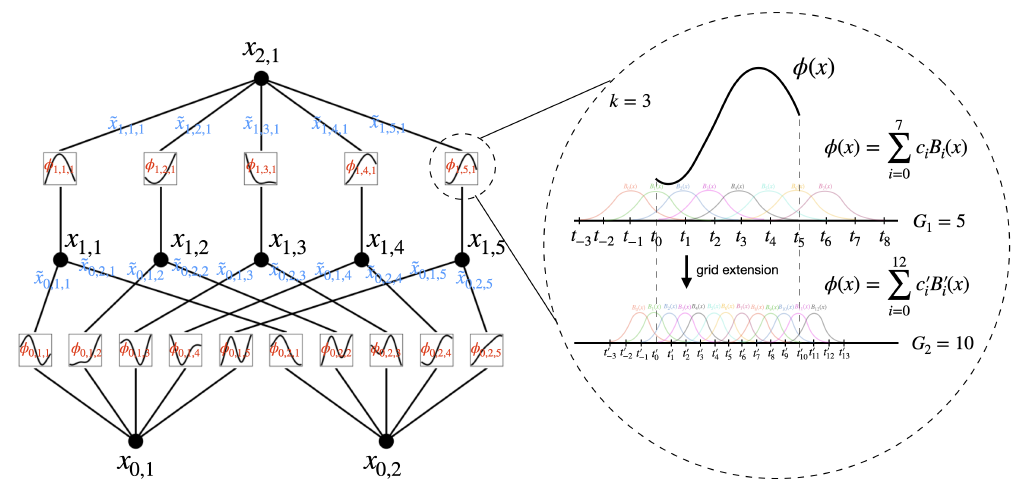 KAN leverages the structure of MLP while benefiting from splines.
KAN architecture
The architecture of Kolmogorov-Arnold Networks (KANs) revolves around a novel concept where traditional weight parameters are replaced by univariate function parameters on the edges of the network. Each node in a KAN sums up these function outputs without applying any nonlinear transformations, in contrast with MLPs that include linear transformations followed by nonlinear activation functions.
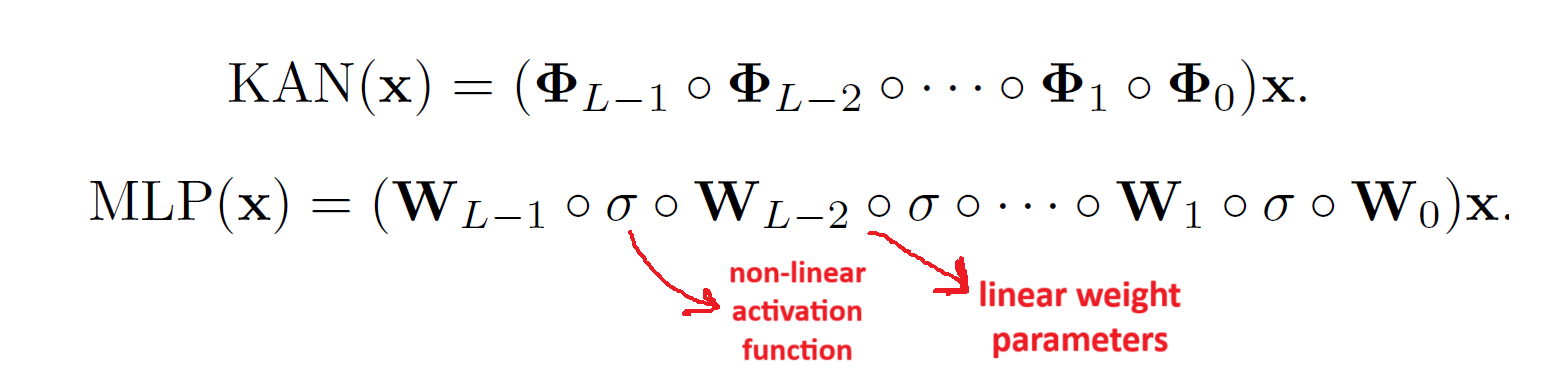 KAN vs MLP formula.
B-Splines: The Core of KAN
Surprisingly, one of the most important figures in the paper can be missed easily. It's the description of Splines. Splines are the backbone of KAN's learning mechanism. They replace the traditional weight parameters typically found in neural networks.
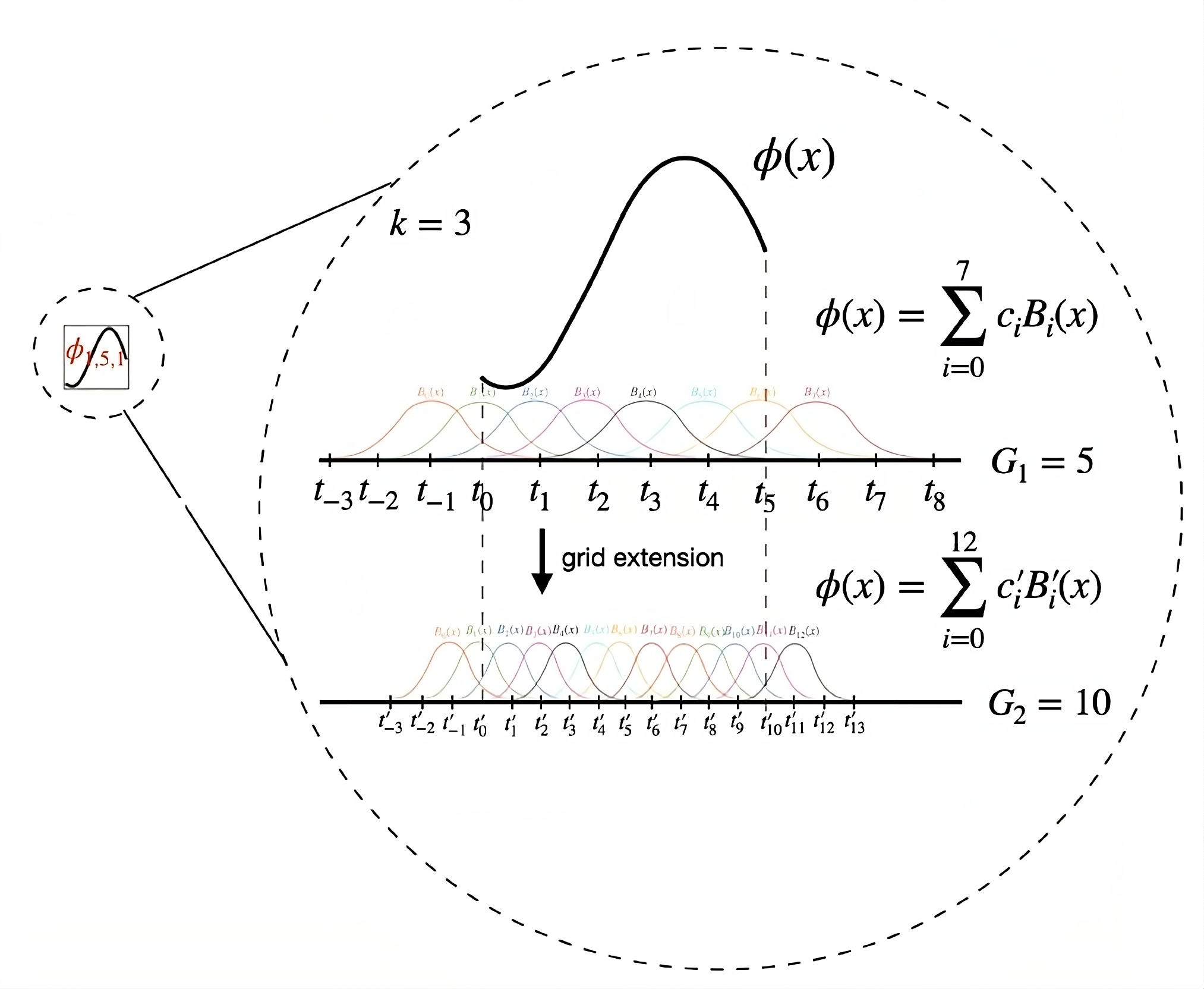 A detailed view of a spline structure.
The flexibility of splines allows them to adaptively model complex relationships in the data by adjusting their shape to minimize approximation error, therefore, enhancing the network's capability to learn subtle patterns from high-dimensional datasets.
The general formula for a spline in the context of KANs can be expressed using B-splines as follows:
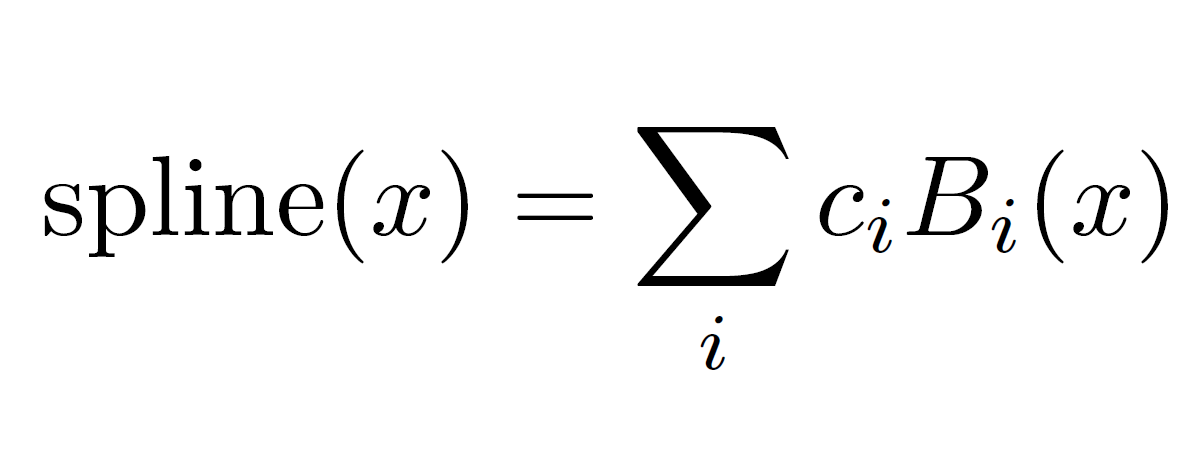 Here, _𝑠pline(𝑥) r_epresents the spline function. ci __ are the coefficients that are optimized during training, and 𝐵𝑖(𝑥) are the B-spline basis functions defined over a grid. The grid points define the intervals where each basis function 𝐵𝑖 is active and significantly affects the shape and sm oothness of the spline. You can think of them as a hyperparameter that a ffects the accuracy of the network. More grids mean more control and p recision, also resulting in more parameters to learn.
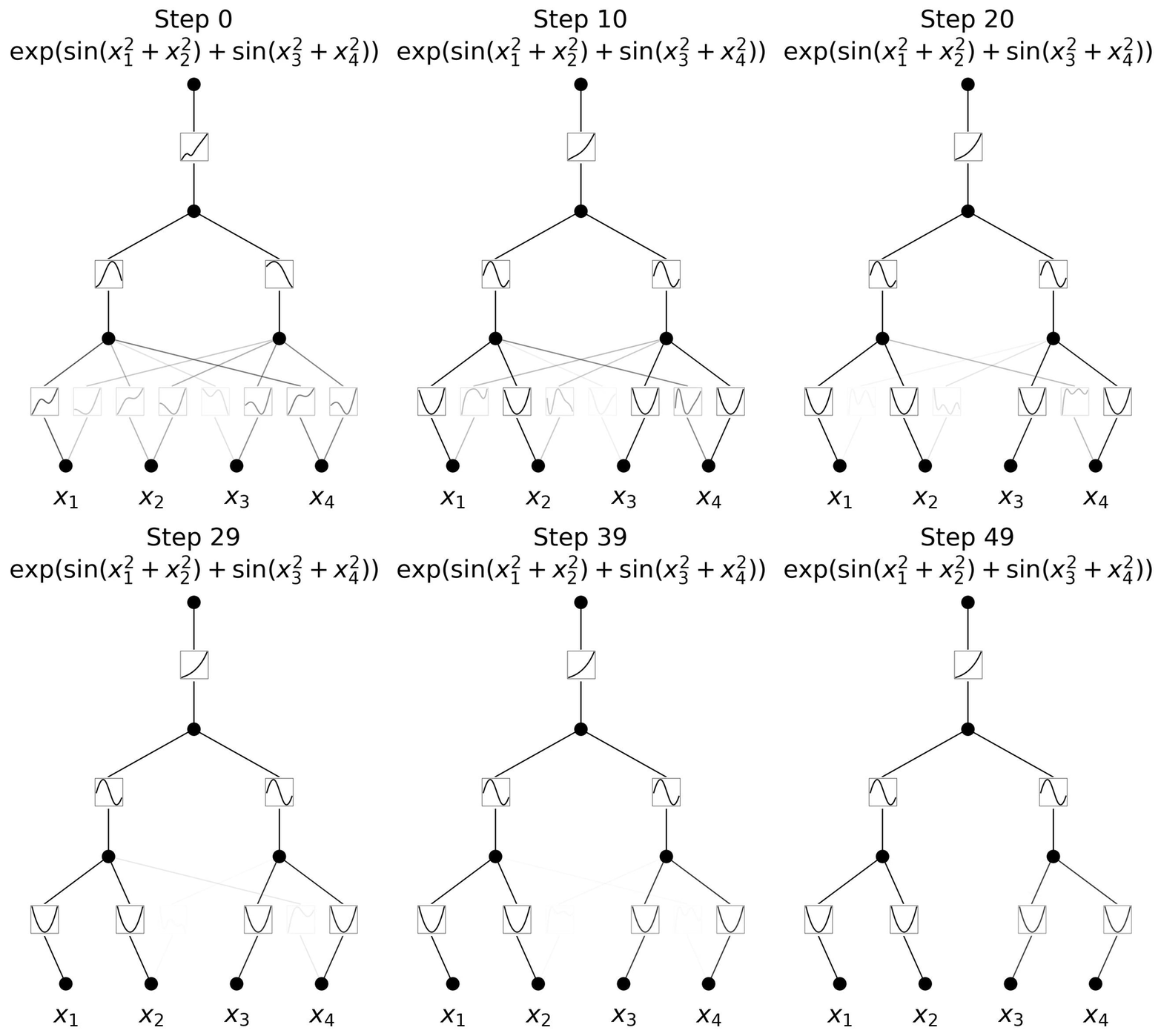 Training a KAN through multiple steps. (source: GitHub)
During training, the ci parameters of these splines (the coefficients of the basis functions Bi(x) ) are optimized to minimize the loss function , thus adjusting the shape of the spline to best fit the training data. This optimization often involves techniques like gradient descent, where each iteration updates the spline parameters to reduce prediction error.
The Best of Two Worlds
While KAN is based on the Kolmogorov-Arnold representation theorem, it is just as inspired by MLPs, "leveraging their respective strengths and avoiding their respective weaknesses ". KAN benefits the structure of MLP on the outside, and splines on the inside.
As a result, KANs can not only learn features (thanks to their external similarity to MLPs), but can also optimize these learned features to great accuracy (thanks to their internal similarity to splines).
Network Simplification
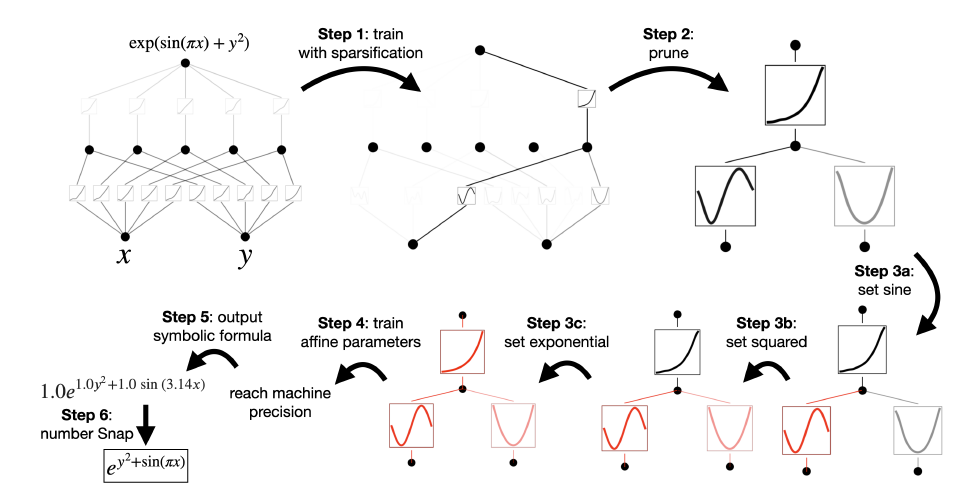 An overview of the network symbolification.
The paper goes on to explain some methods to simplify the network and our interpretation of them. I will only proceed to refer to two of them which were fascinating to me.
- Symbolification : KAN is constructed by approximating functions using compositions of simpler, often interpretable functions. This results in their unique ability to hand over interpretable mathematical formulas , such as shown in the figure above.
- Pruning : The other aspect of KANs discussed in the paper is about optimizing the network architecture by removing less important nodes or connections after the network has been trained. This process helps in reducing the complexity and size. Pruning focuses on identifying and eliminating those parts of the network that contribute minimally to the output. This makes the network lighter and potentially more interpretable.
Is KAN New?
Kolmogorov-Arnold representation theorem is not new**,** so why has the practice of using it in machine learning not been studied before? As the paper explains, multiple attempts have been made...
However, most work has stuck with the original depth-2 width-(2n + 1) representation, and did not have the chance to leverage more modern techniques (e.g., back propagation) to train the networks.
 Visual representation of KAN, created by DALLE-3.
The novelty of the paper is to adapt this idea and apply it to the current landscape of ML. Using arbitrary network architecture (depth, width) and employing techniques such as backpropagation and pruning, KAN is closer to practical use cases than previous studies.
the Kolmogorov-Arnold representation theorem was basically sentenced to death in machine learning, regarded as theoretically sound but practically useless.
So even though there have been attempts to use Kolmogorov-Arnold representation theorem in ML, it's fair to say KAN is a novel approach in that it is aware of where ML stands today. It's a good update to an idea explored before on a limited scale.
4 Fascinating Examples
The paper compares KAN and MLP on several criteria, most of which are gripping. In this part, I will proceed to list some of these interesting examples. The full details of these examples and more are in the paper.
Fitting Symbolic Formulas
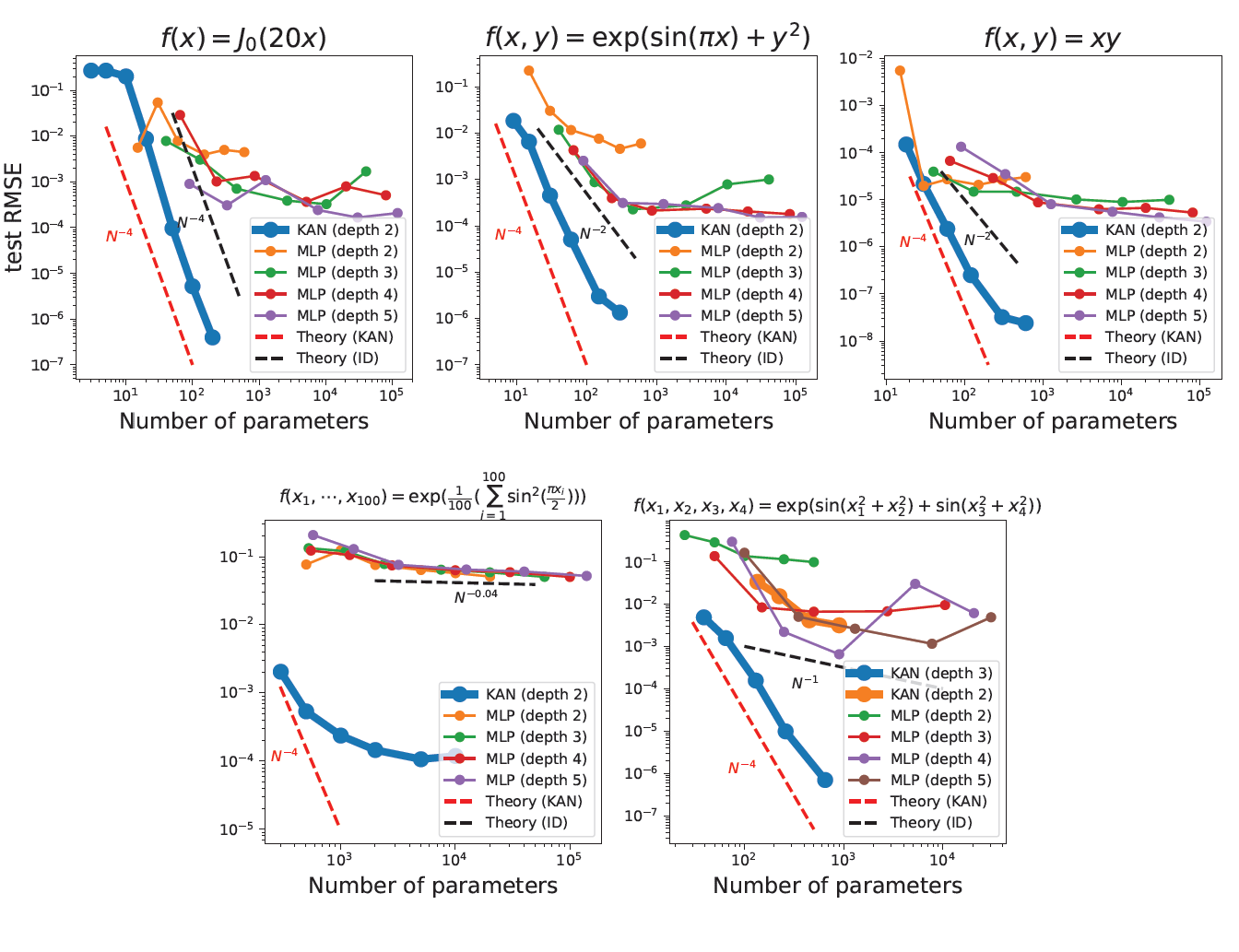
This is an example of training various MLPs and a KAN to fit certain functions of various input dimensions. As can be seen below, KAN has much better scalability compared to MLPs (at least in this range of parameter numbers).
This highlights the greater expressive power of deeper KANs, which is the same for MLPs: deeper MLPs have more expressive power than shallower ones.
Special Functions
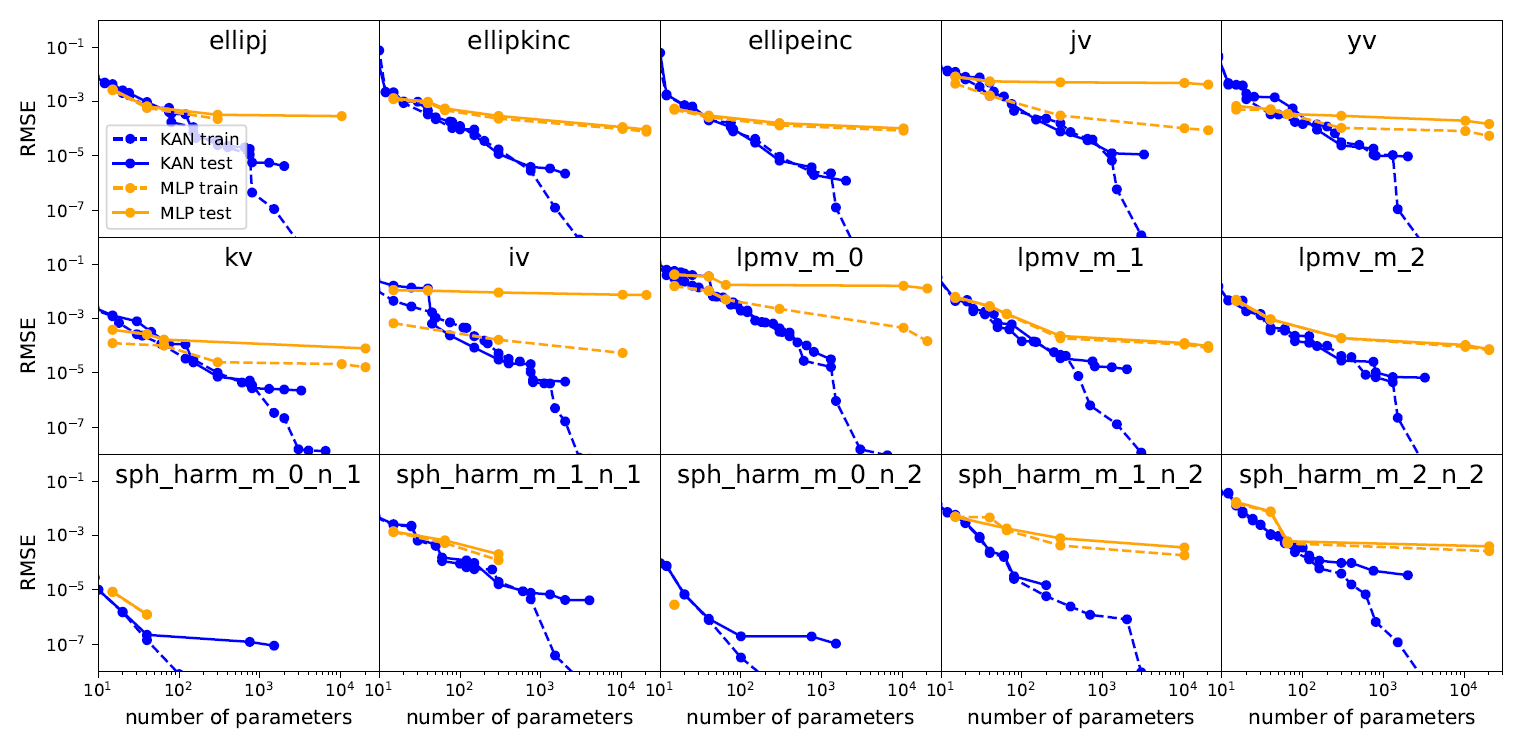
Another example in the paper is to compare KAN and MLP on fitting 15 special functions common in math and physics. The result shows that in almost all of these functions, KANs achieve a lower train/test loss having the same number of parameters compared to MLPs.
Continual Learning
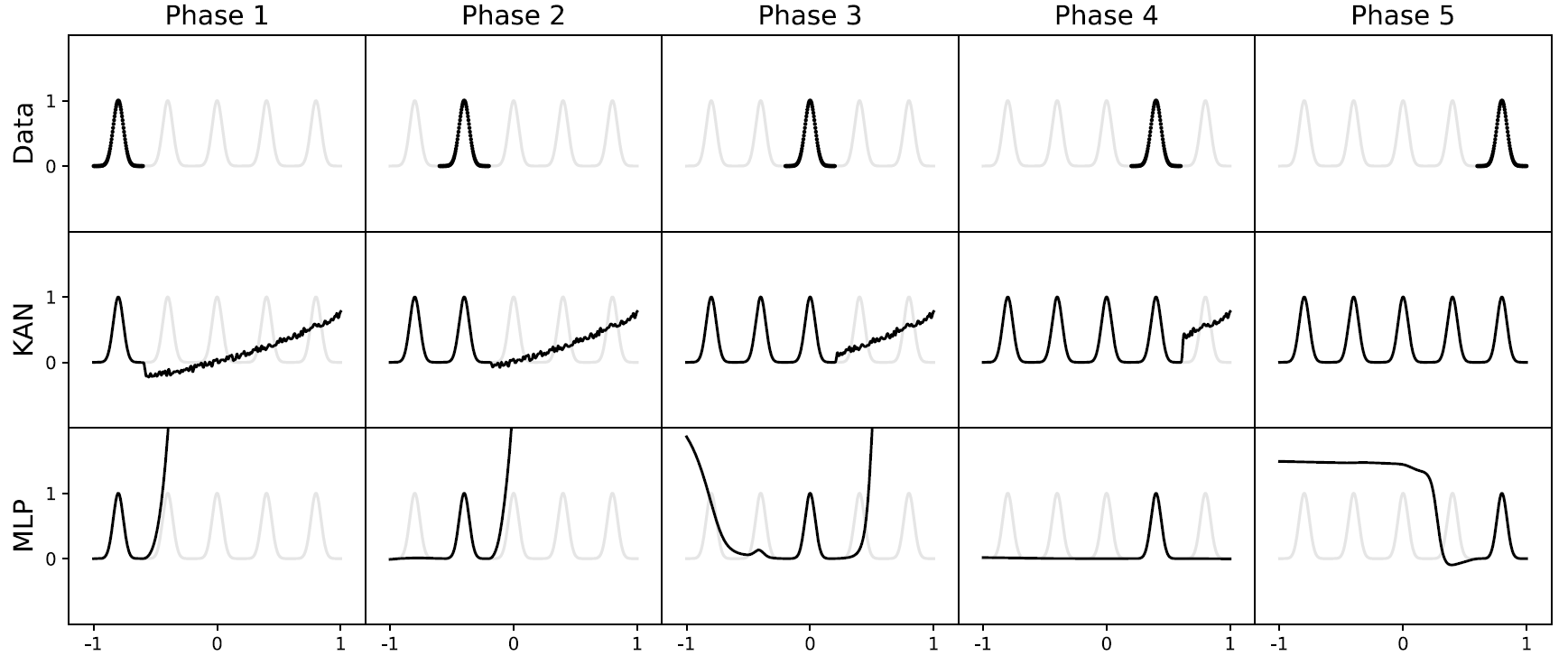
Continual Learning is the quality of how networks can adapt to new information over time without forgetting previously learned knowledge. It is a significant challenge in neural network training, particularly in avoiding the problem of catastrophic forgetting , where acquiring new knowledge leads to a rapid erosion of previously established information.
KANs demonstrate an ability to retain learned information and adapt to new data without catastrophic forgetting, thanks to the local nature of spline functions. Unlike MLPs, which rely on global activations that might unintentionally affect distant parts of the model, KANs modify only a limited set of nearby spline coefficients with each new sample. This focused adjustment preserves previously stored information in other parts of the spline.
Partial Differential Equation solving
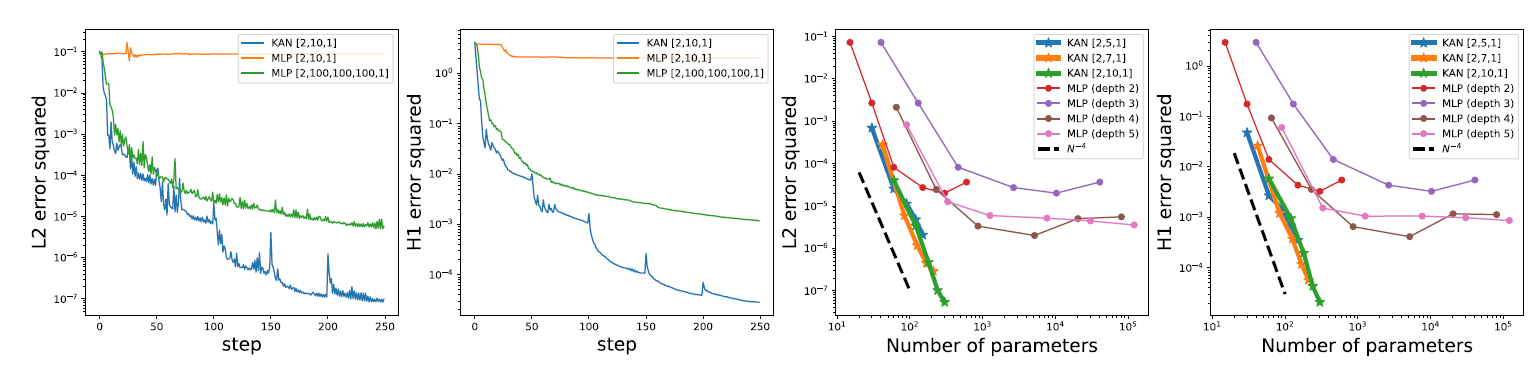
PDE solving, a 2-Layer width-10 KAN is 100 times more accurate than a 4-Layer width-100 MLP (10−7 vs 10−5 MSE) and 100 times more parameter efficient (102 vs 104 parameters).
The paper continues to present more experiments. One of them includes applying KANs to the problem of geometric knot invariant, achieving 81.6% test accuracy with a 200 -parameter KAN, while an MLP model by Google Deepmind achieves 78% having ~ 3 10⁵* parameters. This experiment was performed on the
Final Thoughts
Is the hype over KAN worth it?
It depends on your perspective. The reason KAN is being discussed so far is that it's a potential light at the end of the ML tunnel. I have discussed in "AI Is Hitting A Hard Ceiling It Can't Pass" how we need fresh innovations to guide us through the future barriers of Machine Learning, namely Data and Computation. KANs, though not intentionally, can be a way out.
KAN is written with scientific applications of AI in mind, but already people are using it to mix various ML cocktails, including Multihead Attention.
UPDATE: You can read about my experiment of training KAN on the MNIST dataset to test it out on computer vision tasks, don't miss it 👇
Tweet not found
The embedded tweet could not be found…
KAN + LLM?
The paper focuses mainly on the AI + Science applications of Kolmogorov-Arnold Networks due to their ability to model and discover complex scientific laws and patterns effectively. KANs are particularly suited for tasks that require the understanding and interpreting of underlying physical principles, as their structure allows for the decomposition of functions into symbolic mathematical expressions. This makes them ideal for scientific research where discovering such relationships is crucial, unlike in large language models (LLMs) where the primary goal often revolves around processing a mammoth corpus of data for natural language understanding and generation.
Author's Notes
I encourage you to also read the author's notes on the GitHub page. It provides perspective on what KAN was aimed for, and what could be in the future.
The most common question I've been asked lately is whether KANs will be next-gen LLMs. I don't have good intuition about this. KANs are designed for applications where one cares about high accuracy and/or interpretability. We do care about LLM interpretability for sure, but interpretability can mean wildly different things for LLM and for science. Do we care about high accuracy for LLMs? I don't know, scaling laws seem to imply so, but probably not too high precision. Also, accuracy can also mean different things for LLM and for science. This subtlety makes it hard to directly transfer conclusions in our paper to LLMs, or machine learning tasks in general.
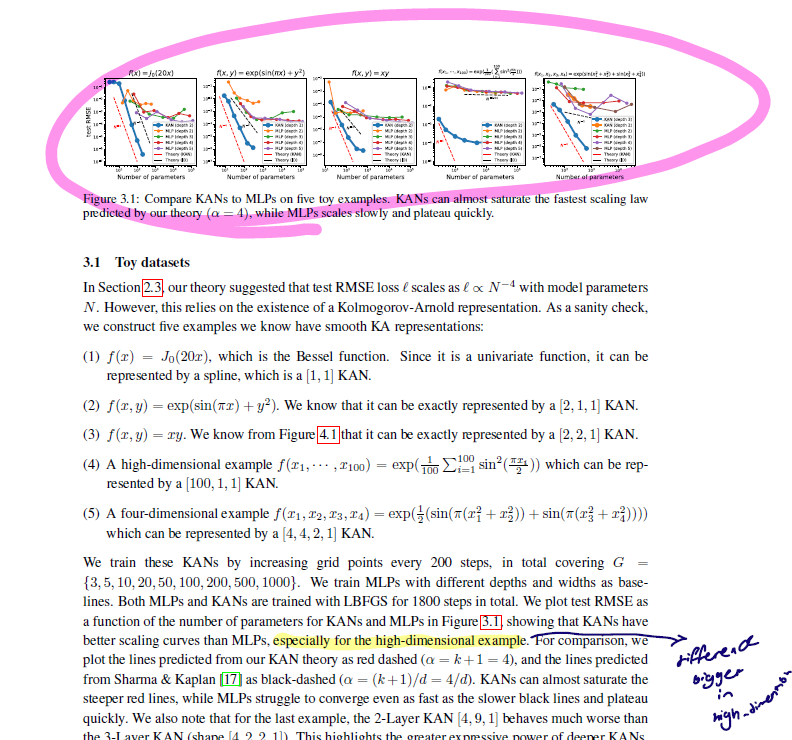 "KAN: Kolmogorov–Arnold Networks" paper.
Conclusion
In my view, it's best to look at KAN for what it is, rather than what we like it to be. This doesn't mean KAN is impossible to be integrated within LLMs, already there is an efficient PyTorch implementation of KAN. But it has to be noted, it is too soon to call KAN revolutionary or game-changing. KAN simply needs more experiments done by community experts.
While KANs offer significant advantages in certain contexts, they come with limitations and considerations that beget caution:
- Complexity and Overfitting : KANs can potentially overfit, especially in scenarios with limited data. Their ability to form complex models might capture noise as significant patterns, leading to poor generalization.
- Computation: KANs may face challenges with GPU optimization due to their specialized nature, which can disrupt parallel processing. This architecture could result in slower operations on GPUs, necessitating serialization and leading to inefficient memory utilization, potentially making CPUs a more suitable platform for these networks.
- Applicability: KANs are primarily designed for scientific and engineering tasks where understanding the underlying function is crucial. They might not be as effective in domains requiring large-scale pattern recognition or classification, such as image recognition or natural language processing, where simpler or more abstract models might suffice.
I have to add this has been an amazing paper to read. It's always exciting to think outside the box and KAN certainly achieves that.
💬 How do you see the potential of KAN? Is it going to niche down to science, or play a key role in our daily AI products?
🌟 Join +1000 people learning about
Python🐍 , ML/MLOps/AI🤖, Data Science📈 , and LLM 🗯
follow me and check out my X/Twitter , where I keep you updated Daily :
Thanks for reading,
— Hesam
Register Now to Continue Reading
Unlock Towards Data Science with a Free Account
All articles on Towards Data Science are available to registered users. Create a free account today to access this article and thousands more.
Register for freeSign in to your account
 Written By
See all from Hesam Sheikh
Deep LearningKanMachine LearningMLNeural Networks
Share This Article
Towards Data Science is a community publication. Submit your insights to reach our global audience and earn through the TDS Author Payment Program.
Write for TDS
Related Articles
Machine Learning
A Debugging Guide for optimal parameterization of Segmentation models
Dr. Sohini Roychowdhury
March 11, 20218 min read
Machine Learning
It's that time of the year again. Shifting through last minutes notes on the morning of the exam, devouring your breakfast like an ape to...
Kartikaya Srivastava
April 20, 20214 min read
Artificial Intelligence
Because there's only one reality to model!
Luciano Abriata
May 7, 20267 min read
ChatGPT
Digging into the details behind the prompting framework
Anand Subramanian
July 6, 202414 min read
Artificial Intelligence
Expectations versus reality
Vicky Yu
February 6, 20214 min read
Artificial Intelligence
The Next Casualty for AI
Jye Sawtell-Rickson
September 17, 20193 min read
Machine Learning
Handling outliers and missing values in borrower data using Python.
JUNIOR JUMBONG
March 20, 202615 min read
Deep Learning
The Power of PyTorch/XLA and how Amazon SageMaker Training Compiler Simplifies its use
Chaim Rand
October 17, 202211 min read
Machine Learning
Guide on how to prepare data for model training for Kaggle's Histopathologic Cancer Detection.
Abdul Qadir
October 26, 20207 min read
Your home for data science and AI. The world's leading publication for data science, data analytics, data engineering, machine learning, and artificial intelligence professionals.
Subscribe to Our NewsletterWrite For TDS•About•Advertise•Privacy Policy•Terms of Use
© Insight Media Group, LLC 2026•The New Stack•roadmap.sh•Creator Network
Recommended Articles
Close