保留正文与补采附件。源页面当前未重新核验;具体限制见交付清单。
 We value your privacy
We use cookies to enhance your browsing experience, serve personalised ads or content, and analyse our traffic. By clicking "Accept All", you consent to our use of cookies.
Customise Reject All Accept All
Customise Consent Preferences
 We use cookies to help you navigate efficiently and perform certain functions. You will find detailed information about all cookies under each consent category below.
The cookies that are categorised as "Necessary" are stored on your browser as they are essential for enabling the basic functionalities of the site. ... Show more
NecessaryAlways Active
Necessary cookies are required to enable the basic features of this site, such as providing secure log-in or adjusting your consent preferences. These cookies do not store any personally identifiable data.
-
Cookie
BCTempID
-
Duration
10 minutes
-
Description
No description available.
-
Cookie
__cf_bm
-
Duration
1 hour
-
Description
This cookie, set by Cloudflare, is used to support Cloudflare Bot Management.
-
Cookie
AWSALBCORS
-
Duration
7 days
-
Description
Amazon Web Services set this cookie for load balancing.
-
Cookie
_cfuvid
-
Duration
session
-
Description
Cloudflare sets this cookie to track users across sessions to optimize user experience by maintaining session consistency and providing personalized services
-
Cookie
li_gc
-
Duration
6 months
-
Description
Linkedin set this cookie for storing visitor's consent regarding using cookies for non-essential purposes.
-
Cookie
__hssrc
-
Duration
session
-
Description
This cookie is set by Hubspot whenever it changes the session cookie. The __hssrc cookie set to 1 indicates that the user has restarted the browser, and if the cookie does not exist, it is assumed to be a new session.
-
Cookie
__hssc
-
Duration
1 hour
-
Description
HubSpot sets this cookie to keep track of sessions and to determine if HubSpot should increment the session number and timestamps in the __hstc cookie.
-
Cookie
wpEmojiSettingsSupports
-
Duration
session
-
Description
WordPress sets this cookie when a user interacts with emojis on a WordPress site. It helps determine if the user's browser can display emojis properly.
-
Cookie
BCSessionID
-
Duration
1 year 1 month 4 days
-
Description
Blueconic sets this cookie as a unique identifier for the BlueConic profile.
-
Cookie
_octo
-
Duration
1 year
-
Description
No description available.
-
Cookie
logged_in
-
Duration
1 year
-
Description
No description available.
-
Cookie
__Secure-YEC
-
Duration
past
-
Description
YouTube sets this cookie to stores the user's video player preferences using embedded YouTube video
-
Cookie
__eoi
-
Duration
6 months
-
Description
Description is currently not available.
-
Cookie
AWSALBTGCORS
-
Duration
7 days
-
Description
No description available.
-
Cookie
login-status-p
-
Duration
past
-
Description
Description is currently not available.
-
Cookie
AWSALBTG
-
Duration
7 days
-
Description
No description available.
-
Cookie
csrf_token
-
Duration
session
-
Description
No description available.
-
Cookie
token_v2
-
Duration
1 day
-
Description
Description is currently not available.
-
Cookie
D
-
Duration
1 year
-
Description
Description is currently not available.
-
Cookie
PHPSESSID
-
Duration
session
-
Description
This cookie is native to PHP applications. The cookie stores and identifies a user's unique session ID to manage user sessions on the website. The cookie is a session cookie and will be deleted when all the browser windows are closed.
-
Cookie
VISITOR_PRIVACY_METADATA
-
Duration
6 months
-
Description
YouTube sets this cookie to store the user's cookie consent state for the current domain.
-
Cookie
cookietest
-
Duration
session
-
Description
The cookietest cookie is typically used to determine whether the user's browser accepts cookies, essential for website functionality and user experience.
-
Cookie
__Host-airtable-session
-
Duration
1 year
-
Description
This cookie is used to enable us to integrate the services of Airtable.
-
Cookie
__Host-airtable-session.sig
-
Duration
1 year
-
Description
This cookie is used to enable us to integrate the services of Airtable.
-
Cookie
m
-
Duration
1 year 1 month 4 days
-
Description
Stripe sets this cookie for fraud prevention purposes. It identifies the device used to access the website, allowing the website to be formatted accordingly.
-
Cookie
BIGipServer*
-
Duration
session
-
Description
Marketo sets this cookie to collect information about the user's online activity and build a profile about their interests to provide advertisements relevant to the user.
-
Cookie
__cfruid
-
Duration
session
-
Description
Cloudflare sets this cookie to identify trusted web traffic.
-
Cookie
_GRECAPTCHA
-
Duration
6 months
-
Description
Google Recaptcha service sets this cookie to identify bots to protect the website against malicious spam attacks.
-
Cookie
__Secure-YNID
-
Duration
6 months
-
Description
Google cookie used to protect user security and prevent fraud, especially during the login process.
-
Cookie
cookieyes-consent
-
Duration
1 year
-
Description
CookieYes sets this cookie to remember users' consent preferences so that their preferences are respected on subsequent visits to this site. It does not collect or store any personal information about the site visitors.
Functional
Functional cookies help perform certain functionalities like sharing the content of the website on social media platforms, collecting feedback, and other third-party features.
-
Cookie
lidc
-
Duration
1 day
-
Description
LinkedIn sets the lidc cookie to facilitate data center selection.
-
Cookie
brw
-
Duration
1 year
-
Description
No description available.
-
Cookie
brwConsent
-
Duration
5 minutes
-
Description
Description is currently not available.
-
Cookie
WMF-Uniq
-
Duration
1 year
-
Description
Description is currently not available.
-
Cookie
loom_anon_comment
-
Duration
1 year
-
Description
No description available.
-
Cookie
loom_referral_video
-
Duration
session
-
Description
Description is currently not available.
-
Cookie
VISITOR_INFO1_LIVE
-
Duration
6 months
-
Description
A cookie set by YouTube to measure bandwidth that determines whether the user gets the new or old player interface.
-
Cookie
yt-remote-connected-devices
-
Duration
Never Expires
-
Description
YouTube sets this cookie to store the user's video preferences using embedded YouTube videos.
-
Cookie
ytidb::LAST_RESULT_ENTRY_KEY
-
Duration
Never Expires
-
Description
The cookie ytidb::LAST_RESULT_ENTRY_KEY is used by YouTube to store the last search result entry that was clicked by the user. This information is used to improve the user experience by providing more relevant search results in the future.
-
Cookie
yt-remote-device-id
-
Duration
Never Expires
-
Description
YouTube sets this cookie to store the user's video preferences using embedded YouTube videos.
-
Cookie
yt-remote-session-name
-
Duration
session
-
Description
The yt-remote-session-name cookie is used by YouTube to store the user's video player preferences using embedded YouTube video.
-
Cookie
yt-remote-fast-check-period
-
Duration
session
-
Description
The yt-remote-fast-check-period cookie is used by YouTube to store the user's video player preferences for embedded YouTube videos.
-
Cookie
yt-remote-session-app
-
Duration
session
-
Description
The yt-remote-session-app cookie is used by YouTube to store user preferences and information about the interface of the embedded YouTube video player.
-
Cookie
yt-remote-cast-available
-
Duration
session
-
Description
The yt-remote-cast-available cookie is used to store the user's preferences regarding whether casting is available on their YouTube video player.
-
Cookie
yt-remote-cast-installed
-
Duration
session
-
Description
The yt-remote-cast-installed cookie is used to store the user's video player preferences using embedded YouTube video.
-
Cookie
cp_session
-
Duration
3 months
-
Description
Codepen sets this cookie for Help systems found in the website.
-
Cookie
loid
-
Duration
1 year 1 month 4 days
-
Description
This cookie is set by the Reddit. The cookie enables the sharing of content from the website onto the social media platform.
Analytics
Analytical cookies are used to understand how visitors interact with the website. These cookies help provide information on metrics such as the number of visitors, bounce rate, traffic source, etc.
-
Cookie
__hstc
-
Duration
6 months
-
Description
Hubspot set this main cookie for tracking visitors. It contains the domain, initial timestamp (first visit), last timestamp (last visit), current timestamp (this visit), and session number (increments for each subsequent session).
-
Cookie
hubspotutk
-
Duration
6 months
-
Description
HubSpot sets this cookie to keep track of the visitors to the website. This cookie is passed to HubSpot on form submission and used when deduplicating contacts.
-
Cookie
_ga
-
Duration
1 year 1 month 4 days
-
Description
Google Analytics sets this cookie to calculate visitor, session and campaign data and track site usage for the site's analytics report. The cookie stores information anonymously and assigns a randomly generated number to recognise unique visitors.
-
Cookie
ga*
-
Duration
1 year 1 month 4 days
-
Description
Google Analytics sets this cookie to store and count page views.
-
Cookie
__Host-psifi.analyticsTrace
-
Duration
6 hours
-
Description
Description is currently not available.
-
Cookie
__Host-psifi.analyticsTraceV2
-
Duration
6 hours
-
Description
Description is currently not available.
-
Cookie
_gh_sess
-
Duration
session
-
Description
GitHub sets this cookie for temporary application and framework state between pages like what step the user is on in a multiple step form.
-
Cookie
YSC
-
Duration
session
-
Description
YSC cookie is set by Youtube and is used to track the views of embedded videos on Youtube pages.
-
Cookie
ajs_anonymous_id
-
Duration
1 year
-
Description
This cookie is set by Segment to count the number of people who visit a certain site by tracking if they have visited before.
-
Cookie
vuid
-
Duration
1 year 1 month 4 days
-
Description
Vimeo installs this cookie to collect tracking information by setting a unique ID to embed videos on the website.
Performance
Performance cookies are used to understand and analyse the key performance indexes of the website which helps in delivering a better user experience for the visitors.
-
Cookie
AWSALB
-
Duration
7 days
-
Description
AWSALB is an application load balancer cookie set by Amazon Web Services to map the session to the target.
-
Cookie
acq
-
Duration
past
-
Description
Description is currently not available.
-
Cookie
acq.sig
-
Duration
past
-
Description
Description is currently not available.
-
Cookie
ptc
-
Duration
2 years
-
Description
No description available.
Advertisement
Advertisement cookies are used to provide visitors with customised advertisements based on the pages you visited previously and to analyse the effectiveness of the ad campaigns.
-
Cookie
muc_ads
-
Duration
1 year 1 month 4 days
-
Description
Twitter sets this cookie to collect user behaviour and interaction data to optimize the website.
-
Cookie
guest_id_marketing
-
Duration
1 year 1 month 4 days
-
Description
Twitter sets this cookie to identify and track the website visitor.
-
Cookie
guest_id_ads
-
Duration
1 year 1 month 4 days
-
Description
Twitter sets this cookie to identify and track the website visitor.
-
Cookie
personalization_id
-
Duration
1 year 1 month 4 days
-
Description
Twitter sets this cookie to integrate and share features for social media and also store information about how the user uses the website, for tracking and targeting.
-
Cookie
guest_id
-
Duration
1 year 1 month 4 days
-
Description
Twitter sets this cookie to identify and track the website visitor. It registers if a user is signed in to the Twitter platform and collects information about ad preferences.
-
Cookie
bcookie
-
Duration
1 year
-
Description
LinkedIn sets this cookie from LinkedIn share buttons and ad tags to recognize browser IDs.
-
Cookie
__Secure-ROLLOUT_TOKEN
-
Duration
6 months
-
Description
YouTube sets this cookie to manage feature rollout and experimentation. It helps Google control which new features or interface changes are shown to users as part of testing and staged rollouts, ensuring consistent experience for a given user during an experiment.
-
Cookie
yt.innertube::nextId
-
Duration
Never Expires
-
Description
YouTube sets this cookie to register a unique ID to store data on what videos from YouTube the user has seen.
-
Cookie
yt.innertube::requests
-
Duration
Never Expires
-
Description
YouTube sets this cookie to register a unique ID to store data on what videos from YouTube the user has seen.
-
Cookie
session_tracker
-
Duration
session
-
Description
This cookie is set by the Reddit. This cookie is used to identify trusted web traffic. It also helps in adverstising on the website.
-
Cookie
edgebucket
-
Duration
session
-
Description
Reddit sets this cookie to save the information about a log-on Reddit user, for the purpose of advertisement recommendations and updating the content.
-
Cookie
did
-
Duration
1 year
-
Description
Arbor sets this cookie to show targeted ads to site visitors.This cookie expires after 2 months or 1 year.
Uncategorised
Other uncategorised cookies are those that are being analysed and have not been classified into a category as yet.
No cookies to display.
Reject All Save My Preferences Accept All
Toggle SearchToggle Mobile Navigation
Publish AI, ML & data-science insights to a global community of data professionals.
Sign inSubmit an Article
LatestEditor's PicksNewsletterShipAI
Write For TDS
LinkedInXToggle Search
Data Science
Radical Simplicity in Data Engineering
Learn from Software Engineers and Discover the Joy of 'Worse is Better' Thinking
Cai Parry-Jones
July 26, 20246 min read
 source: unsplash.com
Recently, I have had the fortune of speaking to a number of data engineers and data architects about the problems they face with data in their businesses. The main pain points I heard time and time again were:
- Not knowing why something broke
- Getting burnt with high cloud compute costs
- Taking too long to build data solutions/complete data projects
- Needing expertise on many tools and technologies
These problems aren't new. I've experienced them, you've probably experienced them. Yet, we can't seem to find a solution that solves all of these issues in the long run. You might think to yourself, 'well point one can be solved with {insert data observability tool}', or 'point two just needs a stricter data governance plan in place'. The problem with these style of solutions is they add additional layers of complexity, which cause the final two pain points to increase in seriousness. The aggregate sum of pain remains the same, just a different distribution between the four points.
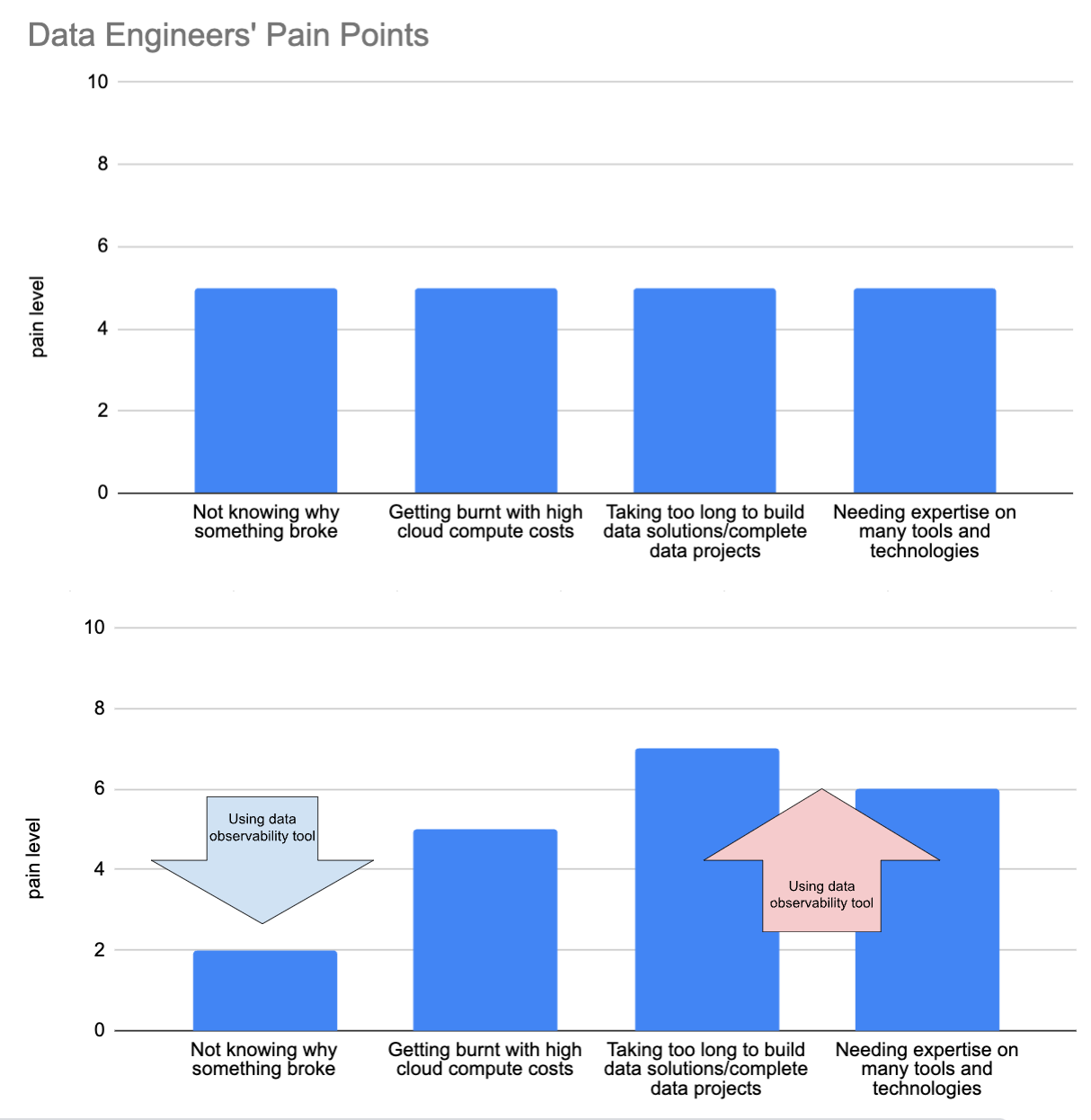 created by the author using Google Sheets
This article aims to present a contrary style of problem solving: radical simplicity.
Learn this step by step with the interactive AI and Data Scientist, Computer Science and Data Engineer roadmaps.
TL;DR
- Software engineers have found massive success in embracing simplicity.
- Over-engineering and pursuing perfection can result in bloated, slow-to-develop data systems, with sky high costs to the business.
- Data teams should consider sacrificing some functionality for the sake of simplicity and speed.
A Lesson From Those Software Guys
In 1989, the computer scientist Richard P. Gabriel wrote a relatively famous essay on computer systems paradoxically called 'Worse Is Better'. I won't go into the details, you can read the essay here if you like, but the underlying message was that software quality does not necessarily improve as functionality increases. In other words, on occasions, you can sacrifice completeness for simplicity and end up with an inherently 'better' product because of it.
This was a strange idea to the pioneers of computing during the 1950/60s. The philosophy of the day was: a computer system needs to be pure, and it can only be pure if it accounts for all possible scenarios. This was likely due to the fact that most leading computer scientists at the time were academics, who very much wanted to treat computer science as a hard science.
Academics at MIT, the leading institution in computing at the time, started working on the operating system for the next generation of computers, called Multics. After nearly a decade of development and millions of dollars of investment, the MIT guys released their new system. It was unquestionably the most advanced operating system of the time, however it was a pain to install due to the computing requirements, and feature updates were slow due to the size of the code base. As a result, it never caught on beyond a few select universities and industries.
While Multics was being built, a small group supporting Multics's development became frustrated with the growing requirements required for the system. They eventually decided to break away from the project. Armed with this experience they set their sights on creating their own operating system, one with a fundamental philosophy shift:
The design must be simple, both in implementation and interface. It is more important for the implementation to be simple than the interface. Simplicity is the most important consideration in a design.
Five years after Multics's release, the breakaway group released their operating system, Unix. Slowly but steadily it caught traction, and by the 1990s Unix became the go-to choice for computers, with over 90% of the world's top 500 fastest supercomputers using it. To this day, Unix is still widely used, most notably as the system underlying macOS.
There were obviously other factors beyond its simplicity that led to Unix's success. But its lightweight design was, and still is, a highly valuable asset of the system. That could only come about because the designers were willing to sacrifice functionality. The data industry should not be afraid to to think the same way.
Back to Data in the 21st Century
Thinking back at my own experiences, the philosophy of most big data engineering projects I've worked on was similar to that of Multics. For example, there was a project where we needed to automate standardising the raw data coming in from all our clients. The decision was made to do this in the data warehouse via dbt, since we could then have a full view of data lineage from the very raw files right through to the standardised single table version and beyond. The problem was that the first stage of transformation was very manual, it required loading each individual raw client file into the warehouse, then dbt creates a model for cleaning each client's file. This led to 100s of dbt models needing to be generated, all using essentially the same logic. Dbt became so bloated it took minutes for the data lineage chart to load in the dbt docs website, and our GitHub Actions for CI (continuous integration) took over an hour to complete for each pull request.
This could have been resolved fairly simply if leadership had allowed us to make the first layer of transformations outside of the data warehouse, using AWS Lambda and Python. But no, that would have meant the data lineage produced by dbt wouldn't be 100% complete. That was it. That was the whole reason not to massively simplify the project. Similar to the group who broke away from the Multics project, I left this project mid-build, it was simply too frustrating to work on something that so clearly could have been much simpler. As I write this, I discovered they are still working on the project.
So, What the Heck is Radical Simplicity?
Radical simplicity in data engineering isn't a framework or data-stack toolkit, it is simply a frame of mind. A philosophy that prioritises simple, straightforward solutions over complex, all-encompassing systems.
Key principles of this philosophy include:
- Minimalism: Focusing on core functionalities that deliver the most value, rather than trying to accommodate every possible scenario or requirement.
- Accepting trade-offs: Willingly sacrificing some degree of completeness or perfection in favour of simplicity, speed, and ease of maintenance.
- Pragmatism over idealism: Prioritising practical, workable solutions that solve real business problems efficiently, rather than pursuing theoretically perfect but overly complex systems.
- Reduced cognitive load: Designing systems and processes that are easier to understand, implement, and maintain, thus reducing the expertise required across multiple tools and technologies.
- Cost-effectiveness: Embracing simpler solutions that often require less computational resources and human capital, leading to lower overall costs.
- Agility and adaptability: Creating systems that are easier to modify and evolve as business needs change, rather than rigid, over-engineered solutions.
- Focus on outcomes: Emphasising the end results and business value rather than getting caught up in the intricacies of the data processes themselves.
This mindset can be in direct contradiction to modern data engineering solutions of adding more tools, processes, and layers. As a result, be expected to fight your corner. Before suggesting an alternative, simpler, solution, come prepared with a deep understanding of the problem at hand. I am reminded of the quote:
It takes a lot of hard work to make something simple, to truly understand the underlying challenges and come up with elegant solutions. [...] It's not just minimalism or the absence of clutter. It involves digging through the depth of complexity. To be truly simple, you have to go really deep. [...] You have to deeply understand the essence of a product in order to be able to get rid of the parts that are not essential.
Side note: Be aware that adopting radical simplicity doesn't mean ignoring new tools and advanced technologies. In fact one of my favourite solutions for a data warehouse at the moment is using a new open-source database called duckDB. Check it out, it's pretty cool.
Conclusion
The lessons from software engineering history offer valuable insights for today's data landscape. By embracing radical simplicity, data teams can address many of the pain points plaguing modern data solutions.
Don't be afraid to champion radical simplicity in your data team. Be the catalyst for change if you see opportunities to streamline and simplify. The path to simplicity isn't easy, but the potential rewards can be substantial.
Register Now to Continue Reading
Unlock Towards Data Science with a Free Account
All articles on Towards Data Science are available to registered users. Create a free account today to access this article and thousands more.
Register for freeSign in to your account
 Written By
See all from Cai Parry-Jones
DataData EngineeringData ScienceProgramming
Share This Article
Towards Data Science is a community publication. Submit your insights to reach our global audience and earn through the TDS Author Payment Program.
Write for TDS
Related Articles
Data Engineering
The Backdrop
Taimoor Akhtar
October 19, 20206 min read
Data Science
Understanding and deploying S3, RDS, and DynamoDB services
Matt Sosna
August 22, 202216 min read
Machine Learning
When is zero actually zero? And when is a lack of information actually information in itself?
Sam Ivanecky
August 23, 20205 min read
Programming
Identity Access Management is the starting point for each enterprise. Learn why.
Daniele Fontani
October 16, 20207 min read
Data Science
A first big step to using QGIS for data science.
Juico Bowley
November 27, 202013 min read
Data Science
An easy-to-follow hands-on tutorial on Plotly Dash. Learn a bit of HTML, CSS, Python Decorators,...
Anshul Sharma
May 23, 202111 min read
Machine Learning
There is a very famous acronym GIGO in the field of computer science which I have learnt in my school days.
Kaushik Choudhury
August 3, 20205 min read
Artificial Intelligence
Is skewed data messing up the power of your predictive model? Let's find out
Dario Radečić
January 4, 20204 min read
Machine Learning
Featurization and blocking key generation
Yifei Huang
November 3, 20205 min read
Your home for data science and AI. The world's leading publication for data science, data analytics, data engineering, machine learning, and artificial intelligence professionals.
Subscribe to Our NewsletterWrite For TDS•About•Advertise•Privacy Policy•Terms of Use
© Insight Media Group, LLC 2026•The New Stack•roadmap.sh•Creator Network
Recommended Articles
Close