保留正文与补采附件。源页面当前未重新核验;具体限制见交付清单。
 We value your privacy
We use cookies to enhance your browsing experience, serve personalised ads or content, and analyse our traffic. By clicking "Accept All", you consent to our use of cookies.
Customise Reject All Accept All
Customise Consent Preferences
 We use cookies to help you navigate efficiently and perform certain functions. You will find detailed information about all cookies under each consent category below.
The cookies that are categorised as "Necessary" are stored on your browser as they are essential for enabling the basic functionalities of the site. ... Show more
NecessaryAlways Active
Necessary cookies are required to enable the basic features of this site, such as providing secure log-in or adjusting your consent preferences. These cookies do not store any personally identifiable data.
-
Cookie
BCTempID
-
Duration
10 minutes
-
Description
No description available.
-
Cookie
__cf_bm
-
Duration
1 hour
-
Description
This cookie, set by Cloudflare, is used to support Cloudflare Bot Management.
-
Cookie
AWSALBCORS
-
Duration
7 days
-
Description
Amazon Web Services set this cookie for load balancing.
-
Cookie
_cfuvid
-
Duration
session
-
Description
Cloudflare sets this cookie to track users across sessions to optimize user experience by maintaining session consistency and providing personalized services
-
Cookie
li_gc
-
Duration
6 months
-
Description
Linkedin set this cookie for storing visitor's consent regarding using cookies for non-essential purposes.
-
Cookie
__hssrc
-
Duration
session
-
Description
This cookie is set by Hubspot whenever it changes the session cookie. The __hssrc cookie set to 1 indicates that the user has restarted the browser, and if the cookie does not exist, it is assumed to be a new session.
-
Cookie
__hssc
-
Duration
1 hour
-
Description
HubSpot sets this cookie to keep track of sessions and to determine if HubSpot should increment the session number and timestamps in the __hstc cookie.
-
Cookie
wpEmojiSettingsSupports
-
Duration
session
-
Description
WordPress sets this cookie when a user interacts with emojis on a WordPress site. It helps determine if the user's browser can display emojis properly.
-
Cookie
BCSessionID
-
Duration
1 year 1 month 4 days
-
Description
Blueconic sets this cookie as a unique identifier for the BlueConic profile.
-
Cookie
_octo
-
Duration
1 year
-
Description
No description available.
-
Cookie
logged_in
-
Duration
1 year
-
Description
No description available.
-
Cookie
__Secure-YEC
-
Duration
past
-
Description
YouTube sets this cookie to stores the user's video player preferences using embedded YouTube video
-
Cookie
__eoi
-
Duration
6 months
-
Description
Description is currently not available.
-
Cookie
AWSALBTGCORS
-
Duration
7 days
-
Description
No description available.
-
Cookie
login-status-p
-
Duration
past
-
Description
Description is currently not available.
-
Cookie
AWSALBTG
-
Duration
7 days
-
Description
No description available.
-
Cookie
csrf_token
-
Duration
session
-
Description
No description available.
-
Cookie
token_v2
-
Duration
1 day
-
Description
Description is currently not available.
-
Cookie
D
-
Duration
1 year
-
Description
Description is currently not available.
-
Cookie
PHPSESSID
-
Duration
session
-
Description
This cookie is native to PHP applications. The cookie stores and identifies a user's unique session ID to manage user sessions on the website. The cookie is a session cookie and will be deleted when all the browser windows are closed.
-
Cookie
VISITOR_PRIVACY_METADATA
-
Duration
6 months
-
Description
YouTube sets this cookie to store the user's cookie consent state for the current domain.
-
Cookie
cookietest
-
Duration
session
-
Description
The cookietest cookie is typically used to determine whether the user's browser accepts cookies, essential for website functionality and user experience.
-
Cookie
__Host-airtable-session
-
Duration
1 year
-
Description
This cookie is used to enable us to integrate the services of Airtable.
-
Cookie
__Host-airtable-session.sig
-
Duration
1 year
-
Description
This cookie is used to enable us to integrate the services of Airtable.
-
Cookie
m
-
Duration
1 year 1 month 4 days
-
Description
Stripe sets this cookie for fraud prevention purposes. It identifies the device used to access the website, allowing the website to be formatted accordingly.
-
Cookie
BIGipServer*
-
Duration
session
-
Description
Marketo sets this cookie to collect information about the user's online activity and build a profile about their interests to provide advertisements relevant to the user.
-
Cookie
__cfruid
-
Duration
session
-
Description
Cloudflare sets this cookie to identify trusted web traffic.
-
Cookie
_GRECAPTCHA
-
Duration
6 months
-
Description
Google Recaptcha service sets this cookie to identify bots to protect the website against malicious spam attacks.
-
Cookie
__Secure-YNID
-
Duration
6 months
-
Description
Google cookie used to protect user security and prevent fraud, especially during the login process.
-
Cookie
cookieyes-consent
-
Duration
1 year
-
Description
CookieYes sets this cookie to remember users' consent preferences so that their preferences are respected on subsequent visits to this site. It does not collect or store any personal information about the site visitors.
Functional
Functional cookies help perform certain functionalities like sharing the content of the website on social media platforms, collecting feedback, and other third-party features.
-
Cookie
lidc
-
Duration
1 day
-
Description
LinkedIn sets the lidc cookie to facilitate data center selection.
-
Cookie
brw
-
Duration
1 year
-
Description
No description available.
-
Cookie
brwConsent
-
Duration
5 minutes
-
Description
Description is currently not available.
-
Cookie
WMF-Uniq
-
Duration
1 year
-
Description
Description is currently not available.
-
Cookie
loom_anon_comment
-
Duration
1 year
-
Description
No description available.
-
Cookie
loom_referral_video
-
Duration
session
-
Description
Description is currently not available.
-
Cookie
VISITOR_INFO1_LIVE
-
Duration
6 months
-
Description
A cookie set by YouTube to measure bandwidth that determines whether the user gets the new or old player interface.
-
Cookie
yt-remote-connected-devices
-
Duration
Never Expires
-
Description
YouTube sets this cookie to store the user's video preferences using embedded YouTube videos.
-
Cookie
ytidb::LAST_RESULT_ENTRY_KEY
-
Duration
Never Expires
-
Description
The cookie ytidb::LAST_RESULT_ENTRY_KEY is used by YouTube to store the last search result entry that was clicked by the user. This information is used to improve the user experience by providing more relevant search results in the future.
-
Cookie
yt-remote-device-id
-
Duration
Never Expires
-
Description
YouTube sets this cookie to store the user's video preferences using embedded YouTube videos.
-
Cookie
yt-remote-session-name
-
Duration
session
-
Description
The yt-remote-session-name cookie is used by YouTube to store the user's video player preferences using embedded YouTube video.
-
Cookie
yt-remote-fast-check-period
-
Duration
session
-
Description
The yt-remote-fast-check-period cookie is used by YouTube to store the user's video player preferences for embedded YouTube videos.
-
Cookie
yt-remote-session-app
-
Duration
session
-
Description
The yt-remote-session-app cookie is used by YouTube to store user preferences and information about the interface of the embedded YouTube video player.
-
Cookie
yt-remote-cast-available
-
Duration
session
-
Description
The yt-remote-cast-available cookie is used to store the user's preferences regarding whether casting is available on their YouTube video player.
-
Cookie
yt-remote-cast-installed
-
Duration
session
-
Description
The yt-remote-cast-installed cookie is used to store the user's video player preferences using embedded YouTube video.
-
Cookie
cp_session
-
Duration
3 months
-
Description
Codepen sets this cookie for Help systems found in the website.
-
Cookie
loid
-
Duration
1 year 1 month 4 days
-
Description
This cookie is set by the Reddit. The cookie enables the sharing of content from the website onto the social media platform.
Analytics
Analytical cookies are used to understand how visitors interact with the website. These cookies help provide information on metrics such as the number of visitors, bounce rate, traffic source, etc.
-
Cookie
__hstc
-
Duration
6 months
-
Description
Hubspot set this main cookie for tracking visitors. It contains the domain, initial timestamp (first visit), last timestamp (last visit), current timestamp (this visit), and session number (increments for each subsequent session).
-
Cookie
hubspotutk
-
Duration
6 months
-
Description
HubSpot sets this cookie to keep track of the visitors to the website. This cookie is passed to HubSpot on form submission and used when deduplicating contacts.
-
Cookie
_ga
-
Duration
1 year 1 month 4 days
-
Description
Google Analytics sets this cookie to calculate visitor, session and campaign data and track site usage for the site's analytics report. The cookie stores information anonymously and assigns a randomly generated number to recognise unique visitors.
-
Cookie
ga*
-
Duration
1 year 1 month 4 days
-
Description
Google Analytics sets this cookie to store and count page views.
-
Cookie
__Host-psifi.analyticsTrace
-
Duration
6 hours
-
Description
Description is currently not available.
-
Cookie
__Host-psifi.analyticsTraceV2
-
Duration
6 hours
-
Description
Description is currently not available.
-
Cookie
_gh_sess
-
Duration
session
-
Description
GitHub sets this cookie for temporary application and framework state between pages like what step the user is on in a multiple step form.
-
Cookie
YSC
-
Duration
session
-
Description
YSC cookie is set by Youtube and is used to track the views of embedded videos on Youtube pages.
-
Cookie
ajs_anonymous_id
-
Duration
1 year
-
Description
This cookie is set by Segment to count the number of people who visit a certain site by tracking if they have visited before.
-
Cookie
vuid
-
Duration
1 year 1 month 4 days
-
Description
Vimeo installs this cookie to collect tracking information by setting a unique ID to embed videos on the website.
Performance
Performance cookies are used to understand and analyse the key performance indexes of the website which helps in delivering a better user experience for the visitors.
-
Cookie
AWSALB
-
Duration
7 days
-
Description
AWSALB is an application load balancer cookie set by Amazon Web Services to map the session to the target.
-
Cookie
acq
-
Duration
past
-
Description
Description is currently not available.
-
Cookie
acq.sig
-
Duration
past
-
Description
Description is currently not available.
-
Cookie
ptc
-
Duration
2 years
-
Description
No description available.
Advertisement
Advertisement cookies are used to provide visitors with customised advertisements based on the pages you visited previously and to analyse the effectiveness of the ad campaigns.
-
Cookie
muc_ads
-
Duration
1 year 1 month 4 days
-
Description
Twitter sets this cookie to collect user behaviour and interaction data to optimize the website.
-
Cookie
guest_id_marketing
-
Duration
1 year 1 month 4 days
-
Description
Twitter sets this cookie to identify and track the website visitor.
-
Cookie
guest_id_ads
-
Duration
1 year 1 month 4 days
-
Description
Twitter sets this cookie to identify and track the website visitor.
-
Cookie
personalization_id
-
Duration
1 year 1 month 4 days
-
Description
Twitter sets this cookie to integrate and share features for social media and also store information about how the user uses the website, for tracking and targeting.
-
Cookie
guest_id
-
Duration
1 year 1 month 4 days
-
Description
Twitter sets this cookie to identify and track the website visitor. It registers if a user is signed in to the Twitter platform and collects information about ad preferences.
-
Cookie
bcookie
-
Duration
1 year
-
Description
LinkedIn sets this cookie from LinkedIn share buttons and ad tags to recognize browser IDs.
-
Cookie
__Secure-ROLLOUT_TOKEN
-
Duration
6 months
-
Description
YouTube sets this cookie to manage feature rollout and experimentation. It helps Google control which new features or interface changes are shown to users as part of testing and staged rollouts, ensuring consistent experience for a given user during an experiment.
-
Cookie
yt.innertube::nextId
-
Duration
Never Expires
-
Description
YouTube sets this cookie to register a unique ID to store data on what videos from YouTube the user has seen.
-
Cookie
yt.innertube::requests
-
Duration
Never Expires
-
Description
YouTube sets this cookie to register a unique ID to store data on what videos from YouTube the user has seen.
-
Cookie
session_tracker
-
Duration
session
-
Description
This cookie is set by the Reddit. This cookie is used to identify trusted web traffic. It also helps in adverstising on the website.
-
Cookie
edgebucket
-
Duration
session
-
Description
Reddit sets this cookie to save the information about a log-on Reddit user, for the purpose of advertisement recommendations and updating the content.
-
Cookie
did
-
Duration
1 year
-
Description
Arbor sets this cookie to show targeted ads to site visitors.This cookie expires after 2 months or 1 year.
Uncategorised
Other uncategorised cookies are those that are being analysed and have not been classified into a category as yet.
No cookies to display.
Reject All Save My Preferences Accept All
Toggle SearchToggle Mobile Navigation
Publish AI, ML & data-science insights to a global community of data professionals.
Sign inSubmit an Article
LatestEditor's PicksNewsletterShipAI
Write For TDS
LinkedInXToggle Search
Data Science
Your Data Quality Checks Are Worth Less (Than You Think)
How to deliver outsized value on your data quality program
Chad Isenberg
November 20, 20245 min read
 Photo by Wolfgang Weiser on Unsplash
Over the last several years, data quality and observability have become hot topics. There is a huge array of solutions in the space (in no particular order, and certainly not exhaustive):
Regardless of their specific features, all of these tools have a similar goal: improve visibility of data quality issues, reduce the number of data incidents, and increase trust. Despite a lower barrier to entry, however, data quality programs remain difficult to implement successfully. I believe that there are three low-hanging fruit that can improve your outcomes. Let's dive in!
Learn this step by step with the interactive AI and Data Scientist, Data Analyst and Data Engineer roadmaps.
Hint 1: Focus on process failures, not bad records (when you can)
For engineering-minded folks, it can be hard pill to swallow that some number of "bad" records will not only flow into your system but through your system, and that may be OK! Consider the following:
- Will the bad records flush out when corrected in the source system? If so, you may go to extraordinary lengths in your warehouse or lakehouse to correct data that is trivial for a source system operator to fix, with the result that your reporting is correct on the next refresh
- Is the dataset useful if it's "directionally correct" in aggregate? CRM data is a classic example, since many fields need to be populated manually, and there's a relatively high error rate compared to automated processes. Even if these errors aren't corrected, as long as they're not systemic, the dataset may still be useful
- Is accuracy of individual records extremely important? Financial reporting, operational reporting on sensor data from expensive machinery, and other "spot-critical" use cases deserve the time and effort needed to identify (and possibly isolate, remove, or remediate) bad records
If your data product can tolerate Type 1 or Type 2 issues, fantastic! You can save a lot of effort by focusing on detection and alerting of process failures rather than one-off or limited anomalies. You can measure high-level metrics skimmed from metadata, such as record counts, unique counts of key columns, and min / max values. A rogue process in your application or SaaS systems can generate too many or too few records, or perhaps a new enumerated value has been added to a column unexpectedly. Depending on your specific use cases, you may need to write custom tests (e. g., total revenue by date and market segment or region), so make sure to profile your data and common failure scenarios.
On the other hand, Type 3 issues require more complex systems and decisions. Do you move bad records to a dead-letter queue and send an alert for manual remediation? Do you build a self-healing process for well-understood data quality issues? Do you simply modify the record in some way to indicate the data quality issue so that downstream processes can decide how to handle the problem? These are all valid approaches, but they do require compute ($) and developer time ($$$$) to maintain.
Hint 2: Don't duplicate your efforts
Long data pipelines with lots of transformation steps require a lot of testing to ensure data quality throughout, but don't make the mistake of repeatedly testing the same data with the same tests. For example, you may be testing that an identifier is not null from a SaaS object or product event stream upon ingestion, and then your transform steps implement the same tests:
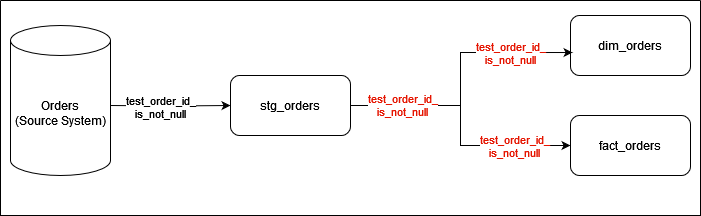 Image by Author
These kinds of duplicate tests can add to cloud spend and development costs, even though they provide no value. The tricky part is that even if you're aware that duplication is a bad pattern, long and complex pipelines can make reasoning about all of their data quality tests difficult.
To my knowledge, there isn't mature tooling available to visualize data quality lineage; just because an upstream source has a data quality test doesn't necessarily mean that it will capture the same kinds of issues as a test in a downstream model. To that end, engineers need to be intentional about data quality monitors. You can't just add a test to a dataset and call it a day; you need to think about the broader data quality ecosystem and what a test adds to it.
Hint 3: Avoid alert fatigue and focus on what matters
Perhaps one of the biggest risks to your data quality program isn't too few data quality tests; it's too many! Frequently, we build out massive suites of data quality monitors and alerts, only to find our teams overwhelmed. When everything's important, nothing is.
 Photo by Brandon Schmidt on Unsplash
If your team can't act on an alert, whether because of an internal force like capacity constraints or an external force like poor data source quality, you probably shouldn't have it in place. That's not to say that you shouldn't have visibility into these issues, but they can be reserved for reports on a less frequent basis, where they can be evaluated alongside more actionable alerts.
Likewise, on a regular basis, review alerts and pages, and ruthlessly cut the ones that weren't actionable. Nobody's winning awards for generating pages and tickets for issues that couldn't be resolved, or whose resolution wasn't worth an engineer's time to address.
Conclusion
Data quality monitoring is an essential component of any modern data operation, and despite the plethora of tools, both open source and proprietary, it can be difficult to implement a successful program. You can spend a lot of time and energy on data quality without seeing results.
To summarize:
- When possible, focus on aggregated data rather than individual data points
- Only test the data once for the same data quality issue. Duplicate tests waste compute and developer time
- Ensure your alert volume doesn't overwhelm your team. If they can't act on all of the alerts in a reasonable amount of time, you either have to staff up, or you need to cut down on the alerts
All of that being said, the most important thing to remember is to focus on value. It can be difficult to quantify the value of your data quality program, but at the very least, you should have some reasonable thesis about your interventions. We know that frozen, broken, or inaccurate pipelines can cost significant amounts of developer, analyst, and business stakeholder time. For every check and monitor, think about how you are or aren't moving the needle. A big impact doesn't require a massive program, as long as you target the right problems.
Register Now to Continue Reading
Unlock Towards Data Science with a Free Account
All articles on Towards Data Science are available to registered users. Create a free account today to access this article and thousands more.
Register for freeSign in to your account
 Written By
See all from Chad Isenberg
AnalyticsDataData EngineeringData QualityData Science
Share This Article
Towards Data Science is a community publication. Submit your insights to reach our global audience and earn through the TDS Author Payment Program.
Write for TDS
Related Articles
Data Science
Impress your audience with animated plots
Eryk Lewinson
January 22, 20225 min read
Programming
Great information from great minds
Sara A. Metwalli
June 11, 20215 min read
Data Science
Tableau is a world-class data analysis and visualization software that lets you see and understand your data easily.
Isha Garg
July 8, 20214 min read
Data Science
Why Use Style Sheet?
Shan Dou
October 17, 20204 min read
Machine Learning
Netflix started as a DVD rental company more than 20 years back. With personalization at its core, Netflix recommended and mailed DVDs to...
Erima Goyal
January 3, 20214 min read
Machine Learning
Learn how to understand your machine learning models better.
Zachary Warnes
November 5, 20215 min read
Data Science
Our weekly selection of must-read Editors' Picks and original features
TDS Editors
April 4, 20243 min read
Data Engineering
Merging to master and sleeping at night
Massimo Belloni
October 7, 20206 min read
Artificial Intelligence
So you have some pdf files with tables in them and want to read them into a pandas data frame. Let me show you how.
Saed Hussain
April 19, 20223 min read
Your home for data science and AI. The world's leading publication for data science, data analytics, data engineering, machine learning, and artificial intelligence professionals.
Subscribe to Our NewsletterWrite For TDS•About•Advertise•Privacy Policy•Terms of Use
© Insight Media Group, LLC 2026•The New Stack•roadmap.sh•Creator Network