保留正文与补采附件。源页面当前未重新核验;具体限制见交付清单。
 We value your privacy
We use cookies to enhance your browsing experience, serve personalised ads or content, and analyse our traffic. By clicking "Accept All", you consent to our use of cookies.
Customise Reject All Accept All
Customise Consent Preferences
 We use cookies to help you navigate efficiently and perform certain functions. You will find detailed information about all cookies under each consent category below.
The cookies that are categorised as "Necessary" are stored on your browser as they are essential for enabling the basic functionalities of the site. ... Show more
NecessaryAlways Active
Necessary cookies are required to enable the basic features of this site, such as providing secure log-in or adjusting your consent preferences. These cookies do not store any personally identifiable data.
-
Cookie
BCTempID
-
Duration
10 minutes
-
Description
No description available.
-
Cookie
__cf_bm
-
Duration
1 hour
-
Description
This cookie, set by Cloudflare, is used to support Cloudflare Bot Management.
-
Cookie
AWSALBCORS
-
Duration
7 days
-
Description
Amazon Web Services set this cookie for load balancing.
-
Cookie
_cfuvid
-
Duration
session
-
Description
Cloudflare sets this cookie to track users across sessions to optimize user experience by maintaining session consistency and providing personalized services
-
Cookie
li_gc
-
Duration
6 months
-
Description
Linkedin set this cookie for storing visitor's consent regarding using cookies for non-essential purposes.
-
Cookie
__hssrc
-
Duration
session
-
Description
This cookie is set by Hubspot whenever it changes the session cookie. The __hssrc cookie set to 1 indicates that the user has restarted the browser, and if the cookie does not exist, it is assumed to be a new session.
-
Cookie
__hssc
-
Duration
1 hour
-
Description
HubSpot sets this cookie to keep track of sessions and to determine if HubSpot should increment the session number and timestamps in the __hstc cookie.
-
Cookie
wpEmojiSettingsSupports
-
Duration
session
-
Description
WordPress sets this cookie when a user interacts with emojis on a WordPress site. It helps determine if the user's browser can display emojis properly.
-
Cookie
BCSessionID
-
Duration
1 year 1 month 4 days
-
Description
Blueconic sets this cookie as a unique identifier for the BlueConic profile.
-
Cookie
_octo
-
Duration
1 year
-
Description
No description available.
-
Cookie
logged_in
-
Duration
1 year
-
Description
No description available.
-
Cookie
__Secure-YEC
-
Duration
past
-
Description
YouTube sets this cookie to stores the user's video player preferences using embedded YouTube video
-
Cookie
__eoi
-
Duration
6 months
-
Description
Description is currently not available.
-
Cookie
AWSALBTGCORS
-
Duration
7 days
-
Description
No description available.
-
Cookie
login-status-p
-
Duration
past
-
Description
Description is currently not available.
-
Cookie
AWSALBTG
-
Duration
7 days
-
Description
No description available.
-
Cookie
csrf_token
-
Duration
session
-
Description
No description available.
-
Cookie
token_v2
-
Duration
1 day
-
Description
Description is currently not available.
-
Cookie
D
-
Duration
1 year
-
Description
Description is currently not available.
-
Cookie
PHPSESSID
-
Duration
session
-
Description
This cookie is native to PHP applications. The cookie stores and identifies a user's unique session ID to manage user sessions on the website. The cookie is a session cookie and will be deleted when all the browser windows are closed.
-
Cookie
VISITOR_PRIVACY_METADATA
-
Duration
6 months
-
Description
YouTube sets this cookie to store the user's cookie consent state for the current domain.
-
Cookie
cookietest
-
Duration
session
-
Description
The cookietest cookie is typically used to determine whether the user's browser accepts cookies, essential for website functionality and user experience.
-
Cookie
__Host-airtable-session
-
Duration
1 year
-
Description
This cookie is used to enable us to integrate the services of Airtable.
-
Cookie
__Host-airtable-session.sig
-
Duration
1 year
-
Description
This cookie is used to enable us to integrate the services of Airtable.
-
Cookie
m
-
Duration
1 year 1 month 4 days
-
Description
Stripe sets this cookie for fraud prevention purposes. It identifies the device used to access the website, allowing the website to be formatted accordingly.
-
Cookie
BIGipServer*
-
Duration
session
-
Description
Marketo sets this cookie to collect information about the user's online activity and build a profile about their interests to provide advertisements relevant to the user.
-
Cookie
__cfruid
-
Duration
session
-
Description
Cloudflare sets this cookie to identify trusted web traffic.
-
Cookie
_GRECAPTCHA
-
Duration
6 months
-
Description
Google Recaptcha service sets this cookie to identify bots to protect the website against malicious spam attacks.
-
Cookie
__Secure-YNID
-
Duration
6 months
-
Description
Google cookie used to protect user security and prevent fraud, especially during the login process.
-
Cookie
cookieyes-consent
-
Duration
1 year
-
Description
CookieYes sets this cookie to remember users' consent preferences so that their preferences are respected on subsequent visits to this site. It does not collect or store any personal information about the site visitors.
Functional
Functional cookies help perform certain functionalities like sharing the content of the website on social media platforms, collecting feedback, and other third-party features.
-
Cookie
lidc
-
Duration
1 day
-
Description
LinkedIn sets the lidc cookie to facilitate data center selection.
-
Cookie
brw
-
Duration
1 year
-
Description
No description available.
-
Cookie
brwConsent
-
Duration
5 minutes
-
Description
Description is currently not available.
-
Cookie
WMF-Uniq
-
Duration
1 year
-
Description
Description is currently not available.
-
Cookie
loom_anon_comment
-
Duration
1 year
-
Description
No description available.
-
Cookie
loom_referral_video
-
Duration
session
-
Description
Description is currently not available.
-
Cookie
VISITOR_INFO1_LIVE
-
Duration
6 months
-
Description
A cookie set by YouTube to measure bandwidth that determines whether the user gets the new or old player interface.
-
Cookie
yt-remote-connected-devices
-
Duration
Never Expires
-
Description
YouTube sets this cookie to store the user's video preferences using embedded YouTube videos.
-
Cookie
ytidb::LAST_RESULT_ENTRY_KEY
-
Duration
Never Expires
-
Description
The cookie ytidb::LAST_RESULT_ENTRY_KEY is used by YouTube to store the last search result entry that was clicked by the user. This information is used to improve the user experience by providing more relevant search results in the future.
-
Cookie
yt-remote-device-id
-
Duration
Never Expires
-
Description
YouTube sets this cookie to store the user's video preferences using embedded YouTube videos.
-
Cookie
yt-remote-session-name
-
Duration
session
-
Description
The yt-remote-session-name cookie is used by YouTube to store the user's video player preferences using embedded YouTube video.
-
Cookie
yt-remote-fast-check-period
-
Duration
session
-
Description
The yt-remote-fast-check-period cookie is used by YouTube to store the user's video player preferences for embedded YouTube videos.
-
Cookie
yt-remote-session-app
-
Duration
session
-
Description
The yt-remote-session-app cookie is used by YouTube to store user preferences and information about the interface of the embedded YouTube video player.
-
Cookie
yt-remote-cast-available
-
Duration
session
-
Description
The yt-remote-cast-available cookie is used to store the user's preferences regarding whether casting is available on their YouTube video player.
-
Cookie
yt-remote-cast-installed
-
Duration
session
-
Description
The yt-remote-cast-installed cookie is used to store the user's video player preferences using embedded YouTube video.
-
Cookie
cp_session
-
Duration
3 months
-
Description
Codepen sets this cookie for Help systems found in the website.
-
Cookie
loid
-
Duration
1 year 1 month 4 days
-
Description
This cookie is set by the Reddit. The cookie enables the sharing of content from the website onto the social media platform.
Analytics
Analytical cookies are used to understand how visitors interact with the website. These cookies help provide information on metrics such as the number of visitors, bounce rate, traffic source, etc.
-
Cookie
__hstc
-
Duration
6 months
-
Description
Hubspot set this main cookie for tracking visitors. It contains the domain, initial timestamp (first visit), last timestamp (last visit), current timestamp (this visit), and session number (increments for each subsequent session).
-
Cookie
hubspotutk
-
Duration
6 months
-
Description
HubSpot sets this cookie to keep track of the visitors to the website. This cookie is passed to HubSpot on form submission and used when deduplicating contacts.
-
Cookie
_ga
-
Duration
1 year 1 month 4 days
-
Description
Google Analytics sets this cookie to calculate visitor, session and campaign data and track site usage for the site's analytics report. The cookie stores information anonymously and assigns a randomly generated number to recognise unique visitors.
-
Cookie
ga*
-
Duration
1 year 1 month 4 days
-
Description
Google Analytics sets this cookie to store and count page views.
-
Cookie
__Host-psifi.analyticsTrace
-
Duration
6 hours
-
Description
Description is currently not available.
-
Cookie
__Host-psifi.analyticsTraceV2
-
Duration
6 hours
-
Description
Description is currently not available.
-
Cookie
_gh_sess
-
Duration
session
-
Description
GitHub sets this cookie for temporary application and framework state between pages like what step the user is on in a multiple step form.
-
Cookie
YSC
-
Duration
session
-
Description
YSC cookie is set by Youtube and is used to track the views of embedded videos on Youtube pages.
-
Cookie
ajs_anonymous_id
-
Duration
1 year
-
Description
This cookie is set by Segment to count the number of people who visit a certain site by tracking if they have visited before.
-
Cookie
vuid
-
Duration
1 year 1 month 4 days
-
Description
Vimeo installs this cookie to collect tracking information by setting a unique ID to embed videos on the website.
Performance
Performance cookies are used to understand and analyse the key performance indexes of the website which helps in delivering a better user experience for the visitors.
-
Cookie
AWSALB
-
Duration
7 days
-
Description
AWSALB is an application load balancer cookie set by Amazon Web Services to map the session to the target.
-
Cookie
acq
-
Duration
past
-
Description
Description is currently not available.
-
Cookie
acq.sig
-
Duration
past
-
Description
Description is currently not available.
-
Cookie
ptc
-
Duration
2 years
-
Description
No description available.
Advertisement
Advertisement cookies are used to provide visitors with customised advertisements based on the pages you visited previously and to analyse the effectiveness of the ad campaigns.
-
Cookie
muc_ads
-
Duration
1 year 1 month 4 days
-
Description
Twitter sets this cookie to collect user behaviour and interaction data to optimize the website.
-
Cookie
guest_id_marketing
-
Duration
1 year 1 month 4 days
-
Description
Twitter sets this cookie to identify and track the website visitor.
-
Cookie
guest_id_ads
-
Duration
1 year 1 month 4 days
-
Description
Twitter sets this cookie to identify and track the website visitor.
-
Cookie
personalization_id
-
Duration
1 year 1 month 4 days
-
Description
Twitter sets this cookie to integrate and share features for social media and also store information about how the user uses the website, for tracking and targeting.
-
Cookie
guest_id
-
Duration
1 year 1 month 4 days
-
Description
Twitter sets this cookie to identify and track the website visitor. It registers if a user is signed in to the Twitter platform and collects information about ad preferences.
-
Cookie
bcookie
-
Duration
1 year
-
Description
LinkedIn sets this cookie from LinkedIn share buttons and ad tags to recognize browser IDs.
-
Cookie
__Secure-ROLLOUT_TOKEN
-
Duration
6 months
-
Description
YouTube sets this cookie to manage feature rollout and experimentation. It helps Google control which new features or interface changes are shown to users as part of testing and staged rollouts, ensuring consistent experience for a given user during an experiment.
-
Cookie
yt.innertube::nextId
-
Duration
Never Expires
-
Description
YouTube sets this cookie to register a unique ID to store data on what videos from YouTube the user has seen.
-
Cookie
yt.innertube::requests
-
Duration
Never Expires
-
Description
YouTube sets this cookie to register a unique ID to store data on what videos from YouTube the user has seen.
-
Cookie
session_tracker
-
Duration
session
-
Description
This cookie is set by the Reddit. This cookie is used to identify trusted web traffic. It also helps in adverstising on the website.
-
Cookie
edgebucket
-
Duration
session
-
Description
Reddit sets this cookie to save the information about a log-on Reddit user, for the purpose of advertisement recommendations and updating the content.
-
Cookie
did
-
Duration
1 year
-
Description
Arbor sets this cookie to show targeted ads to site visitors.This cookie expires after 2 months or 1 year.
Uncategorised
Other uncategorised cookies are those that are being analysed and have not been classified into a category as yet.
No cookies to display.
Reject All Save My Preferences Accept All
Toggle SearchToggle Mobile Navigation
Publish AI, ML & data-science insights to a global community of data professionals.
Sign inSubmit an Article
LatestEditor's PicksNewsletterShipAI
Write For TDS
LinkedInXToggle Search
Large Language Models
Supercharge Your RAG with Multi-Agent Self-RAG
Apply human reasoning to your RAG application
Julian Yip
February 5, 202513 min read
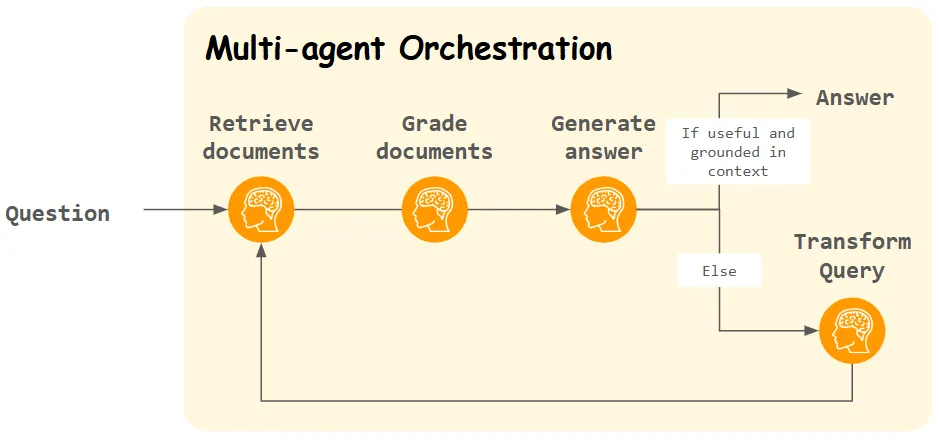 Drawn by the author. Icons are attributed to Brain icons created by Smashicons — Flaticon
Introduction
Many of us might have tried to build a RAG application and noticed it falls significantly short of addressing real-life needs. Why is that? It’s because many real-world problems require multiple steps of information retrieval and reasoning. We need our agent to perform those as humans normally do, yet most RAG applications fall short of this.
This article explores how to supercharge your RAG application by making its data retrieval and reasoning process similar to how a human would, under a multi-agent framework. The framework presented here is based on the Self-RAG strategy but has been significantly modified to enhance its capabilities. Prior knowledge of the original strategy is not necessary for reading this article.
Real-life Case
Consider this: I was going to fly from Delhi to Munich (let’s assume I am taking the flight from an EU airline), but I was denied boarding somehow. Now I want to know what the compensation should be.
These two webpages contain relevant information, I go ahead adding them to my vector store, trying to have my agent answer this for me by retrieving the right information.
Learn this step by step with the interactive AI Engineer roadmap.
Now, I pass this question to the vector store: “how much can I receive if I am denied boarding, for flights from Delhi to Munich?”.
text
– – – – – – – – – – – – – – – – – – – – – – – – –
Overview of US Flight Compensation Policies To get compensation for delayed flights, you should contact your airline via their customer service or go to the customer service desk. At the same time, you should bear in mind that you will only receive compensation if the delay is not weather-related and is within the carrier`s control. According to the US Department of Transportation, US airlines are not required to compensate you if a flight is cancelled or delayed. You can be compensated if you are bumped or moved from an overbooked flight. If your provider cancels your flight less than two weeks before departure and you decide to cancel your trip entirely, you can receive a refund of both pre-paid baggage fees and your plane ticket. There will be no refund if you choose to continue your journey. In the case of a delayed flight, the airline will rebook you on a different flight. According to federal law, you will not be provided with money or other compensation. Comparative Analysis of EU vs. US Flight Compensation Policies
– – – – – – – – – – – – – – – – – – – – – – – – –
(AUTHOR-ADDED NOTE: IMPORTANT, PAY ATTENTION TO THIS)
Short-distance flight delays – if it is up to 1,500 km, you are due 250 Euro compensation.
Medium distance flight delays – for all the flights between 1,500 and 3,500 km, the compensation should be 400 Euro.
Long-distance flight delays – if it is over 3,500 km, you are due 600 Euro compensation. To receive this kind of compensation, the following conditions must be met; Your flight starts in a non-EU member state or in an EU member state and finishes in an EU member state and is organised by an EU airline. Your flight reaches the final destination with a delay that exceeds three hours. There is no force majeure.
– – – – – – – – – – – – – – – – – – – – – – – – –
Compensation policies in the EU and US are not the same, which implies that it is worth knowing more about them. While you can always count on Skycop flight cancellation compensation, you should still get acquainted with the information below.
– – – – – – – – – – – – – – – – – – – – – – – – –
Compensation for flight regulations EU: The EU does regulate flight delay compensation, which is known as EU261. US: According to the US Department of Transportation, every airline has its own policies about what should be done for delayed passengers. Compensation for flight delays EU: Just like in the United States, compensation is not provided when the flight is delayed due to uncontrollable reasons. However, there is a clear approach to compensation calculation based on distance. For example, if your flight was up to 1,500 km, you can receive 250 euros. US: There are no federal requirements. That is why every airline sets its own limits for compensation in terms of length. However, it is usually set at three hours. Overbooking EU: In the EU, they call for volunteers if the flight is overbooked. These people are entitled to a choice of: Re-routing to their final destination at the earliest opportunity. Refund of their ticket cost within a week if not travelling. Re-routing at a later date at the person`s convenience.
Unfortunately, they contain only generic flight compensation policies, without telling me how much I can expect when denied boarding from Delhi to Munich specifically. If the RAG agent takes these as the sole context, it can only provide a generic answer about flight compensation policy, without giving the answer we want.
However, while the documents are not immediately useful, there is an important insight contained in the 2nd piece of context: compensation varies according to flight distance. If the RAG agent thinks more like human, it should follow these steps to provide an answer:
- Based on the retrieved context, reason that compensation varies with flight distance
- Next, retrieve the flight distance between Delhi and Munich
- Given the distance (which is around 5900km), classify the flight as a long-distance one
- Combined with the previously retrieved context, figure out I am due 600 EUR, assuming other conditions are fulfilled
This example demonstrates how a simple RAG, in which a single retrieval is made, fall short for several reasons:
- Complex Queries : Users often have questions that a simple search can’t fully address. For example, “What’s the best smartphone for gaming under $500?” requires consideration of multiple factors like performance, price, and features, which a single retrieval step might miss.
- Deep Information : Some information lies across documents. For example, research papers, medical records, or legal documents often include references that need to be made sense of, before one can fully understand the content of a given article. Multiple retrieval steps help dig deeper into the content.
Multiple retrievals supplemented with human-like reasoning allow for a more nuanced, comprehensive, and accurate response, adapting to the complexity and depth of user queries.
Multi-Agent Self-RAG
Here I explain the reasoning process behind this strategy, afterwards I will provide the code to show you how to achieve this!
Note: For readers interested in knowing how my approach differs from the original Self-RAG, I will describe the discrepancies in quotation boxes like this. But general readers who are unfamiliar with the original Self-RAG can skip them.
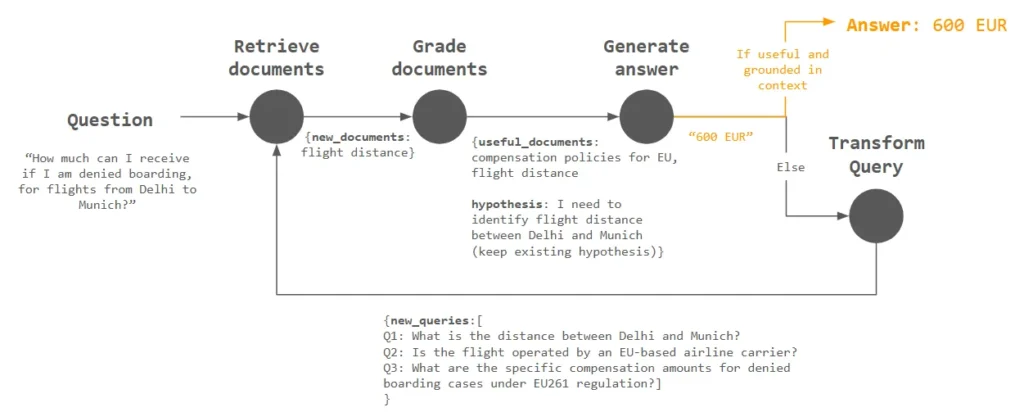
In the below graphs, each circle represents a step (aka Node), which is performed by a dedicated agent working on the specific problem. We orchestrate them to form a multi-agent RAG application.
1st iteration: Simple RAG
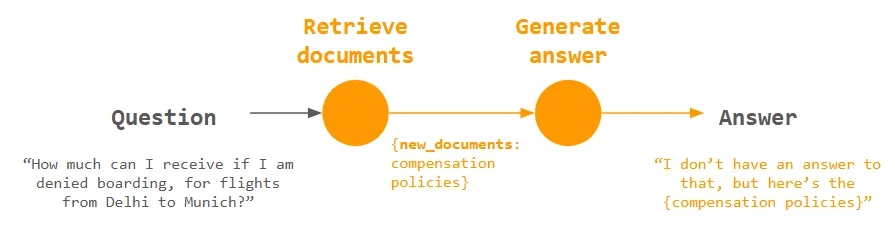 A simple RAG chain
This is just the vanilla RAG approach I described in “Real-life Case”, represented as a graph. After
Retrieve documents, the new_documents will be used as input for Generate Answer. Nothing special, but it serves as our starting point.
2nd iteration: Digest documents with “Grade documents”
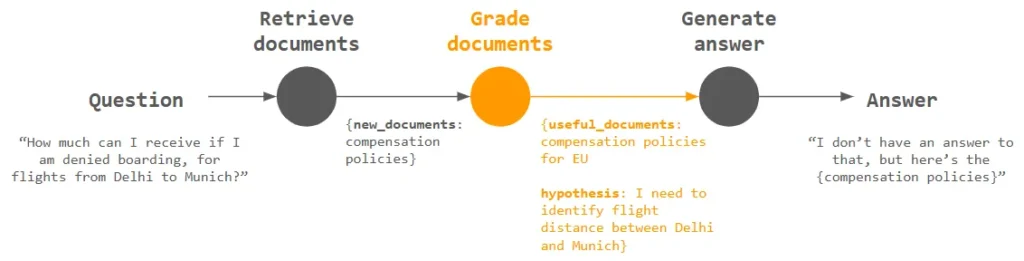 Reasoning like human do
Remember I said in the “Real-life Case” section, that as a next step, the agent should “reason that compensation varies with flight distance”? The
Grade documents step is exactly for this purpose.
Given the new_documents, the agent will try to output two items:
useful_documents: Comparing the question asked, it determines if the documents are useful, and retain a memory for those deemed useful for future reference. As an example, since our question does not concern compensation policies for US, documents describing those are discarded, leaving only those for EUhypothesis: Based on the documents, the agent forms a hypothesis about how the question can be answered, that is, flight distance needs to be identified
Notice how the above reasoning resembles human thinking! But still, while these outputs are useful, we need to instruct the agent to use them as input for performing the next document retrieval. Without this, the answer provided in Generate answer is still not useful.
useful_documents are appended for each document retrieval loop, instead of being overwritten, to keep a memory of documents that are previously deemed useful. hypothesis is formed from useful_documents and new_documents to provide an “abstract reasoning” to inform how query is to be transformed subsequently.
The hypothesis is especially useful when no useful documents can be identified initially, as the agent can still form hypothesis from documents not immediately deemed as useful / only bearing indirect relationship to the question at hand, for informing what questions to ask next
3rd iteration: Brainstorm new questions to ask
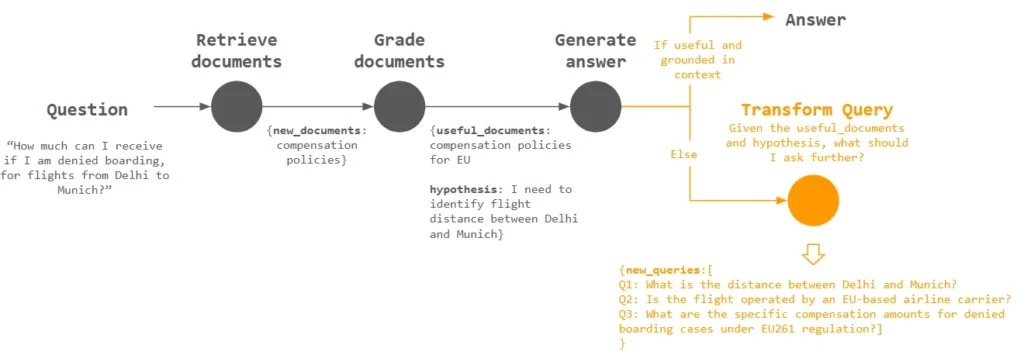 Suggest questions for additional information retrieval
We have the agent reflect upon whether the answer is useful and grounded in context. If not, it should proceed to
Transform query to ask further questions.
The output new_queries will be a list of new questions that the agent consider useful for obtaining extra information. Given the useful_documents (compensation policies for EU), and hypothesis (need to identify flight distance between Delhi and Munich), it asks questions like “What is the distance between Delhi and Munich?”
Now we are ready to use the new_queries for further retrieval!
The transform_query node will use useful_documents (which are accumulated per iteration, instead of being overwritten) and hypothesis as input for providing the agent directions to ask new questions.
The new questions will be a list of questions (instead of a single question) separated from the original question, so that the original question is kept in state, otherwise the agent could lose track of the original question after multiple iterations.
Final iteration: Further retrieval with new questions
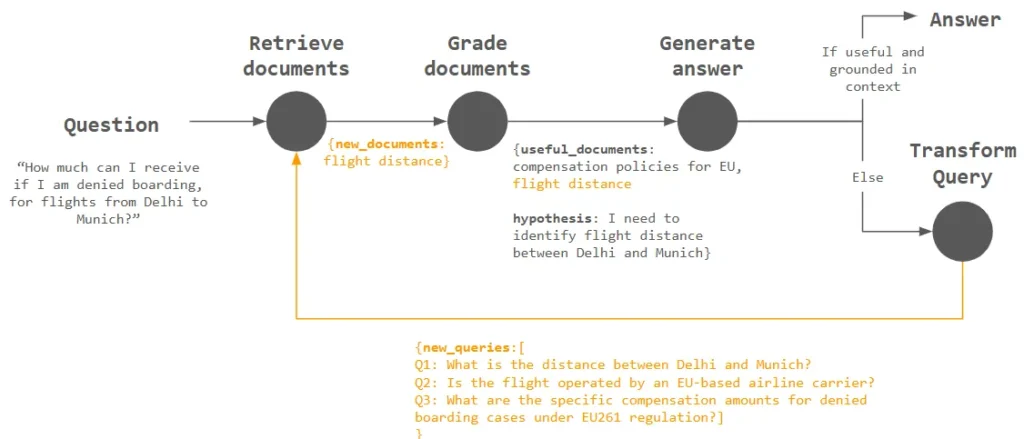 Issuing new queries to retrieve extra documents
The output
new_queries from Transform query will be passed to the Retrieve documents step, forming a retrieval loop.
Since the question “What is the distance between Delhi and Munich?” is asked, we can expect the flight distance is then retrieved as new_documents, and subsequently graded as useful_documents, further used as an input for Generate answer.
The _grade_documents_node will compare the documents against both the original _question_and _new_questions_list, so that documents that are considered useful for _new_questions_, even if not so for the original _question_, are kept.
This is because those documents might help answer the original _question_indirectly, by being relevant to _new_questions_(like “ What is the distance between Delhi and Munich?”)
 Final answer!
Equipped with this new context about flight distance, the agent is now ready to provide the right answer: 600 EUR!
Next, let us now dive into the code to see how this multi-agent RAG application is created.
Implementation
The source code can be found here. Our multi-agent RAG application involves iterations and loops, and LangGraph is a great library for building such complex multi-agent application. If you are not familiar with LangGraph, you are strongly suggested to have a look at LangGraph’s Quickstart guide to understand more about it!
To keep this article concise, I will focus on the key code snippets only.
Important note : I am using OpenRouter as the Llm interface, but the code can be easily adapted for other LLM interfaces. Also, while in my code I am using Claude 3.5 Sonnet as model, you can use any LLM as long as it support tools as parameter (check this list here), so you can also run this with other models, like DeepSeek V3 and OpenAI o1!
State definition
In the previous section, I have defined various elements e.g. new_documents, hypothesis that are to be passed to each step (aka Nodes), in LangGraph’s terminology these elements are called State.
We define the State formally with the following snippet.
python
from typing import List, Annotated
from typing_extensions import TypedDict

def append_to_list(original: list, new: list) -> list:
    original.append(new)
    return original

def combine_list(original: list, new: list) -> list:
    return original + new

class GraphState(TypedDict):
    """
    Represents the state of our graph.

    Attributes:
        question: question
        generation: LLM generation
        new_documents: newly retrieved documents for the current iteration
        useful_documents: documents that are considered useful
        graded_documents: documents that have been graded
        new_queries: newly generated questions
        hypothesis: hypothesis
    """

    question: str
    generation: str
    new_documents: List[str]
    useful_documents: Annotated[List[str], combine_list]
    graded_documents: List[str]
    new_queries: Annotated[List[str], append_to_list]
    hypothesis: str
Graph definition
This is where we combine the different steps to form a “Graph ”, which is a representation of our multi-agent application. The definitions of various steps (e.g. grade_documents) are represented by their respective functions.
python
from langgraph.graph import END, StateGraph, START
from langgraph.checkpoint.memory import MemorySaver
from IPython.display import Image, display

workflow = StateGraph(GraphState)

# Define the nodes
workflow.add_node("retrieve", retrieve)  # retrieve
workflow.add_node("grade_documents", grade_documents)  # grade documents
workflow.add_node("generate", generate)  # generatae
workflow.add_node("transform_query", transform_query)  # transform_query

# Build graph
workflow.add_edge(START, "retrieve")
workflow.add_edge("retrieve", "grade_documents")
workflow.add_conditional_edges(
    "grade_documents",
    decide_to_generate,
    {
        "transform_query": "transform_query",
        "generate": "generate",
    },
)
workflow.add_edge("transform_query", "retrieve")
workflow.add_conditional_edges(
    "generate",
    grade_generation_v_documents_and_question,
    {
        "useful": END,
        "not supported": "transform_query",
        "not useful": "transform_query",
    },
)

# Compile
memory = MemorySaver()
app = workflow.compile(checkpointer=memory)
display(Image(app.get_graph(xray=True).draw_mermaid_png()))
Running the above code, you should see this graphical representation of our RAG application. Notice how it is essentially equivalent to the graph I have shown in the final iteration of “Enhanced Self-RAG Strategy”!
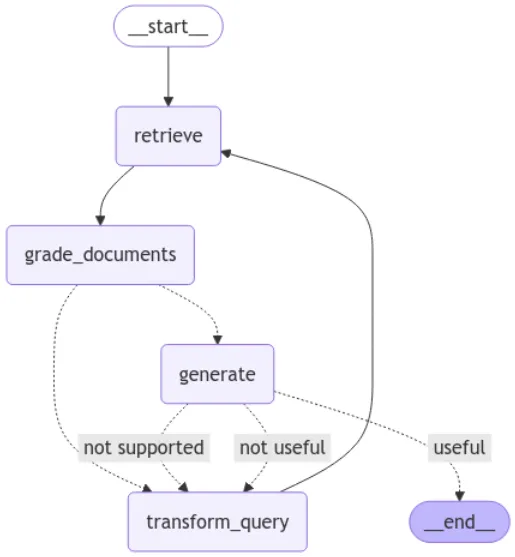 Visualizing the multi-agent RAG graph
After generate, if the answer is considered “not supported”, the agent will proceed to transform_query intead of to generate again, so that the agent will look for additional information rather than trying to regenerate answers based on existing context, which might not suffice for providing a “supported” answer
Now we are ready to put the multi-agent application to test! With the below code snippet, we ask this question how much can I receive if I am denied boarding, for flights from Delhi to Munich?
python
from pprint import pprint
config = {"configurable": {"thread_id": str(uuid4())}}

# Run
inputs = {
    "question": "how much can I receive if I am denied boarding, for flights from Delhi to Munich?",
    }
for output in app.stream(inputs, config):
    for key, value in output.items():
        # Node
        pprint(f"Node '{key}':")
        # Optional: print full state at each node
        # print(app.get_state(config).values)
    pprint("\n---\n")

# Final generation
pprint(value["generation"])
While output might vary (sometimes the application provides the answer without any iterations, because it “guessed” the distance between Delhi and Munich), it should look something like this, which shows the application went through multiple rounds of data retrieval for RAG.
python
---RETRIEVE---
"Node 'retrieve':"
'\n---\n'
---CHECK DOCUMENT RELEVANCE TO QUESTION---
---GRADE: DOCUMENT NOT RELEVANT---
---GRADE: DOCUMENT RELEVANT---
---GRADE: DOCUMENT NOT RELEVANT---
---GRADE: DOCUMENT NOT RELEVANT---
---ASSESS GRADED DOCUMENTS---
---DECISION: GENERATE---
"Node 'grade_documents':"
'\n---\n'
---GENERATE---
---CHECK HALLUCINATIONS---
'---DECISION: GENERATION IS NOT GROUNDED IN DOCUMENTS, RE-TRY---'
"Node 'generate':"
'\n---\n'
---TRANSFORM QUERY---
"Node 'transform_query':"
'\n---\n'
---RETRIEVE---
"Node 'retrieve':"
'\n---\n'
---CHECK DOCUMENT RELEVANCE TO QUESTION---
---GRADE: DOCUMENT NOT RELEVANT---
---GRADE: DOCUMENT NOT RELEVANT---
---GRADE: DOCUMENT RELEVANT---
---GRADE: DOCUMENT NOT RELEVANT---
---GRADE: DOCUMENT NOT RELEVANT---
---GRADE: DOCUMENT NOT RELEVANT---
---GRADE: DOCUMENT NOT RELEVANT---
---ASSESS GRADED DOCUMENTS---
---DECISION: GENERATE---
"Node 'grade_documents':"
'\n---\n'
---GENERATE---
---CHECK HALLUCINATIONS---
---DECISION: GENERATION IS GROUNDED IN DOCUMENTS---
---GRADE GENERATION vs QUESTION---
---DECISION: GENERATION ADDRESSES QUESTION---
"Node 'generate':"
'\n---\n'
('Based on the context provided, the flight distance from Munich to Delhi is '
 '5,931 km, which falls into the long-distance category (over 3,500 km). '
 'Therefore, if you are denied boarding on a flight from Delhi to Munich '
 'operated by an EU airline, you would be eligible for 600 Euro compensation, '
 'provided that:\n'
 '1. The flight is operated by an EU airline\n'
 '2. There is no force majeure\n'
 '3. Other applicable conditions are met\n'
 '\n'
 "However, it's important to note that this compensation amount is only valid "
 'if all the required conditions are met as specified in the regulations.')
And the final answer is what we aimed for!
text
Based on the context provided, the flight distance from Munich to Delhi is
5,931 km, which falls into the long-distance category (over 3,500 km).
Therefore, if you are denied boarding on a flight from Delhi to Munich
operated by an EU airline, you would be eligible for 600 Euro compensation,
provided that:
1. The flight is operated by an EU airline
2. There is no force majeure
3. Other applicable conditions are met

However, it's important to note that this compensation amount is only valid
if all the required conditions are met as specified in the regulations.
Inspecting the State, we see how the hypothesis and new_queries enhance the effectiveness of our multi-agent RAG application by mimicking human thinking process.
Hypothesis
python
print(app.get_state(config).values.get('hypothesis',""))
text
--- Output ---
To answer this question accurately, I need to determine:

1. Is this flight operated by an EU airline? (Since Delhi is non-EU and Munich is EU)
2. What is the flight distance between Delhi and Munich? (To determine compensation amount)
3. Are we dealing with a denied boarding situation due to overbooking? (As opposed to delay/cancellation)

From the context, I can find information about compensation amounts based on distance, but I need to verify:
- If the flight meets EU compensation eligibility criteria
- The exact distance between Delhi and Munich to determine which compensation tier applies (250€, 400€, or 600€)
- If denied boarding compensation follows the same amounts as delay compensation

The context doesn't explicitly state compensation amounts specifically for denied boarding, though it mentions overbooking situations in the EU require offering volunteers re-routing or refund options.

Would you like me to proceed with the information available, or would you need additional context about denied boarding compensation specifically?
New Queries
python
for questions_batch in app.get_state(config).values.get('new_queries',""):
    for q in questions_batch:
        print(q)
text
--- Output ---
What is the flight distance between Delhi and Munich?
Does EU denied boarding compensation follow the same amounts as flight delay compensation?
Are there specific compensation rules for denied boarding versus flight delays for flights from non-EU to EU destinations?
What are the compensation rules when flying with non-EU airlines from Delhi to Munich?
What are the specific conditions that qualify as denied boarding under EU regulations?
Conclusion
Simple RAG, while easy to build, might fall short in tackling real-life questions. By incorporating human thinking process into a multi-agent RAG framework, we are making RAG applications much more practical.
*Unless otherwise noted, all images are by the author
Register Now to Continue Reading
Unlock Towards Data Science with a Free Account
All articles on Towards Data Science are available to registered users. Create a free account today to access this article and thousands more.
Register for freeSign in to your account
 Written By
See all from Julian Yip
Agentic AiLlmLlm AgentMulti Agent SystemsRetrieval Augmented
Share This Article
Towards Data Science is a community publication. Submit your insights to reach our global audience and earn through the TDS Author Payment Program.
Write for TDS
Related Articles
Programming
How I learned to use AI as an alternative to generate amazing random data.
Kory Becker
June 9, 20248 min read
Deep Learning
Adapt a pre-trained model to a new domain using HuggingFace
Mina Ghashami
November 14, 202313 min read
Agentic AI
Get the most out of Claude Code with these four techniques
Eivind Kjosbakken
June 8, 20269 min read
Deep Learning
LLMs are often said to have 'emergent properties'. But what do we even mean by that, and what's the hard evidence?
Anna Rogers
July 15, 202412 min read
Artificial Intelligence
A practical, beginner‑friendly guide to building an AI weather assistant with Python, OpenAI Agents SDK, API tools, and Streamlit.
Iqbal Rahmadhan
July 21, 202513 min read
Large Language Models
A hands-on example of building a time-series anomaly detection system entirely through visualization and prompting
Shuai Guo
September 20, 202511 min read
Large Language Models
Learn how to build an application that might inspire your next road trip
Robert Martin-Short
September 26, 202312 min read
Large Language Models
Prompting ChatGPT and other chatbased language AI - and why you should (not) care about it
Georg Ruile, Ph.D.
April 19, 202413 min read
ChatGPT
Discussing LLMs like ChatGPT, the underlying costs, and inference optimization approaches
Dmytro Nikolaiev (Dimid)
March 31, 202313 min read
Your home for data science and AI. The world's leading publication for data science, data analytics, data engineering, machine learning, and artificial intelligence professionals.
Subscribe to Our NewsletterWrite For TDS•About•Advertise•Privacy Policy•Terms of Use
© Insight Media Group, LLC 2026•The New Stack•roadmap.sh•Creator Network
Recommended Articles
Close