保留正文与补采附件。源页面当前未重新核验;具体限制见交付清单。
 We value your privacy
We use cookies to enhance your browsing experience, serve personalised ads or content, and analyse our traffic. By clicking "Accept All", you consent to our use of cookies.
Customise Reject All Accept All
Customise Consent Preferences
 We use cookies to help you navigate efficiently and perform certain functions. You will find detailed information about all cookies under each consent category below.
The cookies that are categorised as "Necessary" are stored on your browser as they are essential for enabling the basic functionalities of the site. ... Show more
NecessaryAlways Active
Necessary cookies are required to enable the basic features of this site, such as providing secure log-in or adjusting your consent preferences. These cookies do not store any personally identifiable data.
-
Cookie
BCTempID
-
Duration
10 minutes
-
Description
No description available.
-
Cookie
__cf_bm
-
Duration
1 hour
-
Description
This cookie, set by Cloudflare, is used to support Cloudflare Bot Management.
-
Cookie
AWSALBCORS
-
Duration
7 days
-
Description
Amazon Web Services set this cookie for load balancing.
-
Cookie
_cfuvid
-
Duration
session
-
Description
Cloudflare sets this cookie to track users across sessions to optimize user experience by maintaining session consistency and providing personalized services
-
Cookie
li_gc
-
Duration
6 months
-
Description
Linkedin set this cookie for storing visitor's consent regarding using cookies for non-essential purposes.
-
Cookie
__hssrc
-
Duration
session
-
Description
This cookie is set by Hubspot whenever it changes the session cookie. The __hssrc cookie set to 1 indicates that the user has restarted the browser, and if the cookie does not exist, it is assumed to be a new session.
-
Cookie
__hssc
-
Duration
1 hour
-
Description
HubSpot sets this cookie to keep track of sessions and to determine if HubSpot should increment the session number and timestamps in the __hstc cookie.
-
Cookie
wpEmojiSettingsSupports
-
Duration
session
-
Description
WordPress sets this cookie when a user interacts with emojis on a WordPress site. It helps determine if the user's browser can display emojis properly.
-
Cookie
BCSessionID
-
Duration
1 year 1 month 4 days
-
Description
Blueconic sets this cookie as a unique identifier for the BlueConic profile.
-
Cookie
_octo
-
Duration
1 year
-
Description
No description available.
-
Cookie
logged_in
-
Duration
1 year
-
Description
No description available.
-
Cookie
__Secure-YEC
-
Duration
past
-
Description
YouTube sets this cookie to stores the user's video player preferences using embedded YouTube video
-
Cookie
__eoi
-
Duration
6 months
-
Description
Description is currently not available.
-
Cookie
AWSALBTGCORS
-
Duration
7 days
-
Description
No description available.
-
Cookie
login-status-p
-
Duration
past
-
Description
Description is currently not available.
-
Cookie
AWSALBTG
-
Duration
7 days
-
Description
No description available.
-
Cookie
csrf_token
-
Duration
session
-
Description
No description available.
-
Cookie
token_v2
-
Duration
1 day
-
Description
Description is currently not available.
-
Cookie
D
-
Duration
1 year
-
Description
Description is currently not available.
-
Cookie
PHPSESSID
-
Duration
session
-
Description
This cookie is native to PHP applications. The cookie stores and identifies a user's unique session ID to manage user sessions on the website. The cookie is a session cookie and will be deleted when all the browser windows are closed.
-
Cookie
VISITOR_PRIVACY_METADATA
-
Duration
6 months
-
Description
YouTube sets this cookie to store the user's cookie consent state for the current domain.
-
Cookie
cookietest
-
Duration
session
-
Description
The cookietest cookie is typically used to determine whether the user's browser accepts cookies, essential for website functionality and user experience.
-
Cookie
__Host-airtable-session
-
Duration
1 year
-
Description
This cookie is used to enable us to integrate the services of Airtable.
-
Cookie
__Host-airtable-session.sig
-
Duration
1 year
-
Description
This cookie is used to enable us to integrate the services of Airtable.
-
Cookie
m
-
Duration
1 year 1 month 4 days
-
Description
Stripe sets this cookie for fraud prevention purposes. It identifies the device used to access the website, allowing the website to be formatted accordingly.
-
Cookie
BIGipServer*
-
Duration
session
-
Description
Marketo sets this cookie to collect information about the user's online activity and build a profile about their interests to provide advertisements relevant to the user.
-
Cookie
__cfruid
-
Duration
session
-
Description
Cloudflare sets this cookie to identify trusted web traffic.
-
Cookie
_GRECAPTCHA
-
Duration
6 months
-
Description
Google Recaptcha service sets this cookie to identify bots to protect the website against malicious spam attacks.
-
Cookie
__Secure-YNID
-
Duration
6 months
-
Description
Google cookie used to protect user security and prevent fraud, especially during the login process.
-
Cookie
cookieyes-consent
-
Duration
1 year
-
Description
CookieYes sets this cookie to remember users' consent preferences so that their preferences are respected on subsequent visits to this site. It does not collect or store any personal information about the site visitors.
Functional
Functional cookies help perform certain functionalities like sharing the content of the website on social media platforms, collecting feedback, and other third-party features.
-
Cookie
lidc
-
Duration
1 day
-
Description
LinkedIn sets the lidc cookie to facilitate data center selection.
-
Cookie
brw
-
Duration
1 year
-
Description
No description available.
-
Cookie
brwConsent
-
Duration
5 minutes
-
Description
Description is currently not available.
-
Cookie
WMF-Uniq
-
Duration
1 year
-
Description
Description is currently not available.
-
Cookie
loom_anon_comment
-
Duration
1 year
-
Description
No description available.
-
Cookie
loom_referral_video
-
Duration
session
-
Description
Description is currently not available.
-
Cookie
VISITOR_INFO1_LIVE
-
Duration
6 months
-
Description
A cookie set by YouTube to measure bandwidth that determines whether the user gets the new or old player interface.
-
Cookie
yt-remote-connected-devices
-
Duration
Never Expires
-
Description
YouTube sets this cookie to store the user's video preferences using embedded YouTube videos.
-
Cookie
ytidb::LAST_RESULT_ENTRY_KEY
-
Duration
Never Expires
-
Description
The cookie ytidb::LAST_RESULT_ENTRY_KEY is used by YouTube to store the last search result entry that was clicked by the user. This information is used to improve the user experience by providing more relevant search results in the future.
-
Cookie
yt-remote-device-id
-
Duration
Never Expires
-
Description
YouTube sets this cookie to store the user's video preferences using embedded YouTube videos.
-
Cookie
yt-remote-session-name
-
Duration
session
-
Description
The yt-remote-session-name cookie is used by YouTube to store the user's video player preferences using embedded YouTube video.
-
Cookie
yt-remote-fast-check-period
-
Duration
session
-
Description
The yt-remote-fast-check-period cookie is used by YouTube to store the user's video player preferences for embedded YouTube videos.
-
Cookie
yt-remote-session-app
-
Duration
session
-
Description
The yt-remote-session-app cookie is used by YouTube to store user preferences and information about the interface of the embedded YouTube video player.
-
Cookie
yt-remote-cast-available
-
Duration
session
-
Description
The yt-remote-cast-available cookie is used to store the user's preferences regarding whether casting is available on their YouTube video player.
-
Cookie
yt-remote-cast-installed
-
Duration
session
-
Description
The yt-remote-cast-installed cookie is used to store the user's video player preferences using embedded YouTube video.
-
Cookie
cp_session
-
Duration
3 months
-
Description
Codepen sets this cookie for Help systems found in the website.
-
Cookie
loid
-
Duration
1 year 1 month 4 days
-
Description
This cookie is set by the Reddit. The cookie enables the sharing of content from the website onto the social media platform.
Analytics
Analytical cookies are used to understand how visitors interact with the website. These cookies help provide information on metrics such as the number of visitors, bounce rate, traffic source, etc.
-
Cookie
__hstc
-
Duration
6 months
-
Description
Hubspot set this main cookie for tracking visitors. It contains the domain, initial timestamp (first visit), last timestamp (last visit), current timestamp (this visit), and session number (increments for each subsequent session).
-
Cookie
hubspotutk
-
Duration
6 months
-
Description
HubSpot sets this cookie to keep track of the visitors to the website. This cookie is passed to HubSpot on form submission and used when deduplicating contacts.
-
Cookie
_ga
-
Duration
1 year 1 month 4 days
-
Description
Google Analytics sets this cookie to calculate visitor, session and campaign data and track site usage for the site's analytics report. The cookie stores information anonymously and assigns a randomly generated number to recognise unique visitors.
-
Cookie
ga*
-
Duration
1 year 1 month 4 days
-
Description
Google Analytics sets this cookie to store and count page views.
-
Cookie
__Host-psifi.analyticsTrace
-
Duration
6 hours
-
Description
Description is currently not available.
-
Cookie
__Host-psifi.analyticsTraceV2
-
Duration
6 hours
-
Description
Description is currently not available.
-
Cookie
_gh_sess
-
Duration
session
-
Description
GitHub sets this cookie for temporary application and framework state between pages like what step the user is on in a multiple step form.
-
Cookie
YSC
-
Duration
session
-
Description
YSC cookie is set by Youtube and is used to track the views of embedded videos on Youtube pages.
-
Cookie
ajs_anonymous_id
-
Duration
1 year
-
Description
This cookie is set by Segment to count the number of people who visit a certain site by tracking if they have visited before.
-
Cookie
vuid
-
Duration
1 year 1 month 4 days
-
Description
Vimeo installs this cookie to collect tracking information by setting a unique ID to embed videos on the website.
Performance
Performance cookies are used to understand and analyse the key performance indexes of the website which helps in delivering a better user experience for the visitors.
-
Cookie
AWSALB
-
Duration
7 days
-
Description
AWSALB is an application load balancer cookie set by Amazon Web Services to map the session to the target.
-
Cookie
acq
-
Duration
past
-
Description
Description is currently not available.
-
Cookie
acq.sig
-
Duration
past
-
Description
Description is currently not available.
-
Cookie
ptc
-
Duration
2 years
-
Description
No description available.
Advertisement
Advertisement cookies are used to provide visitors with customised advertisements based on the pages you visited previously and to analyse the effectiveness of the ad campaigns.
-
Cookie
muc_ads
-
Duration
1 year 1 month 4 days
-
Description
Twitter sets this cookie to collect user behaviour and interaction data to optimize the website.
-
Cookie
guest_id_marketing
-
Duration
1 year 1 month 4 days
-
Description
Twitter sets this cookie to identify and track the website visitor.
-
Cookie
guest_id_ads
-
Duration
1 year 1 month 4 days
-
Description
Twitter sets this cookie to identify and track the website visitor.
-
Cookie
personalization_id
-
Duration
1 year 1 month 4 days
-
Description
Twitter sets this cookie to integrate and share features for social media and also store information about how the user uses the website, for tracking and targeting.
-
Cookie
guest_id
-
Duration
1 year 1 month 4 days
-
Description
Twitter sets this cookie to identify and track the website visitor. It registers if a user is signed in to the Twitter platform and collects information about ad preferences.
-
Cookie
bcookie
-
Duration
1 year
-
Description
LinkedIn sets this cookie from LinkedIn share buttons and ad tags to recognize browser IDs.
-
Cookie
__Secure-ROLLOUT_TOKEN
-
Duration
6 months
-
Description
YouTube sets this cookie to manage feature rollout and experimentation. It helps Google control which new features or interface changes are shown to users as part of testing and staged rollouts, ensuring consistent experience for a given user during an experiment.
-
Cookie
yt.innertube::nextId
-
Duration
Never Expires
-
Description
YouTube sets this cookie to register a unique ID to store data on what videos from YouTube the user has seen.
-
Cookie
yt.innertube::requests
-
Duration
Never Expires
-
Description
YouTube sets this cookie to register a unique ID to store data on what videos from YouTube the user has seen.
-
Cookie
session_tracker
-
Duration
session
-
Description
This cookie is set by the Reddit. This cookie is used to identify trusted web traffic. It also helps in adverstising on the website.
-
Cookie
edgebucket
-
Duration
session
-
Description
Reddit sets this cookie to save the information about a log-on Reddit user, for the purpose of advertisement recommendations and updating the content.
-
Cookie
did
-
Duration
1 year
-
Description
Arbor sets this cookie to show targeted ads to site visitors.This cookie expires after 2 months or 1 year.
Uncategorised
Other uncategorised cookies are those that are being analysed and have not been classified into a category as yet.
No cookies to display.
Reject All Save My Preferences Accept All
Toggle SearchToggle Mobile Navigation
Publish AI, ML & data-science insights to a global community of data professionals.
Sign inSubmit an Article
LatestEditor's PicksNewsletterShipAI
Write For TDS
LinkedInXToggle Search
Machine Learning
The Machine Learning “Advent Calendar” Day 24: Transformers for Text in Excel
From static embeddings to contextual meaning
Angela and Kezhan Shi
December 24, 20259 min read
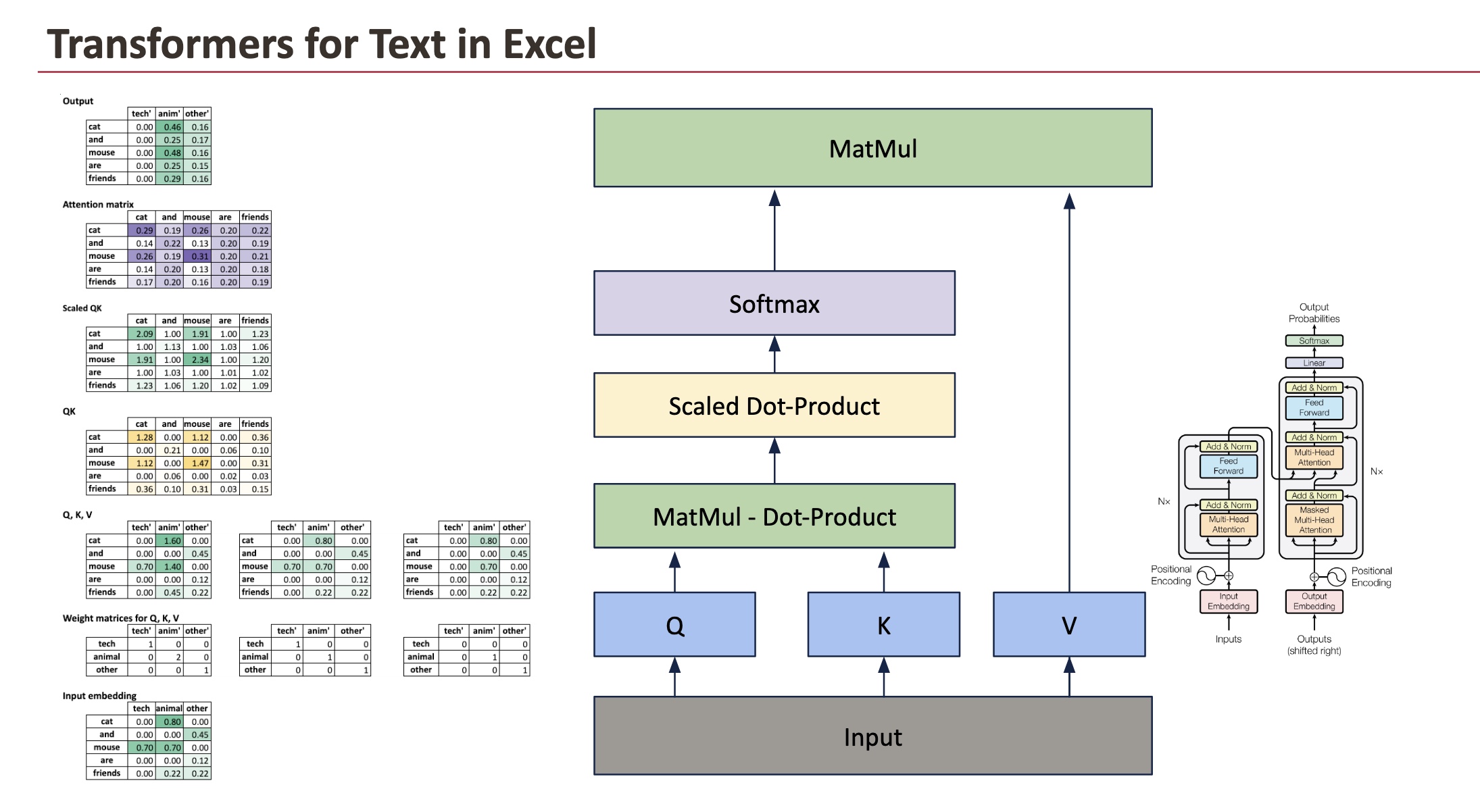 Transformers for text in excel
This is the last day of my Machine Learning Advent Calendar.
Before closing this series, I would like to sincerely thank everyone who followed it, shared feedback, and supported it, in particular the Towards Data Science team.
Ending this calendar with Transformers is not a coincidence. The Transformer is not just a fancy name. It is the backbone of modern Large Language Models.
There is a lot to say about RNNs, LSTMs, and GRUs. They played a key historical role in sequence modeling. But today, modern LLMs are overwhelmingly based on Transformers.
The name Transformer itself marks a rupture. From a naming perspective, the authors could have chosen something like Attention Neural Networks, in line with Recurrent Neural Networks or Convolutional Neural Networks. As a Cartesian mind, I would have appreciated a more consistent naming structure. But naming aside, the conceptual shift introduced by Transformers fully justifies the distinction.
Transformers can be used in different ways. Encoder architectures are commonly used for classification. Decoder architectures are used for next-token prediction, so for text generation.
In this article, we will focus on one core idea only: how the attention matrix transforms input embeddings into something more meaningful.
In the previous article, we introduced 1D Convolutional Neural Networks for text. We saw that a CNN scans a sentence using small windows and reacts when it recognizes local patterns. This approach is already very powerful, but it has a clear limitation: a CNN only looks locally.
Today, we move one step further.
The Transformer answers a fundamentally different question.
What if every word could look at all the other words at once?
Learn this step by step with the interactive Machine Learning roadmap.
1. The same word in two different contexts
To understand why attention is needed, we will start with a simple idea.
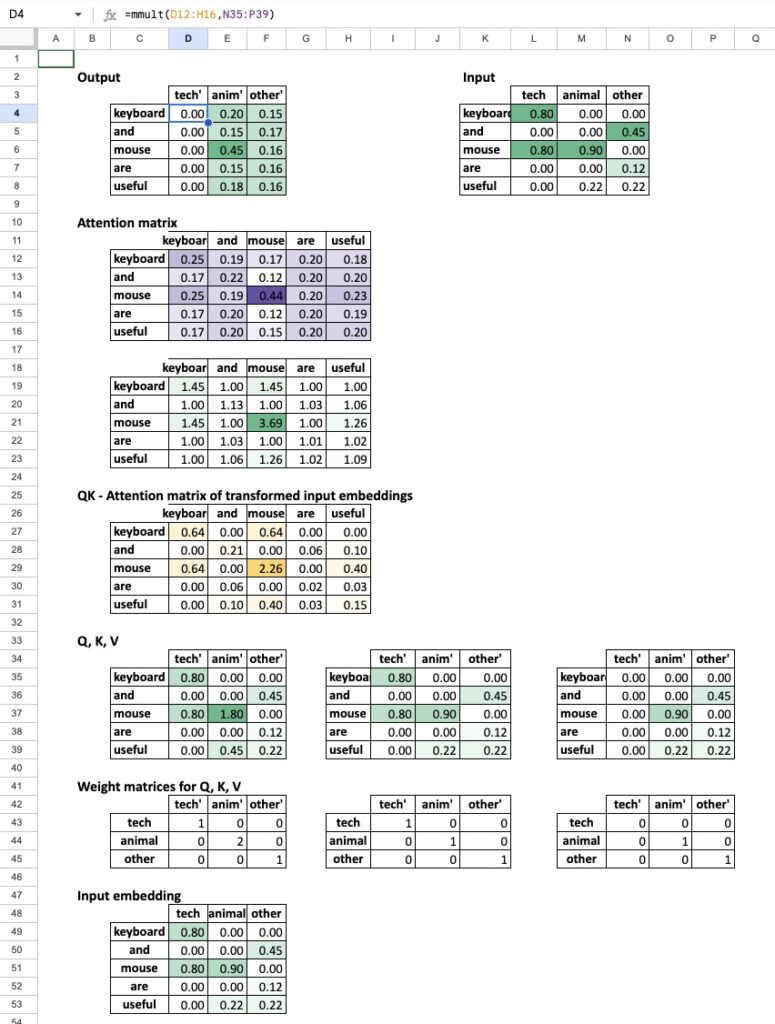
We will use two different input sentences , both containing the word mouse , but used in different contexts.
In the first input, mouse appears in a sentence with cat. In the second input, mouse appears in a sentence with keyboard.
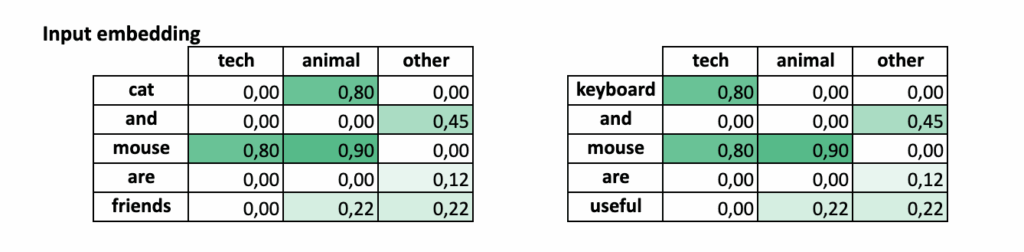 Transformers in Excel - all images by author
At the input level, we deliberately use the same embedding for the word “mouse” in both cases. This is important. At this stage, the model does not know which meaning is intended.
The embedding for mouse contains both:
- a strong animal component
- a strong tech component
This ambiguity is intentional. Without context, mouse could refer to an animal or to a computer device.
All other words provide clearer signals. Cat is strongly animal. Keyboard is strongly tech. Words like and or are mainly carry grammatical information. Words like friends and useful are weakly informative on their own.
At this point, nothing in the input embeddings allows the model to decide which meaning of mouse is correct.
In the next chapter, we will see how the attention matrix performs this transformation, step by step.
2. Self-attention: how context is injected into embeddings
2.1 Self-attention, not just attention
We first clarify what kind of attention we are using here. This chapter focuses on self-attention.
Self-attention means that each word looks at the other words of the same input sequence.
In this simplified example, we make an additional pedagogical choice. We assume that Queries and Keys are directly equal to the input embeddings. In other words, there are no learned weight matrices for Q and K in this chapter.
This is a deliberate simplification. It allows us to focus entirely on the attention mechanism, without introducing extra parameters. Similarity between words is computed directly from their embeddings.
Conceptually, this means:
Q = Input
K = Input
Only the Value vectors are used later to propagate information to the output.
In real Transformer models, Q, K, and V are all obtained through learned linear projections. Those projections add flexibility, but they do not change the logic of attention itself. The simplified version shown here captures the core idea.
Here is the whole picture that we will decompose.
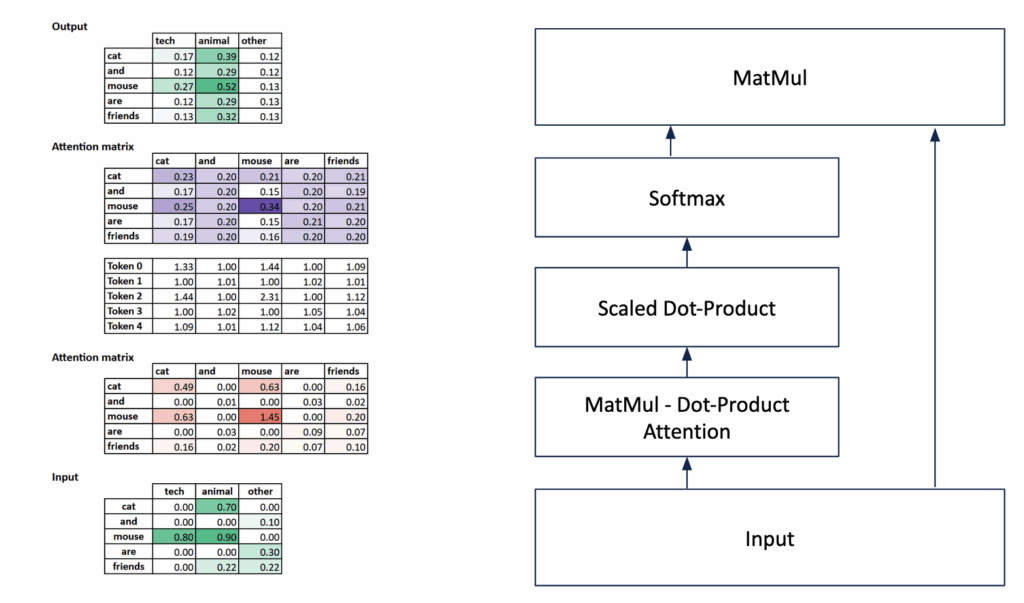
2.2 From input embeddings to raw attention scores
We start from the input embedding matrix, where each row corresponds to a word and each column corresponds to a semantic dimension.
The first operation is to compare every word with every other word. This is done by computing dot products between Queries and Keys.
Because Queries and Keys are equal to the input embeddings in this example, this step reduces to computing dot products between input vectors.
All dot products are computed at once using a matrix multiplication:
Scores = Input × Inputᵀ
Each cell of this matrix answers a simple question: how similar are these two words, given their embeddings?
At this stage, the values are raw scores. They are not probabilities, and they do not yet have a direct interpretation as weights.
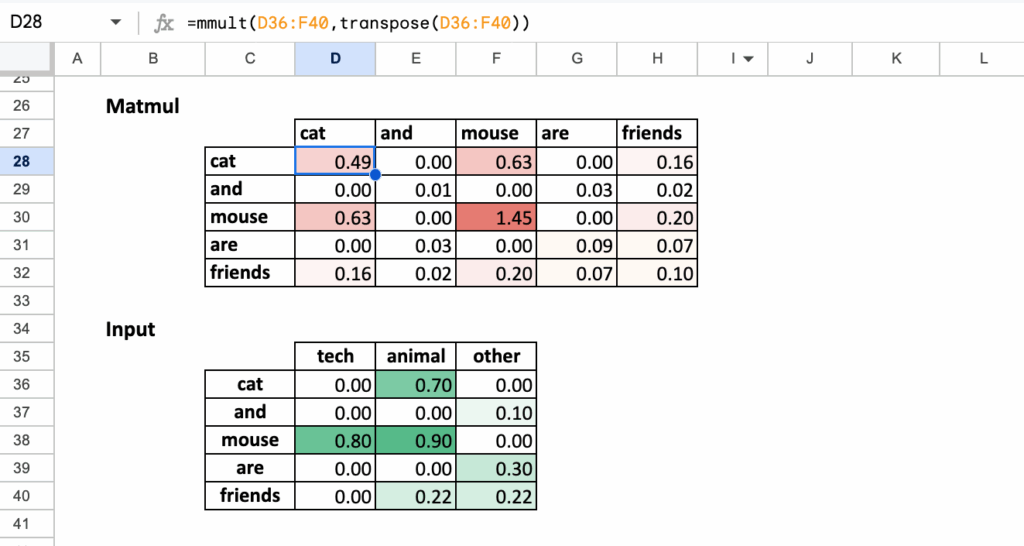
2.3 Scaling and normalization
Raw dot products can grow large as the embedding dimension increases. To keep values in a stable range, the scores are scaled by the square root of the embedding dimension.
ScaledScores = Scores / √d
This scaling step is not conceptually deep, but it is practically important. It prevents the next step, the softmax, from becoming too sharp.
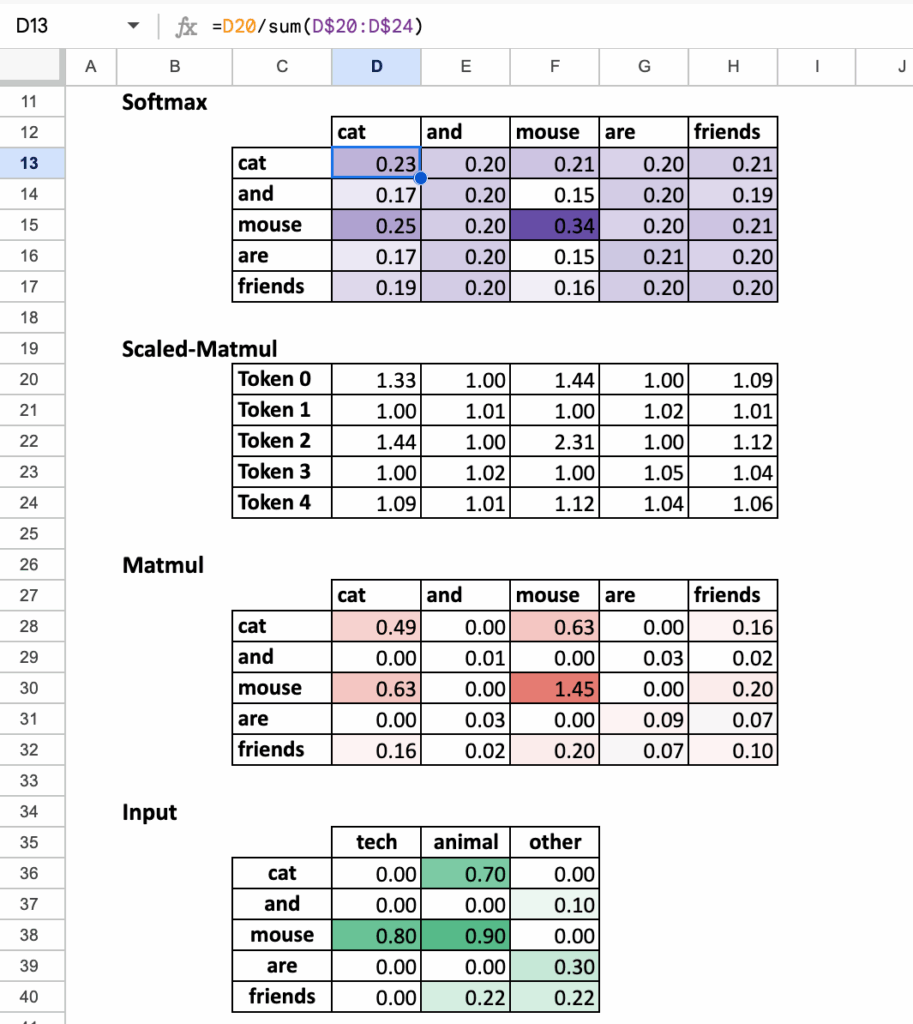
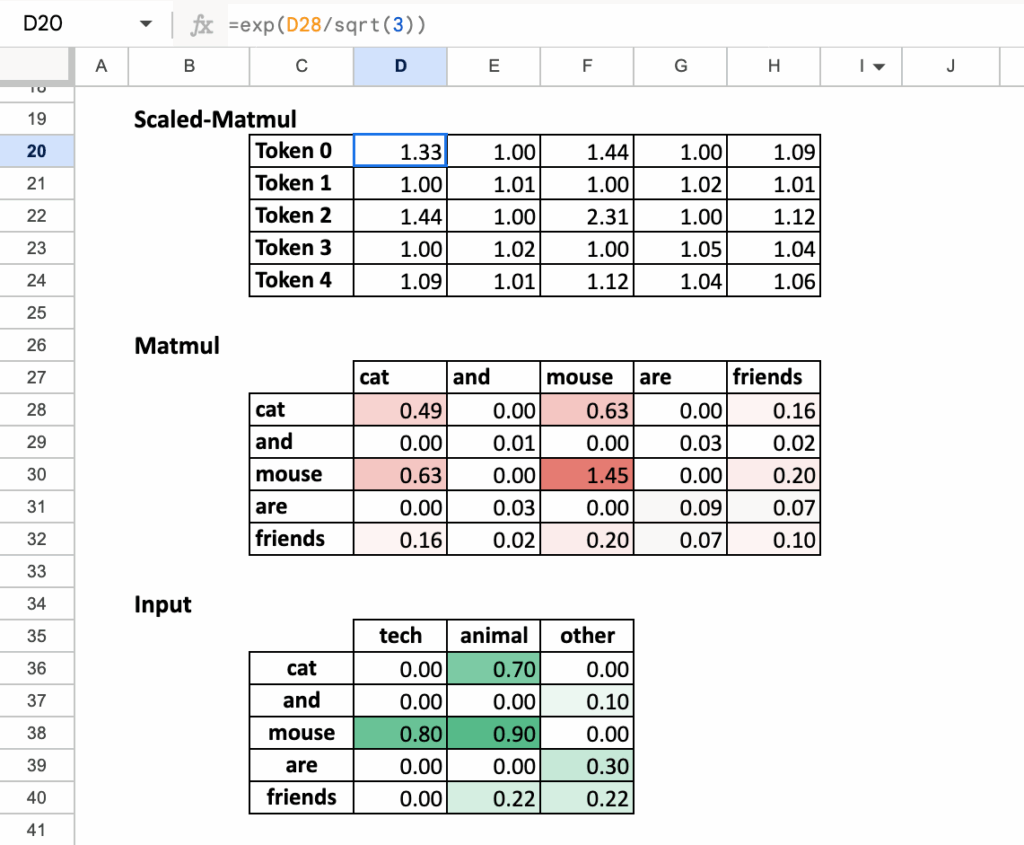 Once scaled, a softmax is applied row by row. This converts raw scores into positive values that sum to one.
The result is the attention matrix.
And attention is all you need.
Each row of this matrix describes how much attention a given word pays to every other word in the sentence.
2.4 Interpreting the attention matrix
The attention matrix is the central object of self-attention.
For a given word, its row in the attention matrix answers the question: when updating this word, which other words matter, and how much?
For example, the row corresponding to mouse assigns higher weights to words that are semantically related in the current context. In the sentence with cat and friends , mouse attends more to animal-related words. In the sentence with keyboard and useful , it attends more to technical words.
The mechanism is identical in both cases. Only the surrounding words change the outcome.
2.5 From attention weights to output embeddings
The attention matrix itself is not the final result. It is a set of weights.
To produce the output embeddings, we combine these weights with the Value vectors.
Output = Attention × V
In this simplified example, the Value vectors are taken directly from the input embeddings. Each output word vector is therefore a weighted average of the input vectors, with weights given by the corresponding row of the attention matrix.
For a word like mouse , this means that its final representation becomes a mixture of:
- its own embedding
- the embeddings of the words it attends to most
This is the precise moment where context is injected into the representation.
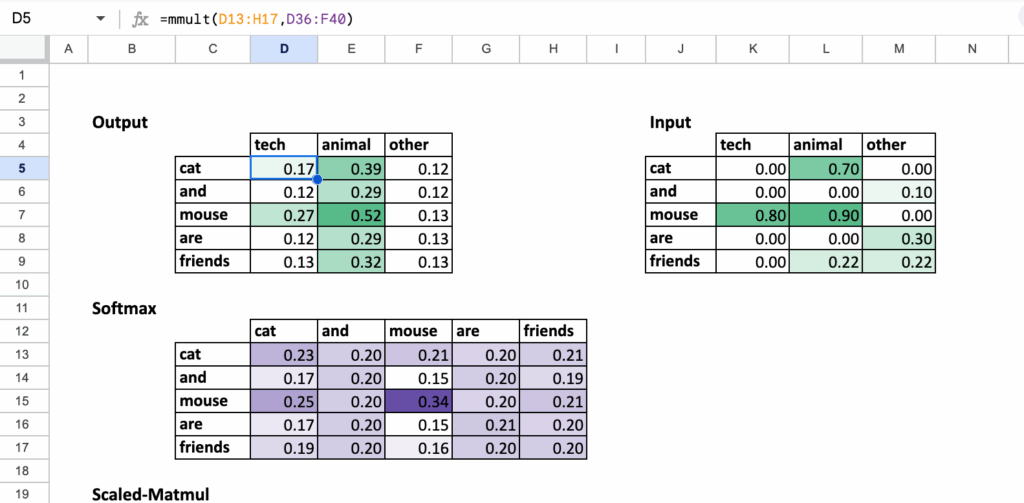 At the end of self-attention, the embeddings are no longer ambiguous.
The word mouse no longer has the same representation in both sentences. Its output vector reflects its context. In one case, it behaves like an animal. In the other, it behaves like a technical object.
Nothing in the embedding table changed. What changed is how information was combined across words.
This is the core idea of self-attention, and the foundation on which Transformer models are built.
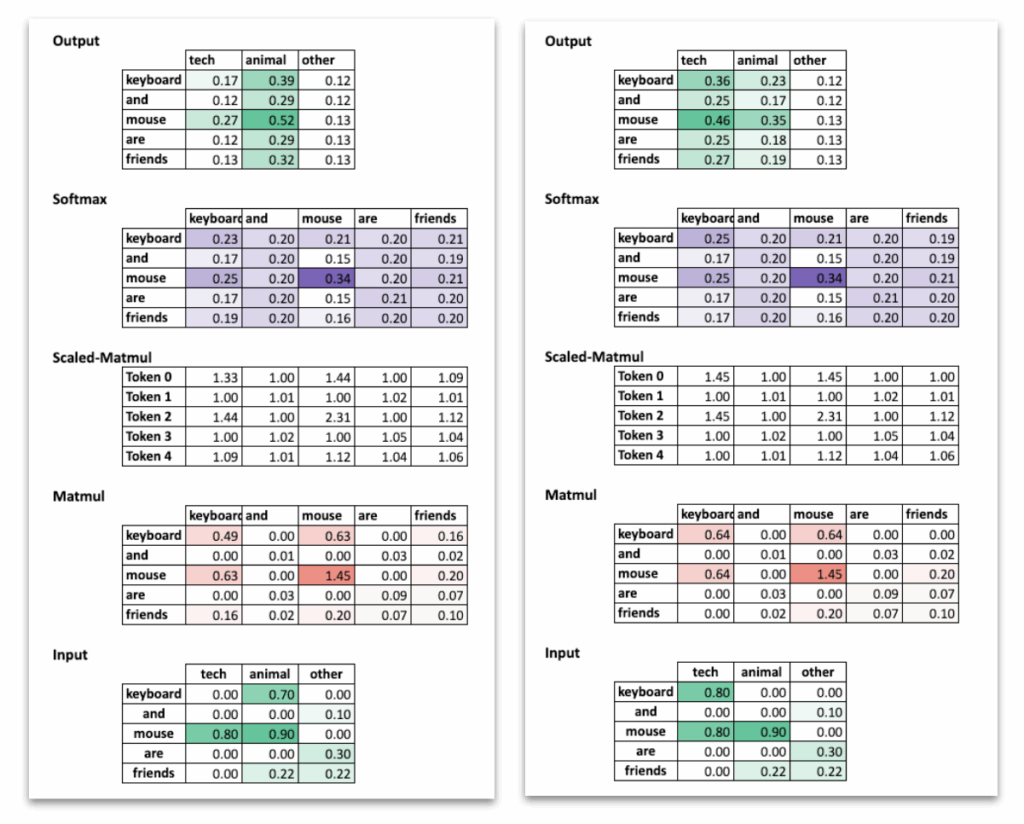
If we now compare the two examples, cat and mouse on the left and keyboard and mouse on the right, the effect of self-attention becomes explicit.
In both cases, the input embedding of mouse is identical. Yet the final representation differs. In the sentence with cat , the output embedding of mouse is dominated by the animal dimension. In the sentence with keyboard , the technical dimension becomes more prominent. Nothing in the embedding table changed. The difference comes entirely from how attention redistributed weights across words before mixing the values.
This comparison highlights the role of self-attention: it does not change words in isolation, but reshapes their representations by taking the full context into account.
3. Learning how to mix information
 Transformers in Excel - all images by author
3.1 Introducing learned weights for Q, K, and V
Until now, we have focused on the mechanics of self-attention itself. We now introduce an important element: learned weights.
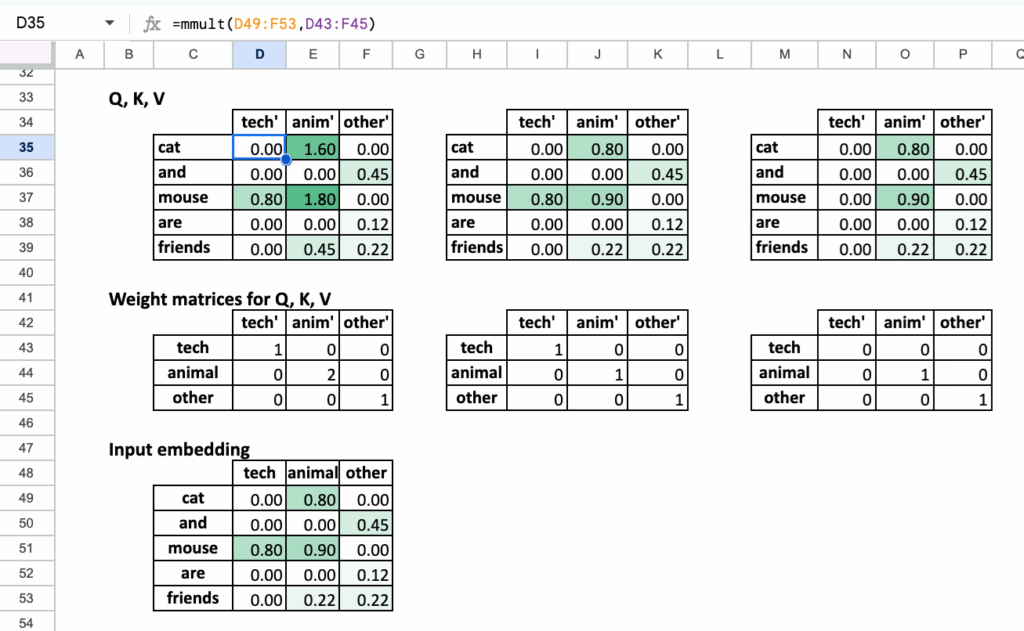
In a real Transformer, Queries, Keys, and Values are not taken directly from the input embeddings. Instead, they are produced by learned linear transformations.
For each word embedding, the model computes:
Q = Input × W_Q
K = Input × W_K
V = Input × W_V
These weight matrices are learned during training.
At this stage, we usually keep the same dimensionality. The input embeddings, Q, K, V, and the output embeddings all have the same number of dimensions. This makes the role of attention easier to understand: it modifies representations without changing the space they live in.
Conceptually, these weights allow the model to decide:
- which aspects of a word matter for comparison (Q and K)
- which aspects of a word should be transmitted to others (V)
3.2 What the model actually learns
The attention mechanism itself is fixed. Dot products, scaling, softmax, and matrix multiplications always work the same way. What the model actually learns are the projections.
By adjusting the Q and K weights, the model learns how to measure relationships between words for a given task. By adjusting the V weights, it learns what information should be propagated when attention is high. The structure defines how information flows, while the weights define what information flows.
Because the attention matrix depends on Q and K, it is partially interpretable. We can inspect which words attend to which others and observe patterns that often align with syntax or semantics.
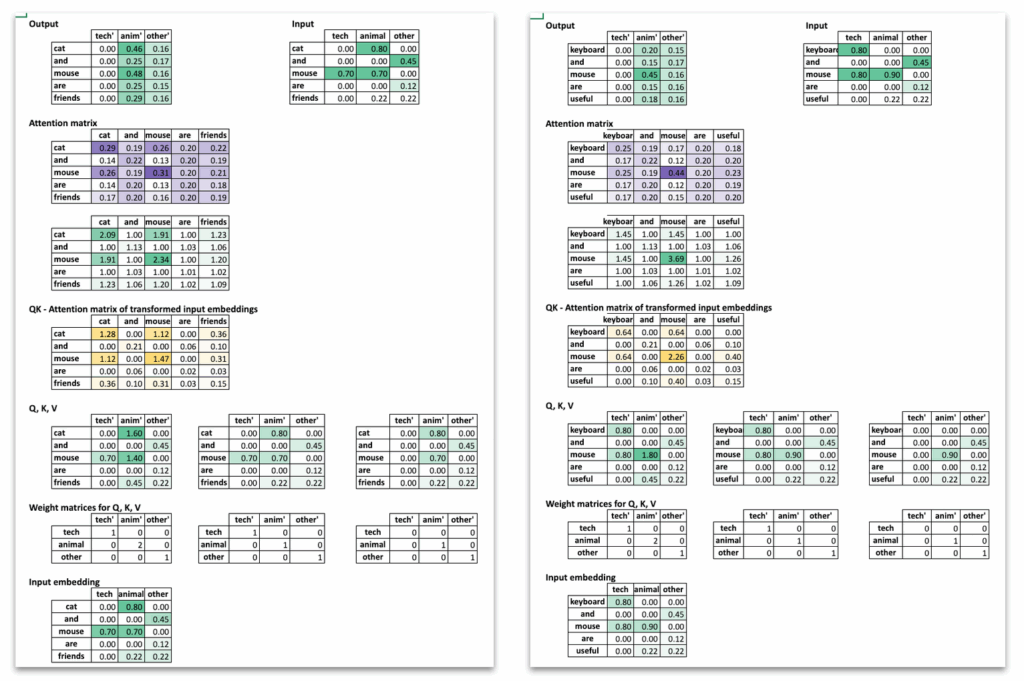
This becomes clear when comparing the same word in two different contexts. In both examples, the word mouse starts with exactly the same input embedding, containing both an animal and a tech component. On its own, it is ambiguous.
What changes is not the word, but the attention it receives. In the sentence with cat and friends , attention emphasizes animal-related words. In the sentence with keyboard and useful , attention shifts toward technical words. The mechanism and the weights are identical in both cases, yet the output embeddings differ. The difference comes entirely from how the learned projections interact with the surrounding context.
This is precisely why the attention matrix is interpretable: it reveals which relationships the model has learned to consider meaningful for the task.
3.3 Changing the dimensionality on purpose
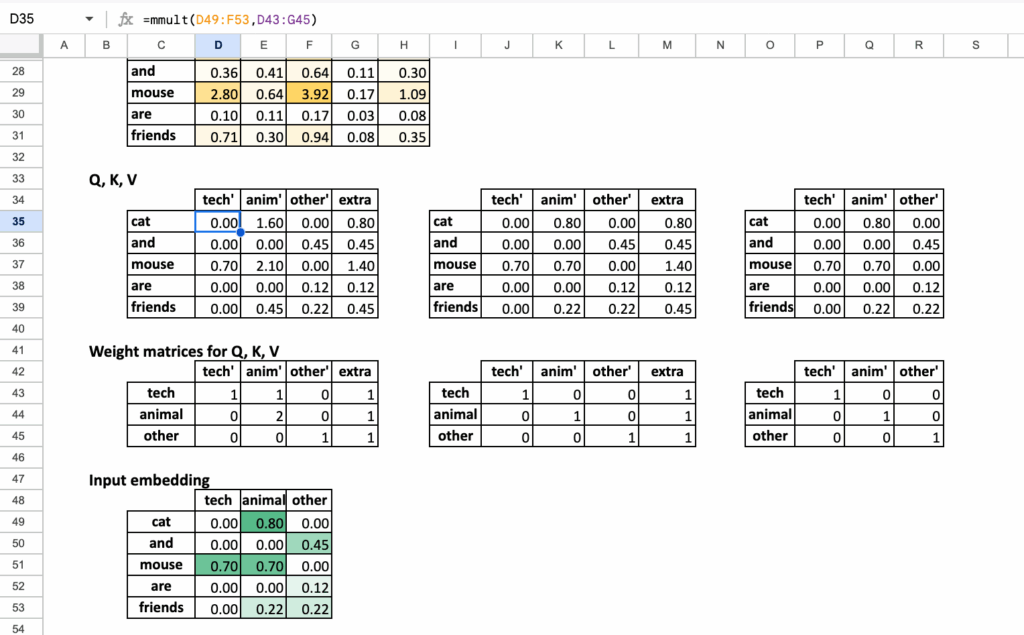
Nothing, however, forces Q, K, and V to have the same dimensionality as the input.
The Value projection, in particular, can map embeddings into a space of a different size. When this happens, the output embeddings inherit the dimensionality of the Value vectors.
This is not a theoretical curiosity. It is exactly what happens in real models, especially in multi-head attention. Each head operates in its own subspace, often with a smaller dimension, and the results are later concatenated into a larger representation.
So attention can do two things:
- mix information across words
- reshape the space in which this information lives
This explains why Transformers scale so well.
They do not rely on fixed features. They learn:
- how to compare words
- how to route information
- how to project meaning into different spaces
 The attention matrix controls where information flows.
The learned projections control what information flows and how it is represented.
Together, they form the core mechanism behind modern language models.
Conclusion
This Advent Calendar was built around a simple idea: understanding machine learning models by looking at how they actually transform data through spreadsheets.
Transformers are a natural way to close this journey. They do not rely on fixed rules or local patterns, but on learned relationships between all elements of a sequence. Through attention, they turn static embeddings into contextual representations, which is the foundation of modern language models.
Transformers can be used with an encoder for classification tasks, and with a decoder to predict the next token and generate text. I will start another series to explain deep learning step by step. If you have any requests or topics you would like to see, feel free to contact me.
Thank you again to everyone who followed this series, shared feedback, and supported it, especially the Towards Data Science team.
Merry Christmas 🎄
···
All the Excel files are available through this Kofi link. Your support means a lot to me. The price will increase during the month, so early supporters get the best value.

Register Now to Continue Reading
Unlock Towards Data Science with a Free Account
All articles on Towards Data Science are available to registered users. Create a free account today to access this article and thousands more.
Register for freeSign in to your account
 Written By
See all from Angela and Kezhan Shi
Deep DivesArtificial IntelligenceData ScienceDeep LearningTransformer
Share This Article
Towards Data Science is a community publication. Submit your insights to reach our global audience and earn through the TDS Author Payment Program.
Write for TDS
Related Articles
Artificial Intelligence
Compensating for trend in exponential smoothing models
Egor Howell
December 13, 20222 min read
Machine Learning
The project based tutorial introduces MLOps integrations such as DVC, DagsHub, Gradio web framework, and Hugging Face Spaces.
Abid Ali Awan
March 1, 20222 min read
Programming
Step by step guide on designing a system
Ashis Chakraborty
October 7, 20207 min read
Machine Learning
This article will go into more details of node embeddings. If you lack intuition and understanding of node embeddings, check out this...
Yves Boutellier
July 23, 20218 min read
Machine Learning
Our weekly selection of must-read Editors' Picks and original features
TDS Editors
September 30, 20213 min read
Deep Learning
Systematically Find the Optimal Training Strategy for the Birds Species Image Classification Task
Patrick Brus
October 26, 202113 min read
Deep Learning
An hands-on tutorial for retrieving, processing, and using the dataset
Yousef Nami
October 18, 20228 min read
Programming
Create your customized unit registry for physical quantities in Python
Jose D. Hernandez-Betancur
July 10, 20249 min read
Machine Learning
Why cubic splines are the best regression model out there.
Brendan Artley
July 26, 20225 min read
Your home for data science and AI. The world's leading publication for data science, data analytics, data engineering, machine learning, and artificial intelligence professionals.
Subscribe to Our NewsletterWrite For TDS•About•Advertise•Privacy Policy•Terms of Use
© Insight Media Group, LLC 2026•The New Stack•roadmap.sh•Creator Network
Recommended Articles
Close