保留正文与补采附件。源页面当前未重新核验;具体限制见交付清单。
 We value your privacy
We use cookies to enhance your browsing experience, serve personalised ads or content, and analyse our traffic. By clicking "Accept All", you consent to our use of cookies.
Customise Reject All Accept All
Customise Consent Preferences
 We use cookies to help you navigate efficiently and perform certain functions. You will find detailed information about all cookies under each consent category below.
The cookies that are categorised as "Necessary" are stored on your browser as they are essential for enabling the basic functionalities of the site. ... Show more
NecessaryAlways Active
Necessary cookies are required to enable the basic features of this site, such as providing secure log-in or adjusting your consent preferences. These cookies do not store any personally identifiable data.
-
Cookie
BCTempID
-
Duration
10 minutes
-
Description
No description available.
-
Cookie
__cf_bm
-
Duration
1 hour
-
Description
This cookie, set by Cloudflare, is used to support Cloudflare Bot Management.
-
Cookie
AWSALBCORS
-
Duration
7 days
-
Description
Amazon Web Services set this cookie for load balancing.
-
Cookie
_cfuvid
-
Duration
session
-
Description
Cloudflare sets this cookie to track users across sessions to optimize user experience by maintaining session consistency and providing personalized services
-
Cookie
li_gc
-
Duration
6 months
-
Description
Linkedin set this cookie for storing visitor's consent regarding using cookies for non-essential purposes.
-
Cookie
__hssrc
-
Duration
session
-
Description
This cookie is set by Hubspot whenever it changes the session cookie. The __hssrc cookie set to 1 indicates that the user has restarted the browser, and if the cookie does not exist, it is assumed to be a new session.
-
Cookie
__hssc
-
Duration
1 hour
-
Description
HubSpot sets this cookie to keep track of sessions and to determine if HubSpot should increment the session number and timestamps in the __hstc cookie.
-
Cookie
wpEmojiSettingsSupports
-
Duration
session
-
Description
WordPress sets this cookie when a user interacts with emojis on a WordPress site. It helps determine if the user's browser can display emojis properly.
-
Cookie
BCSessionID
-
Duration
1 year 1 month 4 days
-
Description
Blueconic sets this cookie as a unique identifier for the BlueConic profile.
-
Cookie
_octo
-
Duration
1 year
-
Description
No description available.
-
Cookie
logged_in
-
Duration
1 year
-
Description
No description available.
-
Cookie
__Secure-YEC
-
Duration
past
-
Description
YouTube sets this cookie to stores the user's video player preferences using embedded YouTube video
-
Cookie
__eoi
-
Duration
6 months
-
Description
Description is currently not available.
-
Cookie
AWSALBTGCORS
-
Duration
7 days
-
Description
No description available.
-
Cookie
login-status-p
-
Duration
past
-
Description
Description is currently not available.
-
Cookie
AWSALBTG
-
Duration
7 days
-
Description
No description available.
-
Cookie
csrf_token
-
Duration
session
-
Description
No description available.
-
Cookie
token_v2
-
Duration
1 day
-
Description
Description is currently not available.
-
Cookie
D
-
Duration
1 year
-
Description
Description is currently not available.
-
Cookie
PHPSESSID
-
Duration
session
-
Description
This cookie is native to PHP applications. The cookie stores and identifies a user's unique session ID to manage user sessions on the website. The cookie is a session cookie and will be deleted when all the browser windows are closed.
-
Cookie
VISITOR_PRIVACY_METADATA
-
Duration
6 months
-
Description
YouTube sets this cookie to store the user's cookie consent state for the current domain.
-
Cookie
cookietest
-
Duration
session
-
Description
The cookietest cookie is typically used to determine whether the user's browser accepts cookies, essential for website functionality and user experience.
-
Cookie
__Host-airtable-session
-
Duration
1 year
-
Description
This cookie is used to enable us to integrate the services of Airtable.
-
Cookie
__Host-airtable-session.sig
-
Duration
1 year
-
Description
This cookie is used to enable us to integrate the services of Airtable.
-
Cookie
m
-
Duration
1 year 1 month 4 days
-
Description
Stripe sets this cookie for fraud prevention purposes. It identifies the device used to access the website, allowing the website to be formatted accordingly.
-
Cookie
BIGipServer*
-
Duration
session
-
Description
Marketo sets this cookie to collect information about the user's online activity and build a profile about their interests to provide advertisements relevant to the user.
-
Cookie
__cfruid
-
Duration
session
-
Description
Cloudflare sets this cookie to identify trusted web traffic.
-
Cookie
_GRECAPTCHA
-
Duration
6 months
-
Description
Google Recaptcha service sets this cookie to identify bots to protect the website against malicious spam attacks.
-
Cookie
__Secure-YNID
-
Duration
6 months
-
Description
Google cookie used to protect user security and prevent fraud, especially during the login process.
-
Cookie
cookieyes-consent
-
Duration
1 year
-
Description
CookieYes sets this cookie to remember users' consent preferences so that their preferences are respected on subsequent visits to this site. It does not collect or store any personal information about the site visitors.
Functional
Functional cookies help perform certain functionalities like sharing the content of the website on social media platforms, collecting feedback, and other third-party features.
-
Cookie
lidc
-
Duration
1 day
-
Description
LinkedIn sets the lidc cookie to facilitate data center selection.
-
Cookie
brw
-
Duration
1 year
-
Description
No description available.
-
Cookie
brwConsent
-
Duration
5 minutes
-
Description
Description is currently not available.
-
Cookie
WMF-Uniq
-
Duration
1 year
-
Description
Description is currently not available.
-
Cookie
loom_anon_comment
-
Duration
1 year
-
Description
No description available.
-
Cookie
loom_referral_video
-
Duration
session
-
Description
Description is currently not available.
-
Cookie
VISITOR_INFO1_LIVE
-
Duration
6 months
-
Description
A cookie set by YouTube to measure bandwidth that determines whether the user gets the new or old player interface.
-
Cookie
yt-remote-connected-devices
-
Duration
Never Expires
-
Description
YouTube sets this cookie to store the user's video preferences using embedded YouTube videos.
-
Cookie
ytidb::LAST_RESULT_ENTRY_KEY
-
Duration
Never Expires
-
Description
The cookie ytidb::LAST_RESULT_ENTRY_KEY is used by YouTube to store the last search result entry that was clicked by the user. This information is used to improve the user experience by providing more relevant search results in the future.
-
Cookie
yt-remote-device-id
-
Duration
Never Expires
-
Description
YouTube sets this cookie to store the user's video preferences using embedded YouTube videos.
-
Cookie
yt-remote-session-name
-
Duration
session
-
Description
The yt-remote-session-name cookie is used by YouTube to store the user's video player preferences using embedded YouTube video.
-
Cookie
yt-remote-fast-check-period
-
Duration
session
-
Description
The yt-remote-fast-check-period cookie is used by YouTube to store the user's video player preferences for embedded YouTube videos.
-
Cookie
yt-remote-session-app
-
Duration
session
-
Description
The yt-remote-session-app cookie is used by YouTube to store user preferences and information about the interface of the embedded YouTube video player.
-
Cookie
yt-remote-cast-available
-
Duration
session
-
Description
The yt-remote-cast-available cookie is used to store the user's preferences regarding whether casting is available on their YouTube video player.
-
Cookie
yt-remote-cast-installed
-
Duration
session
-
Description
The yt-remote-cast-installed cookie is used to store the user's video player preferences using embedded YouTube video.
-
Cookie
cp_session
-
Duration
3 months
-
Description
Codepen sets this cookie for Help systems found in the website.
-
Cookie
loid
-
Duration
1 year 1 month 4 days
-
Description
This cookie is set by the Reddit. The cookie enables the sharing of content from the website onto the social media platform.
Analytics
Analytical cookies are used to understand how visitors interact with the website. These cookies help provide information on metrics such as the number of visitors, bounce rate, traffic source, etc.
-
Cookie
__hstc
-
Duration
6 months
-
Description
Hubspot set this main cookie for tracking visitors. It contains the domain, initial timestamp (first visit), last timestamp (last visit), current timestamp (this visit), and session number (increments for each subsequent session).
-
Cookie
hubspotutk
-
Duration
6 months
-
Description
HubSpot sets this cookie to keep track of the visitors to the website. This cookie is passed to HubSpot on form submission and used when deduplicating contacts.
-
Cookie
_ga
-
Duration
1 year 1 month 4 days
-
Description
Google Analytics sets this cookie to calculate visitor, session and campaign data and track site usage for the site's analytics report. The cookie stores information anonymously and assigns a randomly generated number to recognise unique visitors.
-
Cookie
ga*
-
Duration
1 year 1 month 4 days
-
Description
Google Analytics sets this cookie to store and count page views.
-
Cookie
__Host-psifi.analyticsTrace
-
Duration
6 hours
-
Description
Description is currently not available.
-
Cookie
__Host-psifi.analyticsTraceV2
-
Duration
6 hours
-
Description
Description is currently not available.
-
Cookie
_gh_sess
-
Duration
session
-
Description
GitHub sets this cookie for temporary application and framework state between pages like what step the user is on in a multiple step form.
-
Cookie
YSC
-
Duration
session
-
Description
YSC cookie is set by Youtube and is used to track the views of embedded videos on Youtube pages.
-
Cookie
ajs_anonymous_id
-
Duration
1 year
-
Description
This cookie is set by Segment to count the number of people who visit a certain site by tracking if they have visited before.
-
Cookie
vuid
-
Duration
1 year 1 month 4 days
-
Description
Vimeo installs this cookie to collect tracking information by setting a unique ID to embed videos on the website.
Performance
Performance cookies are used to understand and analyse the key performance indexes of the website which helps in delivering a better user experience for the visitors.
-
Cookie
AWSALB
-
Duration
7 days
-
Description
AWSALB is an application load balancer cookie set by Amazon Web Services to map the session to the target.
-
Cookie
acq
-
Duration
past
-
Description
Description is currently not available.
-
Cookie
acq.sig
-
Duration
past
-
Description
Description is currently not available.
-
Cookie
ptc
-
Duration
2 years
-
Description
No description available.
Advertisement
Advertisement cookies are used to provide visitors with customised advertisements based on the pages you visited previously and to analyse the effectiveness of the ad campaigns.
-
Cookie
muc_ads
-
Duration
1 year 1 month 4 days
-
Description
Twitter sets this cookie to collect user behaviour and interaction data to optimize the website.
-
Cookie
guest_id_marketing
-
Duration
1 year 1 month 4 days
-
Description
Twitter sets this cookie to identify and track the website visitor.
-
Cookie
guest_id_ads
-
Duration
1 year 1 month 4 days
-
Description
Twitter sets this cookie to identify and track the website visitor.
-
Cookie
personalization_id
-
Duration
1 year 1 month 4 days
-
Description
Twitter sets this cookie to integrate and share features for social media and also store information about how the user uses the website, for tracking and targeting.
-
Cookie
guest_id
-
Duration
1 year 1 month 4 days
-
Description
Twitter sets this cookie to identify and track the website visitor. It registers if a user is signed in to the Twitter platform and collects information about ad preferences.
-
Cookie
bcookie
-
Duration
1 year
-
Description
LinkedIn sets this cookie from LinkedIn share buttons and ad tags to recognize browser IDs.
-
Cookie
__Secure-ROLLOUT_TOKEN
-
Duration
6 months
-
Description
YouTube sets this cookie to manage feature rollout and experimentation. It helps Google control which new features or interface changes are shown to users as part of testing and staged rollouts, ensuring consistent experience for a given user during an experiment.
-
Cookie
yt.innertube::nextId
-
Duration
Never Expires
-
Description
YouTube sets this cookie to register a unique ID to store data on what videos from YouTube the user has seen.
-
Cookie
yt.innertube::requests
-
Duration
Never Expires
-
Description
YouTube sets this cookie to register a unique ID to store data on what videos from YouTube the user has seen.
-
Cookie
session_tracker
-
Duration
session
-
Description
This cookie is set by the Reddit. This cookie is used to identify trusted web traffic. It also helps in adverstising on the website.
-
Cookie
edgebucket
-
Duration
session
-
Description
Reddit sets this cookie to save the information about a log-on Reddit user, for the purpose of advertisement recommendations and updating the content.
-
Cookie
did
-
Duration
1 year
-
Description
Arbor sets this cookie to show targeted ads to site visitors.This cookie expires after 2 months or 1 year.
Uncategorised
Other uncategorised cookies are those that are being analysed and have not been classified into a category as yet.
No cookies to display.
Reject All Save My Preferences Accept All
Toggle SearchToggle Mobile Navigation
Publish AI, ML & data-science insights to a global community of data professionals.
Sign inSubmit an Article
LatestEditor's PicksNewsletterShipAI
Write For TDS
LinkedInXToggle Search
Artificial Intelligence
Managing the Technical Debts of Machine Learning Systems
Explore the practices with implementation codes for sustainably mitigating the cost of speedy delivery
John Leung
September 26, 202310 min read
Managing the Technical Debt of Machine Learning Systems
Explore the practices (design patterns, version control, and monitoring systems) for sustainably mitigating the cost of speedy delivery—with implementation codes
As the machine learning (ML) community advances over the years, the resources available for developing ML projects are plentiful. For example, we can rely on the generic Python package scikit-learn, which is built on NumPy, SciPy, and matplotlib, for data preprocessing and basic predictive tasks. Or we can leverage the open-source collection of pre-trained models from Hugging Face for analyzing diverse types of datasets. These empower current data scientists to quickly and effortlessly tackle standard ML tasks while achieving moderately good model performance.
However, the abundance of ML tools often leads business stakeholders and even practitioners to underestimate the effort required to build enterprise-level ML systems. Particularly when faced with tight project deadlines, the teams may expedite deploying systems to production without giving sufficient technical considerations. Consequently, the ML system often does not address the business needs in a technically sustainable and maintainable manner.
As the system evolves and deploys over time, technical debts accumulate - The longer the implied cost remains unaddressed, the more costly it becomes to rectify them.
 Photo by Andrea De Santis on Unsplash
There are multiple sources of technical debts in the ML system. Some are included below.
1 Inflexible code design to cater to unforeseen requirements
To validate if ML can address the enterprise challenges at hand, many ML projects commence with a proof of concept (PoC). We initially created a Jupyter Notebook or Google Colab environment to explore data, then developed several ad-hoc functions, and created the illusion of nearing project completion for stakeholders. Such systems building directly from PoC may end up consisting mostly ofglue code - the supporting code that connects specific incompatible components but itself does not have the functionality of data analysis. They can be spaghetti-like, hard to maintain, and prone to errors.
 Photo by Jakob Owens on Unsplash
Business stakeholders often present alternate requirements from time to time or wish to scale up the project, such as trying out new data sources or new algorithms. We thus often find ourselves frequently revisiting the codebase covering the current preprocessing pipelines and model development processes. Inflexible code design can consequently lead to difficulties in reacting to new changes, or rewrite most of the codes for even minor adjustments.
2 Messiness in the configurations of the ML system
Software engineering programming automates tasks by defining rules for computers to follow, ensuring precise output for the same input. Software engineers are also concerned with the correctness of every corner case. On the other hand, ML systems automate tasks by collecting and feeding feature data into models to achieve desired target results. This experimental process embraces uncertainty and variability. As ML systems mature, they often contain multiple versions of configuration options , such as datasets with different feature combinations, and algorithm-specific learning settings.
 Photo by Ricardo Viana on Unsplash
Input features in ML systems are inherently interconnected. Consider a scenario where feature A is no longer available as an input for your ML systems in production, you are required to re-evaluate the weighting of the remaining features for production serving. However, after 2 months, feature A becomes available again. If you did not systematically save or even mistakenly modify the original configurations, rectifying the decrease in performance would require additional computational resources and time effort.
3 Limited ability to adapt to the evolving external world
ML systems often have dependencies on the external world, and various hidden factors continually evolve but are not being appropriately considered and monitored.
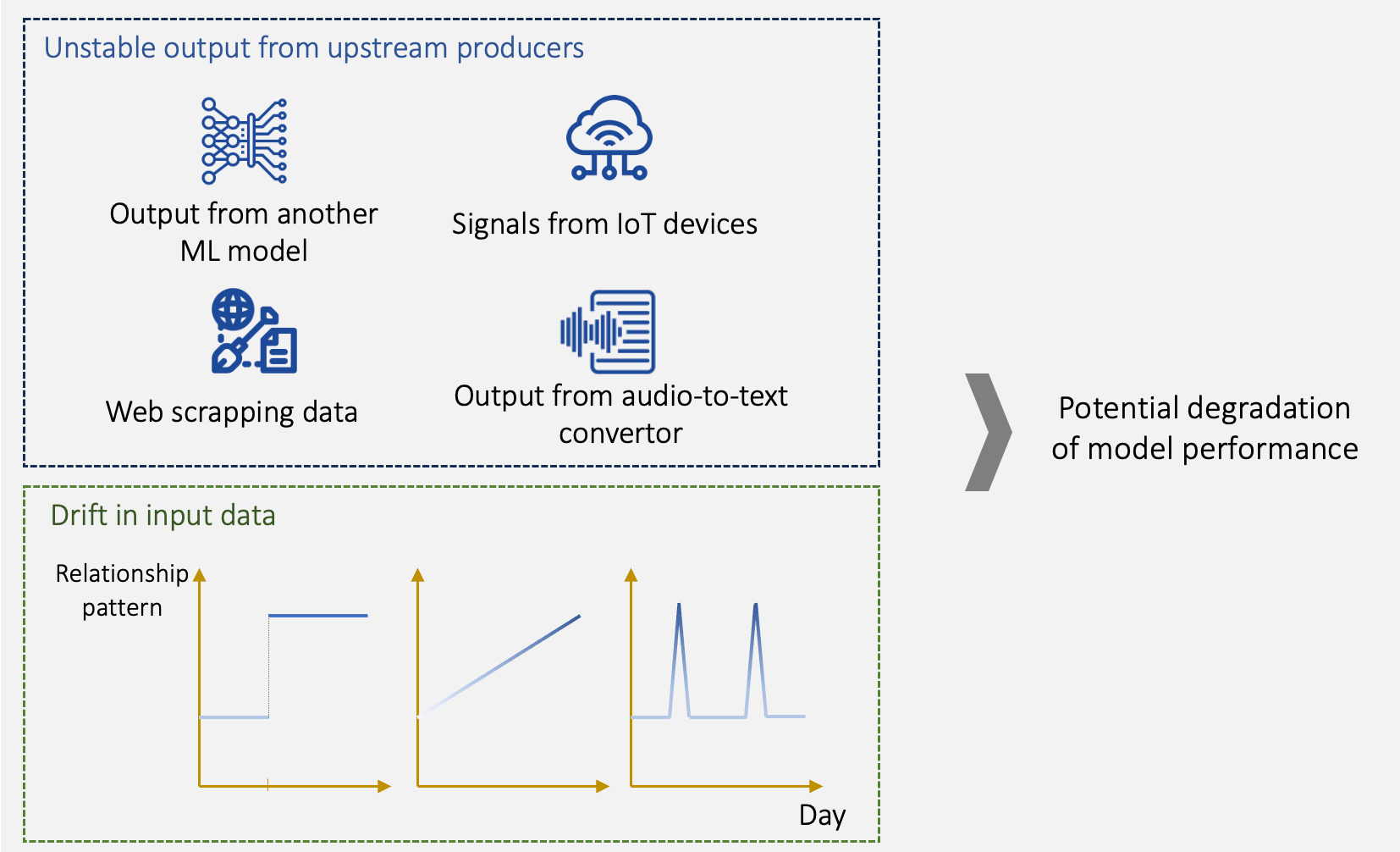 External factors leading to potential degradation of model performance (image by author)
- Unstable data output from upstream producers : The input signal of our ML system may come from another machine learning model that updates over time. Additionally, the system may rely on unstructured data such as signals from Internet of Things (IoT) devices, web scraping data, or output data from audio-to-text converter. If the maintenance of these tools from upstream producers is not properly declared or flawed patching is implemented, it can unexpectedly degrade the performance of the ML system.
- Drift in input data: Take demand forecasting in the retail industry as an example. The input data can exhibit new distributions periodically (such as the seasonal cycle of purchasing behaviors), gradually (like the inflationary cost of goods from suppliers), and suddenly (the entry of new competitors).
In the following sections, we will delve into some great practices for building ML systems and provide illustrative Python code examples to demonstrate their implementation.
Imagine that you would like to build a robust traffic system for the city prepared for traffic peaks, so you collected traffic data from sensors over the past two years. Your goal is to predict the traffic patterns (i.e. the no. of vehicles) for the upcoming six months.
- Training dataset: ID, DateTime, and no. of vehicles
- Test dataset: ID and DateTime
 Photo by Joey Kyber on Unsplash
1 Use design patterns for the ML codebase
To make the code design more flexible and reusable for future requirements, we can leverage design patterns. These patterns serve as the templates for solving common problems in various situations, enabling us to decouple different parts of the codebase. As a result, this helps to improve the comprehension of the codebase and build a common language to communicate quickly about solutions.
The two primary components in ML projects are data and algorithms, which can benefit from design patterns.
This creational pattern provides a layer of abstraction for generating objects at runtime. In ML systems, we can implement this pattern by creating a data loader class (CSVDataLoader in this example) that handles the loading, saving, and returning of training/ test data with a consistent data type. We can then declare the DataProcessor interface without specifying the concrete implementation.
python
# CSV Data loader class
class CSVDataLoader:
  def __init__(self, file_path):
    self.file_path = file_path

  def get_data(self):
    return pd.read_csv(self.file_path)

  def save_data(self, df):
    df.to_csv(f'data/transformed_{self.file_path}', index=False)

# Interface
class DataProcessor:
  def __init__(self, train_data_loader, test_data_loader):
    self.train_data_loader = train_data_loader
    self.test_data_loader = test_data_loader

  def run(self):
    # Load training and test data using data loaders
    train_df = self.train_data_loader.get_data()
    test_df = self.test_data_loader.get_data()

# Create a data processor instance
process = DataProcessor(
 train_data_loader=CSVDataLoader(file_path='train.csv'),
 test_data_loader=CSVDataLoader(file_path='test.csv')
)

# Run the data processing pipeline
process.run()
This approach allows you to extend the code without having to re-implement the DataProcessor. For example, if you want to load the dataset from a JSON file, you can simply create a new class JSONDataLoader as an instance of the data loader for declaration.
Since there is no one-size-fits-all algorithm for ML problems with varying data distribution, we often find ourselves switching and experimenting between algorithms during prototyping or project enhancement. We can apply the Strategy Pattern by creating a new class DataTransformer for feature engineering and another class LGBMModel for encapsulating the strategy of fitting and predicting using the LightGBM model.
python
class DataTransformer:
  def transform_data(self, train_df, test_df):
    for idx, df in enumerate([train_df, test_df]):
      df['DateTime'] = pd.to_datetime(df['DateTime'])

      # Build 'Time' column
      df['Time'] = [date.hour * 3600 + date.minute * 60 + date.second for date in df['DateTime']]

      # Convert DateTime to Unix timestamp
      unixtime = [time.mktime(date.timetuple()) for date in df['DateTime']]
      df['DateTime'] = unixtime

      # Perform one-hot encoding on the DataFrame
      df = pd.get_dummies(df)

      if idx == 0:
        # Split training DataFrame into features (X_train) and target (y_train)
        X_train = df.drop(['Vehicles'], axis=1)
        y_train = df[['Vehicles']]
      elif idx == 1:
        # Store test DataFrame
        X_test = df

    return X_train, y_train, X_test
ruby
class LGBMModel:
  def __init__(self, num_leaves, n_estimators):
    self.model = lgb.LGBMRegressor(
      num_leaves=num_leaves,
      n_estimators=n_estimators
    )

  def fit(self, X, y):
    self.model.fit(X, y)
    self.model.booster_.save_model('model/lgbm_model.txt')
    return self

  def predict(self, X):
    predictions = self.model.predict(X)
    return predictions
The implementation and declaration of the interface DataProcessor are provided below. This is the end-to-end process that includes loading training and test data using train_data_loader and test_data_loaderrespectively, transforming the data using data_transformer, and fitting the model to the transformed data using model. As a result, we can predict the number of vehicles in each record of the test dataset.
python
# Interface
class DataProcessor:
  def __init__(self, train_data_loader, test_data_loader, data_transformer, model):
    self.train_data_loader = train_data_loader
    self.test_data_loader = test_data_loader
    self.data_transformer = data_transformer
    self.model = model

  def run(self):
    # Load train and test data using data loaders
    train_df = self.train_data_loader.get_data()
    test_df = self.test_data_loader.get_data()

    # Transform the data using the data transformer
    X_train, y_train, X_test = self.data_transformer.transform_data(train_df, test_df)

    # Fit the model and make prediction
    self.model.fit(X_train, y_train)
    test_df['Vehicles'] = self.model.predict(X_test)

    # Save the transformed training data and test data
    self.train_data_loader.save_data(pd.concat([X_train, y_train], axis=1))
    self.test_data_loader.save_data(test_df)

# Create a data processor instance
process = DataProcessor(
    train_data_loader=CSVDataLoader(file_path='train.csv'),
    test_data_loader=CSVDataLoader(file_path='test.csv'),
    data_transformer=DataTransformer(),
    model=LGBMModel(num_leaves=16, n_estimators=80)
)

# Run the data processing pipeline
process.run()
You can easily add new blocks of code to implement other data transformation ideas or algorithms. Similar to the Factory Pattern, these changes would not require you to modify the interface DataProcessor. This design makes it easier to maintain the code, even if you have a long list of algorithms. The behavior of the ML system can dynamically vary based on the chosen strategy.
Of course, the above code implementation is only the preliminary template for development. For example, we can further enhance the code by covering data validation, implementing a hyperparameter tuning mechanism, and evaluating the model.
2 Version control of the ML systems
Throughout the complex process of model development and management, we require proper version control. This enables us to maintain a history of modifications done by ourselves or team members and track the version in the local environment relative to the components of the ML system, including data, trained models, and hyperparameters. We can thus address some common questions, including:
- What was the change that led to the model's failure?
- Which modifications resulted in improved model performance?
- Which version of the model was most recently released?
Here we demonstrate how to utilize the versioning features in DVC, which works best in the Git repository for tracking our original traffic data, transformed traffic data, and LGBM models.
shell
# Initialise a Git and DVC project in the current working directory
git init
dvc init

# Capture the current state of transformed data in folder 'data' and latest LGBM model in folder 'model'
dvc add data model

# Commit the current state of 1st version
git add data.dvc model.dvc .gitignore
git commit -m "First LGBM model, with Time feature"
git tag -a "v1.0" -m "model v1.0, Time feature"
Let's consider a scenario where we have made the following changes in the second version of data processing:
- Add the Weekday feature in the
DataTransformer class
python
df['Weekday'] = [datetime.weekday(date) for date in df.DateTime]
- Set new configuration parameters for the LGBM model in the
DataProcessor interface
python
model=LGBMModel(num_leaves=20, n_estimators=90)
With the following commands, we can track the second version of the data and model in DVC and commit the .dvc files that point to them with Git.
shell
git add data.dvc model.dvc
git commit -m "Second LGBM model, with Time and Weekday features"
git tag -a "v2.0" -m "model v2.0, Time and Weakday features"
Though the workspace is currently locating the second version of our data and model, we can easily switch back and restore to the first snapshot whenever necessary.
shell
git checkout v1.0
dvc checkout
The above commands cover the basic operations. We can further leverage the tool for project organization and collaboration. Examples of use cases are to understand how the data was built initially and compare model metrics among experiments.
3 Test and monitor the ML systems continuously
Once the enhanced model can generate predictions, it is essential to perform sanity checks before releasing it to production. This is achieved by fitting a random sample set of online data into the latest model offline and examining the results from various perspectives.
- Ensuring the right access permission : The model results can be stored in the destination path (such as writing them to a Hive table).
- Eliminatingsemantic errors: Visualize the distribution of the transformed features that are fitted to the model, to identify any deviant behavior.
- Assessing model performance : Rescore with the latest model and compare the results to the current online model using appropriate performance metrics (e.g., F1-score is a preferable measurement to accuracy for imbalanced class problems).
Even after the latest version of the ML system is released, ongoing monitoring is necessary to account for evolving external environments.
- Monitoring data drift and model drift: Detect drift conditions through model performance metrics, statistical tests, and adaptive windowing techniques.
- Tracking upstream producers : Stay informed about changes in upstream processes, and routinely monitor them to ensure they meet a service level objective.
Wrapping it up
We have explored several effective practices that can be implemented to tackle technical debts in developing and deploying ML systems.
- Use design patterns, to create a modular and flexible data processing pipeline that can adapt to unforeseen requirements.
- Utilize version control, to track and manage the ML artifacts, such as data and models, ensuring a workflow with less messiness.
- Test and monitor the ML system, to promptly and smoothly handle changes in the dynamic external world.
Before you go
If you enjoy this reading, I invite you to **** follow my Medium page and Linkedin page. By doing so, you can stay updated with exciting content related to data science side projects, Machine Learning Operations (MLOps) demonstrations, and project management methodologies.
Monitoring Machine Learning Models in Production: Why and How?
Optimizing Your Strategies with Approaches Beyond A/B Testing
Register Now to Continue Reading
Unlock Towards Data Science with a Free Account
All articles on Towards Data Science are available to registered users. Create a free account today to access this article and thousands more.
Register for freeSign in to your account
 Written By
See all from John Leung
Artificial IntelligenceMachine LearningPythonTechnical DebtVersion Control
Share This Article
Towards Data Science is a community publication. Submit your insights to reach our global audience and earn through the TDS Author Payment Program.
Write for TDS
Related Articles
Programming
Take full advantage of all the Google Analytics features and data using its REST API and Python
Martin Heinz
November 29, 20218 min read
Machine Learning
Not teaching materials, just useful websites
Dmytro Nikolaiev (Dimid)
April 30, 20228 min read
Machine Learning
How explainable machine learning can be applied for pattern recognition in breast cancer research
Jarrett Evans
August 18, 20226 min read
Measure the execution time of your code in Python the right way
Diego Barba
June 22, 20226 min read
Machine Learning
Building idempotent and re-playable data pipelines
Giorgos Myrianthous
January 7, 20259 min read
Artificial Intelligence
A practical guide with Matplotlib
Soner Yıldırım
December 4, 20206 min read
Artificial Intelligence
3 levels of using LLMs in practice
Shaw Talebi
July 13, 20237 min read
Machine Learning
A Quick Example of How to Tune Density Based Clustering from the Trenches Clustering is...
Charles Frenzel
September 2, 20217 min read
Machine Learning
A case study based introduction to using Bayes rule and how it compares with a frequentist, pessimistic and optimistic approaches to...
Ahmar Shah, PhD (Oxford)
December 25, 20209 min read
Your home for data science and AI. The world's leading publication for data science, data analytics, data engineering, machine learning, and artificial intelligence professionals.
Subscribe to Our NewsletterWrite For TDS•About•Advertise•Privacy Policy•Terms of Use
© Insight Media Group, LLC 2026•The New Stack•roadmap.sh•Creator Network
Recommended Articles
Close