保留正文与补采附件。源页面当前未重新核验;具体限制见交付清单。
 We value your privacy
We use cookies to enhance your browsing experience, serve personalised ads or content, and analyse our traffic. By clicking "Accept All", you consent to our use of cookies.
Customise Reject All Accept All
Customise Consent Preferences
 We use cookies to help you navigate efficiently and perform certain functions. You will find detailed information about all cookies under each consent category below.
The cookies that are categorised as "Necessary" are stored on your browser as they are essential for enabling the basic functionalities of the site. ... Show more
NecessaryAlways Active
Necessary cookies are required to enable the basic features of this site, such as providing secure log-in or adjusting your consent preferences. These cookies do not store any personally identifiable data.
-
Cookie
BCTempID
-
Duration
10 minutes
-
Description
No description available.
-
Cookie
__cf_bm
-
Duration
1 hour
-
Description
This cookie, set by Cloudflare, is used to support Cloudflare Bot Management.
-
Cookie
AWSALBCORS
-
Duration
7 days
-
Description
Amazon Web Services set this cookie for load balancing.
-
Cookie
_cfuvid
-
Duration
session
-
Description
Cloudflare sets this cookie to track users across sessions to optimize user experience by maintaining session consistency and providing personalized services
-
Cookie
li_gc
-
Duration
6 months
-
Description
Linkedin set this cookie for storing visitor's consent regarding using cookies for non-essential purposes.
-
Cookie
__hssrc
-
Duration
session
-
Description
This cookie is set by Hubspot whenever it changes the session cookie. The __hssrc cookie set to 1 indicates that the user has restarted the browser, and if the cookie does not exist, it is assumed to be a new session.
-
Cookie
__hssc
-
Duration
1 hour
-
Description
HubSpot sets this cookie to keep track of sessions and to determine if HubSpot should increment the session number and timestamps in the __hstc cookie.
-
Cookie
wpEmojiSettingsSupports
-
Duration
session
-
Description
WordPress sets this cookie when a user interacts with emojis on a WordPress site. It helps determine if the user's browser can display emojis properly.
-
Cookie
BCSessionID
-
Duration
1 year 1 month 4 days
-
Description
Blueconic sets this cookie as a unique identifier for the BlueConic profile.
-
Cookie
_octo
-
Duration
1 year
-
Description
No description available.
-
Cookie
logged_in
-
Duration
1 year
-
Description
No description available.
-
Cookie
__Secure-YEC
-
Duration
past
-
Description
YouTube sets this cookie to stores the user's video player preferences using embedded YouTube video
-
Cookie
__eoi
-
Duration
6 months
-
Description
Description is currently not available.
-
Cookie
AWSALBTGCORS
-
Duration
7 days
-
Description
No description available.
-
Cookie
login-status-p
-
Duration
past
-
Description
Description is currently not available.
-
Cookie
AWSALBTG
-
Duration
7 days
-
Description
No description available.
-
Cookie
csrf_token
-
Duration
session
-
Description
No description available.
-
Cookie
token_v2
-
Duration
1 day
-
Description
Description is currently not available.
-
Cookie
D
-
Duration
1 year
-
Description
Description is currently not available.
-
Cookie
PHPSESSID
-
Duration
session
-
Description
This cookie is native to PHP applications. The cookie stores and identifies a user's unique session ID to manage user sessions on the website. The cookie is a session cookie and will be deleted when all the browser windows are closed.
-
Cookie
VISITOR_PRIVACY_METADATA
-
Duration
6 months
-
Description
YouTube sets this cookie to store the user's cookie consent state for the current domain.
-
Cookie
cookietest
-
Duration
session
-
Description
The cookietest cookie is typically used to determine whether the user's browser accepts cookies, essential for website functionality and user experience.
-
Cookie
__Host-airtable-session
-
Duration
1 year
-
Description
This cookie is used to enable us to integrate the services of Airtable.
-
Cookie
__Host-airtable-session.sig
-
Duration
1 year
-
Description
This cookie is used to enable us to integrate the services of Airtable.
-
Cookie
m
-
Duration
1 year 1 month 4 days
-
Description
Stripe sets this cookie for fraud prevention purposes. It identifies the device used to access the website, allowing the website to be formatted accordingly.
-
Cookie
BIGipServer*
-
Duration
session
-
Description
Marketo sets this cookie to collect information about the user's online activity and build a profile about their interests to provide advertisements relevant to the user.
-
Cookie
__cfruid
-
Duration
session
-
Description
Cloudflare sets this cookie to identify trusted web traffic.
-
Cookie
_GRECAPTCHA
-
Duration
6 months
-
Description
Google Recaptcha service sets this cookie to identify bots to protect the website against malicious spam attacks.
-
Cookie
__Secure-YNID
-
Duration
6 months
-
Description
Google cookie used to protect user security and prevent fraud, especially during the login process.
-
Cookie
cookieyes-consent
-
Duration
1 year
-
Description
CookieYes sets this cookie to remember users' consent preferences so that their preferences are respected on subsequent visits to this site. It does not collect or store any personal information about the site visitors.
Functional
Functional cookies help perform certain functionalities like sharing the content of the website on social media platforms, collecting feedback, and other third-party features.
-
Cookie
lidc
-
Duration
1 day
-
Description
LinkedIn sets the lidc cookie to facilitate data center selection.
-
Cookie
brw
-
Duration
1 year
-
Description
No description available.
-
Cookie
brwConsent
-
Duration
5 minutes
-
Description
Description is currently not available.
-
Cookie
WMF-Uniq
-
Duration
1 year
-
Description
Description is currently not available.
-
Cookie
loom_anon_comment
-
Duration
1 year
-
Description
No description available.
-
Cookie
loom_referral_video
-
Duration
session
-
Description
Description is currently not available.
-
Cookie
VISITOR_INFO1_LIVE
-
Duration
6 months
-
Description
A cookie set by YouTube to measure bandwidth that determines whether the user gets the new or old player interface.
-
Cookie
yt-remote-connected-devices
-
Duration
Never Expires
-
Description
YouTube sets this cookie to store the user's video preferences using embedded YouTube videos.
-
Cookie
ytidb::LAST_RESULT_ENTRY_KEY
-
Duration
Never Expires
-
Description
The cookie ytidb::LAST_RESULT_ENTRY_KEY is used by YouTube to store the last search result entry that was clicked by the user. This information is used to improve the user experience by providing more relevant search results in the future.
-
Cookie
yt-remote-device-id
-
Duration
Never Expires
-
Description
YouTube sets this cookie to store the user's video preferences using embedded YouTube videos.
-
Cookie
yt-remote-session-name
-
Duration
session
-
Description
The yt-remote-session-name cookie is used by YouTube to store the user's video player preferences using embedded YouTube video.
-
Cookie
yt-remote-fast-check-period
-
Duration
session
-
Description
The yt-remote-fast-check-period cookie is used by YouTube to store the user's video player preferences for embedded YouTube videos.
-
Cookie
yt-remote-session-app
-
Duration
session
-
Description
The yt-remote-session-app cookie is used by YouTube to store user preferences and information about the interface of the embedded YouTube video player.
-
Cookie
yt-remote-cast-available
-
Duration
session
-
Description
The yt-remote-cast-available cookie is used to store the user's preferences regarding whether casting is available on their YouTube video player.
-
Cookie
yt-remote-cast-installed
-
Duration
session
-
Description
The yt-remote-cast-installed cookie is used to store the user's video player preferences using embedded YouTube video.
-
Cookie
cp_session
-
Duration
3 months
-
Description
Codepen sets this cookie for Help systems found in the website.
-
Cookie
loid
-
Duration
1 year 1 month 4 days
-
Description
This cookie is set by the Reddit. The cookie enables the sharing of content from the website onto the social media platform.
Analytics
Analytical cookies are used to understand how visitors interact with the website. These cookies help provide information on metrics such as the number of visitors, bounce rate, traffic source, etc.
-
Cookie
__hstc
-
Duration
6 months
-
Description
Hubspot set this main cookie for tracking visitors. It contains the domain, initial timestamp (first visit), last timestamp (last visit), current timestamp (this visit), and session number (increments for each subsequent session).
-
Cookie
hubspotutk
-
Duration
6 months
-
Description
HubSpot sets this cookie to keep track of the visitors to the website. This cookie is passed to HubSpot on form submission and used when deduplicating contacts.
-
Cookie
_ga
-
Duration
1 year 1 month 4 days
-
Description
Google Analytics sets this cookie to calculate visitor, session and campaign data and track site usage for the site's analytics report. The cookie stores information anonymously and assigns a randomly generated number to recognise unique visitors.
-
Cookie
ga*
-
Duration
1 year 1 month 4 days
-
Description
Google Analytics sets this cookie to store and count page views.
-
Cookie
__Host-psifi.analyticsTrace
-
Duration
6 hours
-
Description
Description is currently not available.
-
Cookie
__Host-psifi.analyticsTraceV2
-
Duration
6 hours
-
Description
Description is currently not available.
-
Cookie
_gh_sess
-
Duration
session
-
Description
GitHub sets this cookie for temporary application and framework state between pages like what step the user is on in a multiple step form.
-
Cookie
YSC
-
Duration
session
-
Description
YSC cookie is set by Youtube and is used to track the views of embedded videos on Youtube pages.
-
Cookie
ajs_anonymous_id
-
Duration
1 year
-
Description
This cookie is set by Segment to count the number of people who visit a certain site by tracking if they have visited before.
-
Cookie
vuid
-
Duration
1 year 1 month 4 days
-
Description
Vimeo installs this cookie to collect tracking information by setting a unique ID to embed videos on the website.
Performance
Performance cookies are used to understand and analyse the key performance indexes of the website which helps in delivering a better user experience for the visitors.
-
Cookie
AWSALB
-
Duration
7 days
-
Description
AWSALB is an application load balancer cookie set by Amazon Web Services to map the session to the target.
-
Cookie
acq
-
Duration
past
-
Description
Description is currently not available.
-
Cookie
acq.sig
-
Duration
past
-
Description
Description is currently not available.
-
Cookie
ptc
-
Duration
2 years
-
Description
No description available.
Advertisement
Advertisement cookies are used to provide visitors with customised advertisements based on the pages you visited previously and to analyse the effectiveness of the ad campaigns.
-
Cookie
muc_ads
-
Duration
1 year 1 month 4 days
-
Description
Twitter sets this cookie to collect user behaviour and interaction data to optimize the website.
-
Cookie
guest_id_marketing
-
Duration
1 year 1 month 4 days
-
Description
Twitter sets this cookie to identify and track the website visitor.
-
Cookie
guest_id_ads
-
Duration
1 year 1 month 4 days
-
Description
Twitter sets this cookie to identify and track the website visitor.
-
Cookie
personalization_id
-
Duration
1 year 1 month 4 days
-
Description
Twitter sets this cookie to integrate and share features for social media and also store information about how the user uses the website, for tracking and targeting.
-
Cookie
guest_id
-
Duration
1 year 1 month 4 days
-
Description
Twitter sets this cookie to identify and track the website visitor. It registers if a user is signed in to the Twitter platform and collects information about ad preferences.
-
Cookie
bcookie
-
Duration
1 year
-
Description
LinkedIn sets this cookie from LinkedIn share buttons and ad tags to recognize browser IDs.
-
Cookie
__Secure-ROLLOUT_TOKEN
-
Duration
6 months
-
Description
YouTube sets this cookie to manage feature rollout and experimentation. It helps Google control which new features or interface changes are shown to users as part of testing and staged rollouts, ensuring consistent experience for a given user during an experiment.
-
Cookie
yt.innertube::nextId
-
Duration
Never Expires
-
Description
YouTube sets this cookie to register a unique ID to store data on what videos from YouTube the user has seen.
-
Cookie
yt.innertube::requests
-
Duration
Never Expires
-
Description
YouTube sets this cookie to register a unique ID to store data on what videos from YouTube the user has seen.
-
Cookie
session_tracker
-
Duration
session
-
Description
This cookie is set by the Reddit. This cookie is used to identify trusted web traffic. It also helps in adverstising on the website.
-
Cookie
edgebucket
-
Duration
session
-
Description
Reddit sets this cookie to save the information about a log-on Reddit user, for the purpose of advertisement recommendations and updating the content.
-
Cookie
did
-
Duration
1 year
-
Description
Arbor sets this cookie to show targeted ads to site visitors.This cookie expires after 2 months or 1 year.
Uncategorised
Other uncategorised cookies are those that are being analysed and have not been classified into a category as yet.
No cookies to display.
Reject All Save My Preferences Accept All
Toggle SearchToggle Mobile Navigation
Publish AI, ML & data-science insights to a global community of data professionals.
Sign inSubmit an Article
LatestEditor's PicksNewsletterShipAI
Write For TDS
LinkedInXToggle Search
Data Science
"Chain-linking" NLP tasks With Wav2Vec2 & Transformers
Going straight from audio to a range of text-based NLP tasks such as translation, summarisation and sentiment analysis.
Chua Chin Hon
March 19, 20216 min read
Going straight from audio to a range of text-based NLP tasks such as translation, summarisation and sentiment analysis
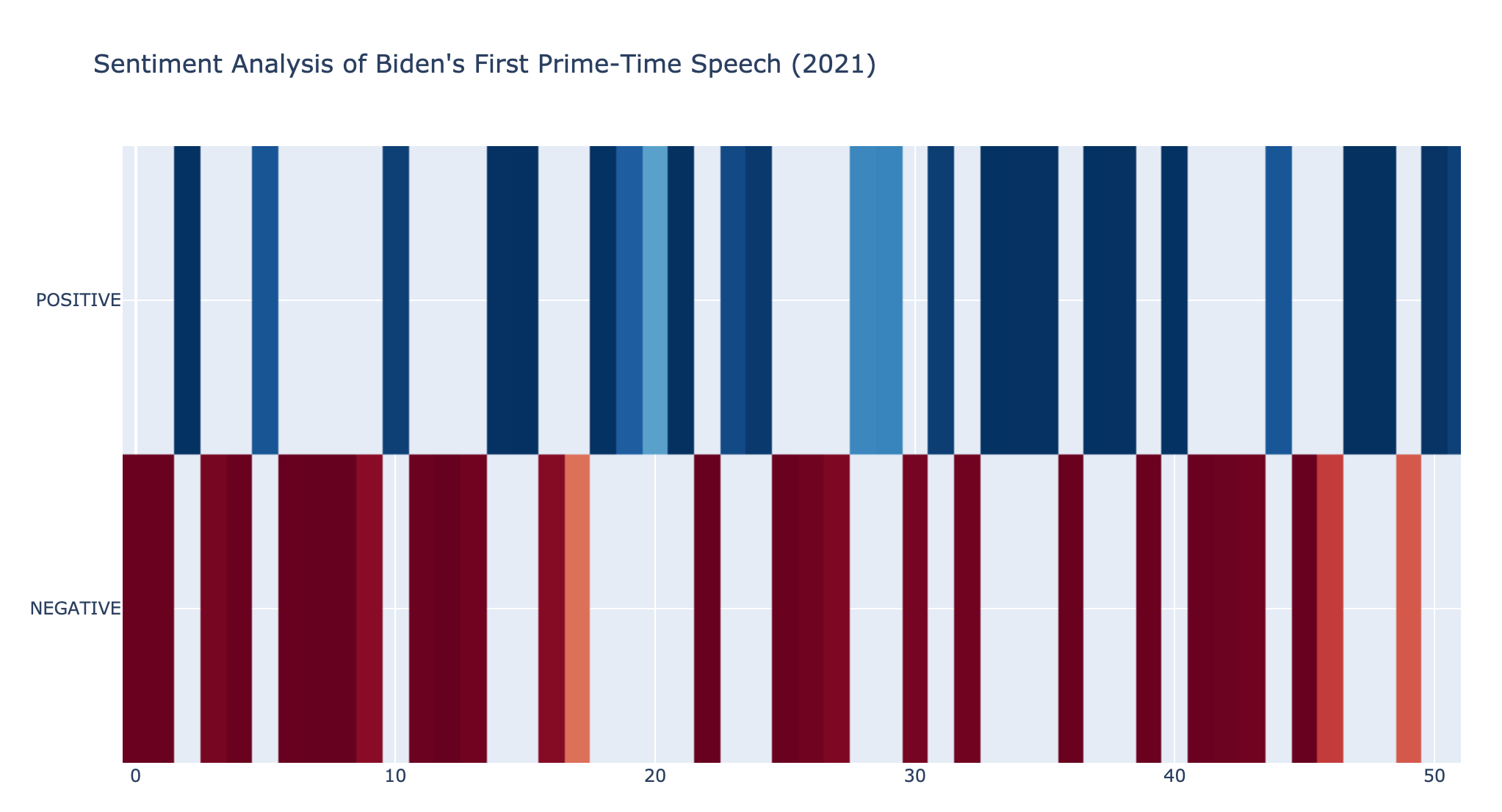 Chart: Chua Chin Hon
The addition of the Wav2Vec2 model in Hugging Face's transformers library has been one of the more exciting developments in NLP in recent months. Until then, it wasn't easy to execute tasks like machine translation or sentiment analysis if you only had a long audio clip to work with.
But now you can link up an interesting combination of NLP tasks in one go: transcribe the audio clip with Wav2Vec2, and then use a variety of transformer models to summarize or translate the transcript. The possible permutations and combinations of NLP tasks that you can link up is pretty mind boggling.
Results could be patchy, of course. Some NLP tasks, such as summarisation, are very hard to crack by nature.
This post, a follow-up to my earlier one on Wav2Vec2 trials, will outline 2 trials:
Learn this step by step with the interactive AI and Data Scientist and Machine Learning roadmaps.
- #1: Speech-to-text-to-translation & sentiment analysis
- #2: Speech-to-text-to-summarisation
REPO, REQUIREMENTS, AND REFERENCES
The notebooks and audio files needed for the trials are in my repo. Additionally, you'll need these to run the notebooks:
The code in most of the notebooks have been updated to use a better approach for transcribing long audio files, via a post on Github by Hugging Face's machine learning engineer Lysandre Jik.
In my earlier work-around, I used Audacity to manually split up long audio clips into smaller, more manageable pieces (audio clips longer than ~90s tend to crash local machines and Colab). Lysandre's code eliminates this step by using Librosa to stream in the long audio clip in shorter, fixed "chunks".
There are several versions of the Wav2Vec2 model on Hugging Face's model hub. For this post, I'll be using the wav2vec2-large-960h-lv60-self model.
TRIAL #1: TRANSCRIBE + TRANSLATE + SENTIMENT ANALYSIS
 Screen-grab on right via CNBC Television's YouTube channel
For this trial, I opted for US President Joe Biden's first prime time speech on Mar 11/12 2021 (depending on which time zone you are in).
His speech was about 24 minutes long, and I streamed it to Wav2Vec2 via 25-second chunks. You can opt for longer or shorter chunks. I found 25s to give decent results. Details are in notebook3.0 in my repo, and I won't repeat them here.
The speech is complex and Biden is known to be fighting a stutter. The transcript (download directly here) is pretty rough in some parts, especially towards the end:
 Download raw Wav2Vec2 transcript here
To be fair, Biden spoke pretty clearly in my view, and this is an example where the Wav2Vec2 model struggled. But the model took just 12 minutes or so on my late-2015 iMac to produce the transcript, which is way, way faster than if I were to do it manually.
Next, I wanted to pipe the transcript of Biden's speech to a machine translation model and see what the quality is like for a Chinese translation. I used Hugging Face's implementation of MarianMT for this, as I've tried it on a few speeches previously.
The results are borderline unusable, unfortunately. Download the full Chinese translation here:
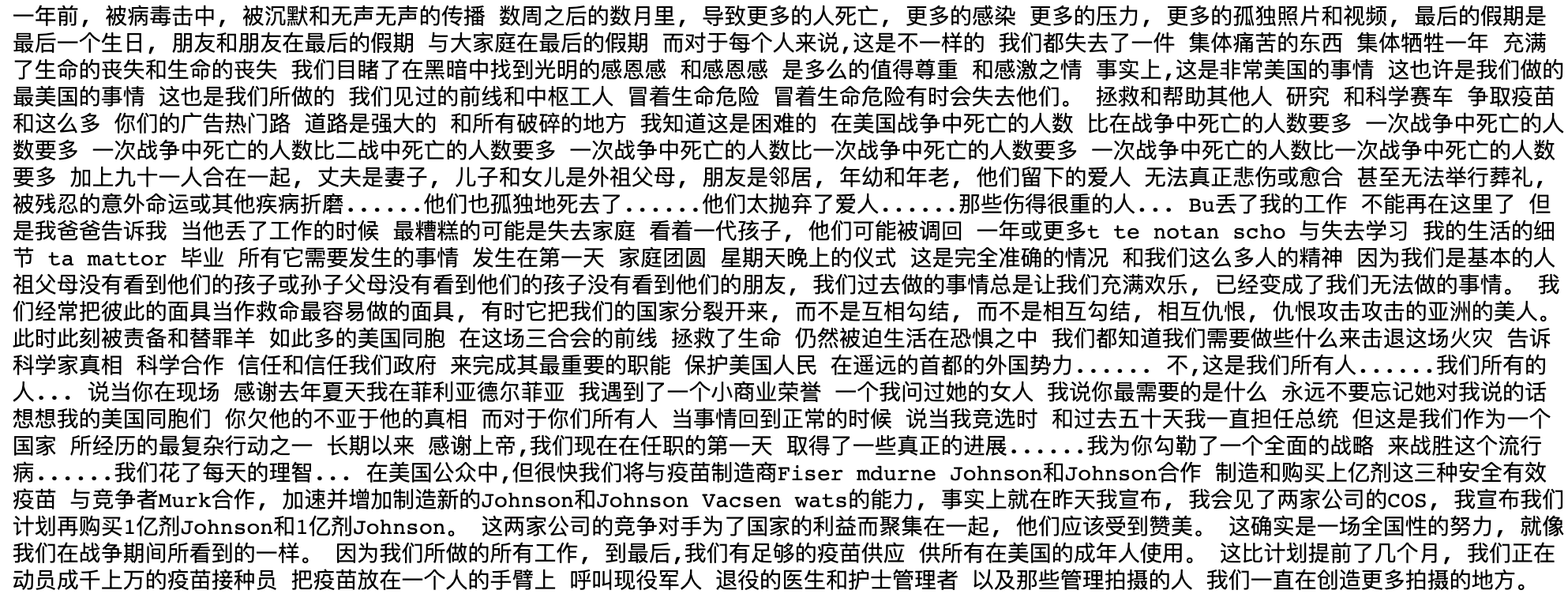 The "chain-linking" process works well from a technical perspective, and you just need about 10 additional lines of code after the Wav2Vec2 process.
But the quality of the translation clearly suffers when the problematic parts of the raw transcript were fed to the MarianMT model without a thorough clean up of the missing or wrong words, and proper punctuation. I added full stops (".") at the end of each 25s-worth of text transcript from Wav2Vec2, but that clearly doesn't capture the correct start and end of each sentence in the original speech.
So while it seems that "chain-linking" the NLP tasks would save a lot of time, the problems in one area can and will compound, resulting in lower quality results for tasks that are further downstream.
Clearly it will take additional time to clean up the raw English transcript. But I believe doing so would improve the quality of the Chinese translation considerably. As for accurate punctuation, there is no quick way to do it within Wav2Vec2 right now. But I suspect future versions of the model would resolve this issue, seeing that a number of auto-speech-recognition services on the market already have the "add punctuation" feature.
Next, I wanted to try applying sentiment analysis to Biden's speech. The combination of speech-to-text with sentiment analysis can be really useful in political or business settings, where a quick understanding of the speaker's sentiment can affect certain decisions.
The raw transcript was turned into a simple data-frame, and I then used Hugging Face's transformers pipeline and Plotly to generate a "sentiment-structure" chart like the one below. I have been experimenting with these sentiment charts for a while. My earlier experiments can be found here.
This worked better than the attempt at Chinese translation, though I'm sure the sentiment analysis would also benefit from a thorough clean up and the inclusion of proper punctuation in the raw English transcript.
There's technically no reason why one would stop at just 3 tasks. You can easily write a few more lines of code and include summarisation as the 4th NLP task in a row.
But auto-summarisation of long text documents, including speeches, remain a highly challenging task even for transformer models. The results aren't ready for prime-time, in my view. Let's take a closer look in the next trial.
TRIAL #2: TRANSCRIBE + SUMMARISE
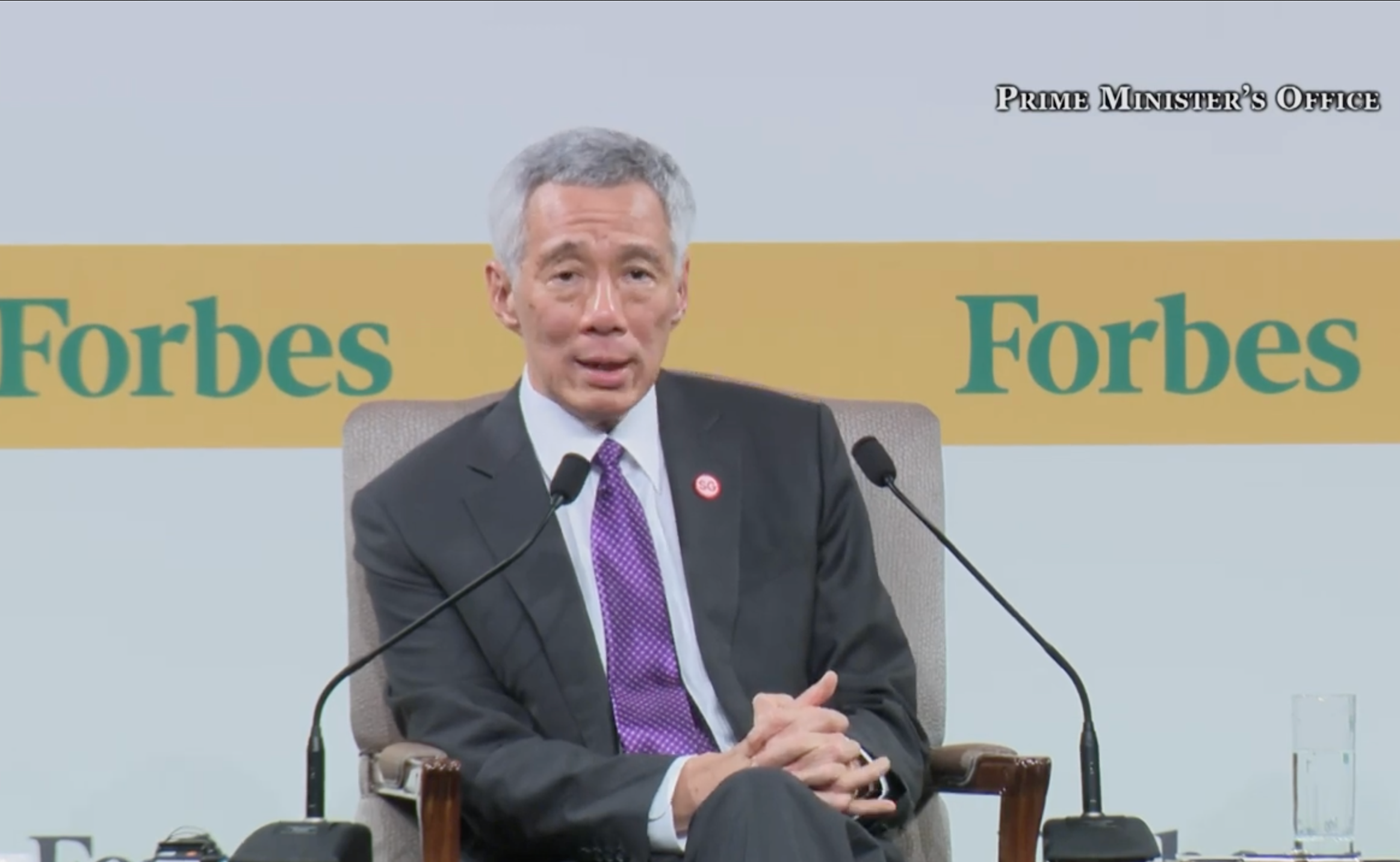 Screen-grab via the YouTube channel of the Singapore Prime Minister's Office.
For this I picked a shorter audio clip, a 4-minute video of Singapore Prime Minister Lee Hsien Loong responding to a question on populism at a business conference in 2019. The clip focuses on a singular issue, but has enough complexity for it to be challenging for any auto-summarisation model.
See notebook3.1 in my repo for details.
The Wav2Vec2 output is excellent, as you can see below (or download here). There are some minor trip ups here and there, but nothing you can't clean up really quickly.
 I ran the raw transcript on 2 transformer models fine-tuned for summarisation, FB's "bart-large-cnn" and Google's "pegasus-large".
Here's the result from Bart:
 This is the summary by Pegasus:
 Both models did well in first capturing the speaker's broad definition of populism, followed by the inclusion of his elaboration about how Singapore tried to avoid the problem.
But the FB-Bart model didn't capture any details from the second part of Mr Lee's comments. Meanwhile, the Pegasus model captured too much from the first part of his comments, and not enough of the second half. Neither version would pass for a good summary, in my view, though to be fair, both models weren't trained on political speeches.
So yet again, we see that the chain-linking of NLP tasks via Wav2Vec2 and transformers is technically viable, but the results are not always satisfactory.
CONCLUSION
These are exciting times for folks working in NLP, and Wav2Vec2 looks set to open up a whole new range of possibilities. With Hugging Face initiating a sprint to extend Wav2Vec2 to other languages (beyond English), the scope for "chain-linking" NLP tasks can only grow.
But given existing limitations on Wav2Vec2 and the inherent difficulties in many NLP tasks such as summarisation, it is probably wiser to add a "pause" button in the process.
By that I mean results will be better if the raw Wav2Vec2 transcripts are cleaned up before they are fed downstream to other NLP tasks. Otherwise the problematic areas in the transcript get compounded, resulting in sub-par results elsewhere.
As always, if you spot mistakes in this or any of my earlier posts, ping me at:
The repo for this post, containing the data and notebooks for the charts, can be found here.
Register Now to Continue Reading
Unlock Towards Data Science with a Free Account
All articles on Towards Data Science are available to registered users. Create a free account today to access this article and thousands more.
Register for freeSign in to your account
 Written By
See all from Chua Chin Hon
AIData ScienceHugging FaceMachine LearningNLP
Share This Article
Towards Data Science is a community publication. Submit your insights to reach our global audience and earn through the TDS Author Payment Program.
Write for TDS
Related Articles
Artificial Intelligence
Learn the basics through examples
André Ribeiro
June 30, 20213 min read
Artificial Intelligence
Extracting human understandable insights from any Machine Learning model
Parul Pandey
April 2, 20199 min read
Artificial Intelligence
Why even care about sample space, events, and probability measures?
Marvin Lanhenke
December 18, 20217 min read
Data Science
Use the Strava API with Python to download you activity data, create an elevation profile and plot your activity details on an interactive...
René
October 19, 20216 min read
Programming
Having difficulty transitioning between using Python and R? Try these tips to make the transition smoother
Madison Hunter
November 8, 20229 min read
Programming
Streamlit-Authenticator allows you to add a simple yet robust method for user authentication in a Streamlit application.
Brian Roepke
November 23, 20246 min read
Machine Learning
Mapping each node to an embedding vector results in enormously large embedding matrices. Is there a way to have a fixed-size vocabulary of...
Michael Galkin
June 24, 202110 min read
Data Science
Over the past 10 years, Facial recognition technology has developed rapidly and has quickly developed a variety of uses. From the...
Mitchell Krieger
October 27, 20205 min read
Data Science
When numbers lie — and your metrics mislead you
Subha Ganapathi
July 15, 20257 min read
Your home for data science and AI. The world's leading publication for data science, data analytics, data engineering, machine learning, and artificial intelligence professionals.
Subscribe to Our NewsletterWrite For TDS•About•Advertise•Privacy Policy•Terms of Use
© Insight Media Group, LLC 2026•The New Stack•roadmap.sh•Creator Network
Recommended Articles
Close