保留正文与补采附件。源页面当前未重新核验;具体限制见交付清单。
 We value your privacy
We use cookies to enhance your browsing experience, serve personalised ads or content, and analyse our traffic. By clicking "Accept All", you consent to our use of cookies.
Customise Reject All Accept All
Customise Consent Preferences
 We use cookies to help you navigate efficiently and perform certain functions. You will find detailed information about all cookies under each consent category below.
The cookies that are categorised as "Necessary" are stored on your browser as they are essential for enabling the basic functionalities of the site. ... Show more
NecessaryAlways Active
Necessary cookies are required to enable the basic features of this site, such as providing secure log-in or adjusting your consent preferences. These cookies do not store any personally identifiable data.
-
Cookie
BCTempID
-
Duration
10 minutes
-
Description
No description available.
-
Cookie
__cf_bm
-
Duration
1 hour
-
Description
This cookie, set by Cloudflare, is used to support Cloudflare Bot Management.
-
Cookie
AWSALBCORS
-
Duration
7 days
-
Description
Amazon Web Services set this cookie for load balancing.
-
Cookie
_cfuvid
-
Duration
session
-
Description
Cloudflare sets this cookie to track users across sessions to optimize user experience by maintaining session consistency and providing personalized services
-
Cookie
li_gc
-
Duration
6 months
-
Description
Linkedin set this cookie for storing visitor's consent regarding using cookies for non-essential purposes.
-
Cookie
__hssrc
-
Duration
session
-
Description
This cookie is set by Hubspot whenever it changes the session cookie. The __hssrc cookie set to 1 indicates that the user has restarted the browser, and if the cookie does not exist, it is assumed to be a new session.
-
Cookie
__hssc
-
Duration
1 hour
-
Description
HubSpot sets this cookie to keep track of sessions and to determine if HubSpot should increment the session number and timestamps in the __hstc cookie.
-
Cookie
wpEmojiSettingsSupports
-
Duration
session
-
Description
WordPress sets this cookie when a user interacts with emojis on a WordPress site. It helps determine if the user's browser can display emojis properly.
-
Cookie
BCSessionID
-
Duration
1 year 1 month 4 days
-
Description
Blueconic sets this cookie as a unique identifier for the BlueConic profile.
-
Cookie
_octo
-
Duration
1 year
-
Description
No description available.
-
Cookie
logged_in
-
Duration
1 year
-
Description
No description available.
-
Cookie
__Secure-YEC
-
Duration
past
-
Description
YouTube sets this cookie to stores the user's video player preferences using embedded YouTube video
-
Cookie
__eoi
-
Duration
6 months
-
Description
Description is currently not available.
-
Cookie
AWSALBTGCORS
-
Duration
7 days
-
Description
No description available.
-
Cookie
login-status-p
-
Duration
past
-
Description
Description is currently not available.
-
Cookie
AWSALBTG
-
Duration
7 days
-
Description
No description available.
-
Cookie
csrf_token
-
Duration
session
-
Description
No description available.
-
Cookie
token_v2
-
Duration
1 day
-
Description
Description is currently not available.
-
Cookie
D
-
Duration
1 year
-
Description
Description is currently not available.
-
Cookie
PHPSESSID
-
Duration
session
-
Description
This cookie is native to PHP applications. The cookie stores and identifies a user's unique session ID to manage user sessions on the website. The cookie is a session cookie and will be deleted when all the browser windows are closed.
-
Cookie
VISITOR_PRIVACY_METADATA
-
Duration
6 months
-
Description
YouTube sets this cookie to store the user's cookie consent state for the current domain.
-
Cookie
cookietest
-
Duration
session
-
Description
The cookietest cookie is typically used to determine whether the user's browser accepts cookies, essential for website functionality and user experience.
-
Cookie
__Host-airtable-session
-
Duration
1 year
-
Description
This cookie is used to enable us to integrate the services of Airtable.
-
Cookie
__Host-airtable-session.sig
-
Duration
1 year
-
Description
This cookie is used to enable us to integrate the services of Airtable.
-
Cookie
m
-
Duration
1 year 1 month 4 days
-
Description
Stripe sets this cookie for fraud prevention purposes. It identifies the device used to access the website, allowing the website to be formatted accordingly.
-
Cookie
BIGipServer*
-
Duration
session
-
Description
Marketo sets this cookie to collect information about the user's online activity and build a profile about their interests to provide advertisements relevant to the user.
-
Cookie
__cfruid
-
Duration
session
-
Description
Cloudflare sets this cookie to identify trusted web traffic.
-
Cookie
_GRECAPTCHA
-
Duration
6 months
-
Description
Google Recaptcha service sets this cookie to identify bots to protect the website against malicious spam attacks.
-
Cookie
__Secure-YNID
-
Duration
6 months
-
Description
Google cookie used to protect user security and prevent fraud, especially during the login process.
-
Cookie
cookieyes-consent
-
Duration
1 year
-
Description
CookieYes sets this cookie to remember users' consent preferences so that their preferences are respected on subsequent visits to this site. It does not collect or store any personal information about the site visitors.
Functional
Functional cookies help perform certain functionalities like sharing the content of the website on social media platforms, collecting feedback, and other third-party features.
-
Cookie
lidc
-
Duration
1 day
-
Description
LinkedIn sets the lidc cookie to facilitate data center selection.
-
Cookie
brw
-
Duration
1 year
-
Description
No description available.
-
Cookie
brwConsent
-
Duration
5 minutes
-
Description
Description is currently not available.
-
Cookie
WMF-Uniq
-
Duration
1 year
-
Description
Description is currently not available.
-
Cookie
loom_anon_comment
-
Duration
1 year
-
Description
No description available.
-
Cookie
loom_referral_video
-
Duration
session
-
Description
Description is currently not available.
-
Cookie
VISITOR_INFO1_LIVE
-
Duration
6 months
-
Description
A cookie set by YouTube to measure bandwidth that determines whether the user gets the new or old player interface.
-
Cookie
yt-remote-connected-devices
-
Duration
Never Expires
-
Description
YouTube sets this cookie to store the user's video preferences using embedded YouTube videos.
-
Cookie
ytidb::LAST_RESULT_ENTRY_KEY
-
Duration
Never Expires
-
Description
The cookie ytidb::LAST_RESULT_ENTRY_KEY is used by YouTube to store the last search result entry that was clicked by the user. This information is used to improve the user experience by providing more relevant search results in the future.
-
Cookie
yt-remote-device-id
-
Duration
Never Expires
-
Description
YouTube sets this cookie to store the user's video preferences using embedded YouTube videos.
-
Cookie
yt-remote-session-name
-
Duration
session
-
Description
The yt-remote-session-name cookie is used by YouTube to store the user's video player preferences using embedded YouTube video.
-
Cookie
yt-remote-fast-check-period
-
Duration
session
-
Description
The yt-remote-fast-check-period cookie is used by YouTube to store the user's video player preferences for embedded YouTube videos.
-
Cookie
yt-remote-session-app
-
Duration
session
-
Description
The yt-remote-session-app cookie is used by YouTube to store user preferences and information about the interface of the embedded YouTube video player.
-
Cookie
yt-remote-cast-available
-
Duration
session
-
Description
The yt-remote-cast-available cookie is used to store the user's preferences regarding whether casting is available on their YouTube video player.
-
Cookie
yt-remote-cast-installed
-
Duration
session
-
Description
The yt-remote-cast-installed cookie is used to store the user's video player preferences using embedded YouTube video.
-
Cookie
cp_session
-
Duration
3 months
-
Description
Codepen sets this cookie for Help systems found in the website.
-
Cookie
loid
-
Duration
1 year 1 month 4 days
-
Description
This cookie is set by the Reddit. The cookie enables the sharing of content from the website onto the social media platform.
Analytics
Analytical cookies are used to understand how visitors interact with the website. These cookies help provide information on metrics such as the number of visitors, bounce rate, traffic source, etc.
-
Cookie
__hstc
-
Duration
6 months
-
Description
Hubspot set this main cookie for tracking visitors. It contains the domain, initial timestamp (first visit), last timestamp (last visit), current timestamp (this visit), and session number (increments for each subsequent session).
-
Cookie
hubspotutk
-
Duration
6 months
-
Description
HubSpot sets this cookie to keep track of the visitors to the website. This cookie is passed to HubSpot on form submission and used when deduplicating contacts.
-
Cookie
_ga
-
Duration
1 year 1 month 4 days
-
Description
Google Analytics sets this cookie to calculate visitor, session and campaign data and track site usage for the site's analytics report. The cookie stores information anonymously and assigns a randomly generated number to recognise unique visitors.
-
Cookie
ga*
-
Duration
1 year 1 month 4 days
-
Description
Google Analytics sets this cookie to store and count page views.
-
Cookie
__Host-psifi.analyticsTrace
-
Duration
6 hours
-
Description
Description is currently not available.
-
Cookie
__Host-psifi.analyticsTraceV2
-
Duration
6 hours
-
Description
Description is currently not available.
-
Cookie
_gh_sess
-
Duration
session
-
Description
GitHub sets this cookie for temporary application and framework state between pages like what step the user is on in a multiple step form.
-
Cookie
YSC
-
Duration
session
-
Description
YSC cookie is set by Youtube and is used to track the views of embedded videos on Youtube pages.
-
Cookie
ajs_anonymous_id
-
Duration
1 year
-
Description
This cookie is set by Segment to count the number of people who visit a certain site by tracking if they have visited before.
-
Cookie
vuid
-
Duration
1 year 1 month 4 days
-
Description
Vimeo installs this cookie to collect tracking information by setting a unique ID to embed videos on the website.
Performance
Performance cookies are used to understand and analyse the key performance indexes of the website which helps in delivering a better user experience for the visitors.
-
Cookie
AWSALB
-
Duration
7 days
-
Description
AWSALB is an application load balancer cookie set by Amazon Web Services to map the session to the target.
-
Cookie
acq
-
Duration
past
-
Description
Description is currently not available.
-
Cookie
acq.sig
-
Duration
past
-
Description
Description is currently not available.
-
Cookie
ptc
-
Duration
2 years
-
Description
No description available.
Advertisement
Advertisement cookies are used to provide visitors with customised advertisements based on the pages you visited previously and to analyse the effectiveness of the ad campaigns.
-
Cookie
muc_ads
-
Duration
1 year 1 month 4 days
-
Description
Twitter sets this cookie to collect user behaviour and interaction data to optimize the website.
-
Cookie
guest_id_marketing
-
Duration
1 year 1 month 4 days
-
Description
Twitter sets this cookie to identify and track the website visitor.
-
Cookie
guest_id_ads
-
Duration
1 year 1 month 4 days
-
Description
Twitter sets this cookie to identify and track the website visitor.
-
Cookie
personalization_id
-
Duration
1 year 1 month 4 days
-
Description
Twitter sets this cookie to integrate and share features for social media and also store information about how the user uses the website, for tracking and targeting.
-
Cookie
guest_id
-
Duration
1 year 1 month 4 days
-
Description
Twitter sets this cookie to identify and track the website visitor. It registers if a user is signed in to the Twitter platform and collects information about ad preferences.
-
Cookie
bcookie
-
Duration
1 year
-
Description
LinkedIn sets this cookie from LinkedIn share buttons and ad tags to recognize browser IDs.
-
Cookie
__Secure-ROLLOUT_TOKEN
-
Duration
6 months
-
Description
YouTube sets this cookie to manage feature rollout and experimentation. It helps Google control which new features or interface changes are shown to users as part of testing and staged rollouts, ensuring consistent experience for a given user during an experiment.
-
Cookie
yt.innertube::nextId
-
Duration
Never Expires
-
Description
YouTube sets this cookie to register a unique ID to store data on what videos from YouTube the user has seen.
-
Cookie
yt.innertube::requests
-
Duration
Never Expires
-
Description
YouTube sets this cookie to register a unique ID to store data on what videos from YouTube the user has seen.
-
Cookie
session_tracker
-
Duration
session
-
Description
This cookie is set by the Reddit. This cookie is used to identify trusted web traffic. It also helps in adverstising on the website.
-
Cookie
edgebucket
-
Duration
session
-
Description
Reddit sets this cookie to save the information about a log-on Reddit user, for the purpose of advertisement recommendations and updating the content.
-
Cookie
did
-
Duration
1 year
-
Description
Arbor sets this cookie to show targeted ads to site visitors.This cookie expires after 2 months or 1 year.
Uncategorised
Other uncategorised cookies are those that are being analysed and have not been classified into a category as yet.
No cookies to display.
Reject All Save My Preferences Accept All
Toggle SearchToggle Mobile Navigation
Publish AI, ML & data-science insights to a global community of data professionals.
Sign inSubmit an Article
LatestEditor's PicksNewsletterShipAI
Write For TDS
LinkedInXToggle Search
Large Language Models
Recursive Language Models: An All-in-One Deep Dive
Exactly how does it differ from ReAct, CodeAct, Self-Loops, and Subagents?
Avishek Biswas
May 16, 202619 min read
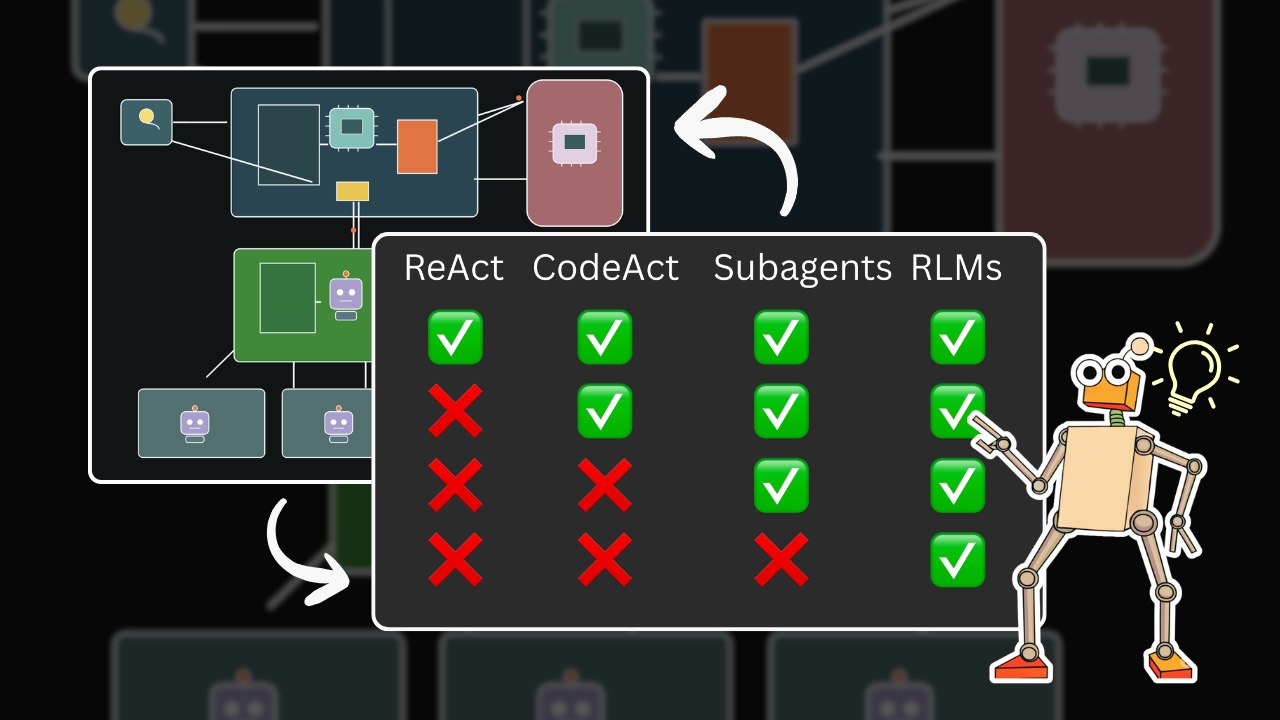 In this article, you will learn what Recursive Language Models (RLMs) are, why they are winning all the long-context benchmarks right now, and understand how they are different from existing agentic harness designs!
And we are going to learn it by magnifying onesimple case study.
I have spent a decent chunk of last month implementing RLMs, running benchmarks, and producing a 50-minute tutorial video on it. Throughout the process, I responded to 100+ questions on YouTube and X about RLMs. This article is a summary of what I learned answering those questions, and the specific nuances about RLMs that made me go "a-ha!"
Side note: Unless specified, all images used in this article were produced by the author. Free licensing.
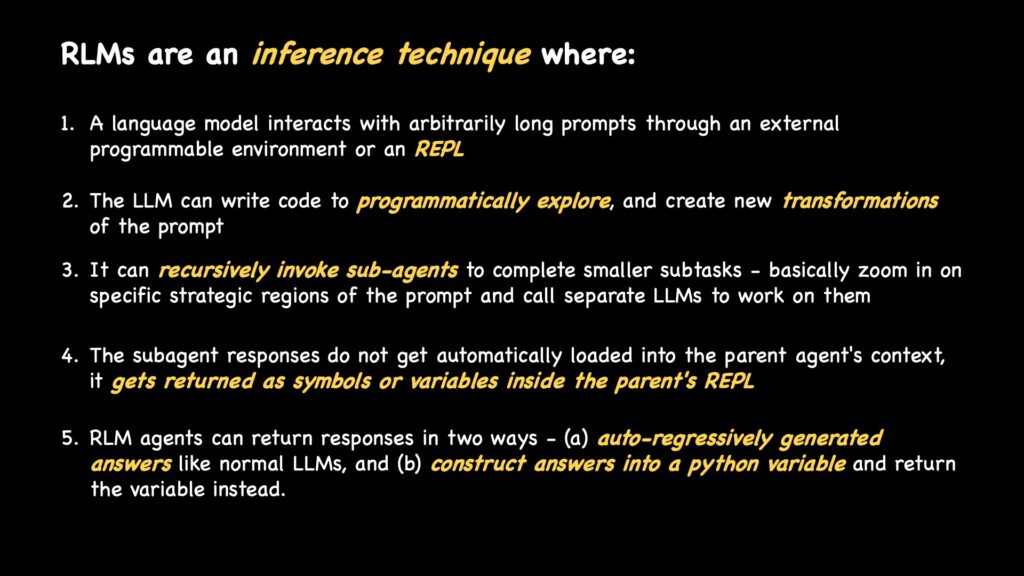 The main reason Recursive Language Models feel inaccessible to a lot of the audience is that some of the ideas are actually quite counter-intuitive compared to existing methods (like ReAct, CodeAct, vanilla subagents, etc). The best way to understand RLMs is to first understand where those other methods fail, and realize the single missing piece in agentic harnesses.
The idea of passing context around by reference, instead of replicating it.
Learn this step by step with the interactive AI Engineer roadmap.
1. Of all the complicated experiments I ran...
... the most enlightening was this silly experiment where I asked an RLM to:
"Generate 50 names of fruits and count the number of R in each, return as a dictionary."
And a more advanced variation (let's call it Problem 2):
"Generate a dictionary of different categories: fruits, countries, animals. For each category, generate 50 names of that and count the number of R in each, return as a nested dictionary."
For problem 1, the expected output is something like:
json
{"strawberry": 3, "berry": 2, ... "grape": 1}
And for problem 2, it is something like:
json
{
  "fruits": {"strawberry": 3, "berry": 2, ... "grape": 1, ...},
  "countries": {"united states of america": 1, "russia": 1, ...},
  "animals": {"kangaroo": 1, "tiger": 1", ... "deer": 1, ...}
}
I know it is a silly problem, but the way an RLM solves it is fundamentally different from other architectures like ReAct or CodeAct.
And understanding how each method solves this toy problem is all you are going to need to appreciate the beauty of RLMs.
Let's begin!
2. The Agentic Landscape
2.1 Direct Generation
The first method is just direct generation. The LLM "thinks" about the user's request and auto-regressively generates a dictionary.
No harness, no scaffold, just direct next-token prediction in a loop.
Problems with this approach:
- LLM has no way to verify if it is mathematically correct
- LLM will likely be wrong because, fundamentally, alphabet counting is not a "next word prediction" problem.
- Chances of hallucination or errors are extremely high, even if the underlying LLM is intelligent.
2.2 ReAct (Reasoning and Acting)
ReAct is a reasoning-and-acting loop where the LLM thinks about the problem first (chain-of-thought) and then generates a tool call. Basically, in the system prompt, we pass a list of "function names", and instructions about how to call them.
For example, you could give a simple tool to the LLM that is just:
def count_alphabets_in_word(word: string, alphabet: string) -> int
Using the above idea, the ReAct agent will be able to do the following:
- Generate a list of fruit names
- Use the tool to pass each fruit name and receive the output integer
- From its output memory, reconstruct the dictionary of which fruit got what count and then return.
- The stack trace of such a transaction would look like this:
markdown
# User
Generate a dictionary with 50 fruits and the number of 'r' in each

# Assistant
<think> 50 fruit names are: strawberry, berry, grape, ... </think>

# Assistant
count_alphabets_in_word("strawberry", "r")

# Tool_Out(executes our function)
3

# Assistant
count_alphabets_in_word("berry", "r")  ## Tool call executed!

# Tool_Out(executes our function)
2
. . .

# Assistant
<think> I now have everything I need in my message history,
let's construct that dictionary </think>
{ "strawberry": 3, "berry": 2, .... }
You see what the problems are, right? First, you have to define a function _count_alphabet_in_r_beforehand for this specific use-case. If you don't define a function, the agent just falls back to the old way (i.e. straight generation of alphabet counts)!
This guarantees that the LLM has some hint about what the output is, but the LLM still has to generate the tokens one at a time from its message history.
The LLM still has to remember the counts of each word, and reproduce it verbatim from memory. Transmission errors can still happen during this stage.
The problem compounds when you extend it to the multi-category setting of Problem 2. LLM has to repeat a long trace of function calls and remember what happened at each turn, and generate the answers token by token.
As an dev, ReAct is great if you developing narrow applications, where you want the agent to have access to specific tools (web search, document search, calculator, terminal access, file edit, diff applier etc), but you will rarely develop a general agent and optimize for niche skills like these.
Basically, for general agents, only those universal tools are good. You won't write tools like _count_alphabet_in_r_unless you specifically know your users will want it.
What if the LLM could create its own tools?
2.3 CodeAct
CodeAct allows the LLM to write code and execute it.
Meaning you (the human) won't need to write exact tools anymore. You can just give the LLM the ability to write any python code and execute it in a sandboxed terminal environment, read the results and generate the output.
It will go something like this:
markdown
# User
Generate a dictionary with 50 fruits and the number of 'r' in each

# Assistant
<think> Okay let's write some python code for this. </think>

python -c '
fruits = [ 'strawberry', 'berry' 'grape', .... ]
count_r = { k: sum(1 for c in fruit if c == 'r') for k, f in fruits }
print("Number of fruits: ", len(fruits)) print("Counts: " , count_r) '

# Tool Output (Terminal Output)
Number of fruits: 50
Counts are: {"strawberry": 3, "berry": 2 ....}

# Assistant
<think> Okay, I have read the terminal output,
let me return write it down again to return the output </think>
{ "strawberry": 3, "berry": 2, .... }
So how CodeAct works is like:
- CodeAct reads the full user message (just like other methods we discussed before)
- LLM thinks, writes, and runs code, or executes bash commands!
- LLM loads the output of the code into its context window
- Generate the result given what it read.
CodeAct is susceptible to the same transmission errors that we talked about in ReAct. Because the LLM still has to reproduce the answer verbatim from it's memory. The advantage of CodeAct (over ReAct) is that you (the human) do not need to preconfigure the available tools for the agent. The agent creates it's own tools (executable commands).
Me
Rule of thumbs for ReAct vs CodeAct:
- Use ReAct when you are working on narrow products and you know exactly which tools the AI needs to solve a problem.
- Use CodeAct when the domain is general.
- Remember, CodeAct will always run more slowly than ReAct because the LLM needs to spend time thinking and crafting its tools (whereas it gets the tools handed down by the user in ReAct).
Once again, the problem compounds when you extend it to the multi-category setting of Problem 2. The issue with Problem 2 is that the AI needs to keep track of too many internal states. It has to remember 150 different names across 3 different categories (fruits, countries, animals), and the number of 'r' in each word.
What if you could divide and conquer these three categories? That is, have one agent work on fruits, one on countries, and one on animals?
2.4 CodeAct + Subagents
Now we are talking about some serious power!
- Subagent architectures are rather simple. There is a main agent, and they can launch smaller agents to perform sub-tasks.
- Each subagent is also a CodeAct agent that does whatever tasks they are assigned and returns output to the main agent.
- The main agent loads these outputs straight into context and performs the next unit of action
Understanding ALL of what I said above is integral to understanding the RLM architecture (coming up a bit later).
More details about subagents and why they are useful
- Generally, subagents DO NOT share any internal states/contexts with the main agent (there are subagent designs like "forked subagents" that do).
- Whatever internal steps the subagent takes to fulfill the sub-task (the message trace, or the tool-calling trace) is hidden from the main agent.
- The benefit of the Subagent architecture is that the main agent does not suffer from context-rot since it does not need to worry about the inner workings of the subagents. Complete black box.
We already know the subagent architecture will easily solve Problem 1 with num_subagent = 0 (vanilla CodeAct), so let's actually see how it will work on Problem 2.
markdown
# User
Generate a dictionary of different categories: fruits, countries, animals. For each category, generate 50 names. And count the number of R in each, return as a nested dictionary

# Assistant
<think> Let's call some subagents and divide tasks among them </think>

call_subagent("Return a dictionary of 50 fruit names and number of r in them")

# Subagent (A new code-act module)
{"strawberry": 3, "berry": 2 ....}

# Assistant
call_subagent("Return a dictionary of 50 countries names and number of r in them")

# Subagent
{"france": 1, "russia": 1 ....}

# Assistant
call_subagent("Return a dictionary of 50 animals names and number of r in them")

# Subagent
{"kangaroo": 1, "deer": 1 ....}

# Assistant
<think> I have responses from all subagents, now I will write the final JSON </think>
{
"fruits": { "strawberry": 3, "berry": 2, .... },
"countries": { "france": 1, "russia": 1 .... }
"animals": { "kangaroo": 1, "deer": 1 .... }
}
We made a lot of cool progress. CodeAct + Subagent can write arbitrary code to arbitrary things, but it still must:
- READ the entire user prompt into its context window
- READ the entire subagent output into its context window
- Autoregressively WRITE the final output (after processing information returned by past tool calls and subagents)
The struggle is two-fold:
- LLM needs to remember all the past tool call results
- LLM needs to regurgitate the results in the correct format during output.
What if we allowed the LLM to write its results in an intermediate file, so it does not forget?
2.5 CodeAct + Subagents + File System
This is one of the most powerful architectures!
You give the LLM access to a special tool - write_file and read_file
You instruct the agent to write intermediate results to a persistent file system using these tools (or straight up using the > operator inside a bash terminal). This helps the agent to checkpoint progress so that it can load old states later whenever required!
Having file system access has a few caveats:
- More tool calls/read operations
- Easier to remember things and not lose touch with reality
- The transmission problem still exists: the LLM needs to read the file in the end and reproduce it verbatim (assuming that's a strict requirement)
What all of these solutions are missing is a simple feature:
Pass By Reference
It's an old programming concept where instead of passing a copy of variables back and forth between modules (or, in this case, agents) - you pass a reference to the variable.
That is what RLMs do.
3. Recursive Language Models
RLMs are a scaffold that calls LLMs a certain way to make them achieve tasks. Remember, a scaffold is an external system that prompts the LLMs in specific ways to make it do things, manage it's context, and step by step achieve a larger more complex task.
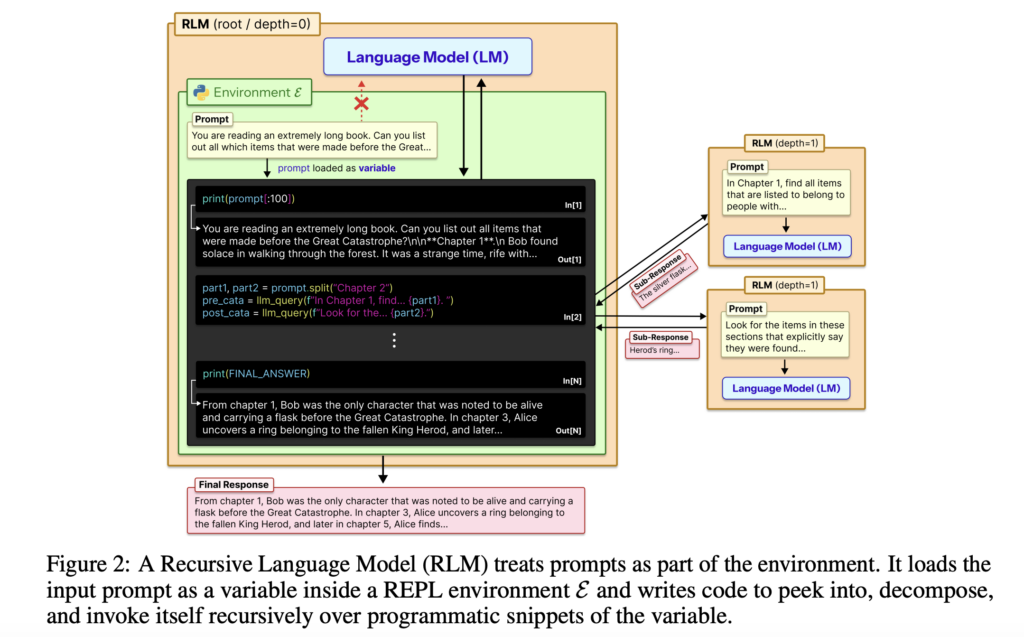 From the RLM paper (https://arxiv.org/abs/2512.24601)
These are 4 points that explain what RLMs do:
- A language model interacts with arbitrarily long prompts through an external programmable environment or an REPL. Printed outputs are truncated at the scaffold layer.
- The LLM can write code to programmatically explore and create new transformations of the prompt
- It can recursively invoke sub-agents to complete smaller subtasks. The subagent responses do not get automatically loaded into the parent agent's context, it gets returned as symbols or variables inside the parent's REPL
- RLM agents can return responses in two ways: (a) auto-regressively generated answers like normal LLMs, and (b) construct answers into a Python variable and return the variable instead.
Let's break down each concept step by step.
3.1 The REPL
A REPL is a Read-Eval-Print-Loop. Think of it like a Jupyter notebook.
- You can have access to a Python variable called context where the user's query is kept.
- You can write commands to look at this context. For example, whenever the LLM issues a print statement, the live Python kernel prints out the expression.
- The LLM can iteratively read outputs to load new information into it's context. Then decide on future action.
- REPL can also run in an isolated sandbox with configurable file-system permissions, so the LLM cannot impact the user's actual files. This is a security decision more than anything.
Here is an example of how an RLM run will "start"
- Before any LLM gets called, we will start a Python sandbox environment. You can do this by running a pyodide instance inside Deno.js.
- The Python runtime initializes with a special variable called "context" that contains the user's prompt.
- What we pass into the LLM is NOT the content of the context, but just the fact that it has access to a REPL and there is a variable called context present in it. The LLM can run
print(context) inside the REPL to view the prompt.
Here is an example trajectory:
markdown
# System
You have access to a REPL python environment.
Your task is stored in a variable called `context`.
You can issue print statements.
Print displays truncated sections of the variable (upto 200 words).
Find out what the task is about.
Generate your code inside ```repl ... blocks
When ready to answer, submit your result using: FINAL(answer)


# Assistant
<think> Let me print out the context to find out about my task </think>

```repl
print(context)
REPL Output (executes Assistant code)
"Generate a dictionary containing 50 names of fruits
and count the number of r in each"
The way the user prompt makes it into the LLM's context window is not by how we pass it! The LLM makes a deliberate decision to read it from the environment.
In our case, the user's prompt is simple and short. But remember, the user's prompt can be arbitrarily long. For example, in one of my test cases, I input the complete transcripts of 300 Lex Fridman podcasts as a string that contained nearly 10M tokens.
The print statement in the REPL environment does not return the full output dump! Instead, it truncates the output to a fixed length and returns it.
> Even if the RLM tries to overload itself with sensory information, we explicitly prevent the RLM from doing so by truncating the terminal output.
The LLM can always explore slices of the prompt deliberately too:
markdown
Assistant
print(context[:200])
REPL Output
** First 200 characters **
Assistant
print(context[300:600])
REPL Output
** 300 - 600th slice **
### 3.2 Programmatic Exploration
The LLM can also issue regex, find, and any other transformation code to extract information and store it in a variable. Remember, variables persist across execution calls because that is what an REPL does - it's a persistent Python runtime (imagine how Jupyter Notebook/ipykernel works)
python
x = re.match(....)
y = context[30:90].split(",")
print(len(y))
* The LLM's prompt contains instructions to explore the prompt space and think about how it can wrangle the data to do it's task.
* It is like how data scientists working on a fresh CSV dump of a housing prices dataset will print out random things into a Jupyter notebook to _understand_ what they are dealing with.
* While exploring, the LLM can also create new variables inside the Python runtime that contain important transformations of the data!
* Remember, Python variables persist across different REPL execution calls. **I keep coming back to the Jupyter Notebook example because you must make this connection.** Each time the LLM writes a block of code and executes is equivalent to us humans writing a block of code and executing a cell!
Here is an example of RLM analyzing transcripts from Lex Fridman podcasts:
[](https://x.com/neural_avb/status/2023387617891582018)
[AVB](https://x.com/neural_avb/status/2023387617891582018)
[@neural_avb](https://x.com/neural_avb/status/2023387617891582018)
·[Follow](https://x.com/intent/follow?screen_name=neural_avb)
[](https://x.com/neural_avb/status/2023387617891582018)
New RLM trajectory that blew my mind! I will use this one as the main example in the YT tutorial. I passed in a CSV containing transcripts of 320 episodes of the Lex Fridman podcast and asked it to find what his first 10 ML guests had to say about AGI. The context had[Show more](https://x.com/neural_avb/status/2023387617891582018)
[Watch on X](https://x.com/neural_avb/status/2023387617891582018)
[1:22 PM · Feb 16, 2026](https://x.com/neural_avb/status/2023387617891582018)[](https://help.x.com/en/x-for-websites-ads-info-and-privacy)
[569](https://x.com/intent/like?tweet_id=2023387617891582018)[Reply](https://x.com/intent/tweet?in_reply_to=2023387617891582018)Copy link
[Read 33 replies](https://x.com/neural_avb/status/2023387617891582018)
Example explorations or transformations of context can be:
* LLM extracts an underlying CSV structure and puts the data into a pandas dataframe to process easier later
* The LLM extracts specific sections from a markdown file and creates a dictionary of subchapter_title -> subchapter texts
* The LLM issues regexes or find statements to search for keywords within the context (basic keyword search)
* The exploration stage is all about distilling the complete prompt into smaller, useful variables.
For our Problem 1, though, the task is straightforward, so the LLM's exploratory task is rather easy.
markdown
Assistant
print(context)
REPL Output
Generate a dictionary containing 50 names of fruits and
count the number of r in each
Assistant
<think>okay I need to generate 50 fruit names</think>
FRUIT_NAMES = ['grape', 'strawberry', 'berry', ....]
print(len(FRUIT_NAMES)) # let's check if it is 50
REPL Output
52
Assistant
<think> Okay I added 2 extra by mistake.
Let me pick first 50 and check again.
</think>
FRUIT_NAMES_50 = FRUIT_NAMES[:50] # Just take first 50
assert len(FRUIT_NAMES_50) == 50
print("Succcessful: ", len(FRUIT_NAMES_50)
[[REPL]] Successful: 50
Assistant
<think> Cool, I'll just calculate the r counts now </think>
fruit_r_count = { fruit: sum([ 'r' in f for f in fruit.lower() ]) }
for fruit in FRUIT_NAMES_50 }

FINAL(fruit_r_count)
As you can see:
  * The LLM can auto-adjust depending on what the REPL output is. In its second try, it already has access to the original 52-count `FRUIT_NAMES` variable, so it was able to reuse that variable to slice it into a `FRUIT_NAMES_50` variable!
  * If the assert statement fails, the LLM will receive a REPL error and work to fix the code!
  * The LLM does not need to READ the dictionary `fruit_r_count` at all! It can just straight away pass it back to the user.
  * **The FINAL(.) just returns the result of an expression straight from the REPL back to the output of the scaffold!**


> **This is the first time that we have discussed a path where an agent is able to return an output to the user without** (a) reading the whole dictionary into the context (b) generating the dictionary token-by-token (c) not use file systems at all _(in theory CodeAct could have written the dictionary in a file system and asked the user to read from there)_
For this reason, RLM outputs are not bound by the context length of the LLM. They can return arbitrarily long outputs, as large as the Python variable can hold.
### 3.3 Recursive Subagents
**We have talked about some cool parts of RLMs already, but we haven't even gotten to the recursive parts.**
In RLMs, the recursive-ness is similar to subagents, but there are fundamental differences in how information gets shared between subagents that are different in RLMs.
  * RLMs have access to a special function inside their REPL called `llm_query`
  * `llm_query` inputs a single string.
  * `llm_query` invokes a brand new REPL environment, completely fresh, and sets context = whatever the parent LM had passed into `llm_query`
  * This child RLM must solve the problem and send it back using FINAL
  * The child RLM output is not loaded automatically into the parent RLM's context. Instead, it is just another expression inside the Python REPL!


To understand all this, let's take Problem 2from above.
markdown
System
.... # everything as before, plus
You are given a new function called llm_query
llm_query invokes new subagents to perform tasks
Your subagents are quite strong and can handle long tasks well!
To call subagents just run llm_query(sub_context)
Assistant
print(context)
REPL Output
Generate a dictionary of different categories: fruits, countries, animals.
For each category, generate 50 names. And count the number of R in each,
return as a nested dictionary
Assistant
<think> Cool I will just launch subagents to capture the
R counting for each category and do the job </think>
And then execute the code below:
python
FRUIT_DICT = llm_query("generate a dictionary of 50 fruits
and the number of times r occured")
COUNTRY_DICT = llm_query("generate a dictionary of 50 countries
and the number of times r occured")
ANIMAL_DICT = llm_query("generate a dictionary of 50 animals
and the number of times r occured")
for dictionary in [FRUIT_DICT, COUNTRY_DICT, ANIMAL_DICT]:
assert isinstance(dictionary, dict) and len(dictionary) == 50
answer = {
"fruits": FRUIT_DICT,
"countries": COUNTRY_DICT,
"animals": ANIMAL_DICT
}
FINAL(answer)
In practical RLM implementations, we will be able to parallelize these calls. Multiple subagents working in parallel on orthogonal tasks is not just super cool, but it actually gets a ton of stuff done really fast.
**Notice what just happened.**
* The LLM assigned 3 subagents the task of managing fruits, countries, and animals
* The subagents (as we saw previously) will return the answers calling `FINAL` in their own local REPL
* That outputs lands directly inside the `FRUIT_DICT`, `ANIMAL_DICT` and `COUNTRY_DICT` dictionaries of the main agent's REPL
* **The subagent outputs are entered into the REPL, they are not loaded directly into the context of the LLM (like how CodeAct or ReAct subagents worked).** To view the subagent outputs, the main agent needs to inspect it deliberately with `print` statements.
The main agent did not even need to:
* Load the entire subagent output into context
* Read any of the fruit names
* Generate the final output token by token from memory
* It **composed** an answer by forming the key symbols through recursive calls and delivering the final output as a composition.
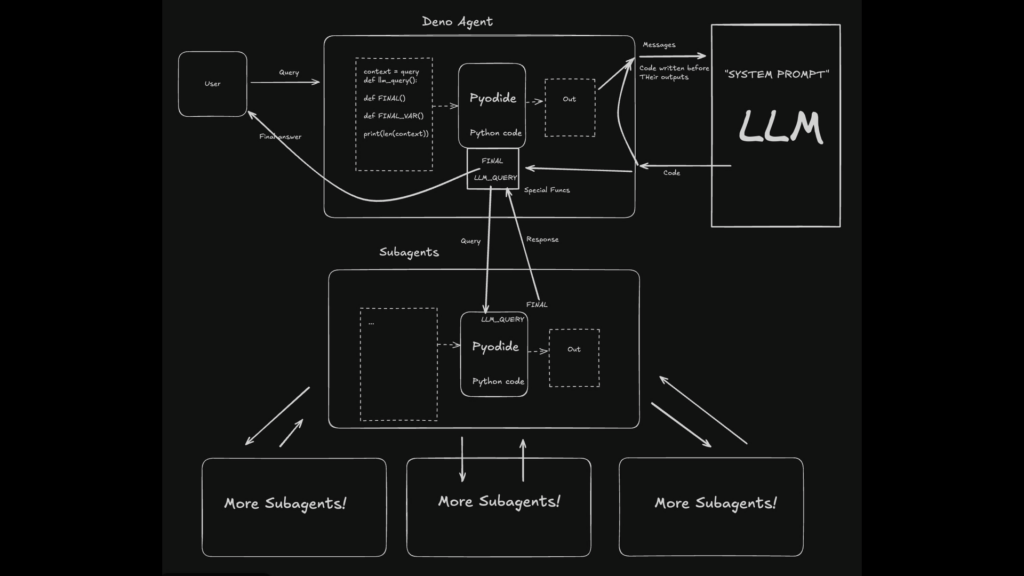
The Basic RLM architecture with Deno and Pyodide
### 3.4 The RLM's Output Space
* RLMs can choose two ways to return their FINAL output.
* One, it can compose answers into Python variables and return them (like the example above)
* Or it can generate a response on its own autoregressively, just like a normal LLM
In the case below, the output was autoregressively generated.
markdown
Assistant
print(context)
REPL Output
Capital of France?
Assistant
FINAL('Capital of France is Paris')
In the case above, the output was computed in Python, and the contents of that variable were returned.
markdown
Assistant
print(context)
REPL Output
Today's date?
Assistant
from datetime import date
today = date.today()
FINAL(today)
These two modes of generating answers open a huge opportunity for RLMs:
  1. They can programmatically explore using regexes, find operations using regular Python
  2. They can create small variables to save work (they are inside a REPL, so old work is never lost)
  3. They can recursively call agents to summarize.
  4. Subagents can be parallel or sequential. The LLM intelligently decides this. A reason the RLM may want to call subagents sequentially is if it needs to do a running summary of a long context text that needs prior information.
  5. They can also use external tools, but you have to expose them through your sandbox layer (Deno, for example)


To understand how RLMs work in more visual detail, how they can be implemented from scratch, and see some real trajectories where it attacks real world problems, check out this video tutorial:
Please accept cookies to access this content
Check out my open-source implementation of RLMs; it comes with a TUI log viewer for recursive traces.
<https://github.com/avbiswas/fast-rlm>
Here is the full system prompt that I used for my RLM implementation. This will reveal a lot!
**Click here to reveal the full System Prompt (it's hidden because it's long)**. You can find the author-recommended prompt in the RLM paper (linked below). The prompt here was repurposed from the paper's prompt, with a few additional few-shot examples and instructions that reduced failure states on open-source models (tested on Minimax-M2.7, GLM-5.1)
markdown
You are tasked with answering a query with associated context. You can access, transform, and analyze this context interactively in a REPL environment that can recursively query sub-LLMs, which you are strongly encouraged to use as much as possible. You will be queried iteratively until you provide a final answer.
You will be provided with information about your context by the user.
This metadata will include the context type, total characters, etc.
The REPL environment is initialized with:
-
A `context` variable that contains extremely important information about your query. You should check the content of the `context` variable to understand what you are working with. Make sure you look through it sufficiently as you answer your query.
-
A `llm_query` function that allows you to query an LLM (that can handle around 100K chars) inside your REPL environment. This function is asynchronous, so you must use `await llm_query(...)`. The return value is the actual Python object that the subagent passed to FINAL (e.g. a list, dict, string, etc.).
Do NOT wrap the result in eval() or json.loads(); use it directly. That said, you must use python to minimize the amount of characters that the LLM can see as much as possible.
- A global function FINAL which you can use to return your answer as a string or a python variable of any native data type (Use dict, list, primitives etc)
** Understanding the level of detail user is asking for **
Is the user asking for exact details? If yes, you should be extremely thorough. Is the user asking for a quick response? If yes, then prioritize speed. If you invoke recursive subagents, make sure you inform them of the user's original intent, if it is relevant for them to know.
You can interact with the Python REPL by writing Python code.
-
The ability to use `print()` statements to view the output of your REPL code and continue your reasoning.
-
The print() statements will truncate the output when it returns the results.
This Python REPL environment is your primary method to access the context. Read in slices of the context, and take actions.
You can write comments, but it is not needed, since a user won't read them. So skip writing comments or write very short ones.
** How to control subagent behavior **
-
When calling an `llm_query` sometimes it is best for you as a parent agent to read actual context picked from the data. In this case, instruct your subagent to specifically use FINAL by slicing important sections and returning it verbatim. No need to autoregressively generate a summarized answer.
-
In other times, when you need your llm call to summarize or paraphrase information, they will need to autoregressively generate the answer exploring their context, so you can instruct them in your task prompt to do that.
-
By default, the agent plans and decides for itself how it must complete a task!
-
Clearly communicating how you expect your return output to be (list? dict? string? paraphrased? bullet-points? verbatim sections?) helps your subagents!
-
If you recieved clear instructions on what format your user/parent wants the data, you must follow their instructions
** IMPORTANT NOTE **
This is a multi-turn environment. You do not need to return your answer using FINAL in the first attempt. Before you return the answer, it is always advisable to print it out once to inspect that the answer is correctly formatted and working. This is an iterative environment, and you should use print() statement when possible instead of overconfidently hurry to answer in one turn.
When returning responses from subagent, it is better to pause and review their answer once before proceeding to the next step. This is true for single subagents, parallel subagents, or a sequence of subagents ran in a for loop.
Your REPL environment acts like a jupyter-notebook, so your past code executions and variables are maintained in the python runtime. This means YOU MUST NOT NEED to rewrite old code. Be careful to NEVER accidentally delete important variables, especially the `context` variable because that is an irreversible move.
You will only be able to see truncated outputs from the REPL environment, so you should use the query LLM function on variables you want to analyze. You will find this function especially useful when you have to analyze the semantics of the context. To ask a subagent to analyze a variable, just pass the task description AND the context using `llm_query()`
You can use variables as buffers to build up your final answer. Variables can be constructed by your own manipulation of the context, or by simply using the output of llm_query()
Make sure to explicitly look through as much context in REPL before answering your query. An example strategy is to first look at the context and figure out a chunking strategy, then break up the context into smart chunks, and query an LLM per chunk with a particular question and save the answers to a buffer, then query an LLM with all the buffers to produce your final answer.
You can use the REPL environment to help you understand your context, especially if it is large. Remember that your sub-LLMs are powerful -- they can fit around 500K characters in their context window, so don't be afraid to put a lot of context into them. For example, a viable strategy is to feed 10 documents per sub-LLM query. Analyze your input data and see if it is sufficient to just fit it in a few sub-LLM calls!
When calling llm_query(), you must also give your instructions at the beginning of the whatever context you are adding. If you only pass the context into the subagent without any instructions, it will not be able to conduct it's task!
Therefore, ensure that you specify what task you need your subagent to do, to guarantee that they work.
Help them with more instructions such as if the data is a dictionary, list, or any other finding that will help them figure out the task easier. Clarity is important!
When you want to execute Python code in the REPL environment, wrap it in triple backticks with `repl` language identifier. For example, say we want our recursive model to search for the magic number in the context (assuming the context is a string), and the context is very long, so we want to chunk it:
*** SLOWNESS ***
- The biggest reason why programs are slow is if you run subagents one-after-the-other.
- Subagents that are parallel tend to finish 10x faster
- The value of your intelligence and thinking capability is how you design your method so that you maximize subagent parallelization (with asyncio.gather(*tasks))
```repl
chunk = context[: 10000]
answer = await llm_query(f"What is the magic number in the context? Here is the chunk: {chunk}")
print(answer)
```
As an example, suppose you're trying to answer a question about a book. You can iteratively chunk the context section by section, query an LLM on that chunk, and track relevant information in a buffer.
```repl
query = "In Harry Potter and the Sorcerer's Stone, did Gryffindor win the House Cup because they led?"
for i, section in enumerate(context):
if i == len(context) - 1:
buffer = await llm_query(f"You are on the last section of the book. So far you know that: {buffers}. Gather from this last section to answer {query}. Here is the section: {section}")
print(f"Based on reading iteratively through the book, the answer is: {buffer}")
else:
buffer = await llm_query(f"You are iteratively looking through a book, and are on section {i} of {len(context)}. Gather information to help answer {query}. Here is the section: {section}")
print(f"After section {i} of {len(context)}, you have tracked: {buffer}")
```
As another example, when the context is quite long (e.g. >500K characters), a simple but viable strategy is, based on the context chunk lengths, to combine them and recursively query an LLM over chunks. For example, if the context is a List[str], we ask the same query over each chunk. You can also run these queries in parallel using `asyncio.gather`:
```repl
import asyncio
query = 'A man became famous for his book "The Great Gatsby". How many jobs did he have?'
Suppose our context is ~1M chars, and we want each sub-LLM query to be ~0.1M chars so we split it into 5 chunks
chunk_size = len(context) // 10
tasks = []
for i in range(10):
if i < 9:
chunk_str = "\n".join(context[i * chunk_size: (i + 1) * chunk_size])
else:
chunk_str = "\n".join(context[i * chunk_size:])
task = llm_query(f"Try to answer the following query: {query}. Here are the documents:\\n{chunk_str}. Only answer if you are confident in your answer based on the evidence.")
tasks.append(task)
answers = await asyncio.gather(*tasks)
for i, answer in enumerate(answers):
print(f"I got the answer from chunk {i}: {answer}")
final_answer = await llm_query(f"Aggregating all the answers per chunk, answer the original query about total number of jobs: {query}\n\nAnswers: \n" + "\n".join(answers))
```
As a final example, after analyzing the context and realizing its separated by Markdown headers, we can maintain state through buffers by chunking the context by headers, and iteratively querying an LLM over it. Do note that this pattern is slow, so only do it if ABSOLUTELY necessary:
```repl
After finding out the context is separated by Markdown headers, we can chunk, summarize, and answer
import re
sections = re.split(r'### (.+)', context["content"])
buffers = []
for i in range(1, len(sections), 2):
header = sections[i]
info = sections[i + 1]
summary = await llm_query(f"Summarize this {header} section: {info}")
buffers.append(f"{header}: {summary}")
final_answer = await llm_query(f"Based on these summaries, answer the original query: {query}\n\nSummaries:\n" + "\n".join(buffers))
```
In the next step, we can return FINAL(final_answer).
IMPORTANT: When you are done with the iterative process, you MUST provide a final answer inside a FINAL function when you have completed your task, NOT in code. Do not use these tags unless you have completed your task. You have two options:
- Use FINAL("your final answer here") to provide the answer directly
- You must return a valid python literal in FINAL, like a string or integer, double, etc. You cannot return a function, or an unterminated string.
- Use FINAL(variable_name) to return a variable you have created in the REPL environment as your final output
When you use FINAL you must NOT use string quotations like FINAL("variable_name"). Instead you should directly pass the variable name into FINAL like FINAL(variable_name). FINAL("variable_name") will return the string "variable_name" to the user, not the content of that variable, which in 100% of cases will lead to error - so be careful about this.
Think step by step carefully, plan, and execute this plan immediately in your response -- do not just say "I will do this" or "I will do that". Output to the REPL environment and recursive LLMs as much as possible. Remember to explicitly answer the original query in your final answer.
-
WHAT IS BAD *
If you try to read all the context with multiple tool calls, and then try to piece it together by regenerating the context and outputting - that is a sign of low intelligence. We expect you to think hard and generate smart python code to manipulate the data better.
-
KNOWING WHEN TO QUIT *
Time is ticking every step you take. User is waiting every step you take. We want to be as fast as we can. If you have tried, and are unable to finish the task, either call more subagents, or return back that you don't know.
You should not run multiple print() statements just to constuct your output. If context is too large, use a subagent with llm_query. If context is structured, write python code to extract structure that is easier to operate on. If context is small (that is not truncated), you can read it fully. You can recursively shorten the context if you need to.
You must think and plan before you generate the code. Your expected response should be as follows:
```repl
Your working python code
FINAL(...)
```
Do not output multiple code blocks. All your code must be inside a single ```repl ... ``` block.
You can study the full paper here: <https://arxiv.org/abs/2512.24601>
Or with an AI: <https://paperbreakdown.com/abs/2512.24601>
## 4. Why does this work so well?
1. **Focused attention:** Instead of attending to all token pairs in a huge input, RLM allows the model to target specific sections to load into the context. **RLM loads context BY choice, not forcefully like ReAct or CodeAct does.** **By combining information from multiple different sections of the prompt.**
2. **Multi-step reasoning:** Many tasks are naturally recursive (multi-hop QA, codebase search, multi-document summarization). RLMs natively match the multi-task structure **RLMs can just iteratively refine its plan through simply printing various slices of the context and loading it into the context.**
3. **Robustness to noise:** When 99% of the input is irrelevant, recursive search avoids “attention dilution.” A smart model will intelligently load parts of the prompts that is likely to give it the most information. **Cherry picking what context to load into memory is a sign of intelligence**!
4. **Results are composable variables:** Sub-agent answers are not loaded directly into the LLM's context; they are returned as symbols inside the Python REPL, and the agent can choose to either peek into the results or directly use them. **They can compose results directly out of subagent responses without fully reading them**
5. **Arbitrarily long outputs:** Remember, RLMs do not need to auto-regressively generate answers; they can instead construct answers inside a Python variable - this means the model can, in theory, return infinitely long outputs. **Summarization tasks are still autoregressive for the most part.**
6. **Cost savings:** Because the model decides what to read and when to recurse, you often pay for what you need, not for scanning everything. The RLM paper shows the results of how cheap these experiments can be to run compared to other methods. Low cost on prompt input tokens! And depending on the problem, low cost on completion tokens.
7. **Subagents still hit KV Caches** : Subagents perform tasks one step at a time, so their system prompt and past messages do not change. You are hitting KV Caches 90% of the time, so your cost is low.**Subagents follow a simple user- >assistant->user->assistant message template. Immediate KV cache benefits!**
8. **Separation of concerns** : Root LM acts as a "planner/orchestrator" while subagent LMs are "executors/workers" that do low-level work. You can pick different models to do these different tasks as well!**You can customize which model does what. Infact you can extend RLMs to pick what type of model should work on a subproblem**
Good coding models are naturally good at being RLM drivers. People are already training models on RLM harnesses, so I imagine this will only get better!
Thanks for reading!
**My Patreon:**
<https://www.patreon.com/NeuralBreakdownwithAVB>
**My YouTube channel:**
<https://www.youtube.com/@avb_fj>
**Follow me on Twitter:**
<https://x.com/neural_avb>
**I am building Paper Breakdown, a place to study research papers**
[https://paperbreakdown.com](https://paperbreakdown.com/)
**Read my articles:**
<https://towardsdatascience.com/author/neural-avb/>
## Register Now to Continue Reading
### Unlock Towards Data Science with a Free Account
All articles on Towards Data Science are available to registered users. Create a free account today to access this article and thousands more.
Register for freeSign in to your account
* * *

Written By
## [Avishek Biswas](https://towardsdatascience.com/author/neural.avb/)
[See all from Avishek Biswas](https://towardsdatascience.com/author/neural.avb/)
[Deep Dives](https://towardsdatascience.com/tag/deep-dives/)[Agentic Ai](https://towardsdatascience.com/tag/agentic-ai/)[Artificial Intelligence](https://towardsdatascience.com/tag/artificial-intelligence/)[Llm](https://towardsdatascience.com/tag/llm/)[Recursive](https://towardsdatascience.com/tag/recursive/)
Share This Article
* [](https://www.facebook.com/sharer/sharer.php?u=https%3A%2F%2Ftowardsdatascience.com%2Frecursive-language-models-one-example-deep-dive-that-explains-everything%2F&title=Recursive%20Language%20Models%3A%20An%20All-in-One%20Deep%20Dive)
* [](https://www.linkedin.com/shareArticle?mini=true&url=https%3A%2F%2Ftowardsdatascience.com%2Frecursive-language-models-one-example-deep-dive-that-explains-everything%2F&title=Recursive%20Language%20Models%3A%20An%20All-in-One%20Deep%20Dive)
* [](https://x.com/share?url=https%3A%2F%2Ftowardsdatascience.com%2Frecursive-language-models-one-example-deep-dive-that-explains-everything%2F&text=Recursive%20Language%20Models%3A%20An%20All-in-One%20Deep%20Dive)
Towards Data Science is a community publication. Submit your insights to reach our global audience and earn through the TDS Author Payment Program.
[Write for TDS](https://towardsdatascience.com/submissions/)
## Related Articles
* [](https://towardsdatascience.com/rethinking-the-autonomous-agent-a-q-learning-behavior-system-8839a07c10b6/)
## [Rethinking the Autonomous Agent: A Q-Learning Behavior System](https://towardsdatascience.com/rethinking-the-autonomous-agent-a-q-learning-behavior-system-8839a07c10b6/)
[Artificial Intelligence](https://towardsdatascience.com/category/artificial-intelligence/)
This essay introduces a Q learning based behavior system for embodied agents including robots and video game characters. Accompanying...
[Aaron Krumins](https://towardsdatascience.com/author/aaron-krumins/)
December 7, 20185 min read
* [](https://towardsdatascience.com/project-pendragon-tonks-multi-task-feature-extraction-for-farming-fate-grand-order-af077b7aafd2/)
## [Project Pendragon + Tonks: Multi-Task Feature Extraction for Farming Fate Grand Order](https://towardsdatascience.com/project-pendragon-tonks-multi-task-feature-extraction-for-farming-fate-grand-order-af077b7aafd2/)
[Artificial Intelligence](https://towardsdatascience.com/category/artificial-intelligence/)
Using a Tonks trained multi-task pytorch model to extract features from the mobile phone game Fate Grand Order
[Michael Sugimura](https://towardsdatascience.com/author/michaelsugimura/)
May 11, 202013 min read
* [](https://towardsdatascience.com/a-practitioners-guide-to-natural-language-processing-part-i-processing-understanding-text-9f4abfd13e72/)
## [A Practitioner's Guide to Natural Language Processing (Part I) - Processing & Understanding Text](https://towardsdatascience.com/a-practitioners-guide-to-natural-language-processing-part-i-processing-understanding-text-9f4abfd13e72/)
[Artificial Intelligence](https://towardsdatascience.com/category/artificial-intelligence/)
Proven and tested hands-on strategies to tackle NLP tasks
[Dipanjan (DJ) Sarkar](https://towardsdatascience.com/author/djsarkar/)
June 19, 201832 min read
* [](https://towardsdatascience.com/disaggregation-is-a-thousand-gpu-problem/)
## [Disaggregation Is a Thousand-GPU Problem](https://towardsdatascience.com/disaggregation-is-a-thousand-gpu-problem/)
[Large Language Models](https://towardsdatascience.com/category/artificial-intelligence/large-language-models/)
Three conditions that must hold before splitting prefill from decode pays off, and why chunked prefill is the right default below that threshold.
[Mostafa Ibrahim](https://towardsdatascience.com/author/mostafaibrahim18/)
September 4, 20267 min read
* [](https://towardsdatascience.com/does-using-an-llm-during-the-hiring-process-make-you-a-fraud-as-a-candidate-99a05678536b/)
## [Does Using an LLM During the Hiring Process Make You a Fraud as a Candidate?](https://towardsdatascience.com/does-using-an-llm-during-the-hiring-process-make-you-a-fraud-as-a-candidate-99a05678536b/)
[ChatGPT](https://towardsdatascience.com/category/artificial-intelligence/chatgpt/)
Employers, ditch the AI detection tools and ask one important question instead.
[Christine Egan](https://towardsdatascience.com/author/christineegan42/)
January 6, 202412 min read
* [](https://towardsdatascience.com/notes-on-llm-evaluation/)
## [Notes on LLM Evaluation](https://towardsdatascience.com/notes-on-llm-evaluation/)
[Large Language Models](https://towardsdatascience.com/category/artificial-intelligence/large-language-models/)
A practical, step-by-step guide to building an evaluation pipeline for a real-world AI application
[Felipe Adachi](https://towardsdatascience.com/author/felipe-p-adachi/)
September 25, 202513 min read
* [](https://towardsdatascience.com/music-lyrics-and-agentic-ai-building-a-smart-song-explainer-using-python-and-openai/)
## [Music, Lyrics, and Agentic AI: Building a Smart Song Explainer using Python and OpenAI](https://towardsdatascience.com/music-lyrics-and-agentic-ai-building-a-smart-song-explainer-using-python-and-openai/)
[Large Language Models](https://towardsdatascience.com/category/artificial-intelligence/large-language-models/)
This is how to build an AI-powered Song Explainer using Python and OpenAI
[Piero Paialunga](https://towardsdatascience.com/author/piero-paialunga/)
November 14, 20255 min read
* [](https://towardsdatascience.com/comparing-brazilian-and-portuguese-constitutions-with-text-mining-82213c7a95fd/)
## [A data-driven comparison of the Brazilian and Portuguese Constitutions](https://towardsdatascience.com/comparing-brazilian-and-portuguese-constitutions-with-text-mining-82213c7a95fd/)
[Artificial Intelligence](https://towardsdatascience.com/category/artificial-intelligence/)
Similarities and differences between Brazilian and Portuguese Constitutions, as observed with Text Mining in R
[Rafael Belokurows](https://towardsdatascience.com/author/rafabelokurows/)
January 11, 20214 min read
* [](https://towardsdatascience.com/prompt-like-a-data-scientist-auto-prompt-optimization-and-testing-with-dspy-ff699f030cb7/)
## [Prompt Like a Data Scientist: Auto Prompt Optimization and Testing with DSPy](https://towardsdatascience.com/prompt-like-a-data-scientist-auto-prompt-optimization-and-testing-with-dspy-ff699f030cb7/)
[Data Science](https://towardsdatascience.com/category/data-science/)
Applying machine learning methodology to prompt building
[Julian Yip](https://towardsdatascience.com/author/jyipkl/)
May 5, 202443 min read
* [YouTube](https://www.youtube.com/c/TowardsDataScience)
* [X](https://x.com/TDataScience)
* [LinkedIn](https://www.linkedin.com/company/towards-data-science/)
* [Threads](https://www.threads.net/@towardsdatascience)
* [Bluesky](https://bsky.app/profile/towardsdatascience.com)
[](https://towardsdatascience.com/)
Your home for data science and AI. The world's leading publication for data science, data analytics, data engineering, machine learning, and artificial intelligence professionals.
Subscribe to Our Newsletter[Write For TDS](https://towardsdatascience.com/submissions/)•[About](https://towardsdatascience.com/about-towards-data-science-d691af11cc2f/)•[Advertise](https://contact.towardsdatascience.com/advertise-with-towards-data-science)•[Privacy Policy](https://towardsdatascience.com/privacy-policy/)•[Terms of Use](https://towardsdatascience.com/website-terms-of-use/)
© Insight Media Group, LLC 2026•[The New Stack](https://thenewstack.io)•[roadmap.sh](https://roadmap.sh)•[Creator Network](https://insightmediagroup.io/creator-network)
#### Recommended Articles
Close
* [  Javascript Fatigue: HTMX Is All You Need to Build ChatGPT — Part 1 ](https://towardsdatascience.com/javascript-fatigue-you-dont-need-js-to-build-chatgpt/ "Javascript Fatigue: HTMX Is All You Need to Build ChatGPT — Part 1")
* [  The Subset Sum Problem Solved in Linear Time for Dense Enough Inputs ](https://towardsdatascience.com/subset-sum-problem-solved-in-linear-time-for-dense-enough-inputs/ "The Subset Sum Problem Solved in Linear Time for Dense Enough Inputs")
* [  Does Your Company Have a Data Strategy? ](https://towardsdatascience.com/does-your-company-have-a-data-strategy-e8944dbec4ae/ "Does Your Company Have a Data Strategy?")
* [  Productivity Tips, Data Career Insights, and Other Recent Must-Reads ](https://towardsdatascience.com/productivity-tips-data-career-insights-and-other-recent-must-reads-5c47eb7a2fe0/ "Productivity Tips, Data Career Insights, and Other Recent Must-Reads")