保留正文与补采附件。源页面当前未重新核验;具体限制见交付清单。
 We value your privacy
We use cookies to enhance your browsing experience, serve personalised ads or content, and analyse our traffic. By clicking "Accept All", you consent to our use of cookies.
Customise Reject All Accept All
Customise Consent Preferences
 We use cookies to help you navigate efficiently and perform certain functions. You will find detailed information about all cookies under each consent category below.
The cookies that are categorised as "Necessary" are stored on your browser as they are essential for enabling the basic functionalities of the site. ... Show more
NecessaryAlways Active
Necessary cookies are required to enable the basic features of this site, such as providing secure log-in or adjusting your consent preferences. These cookies do not store any personally identifiable data.
-
Cookie
BCTempID
-
Duration
10 minutes
-
Description
No description available.
-
Cookie
__cf_bm
-
Duration
1 hour
-
Description
This cookie, set by Cloudflare, is used to support Cloudflare Bot Management.
-
Cookie
AWSALBCORS
-
Duration
7 days
-
Description
Amazon Web Services set this cookie for load balancing.
-
Cookie
_cfuvid
-
Duration
session
-
Description
Cloudflare sets this cookie to track users across sessions to optimize user experience by maintaining session consistency and providing personalized services
-
Cookie
li_gc
-
Duration
6 months
-
Description
Linkedin set this cookie for storing visitor's consent regarding using cookies for non-essential purposes.
-
Cookie
__hssrc
-
Duration
session
-
Description
This cookie is set by Hubspot whenever it changes the session cookie. The __hssrc cookie set to 1 indicates that the user has restarted the browser, and if the cookie does not exist, it is assumed to be a new session.
-
Cookie
__hssc
-
Duration
1 hour
-
Description
HubSpot sets this cookie to keep track of sessions and to determine if HubSpot should increment the session number and timestamps in the __hstc cookie.
-
Cookie
wpEmojiSettingsSupports
-
Duration
session
-
Description
WordPress sets this cookie when a user interacts with emojis on a WordPress site. It helps determine if the user's browser can display emojis properly.
-
Cookie
BCSessionID
-
Duration
1 year 1 month 4 days
-
Description
Blueconic sets this cookie as a unique identifier for the BlueConic profile.
-
Cookie
_octo
-
Duration
1 year
-
Description
No description available.
-
Cookie
logged_in
-
Duration
1 year
-
Description
No description available.
-
Cookie
__Secure-YEC
-
Duration
past
-
Description
YouTube sets this cookie to stores the user's video player preferences using embedded YouTube video
-
Cookie
__eoi
-
Duration
6 months
-
Description
Description is currently not available.
-
Cookie
AWSALBTGCORS
-
Duration
7 days
-
Description
No description available.
-
Cookie
login-status-p
-
Duration
past
-
Description
Description is currently not available.
-
Cookie
AWSALBTG
-
Duration
7 days
-
Description
No description available.
-
Cookie
csrf_token
-
Duration
session
-
Description
No description available.
-
Cookie
token_v2
-
Duration
1 day
-
Description
Description is currently not available.
-
Cookie
D
-
Duration
1 year
-
Description
Description is currently not available.
-
Cookie
PHPSESSID
-
Duration
session
-
Description
This cookie is native to PHP applications. The cookie stores and identifies a user's unique session ID to manage user sessions on the website. The cookie is a session cookie and will be deleted when all the browser windows are closed.
-
Cookie
VISITOR_PRIVACY_METADATA
-
Duration
6 months
-
Description
YouTube sets this cookie to store the user's cookie consent state for the current domain.
-
Cookie
cookietest
-
Duration
session
-
Description
The cookietest cookie is typically used to determine whether the user's browser accepts cookies, essential for website functionality and user experience.
-
Cookie
__Host-airtable-session
-
Duration
1 year
-
Description
This cookie is used to enable us to integrate the services of Airtable.
-
Cookie
__Host-airtable-session.sig
-
Duration
1 year
-
Description
This cookie is used to enable us to integrate the services of Airtable.
-
Cookie
m
-
Duration
1 year 1 month 4 days
-
Description
Stripe sets this cookie for fraud prevention purposes. It identifies the device used to access the website, allowing the website to be formatted accordingly.
-
Cookie
BIGipServer*
-
Duration
session
-
Description
Marketo sets this cookie to collect information about the user's online activity and build a profile about their interests to provide advertisements relevant to the user.
-
Cookie
__cfruid
-
Duration
session
-
Description
Cloudflare sets this cookie to identify trusted web traffic.
-
Cookie
_GRECAPTCHA
-
Duration
6 months
-
Description
Google Recaptcha service sets this cookie to identify bots to protect the website against malicious spam attacks.
-
Cookie
__Secure-YNID
-
Duration
6 months
-
Description
Google cookie used to protect user security and prevent fraud, especially during the login process.
-
Cookie
cookieyes-consent
-
Duration
1 year
-
Description
CookieYes sets this cookie to remember users' consent preferences so that their preferences are respected on subsequent visits to this site. It does not collect or store any personal information about the site visitors.
Functional
Functional cookies help perform certain functionalities like sharing the content of the website on social media platforms, collecting feedback, and other third-party features.
-
Cookie
lidc
-
Duration
1 day
-
Description
LinkedIn sets the lidc cookie to facilitate data center selection.
-
Cookie
brw
-
Duration
1 year
-
Description
No description available.
-
Cookie
brwConsent
-
Duration
5 minutes
-
Description
Description is currently not available.
-
Cookie
WMF-Uniq
-
Duration
1 year
-
Description
Description is currently not available.
-
Cookie
loom_anon_comment
-
Duration
1 year
-
Description
No description available.
-
Cookie
loom_referral_video
-
Duration
session
-
Description
Description is currently not available.
-
Cookie
VISITOR_INFO1_LIVE
-
Duration
6 months
-
Description
A cookie set by YouTube to measure bandwidth that determines whether the user gets the new or old player interface.
-
Cookie
yt-remote-connected-devices
-
Duration
Never Expires
-
Description
YouTube sets this cookie to store the user's video preferences using embedded YouTube videos.
-
Cookie
ytidb::LAST_RESULT_ENTRY_KEY
-
Duration
Never Expires
-
Description
The cookie ytidb::LAST_RESULT_ENTRY_KEY is used by YouTube to store the last search result entry that was clicked by the user. This information is used to improve the user experience by providing more relevant search results in the future.
-
Cookie
yt-remote-device-id
-
Duration
Never Expires
-
Description
YouTube sets this cookie to store the user's video preferences using embedded YouTube videos.
-
Cookie
yt-remote-session-name
-
Duration
session
-
Description
The yt-remote-session-name cookie is used by YouTube to store the user's video player preferences using embedded YouTube video.
-
Cookie
yt-remote-fast-check-period
-
Duration
session
-
Description
The yt-remote-fast-check-period cookie is used by YouTube to store the user's video player preferences for embedded YouTube videos.
-
Cookie
yt-remote-session-app
-
Duration
session
-
Description
The yt-remote-session-app cookie is used by YouTube to store user preferences and information about the interface of the embedded YouTube video player.
-
Cookie
yt-remote-cast-available
-
Duration
session
-
Description
The yt-remote-cast-available cookie is used to store the user's preferences regarding whether casting is available on their YouTube video player.
-
Cookie
yt-remote-cast-installed
-
Duration
session
-
Description
The yt-remote-cast-installed cookie is used to store the user's video player preferences using embedded YouTube video.
-
Cookie
cp_session
-
Duration
3 months
-
Description
Codepen sets this cookie for Help systems found in the website.
-
Cookie
loid
-
Duration
1 year 1 month 4 days
-
Description
This cookie is set by the Reddit. The cookie enables the sharing of content from the website onto the social media platform.
Analytics
Analytical cookies are used to understand how visitors interact with the website. These cookies help provide information on metrics such as the number of visitors, bounce rate, traffic source, etc.
-
Cookie
__hstc
-
Duration
6 months
-
Description
Hubspot set this main cookie for tracking visitors. It contains the domain, initial timestamp (first visit), last timestamp (last visit), current timestamp (this visit), and session number (increments for each subsequent session).
-
Cookie
hubspotutk
-
Duration
6 months
-
Description
HubSpot sets this cookie to keep track of the visitors to the website. This cookie is passed to HubSpot on form submission and used when deduplicating contacts.
-
Cookie
_ga
-
Duration
1 year 1 month 4 days
-
Description
Google Analytics sets this cookie to calculate visitor, session and campaign data and track site usage for the site's analytics report. The cookie stores information anonymously and assigns a randomly generated number to recognise unique visitors.
-
Cookie
ga*
-
Duration
1 year 1 month 4 days
-
Description
Google Analytics sets this cookie to store and count page views.
-
Cookie
__Host-psifi.analyticsTrace
-
Duration
6 hours
-
Description
Description is currently not available.
-
Cookie
__Host-psifi.analyticsTraceV2
-
Duration
6 hours
-
Description
Description is currently not available.
-
Cookie
_gh_sess
-
Duration
session
-
Description
GitHub sets this cookie for temporary application and framework state between pages like what step the user is on in a multiple step form.
-
Cookie
YSC
-
Duration
session
-
Description
YSC cookie is set by Youtube and is used to track the views of embedded videos on Youtube pages.
-
Cookie
ajs_anonymous_id
-
Duration
1 year
-
Description
This cookie is set by Segment to count the number of people who visit a certain site by tracking if they have visited before.
-
Cookie
vuid
-
Duration
1 year 1 month 4 days
-
Description
Vimeo installs this cookie to collect tracking information by setting a unique ID to embed videos on the website.
Performance
Performance cookies are used to understand and analyse the key performance indexes of the website which helps in delivering a better user experience for the visitors.
-
Cookie
AWSALB
-
Duration
7 days
-
Description
AWSALB is an application load balancer cookie set by Amazon Web Services to map the session to the target.
-
Cookie
acq
-
Duration
past
-
Description
Description is currently not available.
-
Cookie
acq.sig
-
Duration
past
-
Description
Description is currently not available.
-
Cookie
ptc
-
Duration
2 years
-
Description
No description available.
Advertisement
Advertisement cookies are used to provide visitors with customised advertisements based on the pages you visited previously and to analyse the effectiveness of the ad campaigns.
-
Cookie
muc_ads
-
Duration
1 year 1 month 4 days
-
Description
Twitter sets this cookie to collect user behaviour and interaction data to optimize the website.
-
Cookie
guest_id_marketing
-
Duration
1 year 1 month 4 days
-
Description
Twitter sets this cookie to identify and track the website visitor.
-
Cookie
guest_id_ads
-
Duration
1 year 1 month 4 days
-
Description
Twitter sets this cookie to identify and track the website visitor.
-
Cookie
personalization_id
-
Duration
1 year 1 month 4 days
-
Description
Twitter sets this cookie to integrate and share features for social media and also store information about how the user uses the website, for tracking and targeting.
-
Cookie
guest_id
-
Duration
1 year 1 month 4 days
-
Description
Twitter sets this cookie to identify and track the website visitor. It registers if a user is signed in to the Twitter platform and collects information about ad preferences.
-
Cookie
bcookie
-
Duration
1 year
-
Description
LinkedIn sets this cookie from LinkedIn share buttons and ad tags to recognize browser IDs.
-
Cookie
__Secure-ROLLOUT_TOKEN
-
Duration
6 months
-
Description
YouTube sets this cookie to manage feature rollout and experimentation. It helps Google control which new features or interface changes are shown to users as part of testing and staged rollouts, ensuring consistent experience for a given user during an experiment.
-
Cookie
yt.innertube::nextId
-
Duration
Never Expires
-
Description
YouTube sets this cookie to register a unique ID to store data on what videos from YouTube the user has seen.
-
Cookie
yt.innertube::requests
-
Duration
Never Expires
-
Description
YouTube sets this cookie to register a unique ID to store data on what videos from YouTube the user has seen.
-
Cookie
session_tracker
-
Duration
session
-
Description
This cookie is set by the Reddit. This cookie is used to identify trusted web traffic. It also helps in adverstising on the website.
-
Cookie
edgebucket
-
Duration
session
-
Description
Reddit sets this cookie to save the information about a log-on Reddit user, for the purpose of advertisement recommendations and updating the content.
-
Cookie
did
-
Duration
1 year
-
Description
Arbor sets this cookie to show targeted ads to site visitors.This cookie expires after 2 months or 1 year.
Uncategorised
Other uncategorised cookies are those that are being analysed and have not been classified into a category as yet.
No cookies to display.
Reject All Save My Preferences Accept All
Toggle SearchToggle Mobile Navigation
Publish AI, ML & data-science insights to a global community of data professionals.
Sign inSubmit an Article
LatestEditor's PicksNewsletterShipAI
Write For TDS
LinkedInXToggle Search
Data Science
Detecting State-backed Twitter Trolls With Transformers
A practical use case on fine tuning a Distilbert model on a custom dataset, and testing its performance against more commonly used models...
Chua Chin Hon
September 21, 20208 min read
A practical use case on fine tuning a Distilbert model on a custom dataset, and testing its performance against more commonly used models like Logistic Regression and XGBoost
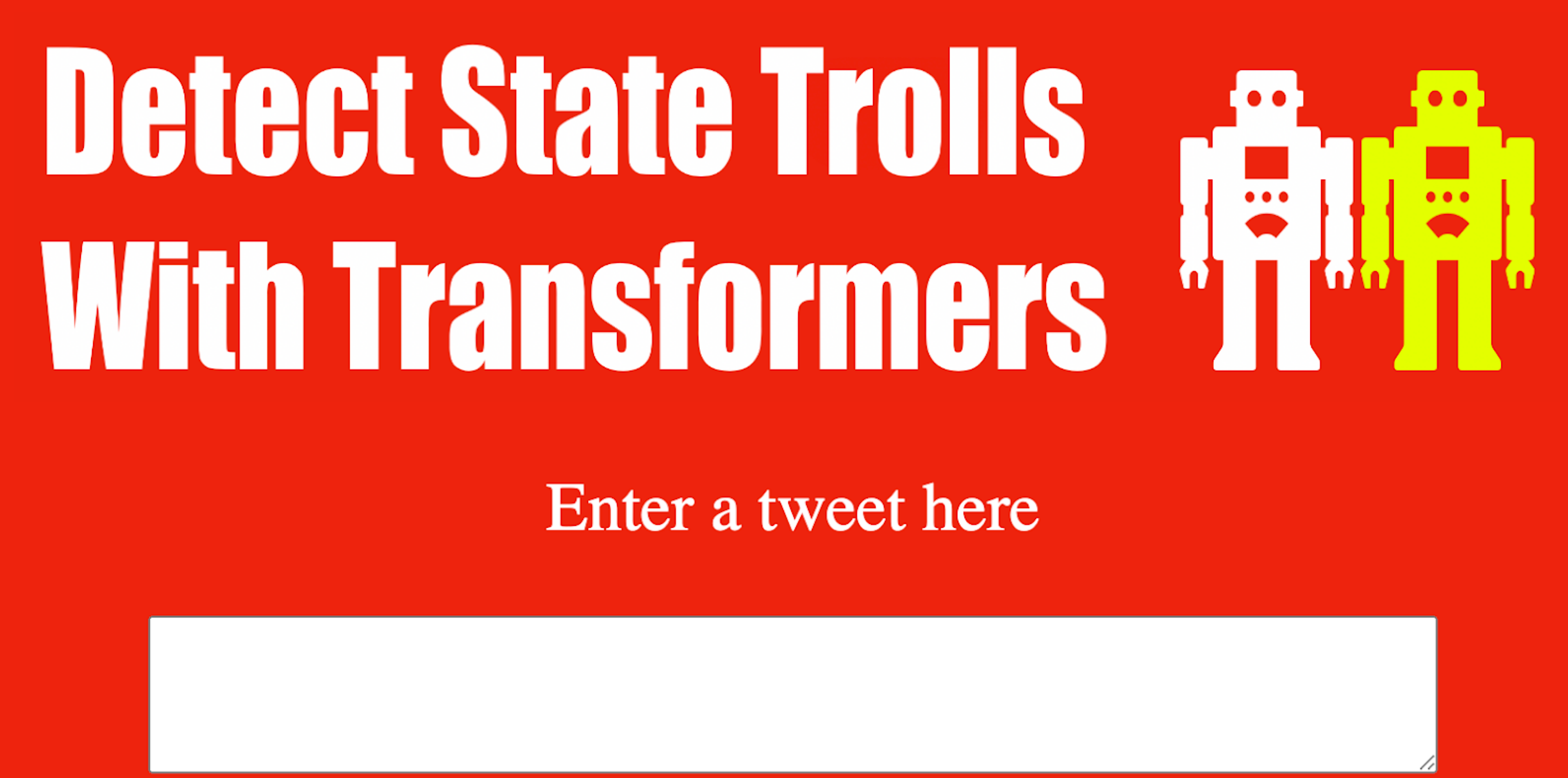 Illustration of web app by: Chua Chin Hon
With the 2020 US election around the corner, concerns about electoral interference by state actors via social media and other online means are back in the spotlight in a big way.
Twitter was a major platform that Russia used to interfere with the 2016 US election, and few have doubts that Moscow, Beijing and others will turn to the platform yet again with new disinformation campaigns.
This post will outline a broad overview of of how you can build a state troll tweets detector by fine tuning a transformer model (Distilbert) with a custom dataset. This builds on my earlier project using "classic" machine learning models and a simple bag-of-words approach to detect state troll tweets.
I'll also compare the results from the fine tuned Distilbert model with those from a Logistic Regression and an XGBoost model, to see if a transformer model can indeed perform better in a practical use case.
Learn this step by step with the interactive AI and Data Scientist and Machine Learning roadmaps.
Spoiler alert: The fine tuned transformer model performed significantly better than the Log-Reg and XGBoost models (which weren't slouches either, to be sure), and held up much better when exposed to state troll tweets from a third country. Jump ahead to Section 4 for the results.
1. GROUND TRUTH, DATA SOURCE, MODEL AND REPO
First things first: How did I ascertain whose tweets are deemed the work of state influence campaigns? In this case, the ground truth is established by Twitter's election integrity team.
The state troll tweets used in this project are those which have been identified by Twitter and progressively released to the public since 2018. I chose six sets of state troll tweets from Twitter - three each from China and Russia - which I cleaned up, combined and downsampled to 50,000 rows.
I created an equivalent set of 50,000 rows of real tweets by using Tweepy to scrape 175 accounts, which comprise a mixture of verified users and those which I've personally checked for authenticity. The resulting combined dataset of 100,000 rows of state troll-plus-real tweets was further split into the usual train-test-validation sets in the standard proportion of 70:20:10 respectively.
Full details are in my notebooks, and I won't repeat them here for brevity's sake. The full repo is available here. Fine tuning was done on a Colab Pro account, and took about five-and-a-half hours.
The fine tuned Distilbert model is too big for Github, but I've uploaded a copy to Dropbox for those who just want to experiment with the model. The six raw CSV files containing state troll tweets have to be downloaded from Twitter if you wish to create a larger training set.
2. DATA PREPARATION
It ought to be pointed out that key assumptions in the data cleaning and preparation process will affect the outcomes. The assumptions are necessary to keep the scope of this project practical, but if you disagree with them, feel agree to slice a different version of the data based on your own preferred cleaning rules.
My main data cleaning rules for this project:
- Exclude non-English tweets, since the working assumption is that the target audience is English-speaking. I also wanted to prevent the model from making predictions based on language.
- Exclude retweets.
- Exclude tweets which have fewer than three words after text cleaning.
I also kept the eventual combined dataset to 100,000 rows for practical reasons. My initial attempts to fine tune Distilbert with a 600,000 rows dataset resulted in repeated crashes of the Colab notebook and/or showed extremely long and impractical run times. A more ambitious version of this project just won't be practical without access to more compute/hardware.
3. FINE TUNE THE DISTILBERT MODEL WITH CUSTOM DATASET
For this project, I picked the distilbert-base-uncased model (smaller and more manageable) and used Hugging Face's trainer for the task. I abandoned attempts to do a hyperparameters search after several trials which ran on for too long, and hope to return to this topic at a future date (check out the discussion here).
The steps involved are fairly straightforward, as outlined in notebook2.0 of my repo. The code is mostly based on the excellent examples and documentation on Hugging Face [here](https://huggingface.co/transformers/master/custom_datasets.html) and here.
The immediate results of the fine tuning certainly look impressive:
text
'eval_accuracy': 0.9158421345191773,
 'eval_f1': 0.9163813100629625,
 'eval_precision': 0.9098486510199605,
 'eval_recall': 0.9230084557187361
I ran a quick test against the validation set - 10,000 rows kept aside and which the model has not seen at all - and the excellent classification metrics barely budged:
text
'eval_accuracy': 0.9179,
'eval_f1': 0.9189935865811544,
'eval_precision': 0.9178163184864012,
'eval_recall': 0.9201738786801027
For a more thorough comparison and analysis, I trained two separate Logistic Regression and XGB classifier models using the same dataset used to fine tune the Distilbert model. Let's see how they do in the same tests.
4. FINE TUNED DISTILBERT VS LOG-REG VS XGB
The pickled Log-Reg and XGB models are available in my repo's "pkl" folder. My notebooks detailing their optimisation process are available [here](https://github.com/chuachinhon/transformers_state_trolls_cch/blob/master/notebooks/3.0_compare_logreg_cch.ipynb) and here. I won't go into the details here, except to highlight that both models scored above 0.8 during training and grid search. While clearly lower than the fine tuned Distilbert model's score, I think these two models did well enough to provide for an adequate comparison.
The chart below shows the detailed breakdown, via confusion matrices, of how all three models performed against the validation set (10,000 rows comprising 5,061 state troll tweets and 4,939 real tweets).
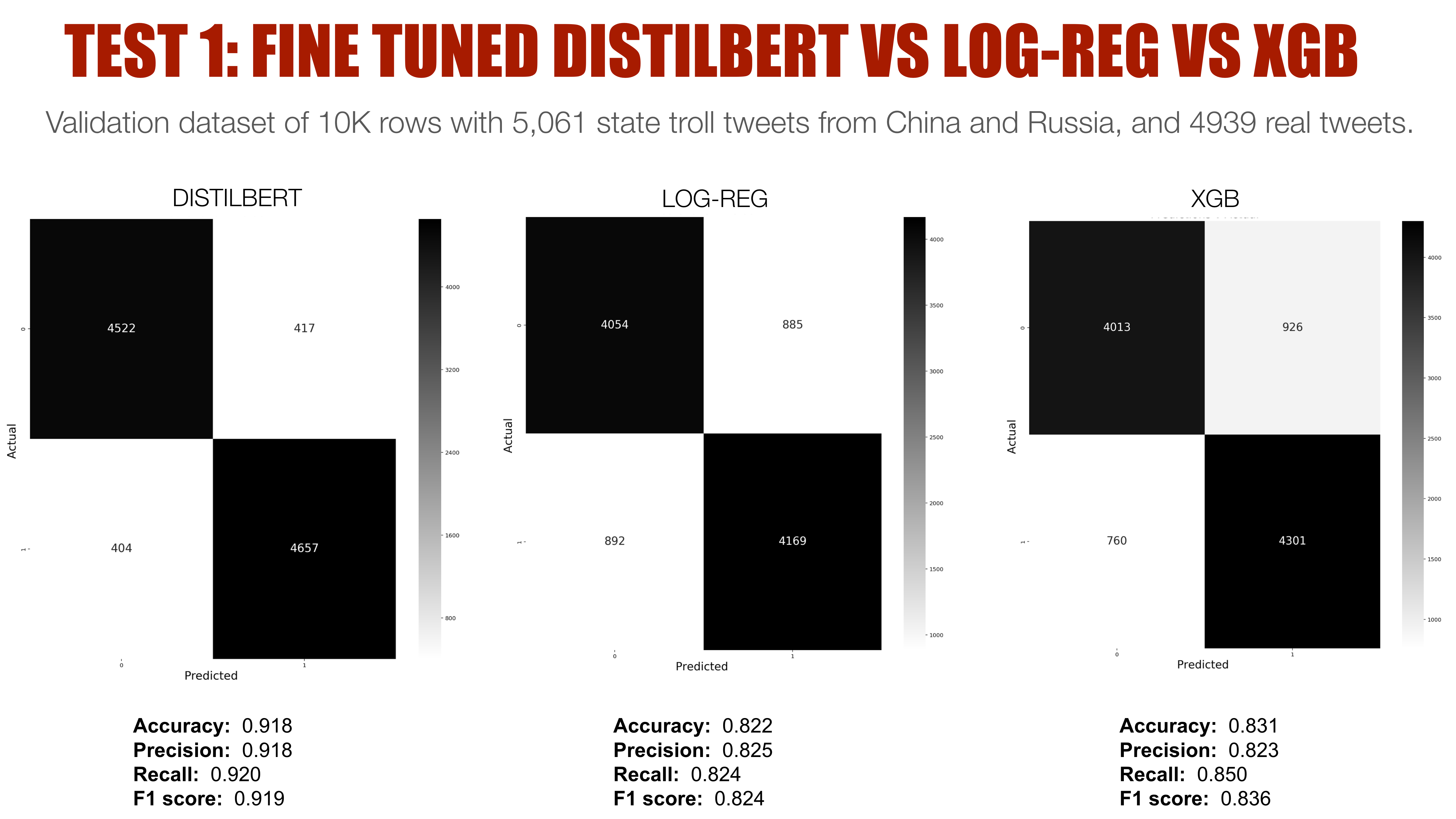 Image by: Chua Chin Hon
At a glance, it's clear that the fine tuned Distilbert model (on far left) is the strongest performer, and accurately picked out more state troll and real tweets than the Log-Reg or XGB models. More significantly, the number of false positives and false negatives for the Distilbert model is about half that produced by the log-reg and XGB models.
So while the three models' performance metrics might seem close, the gap in their classification capabilities become very stark when seen via confusion matrices that give us a better sense of how they performed in classifying thousands of tweets.
4.1 ADDITIONAL TEST FOR THE 3 MODELS
All three models were trained on a 50–50 split of real tweets and state troll tweets from China and Russia. In reality, we don't know the actual proportion of real-versus-troll tweets on Twitter. More importantly, state troll tweets can come from any country and changes in tone, language and topics could significantly affect the classifier's ability to separate real tweets from those originating from state-backed campaigns.
Which of the three models would hold up better if exposed to state troll tweets from a third country? To find out, I ran a new dataset - comprising 1,000 troll tweets from Iran and 993 real tweets from American users - through the three models. This new dataset was created from an earlier project I did on the same subject.
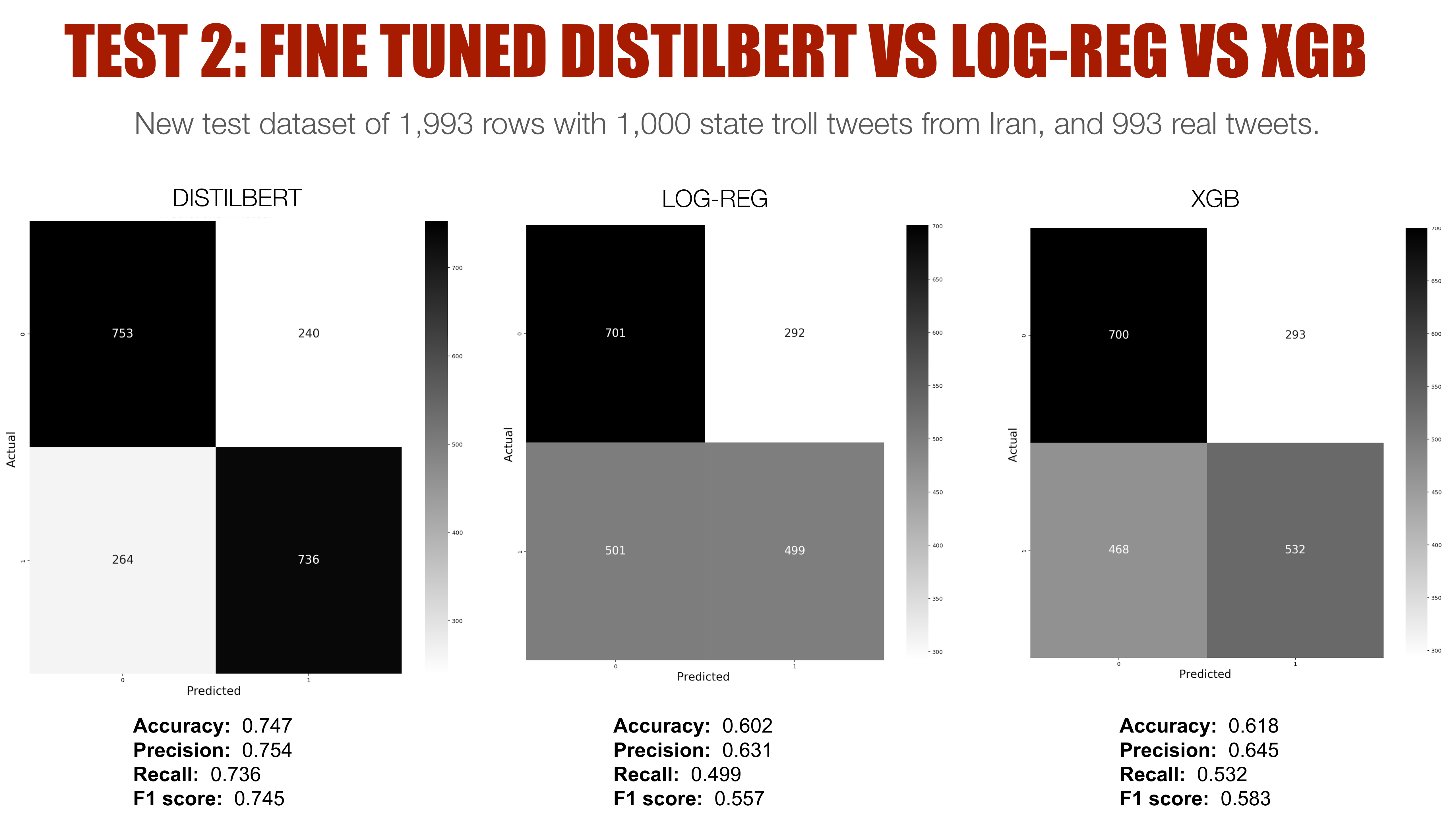 Image by: Chua Chin Hon
As expected, all three classifiers saw their performance drop significantly when exposed to Iranian state troll tweets which they've not seen before.
But the fine tuned Distilbert model still held up decently, in my view. Not only did it correctly pick out more troll and real tweets compared to the Log-Reg or XGB model, the number of false negatives (troll tweets that the model thought were real tweets) was not excessively large.
This is particularly problematic with the Log-Reg model, which classified half (501 out of 1,000) of the troll tweets as real tweets when they were in fact the work of state-backed operators. The XGB model is slightly better in this area, but not by far, with the number of false negatives (468) significantly higher than the number of false positives.
This was a particularly pronounced problem with the models I trained in my earlier project, meaning classifiers trained on one particular state actor's troll tweets were quite good at spotting new, unseen tweets from said state actor. But once troll tweets from another state operator is injected into the mix, the classifier's performance falters significantly.
The fine tuned Distilbert model doesn't overcome this problem completely, but holds up well enough to hold out hopes for a model that can "generalise" better. If you have enough computing resources to train a transformer model on a bigger dataset comprising state troll tweets from all the countries identified by Twitter to date, it stands to reason that said model might do better in the sort of tests we've tried in this post.
Unfortunately that's a hypothesis I'll have to test another time.
5. CONCLUSION
Detection of state influence campaigns on Twitter involves more than just the examination of the tweet text, of course. State trolls often leave bigger tell-tale signs like the (coordinated) dates of account creation, or timing of their tweets. The increasing use of photos and memes also make the detection process trickier.
But spotting trends and hidden structures in their tweet text will continue to be one major area of focus. And it would appear that a fine tuned transformer model can perform significantly better in this task compared to the more popular or traditional classifiers out there.
There are trade-offs, of course, in terms of resources and time. The hardware needed to fine tune a transformer model on, say, a million rows of tweets, is not readily available to most users, to say nothing of whether that's the most efficient way to tackle the task.
6. BONUS SECTION: WEB APP
I tried deploying the fine tuned Distilbert model as part of a simple web app but quickly found out that free hosting accounts don't have enough disk space for pytorch installation on top of hosting the model.
But I've uploaded the necessary files to the repo for anyone who wants to try it out on their local machine. Just make sure to download the fine tuned model from Dropbox and move it to the "app" folder.
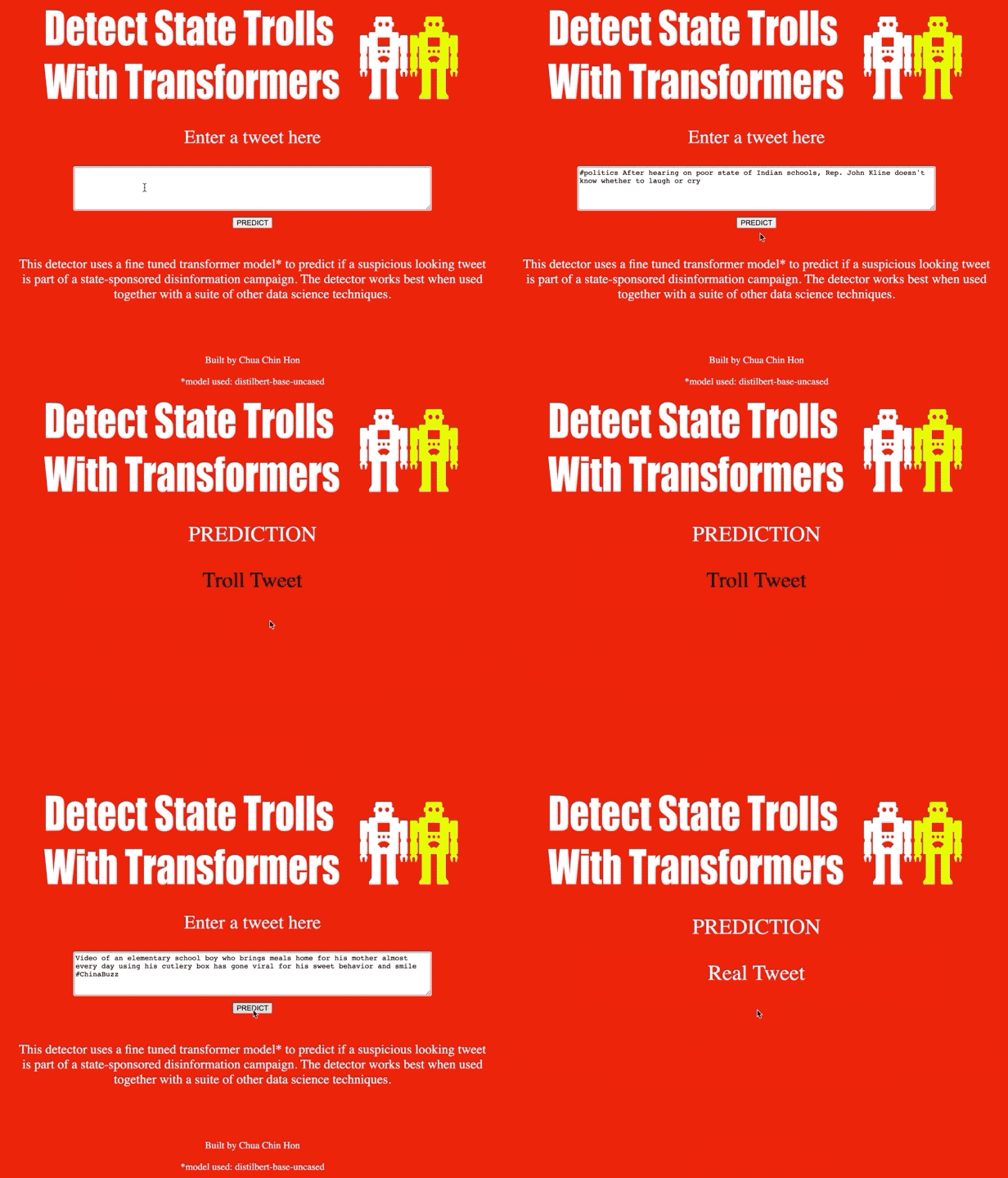 Gif by: Chua Chin Hon
As always, if you spot mistakes in this or any of my earlier posts, ping me at:
Register Now to Continue Reading
Unlock Towards Data Science with a Free Account
All articles on Towards Data Science are available to registered users. Create a free account today to access this article and thousands more.
Register for freeSign in to your account
 Written By
See all from Chua Chin Hon
Data ScienceDeep LearningMachine LearningNLPUS Elections
Share This Article
Towards Data Science is a community publication. Submit your insights to reach our global audience and earn through the TDS Author Payment Program.
Write for TDS
Related Articles
Deep Learning
Explaining their complex mathematical formula with working diagrams
Albers Uzila
October 11, 202211 min read
Artificial Intelligence
Connecting anomaly detection models results back to the original signals
Michaël HOARAU
May 6, 20226 min read
Data Science
Programming language to learn and three questions to ask before making a planned career switch
Nathan Timothy Handoko
February 26, 20225 min read
Artificial Intelligence
Explained with examples
Soner Yıldırım
May 21, 20204 min read
Machine Learning
Combine machine learning models with hypothesis testing. Stop pulling your hair and read this article.
Zijing Zhu, PhD
September 6, 20207 min read
Artificial Intelligence
When Enough is Enough
Dario Radečić
December 3, 20194 min read
NLP
Derive Topics from Long Text
Gaurika Tyagi
June 7, 20203 min read
Machine Learning
How to explain any machine learning model using SHAP
Shreya Rao
May 8, 20239 min read
Programming
A cool and useful algorithm explained and extended
Carl Kadie
September 1, 202210 min read
Your home for data science and AI. The world's leading publication for data science, data analytics, data engineering, machine learning, and artificial intelligence professionals.
Subscribe to Our NewsletterWrite For TDS•About•Advertise•Privacy Policy•Terms of Use
© Insight Media Group, LLC 2026•The New Stack•roadmap.sh•Creator Network
Recommended Articles
Close