保留正文与补采附件。源页面当前未重新核验;具体限制见交付清单。
 We value your privacy
We use cookies to enhance your browsing experience, serve personalised ads or content, and analyse our traffic. By clicking "Accept All", you consent to our use of cookies.
Customise Reject All Accept All
Customise Consent Preferences
 We use cookies to help you navigate efficiently and perform certain functions. You will find detailed information about all cookies under each consent category below.
The cookies that are categorised as "Necessary" are stored on your browser as they are essential for enabling the basic functionalities of the site. ... Show more
NecessaryAlways Active
Necessary cookies are required to enable the basic features of this site, such as providing secure log-in or adjusting your consent preferences. These cookies do not store any personally identifiable data.
-
Cookie
BCTempID
-
Duration
10 minutes
-
Description
No description available.
-
Cookie
__cf_bm
-
Duration
1 hour
-
Description
This cookie, set by Cloudflare, is used to support Cloudflare Bot Management.
-
Cookie
AWSALBCORS
-
Duration
7 days
-
Description
Amazon Web Services set this cookie for load balancing.
-
Cookie
_cfuvid
-
Duration
session
-
Description
Cloudflare sets this cookie to track users across sessions to optimize user experience by maintaining session consistency and providing personalized services
-
Cookie
li_gc
-
Duration
6 months
-
Description
Linkedin set this cookie for storing visitor's consent regarding using cookies for non-essential purposes.
-
Cookie
__hssrc
-
Duration
session
-
Description
This cookie is set by Hubspot whenever it changes the session cookie. The __hssrc cookie set to 1 indicates that the user has restarted the browser, and if the cookie does not exist, it is assumed to be a new session.
-
Cookie
__hssc
-
Duration
1 hour
-
Description
HubSpot sets this cookie to keep track of sessions and to determine if HubSpot should increment the session number and timestamps in the __hstc cookie.
-
Cookie
wpEmojiSettingsSupports
-
Duration
session
-
Description
WordPress sets this cookie when a user interacts with emojis on a WordPress site. It helps determine if the user's browser can display emojis properly.
-
Cookie
BCSessionID
-
Duration
1 year 1 month 4 days
-
Description
Blueconic sets this cookie as a unique identifier for the BlueConic profile.
-
Cookie
_octo
-
Duration
1 year
-
Description
No description available.
-
Cookie
logged_in
-
Duration
1 year
-
Description
No description available.
-
Cookie
__Secure-YEC
-
Duration
past
-
Description
YouTube sets this cookie to stores the user's video player preferences using embedded YouTube video
-
Cookie
__eoi
-
Duration
6 months
-
Description
Description is currently not available.
-
Cookie
AWSALBTGCORS
-
Duration
7 days
-
Description
No description available.
-
Cookie
login-status-p
-
Duration
past
-
Description
Description is currently not available.
-
Cookie
AWSALBTG
-
Duration
7 days
-
Description
No description available.
-
Cookie
csrf_token
-
Duration
session
-
Description
No description available.
-
Cookie
token_v2
-
Duration
1 day
-
Description
Description is currently not available.
-
Cookie
D
-
Duration
1 year
-
Description
Description is currently not available.
-
Cookie
PHPSESSID
-
Duration
session
-
Description
This cookie is native to PHP applications. The cookie stores and identifies a user's unique session ID to manage user sessions on the website. The cookie is a session cookie and will be deleted when all the browser windows are closed.
-
Cookie
VISITOR_PRIVACY_METADATA
-
Duration
6 months
-
Description
YouTube sets this cookie to store the user's cookie consent state for the current domain.
-
Cookie
cookietest
-
Duration
session
-
Description
The cookietest cookie is typically used to determine whether the user's browser accepts cookies, essential for website functionality and user experience.
-
Cookie
__Host-airtable-session
-
Duration
1 year
-
Description
This cookie is used to enable us to integrate the services of Airtable.
-
Cookie
__Host-airtable-session.sig
-
Duration
1 year
-
Description
This cookie is used to enable us to integrate the services of Airtable.
-
Cookie
m
-
Duration
1 year 1 month 4 days
-
Description
Stripe sets this cookie for fraud prevention purposes. It identifies the device used to access the website, allowing the website to be formatted accordingly.
-
Cookie
BIGipServer*
-
Duration
session
-
Description
Marketo sets this cookie to collect information about the user's online activity and build a profile about their interests to provide advertisements relevant to the user.
-
Cookie
__cfruid
-
Duration
session
-
Description
Cloudflare sets this cookie to identify trusted web traffic.
-
Cookie
_GRECAPTCHA
-
Duration
6 months
-
Description
Google Recaptcha service sets this cookie to identify bots to protect the website against malicious spam attacks.
-
Cookie
__Secure-YNID
-
Duration
6 months
-
Description
Google cookie used to protect user security and prevent fraud, especially during the login process.
-
Cookie
cookieyes-consent
-
Duration
1 year
-
Description
CookieYes sets this cookie to remember users' consent preferences so that their preferences are respected on subsequent visits to this site. It does not collect or store any personal information about the site visitors.
Functional
Functional cookies help perform certain functionalities like sharing the content of the website on social media platforms, collecting feedback, and other third-party features.
-
Cookie
lidc
-
Duration
1 day
-
Description
LinkedIn sets the lidc cookie to facilitate data center selection.
-
Cookie
brw
-
Duration
1 year
-
Description
No description available.
-
Cookie
brwConsent
-
Duration
5 minutes
-
Description
Description is currently not available.
-
Cookie
WMF-Uniq
-
Duration
1 year
-
Description
Description is currently not available.
-
Cookie
loom_anon_comment
-
Duration
1 year
-
Description
No description available.
-
Cookie
loom_referral_video
-
Duration
session
-
Description
Description is currently not available.
-
Cookie
VISITOR_INFO1_LIVE
-
Duration
6 months
-
Description
A cookie set by YouTube to measure bandwidth that determines whether the user gets the new or old player interface.
-
Cookie
yt-remote-connected-devices
-
Duration
Never Expires
-
Description
YouTube sets this cookie to store the user's video preferences using embedded YouTube videos.
-
Cookie
ytidb::LAST_RESULT_ENTRY_KEY
-
Duration
Never Expires
-
Description
The cookie ytidb::LAST_RESULT_ENTRY_KEY is used by YouTube to store the last search result entry that was clicked by the user. This information is used to improve the user experience by providing more relevant search results in the future.
-
Cookie
yt-remote-device-id
-
Duration
Never Expires
-
Description
YouTube sets this cookie to store the user's video preferences using embedded YouTube videos.
-
Cookie
yt-remote-session-name
-
Duration
session
-
Description
The yt-remote-session-name cookie is used by YouTube to store the user's video player preferences using embedded YouTube video.
-
Cookie
yt-remote-fast-check-period
-
Duration
session
-
Description
The yt-remote-fast-check-period cookie is used by YouTube to store the user's video player preferences for embedded YouTube videos.
-
Cookie
yt-remote-session-app
-
Duration
session
-
Description
The yt-remote-session-app cookie is used by YouTube to store user preferences and information about the interface of the embedded YouTube video player.
-
Cookie
yt-remote-cast-available
-
Duration
session
-
Description
The yt-remote-cast-available cookie is used to store the user's preferences regarding whether casting is available on their YouTube video player.
-
Cookie
yt-remote-cast-installed
-
Duration
session
-
Description
The yt-remote-cast-installed cookie is used to store the user's video player preferences using embedded YouTube video.
-
Cookie
cp_session
-
Duration
3 months
-
Description
Codepen sets this cookie for Help systems found in the website.
-
Cookie
loid
-
Duration
1 year 1 month 4 days
-
Description
This cookie is set by the Reddit. The cookie enables the sharing of content from the website onto the social media platform.
Analytics
Analytical cookies are used to understand how visitors interact with the website. These cookies help provide information on metrics such as the number of visitors, bounce rate, traffic source, etc.
-
Cookie
__hstc
-
Duration
6 months
-
Description
Hubspot set this main cookie for tracking visitors. It contains the domain, initial timestamp (first visit), last timestamp (last visit), current timestamp (this visit), and session number (increments for each subsequent session).
-
Cookie
hubspotutk
-
Duration
6 months
-
Description
HubSpot sets this cookie to keep track of the visitors to the website. This cookie is passed to HubSpot on form submission and used when deduplicating contacts.
-
Cookie
_ga
-
Duration
1 year 1 month 4 days
-
Description
Google Analytics sets this cookie to calculate visitor, session and campaign data and track site usage for the site's analytics report. The cookie stores information anonymously and assigns a randomly generated number to recognise unique visitors.
-
Cookie
ga*
-
Duration
1 year 1 month 4 days
-
Description
Google Analytics sets this cookie to store and count page views.
-
Cookie
__Host-psifi.analyticsTrace
-
Duration
6 hours
-
Description
Description is currently not available.
-
Cookie
__Host-psifi.analyticsTraceV2
-
Duration
6 hours
-
Description
Description is currently not available.
-
Cookie
_gh_sess
-
Duration
session
-
Description
GitHub sets this cookie for temporary application and framework state between pages like what step the user is on in a multiple step form.
-
Cookie
YSC
-
Duration
session
-
Description
YSC cookie is set by Youtube and is used to track the views of embedded videos on Youtube pages.
-
Cookie
ajs_anonymous_id
-
Duration
1 year
-
Description
This cookie is set by Segment to count the number of people who visit a certain site by tracking if they have visited before.
-
Cookie
vuid
-
Duration
1 year 1 month 4 days
-
Description
Vimeo installs this cookie to collect tracking information by setting a unique ID to embed videos on the website.
Performance
Performance cookies are used to understand and analyse the key performance indexes of the website which helps in delivering a better user experience for the visitors.
-
Cookie
AWSALB
-
Duration
7 days
-
Description
AWSALB is an application load balancer cookie set by Amazon Web Services to map the session to the target.
-
Cookie
acq
-
Duration
past
-
Description
Description is currently not available.
-
Cookie
acq.sig
-
Duration
past
-
Description
Description is currently not available.
-
Cookie
ptc
-
Duration
2 years
-
Description
No description available.
Advertisement
Advertisement cookies are used to provide visitors with customised advertisements based on the pages you visited previously and to analyse the effectiveness of the ad campaigns.
-
Cookie
muc_ads
-
Duration
1 year 1 month 4 days
-
Description
Twitter sets this cookie to collect user behaviour and interaction data to optimize the website.
-
Cookie
guest_id_marketing
-
Duration
1 year 1 month 4 days
-
Description
Twitter sets this cookie to identify and track the website visitor.
-
Cookie
guest_id_ads
-
Duration
1 year 1 month 4 days
-
Description
Twitter sets this cookie to identify and track the website visitor.
-
Cookie
personalization_id
-
Duration
1 year 1 month 4 days
-
Description
Twitter sets this cookie to integrate and share features for social media and also store information about how the user uses the website, for tracking and targeting.
-
Cookie
guest_id
-
Duration
1 year 1 month 4 days
-
Description
Twitter sets this cookie to identify and track the website visitor. It registers if a user is signed in to the Twitter platform and collects information about ad preferences.
-
Cookie
bcookie
-
Duration
1 year
-
Description
LinkedIn sets this cookie from LinkedIn share buttons and ad tags to recognize browser IDs.
-
Cookie
__Secure-ROLLOUT_TOKEN
-
Duration
6 months
-
Description
YouTube sets this cookie to manage feature rollout and experimentation. It helps Google control which new features or interface changes are shown to users as part of testing and staged rollouts, ensuring consistent experience for a given user during an experiment.
-
Cookie
yt.innertube::nextId
-
Duration
Never Expires
-
Description
YouTube sets this cookie to register a unique ID to store data on what videos from YouTube the user has seen.
-
Cookie
yt.innertube::requests
-
Duration
Never Expires
-
Description
YouTube sets this cookie to register a unique ID to store data on what videos from YouTube the user has seen.
-
Cookie
session_tracker
-
Duration
session
-
Description
This cookie is set by the Reddit. This cookie is used to identify trusted web traffic. It also helps in adverstising on the website.
-
Cookie
edgebucket
-
Duration
session
-
Description
Reddit sets this cookie to save the information about a log-on Reddit user, for the purpose of advertisement recommendations and updating the content.
-
Cookie
did
-
Duration
1 year
-
Description
Arbor sets this cookie to show targeted ads to site visitors.This cookie expires after 2 months or 1 year.
Uncategorised
Other uncategorised cookies are those that are being analysed and have not been classified into a category as yet.
No cookies to display.
Reject All Save My Preferences Accept All
Toggle SearchToggle Mobile Navigation
Publish AI, ML & data-science insights to a global community of data professionals.
Sign inSubmit an Article
LatestEditor's PicksNewsletterShipAI
Write For TDS
LinkedInXToggle Search
Artificial Intelligence
Building Machine Learning Operations for Businesses
A Blueprint for Effective MLOps to Support Your AI Strategy
John Adeojo
June 20, 20235 min read
 Image by Author: Generated with Midjourney
Pipelines : Kedro structures your data processing as a pipeline of dependent tasks, enforcing a clear code structure and visualising data flow and dependencies. Nodes : In Kedro, a Node is a wrapper for a Python function that names the inputs and outputs of that function, serving as the building blocks of a Kedro pipeline. Configuration : Kedro manages different configurations for various environments (development, production, etc.) without hardcoding any configuration into your code. I/O : In Kedro, I/O operations are abstracted from the actual computation, which increases code testability and modularity and eases switching between different data sources. Modularity and Reusability : Kedro promotes a modular coding style that results in reusable, maintainable and testable code. Testing : Kedro integrates with PyTest, a testing framework in Python, making it easy to write tests for your pipeline. Versioning : Kedro supports versioning for data and code, enabling reproduction of any previous state of your pipeline. Logging : Kedro offers a standardised logging system for tracking events and changes. Hooks and Plugins : Kedro supports hooks and plugins, extending the framework capabilities as per project requirements. Integration with other tools : Kedro can be integrated with various tools like Jupyter notebook, Dask, Apache Spark, and others to facilitate different aspects of a data science workflow.
All Kedro projects follow this basic template. Enforcing this standard across your data science teams will enable reproducibility and maintainability.
For a more extensive overview of the Kedro framework, please visit these resources:
- Kedro Documentation: link
- The Importance of Layered thinking in Data Engineering: link
Registry & Storage - Data Version Control (DVC)
Registry and storage underpin reproducibility in machine learning, something that any business looking to incorporate ML should bear in mind. ML models are essentially composed of code, data, model artefacts, and environment - all of which must be traceable for reproducibility.
DVC is a tool that provides version control and tracking for models and data. While GitHub could be an alternative, it's limited in its capacity to store large objects, posing issues for extensive datasets or models. DVC essentially extends Git, offering the same version control capabilities while enabling storage of larger datasets and models in a DVC repo, which can be either local or cloud-based.
In commercial settings, there are obvious security benefits to versioning your code in a Git repo, while storing actual model artefacts and data separately in a controlled environment.
Remember, model reproducibility will become increasingly important as regulations tighten around the use of AI commercially. Reproducibility facilitates auditability.
Model Pipeline Deployment - Docker
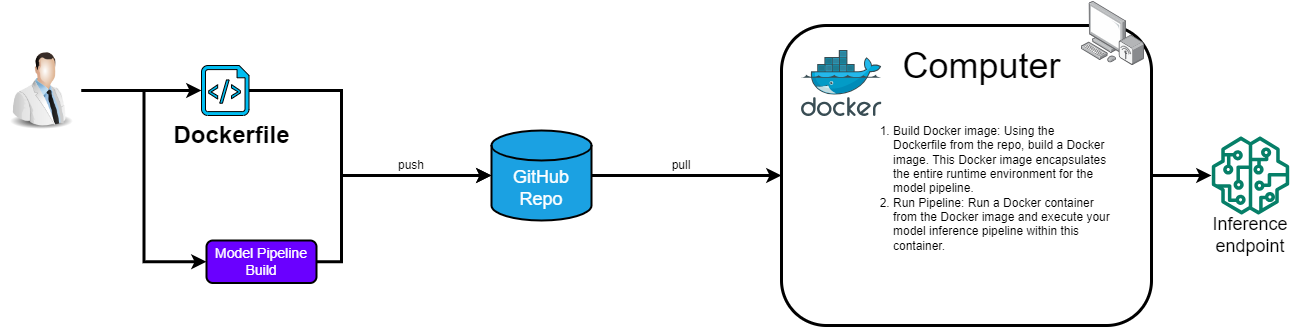 Image by Author: Schematic of Docker deployment of inference pipeline. Note this same approach can be applied to the model monitoring and retraining pipeline
Deployment isn't merely a single task but rather a meticulously crafted fusion of tools, activities, and processes; Docker ties all these together for model deployment. Crucial for intricate ML applications with numerous dependencies, Docker ensures consistency across any machine by encapsulating the application with its environment.
The process begins with a Dockerfile; Docker then uses its commands to construct an image, a ready-packaged model pipeline fit for any Docker-enabled machine. Teamed with Kedro's pipeline functionality, Docker can proficiently deploy both model retraining and inference pipelines, assuring reproducibility across all stages of the ML workflow.
Model Monitoring & Retraining Pipeline - MLflow
Over time, machine learning models suffer from performance deterioration, which can be due to concept drift or data drift. We want to be able to monitor when our models' performance begins to falter and re-train them when necessary. MLflow provides us the ability to do this via its tracking API. The tracking API should be incorporated into the model training and inference pipelines built by the data scientists. Although I have specified MLflow for tracking in the model monitoring and retraining pipeline, tracking can also be done in the model development lab, particularly for experiment tracking.
The Inference Endpoint
Given that the inference pipeline has been encapsulated into a Dockerfile, we can create a Docker image of the pipeline anywhere to be used as an API endpoint for any app. Depending on the use case, we will have to decide where we deploy the Docker image. That, however, is beyond the scope of this article.
Roles & Responsibilities
Assigning distinct roles and responsibilities within MLOps is pivotal to its success. The multifaceted nature of MLOps, which spans across disciplines necessitates a clear demarcation of roles. This ensures that each task is performed efficiently. Further, it fosters accountability, facilitating a quicker resolution of issues. Lastly, clear delegation reduces confusion and overlap, making the team more efficient and helping to maintain a harmonious working environment. It's much like a well-oiled machine, with each cog playing its part to perfection.
Data Scientists
- Role : The main function of data scientists within MLOps strategies is to concentrate on model development. This encompasses initial experiments, prototyping and setting up modelling pipelines for validated models.
- Responsibilities : Data scientists ensure models adhere to machine learning best practices and align with business cases. Beyond lab tasks, they engage with business stakeholders to identify impactful solutions. They take full ownership for the data labs, a lead data scientist should set the operating rhythm and best practices for setting up labs.
Machine Learning Engineers
- Role : ML engineers oversee the MLOps' technical infrastructure, exploring innovative solutions, crafting strategies alongside data scientists, and enhancing process efficiencies.
- Responsibilities : They ensure the functionality of the technical infrastructure, monitor performance of components to control costs, and confirm production models meet demand at the required scale.
Data Governance Professionals
- Role : Data governance professionals maintain security and data privacy policies, playing a pivotal role in the secure transfer of data within the MLOps framework.
- Responsibilities : Although data governance is everyone's responsibility, these professionals create policies and ensure compliance through regular checks and audits. They keep up with regulations and ensure compliance from all data consumers.
Conclusion
Navigating the realm of MLOps is a task that demands deliberate planning, the right blend of technology and talent, and an organisational culture that endorses change and learning.
The journey may appear complex, but by employing a well-designed blueprint and by approaching MLOps as a holistic, iterative process rather than a one-off project, you can derive immense value from your AI strategies. Remember, though, that no single approach fits every scenario. It's crucial to tailor your strategy to your specific needs and to remain agile to changing circumstances.
Follow me on LinkedIn
Subscribe to medium to get more insights from me:
Join Medium with my referral link - John Adeojo
Should you be interested in integrating AI or data science into your business operations, we invite you to schedule a complimentary initial consultation with us:
Book Online | Data-Centric Solutions
Register Now to Continue Reading
Unlock Towards Data Science with a Free Account
All articles on Towards Data Science are available to registered users. Create a free account today to access this article and thousands more.
Register for freeSign in to your account
 Written By
See all from John Adeojo
Artificial IntelligenceBusiness StrategyData ScienceMachine LearningTechnology
Share This Article
Towards Data Science is a community publication. Submit your insights to reach our global audience and earn through the TDS Author Payment Program.
Write for TDS
Related Articles
Machine Learning
You will be safe cycling home
Antonio Ramos
November 24, 20227 min read
Machine Learning
Learn how to deploy ML models in Kubernetes clusters and to implement autoscaling for your deployment with HPA and KEDA
Tin Nguyen
January 9, 202311 min read
Programming
Pandas and Plotly for Initial Data Analysis- A Tennis Example
Stephen Fordham
September 6, 20196 min read
Machine Learning
Learn various essential functions of NumPy which you might be unaware of (with code)
Shantnu & Kartik
September 3, 20208 min read
Artificial Intelligence
A novel approach to integrating speech recognition into authentication systems Part 1
Fangyi Yu
October 9, 20210 min read
Deep Learning
Artificial intelligence software was used to enhance the grammar, flow, and readability of this article's...
Anthony Alcaraz
December 1, 20239 min read
Machine Learning
Five freely available tools that intuitively break down the complicated machine learning concepts
Parul Pandey
October 4, 20203 min read
Machine Learning
How Machine Learning and Natural Language Processing Models Deal with Text
Brian Roepke
January 21, 20225 min read
Deep Learning
Extract important features from data using deep learning.
Rajas Bakshi
June 28, 20216 min read
Your home for data science and AI. The world's leading publication for data science, data analytics, data engineering, machine learning, and artificial intelligence professionals.
Subscribe to Our NewsletterWrite For TDS•About•Advertise•Privacy Policy•Terms of Use
© Insight Media Group, LLC 2026•The New Stack•roadmap.sh•Creator Network
Recommended Articles
Close