保留正文与补采附件。源页面当前未重新核验;具体限制见交付清单。
 We value your privacy
We use cookies to enhance your browsing experience, serve personalised ads or content, and analyse our traffic. By clicking "Accept All", you consent to our use of cookies.
Customise Reject All Accept All
Customise Consent Preferences
 We use cookies to help you navigate efficiently and perform certain functions. You will find detailed information about all cookies under each consent category below.
The cookies that are categorised as "Necessary" are stored on your browser as they are essential for enabling the basic functionalities of the site. ... Show more
NecessaryAlways Active
Necessary cookies are required to enable the basic features of this site, such as providing secure log-in or adjusting your consent preferences. These cookies do not store any personally identifiable data.
-
Cookie
BCTempID
-
Duration
10 minutes
-
Description
No description available.
-
Cookie
__cf_bm
-
Duration
1 hour
-
Description
This cookie, set by Cloudflare, is used to support Cloudflare Bot Management.
-
Cookie
AWSALBCORS
-
Duration
7 days
-
Description
Amazon Web Services set this cookie for load balancing.
-
Cookie
_cfuvid
-
Duration
session
-
Description
Cloudflare sets this cookie to track users across sessions to optimize user experience by maintaining session consistency and providing personalized services
-
Cookie
li_gc
-
Duration
6 months
-
Description
Linkedin set this cookie for storing visitor's consent regarding using cookies for non-essential purposes.
-
Cookie
__hssrc
-
Duration
session
-
Description
This cookie is set by Hubspot whenever it changes the session cookie. The __hssrc cookie set to 1 indicates that the user has restarted the browser, and if the cookie does not exist, it is assumed to be a new session.
-
Cookie
__hssc
-
Duration
1 hour
-
Description
HubSpot sets this cookie to keep track of sessions and to determine if HubSpot should increment the session number and timestamps in the __hstc cookie.
-
Cookie
wpEmojiSettingsSupports
-
Duration
session
-
Description
WordPress sets this cookie when a user interacts with emojis on a WordPress site. It helps determine if the user's browser can display emojis properly.
-
Cookie
BCSessionID
-
Duration
1 year 1 month 4 days
-
Description
Blueconic sets this cookie as a unique identifier for the BlueConic profile.
-
Cookie
_octo
-
Duration
1 year
-
Description
No description available.
-
Cookie
logged_in
-
Duration
1 year
-
Description
No description available.
-
Cookie
__Secure-YEC
-
Duration
past
-
Description
YouTube sets this cookie to stores the user's video player preferences using embedded YouTube video
-
Cookie
__eoi
-
Duration
6 months
-
Description
Description is currently not available.
-
Cookie
AWSALBTGCORS
-
Duration
7 days
-
Description
No description available.
-
Cookie
login-status-p
-
Duration
past
-
Description
Description is currently not available.
-
Cookie
AWSALBTG
-
Duration
7 days
-
Description
No description available.
-
Cookie
csrf_token
-
Duration
session
-
Description
No description available.
-
Cookie
token_v2
-
Duration
1 day
-
Description
Description is currently not available.
-
Cookie
D
-
Duration
1 year
-
Description
Description is currently not available.
-
Cookie
PHPSESSID
-
Duration
session
-
Description
This cookie is native to PHP applications. The cookie stores and identifies a user's unique session ID to manage user sessions on the website. The cookie is a session cookie and will be deleted when all the browser windows are closed.
-
Cookie
VISITOR_PRIVACY_METADATA
-
Duration
6 months
-
Description
YouTube sets this cookie to store the user's cookie consent state for the current domain.
-
Cookie
cookietest
-
Duration
session
-
Description
The cookietest cookie is typically used to determine whether the user's browser accepts cookies, essential for website functionality and user experience.
-
Cookie
__Host-airtable-session
-
Duration
1 year
-
Description
This cookie is used to enable us to integrate the services of Airtable.
-
Cookie
__Host-airtable-session.sig
-
Duration
1 year
-
Description
This cookie is used to enable us to integrate the services of Airtable.
-
Cookie
m
-
Duration
1 year 1 month 4 days
-
Description
Stripe sets this cookie for fraud prevention purposes. It identifies the device used to access the website, allowing the website to be formatted accordingly.
-
Cookie
BIGipServer*
-
Duration
session
-
Description
Marketo sets this cookie to collect information about the user's online activity and build a profile about their interests to provide advertisements relevant to the user.
-
Cookie
__cfruid
-
Duration
session
-
Description
Cloudflare sets this cookie to identify trusted web traffic.
-
Cookie
_GRECAPTCHA
-
Duration
6 months
-
Description
Google Recaptcha service sets this cookie to identify bots to protect the website against malicious spam attacks.
-
Cookie
__Secure-YNID
-
Duration
6 months
-
Description
Google cookie used to protect user security and prevent fraud, especially during the login process.
-
Cookie
cookieyes-consent
-
Duration
1 year
-
Description
CookieYes sets this cookie to remember users' consent preferences so that their preferences are respected on subsequent visits to this site. It does not collect or store any personal information about the site visitors.
Functional
Functional cookies help perform certain functionalities like sharing the content of the website on social media platforms, collecting feedback, and other third-party features.
-
Cookie
lidc
-
Duration
1 day
-
Description
LinkedIn sets the lidc cookie to facilitate data center selection.
-
Cookie
brw
-
Duration
1 year
-
Description
No description available.
-
Cookie
brwConsent
-
Duration
5 minutes
-
Description
Description is currently not available.
-
Cookie
WMF-Uniq
-
Duration
1 year
-
Description
Description is currently not available.
-
Cookie
loom_anon_comment
-
Duration
1 year
-
Description
No description available.
-
Cookie
loom_referral_video
-
Duration
session
-
Description
Description is currently not available.
-
Cookie
VISITOR_INFO1_LIVE
-
Duration
6 months
-
Description
A cookie set by YouTube to measure bandwidth that determines whether the user gets the new or old player interface.
-
Cookie
yt-remote-connected-devices
-
Duration
Never Expires
-
Description
YouTube sets this cookie to store the user's video preferences using embedded YouTube videos.
-
Cookie
ytidb::LAST_RESULT_ENTRY_KEY
-
Duration
Never Expires
-
Description
The cookie ytidb::LAST_RESULT_ENTRY_KEY is used by YouTube to store the last search result entry that was clicked by the user. This information is used to improve the user experience by providing more relevant search results in the future.
-
Cookie
yt-remote-device-id
-
Duration
Never Expires
-
Description
YouTube sets this cookie to store the user's video preferences using embedded YouTube videos.
-
Cookie
yt-remote-session-name
-
Duration
session
-
Description
The yt-remote-session-name cookie is used by YouTube to store the user's video player preferences using embedded YouTube video.
-
Cookie
yt-remote-fast-check-period
-
Duration
session
-
Description
The yt-remote-fast-check-period cookie is used by YouTube to store the user's video player preferences for embedded YouTube videos.
-
Cookie
yt-remote-session-app
-
Duration
session
-
Description
The yt-remote-session-app cookie is used by YouTube to store user preferences and information about the interface of the embedded YouTube video player.
-
Cookie
yt-remote-cast-available
-
Duration
session
-
Description
The yt-remote-cast-available cookie is used to store the user's preferences regarding whether casting is available on their YouTube video player.
-
Cookie
yt-remote-cast-installed
-
Duration
session
-
Description
The yt-remote-cast-installed cookie is used to store the user's video player preferences using embedded YouTube video.
-
Cookie
cp_session
-
Duration
3 months
-
Description
Codepen sets this cookie for Help systems found in the website.
-
Cookie
loid
-
Duration
1 year 1 month 4 days
-
Description
This cookie is set by the Reddit. The cookie enables the sharing of content from the website onto the social media platform.
Analytics
Analytical cookies are used to understand how visitors interact with the website. These cookies help provide information on metrics such as the number of visitors, bounce rate, traffic source, etc.
-
Cookie
__hstc
-
Duration
6 months
-
Description
Hubspot set this main cookie for tracking visitors. It contains the domain, initial timestamp (first visit), last timestamp (last visit), current timestamp (this visit), and session number (increments for each subsequent session).
-
Cookie
hubspotutk
-
Duration
6 months
-
Description
HubSpot sets this cookie to keep track of the visitors to the website. This cookie is passed to HubSpot on form submission and used when deduplicating contacts.
-
Cookie
_ga
-
Duration
1 year 1 month 4 days
-
Description
Google Analytics sets this cookie to calculate visitor, session and campaign data and track site usage for the site's analytics report. The cookie stores information anonymously and assigns a randomly generated number to recognise unique visitors.
-
Cookie
ga*
-
Duration
1 year 1 month 4 days
-
Description
Google Analytics sets this cookie to store and count page views.
-
Cookie
__Host-psifi.analyticsTrace
-
Duration
6 hours
-
Description
Description is currently not available.
-
Cookie
__Host-psifi.analyticsTraceV2
-
Duration
6 hours
-
Description
Description is currently not available.
-
Cookie
_gh_sess
-
Duration
session
-
Description
GitHub sets this cookie for temporary application and framework state between pages like what step the user is on in a multiple step form.
-
Cookie
YSC
-
Duration
session
-
Description
YSC cookie is set by Youtube and is used to track the views of embedded videos on Youtube pages.
-
Cookie
ajs_anonymous_id
-
Duration
1 year
-
Description
This cookie is set by Segment to count the number of people who visit a certain site by tracking if they have visited before.
-
Cookie
vuid
-
Duration
1 year 1 month 4 days
-
Description
Vimeo installs this cookie to collect tracking information by setting a unique ID to embed videos on the website.
Performance
Performance cookies are used to understand and analyse the key performance indexes of the website which helps in delivering a better user experience for the visitors.
-
Cookie
AWSALB
-
Duration
7 days
-
Description
AWSALB is an application load balancer cookie set by Amazon Web Services to map the session to the target.
-
Cookie
acq
-
Duration
past
-
Description
Description is currently not available.
-
Cookie
acq.sig
-
Duration
past
-
Description
Description is currently not available.
-
Cookie
ptc
-
Duration
2 years
-
Description
No description available.
Advertisement
Advertisement cookies are used to provide visitors with customised advertisements based on the pages you visited previously and to analyse the effectiveness of the ad campaigns.
-
Cookie
muc_ads
-
Duration
1 year 1 month 4 days
-
Description
Twitter sets this cookie to collect user behaviour and interaction data to optimize the website.
-
Cookie
guest_id_marketing
-
Duration
1 year 1 month 4 days
-
Description
Twitter sets this cookie to identify and track the website visitor.
-
Cookie
guest_id_ads
-
Duration
1 year 1 month 4 days
-
Description
Twitter sets this cookie to identify and track the website visitor.
-
Cookie
personalization_id
-
Duration
1 year 1 month 4 days
-
Description
Twitter sets this cookie to integrate and share features for social media and also store information about how the user uses the website, for tracking and targeting.
-
Cookie
guest_id
-
Duration
1 year 1 month 4 days
-
Description
Twitter sets this cookie to identify and track the website visitor. It registers if a user is signed in to the Twitter platform and collects information about ad preferences.
-
Cookie
bcookie
-
Duration
1 year
-
Description
LinkedIn sets this cookie from LinkedIn share buttons and ad tags to recognize browser IDs.
-
Cookie
__Secure-ROLLOUT_TOKEN
-
Duration
6 months
-
Description
YouTube sets this cookie to manage feature rollout and experimentation. It helps Google control which new features or interface changes are shown to users as part of testing and staged rollouts, ensuring consistent experience for a given user during an experiment.
-
Cookie
yt.innertube::nextId
-
Duration
Never Expires
-
Description
YouTube sets this cookie to register a unique ID to store data on what videos from YouTube the user has seen.
-
Cookie
yt.innertube::requests
-
Duration
Never Expires
-
Description
YouTube sets this cookie to register a unique ID to store data on what videos from YouTube the user has seen.
-
Cookie
session_tracker
-
Duration
session
-
Description
This cookie is set by the Reddit. This cookie is used to identify trusted web traffic. It also helps in adverstising on the website.
-
Cookie
edgebucket
-
Duration
session
-
Description
Reddit sets this cookie to save the information about a log-on Reddit user, for the purpose of advertisement recommendations and updating the content.
-
Cookie
did
-
Duration
1 year
-
Description
Arbor sets this cookie to show targeted ads to site visitors.This cookie expires after 2 months or 1 year.
Uncategorised
Other uncategorised cookies are those that are being analysed and have not been classified into a category as yet.
No cookies to display.
Reject All Save My Preferences Accept All
Toggle SearchToggle Mobile Navigation
Publish AI, ML & data-science insights to a global community of data professionals.
Sign inSubmit an Article
LatestEditor's PicksNewsletterShipAI
Write For TDS
LinkedInXToggle Search
Data Science
Topic Modelling with BERTtopic in Python
Hands-on tutorial on modeling political statements with a state-of-the-art transformer-based topic model
Petr Koráb
April 1, 20245 min read
 Photo by Harryarts on Freepik
Topic modeling (i.e., topic identification in a corpus of text data) has developed quickly since the Latent Dirichlet Allocation (LDA) model was published. This classic topic model, however, does not well capture the relationships between words because it is based on the statistical concept of a bag of words. Recent embedding-based Top2Vec and BERTopic models address its drawbacks by exploiting pre-trained language models to generate topics.
In this article, we'll use Maarten Grootendorst's (2022) BERTopic to identify the terms representing topics in political speech transcripts. It outperforms most traditional and modern topic models in topic modeling metrics on various corpora and has been used in companies, academia (Chagnon, 2024), and the public sector. We'll explore in Python code:
- how to effectively preprocess data
- how to create a Bigram topic model
- how to explore the most frequent terms over time.
Learn this step by step with the interactive AI and Data Scientist roadmap.
1. Example data
As an example dataset, we'll use the Empoliticon: Political Speeches-Context & Emotion dataset, released under the Attribution 4.0 International license, as part of the Efat et al. (2023) paper. It contains 2010 transcripts of political speeches from the presidents/ prime ministers of the USA, UK, China, and Russia. To make the topic model more focused, the subset only includes the 556 speeches of leaders from Russia:
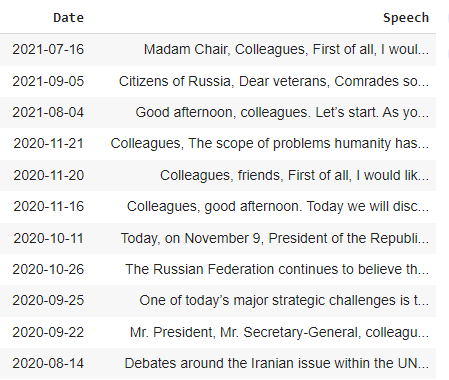 Source: Emopoliticon: Political Speeches-Context & Emotion dataset
2. Data pre-processing
Working with text datasets is complex. Just cleaning involves several steps that should systematically remove all unnecessary information from the dataset. Check all requirements for this project here.
2.1. Fixing mojibake errors
Mojibake is a Japanese word for the confusing text that results from character-encoding errors. Here is an example:
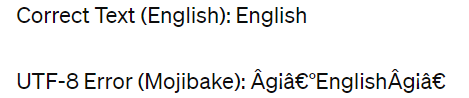 Mojibake example
It is useful to include this step right at the beginning of the cleaning. Correcting encoding-related errors is simple:
2.2. Cleaning special characters, punctuation, and numbers
This step should come right after fixing the encoding errors. The simplest way is to use the cleantext library. Also, consider lower-casing. Does "labor" mean the same as "Labor" in the dataset? In case it does, add a
lowercase parameter and apply the cleaning function:
2.3. Define the stopwords removal strategy
Removing the standard list of stopwords is generally a necessary step. Depending on the project focus, it might also be useful to clean data from an additional list of stopwords that don't bring any value. As written in the BERTopic's documentation:
Removing stop words as a preprocessing step is not advised as the transformer-based embedding models that we use need the full context to create accurate embeddings.
Instead, we use CountVectorizer to preprocess our documents after having generated embeddings during the topic model generation.
3. Topic generation
Having a cleaner dataset, it is now possible to remove English stopwords along with a list of additional stopwords , generate a topic bigram model, and apply it to the data.
Note that the nr_topicsparameter is set to 7 for generating 6 topics. The remaining topic is used to keep the outliers.
4. Topic visualization
In the next step, let's visualize the data in a heatmap to present the results better. Here is the outcome:
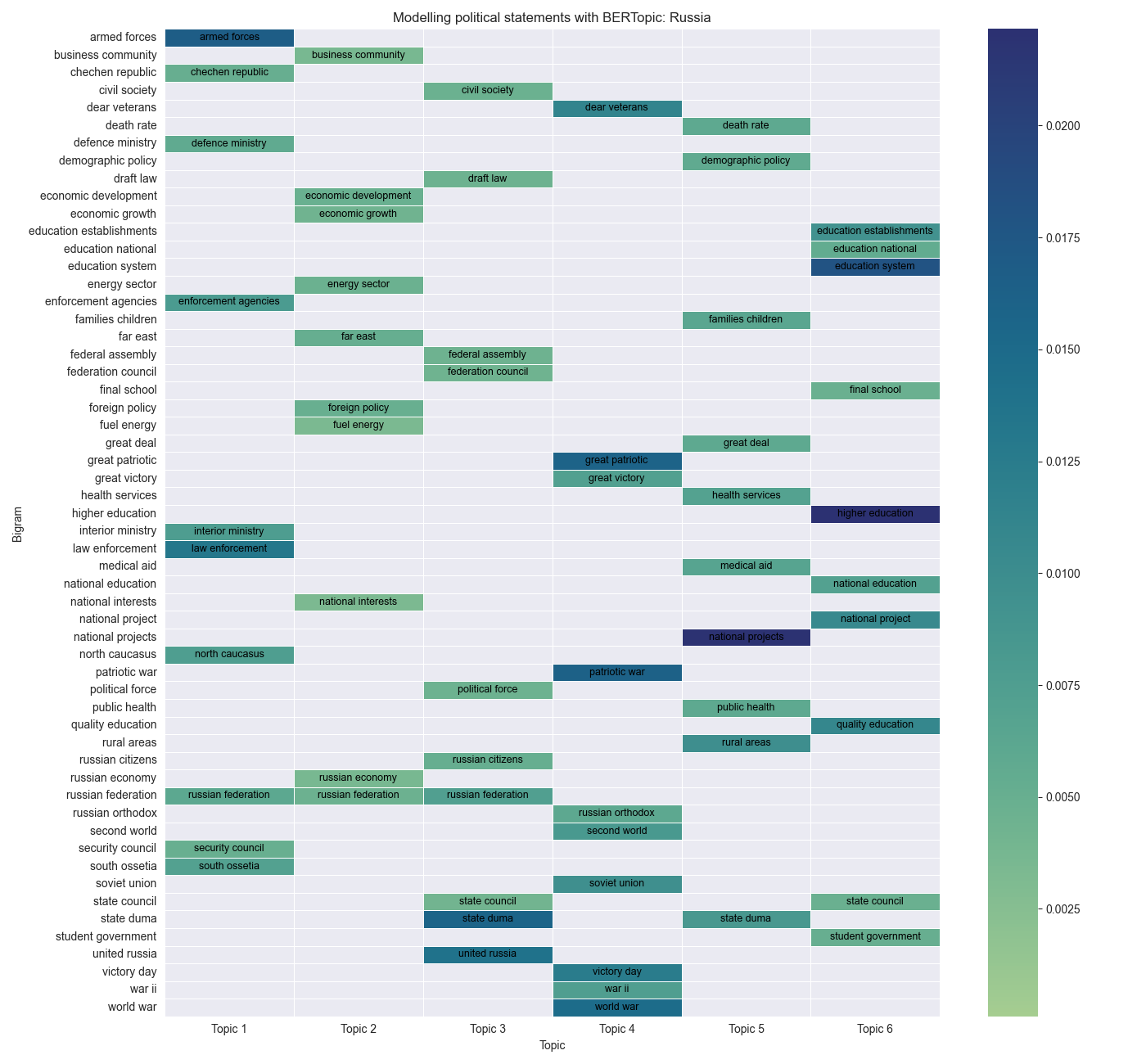 Figure 1: Heatmaps with bigrams and their probabilities, Image by Author
To do so, we'll extract bigrams and their probabilities from the topic model and create a data frame for each of the 6 topics:
Next, this code creates a heatmap in Figure 1.
5. Token frequencies over time
Now, we'll add a perspective on the development of bigrams over time. The goal is to look at which years the bigrams in the Russian leader(s) speeches were most frequently spoken out. The heatmap in Figure 2 displays the frequencies of the 5 most frequent bigrams for each year.
 Figure 2: Heatmaps with bigrams and their frequencies by year, Image by Author
The arabica library, which is now forthcoming in the Journal of Open Source Software (Koráb & Poměnková, 2024), was developed for this purpose.
EDIT Jul 2024 : Arabica has been updated. Check the documentation for the full list of parameters.
Here is the code generating the heatmap in Figure 2:
 Image by rawpixel on Freepik
Conclusions
This article briefly introduced topic modeling with BERTopic. The model's framework offers many extensions, fine-tuning, and visualization methods (see the documentation). Let's summarize the key findings:
- topic models show 6 distinct topics for defense policy (topic 1), economic development (topic 2), WW2 (topic 3 ), internal policies (topic 4), healthcare and demographics (topic 5), and education (topic 6).
- combining BERTopic with Arabica, we can see that the foreign and defense policy topics ("armed forces", "russian federation", "law enforcement") were more frequently discussed before 2012, while there is a shallow frequency of topics discussed related to education and healthcare , especially after 2010.
- The dataset contains more WW2, foreign, and defense policy terms because Arabica returns absolute frequencies. However, it's difficult to interpret the results well without knowing the regional context.
My previous article briefly explains a simpler approach to topic modeling with LDA. The complete code for this tutorial is on my GitHub.
If you enjoy my work, you can invite me for coffee and support my writing. You can also subscribe to my email list to get notified about my new articles. Thanks!
References
[1] Blei, Ng, Jordan (2003). Latent Dirichlet Allocation. Journal Of Machine Learning Research 3, pp. 993–1022.
[2] Chagnon, Pandolfi, Donatelli, Ushizima (2024). Benchmarking topic models on scientific articles using BERTeley. Natural Language Processing Journal 6.
[3] Efat, Atiq, Abeed, Momin, Alam (2023). Empoliticon: NLP And MLBased Approach For Context And Emotion Classification Of Political Speeches From Transcripts. IEEE Access , vol. 11.
[4] Grootendorst (2022). Bertopic: Neural Topic Modeling With A Class-Based TF-IDF Procedure. Computer Science.
[5] Koráb, Poměnková (2024). Arabica: A Python package for exploratory analysis of text data. In The Journal of Open Source Software. Journal of Open Source Software. https://doi.org/10.5281/zenodo.10866697.
Register Now to Continue Reading
Unlock Towards Data Science with a Free Account
All articles on Towards Data Science are available to registered users. Create a free account today to access this article and thousands more.
Register for freeSign in to your account
 Written By
See all from Petr Koráb
BertopicData SciencePythonText MiningTopic Modeling
Share This Article
Towards Data Science is a community publication. Submit your insights to reach our global audience and earn through the TDS Author Payment Program.
Write for TDS
Related Articles
Machine Learning
A Case Study in Model Generalization
John Morrow
January 24, 20235 min read
Data Science
Analyzing the Twitter user network using centrality and community detection algorithms.
Mananai Saengsuwan
June 23, 20223 min read
Deep Learning
A comparison of matrix arithmetic calculation in CPU and GPU with Python and PyTorch
Andrew Zhu (Shudong Zhu)
September 27, 20223 min read
Data Science
Brainstorming How to Increase Customer ROI for the Education as a Service Industry
Tony Yiu
August 29, 201910 min read
Data Science
Lessons learned from two years with a data science mentor
Rose Day
December 10, 20216 min read
Artificial Intelligence
Here's what to do and what to avoid
Benjamin Nweke
July 30, 20217 min read
Artificial Intelligence
Entire machine learning pipeline with 10 lines of code.
Soner Yıldırım
July 13, 20206 min read
Machine Learning
Dockerized Lambdas
Sebastian Telsemeyer
January 12, 20213 min read
Data Science
What to do when you realize that a Data job is not for you.
Cornellius Wijaya
January 9, 20214 min read
Your home for data science and AI. The world's leading publication for data science, data analytics, data engineering, machine learning, and artificial intelligence professionals.
Subscribe to Our NewsletterWrite For TDS•About•Advertise•Privacy Policy•Terms of Use
© Insight Media Group, LLC 2026•The New Stack•roadmap.sh•Creator Network
Recommended Articles
Close