保留正文与补采附件。源页面当前未重新核验;具体限制见交付清单。
 We value your privacy
We use cookies to enhance your browsing experience, serve personalised ads or content, and analyse our traffic. By clicking "Accept All", you consent to our use of cookies.
Customise Reject All Accept All
Customise Consent Preferences
 We use cookies to help you navigate efficiently and perform certain functions. You will find detailed information about all cookies under each consent category below.
The cookies that are categorised as "Necessary" are stored on your browser as they are essential for enabling the basic functionalities of the site. ... Show more
NecessaryAlways Active
Necessary cookies are required to enable the basic features of this site, such as providing secure log-in or adjusting your consent preferences. These cookies do not store any personally identifiable data.
-
Cookie
BCTempID
-
Duration
10 minutes
-
Description
No description available.
-
Cookie
__cf_bm
-
Duration
1 hour
-
Description
This cookie, set by Cloudflare, is used to support Cloudflare Bot Management.
-
Cookie
AWSALBCORS
-
Duration
7 days
-
Description
Amazon Web Services set this cookie for load balancing.
-
Cookie
_cfuvid
-
Duration
session
-
Description
Cloudflare sets this cookie to track users across sessions to optimize user experience by maintaining session consistency and providing personalized services
-
Cookie
li_gc
-
Duration
6 months
-
Description
Linkedin set this cookie for storing visitor's consent regarding using cookies for non-essential purposes.
-
Cookie
__hssrc
-
Duration
session
-
Description
This cookie is set by Hubspot whenever it changes the session cookie. The __hssrc cookie set to 1 indicates that the user has restarted the browser, and if the cookie does not exist, it is assumed to be a new session.
-
Cookie
__hssc
-
Duration
1 hour
-
Description
HubSpot sets this cookie to keep track of sessions and to determine if HubSpot should increment the session number and timestamps in the __hstc cookie.
-
Cookie
wpEmojiSettingsSupports
-
Duration
session
-
Description
WordPress sets this cookie when a user interacts with emojis on a WordPress site. It helps determine if the user's browser can display emojis properly.
-
Cookie
BCSessionID
-
Duration
1 year 1 month 4 days
-
Description
Blueconic sets this cookie as a unique identifier for the BlueConic profile.
-
Cookie
_octo
-
Duration
1 year
-
Description
No description available.
-
Cookie
logged_in
-
Duration
1 year
-
Description
No description available.
-
Cookie
__Secure-YEC
-
Duration
past
-
Description
YouTube sets this cookie to stores the user's video player preferences using embedded YouTube video
-
Cookie
__eoi
-
Duration
6 months
-
Description
Description is currently not available.
-
Cookie
AWSALBTGCORS
-
Duration
7 days
-
Description
No description available.
-
Cookie
login-status-p
-
Duration
past
-
Description
Description is currently not available.
-
Cookie
AWSALBTG
-
Duration
7 days
-
Description
No description available.
-
Cookie
csrf_token
-
Duration
session
-
Description
No description available.
-
Cookie
token_v2
-
Duration
1 day
-
Description
Description is currently not available.
-
Cookie
D
-
Duration
1 year
-
Description
Description is currently not available.
-
Cookie
PHPSESSID
-
Duration
session
-
Description
This cookie is native to PHP applications. The cookie stores and identifies a user's unique session ID to manage user sessions on the website. The cookie is a session cookie and will be deleted when all the browser windows are closed.
-
Cookie
VISITOR_PRIVACY_METADATA
-
Duration
6 months
-
Description
YouTube sets this cookie to store the user's cookie consent state for the current domain.
-
Cookie
cookietest
-
Duration
session
-
Description
The cookietest cookie is typically used to determine whether the user's browser accepts cookies, essential for website functionality and user experience.
-
Cookie
__Host-airtable-session
-
Duration
1 year
-
Description
This cookie is used to enable us to integrate the services of Airtable.
-
Cookie
__Host-airtable-session.sig
-
Duration
1 year
-
Description
This cookie is used to enable us to integrate the services of Airtable.
-
Cookie
m
-
Duration
1 year 1 month 4 days
-
Description
Stripe sets this cookie for fraud prevention purposes. It identifies the device used to access the website, allowing the website to be formatted accordingly.
-
Cookie
BIGipServer*
-
Duration
session
-
Description
Marketo sets this cookie to collect information about the user's online activity and build a profile about their interests to provide advertisements relevant to the user.
-
Cookie
__cfruid
-
Duration
session
-
Description
Cloudflare sets this cookie to identify trusted web traffic.
-
Cookie
_GRECAPTCHA
-
Duration
6 months
-
Description
Google Recaptcha service sets this cookie to identify bots to protect the website against malicious spam attacks.
-
Cookie
__Secure-YNID
-
Duration
6 months
-
Description
Google cookie used to protect user security and prevent fraud, especially during the login process.
-
Cookie
cookieyes-consent
-
Duration
1 year
-
Description
CookieYes sets this cookie to remember users' consent preferences so that their preferences are respected on subsequent visits to this site. It does not collect or store any personal information about the site visitors.
Functional
Functional cookies help perform certain functionalities like sharing the content of the website on social media platforms, collecting feedback, and other third-party features.
-
Cookie
lidc
-
Duration
1 day
-
Description
LinkedIn sets the lidc cookie to facilitate data center selection.
-
Cookie
brw
-
Duration
1 year
-
Description
No description available.
-
Cookie
brwConsent
-
Duration
5 minutes
-
Description
Description is currently not available.
-
Cookie
WMF-Uniq
-
Duration
1 year
-
Description
Description is currently not available.
-
Cookie
loom_anon_comment
-
Duration
1 year
-
Description
No description available.
-
Cookie
loom_referral_video
-
Duration
session
-
Description
Description is currently not available.
-
Cookie
VISITOR_INFO1_LIVE
-
Duration
6 months
-
Description
A cookie set by YouTube to measure bandwidth that determines whether the user gets the new or old player interface.
-
Cookie
yt-remote-connected-devices
-
Duration
Never Expires
-
Description
YouTube sets this cookie to store the user's video preferences using embedded YouTube videos.
-
Cookie
ytidb::LAST_RESULT_ENTRY_KEY
-
Duration
Never Expires
-
Description
The cookie ytidb::LAST_RESULT_ENTRY_KEY is used by YouTube to store the last search result entry that was clicked by the user. This information is used to improve the user experience by providing more relevant search results in the future.
-
Cookie
yt-remote-device-id
-
Duration
Never Expires
-
Description
YouTube sets this cookie to store the user's video preferences using embedded YouTube videos.
-
Cookie
yt-remote-session-name
-
Duration
session
-
Description
The yt-remote-session-name cookie is used by YouTube to store the user's video player preferences using embedded YouTube video.
-
Cookie
yt-remote-fast-check-period
-
Duration
session
-
Description
The yt-remote-fast-check-period cookie is used by YouTube to store the user's video player preferences for embedded YouTube videos.
-
Cookie
yt-remote-session-app
-
Duration
session
-
Description
The yt-remote-session-app cookie is used by YouTube to store user preferences and information about the interface of the embedded YouTube video player.
-
Cookie
yt-remote-cast-available
-
Duration
session
-
Description
The yt-remote-cast-available cookie is used to store the user's preferences regarding whether casting is available on their YouTube video player.
-
Cookie
yt-remote-cast-installed
-
Duration
session
-
Description
The yt-remote-cast-installed cookie is used to store the user's video player preferences using embedded YouTube video.
-
Cookie
cp_session
-
Duration
3 months
-
Description
Codepen sets this cookie for Help systems found in the website.
-
Cookie
loid
-
Duration
1 year 1 month 4 days
-
Description
This cookie is set by the Reddit. The cookie enables the sharing of content from the website onto the social media platform.
Analytics
Analytical cookies are used to understand how visitors interact with the website. These cookies help provide information on metrics such as the number of visitors, bounce rate, traffic source, etc.
-
Cookie
__hstc
-
Duration
6 months
-
Description
Hubspot set this main cookie for tracking visitors. It contains the domain, initial timestamp (first visit), last timestamp (last visit), current timestamp (this visit), and session number (increments for each subsequent session).
-
Cookie
hubspotutk
-
Duration
6 months
-
Description
HubSpot sets this cookie to keep track of the visitors to the website. This cookie is passed to HubSpot on form submission and used when deduplicating contacts.
-
Cookie
_ga
-
Duration
1 year 1 month 4 days
-
Description
Google Analytics sets this cookie to calculate visitor, session and campaign data and track site usage for the site's analytics report. The cookie stores information anonymously and assigns a randomly generated number to recognise unique visitors.
-
Cookie
ga*
-
Duration
1 year 1 month 4 days
-
Description
Google Analytics sets this cookie to store and count page views.
-
Cookie
__Host-psifi.analyticsTrace
-
Duration
6 hours
-
Description
Description is currently not available.
-
Cookie
__Host-psifi.analyticsTraceV2
-
Duration
6 hours
-
Description
Description is currently not available.
-
Cookie
_gh_sess
-
Duration
session
-
Description
GitHub sets this cookie for temporary application and framework state between pages like what step the user is on in a multiple step form.
-
Cookie
YSC
-
Duration
session
-
Description
YSC cookie is set by Youtube and is used to track the views of embedded videos on Youtube pages.
-
Cookie
ajs_anonymous_id
-
Duration
1 year
-
Description
This cookie is set by Segment to count the number of people who visit a certain site by tracking if they have visited before.
-
Cookie
vuid
-
Duration
1 year 1 month 4 days
-
Description
Vimeo installs this cookie to collect tracking information by setting a unique ID to embed videos on the website.
Performance
Performance cookies are used to understand and analyse the key performance indexes of the website which helps in delivering a better user experience for the visitors.
-
Cookie
AWSALB
-
Duration
7 days
-
Description
AWSALB is an application load balancer cookie set by Amazon Web Services to map the session to the target.
-
Cookie
acq
-
Duration
past
-
Description
Description is currently not available.
-
Cookie
acq.sig
-
Duration
past
-
Description
Description is currently not available.
-
Cookie
ptc
-
Duration
2 years
-
Description
No description available.
Advertisement
Advertisement cookies are used to provide visitors with customised advertisements based on the pages you visited previously and to analyse the effectiveness of the ad campaigns.
-
Cookie
muc_ads
-
Duration
1 year 1 month 4 days
-
Description
Twitter sets this cookie to collect user behaviour and interaction data to optimize the website.
-
Cookie
guest_id_marketing
-
Duration
1 year 1 month 4 days
-
Description
Twitter sets this cookie to identify and track the website visitor.
-
Cookie
guest_id_ads
-
Duration
1 year 1 month 4 days
-
Description
Twitter sets this cookie to identify and track the website visitor.
-
Cookie
personalization_id
-
Duration
1 year 1 month 4 days
-
Description
Twitter sets this cookie to integrate and share features for social media and also store information about how the user uses the website, for tracking and targeting.
-
Cookie
guest_id
-
Duration
1 year 1 month 4 days
-
Description
Twitter sets this cookie to identify and track the website visitor. It registers if a user is signed in to the Twitter platform and collects information about ad preferences.
-
Cookie
bcookie
-
Duration
1 year
-
Description
LinkedIn sets this cookie from LinkedIn share buttons and ad tags to recognize browser IDs.
-
Cookie
__Secure-ROLLOUT_TOKEN
-
Duration
6 months
-
Description
YouTube sets this cookie to manage feature rollout and experimentation. It helps Google control which new features or interface changes are shown to users as part of testing and staged rollouts, ensuring consistent experience for a given user during an experiment.
-
Cookie
yt.innertube::nextId
-
Duration
Never Expires
-
Description
YouTube sets this cookie to register a unique ID to store data on what videos from YouTube the user has seen.
-
Cookie
yt.innertube::requests
-
Duration
Never Expires
-
Description
YouTube sets this cookie to register a unique ID to store data on what videos from YouTube the user has seen.
-
Cookie
session_tracker
-
Duration
session
-
Description
This cookie is set by the Reddit. This cookie is used to identify trusted web traffic. It also helps in adverstising on the website.
-
Cookie
edgebucket
-
Duration
session
-
Description
Reddit sets this cookie to save the information about a log-on Reddit user, for the purpose of advertisement recommendations and updating the content.
-
Cookie
did
-
Duration
1 year
-
Description
Arbor sets this cookie to show targeted ads to site visitors.This cookie expires after 2 months or 1 year.
Uncategorised
Other uncategorised cookies are those that are being analysed and have not been classified into a category as yet.
No cookies to display.
Reject All Save My Preferences Accept All
Toggle SearchToggle Mobile Navigation
Publish AI, ML & data-science insights to a global community of data professionals.
Sign inSubmit an Article
LatestEditor's PicksNewsletterShipAI
Write For TDS
LinkedInXToggle Search
Artificial Intelligence
What Makes A Strong AI?
"The Book of Why" Chapters 9&10, a Read with Me series
Zijing Zhu, PhD
January 4, 202414 min read
 Photo by Emmanuel Ikwuegbu on Unsplash
What Makes A Strong AI?
We are at the last article reading Judea Pearl's inspiring "The Book of Why," and it will mostly focus on mediators and how to combine causality with big data to derive trustworthy conclusions. I will also summarize what makes a strong AI in the end based on the whole book.
Mediators
We have briefly talked about mediation in the previous articles. We mentioned it is important to identify mediators not only because we shouldn't treat them as confounders, since conditioning on them will block the causal effect completely or partially, but also in proper cases, we can use mediators for front-door criterion when unobserved confounders exist.
 Photo by sally crierie on Unsplash
In this section, we will dive deeper into different examples of mediators and understand how to properly define direct causal effect, indirect causal effect, and total causal effect when mediators exist.
Learn this step by step with the interactive AI Engineer and AI and Data Scientist roadmaps.
In history, scurvy had always been the most terrifying disease for sailors. Before vitamins were discovered and properly named, scientists struggled to figure out how to prevent sailors from getting scurvy. They first asked what is the cause - why did some sailors get scurvy and some don't? Having observed that citrus fruits helped reduce scurvy, they needed to explain why citrus fruits help prevent scurvy, which led to the discovery of Vitamin C.
 Image by Author based on The Book of Why Chapter 9
Mediators provide answers to the second "why" question. In this example, Vitamin C is the mediator for the citrus fruits to take into effect, and citrus fruits have no direct effect on scurvy. If we dry or boil these fruits, it won't help prevent scurvy anymore.
Unlike the previous example, in many cases, there are two paths for a cause to effect. The route that connects cause to effect directly represents the direct causal effect. There may exist another route that connects the cause and effect through a mediator, which produces the indirect causal effect.
 Image by Author based on The Book of Why Chapter 9
Thus, a one-unit change in the cause will impact the outcome variable in two paths, and only the total effect is what we observe. In this section, we will explore some examples to see why it is important to isolate the direct and indirect effects from the total effects. To estimate the direct and indirect effects, we need to borrow the concept of counterfactuals from the last article, and we will discuss more details in the next section.
Algebra for All
Chicago Public School system once introduced an "Algebra for All" program that required all ninth graders to take college-prep math courses. To understand whether taking these courses improved students' test grades causally, we first need to remove confounders, like other curriculum changes that would also impact students' test grades. After careful consideration, researchers found no significant improvement in test scores. However, before jumping into claiming the program is not effective, the researcher examined more on how can introducing new courses impact students' grades. It turned out that "Algebra for All" not only changed the curriculum but also changed the teaching environment where lower-achieving students are mixed with higher-achieving students during class. Larger class size not only reduces teaching efficiency but also discourage lower-achieving students from catching up. Thus, we have the following causal graph when adding "Environment" as a mediator:
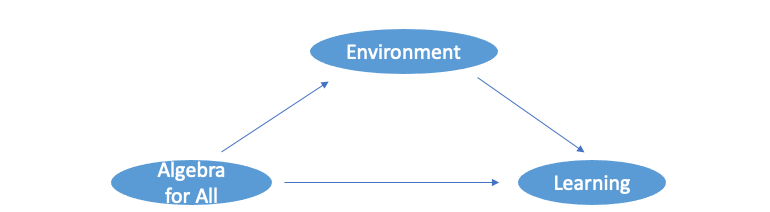 Image by Author based on The Book of Why Chapter 9
Here, the direct effect of "Algebra for All" on learning is positive, but the indirect effect through the mediator "Environment" is negative. Thus, the total effect without distinguishing the direct and indirect effects will more than likely be minimal.
In this case, the researcher estimated the direct effect and indirect effect individually. Since the results did show a positive direct effect and a negative indirect effect, the researcher concluded that "Allegra for All" should increase students' test scores if maintaining the pre policy classroom environment.
Revisit The Smoking Gene
From previous articles, we might be very familiar with the debate happening when analyzing the causal effect of smoking on lung cancer. One confounder that was brought into the front stage was the smoking gene:
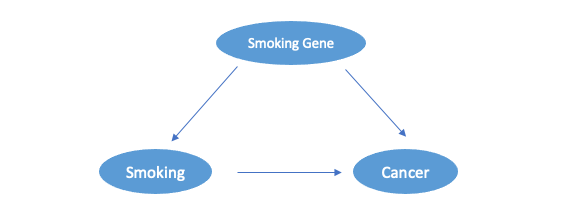 Image by Author based on The Book of Why Chapter 9
With progress in medical research, genomics experts did locate the smoking gene, what they called "Mr. Big," because of its strong association with lung cancer. The finding of the smoking gene shouldn't overshadow smoking as a causal factor in lung cancer. Nevertheless, even a double dose of the smoking gene doesn't double the risk of getting lung cancer.
How can the discovery of the smoking gene help us other than serving as a confounder? If we make a small shift on the same causal graph and treat smoking gene as the treatment and smoking as a mediator to lung cancer:
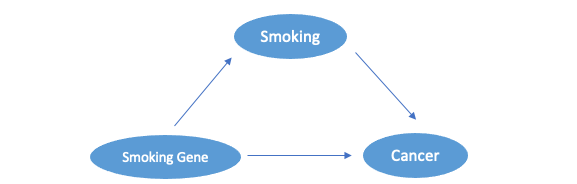 Image by Author based on The Book of Why Chapter 9
With this change, as Pearl mentioned, we can estimate the smoking gene's direct effect: Does the smoking gene make lung cells more vulnerable to cancer? We can also estimate the smoking gene's indirect effect: Does the smoking gene make people smoke more and inhale harder?
Comparing whether direct or indirect is higher will give different action guidance. If the direct effect is higher, then people with the smoking gene should receive extra screening for lung cancer throughout their lives. On the contrary, if the indirect effect is higher, health professionals should pay more attention to intervening in the smoking behaviors of individuals carrying the smoking gene.
Estimate Direct and Indirect Effects
After demonstrating the importance of isolating direct effect and indirect effect, let's move to how to estimate the causal effect, a Rung 2&3 question, from Rung 1 data.
For a long period of time, the standard way of estimating direct and direct effects follows simple rules. Supposed we have the following causal diagram with the coefficients representing the causal effects:
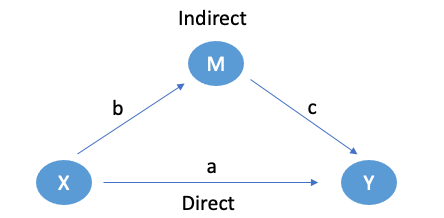 Image by Author based on The Book of Why Chapter 9
The direct effect would be a , and the indirect effect would be b c.****Thus, ****** **the total effect with one unit increase in the cause is a+b c. However, there are some assumptions needed to arrive at this conclusion.
The first assumption is that all variables follow linear relationships. There is a simple example in Pearl's book that shows that if we change the linear relationship simply to binary conditions, this would not work. Moreover, in essence, a linear relationship would not be able to capture the case when there are interactions between the cause and the mediator.
 Photo by Shubham Dhage on Unsplash
No interaction is a strong assumption. Take "Algebra for All" as an example. It is very likely that a more challenging curriculum, combined with a less supportive classroom environment, will be more discouraging for low-achieving students to get better grades. The linear system would not be able to reflect this interaction.
Another assumption made here is this equation:
Total Effect = Direct Effect + Indirect Effect
This sounds very logical. What's the problem with this? In the book, Pearl gives an example. Suppose we are estimating the efficiency of a drug that doesn't have a direct effect but has an indirect effect through stimulating enzymes.
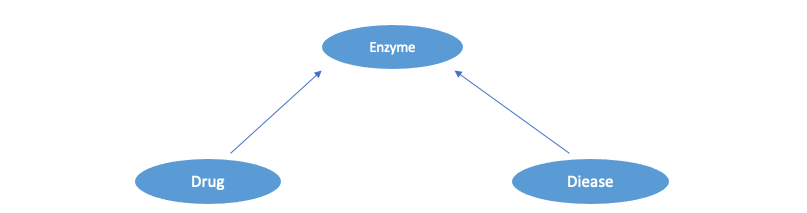 Image by Author based on The Book of Why Chapter 9
We know the total effect is positive because the drug is effective. The direct effect is zero because if we disable the enzyme, the drug will not work.
When estimating the indirect effect, and we block the drug and artificially get the enzyme, the disease would not be cured because it would only work if we combine the drug and the enzyme.
This is another example of interaction between cause and mediator. In this case, the total effect is positive, but both direct and indirect effects are zeros.
The essence of the challenges, in my opinion, is how to define the quantity of mediator M when calculating indirect effect, especially when there are interactions between X and M.
We know the value of M when there is treatment, what would have been the value of M without the treatment? And how does this value differ across individuals?
These questions all point to the concept we have discussed in the previous chapter - - counterfactuals. If the direct effect is
The effect remaining after holding the mediator fixed
The definition Pearl gives for indirect effect is more complicated:
The indirect effect of X on Y is the increase we would see in Y while holding X constant and increasing M to whatever value M would attain under a unit increase in X.
The key here is we first need to know what M would have been when X changes before we know it's indirect impact on Y. With counterfactuals embedded, Pearl presents the two equations to estimate direct and indirect effects. The natural direct effect (NDE) is:
 Here we make the mediator fixed at M0, a value that M would have been given that X takes the value 0. In the "Algebra for All" example, M would be the teaching environment, or specifically, the classroom size when there is no curriculum change. We are comparing the direct impact of do(X=0) and do(X=1) on outcome Y=1.
The natural indirect effect (NIE) is:
 Here we ensure do(X=0) on both terms to ensure no direct effects. Note we make the mediator take the value of M1 in the first term, which is what M would be given that X=1. For example, what the classroom size would have been given that the "Algebra for All" program had launched. In the second term, however, the mediator takes the value of M0. The natural indirect effect basically calculates a difference that is only deduced by the change in the value of the mediator, and how much the mediator will change from M0 to M1 depends largely on the causal relationship between X and M.
 Photo by Anne Nygård on Unsplash
Arriving at these equations was not an easy task. There are so many more details to this journey, with generations of researchers' efforts. You can refer to Pearl's book for more.
Causality and Big Data
All throughout the book, Pearl tries to prove that only relying on data without understanding causality is not enough to derive trustworthy results. However, data and models are never enemies. In fact, having data is the first step to arrive at any conclusion. For the last chapter of the book, Pearl explores the opportunities we have combining causality and big data:
Causal inference permits us to screen off the irrelevant characteristics and to recruit these individuals from diverse studies, while Big Data allows us to gather enough information about them.
To illustrate how we can combine causal models and data from different studies to get new insights, Pearl shows an example to analyze an online advertisement(X) on the likelihood that a consumer will purchase the product(Y). If the company already has data from different cities' previous campaigns, like in Los Angeles, Boston, Toronto, etc, and is looking for ways to generalize the results to the population in Arkansas, with the help of causal diagrams, there might be ways we can measure the effect in new population without all the new data, or any new data.
Specifically, let's look at the causal diagram showing how the online campaign causes sales to increase:
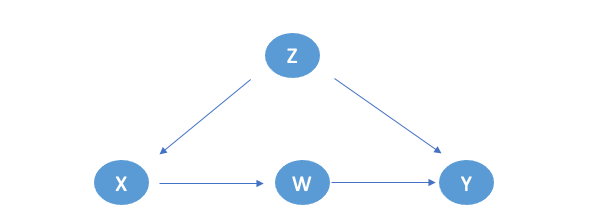 Image by Author based on The Book of Why Chapter 10
There is Z representing confounders. In this case, Z could be age, showing that some products are only preferred by certain age groups, like young people, and they also happen to be more exposed to online promotions. W represents the mediator for X to affect Y. For example, it could be the click rate on a link that converts customers from seeing an advertisement to purchasing the product.
In the easiest case, suppose we already have survey data from Boston from their past campaigns and the only difference between Boston and Arkansas population is the rate of car ownership. Let S represent the difference between these two populations, and we can revise the causal diagram:
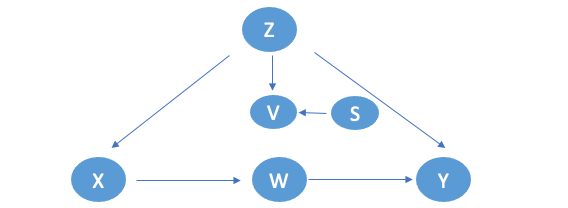 Image by Author based on The Book of Why Chapter 10
If the causal diagram holds, it means the effect of the Arkansas online advertisement should be the same as in Boston since S and V will not affect the causal path X->W->Y because it's blocked by the collider Z.
In a more complicated case, suppose we have survey data from Los Angeles, and the difference is that the LA population might be younger. The revised causal diagram would be:
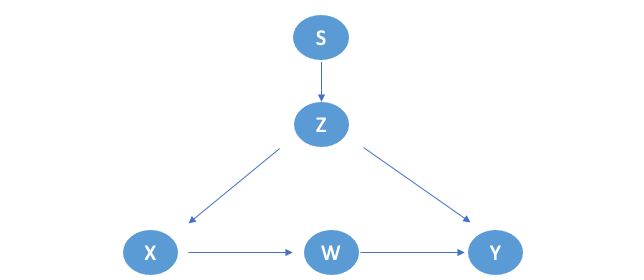 Image by Author based on The Book of Why Chapter 10
In this case, S is impacting the X->Y causal effects through the confounder Z. Thus, we need to reweigh the data in LA to account for the different age structures.
If we cannot measure Z in Arkansas, we can instead look for randomized trials that might have been done in other cities and see whether we can adjust for Arkansas. For example, if we have randomized trials from Toronto, and the only difference is that Toronto has a higher click-through rate:
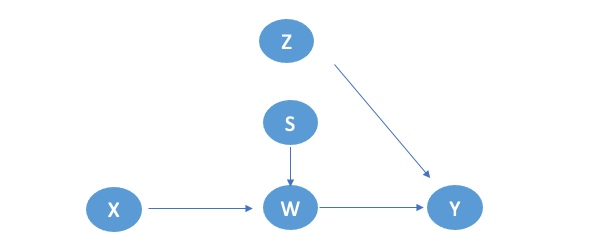 Image by Author based on The Book of Why Chapter 10
Since this is a randomized experiment, we could remove the path between X and Z. By just collecting data on X, W, and Y in Arkansas, we can estimate the causal impact with the results from Toronto.
Even in the case where S impacts Y directly, i.e., the product is more desirable in this city:
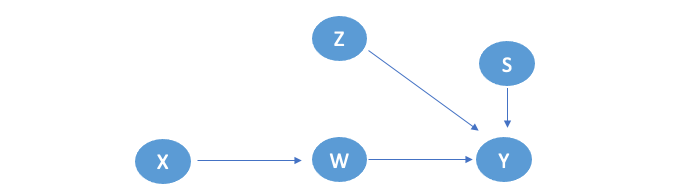 Again, this is from experiment data so we can remove the link between X and Z. Even if the difference S directly impacts Y, we can still use this city's estimation on P(W|X) to contribute partially to the overall causal impact.
All these examples show that Big Data is our friend. Combining with reasonable causal structure, we know which sets of data are desired to derive trustworthy causal effects, which saves us trouble from always running randomized trials or collecting as much data as possible.
What Makes A Strong AI
In the last two months of 2023, we have been indulging in the world of causality through reading "The Book of Why" by Judea Pearl. Time flies. We said goodbye to 2023 and to "The Book of Why." However, this won't be the end of exploring the fascinating world of causality and pushing the boundaries of artificial intelligence. Pearl illustrates what makes a strong AI in every chapter, and I briefly talked about in my previous articles:
A strong AI never makes decisions only based on correlations. It needs to step up from Rung 1, "seeing," to Rung 2, "intervening," and Rung 3, "imagining." Not only do they need to know what the patterns were from the past, but they also need to understand why these patterns came up to make intelligent predictions.
A strong AI never makes decisions based on rules. Instead, it draws conclusions following causal structures. In addition to having the ability to derive the probability of an outcome based on the probability of cause, it also knows to update its belief that given the outcome, what's the probability of cause. With the help of causal diagrams, a strong AI goes beyond the Bayesian network and is capable of finding causality in observational studies.
A strong AI knows how to distinguish spurious correlations and true causalities. It will not mistake collider bias as causation, and will not eliminate causal impacts by conditioning on mediators.
A strong AI resembles human brains when categorizing causes into necessary causes and sufficient causes. Although multiple variables can be the causal factors for an outcome, human brains automatically "rank" these factors based on how rare events happen and what are the action points. A strong AI not only looks for why but also ranks the why.
 Photo by Jason Leung on Unsplash
In the last two chapters, Pearl also mentioned the importance of transparency in the AI decision making process. Just like we want to know the why about everything, we want to know why the AI makes this decision.
Not all AI researchers are fans of transparency. In Pearl's book, he mentions:
The field at that time was divided into "neats" (who wanted transparent systems with guarantees of behavior) and "scruffies" (who just wanted something that worked)
Although scruffies could get temporary solutions, a strong AI is a transparent AI so that humans can better coach it, tailor it the way we like, and even learn from it. Ultimately, humans always long for effective communication. As Pearl said, it would be "quite unfortunate " if we cannot hold meaningful conversations with AI.
2023 was a revolutionary year. With the widespread use of Generative AI, we are hopeful and simultaneously intimidated by what AI can do, just like when we were facing any new technology in history. Pearl is optimistic, he said at the end of the book:
Once we have built a moral robot...... we will be able to depend on our machines for a clear-eyed and causally sound sense of justice...... Such a thinking machine would be a wonderful companion for our species and would truly qualify as AI's first and best gift to humanity.
However, having data, no matter how much more, will not enable machines to resemble human-level intelligence without embedding causal models, with which, AI can "think about own intentions and reflect on its own mistakes." The AI that climbs above Rung 1 to make Rung 2 interventions and Rung 3 counterfactuals. And this is how we make a strong AI.
Thanks for reading. This concludes the Read with Me series. What an amazing collective learning experience! The good news is that I plan to publish a bonus article in two weeks to officially close this series.
How is Causal Inference Different in Academia and Industry?
If interested, subscribe to my email list to get notified of my future articles. If you like this article, don't forget to:
Please accept cookies to access this content
Register Now to Continue Reading
Unlock Towards Data Science with a Free Account
All articles on Towards Data Science are available to registered users. Create a free account today to access this article and thousands more.
Register for freeSign in to your account
 Written By
See all from Zijing Zhu, PhD
Deep DivesArtificial IntelligenceCausal InferenceCausalityData Science
Share This Article
Towards Data Science is a community publication. Submit your insights to reach our global audience and earn through the TDS Author Payment Program.
Write for TDS
Related Articles
Data Science
Learn how to plot time series boxplots using matplotlib and Seaborn
Wei-Meng Lee
March 25, 20225 min read
Artificial Intelligence
How history’s biggest tech bubble explains where AI is headed next
Michael Malin
December 8, 20257 min read
Data Science
Learn how to tackle interview questions related to causal inference, gaining insights into the core concepts and applications.
Julie Zhang
August 11, 20236 min read
Data Visualization
Go beyond static plots with matplotlib.
MARCUS SENA
May 6, 20256 min read
Artificial Intelligence
How to manipulate strings in both libraries
Soner Yıldırım
February 6, 20215 min read
Artificial Intelligence
Before suggesting that AI can enhance human potential, it can be useful to ask what separates humanity from the progress of technology
Lee Schlenker
January 10, 20204 min read
Machine Learning
3 cases to prove this from my own experience
Radmila Mandzhieva
November 14, 20247 min read
Data Science
Making reproducible datasets possible
Pratik Gandhi
October 18, 20214 min read
Machine Learning
A primer about Semi-Supervised Learning, the approaches taken with different algorithms and the limitations of using unlabelled data.
Carolina Bento
August 5, 20267 min read
Your home for data science and AI. The world's leading publication for data science, data analytics, data engineering, machine learning, and artificial intelligence professionals.
Subscribe to Our NewsletterWrite For TDS•About•Advertise•Privacy Policy•Terms of Use
© Insight Media Group, LLC 2026•The New Stack•roadmap.sh•Creator Network
Recommended Articles
Close