保留正文与补采附件。源页面当前未重新核验;具体限制见交付清单。
 We value your privacy
We use cookies to enhance your browsing experience, serve personalised ads or content, and analyse our traffic. By clicking "Accept All", you consent to our use of cookies.
Customise Reject All Accept All
Customise Consent Preferences
 We use cookies to help you navigate efficiently and perform certain functions. You will find detailed information about all cookies under each consent category below.
The cookies that are categorised as "Necessary" are stored on your browser as they are essential for enabling the basic functionalities of the site. ... Show more
NecessaryAlways Active
Necessary cookies are required to enable the basic features of this site, such as providing secure log-in or adjusting your consent preferences. These cookies do not store any personally identifiable data.
-
Cookie
BCTempID
-
Duration
10 minutes
-
Description
No description available.
-
Cookie
__cf_bm
-
Duration
1 hour
-
Description
This cookie, set by Cloudflare, is used to support Cloudflare Bot Management.
-
Cookie
AWSALBCORS
-
Duration
7 days
-
Description
Amazon Web Services set this cookie for load balancing.
-
Cookie
_cfuvid
-
Duration
session
-
Description
Cloudflare sets this cookie to track users across sessions to optimize user experience by maintaining session consistency and providing personalized services
-
Cookie
li_gc
-
Duration
6 months
-
Description
Linkedin set this cookie for storing visitor's consent regarding using cookies for non-essential purposes.
-
Cookie
__hssrc
-
Duration
session
-
Description
This cookie is set by Hubspot whenever it changes the session cookie. The __hssrc cookie set to 1 indicates that the user has restarted the browser, and if the cookie does not exist, it is assumed to be a new session.
-
Cookie
__hssc
-
Duration
1 hour
-
Description
HubSpot sets this cookie to keep track of sessions and to determine if HubSpot should increment the session number and timestamps in the __hstc cookie.
-
Cookie
wpEmojiSettingsSupports
-
Duration
session
-
Description
WordPress sets this cookie when a user interacts with emojis on a WordPress site. It helps determine if the user's browser can display emojis properly.
-
Cookie
BCSessionID
-
Duration
1 year 1 month 4 days
-
Description
Blueconic sets this cookie as a unique identifier for the BlueConic profile.
-
Cookie
_octo
-
Duration
1 year
-
Description
No description available.
-
Cookie
logged_in
-
Duration
1 year
-
Description
No description available.
-
Cookie
__Secure-YEC
-
Duration
past
-
Description
YouTube sets this cookie to stores the user's video player preferences using embedded YouTube video
-
Cookie
__eoi
-
Duration
6 months
-
Description
Description is currently not available.
-
Cookie
AWSALBTGCORS
-
Duration
7 days
-
Description
No description available.
-
Cookie
login-status-p
-
Duration
past
-
Description
Description is currently not available.
-
Cookie
AWSALBTG
-
Duration
7 days
-
Description
No description available.
-
Cookie
csrf_token
-
Duration
session
-
Description
No description available.
-
Cookie
token_v2
-
Duration
1 day
-
Description
Description is currently not available.
-
Cookie
D
-
Duration
1 year
-
Description
Description is currently not available.
-
Cookie
PHPSESSID
-
Duration
session
-
Description
This cookie is native to PHP applications. The cookie stores and identifies a user's unique session ID to manage user sessions on the website. The cookie is a session cookie and will be deleted when all the browser windows are closed.
-
Cookie
VISITOR_PRIVACY_METADATA
-
Duration
6 months
-
Description
YouTube sets this cookie to store the user's cookie consent state for the current domain.
-
Cookie
cookietest
-
Duration
session
-
Description
The cookietest cookie is typically used to determine whether the user's browser accepts cookies, essential for website functionality and user experience.
-
Cookie
__Host-airtable-session
-
Duration
1 year
-
Description
This cookie is used to enable us to integrate the services of Airtable.
-
Cookie
__Host-airtable-session.sig
-
Duration
1 year
-
Description
This cookie is used to enable us to integrate the services of Airtable.
-
Cookie
m
-
Duration
1 year 1 month 4 days
-
Description
Stripe sets this cookie for fraud prevention purposes. It identifies the device used to access the website, allowing the website to be formatted accordingly.
-
Cookie
BIGipServer*
-
Duration
session
-
Description
Marketo sets this cookie to collect information about the user's online activity and build a profile about their interests to provide advertisements relevant to the user.
-
Cookie
__cfruid
-
Duration
session
-
Description
Cloudflare sets this cookie to identify trusted web traffic.
-
Cookie
_GRECAPTCHA
-
Duration
6 months
-
Description
Google Recaptcha service sets this cookie to identify bots to protect the website against malicious spam attacks.
-
Cookie
__Secure-YNID
-
Duration
6 months
-
Description
Google cookie used to protect user security and prevent fraud, especially during the login process.
-
Cookie
cookieyes-consent
-
Duration
1 year
-
Description
CookieYes sets this cookie to remember users' consent preferences so that their preferences are respected on subsequent visits to this site. It does not collect or store any personal information about the site visitors.
Functional
Functional cookies help perform certain functionalities like sharing the content of the website on social media platforms, collecting feedback, and other third-party features.
-
Cookie
lidc
-
Duration
1 day
-
Description
LinkedIn sets the lidc cookie to facilitate data center selection.
-
Cookie
brw
-
Duration
1 year
-
Description
No description available.
-
Cookie
brwConsent
-
Duration
5 minutes
-
Description
Description is currently not available.
-
Cookie
WMF-Uniq
-
Duration
1 year
-
Description
Description is currently not available.
-
Cookie
loom_anon_comment
-
Duration
1 year
-
Description
No description available.
-
Cookie
loom_referral_video
-
Duration
session
-
Description
Description is currently not available.
-
Cookie
VISITOR_INFO1_LIVE
-
Duration
6 months
-
Description
A cookie set by YouTube to measure bandwidth that determines whether the user gets the new or old player interface.
-
Cookie
yt-remote-connected-devices
-
Duration
Never Expires
-
Description
YouTube sets this cookie to store the user's video preferences using embedded YouTube videos.
-
Cookie
ytidb::LAST_RESULT_ENTRY_KEY
-
Duration
Never Expires
-
Description
The cookie ytidb::LAST_RESULT_ENTRY_KEY is used by YouTube to store the last search result entry that was clicked by the user. This information is used to improve the user experience by providing more relevant search results in the future.
-
Cookie
yt-remote-device-id
-
Duration
Never Expires
-
Description
YouTube sets this cookie to store the user's video preferences using embedded YouTube videos.
-
Cookie
yt-remote-session-name
-
Duration
session
-
Description
The yt-remote-session-name cookie is used by YouTube to store the user's video player preferences using embedded YouTube video.
-
Cookie
yt-remote-fast-check-period
-
Duration
session
-
Description
The yt-remote-fast-check-period cookie is used by YouTube to store the user's video player preferences for embedded YouTube videos.
-
Cookie
yt-remote-session-app
-
Duration
session
-
Description
The yt-remote-session-app cookie is used by YouTube to store user preferences and information about the interface of the embedded YouTube video player.
-
Cookie
yt-remote-cast-available
-
Duration
session
-
Description
The yt-remote-cast-available cookie is used to store the user's preferences regarding whether casting is available on their YouTube video player.
-
Cookie
yt-remote-cast-installed
-
Duration
session
-
Description
The yt-remote-cast-installed cookie is used to store the user's video player preferences using embedded YouTube video.
-
Cookie
cp_session
-
Duration
3 months
-
Description
Codepen sets this cookie for Help systems found in the website.
-
Cookie
loid
-
Duration
1 year 1 month 4 days
-
Description
This cookie is set by the Reddit. The cookie enables the sharing of content from the website onto the social media platform.
Analytics
Analytical cookies are used to understand how visitors interact with the website. These cookies help provide information on metrics such as the number of visitors, bounce rate, traffic source, etc.
-
Cookie
__hstc
-
Duration
6 months
-
Description
Hubspot set this main cookie for tracking visitors. It contains the domain, initial timestamp (first visit), last timestamp (last visit), current timestamp (this visit), and session number (increments for each subsequent session).
-
Cookie
hubspotutk
-
Duration
6 months
-
Description
HubSpot sets this cookie to keep track of the visitors to the website. This cookie is passed to HubSpot on form submission and used when deduplicating contacts.
-
Cookie
_ga
-
Duration
1 year 1 month 4 days
-
Description
Google Analytics sets this cookie to calculate visitor, session and campaign data and track site usage for the site's analytics report. The cookie stores information anonymously and assigns a randomly generated number to recognise unique visitors.
-
Cookie
ga*
-
Duration
1 year 1 month 4 days
-
Description
Google Analytics sets this cookie to store and count page views.
-
Cookie
__Host-psifi.analyticsTrace
-
Duration
6 hours
-
Description
Description is currently not available.
-
Cookie
__Host-psifi.analyticsTraceV2
-
Duration
6 hours
-
Description
Description is currently not available.
-
Cookie
_gh_sess
-
Duration
session
-
Description
GitHub sets this cookie for temporary application and framework state between pages like what step the user is on in a multiple step form.
-
Cookie
YSC
-
Duration
session
-
Description
YSC cookie is set by Youtube and is used to track the views of embedded videos on Youtube pages.
-
Cookie
ajs_anonymous_id
-
Duration
1 year
-
Description
This cookie is set by Segment to count the number of people who visit a certain site by tracking if they have visited before.
-
Cookie
vuid
-
Duration
1 year 1 month 4 days
-
Description
Vimeo installs this cookie to collect tracking information by setting a unique ID to embed videos on the website.
Performance
Performance cookies are used to understand and analyse the key performance indexes of the website which helps in delivering a better user experience for the visitors.
-
Cookie
AWSALB
-
Duration
7 days
-
Description
AWSALB is an application load balancer cookie set by Amazon Web Services to map the session to the target.
-
Cookie
acq
-
Duration
past
-
Description
Description is currently not available.
-
Cookie
acq.sig
-
Duration
past
-
Description
Description is currently not available.
-
Cookie
ptc
-
Duration
2 years
-
Description
No description available.
Advertisement
Advertisement cookies are used to provide visitors with customised advertisements based on the pages you visited previously and to analyse the effectiveness of the ad campaigns.
-
Cookie
muc_ads
-
Duration
1 year 1 month 4 days
-
Description
Twitter sets this cookie to collect user behaviour and interaction data to optimize the website.
-
Cookie
guest_id_marketing
-
Duration
1 year 1 month 4 days
-
Description
Twitter sets this cookie to identify and track the website visitor.
-
Cookie
guest_id_ads
-
Duration
1 year 1 month 4 days
-
Description
Twitter sets this cookie to identify and track the website visitor.
-
Cookie
personalization_id
-
Duration
1 year 1 month 4 days
-
Description
Twitter sets this cookie to integrate and share features for social media and also store information about how the user uses the website, for tracking and targeting.
-
Cookie
guest_id
-
Duration
1 year 1 month 4 days
-
Description
Twitter sets this cookie to identify and track the website visitor. It registers if a user is signed in to the Twitter platform and collects information about ad preferences.
-
Cookie
bcookie
-
Duration
1 year
-
Description
LinkedIn sets this cookie from LinkedIn share buttons and ad tags to recognize browser IDs.
-
Cookie
__Secure-ROLLOUT_TOKEN
-
Duration
6 months
-
Description
YouTube sets this cookie to manage feature rollout and experimentation. It helps Google control which new features or interface changes are shown to users as part of testing and staged rollouts, ensuring consistent experience for a given user during an experiment.
-
Cookie
yt.innertube::nextId
-
Duration
Never Expires
-
Description
YouTube sets this cookie to register a unique ID to store data on what videos from YouTube the user has seen.
-
Cookie
yt.innertube::requests
-
Duration
Never Expires
-
Description
YouTube sets this cookie to register a unique ID to store data on what videos from YouTube the user has seen.
-
Cookie
session_tracker
-
Duration
session
-
Description
This cookie is set by the Reddit. This cookie is used to identify trusted web traffic. It also helps in adverstising on the website.
-
Cookie
edgebucket
-
Duration
session
-
Description
Reddit sets this cookie to save the information about a log-on Reddit user, for the purpose of advertisement recommendations and updating the content.
-
Cookie
did
-
Duration
1 year
-
Description
Arbor sets this cookie to show targeted ads to site visitors.This cookie expires after 2 months or 1 year.
Uncategorised
Other uncategorised cookies are those that are being analysed and have not been classified into a category as yet.
No cookies to display.
Reject All Save My Preferences Accept All
Toggle SearchToggle Mobile Navigation
Publish AI, ML & data-science insights to a global community of data professionals.
Sign inSubmit an Article
LatestEditor's PicksNewsletterShipAI
Write For TDS
LinkedInXToggle Search
Artificial Intelligence
Data drift: It can come at you from anywhere
The concept of data drift is illustrated visually in various shapes and forms.
Tirthajyoti Sarkar
January 19, 20225 min read
A short introduction to data drift
Machine learning (ML) models, at least in their present incarnations, are little more than powerful inductive machines. Their lofty goal is to go from a small example set to a broader inductive generalization.
Naturally, for successful (and dependable) functioning, they need to depend on the critical assumption - the input data distribution does not drift away too much over time.
Because, if that happens, then a successful model is only successful at a single point in time. Over time, the model will make inductive generalizations based on a distribution that is not exactly what it was trained on, and performance will degrade.
So, we need monitoring and (timely) detection of any data-drift in the MLOps or ModelOps pipeline for any (continually) successful ML model deployment. Apart from regular MLops, the concept of data drift is important for ML explainability or Explainable AI (xAI) field too.
Where exactly a data drift monitoring block should sit in an end-to-end MLops cycle is nicely visualized in the following article.
Essential guide to Machine Learning Model Monitoring in Production
A lot of articles on this topic discuss the shape and statistical properties of the input distributions. In this article, we will take the example of (one or more) data streams feeding into ML models in the form of time series and visualize those variations to understand the concept clearly. Additionally, we will also talk about a few not-so-obvious sources of data drifts in an industrial context.
Learn this step by step with the interactive AI Engineer, AI and Data Scientist, Computer Science and Machine Learning roadmaps.
Data drift is like a box of chocolates...
You never know what you're gonna get (next)! Let's see some obvious and not-so-obvious examples...
Level shift? Obviously
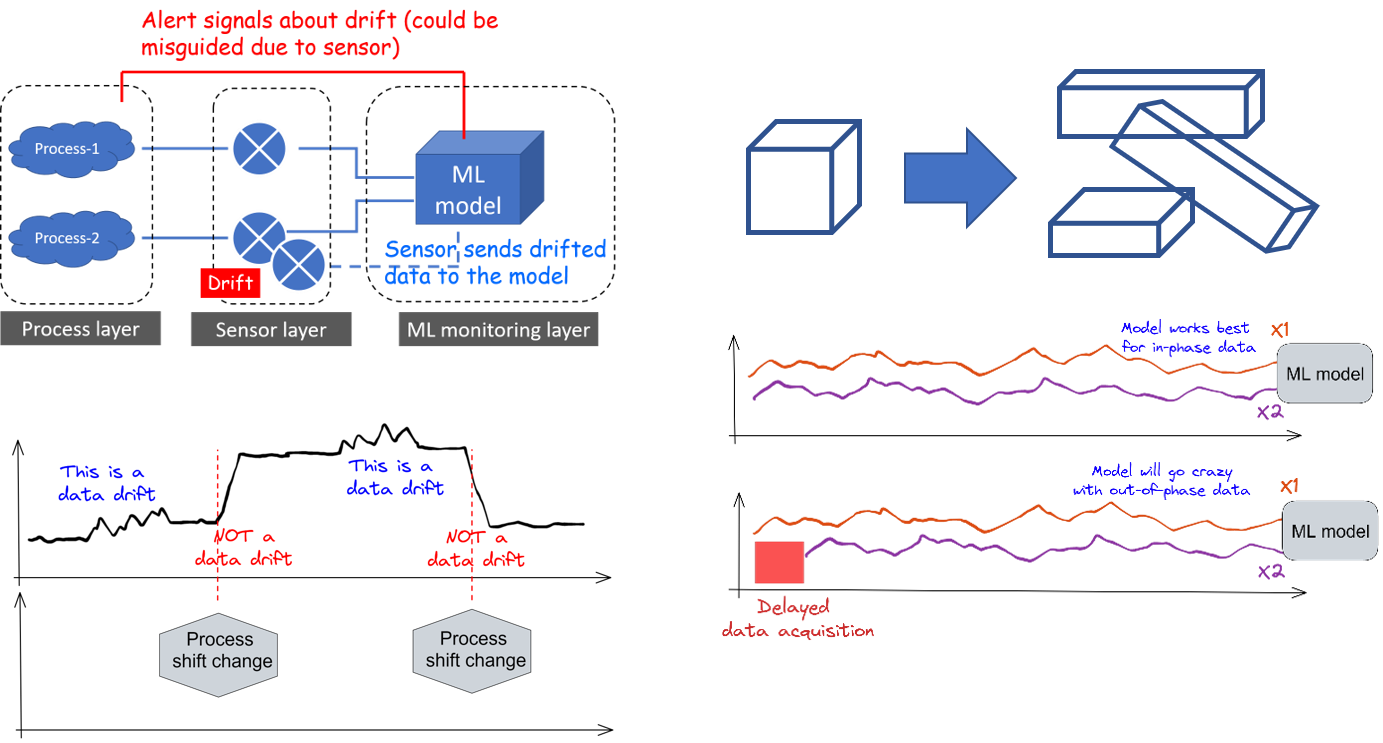
This is an obvious data drift. In many unsupervised model settings, this will also be called an 'outlier ' or 'anomaly '. Also note, drift may not be permanent and can be short-lived. Both the start and end of the drift should be identified quickly.
Variance shift? Subtler
This is slightly harder to detect than level shift. See the illustration below.
Variance decrease? That's a drift too
At a high level, business/ process people (or your customer) will tell you that high variance is bad. Yes, they are almost always right. But from a data drift point of view, you have to watch for any chance - even a sudden decrease in the variance. Statistically, that is a change in the distribution properties too.
Peak shifts inside a period
This one is more subtle and hard to detect. I have tried to illustrate the drift with additional annotations like peak and period. Did you see what really happened here? The data comes in a periodic fashion and there is a peak within each period. The relative position of that peak (within a period) shifted for some time before it came back to normal.
Do you see the problem? Simple statistical properties may not catch this drift. The mean and variance (other moments too) may look similar. How do you catch it then? Interestingly, some simple spectral analysis will indicate a shift. So, you have to bring in some knowledge of signal processing to catch this data drift.
Contextual data - another way to catch the drift
If you are also monitoring a logging stream that has fixed-time indicators, like a shift start, or a machine reset, that can sometimes help catch these temporal shifts in an intuitive manner. The data monitoring has to ensure excellent time-synchronization of course. In the following illustration, the anchor events and the relative distance of the peaks from those anchors will indicate a drift.
Phase-shift/delay
This is a killer, in a true sense. For ML models training and inferencing on time-series data, a slight phase delay can generate totally wrong predictions. Basically, the model was trained like "If _X_1 and _X_2 were similar then predict _Y_0, otherwise predict _Y_1".
Now, look at the situation below and realize what would happen with out-of-phase data streams. The top data stream is fine, the bottom one drifted slightly. It is possible that the data stream is fine, only the acquisition was delayed and fell out of sync.
Some are drift, some not
In industrial or manufacturing scenarios, process recipes and settings change all the time. There may also be a scheduled changelog. This kind of contextual data needs to be monitored for identifying correct data drift. Here is the visual illustration,
Measurement/Sensor drift
This is also one of the hardest to detect and manage. The input data streams and the generative processes may be fine but there may be drift on the sensor (that is measuring the incoming data and feeding to the ML model or monitoring system).
A monitoring system (consisting of an ML model and an alert generating module) may detect a drift and send a wrong recommendation signal to the core process layer thinking that the fundamental process has shifted. That would be a misjudgment and bad recommendation.
This is also an example where a concept drift (the model or the physical dynamics of the sensor itself) can be mistaken for a data drift. That's an error to be avoided at all costs.
Summary
We discussed the concept of data drift in a time-series sense by showing some visual illustrations. It is obvious that catching and analyzing data drift is not a trivial problem, even in the simplest one-dimensional setting. Additional techniques like signal processing or merging with contextual data may be needed to correctly identify the onset and nature of data drift.
What are the mitigations? There is no one answer and it totally depends on the industry and the specific application area. This article goes through some of them systematically. Give it a read.
"My data drifted. What's next?" How to handle ML model drift in production.
Loved the article? Become a Medium member to continue learning without limits . I'll receive a portion of your membership fee if you use the following link,__with no extra cost to you .
Join Medium with my referral link - Tirthajyoti Sarkar
Register Now to Continue Reading
Unlock Towards Data Science with a Free Account
All articles on Towards Data Science are available to registered users. Create a free account today to access this article and thousands more.
Register for freeSign in to your account
 Written By
See all from Tirthajyoti Sarkar
Artificial IntelligenceData ScienceMachine LearningTechnology
Share This Article
Towards Data Science is a community publication. Submit your insights to reach our global audience and earn through the TDS Author Payment Program.
Write for TDS
Related Articles
Deep Learning
Learn the basics of this advanced computer vision task of object detection in an easy to understand multi-part beginner's guide
Raghav Bali
February 5, 202410 min read
Machine Learning
Two case studies with parameter estimation and input function calibration
Shuai Guo
July 17, 202324 min read
The Variable
Gain a high-level understanding of how the different pieces in your workflow come together
TDS Editors
November 20, 20253 min read
Artificial Intelligence
OpenAI's CEO made a prediction that could change everything.
Alberto Romero
June 18, 20215 min read
Data Science
Creating robust CO₂ scenarios for data-driven climate action
Boris Ruf
March 31, 20237 min read
Deep Learning
A friendly guide to the mathematical intuition behind vanilla Neural Networks. Understanding the mathematical operations...
Lihi Gur Arie, PhD
May 8, 20217 min read
Machine Learning
I show how spectral entropy helped me solve two time series classification problems.
Ning Jia
December 7, 20226 min read
Artificial Intelligence
"The Book of Why" Chapters 9&10, a Read with Me series
Zijing Zhu, PhD
January 4, 202414 min read
Data Science
Throughout my many years in math education as a tutor, TA, and teacher, one thing that stood out to me was that my students consistently...
Neda Saleem
December 15, 20204 min read
Your home for data science and AI. The world's leading publication for data science, data analytics, data engineering, machine learning, and artificial intelligence professionals.
Subscribe to Our NewsletterWrite For TDS•About•Advertise•Privacy Policy•Terms of Use
© Insight Media Group, LLC 2026•The New Stack•roadmap.sh•Creator Network
Recommended Articles
Close