保留正文与补采附件。源页面当前未重新核验;具体限制见交付清单。
 We value your privacy
We use cookies to enhance your browsing experience, serve personalised ads or content, and analyse our traffic. By clicking "Accept All", you consent to our use of cookies.
Customise Reject All Accept All
Customise Consent Preferences
 We use cookies to help you navigate efficiently and perform certain functions. You will find detailed information about all cookies under each consent category below.
The cookies that are categorised as "Necessary" are stored on your browser as they are essential for enabling the basic functionalities of the site. ... Show more
NecessaryAlways Active
Necessary cookies are required to enable the basic features of this site, such as providing secure log-in or adjusting your consent preferences. These cookies do not store any personally identifiable data.
-
Cookie
BCTempID
-
Duration
10 minutes
-
Description
No description available.
-
Cookie
__cf_bm
-
Duration
1 hour
-
Description
This cookie, set by Cloudflare, is used to support Cloudflare Bot Management.
-
Cookie
AWSALBCORS
-
Duration
7 days
-
Description
Amazon Web Services set this cookie for load balancing.
-
Cookie
_cfuvid
-
Duration
session
-
Description
Cloudflare sets this cookie to track users across sessions to optimize user experience by maintaining session consistency and providing personalized services
-
Cookie
li_gc
-
Duration
6 months
-
Description
Linkedin set this cookie for storing visitor's consent regarding using cookies for non-essential purposes.
-
Cookie
__hssrc
-
Duration
session
-
Description
This cookie is set by Hubspot whenever it changes the session cookie. The __hssrc cookie set to 1 indicates that the user has restarted the browser, and if the cookie does not exist, it is assumed to be a new session.
-
Cookie
__hssc
-
Duration
1 hour
-
Description
HubSpot sets this cookie to keep track of sessions and to determine if HubSpot should increment the session number and timestamps in the __hstc cookie.
-
Cookie
wpEmojiSettingsSupports
-
Duration
session
-
Description
WordPress sets this cookie when a user interacts with emojis on a WordPress site. It helps determine if the user's browser can display emojis properly.
-
Cookie
BCSessionID
-
Duration
1 year 1 month 4 days
-
Description
Blueconic sets this cookie as a unique identifier for the BlueConic profile.
-
Cookie
_octo
-
Duration
1 year
-
Description
No description available.
-
Cookie
logged_in
-
Duration
1 year
-
Description
No description available.
-
Cookie
__Secure-YEC
-
Duration
past
-
Description
YouTube sets this cookie to stores the user's video player preferences using embedded YouTube video
-
Cookie
__eoi
-
Duration
6 months
-
Description
Description is currently not available.
-
Cookie
AWSALBTGCORS
-
Duration
7 days
-
Description
No description available.
-
Cookie
login-status-p
-
Duration
past
-
Description
Description is currently not available.
-
Cookie
AWSALBTG
-
Duration
7 days
-
Description
No description available.
-
Cookie
csrf_token
-
Duration
session
-
Description
No description available.
-
Cookie
token_v2
-
Duration
1 day
-
Description
Description is currently not available.
-
Cookie
D
-
Duration
1 year
-
Description
Description is currently not available.
-
Cookie
PHPSESSID
-
Duration
session
-
Description
This cookie is native to PHP applications. The cookie stores and identifies a user's unique session ID to manage user sessions on the website. The cookie is a session cookie and will be deleted when all the browser windows are closed.
-
Cookie
VISITOR_PRIVACY_METADATA
-
Duration
6 months
-
Description
YouTube sets this cookie to store the user's cookie consent state for the current domain.
-
Cookie
cookietest
-
Duration
session
-
Description
The cookietest cookie is typically used to determine whether the user's browser accepts cookies, essential for website functionality and user experience.
-
Cookie
__Host-airtable-session
-
Duration
1 year
-
Description
This cookie is used to enable us to integrate the services of Airtable.
-
Cookie
__Host-airtable-session.sig
-
Duration
1 year
-
Description
This cookie is used to enable us to integrate the services of Airtable.
-
Cookie
m
-
Duration
1 year 1 month 4 days
-
Description
Stripe sets this cookie for fraud prevention purposes. It identifies the device used to access the website, allowing the website to be formatted accordingly.
-
Cookie
BIGipServer*
-
Duration
session
-
Description
Marketo sets this cookie to collect information about the user's online activity and build a profile about their interests to provide advertisements relevant to the user.
-
Cookie
__cfruid
-
Duration
session
-
Description
Cloudflare sets this cookie to identify trusted web traffic.
-
Cookie
_GRECAPTCHA
-
Duration
6 months
-
Description
Google Recaptcha service sets this cookie to identify bots to protect the website against malicious spam attacks.
-
Cookie
__Secure-YNID
-
Duration
6 months
-
Description
Google cookie used to protect user security and prevent fraud, especially during the login process.
-
Cookie
cookieyes-consent
-
Duration
1 year
-
Description
CookieYes sets this cookie to remember users' consent preferences so that their preferences are respected on subsequent visits to this site. It does not collect or store any personal information about the site visitors.
Functional
Functional cookies help perform certain functionalities like sharing the content of the website on social media platforms, collecting feedback, and other third-party features.
-
Cookie
lidc
-
Duration
1 day
-
Description
LinkedIn sets the lidc cookie to facilitate data center selection.
-
Cookie
brw
-
Duration
1 year
-
Description
No description available.
-
Cookie
brwConsent
-
Duration
5 minutes
-
Description
Description is currently not available.
-
Cookie
WMF-Uniq
-
Duration
1 year
-
Description
Description is currently not available.
-
Cookie
loom_anon_comment
-
Duration
1 year
-
Description
No description available.
-
Cookie
loom_referral_video
-
Duration
session
-
Description
Description is currently not available.
-
Cookie
VISITOR_INFO1_LIVE
-
Duration
6 months
-
Description
A cookie set by YouTube to measure bandwidth that determines whether the user gets the new or old player interface.
-
Cookie
yt-remote-connected-devices
-
Duration
Never Expires
-
Description
YouTube sets this cookie to store the user's video preferences using embedded YouTube videos.
-
Cookie
ytidb::LAST_RESULT_ENTRY_KEY
-
Duration
Never Expires
-
Description
The cookie ytidb::LAST_RESULT_ENTRY_KEY is used by YouTube to store the last search result entry that was clicked by the user. This information is used to improve the user experience by providing more relevant search results in the future.
-
Cookie
yt-remote-device-id
-
Duration
Never Expires
-
Description
YouTube sets this cookie to store the user's video preferences using embedded YouTube videos.
-
Cookie
yt-remote-session-name
-
Duration
session
-
Description
The yt-remote-session-name cookie is used by YouTube to store the user's video player preferences using embedded YouTube video.
-
Cookie
yt-remote-fast-check-period
-
Duration
session
-
Description
The yt-remote-fast-check-period cookie is used by YouTube to store the user's video player preferences for embedded YouTube videos.
-
Cookie
yt-remote-session-app
-
Duration
session
-
Description
The yt-remote-session-app cookie is used by YouTube to store user preferences and information about the interface of the embedded YouTube video player.
-
Cookie
yt-remote-cast-available
-
Duration
session
-
Description
The yt-remote-cast-available cookie is used to store the user's preferences regarding whether casting is available on their YouTube video player.
-
Cookie
yt-remote-cast-installed
-
Duration
session
-
Description
The yt-remote-cast-installed cookie is used to store the user's video player preferences using embedded YouTube video.
-
Cookie
cp_session
-
Duration
3 months
-
Description
Codepen sets this cookie for Help systems found in the website.
-
Cookie
loid
-
Duration
1 year 1 month 4 days
-
Description
This cookie is set by the Reddit. The cookie enables the sharing of content from the website onto the social media platform.
Analytics
Analytical cookies are used to understand how visitors interact with the website. These cookies help provide information on metrics such as the number of visitors, bounce rate, traffic source, etc.
-
Cookie
__hstc
-
Duration
6 months
-
Description
Hubspot set this main cookie for tracking visitors. It contains the domain, initial timestamp (first visit), last timestamp (last visit), current timestamp (this visit), and session number (increments for each subsequent session).
-
Cookie
hubspotutk
-
Duration
6 months
-
Description
HubSpot sets this cookie to keep track of the visitors to the website. This cookie is passed to HubSpot on form submission and used when deduplicating contacts.
-
Cookie
_ga
-
Duration
1 year 1 month 4 days
-
Description
Google Analytics sets this cookie to calculate visitor, session and campaign data and track site usage for the site's analytics report. The cookie stores information anonymously and assigns a randomly generated number to recognise unique visitors.
-
Cookie
ga*
-
Duration
1 year 1 month 4 days
-
Description
Google Analytics sets this cookie to store and count page views.
-
Cookie
__Host-psifi.analyticsTrace
-
Duration
6 hours
-
Description
Description is currently not available.
-
Cookie
__Host-psifi.analyticsTraceV2
-
Duration
6 hours
-
Description
Description is currently not available.
-
Cookie
_gh_sess
-
Duration
session
-
Description
GitHub sets this cookie for temporary application and framework state between pages like what step the user is on in a multiple step form.
-
Cookie
YSC
-
Duration
session
-
Description
YSC cookie is set by Youtube and is used to track the views of embedded videos on Youtube pages.
-
Cookie
ajs_anonymous_id
-
Duration
1 year
-
Description
This cookie is set by Segment to count the number of people who visit a certain site by tracking if they have visited before.
-
Cookie
vuid
-
Duration
1 year 1 month 4 days
-
Description
Vimeo installs this cookie to collect tracking information by setting a unique ID to embed videos on the website.
Performance
Performance cookies are used to understand and analyse the key performance indexes of the website which helps in delivering a better user experience for the visitors.
-
Cookie
AWSALB
-
Duration
7 days
-
Description
AWSALB is an application load balancer cookie set by Amazon Web Services to map the session to the target.
-
Cookie
acq
-
Duration
past
-
Description
Description is currently not available.
-
Cookie
acq.sig
-
Duration
past
-
Description
Description is currently not available.
-
Cookie
ptc
-
Duration
2 years
-
Description
No description available.
Advertisement
Advertisement cookies are used to provide visitors with customised advertisements based on the pages you visited previously and to analyse the effectiveness of the ad campaigns.
-
Cookie
muc_ads
-
Duration
1 year 1 month 4 days
-
Description
Twitter sets this cookie to collect user behaviour and interaction data to optimize the website.
-
Cookie
guest_id_marketing
-
Duration
1 year 1 month 4 days
-
Description
Twitter sets this cookie to identify and track the website visitor.
-
Cookie
guest_id_ads
-
Duration
1 year 1 month 4 days
-
Description
Twitter sets this cookie to identify and track the website visitor.
-
Cookie
personalization_id
-
Duration
1 year 1 month 4 days
-
Description
Twitter sets this cookie to integrate and share features for social media and also store information about how the user uses the website, for tracking and targeting.
-
Cookie
guest_id
-
Duration
1 year 1 month 4 days
-
Description
Twitter sets this cookie to identify and track the website visitor. It registers if a user is signed in to the Twitter platform and collects information about ad preferences.
-
Cookie
bcookie
-
Duration
1 year
-
Description
LinkedIn sets this cookie from LinkedIn share buttons and ad tags to recognize browser IDs.
-
Cookie
__Secure-ROLLOUT_TOKEN
-
Duration
6 months
-
Description
YouTube sets this cookie to manage feature rollout and experimentation. It helps Google control which new features or interface changes are shown to users as part of testing and staged rollouts, ensuring consistent experience for a given user during an experiment.
-
Cookie
yt.innertube::nextId
-
Duration
Never Expires
-
Description
YouTube sets this cookie to register a unique ID to store data on what videos from YouTube the user has seen.
-
Cookie
yt.innertube::requests
-
Duration
Never Expires
-
Description
YouTube sets this cookie to register a unique ID to store data on what videos from YouTube the user has seen.
-
Cookie
session_tracker
-
Duration
session
-
Description
This cookie is set by the Reddit. This cookie is used to identify trusted web traffic. It also helps in adverstising on the website.
-
Cookie
edgebucket
-
Duration
session
-
Description
Reddit sets this cookie to save the information about a log-on Reddit user, for the purpose of advertisement recommendations and updating the content.
-
Cookie
did
-
Duration
1 year
-
Description
Arbor sets this cookie to show targeted ads to site visitors.This cookie expires after 2 months or 1 year.
Uncategorised
Other uncategorised cookies are those that are being analysed and have not been classified into a category as yet.
No cookies to display.
Reject All Save My Preferences Accept All
Toggle SearchToggle Mobile Navigation
Publish AI, ML & data-science insights to a global community of data professionals.
Sign inSubmit an Article
LatestEditor's PicksNewsletterShipAI
Write For TDS
LinkedInXToggle Search
Machine Learning
The Machine Learning “Advent Calendar” Day 19: Bagging in Excel
Understanding ensemble learning from first principles in Excel
Angela and Kezhan Shi
December 19, 20259 min read
 Bagging in Excel
For 18 days, we have explored most of the core machine learning models, organized into three major families: distance- and density-based models, tree- or rule-based models, and weight-based models.
Up to this point, each article focused on a single model, trained on its own. Ensemble learning changes this perspective completely. It is not a standalone model. Instead, it is a way of combining these base models to build something new.
As illustrated in the diagram below, an ensemble is a meta-model. It sits on top of individual models and aggregates their predictions.
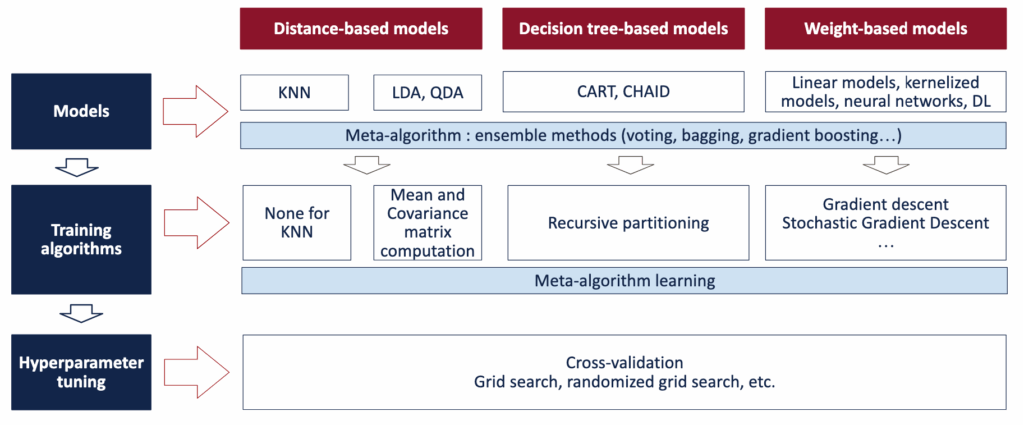 Trois learning steps in Machine Learning - Image by author
Learn this step by step with the interactive Machine Learning roadmap.
Voting: the simplest ensemble idea
The simplest form of ensemble learning is voting.
The idea is almost trivial: train several models, take their predictions, and compute the average. If one model is wrong in one direction and another is wrong in the opposite direction, the errors should cancel out. At least, that is the intuition.
On paper, this sounds reasonable. In practice, things are very different.
As soon as you try voting on real models, one fact becomes obvious: voting is not magic. Simply averaging predictions does not guarantee better performance. In many cases, it actually makes things worse.
The reason is simple. When you combine models that behave very differently, you also combine their weaknesses. If the models do not make complementary errors, averaging can dilute useful structure instead of reinforcing it.
To see this clearly, consider a very simple example. Take a decision tree and a linear regression trained on the same dataset. The decision tree captures local, non-linear patterns. The linear regression captures a global linear trend. When you average their predictions, you do not obtain a better model. You obtain a compromise that is often worse than each model taken individually.
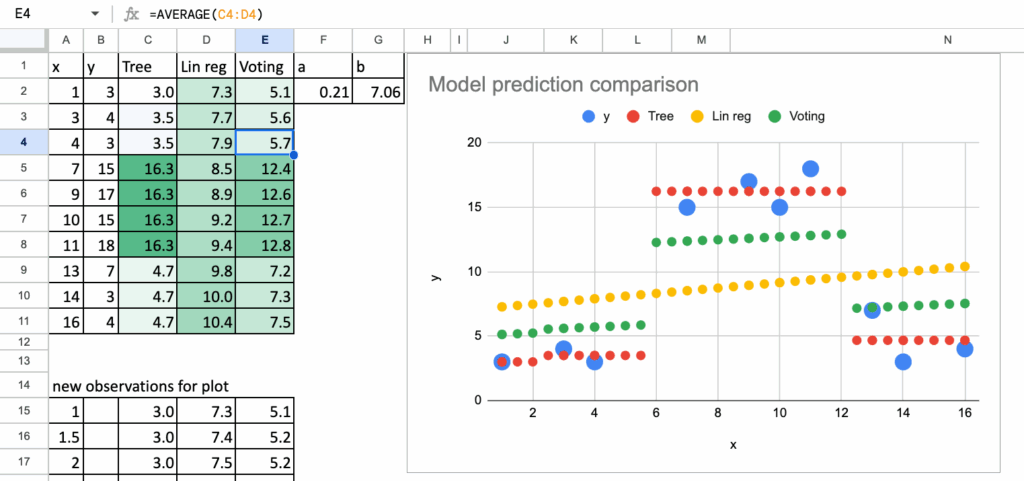 Voting machine learning - all images by author
This illustrates an important point: ensemble learning requires more than averaging. It requires a strategy. A way to combine models that actually improves stability or generalization.
Moreover, if we consider the ensemble as a single model, then it must be trained as such. Simple averaging offers no parameter to adjust. There is nothing to learn, nothing to optimize.
One possible improvement to voting is to assign different weights to the models. Instead of giving each model the same importance, we could try to learn which ones should matter more. But as soon as we introduce weights, a new question appears: how do we train them? At that point, the ensemble itself becomes a model that needs to be fitted.
This observation leads naturally to more structured ensemble methods.
In this article, we begin with one statistical approach to resample the training dataset before averaging: Bagging.
The intuition behind Bagging
Why "bagging"?
What is bagging?
The answer is actually hidden in the name itself.
Bagging = Bootstrap + Aggregating.
You can immediately tell that a mathematician or a statistician named it. :)
Behind this slightly intimidating word, the idea is extremely simple. Bagging is about doing two things: first, creating many versions of the dataset using the bootstrap, and second, aggregating the results obtained from these datasets.
The core idea is therefore not about changing the model. It is about changing the data.
Bootstrapping the dataset
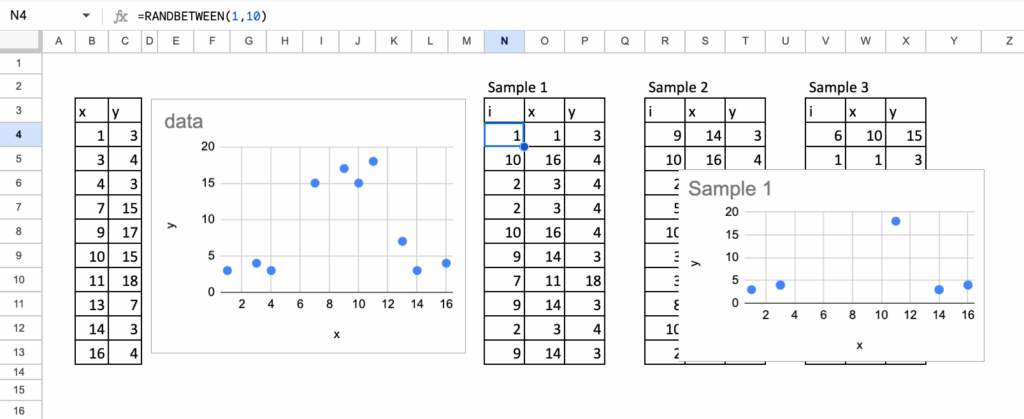
Bootstrapping means sampling the dataset with replacement. Each bootstrap sample has the same size as the original dataset, but not the same observations. Some rows appear several times. Others disappear.
In Excel, this is very easy to implement and, more importantly, very easy to see.
You start by adding an ID column to your dataset, one unique identifier per row. Then, using the RANDBETWEEN function, you randomly draw row indices. Each draw corresponds to one row in the bootstrap sample. By repeating this process, you generate a full dataset that looks familiar, but is slightly different from the original one.
This step alone already makes the idea of bagging concrete. You can literally see the duplicates. You can see which observations are missing. Nothing is abstract.
Below, you can see examples of bootstrap samples generated from the same original dataset. Each sample tells a slightly different story, even though all of them come from the same data.
These alternative datasets are the foundation of bagging.
 Dataset generated by author - image by author
Bagging linear regression: understanding the principle
Bagging process
Yes, this is probably the first time you hear about bagging linear regression.
In theory, there is nothing wrong with it. As we said earlier, bagging is an ensemble method that can be applied to any base model. Linear regression is a model, so technically, it qualifies.
In practice, however, you will quickly see that this is not very useful.
But nothing prevents us from doing it. And precisely because it is not very useful, it makes for an excellent learning example. So let us do it.
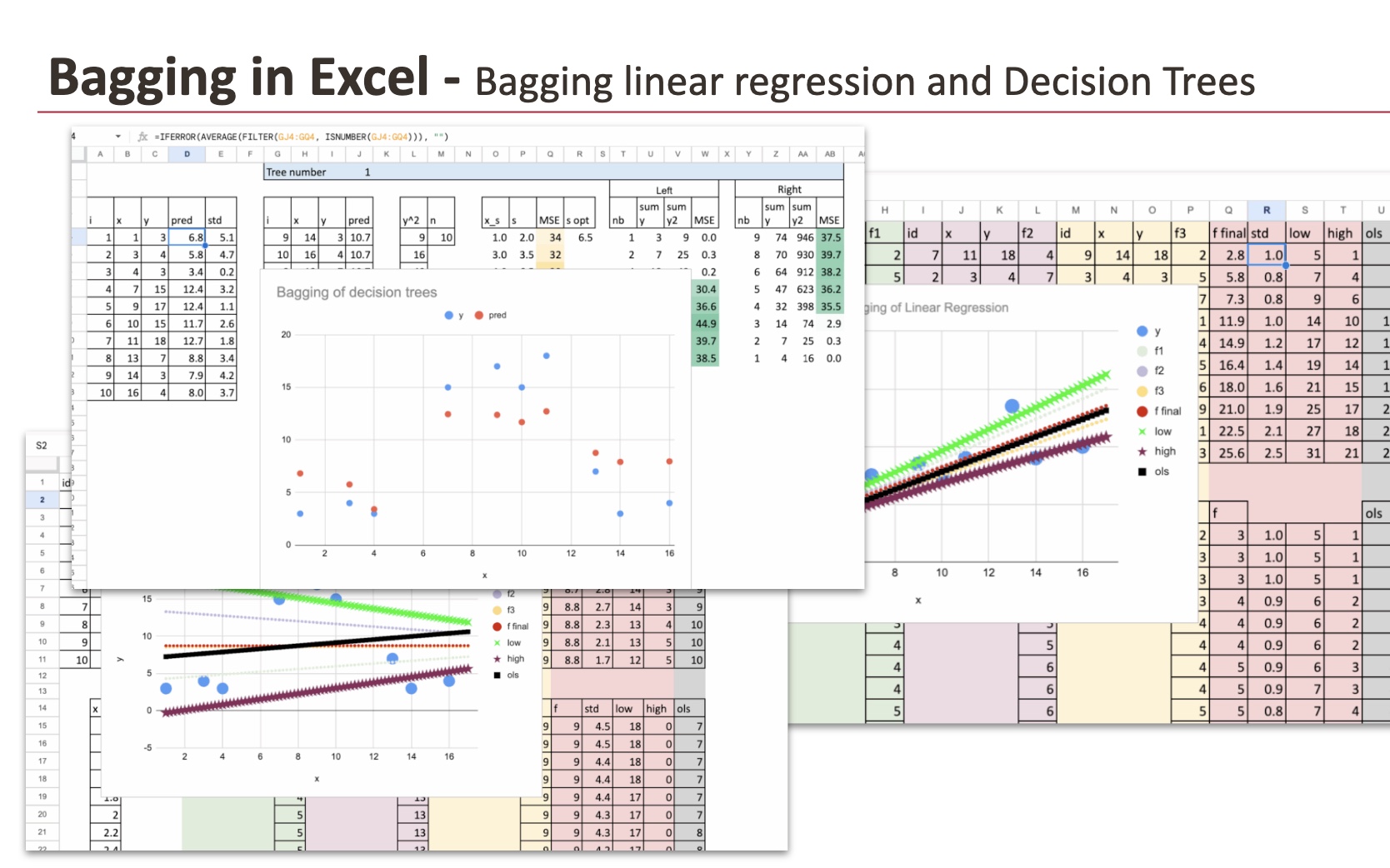
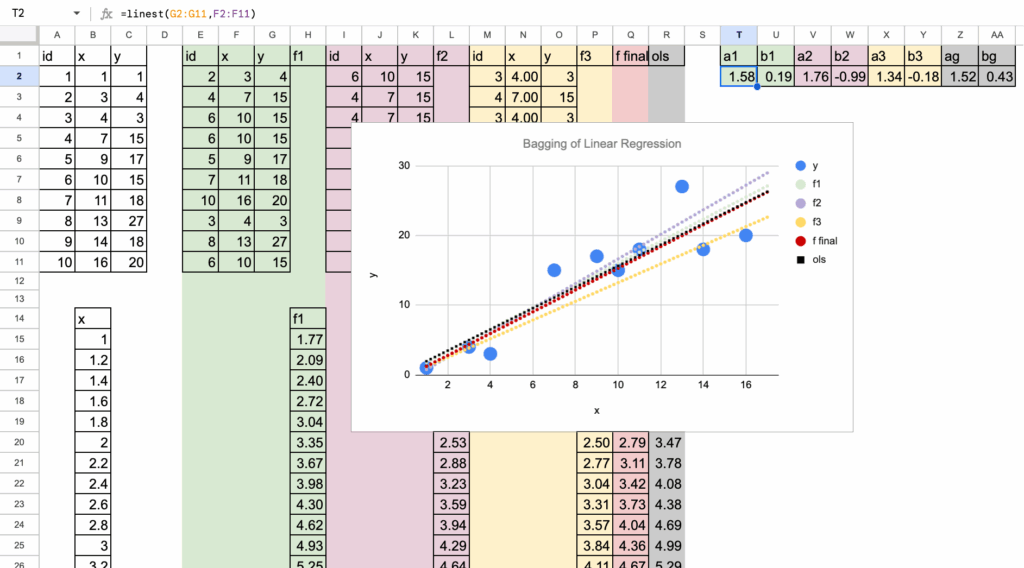
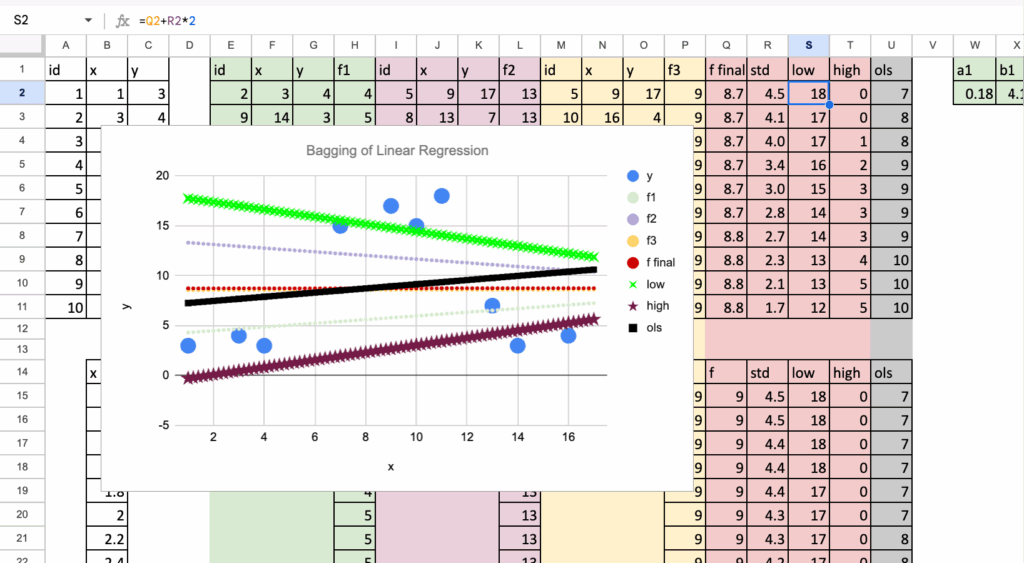
For each bootstrap sample, we fit a linear regression. In Excel, this is straightforward. We can directly use the LINEST function to estimate the coefficients. Each color in the plot corresponds to one bootstrap sample and its associated regression line.
So far, everything behaves exactly as expected. The lines are close to each other, but not identical. Each bootstrap sample slightly changes the coefficients, and therefore the fitted line.
 Bagging of linear regression - image by author
Now comes the key observation.
You may notice that one additional model is plotted in black. This one corresponds to the standard linear regression fitted on the original dataset , without bootstrapping.
What happens when we compare it to the bagged models?
When we average the predictions of all these linear regressions, the final result is still a linear regression. The shape of the prediction does not change. The relationship between the variables remains linear. We did not create a more expressive model.
And more importantly, the bagged model ends up being very close to the standard linear regression trained on the original data.
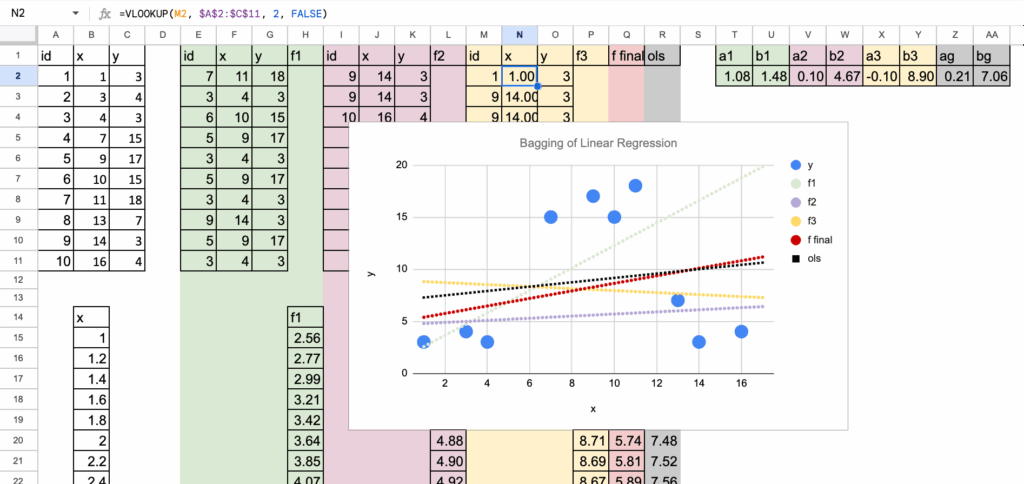
We can even push the example further by using a dataset with a clearly non-linear structure. In this case, each linear regression fitted on a bootstrap sample struggles in its own way. Some lines tilt slightly upward, others downward, depending on which observations were duplicated or missing in the sample.
 Bagging of linear regression - image by author
Bootstrap confidence intervals
From a prediction performance point of view, bagging linear regression is not very useful.
However, bootstrapping remains extremely useful for one important statistical notion : estimating the confidence interval of the predictions.
Instead of looking only at the average prediction, we can look at the distribution of predictions produced by all the bootstrapped models. For each input value, we now have many predicted values, one from each bootstrap sample.
You can use NO_BLACKBOX when completing the purchase.
A simple and intuitive way to quantify uncertainty is to compute the standard deviation of these predictions. This standard deviation tells us how sensitive the prediction is to changes in the data. A small value means the prediction is stable. A large value means it is uncertain.
This idea works naturally in Excel. Once you have all the predictions from the bootstrapped models, computing their standard deviation is straightforward. The result can be interpreted as a confidence band around the prediction.
This is clearly visible in the plot below. The interpretation is straightforward: in regions where the training data is sparse or highly dispersed, the confidence interval becomes wide, as predictions vary significantly across bootstrap samples.
Conversely, where the data is dense, predictions are more stable and the confidence interval narrows.
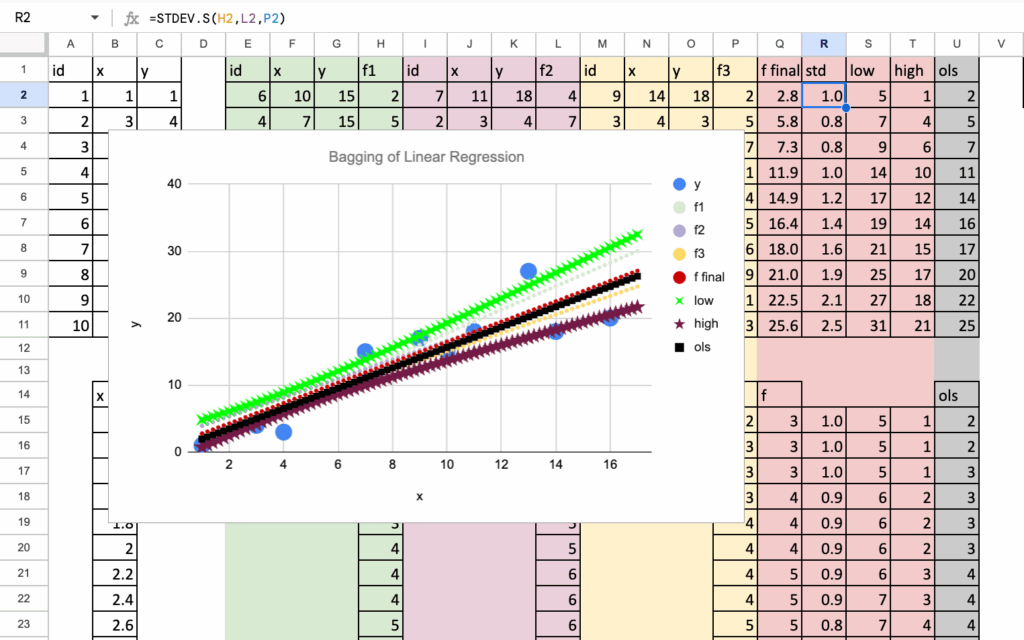 Now, when we apply this to non-linear data, something becomes very clear. In regions where the linear model struggles to fit the data, the predictions from different bootstrap samples spread out much more. The confidence interval becomes wider.
This is an important insight. Even when bagging does not improve prediction accuracy, it provides valuable information about uncertainty. It tells us where the model is reliable and where it is not.
Seeing these confidence intervals emerge directly from bootstrap samples in Excel makes this statistical concept very concrete and intuitive.
Bagging decision trees: from weak learners to a strong model
Now we move to decision trees.
The principle of bagging remains exactly the same. We generate multiple bootstrap samples, train one model on each of them, and then aggregate their predictions.
I improved the Excel implementation to make the splitting process more automatic. To keep things manageable in Excel, we restrict the trees to a single split. Building deeper trees is possible, but it quickly becomes cumbersome in a spreadsheet.
Below, you can see two of the bootstrapped trees. In total, I built eight of them by simply copying and pasting formulas, which makes the process straightforward and easy to reproduce.
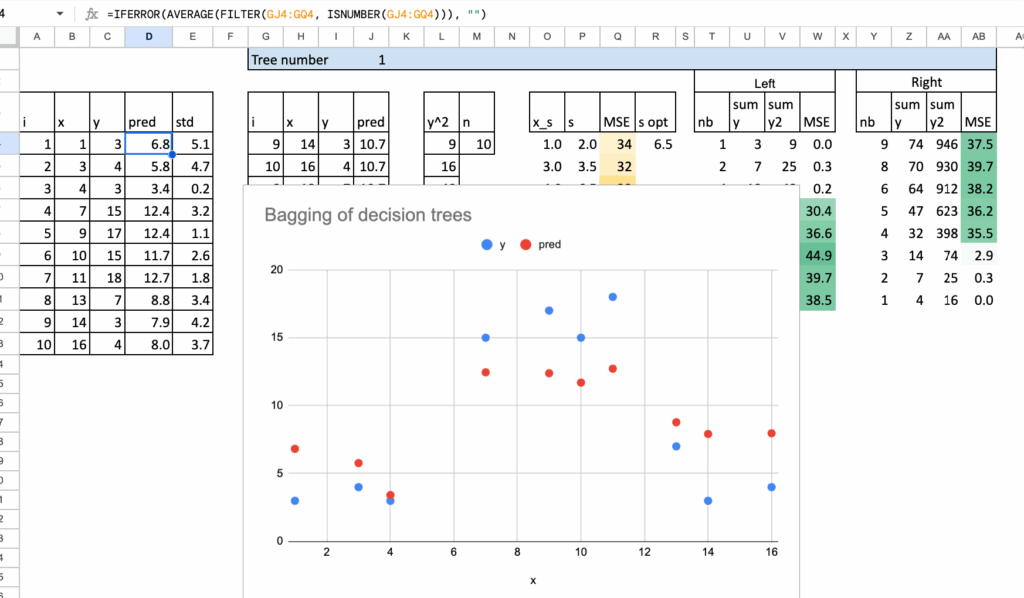
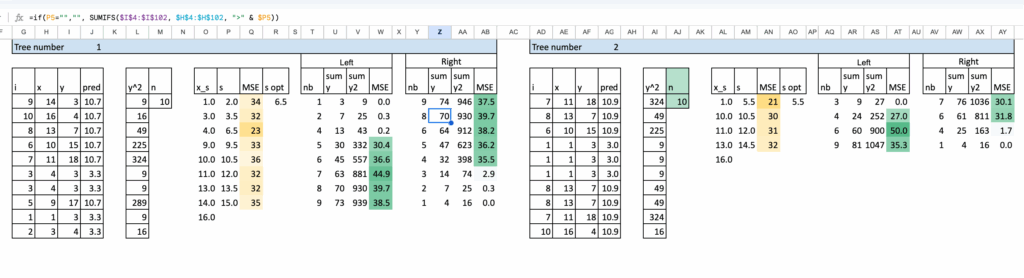 Since decision trees are highly non-linear models and their predictions are piecewise constant, averaging their outputs has a smoothing effect.
As a result, bagging naturally smooths the predictions. Instead of sharp jumps created by individual trees, the aggregated model produces more gradual transitions.
In Excel, this effect is very easy to observe. The bagged predictions are clearly smoother than the predictions of any single tree.
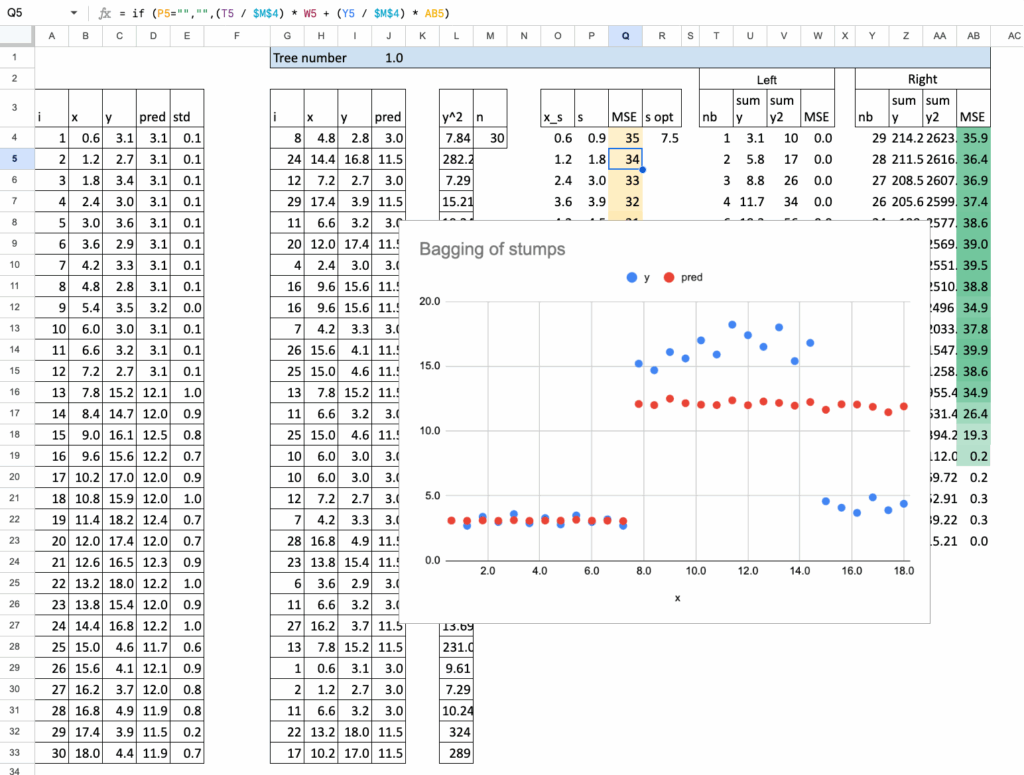
 Some of you may have already heard of decision stumps , which are decision trees with a maximum depth of one. That is exactly what we use here. Each model is extremely simple. On its own, a stump is a weak learner.
The question here is:
is a collection of decision stumps sufficient when combined with bagging?
We will come back to this later in my Machine Learning "Advent Calendar".
And one good way is also to test with a bit more data:
Random Forest: extending bagging
What about Random Forest?
This is probably one of the favorite models among data scientists.
So why not talk about it here, even in Excel?
In fact, what we have just built is already very close to a Random Forest!
To understand why, recall that Random Forest introduces two sources of randomness.
- The first one is the bootstrap of the dataset. This is exactly what we have already done with bagging.
- The second one is randomness in the splitting process. At each split, only a random subset of features is considered.
In our case, however, we only have one feature. That means there is nothing to select from. Feature randomness simply does not apply.
As a result, what we obtain here can be seen as a simplified Random Forest.
Once this concept is clear, extending the idea to multiple features is just an additional layer of randomness, not a new concept.
And you may even ask, we can apply this principle to Linear Regression, and do a Random
Conclusion
Ensemble learning is less about complex models and more about managing instability.
Simple voting is rarely effective. Bagging linear regression changes little and remains mostly pedagogical, though it is useful for estimating uncertainty. With decision trees, however, bagging truly matters: averaging unstable models leads to smoother and more robust predictions.
Random Forest naturally extends this idea by adding extra randomness, without changing the core principle. Seen in Excel, ensemble methods stop being black boxes and become a logical next step.
···
All the Excel files are available through this Kofi link. Your support means a lot to me. The price will increase during the month, so early supporters get the best value.
 All Excel/Google sheet files for ML and DL
Register Now to Continue Reading
Unlock Towards Data Science with a Free Account
All articles on Towards Data Science are available to registered users. Create a free account today to access this article and thousands more.
Register for freeSign in to your account
 Written By
See all from Angela and Kezhan Shi
Artificial IntelligenceBaggingData ScienceMachine LearningStatistics
Share This Article
Towards Data Science is a community publication. Submit your insights to reach our global audience and earn through the TDS Author Payment Program.
Write for TDS
Related Articles
Machine Learning
"I'm overwhelmed with all the resources available; what should I do?"
Arunn Thevapalan
June 14, 20215 min read
Machine Learning
Open-source library Sweetviz is the way
Pau Labarta Bajo
June 15, 20227 min read
Machine Learning
Your daily dose of data science
TDS Editors
February 18, 20211 min read
Artificial Intelligence
In this article, you will learn about rewriting decision trees using a Differentiable Programming approach, as proposed by the NODE paper...
Saupin Guillaume
May 29, 20237 min read
Machine Learning
A pragmatic look into protecting algorithms and models deployed into real-world federated analysis and learning settings in healthcare.
Bartek Szubstarski
March 20, 20259 min read
Data Science
and we should do it right to produce great quality
Thomas Reinecke
September 20, 20227 min read
Machine Learning
Machine learning algorithms can figure out how to perform important tasks by generalizing from examples. This is often feasible and...
James Le
January 27, 201816 min read
Machine Learning
Practical advice and philosophy on how to become a proficient Data Scientist without formal education
Nicholas Lewis
January 14, 20238 min read
Data Science
DINOv2 is one of the best self-supervised ViT-based DL models for image feature extraction.
Gurami Keretchashvili
June 26, 20238 min read
Your home for data science and AI. The world's leading publication for data science, data analytics, data engineering, machine learning, and artificial intelligence professionals.
Subscribe to Our NewsletterWrite For TDS•About•Advertise•Privacy Policy•Terms of Use
© Insight Media Group, LLC 2026•The New Stack•roadmap.sh•Creator Network
Recommended Articles
Close