保留正文与补采附件。源页面当前未重新核验;具体限制见交付清单。
 We value your privacy
We use cookies to enhance your browsing experience, serve personalised ads or content, and analyse our traffic. By clicking "Accept All", you consent to our use of cookies.
Customise Reject All Accept All
Customise Consent Preferences
 We use cookies to help you navigate efficiently and perform certain functions. You will find detailed information about all cookies under each consent category below.
The cookies that are categorised as "Necessary" are stored on your browser as they are essential for enabling the basic functionalities of the site. ... Show more
NecessaryAlways Active
Necessary cookies are required to enable the basic features of this site, such as providing secure log-in or adjusting your consent preferences. These cookies do not store any personally identifiable data.
-
Cookie
BCTempID
-
Duration
10 minutes
-
Description
No description available.
-
Cookie
__cf_bm
-
Duration
1 hour
-
Description
This cookie, set by Cloudflare, is used to support Cloudflare Bot Management.
-
Cookie
AWSALBCORS
-
Duration
7 days
-
Description
Amazon Web Services set this cookie for load balancing.
-
Cookie
_cfuvid
-
Duration
session
-
Description
Cloudflare sets this cookie to track users across sessions to optimize user experience by maintaining session consistency and providing personalized services
-
Cookie
li_gc
-
Duration
6 months
-
Description
Linkedin set this cookie for storing visitor's consent regarding using cookies for non-essential purposes.
-
Cookie
__hssrc
-
Duration
session
-
Description
This cookie is set by Hubspot whenever it changes the session cookie. The __hssrc cookie set to 1 indicates that the user has restarted the browser, and if the cookie does not exist, it is assumed to be a new session.
-
Cookie
__hssc
-
Duration
1 hour
-
Description
HubSpot sets this cookie to keep track of sessions and to determine if HubSpot should increment the session number and timestamps in the __hstc cookie.
-
Cookie
wpEmojiSettingsSupports
-
Duration
session
-
Description
WordPress sets this cookie when a user interacts with emojis on a WordPress site. It helps determine if the user's browser can display emojis properly.
-
Cookie
BCSessionID
-
Duration
1 year 1 month 4 days
-
Description
Blueconic sets this cookie as a unique identifier for the BlueConic profile.
-
Cookie
_octo
-
Duration
1 year
-
Description
No description available.
-
Cookie
logged_in
-
Duration
1 year
-
Description
No description available.
-
Cookie
__Secure-YEC
-
Duration
past
-
Description
YouTube sets this cookie to stores the user's video player preferences using embedded YouTube video
-
Cookie
__eoi
-
Duration
6 months
-
Description
Description is currently not available.
-
Cookie
AWSALBTGCORS
-
Duration
7 days
-
Description
No description available.
-
Cookie
login-status-p
-
Duration
past
-
Description
Description is currently not available.
-
Cookie
AWSALBTG
-
Duration
7 days
-
Description
No description available.
-
Cookie
csrf_token
-
Duration
session
-
Description
No description available.
-
Cookie
token_v2
-
Duration
1 day
-
Description
Description is currently not available.
-
Cookie
D
-
Duration
1 year
-
Description
Description is currently not available.
-
Cookie
PHPSESSID
-
Duration
session
-
Description
This cookie is native to PHP applications. The cookie stores and identifies a user's unique session ID to manage user sessions on the website. The cookie is a session cookie and will be deleted when all the browser windows are closed.
-
Cookie
VISITOR_PRIVACY_METADATA
-
Duration
6 months
-
Description
YouTube sets this cookie to store the user's cookie consent state for the current domain.
-
Cookie
cookietest
-
Duration
session
-
Description
The cookietest cookie is typically used to determine whether the user's browser accepts cookies, essential for website functionality and user experience.
-
Cookie
__Host-airtable-session
-
Duration
1 year
-
Description
This cookie is used to enable us to integrate the services of Airtable.
-
Cookie
__Host-airtable-session.sig
-
Duration
1 year
-
Description
This cookie is used to enable us to integrate the services of Airtable.
-
Cookie
m
-
Duration
1 year 1 month 4 days
-
Description
Stripe sets this cookie for fraud prevention purposes. It identifies the device used to access the website, allowing the website to be formatted accordingly.
-
Cookie
BIGipServer*
-
Duration
session
-
Description
Marketo sets this cookie to collect information about the user's online activity and build a profile about their interests to provide advertisements relevant to the user.
-
Cookie
__cfruid
-
Duration
session
-
Description
Cloudflare sets this cookie to identify trusted web traffic.
-
Cookie
_GRECAPTCHA
-
Duration
6 months
-
Description
Google Recaptcha service sets this cookie to identify bots to protect the website against malicious spam attacks.
-
Cookie
__Secure-YNID
-
Duration
6 months
-
Description
Google cookie used to protect user security and prevent fraud, especially during the login process.
-
Cookie
cookieyes-consent
-
Duration
1 year
-
Description
CookieYes sets this cookie to remember users' consent preferences so that their preferences are respected on subsequent visits to this site. It does not collect or store any personal information about the site visitors.
Functional
Functional cookies help perform certain functionalities like sharing the content of the website on social media platforms, collecting feedback, and other third-party features.
-
Cookie
lidc
-
Duration
1 day
-
Description
LinkedIn sets the lidc cookie to facilitate data center selection.
-
Cookie
brw
-
Duration
1 year
-
Description
No description available.
-
Cookie
brwConsent
-
Duration
5 minutes
-
Description
Description is currently not available.
-
Cookie
WMF-Uniq
-
Duration
1 year
-
Description
Description is currently not available.
-
Cookie
loom_anon_comment
-
Duration
1 year
-
Description
No description available.
-
Cookie
loom_referral_video
-
Duration
session
-
Description
Description is currently not available.
-
Cookie
VISITOR_INFO1_LIVE
-
Duration
6 months
-
Description
A cookie set by YouTube to measure bandwidth that determines whether the user gets the new or old player interface.
-
Cookie
yt-remote-connected-devices
-
Duration
Never Expires
-
Description
YouTube sets this cookie to store the user's video preferences using embedded YouTube videos.
-
Cookie
ytidb::LAST_RESULT_ENTRY_KEY
-
Duration
Never Expires
-
Description
The cookie ytidb::LAST_RESULT_ENTRY_KEY is used by YouTube to store the last search result entry that was clicked by the user. This information is used to improve the user experience by providing more relevant search results in the future.
-
Cookie
yt-remote-device-id
-
Duration
Never Expires
-
Description
YouTube sets this cookie to store the user's video preferences using embedded YouTube videos.
-
Cookie
yt-remote-session-name
-
Duration
session
-
Description
The yt-remote-session-name cookie is used by YouTube to store the user's video player preferences using embedded YouTube video.
-
Cookie
yt-remote-fast-check-period
-
Duration
session
-
Description
The yt-remote-fast-check-period cookie is used by YouTube to store the user's video player preferences for embedded YouTube videos.
-
Cookie
yt-remote-session-app
-
Duration
session
-
Description
The yt-remote-session-app cookie is used by YouTube to store user preferences and information about the interface of the embedded YouTube video player.
-
Cookie
yt-remote-cast-available
-
Duration
session
-
Description
The yt-remote-cast-available cookie is used to store the user's preferences regarding whether casting is available on their YouTube video player.
-
Cookie
yt-remote-cast-installed
-
Duration
session
-
Description
The yt-remote-cast-installed cookie is used to store the user's video player preferences using embedded YouTube video.
-
Cookie
cp_session
-
Duration
3 months
-
Description
Codepen sets this cookie for Help systems found in the website.
-
Cookie
loid
-
Duration
1 year 1 month 4 days
-
Description
This cookie is set by the Reddit. The cookie enables the sharing of content from the website onto the social media platform.
Analytics
Analytical cookies are used to understand how visitors interact with the website. These cookies help provide information on metrics such as the number of visitors, bounce rate, traffic source, etc.
-
Cookie
__hstc
-
Duration
6 months
-
Description
Hubspot set this main cookie for tracking visitors. It contains the domain, initial timestamp (first visit), last timestamp (last visit), current timestamp (this visit), and session number (increments for each subsequent session).
-
Cookie
hubspotutk
-
Duration
6 months
-
Description
HubSpot sets this cookie to keep track of the visitors to the website. This cookie is passed to HubSpot on form submission and used when deduplicating contacts.
-
Cookie
_ga
-
Duration
1 year 1 month 4 days
-
Description
Google Analytics sets this cookie to calculate visitor, session and campaign data and track site usage for the site's analytics report. The cookie stores information anonymously and assigns a randomly generated number to recognise unique visitors.
-
Cookie
ga*
-
Duration
1 year 1 month 4 days
-
Description
Google Analytics sets this cookie to store and count page views.
-
Cookie
__Host-psifi.analyticsTrace
-
Duration
6 hours
-
Description
Description is currently not available.
-
Cookie
__Host-psifi.analyticsTraceV2
-
Duration
6 hours
-
Description
Description is currently not available.
-
Cookie
_gh_sess
-
Duration
session
-
Description
GitHub sets this cookie for temporary application and framework state between pages like what step the user is on in a multiple step form.
-
Cookie
YSC
-
Duration
session
-
Description
YSC cookie is set by Youtube and is used to track the views of embedded videos on Youtube pages.
-
Cookie
ajs_anonymous_id
-
Duration
1 year
-
Description
This cookie is set by Segment to count the number of people who visit a certain site by tracking if they have visited before.
-
Cookie
vuid
-
Duration
1 year 1 month 4 days
-
Description
Vimeo installs this cookie to collect tracking information by setting a unique ID to embed videos on the website.
Performance
Performance cookies are used to understand and analyse the key performance indexes of the website which helps in delivering a better user experience for the visitors.
-
Cookie
AWSALB
-
Duration
7 days
-
Description
AWSALB is an application load balancer cookie set by Amazon Web Services to map the session to the target.
-
Cookie
acq
-
Duration
past
-
Description
Description is currently not available.
-
Cookie
acq.sig
-
Duration
past
-
Description
Description is currently not available.
-
Cookie
ptc
-
Duration
2 years
-
Description
No description available.
Advertisement
Advertisement cookies are used to provide visitors with customised advertisements based on the pages you visited previously and to analyse the effectiveness of the ad campaigns.
-
Cookie
muc_ads
-
Duration
1 year 1 month 4 days
-
Description
Twitter sets this cookie to collect user behaviour and interaction data to optimize the website.
-
Cookie
guest_id_marketing
-
Duration
1 year 1 month 4 days
-
Description
Twitter sets this cookie to identify and track the website visitor.
-
Cookie
guest_id_ads
-
Duration
1 year 1 month 4 days
-
Description
Twitter sets this cookie to identify and track the website visitor.
-
Cookie
personalization_id
-
Duration
1 year 1 month 4 days
-
Description
Twitter sets this cookie to integrate and share features for social media and also store information about how the user uses the website, for tracking and targeting.
-
Cookie
guest_id
-
Duration
1 year 1 month 4 days
-
Description
Twitter sets this cookie to identify and track the website visitor. It registers if a user is signed in to the Twitter platform and collects information about ad preferences.
-
Cookie
bcookie
-
Duration
1 year
-
Description
LinkedIn sets this cookie from LinkedIn share buttons and ad tags to recognize browser IDs.
-
Cookie
__Secure-ROLLOUT_TOKEN
-
Duration
6 months
-
Description
YouTube sets this cookie to manage feature rollout and experimentation. It helps Google control which new features or interface changes are shown to users as part of testing and staged rollouts, ensuring consistent experience for a given user during an experiment.
-
Cookie
yt.innertube::nextId
-
Duration
Never Expires
-
Description
YouTube sets this cookie to register a unique ID to store data on what videos from YouTube the user has seen.
-
Cookie
yt.innertube::requests
-
Duration
Never Expires
-
Description
YouTube sets this cookie to register a unique ID to store data on what videos from YouTube the user has seen.
-
Cookie
session_tracker
-
Duration
session
-
Description
This cookie is set by the Reddit. This cookie is used to identify trusted web traffic. It also helps in adverstising on the website.
-
Cookie
edgebucket
-
Duration
session
-
Description
Reddit sets this cookie to save the information about a log-on Reddit user, for the purpose of advertisement recommendations and updating the content.
-
Cookie
did
-
Duration
1 year
-
Description
Arbor sets this cookie to show targeted ads to site visitors.This cookie expires after 2 months or 1 year.
Uncategorised
Other uncategorised cookies are those that are being analysed and have not been classified into a category as yet.
No cookies to display.
Reject All Save My Preferences Accept All
Toggle SearchToggle Mobile Navigation
Publish AI, ML & data-science insights to a global community of data professionals.
Sign inSubmit an Article
LatestEditor's PicksNewsletterShipAI
Write For TDS
LinkedInXToggle Search
Artificial Intelligence
Courage to Learn ML: A Deeper Dive into F1, Recall, Precision, and ROC Curves
F1 Score: Your Key Metric for Imbalanced Data - But Do You Really Know Why?
Amy Ma
December 17, 202312 min read
 We'll use the analogy of sorting laundry to illustrate the core concepts of recall and precision; Photo by Ace Maxwell on Unsplash
Welcome back to our journey with the 'Courage to Learn ML' series. In this session, we're exploring the nuanced world of metrics. Many resources introduce these metrics or delve into their mathematical aspects, yet the logic behind these 'simple' maths can sometimes remain opaque. For those new to this topic, I recommend checking out Shervin's thorough post along with the comprehensive guide from neptune.ai.
In typical data science interview preparations, when addressing how to handle imbalanced data, the go-to metric is often the F1 score, known as the harmonic mean of recall and precision. However, the rationale behind why the F1 score is particularly suitable for such cases is frequently left unexplained. This post is dedicated to unraveling these reasons, helping you understand the choice of specific metrics in various scenarios.
As usual, this post will outline all the questions we're tackling. If you've been pondering these same queries, you're in the right place:
- What exactly are precision and recall, and how can we intuitively understand them?
- Why are precision and recall important, and why do they often seem to conflict with each other? Is it possible to achieve high levels of both?
- What's the F1 score, and why do we calculate it as the harmonic mean of recall and precision?
- Why is the F1 score frequently used for imbalanced data? Is it only useful in these scenarios?
- How does the interpretation of the F1 score change when the positive class is the majority?
- What's the difference between PR and ROC curves, and when should we prefer using one over the other?
With a fundamental understanding of these metrics, our learner approaches the mentor, who is busy doing laundry, with the first question:
Learn this step by step with the interactive AI Engineer, AI and Data Scientist, Computer Science and Machine Learning roadmaps.
I'm working on a game recommendation system. It's designed to suggest video games based on users' preferences and lifestyles. But I've noticed that it mostly recommends popular games, like this year's TGA game - Baldur's Gate, and users are missing out on niche and cult classic games they're searching for. How can I tackle this issue? Should I change my algorithm or maybe use LLM, given its power?
 Photo by Nick Hamze on Unsplash
Let's not rush to the conclusion that you need the most advanced algorithm just yet. Instead, let's explore why your model isn't performing as expected. It seems your model scores well in Precision@k but get a low Recall@k.
To understand this better, let's break down these metrics:
- Percision@k = (# of top k recommendations that are relevant)/(# of items that are recommended). In simple terms, it measures how many of the games your model recommends are actually relevant to the users.
- Recall@k = (# of top k recommendations that are relevant)/(# of all relevant items). This tells us how many of the relevant games actually make it to your top k recommendations.
From this, it seems users often find relevant games in your recommendations, but not all relevant games are making it to your top k list. It's important to note that the items recommended are those your model predicts to be relevant, which can be considered as 'the number of items predicted to be relevant'.
Hold on, are you suggesting I should use both recall and precision to evaluate my model? But aren't recall and precision mainly used for imbalanced data, similar to their harmonic mean, the F1 score?
You've grasped an essential aspect of precision and recall, and you understand why accuracy isn't always reliable. However, your perspective on recall and precision seems a bit limited, and you shouldn't restrict them to just one scenario, handling imbalanced data. Let's dissect this into smaller parts, starting with:
What are precision and recall?
Precision measures the accuracy of the model's positive predictions , calculated as
Precision = # of samples correctly predicted as positive / total # of samples predicted as positive = true positive / (true positive + false positive)
On the other hand, recall assesses how well the model identifies all positive cases , calculated as
recall = # of samples correctly predicted as positive / total # of actual positive samples = true positive / (true positive + false negative)
A quick tip for remembering TP, TN: The first letter (True/False) indicates if your prediction is correct or not, while the second (Positive/Negative) refers to the predicted label. So, true positive means 'correctly predicted as positive,' and false negative is 'incorrectly predicted as negative...it's actually positive!'
The total number of predicted positives is the sum of true positives (TP) and false positives (FP).
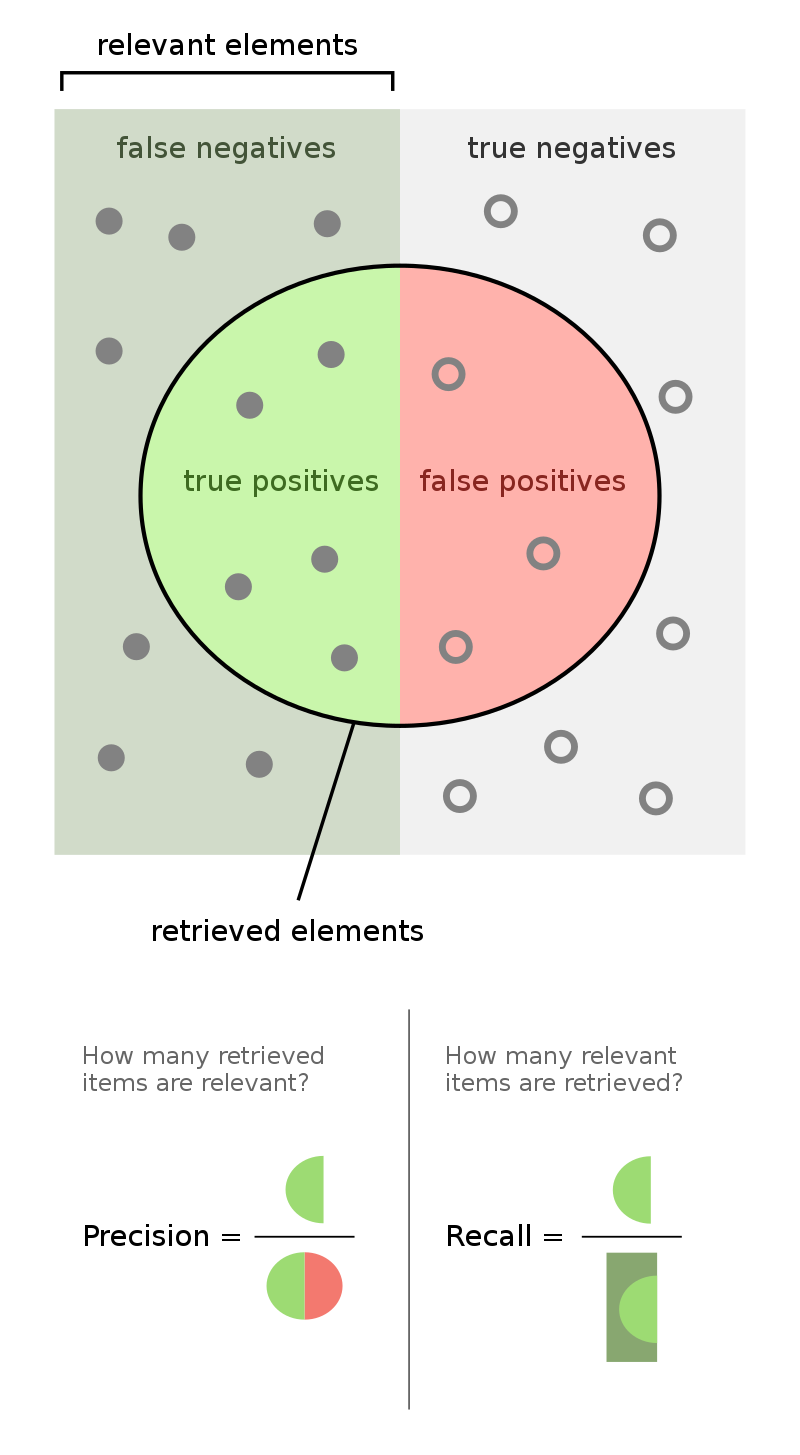 source: https://upload.wikimedia.org/wikipedia/commons/thumb/2/26/Precisionrecall.svg/800px-Precisionrecall.svg.png
Let me offer an intuitive example to understand those two terms: Consider I'm sorting laundry, my aim is to select all the dirty clothes from the pile for washing. In this scenario, precision is about how accurately I can identify a piece of clothing as dirty. Meanwhile, recall measures how many of the actual dirty clothes I can correctly identify
Then, our next question is:
Why do we care about precision and recall, and why do they often seem to conflict? Is it possible to have both high precision and recall?
The importance of precision and recall lies in their complementary nature. Let's use the laundry sorting analogy again. My objectives are twofold: first, to ensure all dirty clothes are picked up, and second, to avoid unnecessary washing. Linking this back to metrics, precision is like my aim to correctly identify dirty clothes and save effort by not washing clean ones. Recall, meanwhile, assesses how well I manage to gather all the dirty clothes.
To clarify, let's look at two extreme scenarios:
- With a focus solely on high precision, I'd be extremely selective, only choosing visibly stained clothes for the wash. This means potentially overlooking less obvious dirt, like a shirt with only a bit of cat hair. Consequently, I'd end up washing only a small portion of the laundry, leaving behind some dirty items (hence, low recall).
- If I prioritize high recall, I'd wash everything without sorting. This ensures all dirty clothes are cleaned but at the expense of washing clean items too (resulting in low precision).
No matter what kind of laundry types you are, you can see the choice of metrics does impact our (the model's ) behaviors. Recall and precision measure different aspects and optimizing both simultaneously is challenging. That's why in classification, we talk about the trade-off between them. They work together to ensure our model accurately predicts while capturing all positive cases.
Next, let's dive into:
What is the F1 score, and why is it calculated as the harmonic mean of recall and precision?
Most data science interview guides suggest handling imbalanced data by using the F1 score, which is the harmonic mean of recall and precision. But often, they don't explain why the F1 score is effective in these situations.
Then, why use the F1 score? In model evaluations, we're concerned with balancing precision and recall - we want correct predictions and comprehensive coverage. Monitoring both metrics separately can be tedious, so a single measure that reflects the balance is preferred. A simple average doesn't reveal much about the balance; a high score could still mask an imbalance. However, the harmonic mean, used in the F1 score, penalizes extreme values more severely. If either recall or precision is low, it significantly lowers the F1 score.
Consider two hypothetical cases to understand why we use the harmonic mean instead of a simple average:
- Scenario A : Precision = 0.9, Recall = 0.1
- Scenario B : Precision = 0.5, Recall = 0.5 (more balanced case)
Simple average calculation :
- Scenario A: (0.9 + 0.1) / 2 = 0.5
- Scenario B: (0.5 + 0.5) / 2 = 0.5
Harmonic mean calculation (F1 Score):
- Scenario A: 2 (0.9 0.1) / (0.9 + 0.1) = 0.18
- Scenario B: 2 (0.5 0.5) / (0.5 + 0.5) = 0.5
While both scenarios have the same average, the simple average hides Scenario A's poor recall. The harmonic mean, on the other hand, provides a more accurate reflection of the balance between precision and recall. A higher F1 score indicates a better balance.
Then... why is the F1 Score often used for imbalanced data, and is its use limited to these scenarios?
Let's explore the challenges of imbalanced data, which is common in binary classification problems. Here, one class often has far fewer samples and represents rare but significant cases (like customer churn or cancer diagnosis). These rare cases usually have higher consequences, and accurately identifying them is crucial. We need a model that not only makes accurate predictions but also effectively identifies these rare cases. This requirement leads us to seek a balance between precision and recall, and the F1 score becomes a handy tool. It provides a single number that reflects this balance, making it a preferred metric in imbalanced datasets. The F1 score's value lies in its ability to accurately portray a model's efficacy in spotting the minority class.
However, the F1 score's usefulness isn't confined to just imbalanced datasets. It's also relevant wherever balancing precision and recall is essential, even in balanced datasets. The F1 score remains a vital metric for balancing precision and recall, and it simplifies model comparisons.
Beyond the F1 score, other metrics are also useful for assessing model performance in cases of imbalanced data.
I've heard that F1, precision, and recall are asymmetric metrics, meaning they depend on which class is labeled as positive. How does the F1 score's interpretation change when the positive class is actually the majority?
Good question. To answer that, let's think about how recall and precision would shift if the majority class is considered positive. Achieving a high recall becomes easier because most samples will be predicted as positive.
But here's the catch: high precision might be misleading in this scenario. With a larger majority class, it's easy to get high precision just by predicting the majority class all the time. By switching the majority class to positive, we lose sight of how the model handles the rare class, especially in imbalanced data situations. So, the balance between precision and recall doesn't guarantee the model's effectiveness anymore since its focus has shifted. This means a model might show a high F1 score even if it's not great at identifying the minority class.
When the positive class forms the majority, a high F1 score might not truly reflect the model's ability to identify the minority class. It could simply mean the model often predicts the majority class.
In such cases, it's wise to include other metrics less biased towards the majority, like the recall of the negative (minority) class, to get a fuller picture of the model's performance.
What are the limitations of the F1 score, and what other metrics can we use to evaluate model performance on imbalanced data?
You know, we often approach classification problems in a regression-like manner. What I mean is, some algorithms predict probabilities, not just classes. For these, you need to set a threshold. But the F1 score doesn't really show how the model performs at different thresholds. That's where ROC curves or precision-recall curves come in, helping us assess performance across various thresholds.
It's quite common that we do classification in regression way. What I mean is some algorithm will predict probabilities instead of the class. for those models, we need to choose a threshold. However, F1 score cannot give us an illustration on model performance related to different threshold. So we can use ROC curve or precision and recall curve to consider the model performance with various threshold. Additionally, the Area Under the Curve (AUC) metric serves as a single-number summary, facilitating comparison between multiple models. The AUC scale ranges from 1, indicating a perfect classifier, to 0, the mark of the poorest classifier. Notably, an AUC of 0.5 signifies performance equivalent to random guessing, where True Positive Rate (TPR) and the False Positive Rate (FPR) are equal at all thresholds.
An interesting question to explore is
How an AUC (Area Under the Curve) value of 0.5 equates to a classifier making random guesses?
When the AUC equals 0.5, the ROC curve is represented by a diagonal line connecting the points (0,0) and (1,1) on the plot. This diagonal line signifies that with this classifier, we have TPR = FPR at all thresholds. In simpler terms, the likelihood of correctly identifying a positive case is exactly the same as the likelihood of incorrectly labeling it as negative. Therefore, for any given positive instance, the classifier has a 50% chance of making a correct prediction, akin to the randomness of a coin flip. This equivalence to chance highlights why an AUC of 0.5 is considered indicative of a model performing no better than random guessing.
When it comes to imbalanced data, we can use precision-recall curve to observe the model's performance on balancing precision and recall under different threshold.
To sum it up, for some scenarios, we'd love the model to balance recall and precision well. That's why we use the F1 score, the harmonic mean of recall and precision, as a single-number metric. But with imbalanced data, where the focus is more on the minority class's performance, the F1 score becomes particularly valuable since achieving balance is tougher. Other handy tools are ROC and PR (Precision-Recall) curves.
So, for your game recommendation system, consider using multiple metrics. This way, you can better evaluate how well the model retrieves relevant items (recall) and ensures those items are indeed relevant (precision). You could evaluate precision@k and recall@k together, calculate f1@k, or draw PR curves.
In practice, it's crucial to select model metrics based on the actual cost of errors , like whether recall matters more than precision to you. Using multiple metrics gives a fuller picture of your model's performance. And remember, the key is to align your metrics with the model's business or application goals.
Before wrapping up this post, there's one more topic I'd like to touch on:
What's the difference between the PR curve and the ROC curve, and when should you choose one over the other?
Most DS interview guides state using the PR curve instead of the ROC curve for imbalanced data, but often don't explain when to opt for the ROC curve. While I won't delve into how to draw these curves here (for that, check out the excellent explanation by StatQuest with Josh Starmer here), let's understand that these curves are drawn by varying the threshold and calculating two metrics (precision and recall for PR, or TPR and FPR for ROC). Both curves represent different balances in binary classification:
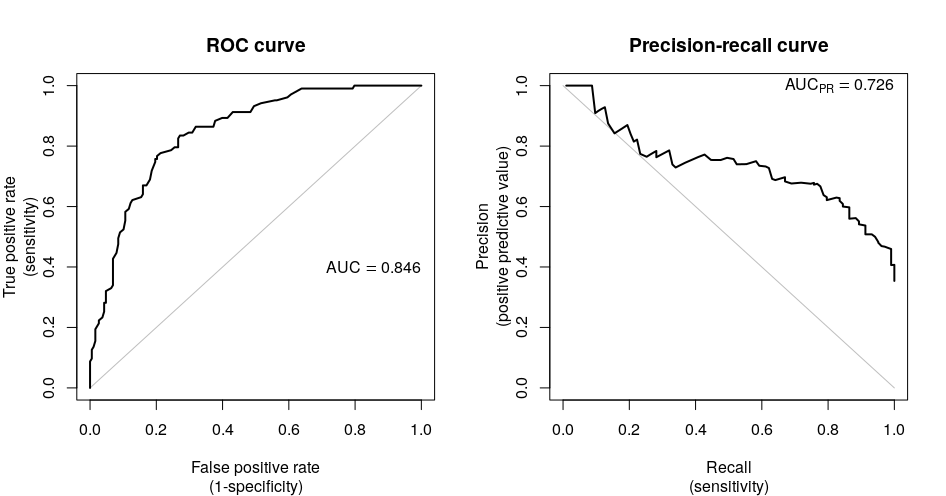 A sample calculation of ROC curve vs. PR curve. source: https://modtools.files.wordpress.com/2020/01/roc_pr-1.png?w=946
The ROC curve focuses on TPR and FPR; the PR curve on precision and recall:
- TPR (Recall) = # of samples correctly predicted as positive / total actual positive samples.
- FPR = # of samples wrongly classified as positive / total actual negative samples.
While precision and recall focus solely on the model's performance for the positive class, TPR and FPR provide a broader view of predictability (correct positives vs. misclassified samples).
ROC curves are less sensitive to data distribution, as FPR uses the size of the negative class. If the negative class is the majority, the FPR value can still remain low, even with lots of negative predictions, due to the larger size of this class. This means ROC is less affected by data imbalance. On the other hand, PR curves, with precision calculated using predicted positives, are more sensitive to the positive class.
What does this imply? It means when comparing model performance across different datasets, ROC curves offer more stability than PR curves and can better reflect a model's performance. So, rather than just remembering PR curves as preferable for imbalanced data, it's important to recognize that ROC curves provide a consistent measure less influenced by data distribution.
In our upcoming session, the mentor-learner duo will delve into the common loss functions, exploring cross-entropy through the lenses of information theory and MLE. If you're enjoying this series, remember that your interactions - claps, comments, and follows - do more than just support; they're the driving force that keeps this series going and inspires my continued sharing.
Other posts in this series:
If you liked the article, you can find me on LinkedIn, and please don't hesitate to connect or reach out with your questions and suggestions!
Register Now to Continue Reading
Unlock Towards Data Science with a Free Account
All articles on Towards Data Science are available to registered users. Create a free account today to access this article and thousands more.
Register for freeSign in to your account
 Written By
See all from Amy Ma
Artificial IntelligenceCourage To Learn MlData ScienceMachine LearningTechnology
Share This Article
Towards Data Science is a community publication. Submit your insights to reach our global audience and earn through the TDS Author Payment Program.
Write for TDS
Related Articles
Artificial Intelligence
Everything in data science starts from data
Soner Yıldırım
July 15, 20215 min read
Machine Learning
How to leverage this powerhouse NoSQL database for online inference
Avi Chad-Friedman
February 7, 20235 min read
Data Science
An attempt at an "unbiased" perspective from a tidyverse fanboy
Lathan Liou
January 16, 20216 min read
Data Science
Handle very many pipelined web, database, and micro-service requests concurrently and efficiently
Dewald Abrie
November 11, 20204 min read
Artificial Intelligence
We Implement a Blackjack Simulator in Python to Better Understand the Risks of Going to Vegas
Tony Yiu
September 22, 201915 min read
Machine Learning
A step-by-step guide in understanding the concept of dependence and how to apply it to validate directed acyclic graphs in causal inference
Graham Harrison
November 11, 202316 min read
Machine Learning
A simple and intuitive way to create synthetic (artificial) time-series data with customized anomalies - suited to industrial applications.
Tirthajyoti Sarkar
August 9, 20217 min read
Machine Learning
Understanding the foundational distortion of digital audio from first principles, with worked examples and visual intuition
Aman Agrawal
February 25, 202618 min read
Machine Learning
Building Chatbots with Rasa - part II
Aniruddha Karajgi
October 4, 20217 min read
Your home for data science and AI. The world's leading publication for data science, data analytics, data engineering, machine learning, and artificial intelligence professionals.
Subscribe to Our NewsletterWrite For TDS•About•Advertise•Privacy Policy•Terms of Use
© Insight Media Group, LLC 2026•The New Stack•roadmap.sh•Creator Network