保留正文与补采附件。源页面当前未重新核验;具体限制见交付清单。
 We value your privacy
We use cookies to enhance your browsing experience, serve personalised ads or content, and analyse our traffic. By clicking "Accept All", you consent to our use of cookies.
Customise Reject All Accept All
Customise Consent Preferences
 We use cookies to help you navigate efficiently and perform certain functions. You will find detailed information about all cookies under each consent category below.
The cookies that are categorised as "Necessary" are stored on your browser as they are essential for enabling the basic functionalities of the site. ... Show more
NecessaryAlways Active
Necessary cookies are required to enable the basic features of this site, such as providing secure log-in or adjusting your consent preferences. These cookies do not store any personally identifiable data.
-
Cookie
BCTempID
-
Duration
10 minutes
-
Description
No description available.
-
Cookie
__cf_bm
-
Duration
1 hour
-
Description
This cookie, set by Cloudflare, is used to support Cloudflare Bot Management.
-
Cookie
AWSALBCORS
-
Duration
7 days
-
Description
Amazon Web Services set this cookie for load balancing.
-
Cookie
_cfuvid
-
Duration
session
-
Description
Cloudflare sets this cookie to track users across sessions to optimize user experience by maintaining session consistency and providing personalized services
-
Cookie
li_gc
-
Duration
6 months
-
Description
Linkedin set this cookie for storing visitor's consent regarding using cookies for non-essential purposes.
-
Cookie
__hssrc
-
Duration
session
-
Description
This cookie is set by Hubspot whenever it changes the session cookie. The __hssrc cookie set to 1 indicates that the user has restarted the browser, and if the cookie does not exist, it is assumed to be a new session.
-
Cookie
__hssc
-
Duration
1 hour
-
Description
HubSpot sets this cookie to keep track of sessions and to determine if HubSpot should increment the session number and timestamps in the __hstc cookie.
-
Cookie
wpEmojiSettingsSupports
-
Duration
session
-
Description
WordPress sets this cookie when a user interacts with emojis on a WordPress site. It helps determine if the user's browser can display emojis properly.
-
Cookie
BCSessionID
-
Duration
1 year 1 month 4 days
-
Description
Blueconic sets this cookie as a unique identifier for the BlueConic profile.
-
Cookie
_octo
-
Duration
1 year
-
Description
No description available.
-
Cookie
logged_in
-
Duration
1 year
-
Description
No description available.
-
Cookie
__Secure-YEC
-
Duration
past
-
Description
YouTube sets this cookie to stores the user's video player preferences using embedded YouTube video
-
Cookie
__eoi
-
Duration
6 months
-
Description
Description is currently not available.
-
Cookie
AWSALBTGCORS
-
Duration
7 days
-
Description
No description available.
-
Cookie
login-status-p
-
Duration
past
-
Description
Description is currently not available.
-
Cookie
AWSALBTG
-
Duration
7 days
-
Description
No description available.
-
Cookie
csrf_token
-
Duration
session
-
Description
No description available.
-
Cookie
token_v2
-
Duration
1 day
-
Description
Description is currently not available.
-
Cookie
D
-
Duration
1 year
-
Description
Description is currently not available.
-
Cookie
PHPSESSID
-
Duration
session
-
Description
This cookie is native to PHP applications. The cookie stores and identifies a user's unique session ID to manage user sessions on the website. The cookie is a session cookie and will be deleted when all the browser windows are closed.
-
Cookie
VISITOR_PRIVACY_METADATA
-
Duration
6 months
-
Description
YouTube sets this cookie to store the user's cookie consent state for the current domain.
-
Cookie
cookietest
-
Duration
session
-
Description
The cookietest cookie is typically used to determine whether the user's browser accepts cookies, essential for website functionality and user experience.
-
Cookie
__Host-airtable-session
-
Duration
1 year
-
Description
This cookie is used to enable us to integrate the services of Airtable.
-
Cookie
__Host-airtable-session.sig
-
Duration
1 year
-
Description
This cookie is used to enable us to integrate the services of Airtable.
-
Cookie
m
-
Duration
1 year 1 month 4 days
-
Description
Stripe sets this cookie for fraud prevention purposes. It identifies the device used to access the website, allowing the website to be formatted accordingly.
-
Cookie
BIGipServer*
-
Duration
session
-
Description
Marketo sets this cookie to collect information about the user's online activity and build a profile about their interests to provide advertisements relevant to the user.
-
Cookie
__cfruid
-
Duration
session
-
Description
Cloudflare sets this cookie to identify trusted web traffic.
-
Cookie
_GRECAPTCHA
-
Duration
6 months
-
Description
Google Recaptcha service sets this cookie to identify bots to protect the website against malicious spam attacks.
-
Cookie
__Secure-YNID
-
Duration
6 months
-
Description
Google cookie used to protect user security and prevent fraud, especially during the login process.
-
Cookie
cookieyes-consent
-
Duration
1 year
-
Description
CookieYes sets this cookie to remember users' consent preferences so that their preferences are respected on subsequent visits to this site. It does not collect or store any personal information about the site visitors.
Functional
Functional cookies help perform certain functionalities like sharing the content of the website on social media platforms, collecting feedback, and other third-party features.
-
Cookie
lidc
-
Duration
1 day
-
Description
LinkedIn sets the lidc cookie to facilitate data center selection.
-
Cookie
brw
-
Duration
1 year
-
Description
No description available.
-
Cookie
brwConsent
-
Duration
5 minutes
-
Description
Description is currently not available.
-
Cookie
WMF-Uniq
-
Duration
1 year
-
Description
Description is currently not available.
-
Cookie
loom_anon_comment
-
Duration
1 year
-
Description
No description available.
-
Cookie
loom_referral_video
-
Duration
session
-
Description
Description is currently not available.
-
Cookie
VISITOR_INFO1_LIVE
-
Duration
6 months
-
Description
A cookie set by YouTube to measure bandwidth that determines whether the user gets the new or old player interface.
-
Cookie
yt-remote-connected-devices
-
Duration
Never Expires
-
Description
YouTube sets this cookie to store the user's video preferences using embedded YouTube videos.
-
Cookie
ytidb::LAST_RESULT_ENTRY_KEY
-
Duration
Never Expires
-
Description
The cookie ytidb::LAST_RESULT_ENTRY_KEY is used by YouTube to store the last search result entry that was clicked by the user. This information is used to improve the user experience by providing more relevant search results in the future.
-
Cookie
yt-remote-device-id
-
Duration
Never Expires
-
Description
YouTube sets this cookie to store the user's video preferences using embedded YouTube videos.
-
Cookie
yt-remote-session-name
-
Duration
session
-
Description
The yt-remote-session-name cookie is used by YouTube to store the user's video player preferences using embedded YouTube video.
-
Cookie
yt-remote-fast-check-period
-
Duration
session
-
Description
The yt-remote-fast-check-period cookie is used by YouTube to store the user's video player preferences for embedded YouTube videos.
-
Cookie
yt-remote-session-app
-
Duration
session
-
Description
The yt-remote-session-app cookie is used by YouTube to store user preferences and information about the interface of the embedded YouTube video player.
-
Cookie
yt-remote-cast-available
-
Duration
session
-
Description
The yt-remote-cast-available cookie is used to store the user's preferences regarding whether casting is available on their YouTube video player.
-
Cookie
yt-remote-cast-installed
-
Duration
session
-
Description
The yt-remote-cast-installed cookie is used to store the user's video player preferences using embedded YouTube video.
-
Cookie
cp_session
-
Duration
3 months
-
Description
Codepen sets this cookie for Help systems found in the website.
-
Cookie
loid
-
Duration
1 year 1 month 4 days
-
Description
This cookie is set by the Reddit. The cookie enables the sharing of content from the website onto the social media platform.
Analytics
Analytical cookies are used to understand how visitors interact with the website. These cookies help provide information on metrics such as the number of visitors, bounce rate, traffic source, etc.
-
Cookie
__hstc
-
Duration
6 months
-
Description
Hubspot set this main cookie for tracking visitors. It contains the domain, initial timestamp (first visit), last timestamp (last visit), current timestamp (this visit), and session number (increments for each subsequent session).
-
Cookie
hubspotutk
-
Duration
6 months
-
Description
HubSpot sets this cookie to keep track of the visitors to the website. This cookie is passed to HubSpot on form submission and used when deduplicating contacts.
-
Cookie
_ga
-
Duration
1 year 1 month 4 days
-
Description
Google Analytics sets this cookie to calculate visitor, session and campaign data and track site usage for the site's analytics report. The cookie stores information anonymously and assigns a randomly generated number to recognise unique visitors.
-
Cookie
ga*
-
Duration
1 year 1 month 4 days
-
Description
Google Analytics sets this cookie to store and count page views.
-
Cookie
__Host-psifi.analyticsTrace
-
Duration
6 hours
-
Description
Description is currently not available.
-
Cookie
__Host-psifi.analyticsTraceV2
-
Duration
6 hours
-
Description
Description is currently not available.
-
Cookie
_gh_sess
-
Duration
session
-
Description
GitHub sets this cookie for temporary application and framework state between pages like what step the user is on in a multiple step form.
-
Cookie
YSC
-
Duration
session
-
Description
YSC cookie is set by Youtube and is used to track the views of embedded videos on Youtube pages.
-
Cookie
ajs_anonymous_id
-
Duration
1 year
-
Description
This cookie is set by Segment to count the number of people who visit a certain site by tracking if they have visited before.
-
Cookie
vuid
-
Duration
1 year 1 month 4 days
-
Description
Vimeo installs this cookie to collect tracking information by setting a unique ID to embed videos on the website.
Performance
Performance cookies are used to understand and analyse the key performance indexes of the website which helps in delivering a better user experience for the visitors.
-
Cookie
AWSALB
-
Duration
7 days
-
Description
AWSALB is an application load balancer cookie set by Amazon Web Services to map the session to the target.
-
Cookie
acq
-
Duration
past
-
Description
Description is currently not available.
-
Cookie
acq.sig
-
Duration
past
-
Description
Description is currently not available.
-
Cookie
ptc
-
Duration
2 years
-
Description
No description available.
Advertisement
Advertisement cookies are used to provide visitors with customised advertisements based on the pages you visited previously and to analyse the effectiveness of the ad campaigns.
-
Cookie
muc_ads
-
Duration
1 year 1 month 4 days
-
Description
Twitter sets this cookie to collect user behaviour and interaction data to optimize the website.
-
Cookie
guest_id_marketing
-
Duration
1 year 1 month 4 days
-
Description
Twitter sets this cookie to identify and track the website visitor.
-
Cookie
guest_id_ads
-
Duration
1 year 1 month 4 days
-
Description
Twitter sets this cookie to identify and track the website visitor.
-
Cookie
personalization_id
-
Duration
1 year 1 month 4 days
-
Description
Twitter sets this cookie to integrate and share features for social media and also store information about how the user uses the website, for tracking and targeting.
-
Cookie
guest_id
-
Duration
1 year 1 month 4 days
-
Description
Twitter sets this cookie to identify and track the website visitor. It registers if a user is signed in to the Twitter platform and collects information about ad preferences.
-
Cookie
bcookie
-
Duration
1 year
-
Description
LinkedIn sets this cookie from LinkedIn share buttons and ad tags to recognize browser IDs.
-
Cookie
__Secure-ROLLOUT_TOKEN
-
Duration
6 months
-
Description
YouTube sets this cookie to manage feature rollout and experimentation. It helps Google control which new features or interface changes are shown to users as part of testing and staged rollouts, ensuring consistent experience for a given user during an experiment.
-
Cookie
yt.innertube::nextId
-
Duration
Never Expires
-
Description
YouTube sets this cookie to register a unique ID to store data on what videos from YouTube the user has seen.
-
Cookie
yt.innertube::requests
-
Duration
Never Expires
-
Description
YouTube sets this cookie to register a unique ID to store data on what videos from YouTube the user has seen.
-
Cookie
session_tracker
-
Duration
session
-
Description
This cookie is set by the Reddit. This cookie is used to identify trusted web traffic. It also helps in adverstising on the website.
-
Cookie
edgebucket
-
Duration
session
-
Description
Reddit sets this cookie to save the information about a log-on Reddit user, for the purpose of advertisement recommendations and updating the content.
-
Cookie
did
-
Duration
1 year
-
Description
Arbor sets this cookie to show targeted ads to site visitors.This cookie expires after 2 months or 1 year.
Uncategorised
Other uncategorised cookies are those that are being analysed and have not been classified into a category as yet.
No cookies to display.
Reject All Save My Preferences Accept All
Toggle SearchToggle Mobile Navigation
Publish AI, ML & data-science insights to a global community of data professionals.
Sign inSubmit an Article
LatestEditor's PicksNewsletterShipAI
Write For TDS
LinkedInXToggle Search
Agentic AI
Most AI Agents Fail in Production Because They’re Built Backwards
Good models don't save bad architecture, and most teams learn that the hard way.
Benjamin Nweke
May 27, 20268 min read
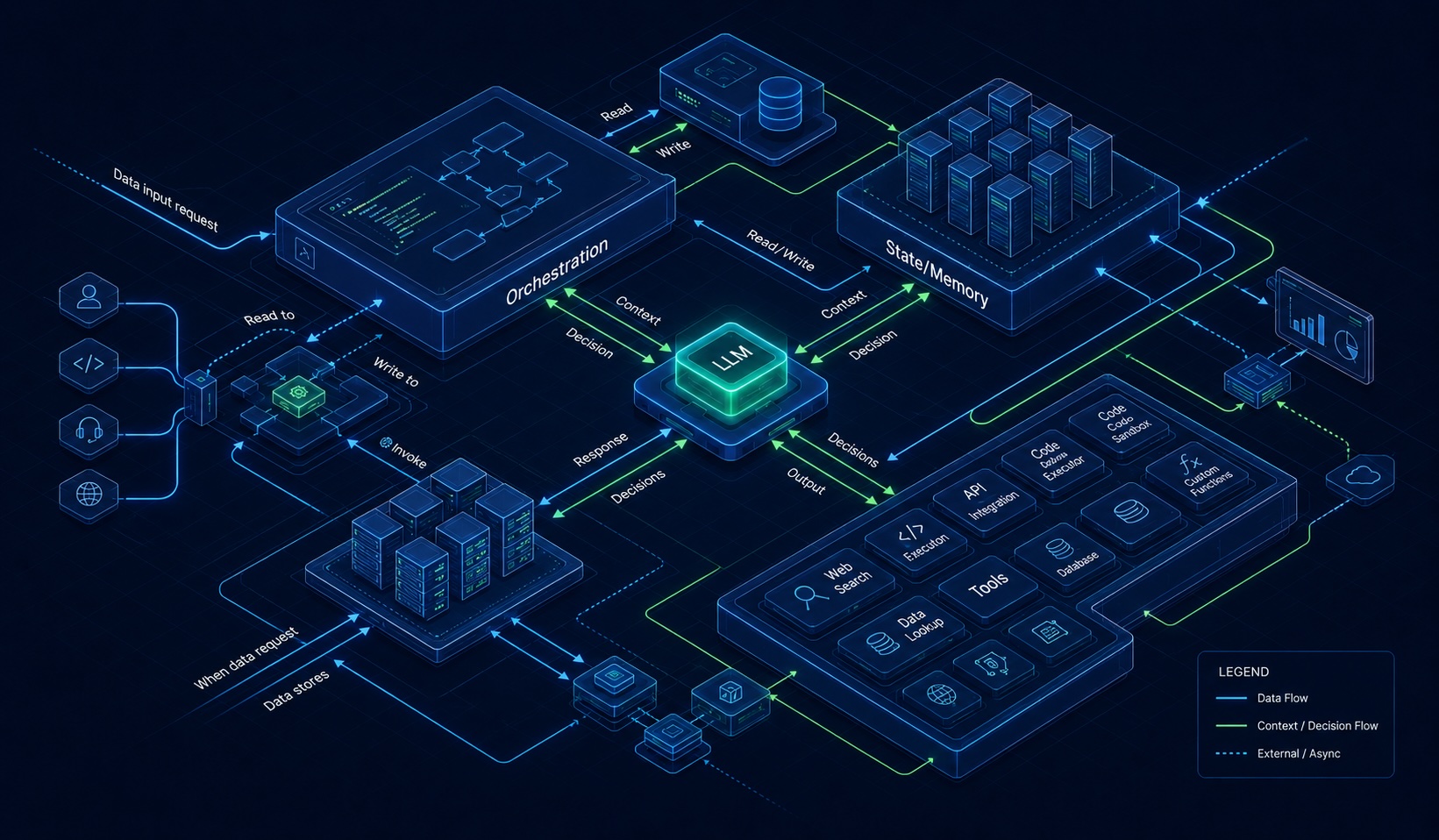 Image by author (Generated with ChatGPT)
The first time I saw a multi-agent system seriously fail in production, it wasn’t dramatic. There was no crash. No error message. The system just kept running and producing outputs that looked reasonable until someone actually read them carefully enough to notice something was off.
When we decided to look into it, it took us two days' worth of debugging to figure out what was going on. Funny enough, the model wasn't hallucinating, and the input-output tools were delivering the correct results.
The problem, when we finally found it, was architectural. The model and the tools were set up correctly, but the idea was that reasoning would tie the whole thing together, which, as you would guess, obviously failed.
Turns out reasoning does not do that sort of thing.
That experience is what I keep coming back to when I think about why so many AI agents that work in demos don't really survive real-world use.
It's not a capability problem.
It's an architectural one.
And if you've read my previous piece here on TDS, Why AI Engineers Are Moving Beyond LangChain to Native Agent Architectures, the pattern should sound familiar: systems built top-down, from goal to tools to model, with the quiet assumption that intelligent behavior fills in the gaps.
That assumption is what "built backwards" means. And it's more common than most teams realize until something breaks.
Learn this step by step with the interactive AI Agents roadmap.
Agents Aren't Entities. They're Systems.
A production AI agent isn't a single intelligent thing.
Rather, there is a set of interacting pieces with different responsibilities, failure modes, and levels of observability.
The LLM is one of those components, not the whole system. Just one piece of it.
It may sound obvious when you say it out loud. But the "autonomous agent" framing that dominated 2023 and most of 2024 kept pulling engineers toward a different mental model: one entity, one reasoning loop, everything handled by the model.
All you need is tools, a good system prompt, and a hope that everything will fall into place.
In contrast, engineers who have shipped real AI-based products rarely describe their systems that way. What they actually describe sounds a lot more like distributed systems architecture.
Not because they read a book about design patterns, but because they got burned enough times that they started putting structure more seriously in their workflow.
Building top-down, starting from "what should this agent do" and working backwards into tools and prompts, is quick to get started.
It's also how you end up with a system where the model is responsible for too much, and nothing is individually debuggable.
The architecture was decided by the goal, not by the engineering requirements.
That's the backwards part.
···
So What Really Goes Into a Production System?
The abstract version is easy to nod along to. Here's what it actually looks like.
Every production AI system I have seen that works cleanly has something like a decision layer , whether the team named it like this or not. It's the part where the model lives and does its actual job.
The instinct is to push everything into this layer: parsing requests, managing memory, handling retries, resolving tool failures.
This is okay if you’re working in a Jupyter notebook. In production, under load, with real users, this becomes the part of your system where everything is everyone's fault, and most times, nothing can be debugged.
The decision layer should do one thing well, and that is deciding what to do next, given a certain context that is already prepared for it.
That's the whole job.
Who prepares the context? Something else. Who acts on the decision? Also something else.
That "something else" is the orchestration layer, and in most well-built systems, it’s genuinely just code: conditionals, asynchronous runners, retry handling, queue routing, maybe even a state machine depending on how involved the workflow is.
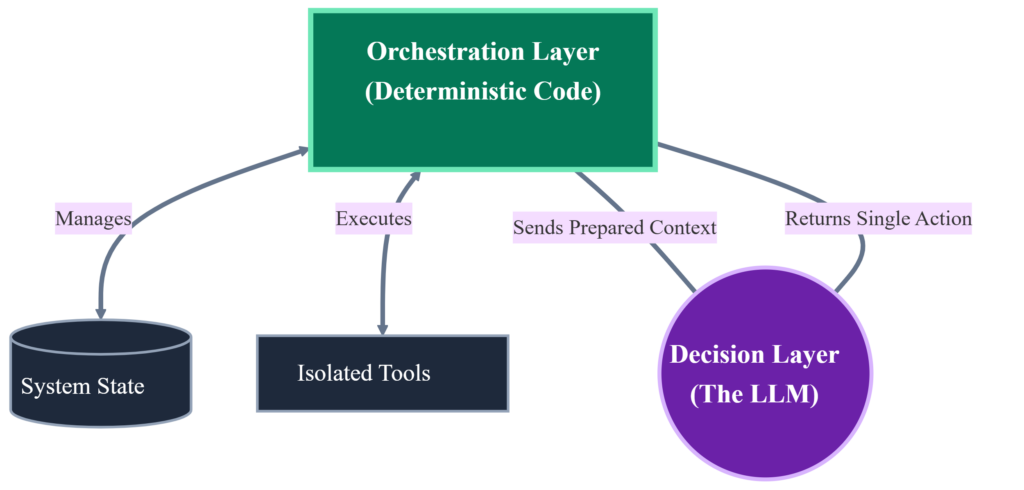 Instead of expecting the model to do everything, treat it like just another component. Here, standard code does the heavy lifting with state and tools, so the LLM only has to worry about making the next decision. Image by author.
Many teams reach for frameworks here because bare orchestration code feels too simple, like surely there's supposed to be more infrastructure.
There usually isn't.
The less magic this layer contains, the faster you'll find bugs when they appear. And they will appear.
From experience, I learned this the hard way on a project where the orchestration lived inside a framework's execution model. Something was retrying tool calls in a way that was corrupting state downstream.
We spent two days finding the issue. Two days for a bug that could have been resolved in no time at all if the retry logic had been three lines of Python I wrote myself.
This leads us to the tools and execution layer, where all communication happens.
Now, the tools and execution layer is where things talk to the outside world. This layer usually has just one job, and that is to take a well-defined input and then produce a predictable output.
But the failure I kept seeing, and kept repeating, honestly, was tools that tried to be helpful by doing more than one thing. A single function that calls an API, updates a cache, and does other things.
In a setup like that, when it breaks, you don't know where. Even when you try to replace the API, you're untangling logic that shouldn't have been tangled in the first place.
Memory and state is where I'd push hardest, because it's where most teams are most underprepared.
Most teams think about memory as "what the model knows." The more important question is what the system knows, and whether that knowledge is current.
I remember one day when it took me an afternoon to debug what seemed to be a simple "model hallucination." The model had kept referring to user preferences, which, however, had been updated twenty minutes ago.
That's not a model problem.
That's a systems problem.
And it's surprisingly common.
In multi-agent systems, specifically, shared state is where subtle failures breed. One agent updates something. The others don't know.
Everyone proceeds confidently in slightly different directions. The output looks almost right, which is almost worse than looking wrong.
And then there's evaluation and observability , which almost everyone always puts off until something goes wrong. I've been guilty of this, too.
The difference I keep in mind is that logging tells you what happened. Observability tells you whether what happened was correct. In a deterministic system, those are close to the same thing.
In an AI system, it’s not. You have to be able to follow the specific request from start to finish, including what information the model had to consider, what decision it made, what external API call it invoked, and how it acted upon its response.
···
Building It the Right Way Around
It starts with the top-down approach: I want an agent to do X, so I'll give it the tools, a nice system prompt, and if the model is smart enough, it will be fine.
And this is exactly what people use to make prototypes, and why wouldn't they? They are not wrong.
But here's the thing: the problem is that it treats the architecture as a consequence of the goal rather than as something you design deliberately.
Then the system grows. You know, more tools, more workflows, more edge cases, more users, and suddenly there’s no real foundation underneath any of it.
Bottom-up is more time-consuming, but it’s far more comfortable.
You start with the basic building blocks and make sure they actually work. Then you figure out what each part should communicate, what data it owns, and what it’s responsible for.
Eventually, the system takes shape naturally from the interaction of its parts.
This isn't a "real engineers build everything from scratch" argument. It's not even about tooling at all, actually. It's about the mental model you're building with.
I've seen engineers use sophisticated frameworks and build clean systems because they understood what each layer needed to do.
I have also seen engineers write vanilla Python and build an undebuggable mess because they were still thinking in terms of "the agent decides everything." The tools follow from the model in your head, not the other way around.
The most robust multi-agent system I have had the opportunity to work with closely had almost no AI-specific infrastructure. When I first saw the repo, I honestly assumed I was looking at the wrong codebase.
A message queue, worker processes with distinct scopes, shared state storage with explicit read/write contracts, and a coordinator making routing decisions.
The language model queries were performed by the workers themselves, each receiving a set of context created upstream by a different process.
All in all, the whole thing was about a thousand lines of Python. I've seen demo agents with more code than that. Every part was traceable.
When something behaved unexpectedly, we'd usually find the problem in under an hour because there was no magic to look through. Just code with a clear path through it.
That system was built bottom-up. The goal was defined, but the architecture wasn't derived from it. Components were designed first, evaluated on their own, and then composed in order to implement the desired functionality. The latter is the most important aspect, not the former.
···
Where I Think This Is Going
As far as I can tell, the direction we’re heading in is slowly shifting away from “agent frameworks” and toward proper infrastructure, with systems for evaluation, model routing, fallbacks, and state management.
At least some of it already exists out there. The majority is yet to come as people solve hard production problems in this space.
The thing I see over and over again is that people building the most reliable systems rarely even use the best models. What they have instead is a clear understanding of everything that happens inside their systems.
The model used by such a system can be GPT-4, but it may as well be a small local model. It matters little when everything else works properly.
We’re moving from treating the model as the product to treating the system as the product. The model matters, but it’s only one component among many.
Most agents don't fail because the model wasn't good enough. They fail because the system around the model was designed backwards, starting from what the agent should do and assuming the architecture would sort itself out.
It doesn't.
Building it the right way around, components first, behavior second, is what separates the systems that hold up from the ones that look impressive until they don't.
···
Before you go!
I write more about the real engineering decisions behind AI systems, where abstractions help, where they hurt, and what it takes to build reliably.
You can subscribe to my newsletter if you'd like more of that.
Connect With Me
Register Now to Continue Reading
Unlock Towards Data Science with a Free Account
All articles on Towards Data Science are available to registered users. Create a free account today to access this article and thousands more.
Register for freeSign in to your account
 Written By
Benjamin Nweke is a Computer Science graduate and technical writer exploring AI, machine learning, and data science. He writes about building reliable AI systems, model evaluation, agentic architectures, and the practical challenges that appear when machine learning moves beyond experiments. His work focuses on making technically complex ideas clear, useful, and grounded in real implementation.
See all from Benjamin Nweke
AI AgentsArtificial IntelligenceData ScienceMachine LearningSoftware Architecture
Share This Article
Towards Data Science is a community publication. Submit your insights to reach our global audience and earn through the TDS Author Payment Program.
Write for TDS
Related Articles
Artificial Intelligence
Forecasting the probability of extreme values with the cumulative distribution function
Vitor Cerqueira
March 8, 20235 min read
Data Science
Enhance your statistic skills with these packages Data Scientists are known for having better programming...
Cornellius Wijaya
May 14, 20217 min read
Agentic AI
Without these, Claude might end up being confidently wrong.
Haden Pelletier
June 14, 20267 min read
Data Science
Learn How to Visualize Time Series Data from Satellite Imagery on a Map Using Folium and Plotly Libraries (Python)
Mahyar Aboutalebi
May 17, 202411 min read
Machine Learning
Using distributed lag models to predict remaining useful life
Koen Peters
October 4, 20200 min read
Artificial Intelligence
How AI algorithms are influenced by our life, nature, and the environment
Baijayanta Roy
June 22, 20218 min read
Agentic AI
How timeouts, truncation, and result sanitization keep Cypher outputs LLM-ready
Tomaz Bratanic
September 7, 20254 min read
Agentic AI
A practical LangChain tutorial for data scientists to inspect CSVs
Sarah Schürch
September 9, 202517 min read
Agentic AI
The true bottleneck was never the analysis.
Mahdi Karabiben
June 11, 20268 min read
Your home for data science and AI. The world's leading publication for data science, data analytics, data engineering, machine learning, and artificial intelligence professionals.
Subscribe to Our NewsletterWrite For TDS•About•Advertise•Privacy Policy•Terms of Use
© Insight Media Group, LLC 2026•The New Stack•roadmap.sh•Creator Network
Recommended Articles
Close