保留正文与补采附件。源页面当前未重新核验;具体限制见交付清单。
 We value your privacy
We use cookies to enhance your browsing experience, serve personalised ads or content, and analyse our traffic. By clicking "Accept All", you consent to our use of cookies.
Customise Reject All Accept All
Customise Consent Preferences
 We use cookies to help you navigate efficiently and perform certain functions. You will find detailed information about all cookies under each consent category below.
The cookies that are categorised as "Necessary" are stored on your browser as they are essential for enabling the basic functionalities of the site. ... Show more
NecessaryAlways Active
Necessary cookies are required to enable the basic features of this site, such as providing secure log-in or adjusting your consent preferences. These cookies do not store any personally identifiable data.
-
Cookie
BCTempID
-
Duration
10 minutes
-
Description
No description available.
-
Cookie
__cf_bm
-
Duration
1 hour
-
Description
This cookie, set by Cloudflare, is used to support Cloudflare Bot Management.
-
Cookie
AWSALBCORS
-
Duration
7 days
-
Description
Amazon Web Services set this cookie for load balancing.
-
Cookie
_cfuvid
-
Duration
session
-
Description
Cloudflare sets this cookie to track users across sessions to optimize user experience by maintaining session consistency and providing personalized services
-
Cookie
li_gc
-
Duration
6 months
-
Description
Linkedin set this cookie for storing visitor's consent regarding using cookies for non-essential purposes.
-
Cookie
__hssrc
-
Duration
session
-
Description
This cookie is set by Hubspot whenever it changes the session cookie. The __hssrc cookie set to 1 indicates that the user has restarted the browser, and if the cookie does not exist, it is assumed to be a new session.
-
Cookie
__hssc
-
Duration
1 hour
-
Description
HubSpot sets this cookie to keep track of sessions and to determine if HubSpot should increment the session number and timestamps in the __hstc cookie.
-
Cookie
wpEmojiSettingsSupports
-
Duration
session
-
Description
WordPress sets this cookie when a user interacts with emojis on a WordPress site. It helps determine if the user's browser can display emojis properly.
-
Cookie
BCSessionID
-
Duration
1 year 1 month 4 days
-
Description
Blueconic sets this cookie as a unique identifier for the BlueConic profile.
-
Cookie
_octo
-
Duration
1 year
-
Description
No description available.
-
Cookie
logged_in
-
Duration
1 year
-
Description
No description available.
-
Cookie
__Secure-YEC
-
Duration
past
-
Description
YouTube sets this cookie to stores the user's video player preferences using embedded YouTube video
-
Cookie
__eoi
-
Duration
6 months
-
Description
Description is currently not available.
-
Cookie
AWSALBTGCORS
-
Duration
7 days
-
Description
No description available.
-
Cookie
login-status-p
-
Duration
past
-
Description
Description is currently not available.
-
Cookie
AWSALBTG
-
Duration
7 days
-
Description
No description available.
-
Cookie
csrf_token
-
Duration
session
-
Description
No description available.
-
Cookie
token_v2
-
Duration
1 day
-
Description
Description is currently not available.
-
Cookie
D
-
Duration
1 year
-
Description
Description is currently not available.
-
Cookie
PHPSESSID
-
Duration
session
-
Description
This cookie is native to PHP applications. The cookie stores and identifies a user's unique session ID to manage user sessions on the website. The cookie is a session cookie and will be deleted when all the browser windows are closed.
-
Cookie
VISITOR_PRIVACY_METADATA
-
Duration
6 months
-
Description
YouTube sets this cookie to store the user's cookie consent state for the current domain.
-
Cookie
cookietest
-
Duration
session
-
Description
The cookietest cookie is typically used to determine whether the user's browser accepts cookies, essential for website functionality and user experience.
-
Cookie
__Host-airtable-session
-
Duration
1 year
-
Description
This cookie is used to enable us to integrate the services of Airtable.
-
Cookie
__Host-airtable-session.sig
-
Duration
1 year
-
Description
This cookie is used to enable us to integrate the services of Airtable.
-
Cookie
m
-
Duration
1 year 1 month 4 days
-
Description
Stripe sets this cookie for fraud prevention purposes. It identifies the device used to access the website, allowing the website to be formatted accordingly.
-
Cookie
BIGipServer*
-
Duration
session
-
Description
Marketo sets this cookie to collect information about the user's online activity and build a profile about their interests to provide advertisements relevant to the user.
-
Cookie
__cfruid
-
Duration
session
-
Description
Cloudflare sets this cookie to identify trusted web traffic.
-
Cookie
_GRECAPTCHA
-
Duration
6 months
-
Description
Google Recaptcha service sets this cookie to identify bots to protect the website against malicious spam attacks.
-
Cookie
__Secure-YNID
-
Duration
6 months
-
Description
Google cookie used to protect user security and prevent fraud, especially during the login process.
-
Cookie
cookieyes-consent
-
Duration
1 year
-
Description
CookieYes sets this cookie to remember users' consent preferences so that their preferences are respected on subsequent visits to this site. It does not collect or store any personal information about the site visitors.
Functional
Functional cookies help perform certain functionalities like sharing the content of the website on social media platforms, collecting feedback, and other third-party features.
-
Cookie
lidc
-
Duration
1 day
-
Description
LinkedIn sets the lidc cookie to facilitate data center selection.
-
Cookie
brw
-
Duration
1 year
-
Description
No description available.
-
Cookie
brwConsent
-
Duration
5 minutes
-
Description
Description is currently not available.
-
Cookie
WMF-Uniq
-
Duration
1 year
-
Description
Description is currently not available.
-
Cookie
loom_anon_comment
-
Duration
1 year
-
Description
No description available.
-
Cookie
loom_referral_video
-
Duration
session
-
Description
Description is currently not available.
-
Cookie
VISITOR_INFO1_LIVE
-
Duration
6 months
-
Description
A cookie set by YouTube to measure bandwidth that determines whether the user gets the new or old player interface.
-
Cookie
yt-remote-connected-devices
-
Duration
Never Expires
-
Description
YouTube sets this cookie to store the user's video preferences using embedded YouTube videos.
-
Cookie
ytidb::LAST_RESULT_ENTRY_KEY
-
Duration
Never Expires
-
Description
The cookie ytidb::LAST_RESULT_ENTRY_KEY is used by YouTube to store the last search result entry that was clicked by the user. This information is used to improve the user experience by providing more relevant search results in the future.
-
Cookie
yt-remote-device-id
-
Duration
Never Expires
-
Description
YouTube sets this cookie to store the user's video preferences using embedded YouTube videos.
-
Cookie
yt-remote-session-name
-
Duration
session
-
Description
The yt-remote-session-name cookie is used by YouTube to store the user's video player preferences using embedded YouTube video.
-
Cookie
yt-remote-fast-check-period
-
Duration
session
-
Description
The yt-remote-fast-check-period cookie is used by YouTube to store the user's video player preferences for embedded YouTube videos.
-
Cookie
yt-remote-session-app
-
Duration
session
-
Description
The yt-remote-session-app cookie is used by YouTube to store user preferences and information about the interface of the embedded YouTube video player.
-
Cookie
yt-remote-cast-available
-
Duration
session
-
Description
The yt-remote-cast-available cookie is used to store the user's preferences regarding whether casting is available on their YouTube video player.
-
Cookie
yt-remote-cast-installed
-
Duration
session
-
Description
The yt-remote-cast-installed cookie is used to store the user's video player preferences using embedded YouTube video.
-
Cookie
cp_session
-
Duration
3 months
-
Description
Codepen sets this cookie for Help systems found in the website.
-
Cookie
loid
-
Duration
1 year 1 month 4 days
-
Description
This cookie is set by the Reddit. The cookie enables the sharing of content from the website onto the social media platform.
Analytics
Analytical cookies are used to understand how visitors interact with the website. These cookies help provide information on metrics such as the number of visitors, bounce rate, traffic source, etc.
-
Cookie
__hstc
-
Duration
6 months
-
Description
Hubspot set this main cookie for tracking visitors. It contains the domain, initial timestamp (first visit), last timestamp (last visit), current timestamp (this visit), and session number (increments for each subsequent session).
-
Cookie
hubspotutk
-
Duration
6 months
-
Description
HubSpot sets this cookie to keep track of the visitors to the website. This cookie is passed to HubSpot on form submission and used when deduplicating contacts.
-
Cookie
_ga
-
Duration
1 year 1 month 4 days
-
Description
Google Analytics sets this cookie to calculate visitor, session and campaign data and track site usage for the site's analytics report. The cookie stores information anonymously and assigns a randomly generated number to recognise unique visitors.
-
Cookie
ga*
-
Duration
1 year 1 month 4 days
-
Description
Google Analytics sets this cookie to store and count page views.
-
Cookie
__Host-psifi.analyticsTrace
-
Duration
6 hours
-
Description
Description is currently not available.
-
Cookie
__Host-psifi.analyticsTraceV2
-
Duration
6 hours
-
Description
Description is currently not available.
-
Cookie
_gh_sess
-
Duration
session
-
Description
GitHub sets this cookie for temporary application and framework state between pages like what step the user is on in a multiple step form.
-
Cookie
YSC
-
Duration
session
-
Description
YSC cookie is set by Youtube and is used to track the views of embedded videos on Youtube pages.
-
Cookie
ajs_anonymous_id
-
Duration
1 year
-
Description
This cookie is set by Segment to count the number of people who visit a certain site by tracking if they have visited before.
-
Cookie
vuid
-
Duration
1 year 1 month 4 days
-
Description
Vimeo installs this cookie to collect tracking information by setting a unique ID to embed videos on the website.
Performance
Performance cookies are used to understand and analyse the key performance indexes of the website which helps in delivering a better user experience for the visitors.
-
Cookie
AWSALB
-
Duration
7 days
-
Description
AWSALB is an application load balancer cookie set by Amazon Web Services to map the session to the target.
-
Cookie
acq
-
Duration
past
-
Description
Description is currently not available.
-
Cookie
acq.sig
-
Duration
past
-
Description
Description is currently not available.
-
Cookie
ptc
-
Duration
2 years
-
Description
No description available.
Advertisement
Advertisement cookies are used to provide visitors with customised advertisements based on the pages you visited previously and to analyse the effectiveness of the ad campaigns.
-
Cookie
muc_ads
-
Duration
1 year 1 month 4 days
-
Description
Twitter sets this cookie to collect user behaviour and interaction data to optimize the website.
-
Cookie
guest_id_marketing
-
Duration
1 year 1 month 4 days
-
Description
Twitter sets this cookie to identify and track the website visitor.
-
Cookie
guest_id_ads
-
Duration
1 year 1 month 4 days
-
Description
Twitter sets this cookie to identify and track the website visitor.
-
Cookie
personalization_id
-
Duration
1 year 1 month 4 days
-
Description
Twitter sets this cookie to integrate and share features for social media and also store information about how the user uses the website, for tracking and targeting.
-
Cookie
guest_id
-
Duration
1 year 1 month 4 days
-
Description
Twitter sets this cookie to identify and track the website visitor. It registers if a user is signed in to the Twitter platform and collects information about ad preferences.
-
Cookie
bcookie
-
Duration
1 year
-
Description
LinkedIn sets this cookie from LinkedIn share buttons and ad tags to recognize browser IDs.
-
Cookie
__Secure-ROLLOUT_TOKEN
-
Duration
6 months
-
Description
YouTube sets this cookie to manage feature rollout and experimentation. It helps Google control which new features or interface changes are shown to users as part of testing and staged rollouts, ensuring consistent experience for a given user during an experiment.
-
Cookie
yt.innertube::nextId
-
Duration
Never Expires
-
Description
YouTube sets this cookie to register a unique ID to store data on what videos from YouTube the user has seen.
-
Cookie
yt.innertube::requests
-
Duration
Never Expires
-
Description
YouTube sets this cookie to register a unique ID to store data on what videos from YouTube the user has seen.
-
Cookie
session_tracker
-
Duration
session
-
Description
This cookie is set by the Reddit. This cookie is used to identify trusted web traffic. It also helps in adverstising on the website.
-
Cookie
edgebucket
-
Duration
session
-
Description
Reddit sets this cookie to save the information about a log-on Reddit user, for the purpose of advertisement recommendations and updating the content.
-
Cookie
did
-
Duration
1 year
-
Description
Arbor sets this cookie to show targeted ads to site visitors.This cookie expires after 2 months or 1 year.
Uncategorised
Other uncategorised cookies are those that are being analysed and have not been classified into a category as yet.
No cookies to display.
Reject All Save My Preferences Accept All
Toggle SearchToggle Mobile Navigation
Publish AI, ML & data-science insights to a global community of data professionals.
Sign inSubmit an Article
LatestEditor's PicksNewsletterShipAI
Write For TDS
LinkedInXToggle Search
Data Science
Platonic Representation: Are AI Deep Network Models Converging?
Are Artificial Intelligence models evolving towards a unified representation of reality? The Platonic Representation Hypothesis says yes!
Hesam Sheikh
May 23, 20248 min read
Are AI Deep Network Models Converging?
Are artificial intelligence models evolving towards a unified representation of reality? The Platonic Representation Hypothesis says ML models are converging.
A recent MIT paper has come to my attention for its impressive claim: AI models are converging, even across different modalities - vision and language. "We argue that representations in AI models, particularly deep networks, are converging " is how The Platonic Representation Hypothesis paper begins.
But how can different models, trained on different datasets and for different use cases converge? What has led to this convergence?
✨This is a paid article. If you're not a Medium member, you can read this for free in my newsletter:Qiubyte .
 Plato's allegory of the cave by Jan Saenredam (public domain).
Learn this step by step with the interactive AI and Data Scientist, AI Engineer and Machine Learning roadmaps.
1. The Platonic Representation Hypothesis
We argue that there is a growing similarity in how datapoints are represented in different neural network models. This similarity spans across different model architectures, training objectives, and even data modalities.
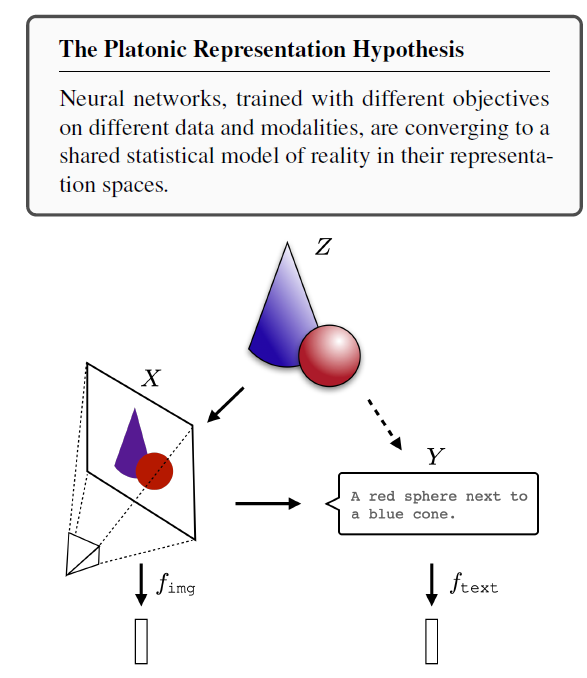 The Platonic Representation Hypothesis. The visual representation, X, and the textual one Y , are both projections of a common reality, Z. (source: Paper)
introduction
The paper's central argument is that models of various origins and modalities are converging to a representation of reality - the joint distribution over the events of the world that generate the data we observe and use to train the models.
The authors argue that this convergence towards a platonic representation is driven by the underlying structure and nature of the data that models are trained on, and by the growing complexity and capability of the models themselves. As models encounter various datasets and wider applications, they require a representation that captures the fundamental properties commonly found in all data types.
 An Illustration of The Allegory of the Cave, from Plato's Republic (art by 4edges, source: Wikipedia)
2. Are AI Models Converging?
AI models of various scales, even built on diverse architecture and trained for different tasks, are showing signs of convergence in how they represent data. As these models grow in size and complexity and the feeding data becomes larger and varied, their methods of processing data begin to align.
Do models trained on different data modalities - vision or text, also converge? The answer could be yes!
2.1 Vision Models that Talk
This alignment spans over visual and textual data - the paper later confirms that the limitations of this theory are that it's focused on these two modularities and not other modalities such as audio, or robotics perception of the world. One of the cases [1] to support this is LLaVA, which shows projecting visual features into language features using a 2-layer MLP, resulting in state-of-the-art results.
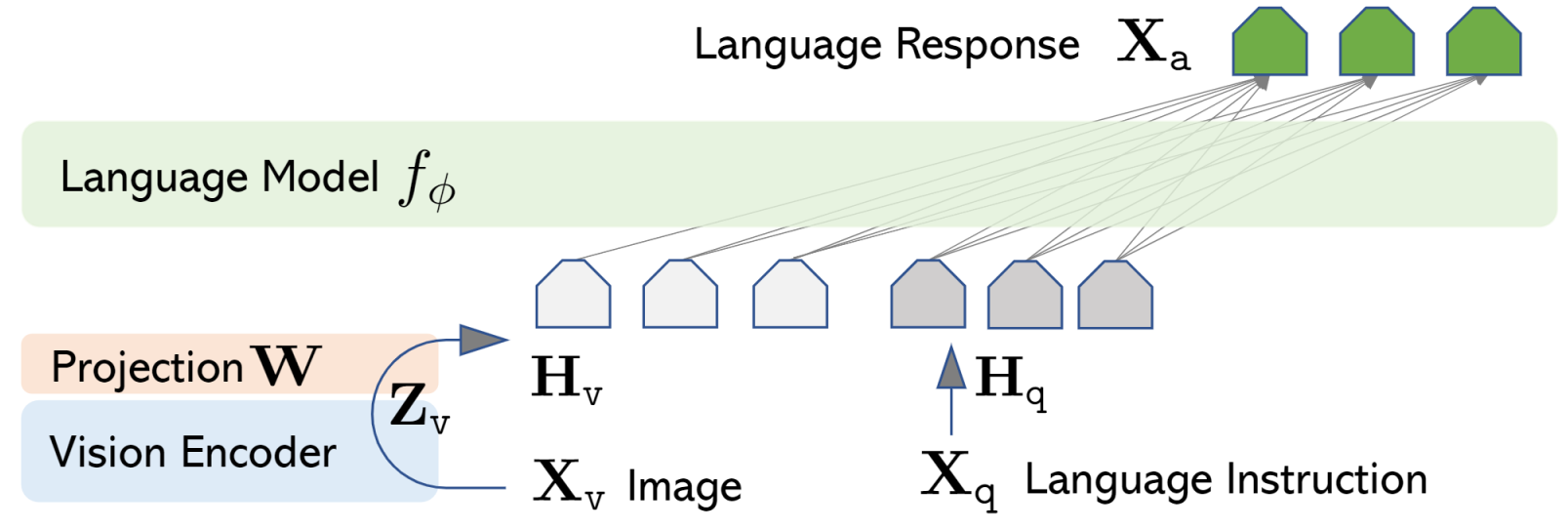 Outline of how LLaVA maps visual features to a Language Model. (source: LLaVA, CC-BY)
2.2 Language Models that See
Another interesting example is A Vision Check-up for Language Models [2] which explores the extent to which large language models understand and process visual data. The study uses code as a bridge between images and text, as a novel approach to feed visual data to LLMs. The paper reveals that LLMs can generate images by code that while may not look realistic, still contain enough visual information to train vision models.
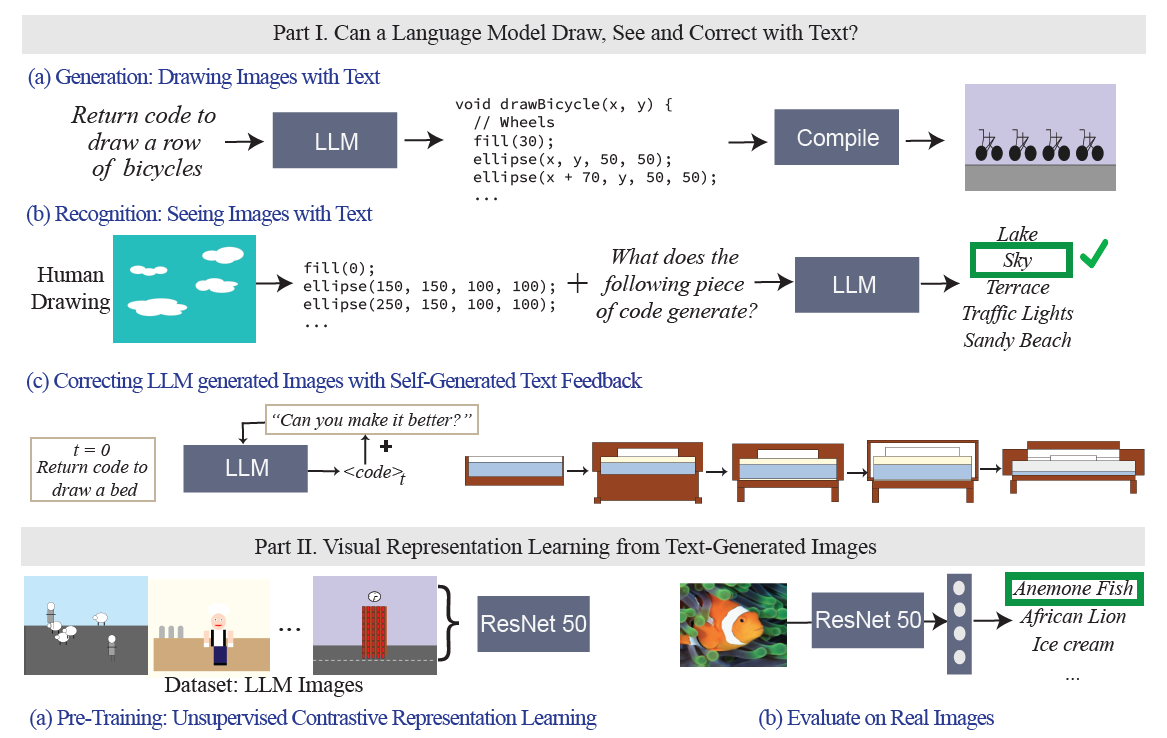 Can a language model see? (source)
2.3 Bigger Models, Bigger Alignment
The alignment of different models is correlated with their scale. As an example, models trained on CIFAR-10 classification that are bigger, show greater alignment with each other, compared to smaller models. This means that with the current trend of building models in the order of 10s and now 100s of billions, these giants will be even more aligned.
"all strong models are alike, each weak model is weak in its own way."
3. Why are AI Models Converging?
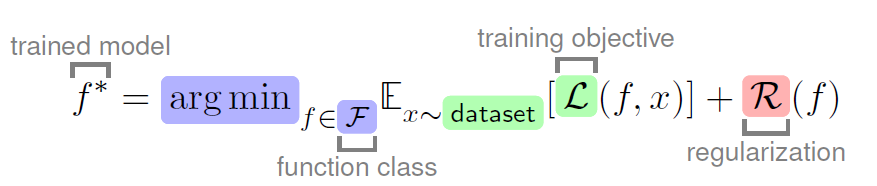 The learning process of an AI model, f ∗ is the trained model, 𝐹 F is the function class, 𝐿 L is the loss function depending on the model 𝑓 f and an input 𝑥 x from the dataset, 𝑅 R represents the regularization function, and 𝐸 E denotes the expectation over the dataset. Each color represents one of the causes of this convergence. (source: Paper)
In training an AI model, there are elements that contribute most to why AI models converge:
3.1 Tasks are Becoming General
As models are trained to solve tasks that are more and more general simultaneously, the size of their solution space becomes smaller and more constrained. More generality means trying to learn data points that are closer to reality.
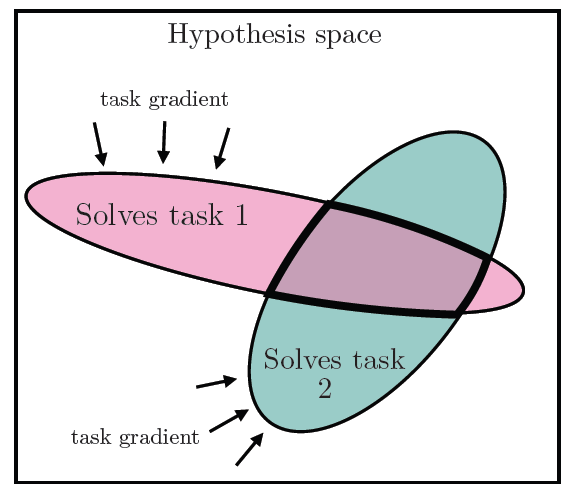 The more tasks a model can solve, it is forced to learn a disjoint representation that is useful in solving all of those tasks. (source: Paper)
The Platonic Representation Hypothesis paper formulates this as The Multitask Scaling Hypothesis:
"There are fewer representations that are competent for N tasks than there are for M < N tasks. As we train more general models that solve more tasks at once, we should expect fewer possible solutions."
In other words, the solution to a complex problem is much more narrow than the solution to an easy problem. As we are training models that are more and more general on gigantic internet-wide datasets across different modalities, you can only imagine how constrained the solution space will be.
3.2 Models are Getting Bigger
As the capacity of models increases, through more sophisticated architectures, larger datasets, or more complex training algorithms, these models develop representations that are more similar to each other.
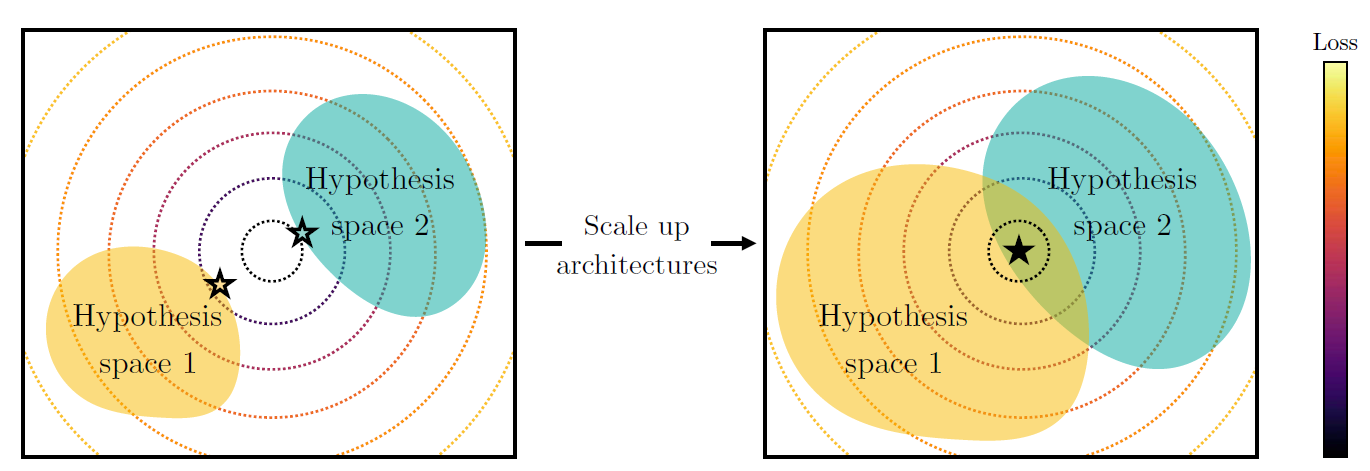 Bigger hypothesis spaces are more likely to converge on a solution, rather than smaller spaces. (source: Paper)
While The Platonic Representation Hypothesis paper doesn't offer proofs or examples for this hypothesis that they call The Capacity Hypothesis - that "Bigger models are more likely to converge to a shared representation than smaller models", it seems trivial that bigger models at least have more capacity to come up with mutual solution spaces than small models.
As AI models scale, thanks to their depth and complexity, they have a greater capacity for abstraction. This allows them to capture underlying concepts and patterns of the data and wave off noise or outliers, thus arriving at a representation that is more generalized and possibly closer to the real world.
3.3 The Simplicity Bias
Imagine training two large-scale neural networks on two separate tasks: one model must be able to recognize faces from images, and another is trained to interpret the emotions of faces. Initially, these two tasks might seem unrelated - but would you be surprised to see both models converge on similar ways of representing facial features? After all, it all comes down to an accurate identification and interpretation of key facial landmarks (eyes, nose, mouth, etc).
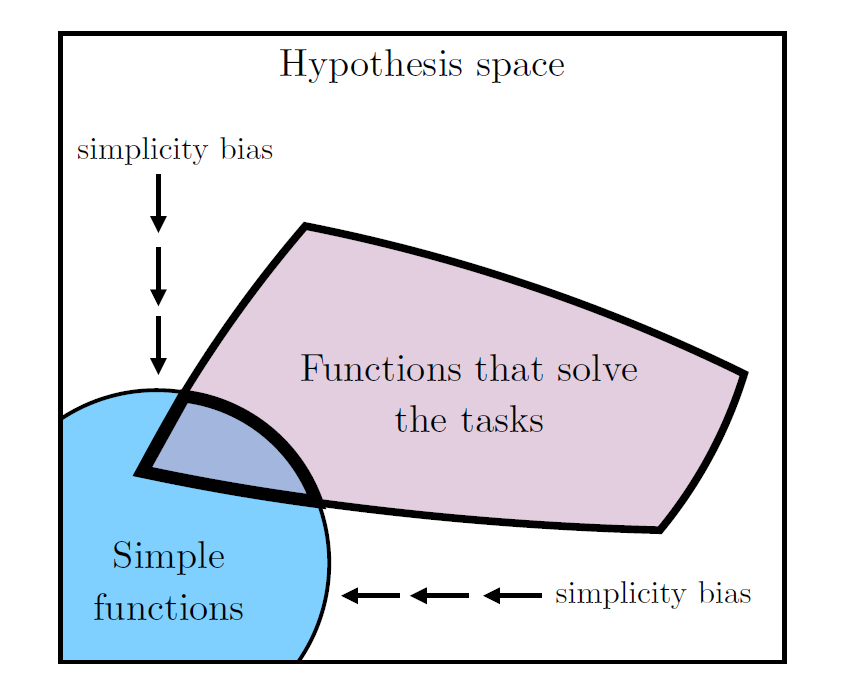 Deep Neural Networks tend towards simpler functions. (source: Paper)
Several literature points out a tendency of deep neural networks to find simpler and more general solutions [3,4,5]. In other words, deep networks favor simple solutions. Often called The Simplicity Bias the paper formulates it as such:
Deep networks are biased toward finding simple fits to the data, and the bigger the model, the stronger the bias. Therefore, as models get bigger, we should expect convergence to a smaller solution space.
Why do neural networks show this behavior? Networks show simplicity bias mostly because of the fundamental properties of the learning algorithms used to train them. Algorithms tend to favor simpler, more generalizable models as a way to prevent overfitting and enhance generalization. During training, simpler models are more likely to emerge because by capturing the dominant patterns in the data, they minimize the loss function more efficiently.
Simplicity bias acts as a natural regulator during training. It pushes models toward an optimal way of representing and processing data, which is both general across tasks and simple enough to be efficiently learned and applied, and this increases the chance of models learning mutual hypothesis spaces.
4. Implications of This Convergence
So what if models are converging? First of all, this shows that data across different modalities can be more useful than thought before. Fine-tuning vision models from pre-trained LLMs or vice-versa could yield surprisingly good results.
Another implication pointed out by the paper is that "Scaling may reduce hallucination and bias". The argument is that as models scale, they can learn from a larger and more diverse dataset, which helps them develop a more accurate and robust understanding of the world. This enhanced understanding allows them to make predictions and generate outputs that are not only more reliable but also less biased.
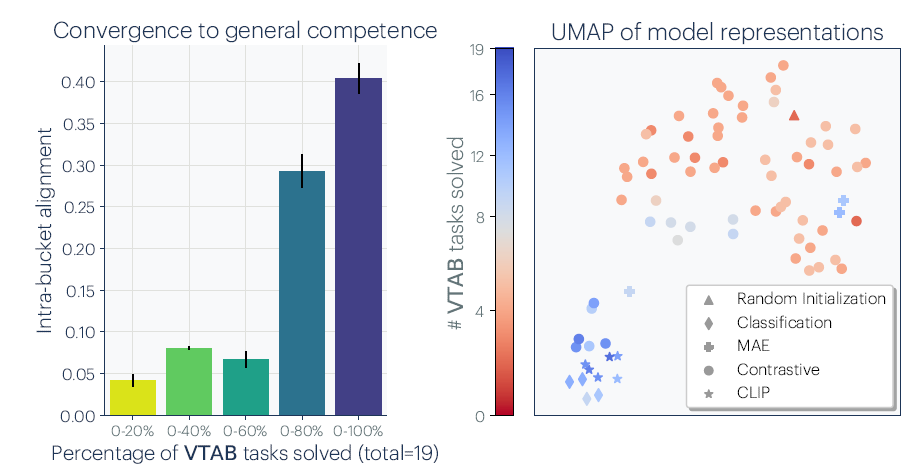 VISION models converge as COMPETENCE increases. (source: Paper)
5. A Pinch of Salt
When it comes to the arguments posed by the paper, you have to consider some limitations, almost all of which are also addressed by the paper as well.
Firstly, the paper assumes a bijective projection of reality in which one real-world concept Z, has projections X and Y that can be learned. However, some concepts are uniquely inherent in one modularity. Sometimes, language can express a concept or feeling that many images can't, and in the same way, language can fail to take the place of an image in describing a visual concept.
Secondly, as mentioned before, the paper focuses on two modalities: vision and language. Thirdly, the argument that "AI models are Converging" only holds for multi-task AI models and not specific ones, such as ADAS or Sentiment Analysis models.
Lastly, while the paper shows that the alignment of different models increases , it doesn't indicate the models' representations become similar. The score of alignment between larger models is indeed higher than smaller ones, but still, a score of 0.16/1.00 leaves some open questions to the research.
🌟 Join +1000 people learning about Python🐍 , ML/MLOps/AI🤖, Data Science📈 , and LLM 🗯
follow me and check out my X/Twitter , where I keep you updated Daily**.**
QiuByte | Hesam Sheikh | Substack
Thanks for reading,
— Hesam
[1] Liu, H., Li, C., Wu, Q., and Lee, Y. J. Visual instruction tuning. In NeurIPS, 2023.
[2] Sharma, P., Rott Shaham, T., Baradad, M., Fu, S., Rodriguez-Munoz, A., Duggal, S., Isola, P., and Torralba, A. A vision check-up for language models. In arXiv preprint, 2024.
[3]H. Shah, K. Tamuly, The Pitfalls of Simplicity Bias in Neural Networks, 2020, https://arxiv.org/abs/2006.07710
[4] A brief note on Simplicity Bias
[5] Deep Neural Networks are biased, at initialisation, towards simple functions
Register Now to Continue Reading
Unlock Towards Data Science with a Free Account
All articles on Towards Data Science are available to registered users. Create a free account today to access this article and thousands more.
Register for freeSign in to your account
 Written By
See all from Hesam Sheikh
Aritificial IntelligenceData ScienceDeep Neural NetworksLarge Language ModelsMachine Learning
Share This Article
Towards Data Science is a community publication. Submit your insights to reach our global audience and earn through the TDS Author Payment Program.
Write for TDS
Related Articles
Machine Learning
Classification problems are one of the main business problems where organizations can harness the power of data science to create...
Ivo Bernardo
August 14, 20198 min read
Artificial Intelligence
Guidance, tips and suggestions that I would have loved to receive when I was in the process of my career change to DL/ML/CV.
Manpreet Singh Minhas
January 9, 202111 min read
Artificial Intelligence
No, you don't go and ask them to mentor you.
Arunn Thevapalan
November 30, 20207 min read
Machine Learning
Modern data warehousing and Machine Learning
Mike Shakhomirov
December 23, 202312 min read
Programming
An extensive comparison between the Java and Python implementation of the Smart Wordle Solver
Daniel García Solla
December 20, 202219 min read
Data Science
Developing new data scientists will require change, and it is vitally important for organizations to be thoughtful and creative about the...
Dr. Xuxu Wang
May 26, 20204 min read
Machine Learning
Being one of the most talked about dimensionality reduction algorithms in the recent years, especially for visualizations, I thought I'd...
Sushanth Sreenivasa
August 15, 20204 min read
Machine Learning
A generic approach for training probabilistic machine learning models
Nicolas Arroyo Duran
November 14, 202018 min read
NLP
An introduction to embedding-based classification of unlabeled text documents
Tim Schopf
December 23, 20216 min read
Your home for data science and AI. The world's leading publication for data science, data analytics, data engineering, machine learning, and artificial intelligence professionals.
Subscribe to Our NewsletterWrite For TDS•About•Advertise•Privacy Policy•Terms of Use
© Insight Media Group, LLC 2026•The New Stack•roadmap.sh•Creator Network
Recommended Articles
Close