保留正文与补采附件。源页面当前未重新核验;具体限制见交付清单。
 We value your privacy
We use cookies to enhance your browsing experience, serve personalised ads or content, and analyse our traffic. By clicking "Accept All", you consent to our use of cookies.
Customise Reject All Accept All
Customise Consent Preferences
 We use cookies to help you navigate efficiently and perform certain functions. You will find detailed information about all cookies under each consent category below.
The cookies that are categorised as "Necessary" are stored on your browser as they are essential for enabling the basic functionalities of the site. ... Show more
NecessaryAlways Active
Necessary cookies are required to enable the basic features of this site, such as providing secure log-in or adjusting your consent preferences. These cookies do not store any personally identifiable data.
-
Cookie
BCTempID
-
Duration
10 minutes
-
Description
No description available.
-
Cookie
__cf_bm
-
Duration
1 hour
-
Description
This cookie, set by Cloudflare, is used to support Cloudflare Bot Management.
-
Cookie
AWSALBCORS
-
Duration
7 days
-
Description
Amazon Web Services set this cookie for load balancing.
-
Cookie
_cfuvid
-
Duration
session
-
Description
Cloudflare sets this cookie to track users across sessions to optimize user experience by maintaining session consistency and providing personalized services
-
Cookie
li_gc
-
Duration
6 months
-
Description
Linkedin set this cookie for storing visitor's consent regarding using cookies for non-essential purposes.
-
Cookie
__hssrc
-
Duration
session
-
Description
This cookie is set by Hubspot whenever it changes the session cookie. The __hssrc cookie set to 1 indicates that the user has restarted the browser, and if the cookie does not exist, it is assumed to be a new session.
-
Cookie
__hssc
-
Duration
1 hour
-
Description
HubSpot sets this cookie to keep track of sessions and to determine if HubSpot should increment the session number and timestamps in the __hstc cookie.
-
Cookie
wpEmojiSettingsSupports
-
Duration
session
-
Description
WordPress sets this cookie when a user interacts with emojis on a WordPress site. It helps determine if the user's browser can display emojis properly.
-
Cookie
BCSessionID
-
Duration
1 year 1 month 4 days
-
Description
Blueconic sets this cookie as a unique identifier for the BlueConic profile.
-
Cookie
_octo
-
Duration
1 year
-
Description
No description available.
-
Cookie
logged_in
-
Duration
1 year
-
Description
No description available.
-
Cookie
__Secure-YEC
-
Duration
past
-
Description
YouTube sets this cookie to stores the user's video player preferences using embedded YouTube video
-
Cookie
__eoi
-
Duration
6 months
-
Description
Description is currently not available.
-
Cookie
AWSALBTGCORS
-
Duration
7 days
-
Description
No description available.
-
Cookie
login-status-p
-
Duration
past
-
Description
Description is currently not available.
-
Cookie
AWSALBTG
-
Duration
7 days
-
Description
No description available.
-
Cookie
csrf_token
-
Duration
session
-
Description
No description available.
-
Cookie
token_v2
-
Duration
1 day
-
Description
Description is currently not available.
-
Cookie
D
-
Duration
1 year
-
Description
Description is currently not available.
-
Cookie
PHPSESSID
-
Duration
session
-
Description
This cookie is native to PHP applications. The cookie stores and identifies a user's unique session ID to manage user sessions on the website. The cookie is a session cookie and will be deleted when all the browser windows are closed.
-
Cookie
VISITOR_PRIVACY_METADATA
-
Duration
6 months
-
Description
YouTube sets this cookie to store the user's cookie consent state for the current domain.
-
Cookie
cookietest
-
Duration
session
-
Description
The cookietest cookie is typically used to determine whether the user's browser accepts cookies, essential for website functionality and user experience.
-
Cookie
__Host-airtable-session
-
Duration
1 year
-
Description
This cookie is used to enable us to integrate the services of Airtable.
-
Cookie
__Host-airtable-session.sig
-
Duration
1 year
-
Description
This cookie is used to enable us to integrate the services of Airtable.
-
Cookie
m
-
Duration
1 year 1 month 4 days
-
Description
Stripe sets this cookie for fraud prevention purposes. It identifies the device used to access the website, allowing the website to be formatted accordingly.
-
Cookie
BIGipServer*
-
Duration
session
-
Description
Marketo sets this cookie to collect information about the user's online activity and build a profile about their interests to provide advertisements relevant to the user.
-
Cookie
__cfruid
-
Duration
session
-
Description
Cloudflare sets this cookie to identify trusted web traffic.
-
Cookie
_GRECAPTCHA
-
Duration
6 months
-
Description
Google Recaptcha service sets this cookie to identify bots to protect the website against malicious spam attacks.
-
Cookie
__Secure-YNID
-
Duration
6 months
-
Description
Google cookie used to protect user security and prevent fraud, especially during the login process.
-
Cookie
cookieyes-consent
-
Duration
1 year
-
Description
CookieYes sets this cookie to remember users' consent preferences so that their preferences are respected on subsequent visits to this site. It does not collect or store any personal information about the site visitors.
Functional
Functional cookies help perform certain functionalities like sharing the content of the website on social media platforms, collecting feedback, and other third-party features.
-
Cookie
lidc
-
Duration
1 day
-
Description
LinkedIn sets the lidc cookie to facilitate data center selection.
-
Cookie
brw
-
Duration
1 year
-
Description
No description available.
-
Cookie
brwConsent
-
Duration
5 minutes
-
Description
Description is currently not available.
-
Cookie
WMF-Uniq
-
Duration
1 year
-
Description
Description is currently not available.
-
Cookie
loom_anon_comment
-
Duration
1 year
-
Description
No description available.
-
Cookie
loom_referral_video
-
Duration
session
-
Description
Description is currently not available.
-
Cookie
VISITOR_INFO1_LIVE
-
Duration
6 months
-
Description
A cookie set by YouTube to measure bandwidth that determines whether the user gets the new or old player interface.
-
Cookie
yt-remote-connected-devices
-
Duration
Never Expires
-
Description
YouTube sets this cookie to store the user's video preferences using embedded YouTube videos.
-
Cookie
ytidb::LAST_RESULT_ENTRY_KEY
-
Duration
Never Expires
-
Description
The cookie ytidb::LAST_RESULT_ENTRY_KEY is used by YouTube to store the last search result entry that was clicked by the user. This information is used to improve the user experience by providing more relevant search results in the future.
-
Cookie
yt-remote-device-id
-
Duration
Never Expires
-
Description
YouTube sets this cookie to store the user's video preferences using embedded YouTube videos.
-
Cookie
yt-remote-session-name
-
Duration
session
-
Description
The yt-remote-session-name cookie is used by YouTube to store the user's video player preferences using embedded YouTube video.
-
Cookie
yt-remote-fast-check-period
-
Duration
session
-
Description
The yt-remote-fast-check-period cookie is used by YouTube to store the user's video player preferences for embedded YouTube videos.
-
Cookie
yt-remote-session-app
-
Duration
session
-
Description
The yt-remote-session-app cookie is used by YouTube to store user preferences and information about the interface of the embedded YouTube video player.
-
Cookie
yt-remote-cast-available
-
Duration
session
-
Description
The yt-remote-cast-available cookie is used to store the user's preferences regarding whether casting is available on their YouTube video player.
-
Cookie
yt-remote-cast-installed
-
Duration
session
-
Description
The yt-remote-cast-installed cookie is used to store the user's video player preferences using embedded YouTube video.
-
Cookie
cp_session
-
Duration
3 months
-
Description
Codepen sets this cookie for Help systems found in the website.
-
Cookie
loid
-
Duration
1 year 1 month 4 days
-
Description
This cookie is set by the Reddit. The cookie enables the sharing of content from the website onto the social media platform.
Analytics
Analytical cookies are used to understand how visitors interact with the website. These cookies help provide information on metrics such as the number of visitors, bounce rate, traffic source, etc.
-
Cookie
__hstc
-
Duration
6 months
-
Description
Hubspot set this main cookie for tracking visitors. It contains the domain, initial timestamp (first visit), last timestamp (last visit), current timestamp (this visit), and session number (increments for each subsequent session).
-
Cookie
hubspotutk
-
Duration
6 months
-
Description
HubSpot sets this cookie to keep track of the visitors to the website. This cookie is passed to HubSpot on form submission and used when deduplicating contacts.
-
Cookie
_ga
-
Duration
1 year 1 month 4 days
-
Description
Google Analytics sets this cookie to calculate visitor, session and campaign data and track site usage for the site's analytics report. The cookie stores information anonymously and assigns a randomly generated number to recognise unique visitors.
-
Cookie
ga*
-
Duration
1 year 1 month 4 days
-
Description
Google Analytics sets this cookie to store and count page views.
-
Cookie
__Host-psifi.analyticsTrace
-
Duration
6 hours
-
Description
Description is currently not available.
-
Cookie
__Host-psifi.analyticsTraceV2
-
Duration
6 hours
-
Description
Description is currently not available.
-
Cookie
_gh_sess
-
Duration
session
-
Description
GitHub sets this cookie for temporary application and framework state between pages like what step the user is on in a multiple step form.
-
Cookie
YSC
-
Duration
session
-
Description
YSC cookie is set by Youtube and is used to track the views of embedded videos on Youtube pages.
-
Cookie
ajs_anonymous_id
-
Duration
1 year
-
Description
This cookie is set by Segment to count the number of people who visit a certain site by tracking if they have visited before.
-
Cookie
vuid
-
Duration
1 year 1 month 4 days
-
Description
Vimeo installs this cookie to collect tracking information by setting a unique ID to embed videos on the website.
Performance
Performance cookies are used to understand and analyse the key performance indexes of the website which helps in delivering a better user experience for the visitors.
-
Cookie
AWSALB
-
Duration
7 days
-
Description
AWSALB is an application load balancer cookie set by Amazon Web Services to map the session to the target.
-
Cookie
acq
-
Duration
past
-
Description
Description is currently not available.
-
Cookie
acq.sig
-
Duration
past
-
Description
Description is currently not available.
-
Cookie
ptc
-
Duration
2 years
-
Description
No description available.
Advertisement
Advertisement cookies are used to provide visitors with customised advertisements based on the pages you visited previously and to analyse the effectiveness of the ad campaigns.
-
Cookie
muc_ads
-
Duration
1 year 1 month 4 days
-
Description
Twitter sets this cookie to collect user behaviour and interaction data to optimize the website.
-
Cookie
guest_id_marketing
-
Duration
1 year 1 month 4 days
-
Description
Twitter sets this cookie to identify and track the website visitor.
-
Cookie
guest_id_ads
-
Duration
1 year 1 month 4 days
-
Description
Twitter sets this cookie to identify and track the website visitor.
-
Cookie
personalization_id
-
Duration
1 year 1 month 4 days
-
Description
Twitter sets this cookie to integrate and share features for social media and also store information about how the user uses the website, for tracking and targeting.
-
Cookie
guest_id
-
Duration
1 year 1 month 4 days
-
Description
Twitter sets this cookie to identify and track the website visitor. It registers if a user is signed in to the Twitter platform and collects information about ad preferences.
-
Cookie
bcookie
-
Duration
1 year
-
Description
LinkedIn sets this cookie from LinkedIn share buttons and ad tags to recognize browser IDs.
-
Cookie
__Secure-ROLLOUT_TOKEN
-
Duration
6 months
-
Description
YouTube sets this cookie to manage feature rollout and experimentation. It helps Google control which new features or interface changes are shown to users as part of testing and staged rollouts, ensuring consistent experience for a given user during an experiment.
-
Cookie
yt.innertube::nextId
-
Duration
Never Expires
-
Description
YouTube sets this cookie to register a unique ID to store data on what videos from YouTube the user has seen.
-
Cookie
yt.innertube::requests
-
Duration
Never Expires
-
Description
YouTube sets this cookie to register a unique ID to store data on what videos from YouTube the user has seen.
-
Cookie
session_tracker
-
Duration
session
-
Description
This cookie is set by the Reddit. This cookie is used to identify trusted web traffic. It also helps in adverstising on the website.
-
Cookie
edgebucket
-
Duration
session
-
Description
Reddit sets this cookie to save the information about a log-on Reddit user, for the purpose of advertisement recommendations and updating the content.
-
Cookie
did
-
Duration
1 year
-
Description
Arbor sets this cookie to show targeted ads to site visitors.This cookie expires after 2 months or 1 year.
Uncategorised
Other uncategorised cookies are those that are being analysed and have not been classified into a category as yet.
No cookies to display.
Reject All Save My Preferences Accept All
Toggle SearchToggle Mobile Navigation
Publish AI, ML & data-science insights to a global community of data professionals.
Sign inSubmit an Article
LatestEditor's PicksNewsletterShipAI
Write For TDS
LinkedInXToggle Search
Artificial Intelligence
Build More Capable LLMs with Retrieval Augmented Generation
How Retrieval Augmented Generation Can Enhance Your LLMs by Integrating a Knowledge Base
John Adeojo
August 8, 202312 min read
 Image by author: Generated with Midjourney
The Limitations of ChatGPT
ChatGPT is limited for many practical business use cases outside of code generation. The limitation arises from the training data, and the model's propensity to hallucinate. At the time of writing, if you try to ask the Chat-GPT questions about events occurring after September 2021, you will probably receive a response like this:
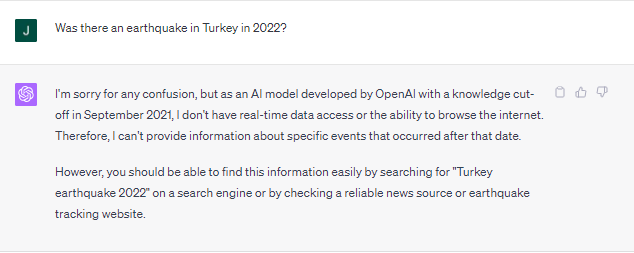 Image by author
This isn't helpful, so how can we go about rectifying it?
Option 1 - Train or fine-tune the model on up-to-date data.
Fine-tuning or training a model can be impractical and expensive. Putting aside the costs, the effort required to prepare the data sets is enough to forgo this option.
Option 2 - Use retrieval augmented generation (RAG) methods.
RAG methods enable us to give the large language model access to an up-to-date knowledge base. This is much cheaper than training a model from scratch or fine-tuning, and much easier to implement. In this article, I show you how to leverage RAG with your OpenAI model. We will put the model to the test by conducting a short analysis of its ability to answer questions about the Russia-Ukraine conflict of 2022 from a Wikipedia knowledge base.
Note: This topic, although sensitive, was chosen for the obvious reason that the current ChatGPT model has no knowledge of it.
Libraries & Pre-requisites
You will require an OpenAI API key, you can grab one directly from their website or follow this tutorial. The framework used for RAG is Haystack by Deepset, which is open source. They provide APIs enabling you to build applications on top of large language models. We also leverage sentence transformers and the transformers library from Hugging Face.
Sentence Embeddings Help Models Interpret Text
Before getting into the technical details around building, we should briefly cover sentence embedding. Understanding this concept is key to gaining an intuition into how RAG methods work.
This may be a cliché, especially for those from a data science background, but models don't actually understand text, they only understand numbers. Much of language modelling is about formulating ways to effectively encode text into numbers, and currently, we do this with sentence embeddings.
Sentence embeddings are a way for us to represent sentences as a dense vector while preserving the semantic structure. Embeddings are learnt from a dense layer in a deep neural network, the structure of which can vary from network to network.
In much simpler terms, sentence embeddings can be thought of as numeric representations of our sentences that preserve information about their meaning. We can get our sentence embeddings from pre-trained models. Hugging Face provides open-source models for this via their sentence transformers library.
Pre-processing and Storage
Before we can build our RAG-enabled model, we need to pre-process and store our documents. Let's explore how we do this, but first take note of the architecture of this process to help with your understanding.
Note: the architectural diagram also applies to the extractive question answer pipeline we define in the next section.
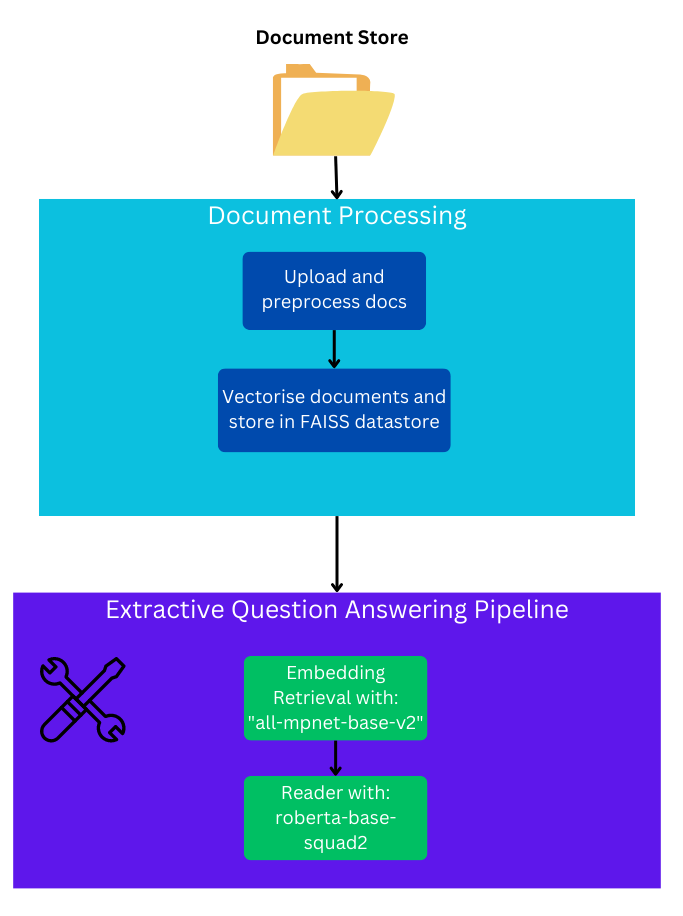 Image by author: High level architecture pre-processing, vectore store, and extractive question-answer pipeline
Pre-processing our Documents
Haystack provides us tools for easily pre-processing most types of text documents (.pdf, .txt, .docx included). The preprocessing steps are simple; we read in our knowledge base using the convert_files_to_docs() function, which can automatically detect the file type and convert it to the format we need to work with downstream.
Haystack also provides a PreProcessor class that enables us to apply preprocessing steps to our documents. The steps you apply will depend very much on your specific application.
Note: the processor will enable you to split a long document into a list of smaller documents, defined as sentences. For question-and-answer applications, a common approach is to have some overlap between sentences; I have set this at roughly 30%.
Vector Store
We leverage FAISS, a library by Meta that enables efficient similarity search over our sentence embeddings. The importance of this will become more obvious in the coming sections. The script below shows how we can set up our pre-process for our text documents and set up the FAISS vector store.
The full pre-processing script is outlined below:
Defining an Extractive Question-Answer Pipeline
The next step is to construct our extractive question answer pipeline. Our pipeline is defined by nodes which are run sequentially as a directed acyclic graph (DAG). In this case, the pipeline consists of two nodes, a retriever, and a reader.
Retriever
Retrieval is the method used to find the relevant information from a knowledge base based on the user's query. When defining our retriever node, we specify a sentence embedding model from the sentence transformers library, in this case, we use all-mpnet-base-v2, which creates 768-dimensional embeddings.
Once we have fully defined our retrieval node, we can compute and store the sentence embeddings in our FAISS vector store. The same sentence embedding model is used to generate sentence embeddings for the user's query.
Note: when selecting your sentence embedding model, there is a trade-off between computational efficiency and information loss. In general, sentence embedding models with higher dimensions capture more information but are less computationally efficient.
Remember, the ultimate purpose of the retriever node is to find the information that relates semantically to the query. This is done by performing a similarity search between the sentence embeddings from the query and the documents in our vector store. The top-k most relevant sentence embeddings are returned as an output from this node.
Reader
The reader node is a large language model that has been fine-tuned on question-answering tasks. For our use case, we leverage Roberta-base-squad2 as our reader model. The reader operates on the output from the retriever and the initial query from the user and returns the relevant span of text to answer the query. The reader will do this for each document in the retriever output, allocating a confidence score in each case. The answers are ranked by their score, and the top-k answers are returned.
The full script for the pipeline is outlined below:
Leveraging LLM-Powered Agents
Now that we have pre-processed our documents and defined our pipeline, we can construct our agent. An agent is powered by a large language model, in our case, OpenAI's gpt-4 (or gpt-3.5-turbo alternatively).
The agent we are using works on the basis of Zero-shot ReAcT (Reason + Act) prompting. We prompt the large language model to return verbal reasoning traces and actions for a task. The agent can "act" on the verbal reasoning traces using a set of tools we provide it access to. The agent can observe and reason about the output from using the tools, helping it to inform its next action.
The animation below gives a simplified view of our ReAct agent at work.
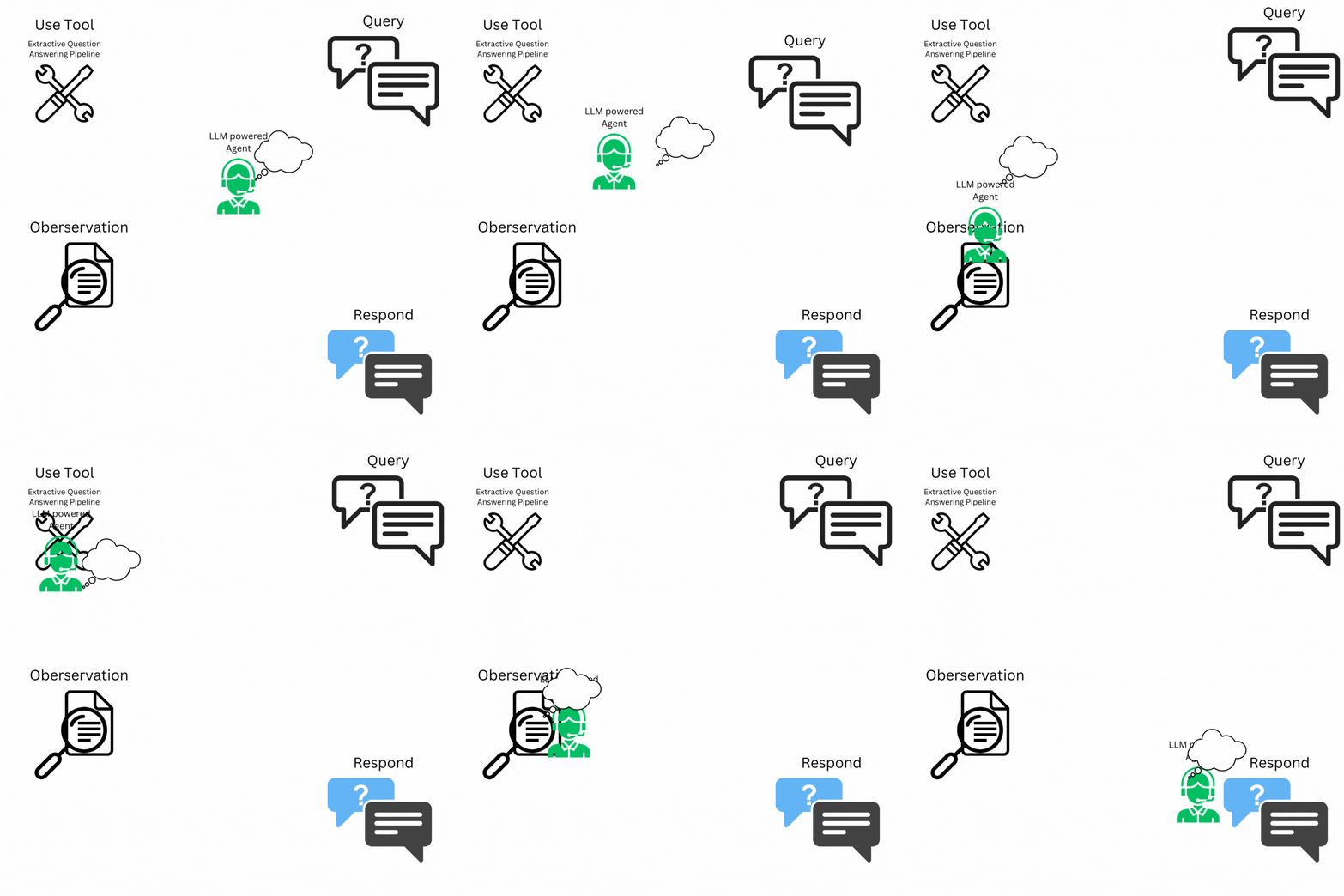 Gif by author: Simplified view of a our agent at work
Note:Research suggests that ReAct prompting has been shown to effectively reduce hallucinations by LLMs.
The script below shows how we construct our agent:
In this use case, the tool we have provided the agent is the extractive question-answer pipeline we defined earlier. Essentially the agent can interpret our query, use our pipeline as a tool to find the relevant responses in our knowledge base, reason to see if this answers the query, choose to respond, or perform the action again to get a better answer.
A Brief Note on Tools
It's important that we define our tools clearly. For our particular use case, we only have one tool, but we need to provide a description of that tool so that the LLM-powered agent knows how and when to use the tool. This becomes even more important when an agent has access to more than just one tool.
Putting it to the Test
So we have defined our RAG-enabled model; let's put it to the test by asking it trivia on the Russia-Ukraine conflict of 2022. I have chosen two questions, each of which can be answered with information from the wikipedia knowledge base. As well as the responses I provide the workflow trace for each agent, you should inspect this carefully to gain a better insight into how the ReAct prompting works with the agent.
How did the international community respond to Russia's invasion of Ukraine in 2022?
Response from the RAG enabled model:
The international community responded to Russia's invasion of Ukraine in 2022 with condemnation and the imposition of new sanctions. These sanctions were comprehensive, affecting individuals, banks, businesses, and various types of economic activity including monetary exchanges, bank transfers, exports, and imports. Some of the specific measures included prison sentences of up to 15 years.
Note: The prison sentence for up to 15 years appears to be a hallucination. The model has mistakenly suggested this as a sanction measure.
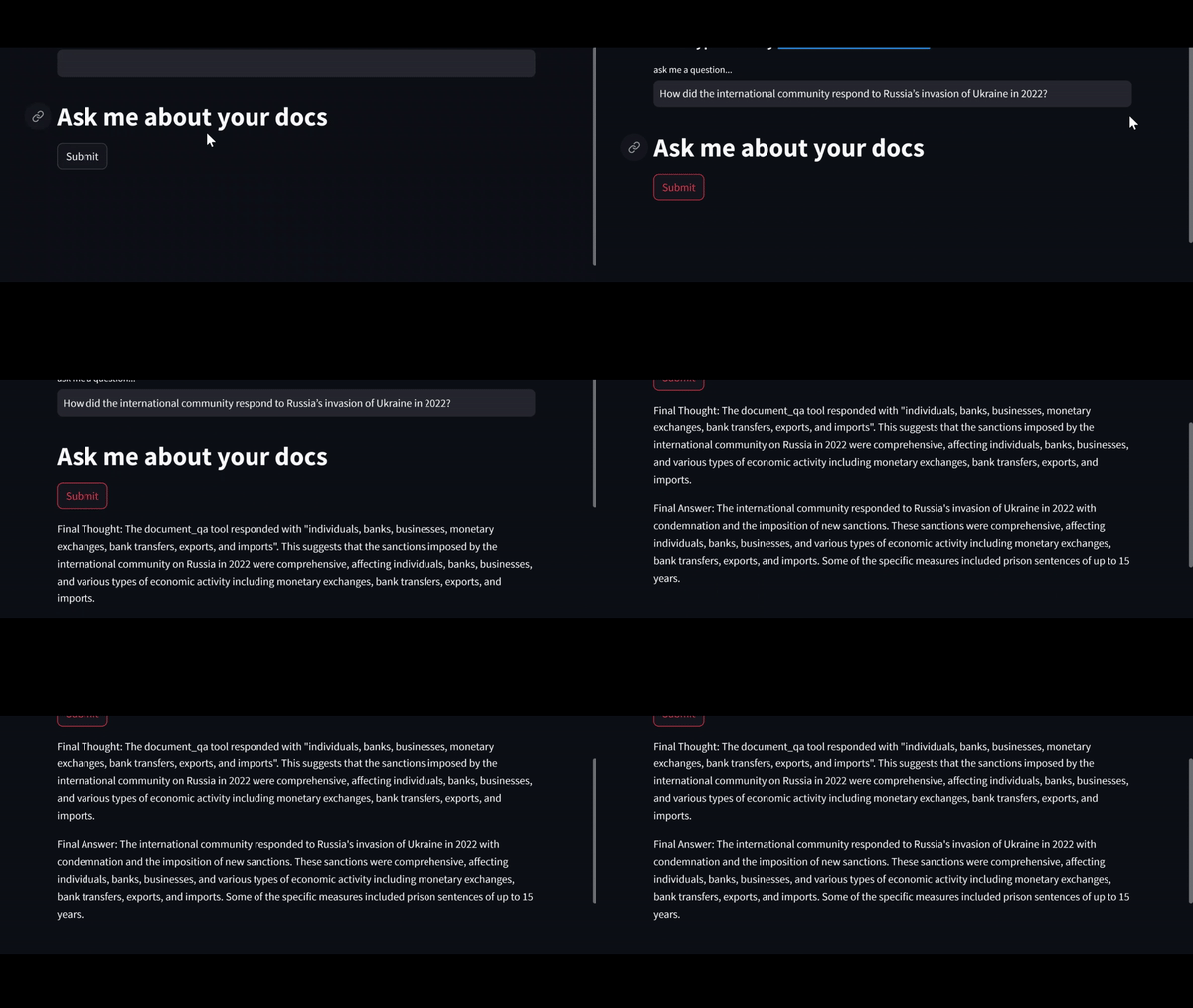 Gif by author: Response to the question "How did the international community respond to Russia's invasion of Ukraine in 2022?"
Response from Google search:
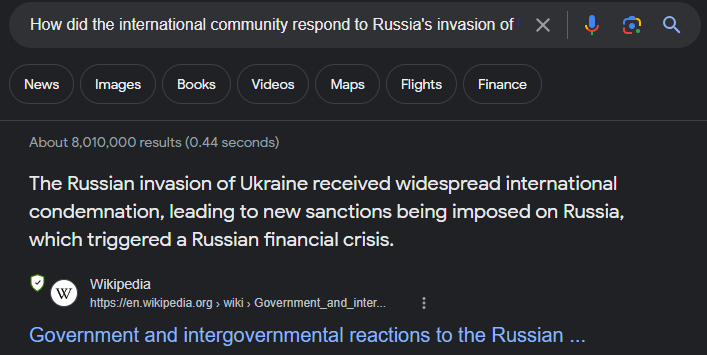 Image by author: Response from Google search for "How did the international community respond to Russia's invasion of Ukraine in 2022?"
Here's the trace tracking the agent's workflow:
bash
Agent custom-at-query-time started with
{'query':
'How did the international community respond to
Russia's invasion of Ukraine in 2022?', 'params': None}
The 'transcript' parameter is missing from
the Agent's prompt template. All ReAct agents
that go through multiple steps to reach
a goal require this parameter. Please append
{transcript} to the end of the Agent's
prompt template to ensure its proper functioning.
A temporary prompt template with {transcript} appended
will be used for this run.
find out the details about the international
community's response to Russia's invasion of Ukraine
in 2022.
I don't have this information readily available,
so I will use the document_qa tool to
find it.
Tool: document_qa
Tool Input: "International community response to Russia's invasion of Ukraine
in 2022"
Batches: 100%|███████████████████████████████████████████████████████████████████████████████████████████████████████| 1/1 [00:00<00:00, 13.05it/s]
Inferencing Samples: 100%|█████████████████████████████████████████████████████████████████████████████████████| 1/1 [00:09<00:00, 9.98s/ Batches]
Observation: 308
Thought: The document_qa tool provided a response
code of 308, which is not informative.
I need to try again to get
the required information.
Tool: document_qa
Tool Input: "How did the international community respond to Russia's invasion
of Ukraine in 2022?"
Batches: 100%|███████████████████████████████████████████████████████████████████████████████████████████████████████| 1/1 [00:00<00:00, 9.72it/s]
Inferencing Samples: 100%|█████████████████████████████████████████████████████████████████████████████████████| 1/1 [00:07<00:00, 7.78s/ Batches]
Observation: condemnation
Thought: The document_qa tool responded with "condemnation".
This suggests that the international community condemned
Russia's invasion of Ukraine in 2022. However,
this is a very broad response and
doesn't provide specific details about the actions
taken by the international community. I need
to find more detailed information.
Tool: document_qa
Tool Input: "What specific actions did the international community take in response to Russia's invasion of Ukraine in 2022?"
Batches: 100%|███████████████████████████████████████████████████████████████████████████████████████████████████████| 1/1 [00:00<00:00, 13.41it/s]
Inferencing Samples: 100%|█████████████████████████████████████████████████████████████████████████████████████| 1/1 [00:07<00:00, 7.95s/ Batches]
Observation: new sanctions
Thought: The document_qa tool responded with "new
sanctions". This suggests that the international community
imposed new sanctions on Russia in response
to their invasion of Ukraine in 2022.
However, this still doesn't provide a comprehensive
picture of the international community's response. I
need to find more detailed information.
Tool: document_qa
Tool Input: "What were the new sanctions imposed by the international community on Russia in 2022?"
Batches: 100%|███████████████████████████████████████████████████████████████████████████████████████████████████████| 1/1 [00:00<00:00, 12.66it/s]
Inferencing Samples: 100%|█████████████████████████████████████████████████████████████████████████████████████| 1/1 [00:10<00:00, 10.77s/ Batches]
Observation: prison sentences of up to 15 years
Thought: The document_qa tool responded with "prison
sentences of up to 15 years". This
suggests that part of the sanctions imposed
by the international community on Russia in
2022 included prison sentences of up to
15 years. However, this seems to be
a specific measure and may not represent
the full range of sanctions. I need
to find more detailed information.
Tool: document_qa
Tool Input: "What other sanctions were imposed by the international community on Russia in 2022?"
Observation: individuals, banks, businesses, monetary     exchanges,
bank transfers, exports, and imports
Observation: individuals, banks, businesses, monetaryexchanges, bank transfers,
exports, and importsThought: The document_qa tool responded
with "individuals, banks, businesses, monetary exchanges, bank
transfers, exports, and imports". This suggests that
the sanctions imposed by the international community
on Russia in 2022 were comprehensive, affecting
individuals, banks, businesses, and various types of
economic activity including monetary exchanges, bank transfers,
exports, and imports.
Final Answer: The international community responded
to Russia's invasion of Ukraine in 2022
with condemnation and the imposition of new
sanctions. These sanctions were comprehensive, affecting individuals,
banks, businesses, and various types of economic
activity including monetary exchanges, bank transfers, exports,
and imports. Some of the specific measures
included prison sentences of up to 15 years.
Who led the IAEA team that investigated the plant on 29 August 2022?
Response from the RAG enabled model:
Rafael Grossi led the IAEA team that investigated the plant on 29 August 2022.
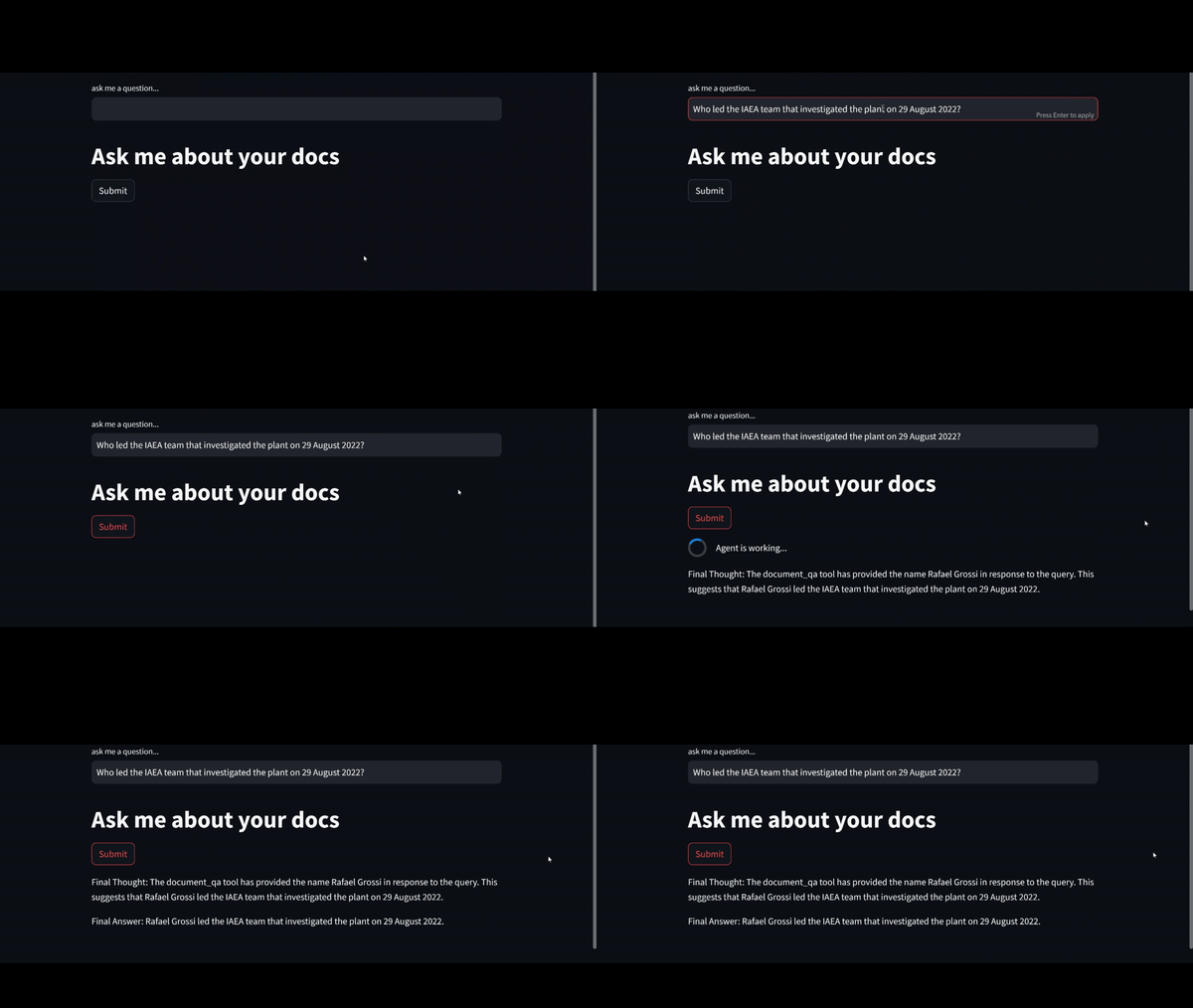 Gif by author: Response to the question "Who led the IAEA team that investigated the plant on 29 August 2022?"
Response from Google search:
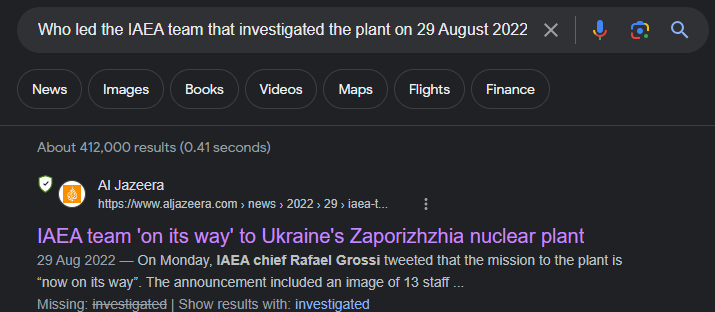 Image by author: Response from Google search for "Who led the IAEA team that investigated the plant on 29 August 2022?"
Here's the trace tracking the agent's workflow:
bash
Agent custom-at-query-time started with {'query': 'Who
led the IAEA team that investigated the
plant on 29 Augustxa02022?', 'params': None}The 'transcript'
parameter is missing from the Agent's prompt
template. All ReAct agents that go through
multiple steps to reach a goal require
this parameter. Please append {transcript} to the
end of the Agent's prompt template to
ensure its proper functioning.
A temporary prompt template with {transcript} appended will
be used for this run.
find out what the IAEA is and
what plant was investigated on 29 August 2022.
Then, I need to find out who led
the IAEA team during this investigation.
I don't have this information at hand,
so I will use the document_qa tool
to find it.
Tool: document_qa
Tool Input: Who led the IAEA team that
investigated the plant on 29 August 2022?
Observation: Rafael Grossi
Thought: The document_qa tool has provided the name
Rafael Grossi in response to the query.
This suggests that Rafael Grossi led the
IAEA team that investigated the plant on
29 August 2022.
Final Answer: Rafael Grossi led the IAEA team
that investigated the plant on 29 August 2022.
For your own curiosity, have a look at the responses from ChatGPT for the same questions. You can even try to ask the questions yourself to confirm the response.
Conclusion
Retrieval augmented generation (RAG) enables a large language model to connect with an existing knowledge base. RAG-enabled language models have access to up-to-date information, making them more useful across a variety of use cases.
The retriever and reader methods enable the models to query large corpuses of text, overcoming the issues faced by the limited context of large language models by themselves. Open-source frameworks like Haystack make it easy to build a RAG-enabled LLM prototype quickly.
Some key points to note here are that the performance of this method is only as good as the knowledge base provided. Also, the inference time can be sped up dramatically by deploying the model on suitable infrastructure.
For more complex queries, agents may get into situations where they can't respond in the alotted amount of steps. It would be interesting to see how the quality of responses varies by increasing the amount of steps, or adding a memory component to make the pipeline more conversational. Leveraging a more heavy duty sentence embedding model could also serve to improve overall performance.
The code base is in the GitHub repo (including the front-end) and is available for you to experiment with.
There is also a YouTube demo of project.
Thanks for reading.
If you're keen to enhance your skills in artificial intelligence, join the waiting list for my course, where I will guide you through the process of developing large language model powered applications.
If you're seeking AI-transformation for your business, book a discovery call today.
Brainqub3 | AI software development
For more insights on artificial intelligence, data science, and large language models you can subscribe to the YouTube channel.
Register Now to Continue Reading
Unlock Towards Data Science with a Free Account
All articles on Towards Data Science are available to registered users. Create a free account today to access this article and thousands more.
Register for freeSign in to your account
 Written By
See all from John Adeojo
Artificial IntelligenceData ScienceLarge Language ModelsNLPPrompt Engineering
Share This Article
Towards Data Science is a community publication. Submit your insights to reach our global audience and earn through the TDS Author Payment Program.
Write for TDS
Related Articles
Machine Learning
When we measure data more frequently, how can we best analyze it? Functional Data Analysis (FDA) can simplify the analysis drastically.
Florian Heinrichs
January 5, 202111 min read
Machine Learning
A practical guide to hyperparameter optimization using three methods: grid, random and bayesian search (with skopt)
Maria Gorodetski
August 28, 20214 min read
Programming
Using GENERATE_ARRAY for Histograms and More
Jye Sawtell-Rickson
May 30, 20204 min read
Artificial Intelligence
Utilizing Unsupervised Learning as a Dating Algorithm
Marco Santos
March 8, 20202 min read
Large Language Models
Enterprise Document Intelligence [Vol.1 #B2] - The FAQ inverts every brick of the standard RAG pipeline. Parsing is trivial, retrieval doubles as a cache, and few-shot prompting becomes a retrieval problem too
Kezhan Shi
August 31, 202619 min read
Machine Learning
Learn how to train a Transformer model called T5 to be your very own grammar corrector
Eric Fillion
August 18, 20219 min read
Artificial Intelligence
Combine the dataset curation of FiftyOne with the model training of Detectron2 to easily train custom detection models
Eric Hofesmann
October 13, 20226 min read
Data Science
Are you an R user flirting with the idea of doing Python? I wrote an article that may be of your interest!
Vít Gabrhel
August 24, 202010 min read
Machine Learning
Don't forget that bias could impact your project
Cornellius Wijaya
August 4, 20229 min read
Your home for data science and AI. The world's leading publication for data science, data analytics, data engineering, machine learning, and artificial intelligence professionals.
Subscribe to Our NewsletterWrite For TDS•About•Advertise•Privacy Policy•Terms of Use
© Insight Media Group, LLC 2026•The New Stack•roadmap.sh•Creator Network
Recommended Articles
Close