保留正文与补采附件。源页面当前未重新核验;具体限制见交付清单。
 We value your privacy
We use cookies to enhance your browsing experience, serve personalised ads or content, and analyse our traffic. By clicking "Accept All", you consent to our use of cookies.
Customise Reject All Accept All
Customise Consent Preferences
 We use cookies to help you navigate efficiently and perform certain functions. You will find detailed information about all cookies under each consent category below.
The cookies that are categorised as "Necessary" are stored on your browser as they are essential for enabling the basic functionalities of the site. ... Show more
NecessaryAlways Active
Necessary cookies are required to enable the basic features of this site, such as providing secure log-in or adjusting your consent preferences. These cookies do not store any personally identifiable data.
-
Cookie
BCTempID
-
Duration
10 minutes
-
Description
No description available.
-
Cookie
__cf_bm
-
Duration
1 hour
-
Description
This cookie, set by Cloudflare, is used to support Cloudflare Bot Management.
-
Cookie
AWSALBCORS
-
Duration
7 days
-
Description
Amazon Web Services set this cookie for load balancing.
-
Cookie
_cfuvid
-
Duration
session
-
Description
Cloudflare sets this cookie to track users across sessions to optimize user experience by maintaining session consistency and providing personalized services
-
Cookie
li_gc
-
Duration
6 months
-
Description
Linkedin set this cookie for storing visitor's consent regarding using cookies for non-essential purposes.
-
Cookie
__hssrc
-
Duration
session
-
Description
This cookie is set by Hubspot whenever it changes the session cookie. The __hssrc cookie set to 1 indicates that the user has restarted the browser, and if the cookie does not exist, it is assumed to be a new session.
-
Cookie
__hssc
-
Duration
1 hour
-
Description
HubSpot sets this cookie to keep track of sessions and to determine if HubSpot should increment the session number and timestamps in the __hstc cookie.
-
Cookie
wpEmojiSettingsSupports
-
Duration
session
-
Description
WordPress sets this cookie when a user interacts with emojis on a WordPress site. It helps determine if the user's browser can display emojis properly.
-
Cookie
BCSessionID
-
Duration
1 year 1 month 4 days
-
Description
Blueconic sets this cookie as a unique identifier for the BlueConic profile.
-
Cookie
_octo
-
Duration
1 year
-
Description
No description available.
-
Cookie
logged_in
-
Duration
1 year
-
Description
No description available.
-
Cookie
__Secure-YEC
-
Duration
past
-
Description
YouTube sets this cookie to stores the user's video player preferences using embedded YouTube video
-
Cookie
__eoi
-
Duration
6 months
-
Description
Description is currently not available.
-
Cookie
AWSALBTGCORS
-
Duration
7 days
-
Description
No description available.
-
Cookie
login-status-p
-
Duration
past
-
Description
Description is currently not available.
-
Cookie
AWSALBTG
-
Duration
7 days
-
Description
No description available.
-
Cookie
csrf_token
-
Duration
session
-
Description
No description available.
-
Cookie
token_v2
-
Duration
1 day
-
Description
Description is currently not available.
-
Cookie
D
-
Duration
1 year
-
Description
Description is currently not available.
-
Cookie
PHPSESSID
-
Duration
session
-
Description
This cookie is native to PHP applications. The cookie stores and identifies a user's unique session ID to manage user sessions on the website. The cookie is a session cookie and will be deleted when all the browser windows are closed.
-
Cookie
VISITOR_PRIVACY_METADATA
-
Duration
6 months
-
Description
YouTube sets this cookie to store the user's cookie consent state for the current domain.
-
Cookie
cookietest
-
Duration
session
-
Description
The cookietest cookie is typically used to determine whether the user's browser accepts cookies, essential for website functionality and user experience.
-
Cookie
__Host-airtable-session
-
Duration
1 year
-
Description
This cookie is used to enable us to integrate the services of Airtable.
-
Cookie
__Host-airtable-session.sig
-
Duration
1 year
-
Description
This cookie is used to enable us to integrate the services of Airtable.
-
Cookie
m
-
Duration
1 year 1 month 4 days
-
Description
Stripe sets this cookie for fraud prevention purposes. It identifies the device used to access the website, allowing the website to be formatted accordingly.
-
Cookie
BIGipServer*
-
Duration
session
-
Description
Marketo sets this cookie to collect information about the user's online activity and build a profile about their interests to provide advertisements relevant to the user.
-
Cookie
__cfruid
-
Duration
session
-
Description
Cloudflare sets this cookie to identify trusted web traffic.
-
Cookie
_GRECAPTCHA
-
Duration
6 months
-
Description
Google Recaptcha service sets this cookie to identify bots to protect the website against malicious spam attacks.
-
Cookie
__Secure-YNID
-
Duration
6 months
-
Description
Google cookie used to protect user security and prevent fraud, especially during the login process.
-
Cookie
cookieyes-consent
-
Duration
1 year
-
Description
CookieYes sets this cookie to remember users' consent preferences so that their preferences are respected on subsequent visits to this site. It does not collect or store any personal information about the site visitors.
Functional
Functional cookies help perform certain functionalities like sharing the content of the website on social media platforms, collecting feedback, and other third-party features.
-
Cookie
lidc
-
Duration
1 day
-
Description
LinkedIn sets the lidc cookie to facilitate data center selection.
-
Cookie
brw
-
Duration
1 year
-
Description
No description available.
-
Cookie
brwConsent
-
Duration
5 minutes
-
Description
Description is currently not available.
-
Cookie
WMF-Uniq
-
Duration
1 year
-
Description
Description is currently not available.
-
Cookie
loom_anon_comment
-
Duration
1 year
-
Description
No description available.
-
Cookie
loom_referral_video
-
Duration
session
-
Description
Description is currently not available.
-
Cookie
VISITOR_INFO1_LIVE
-
Duration
6 months
-
Description
A cookie set by YouTube to measure bandwidth that determines whether the user gets the new or old player interface.
-
Cookie
yt-remote-connected-devices
-
Duration
Never Expires
-
Description
YouTube sets this cookie to store the user's video preferences using embedded YouTube videos.
-
Cookie
ytidb::LAST_RESULT_ENTRY_KEY
-
Duration
Never Expires
-
Description
The cookie ytidb::LAST_RESULT_ENTRY_KEY is used by YouTube to store the last search result entry that was clicked by the user. This information is used to improve the user experience by providing more relevant search results in the future.
-
Cookie
yt-remote-device-id
-
Duration
Never Expires
-
Description
YouTube sets this cookie to store the user's video preferences using embedded YouTube videos.
-
Cookie
yt-remote-session-name
-
Duration
session
-
Description
The yt-remote-session-name cookie is used by YouTube to store the user's video player preferences using embedded YouTube video.
-
Cookie
yt-remote-fast-check-period
-
Duration
session
-
Description
The yt-remote-fast-check-period cookie is used by YouTube to store the user's video player preferences for embedded YouTube videos.
-
Cookie
yt-remote-session-app
-
Duration
session
-
Description
The yt-remote-session-app cookie is used by YouTube to store user preferences and information about the interface of the embedded YouTube video player.
-
Cookie
yt-remote-cast-available
-
Duration
session
-
Description
The yt-remote-cast-available cookie is used to store the user's preferences regarding whether casting is available on their YouTube video player.
-
Cookie
yt-remote-cast-installed
-
Duration
session
-
Description
The yt-remote-cast-installed cookie is used to store the user's video player preferences using embedded YouTube video.
-
Cookie
cp_session
-
Duration
3 months
-
Description
Codepen sets this cookie for Help systems found in the website.
-
Cookie
loid
-
Duration
1 year 1 month 4 days
-
Description
This cookie is set by the Reddit. The cookie enables the sharing of content from the website onto the social media platform.
Analytics
Analytical cookies are used to understand how visitors interact with the website. These cookies help provide information on metrics such as the number of visitors, bounce rate, traffic source, etc.
-
Cookie
__hstc
-
Duration
6 months
-
Description
Hubspot set this main cookie for tracking visitors. It contains the domain, initial timestamp (first visit), last timestamp (last visit), current timestamp (this visit), and session number (increments for each subsequent session).
-
Cookie
hubspotutk
-
Duration
6 months
-
Description
HubSpot sets this cookie to keep track of the visitors to the website. This cookie is passed to HubSpot on form submission and used when deduplicating contacts.
-
Cookie
_ga
-
Duration
1 year 1 month 4 days
-
Description
Google Analytics sets this cookie to calculate visitor, session and campaign data and track site usage for the site's analytics report. The cookie stores information anonymously and assigns a randomly generated number to recognise unique visitors.
-
Cookie
ga*
-
Duration
1 year 1 month 4 days
-
Description
Google Analytics sets this cookie to store and count page views.
-
Cookie
__Host-psifi.analyticsTrace
-
Duration
6 hours
-
Description
Description is currently not available.
-
Cookie
__Host-psifi.analyticsTraceV2
-
Duration
6 hours
-
Description
Description is currently not available.
-
Cookie
_gh_sess
-
Duration
session
-
Description
GitHub sets this cookie for temporary application and framework state between pages like what step the user is on in a multiple step form.
-
Cookie
YSC
-
Duration
session
-
Description
YSC cookie is set by Youtube and is used to track the views of embedded videos on Youtube pages.
-
Cookie
ajs_anonymous_id
-
Duration
1 year
-
Description
This cookie is set by Segment to count the number of people who visit a certain site by tracking if they have visited before.
-
Cookie
vuid
-
Duration
1 year 1 month 4 days
-
Description
Vimeo installs this cookie to collect tracking information by setting a unique ID to embed videos on the website.
Performance
Performance cookies are used to understand and analyse the key performance indexes of the website which helps in delivering a better user experience for the visitors.
-
Cookie
AWSALB
-
Duration
7 days
-
Description
AWSALB is an application load balancer cookie set by Amazon Web Services to map the session to the target.
-
Cookie
acq
-
Duration
past
-
Description
Description is currently not available.
-
Cookie
acq.sig
-
Duration
past
-
Description
Description is currently not available.
-
Cookie
ptc
-
Duration
2 years
-
Description
No description available.
Advertisement
Advertisement cookies are used to provide visitors with customised advertisements based on the pages you visited previously and to analyse the effectiveness of the ad campaigns.
-
Cookie
muc_ads
-
Duration
1 year 1 month 4 days
-
Description
Twitter sets this cookie to collect user behaviour and interaction data to optimize the website.
-
Cookie
guest_id_marketing
-
Duration
1 year 1 month 4 days
-
Description
Twitter sets this cookie to identify and track the website visitor.
-
Cookie
guest_id_ads
-
Duration
1 year 1 month 4 days
-
Description
Twitter sets this cookie to identify and track the website visitor.
-
Cookie
personalization_id
-
Duration
1 year 1 month 4 days
-
Description
Twitter sets this cookie to integrate and share features for social media and also store information about how the user uses the website, for tracking and targeting.
-
Cookie
guest_id
-
Duration
1 year 1 month 4 days
-
Description
Twitter sets this cookie to identify and track the website visitor. It registers if a user is signed in to the Twitter platform and collects information about ad preferences.
-
Cookie
bcookie
-
Duration
1 year
-
Description
LinkedIn sets this cookie from LinkedIn share buttons and ad tags to recognize browser IDs.
-
Cookie
__Secure-ROLLOUT_TOKEN
-
Duration
6 months
-
Description
YouTube sets this cookie to manage feature rollout and experimentation. It helps Google control which new features or interface changes are shown to users as part of testing and staged rollouts, ensuring consistent experience for a given user during an experiment.
-
Cookie
yt.innertube::nextId
-
Duration
Never Expires
-
Description
YouTube sets this cookie to register a unique ID to store data on what videos from YouTube the user has seen.
-
Cookie
yt.innertube::requests
-
Duration
Never Expires
-
Description
YouTube sets this cookie to register a unique ID to store data on what videos from YouTube the user has seen.
-
Cookie
session_tracker
-
Duration
session
-
Description
This cookie is set by the Reddit. This cookie is used to identify trusted web traffic. It also helps in adverstising on the website.
-
Cookie
edgebucket
-
Duration
session
-
Description
Reddit sets this cookie to save the information about a log-on Reddit user, for the purpose of advertisement recommendations and updating the content.
-
Cookie
did
-
Duration
1 year
-
Description
Arbor sets this cookie to show targeted ads to site visitors.This cookie expires after 2 months or 1 year.
Uncategorised
Other uncategorised cookies are those that are being analysed and have not been classified into a category as yet.
No cookies to display.
Reject All Save My Preferences Accept All
Toggle SearchToggle Mobile Navigation
Publish AI, ML & data-science insights to a global community of data professionals.
Sign inSubmit an Article
LatestEditor's PicksNewsletterShipAI
Write For TDS
LinkedInXToggle Search
Language Models for Sentence Completion
A practical application of a language model that picks the most likely candidate word that extends an English sentence by a single word
Dhruv Matani
September 15, 202314 min read
 Photo by Brett Jordan on Unsplash
Co-authored with Naresh Singh.
Table of contents
Introduction Problem Statement Brainstorming a solution
An LSTM model
A Transformer model
Conclusion
Introduction
Language models such as GPT have become very popular recently and are being used for a variety of text generation tasks, such as in ChatGPT or other conversational AI systems. These language models are huge, often exceeding tens of billions of parameters, and need a lot of computing resources and money to run.
In the context of English language models, these massive models are over-parameterized since they use the model's parameters to memorize and learn aspects of our world instead of just modeling the English language. We can likely use a much smaller model if we have an application that requires the model to understand just the language and its constructs.
The complete code for running inference on the trained model can be found in this notebook.
Problem Statement
Let's assume we're building a swipe keyboard system that tries to predict the word you type in next on your mobile phone. Based on the pattern traced by the swipe pattern, there are many possibilities for the user's intended word. However, many of these possible words aren't actual words in English and can be eliminated. Even after this initial pruning and elimination step, many candidates remain, and we need to pick one as a suggestion for the user.
To further prune this list of candidates, we can use a deep-learning-based language model that looks at the provided context and tells us which candidate is most likely to complete the sentence.
For example, if the user has typed the sentence "I've scheduled this" and then swipes a pattern as shown below
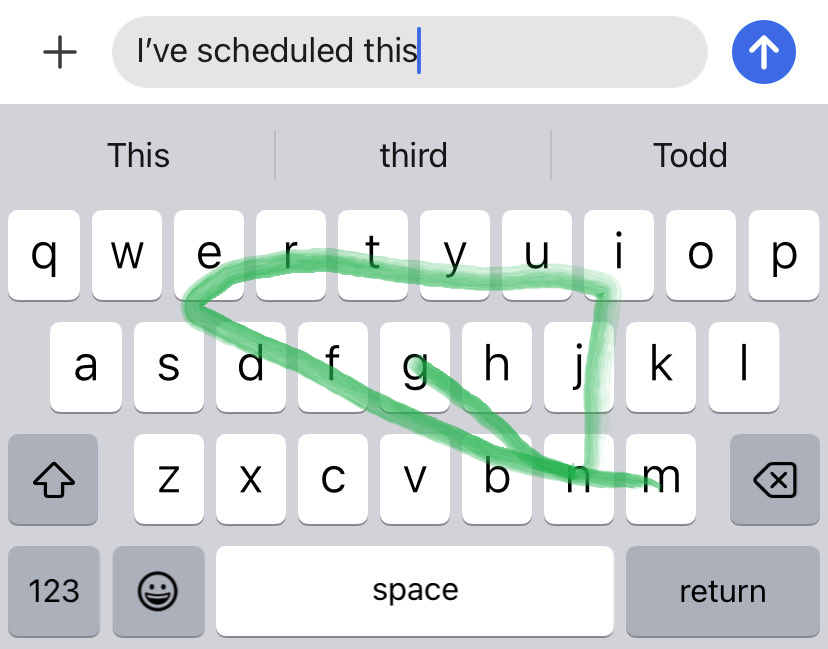 Then, some possible English language words that the user could have meant are:
- messing
- meeting
However, if we think about it, it's probably more likely that the user meant "meeting" and not "messing" because of the word "scheduled" in the earlier part of the sentence.
Given everything we know so far, what options do we have for doing this pruning programmatically? Let's brainstorm some solutions in the section below.
Brainstorming a solution
Algorithms and Data Structures
Using first principles, it seems reasonable to start with a corpus of data, find pairs of words that come together, and train a Markov model that predicts the probability of the pair occurring in a sentence. You'll notice two significant issues with this approach.
- Space utilization : There are anywhere between 250k to 1 million words in the English language, which don't include the numerous proper nouns that are constantly growing in volume. Hence, any traditional software solution modeling the probability of a pair of words occurring together must maintain a lookup table with 250k*250k = 62.5 billion word pairs, which is somewhat excessive. It seems likely that many pairs don't occur very often and can be pruned. Even after pruning, there are a lot of pairs to worry about.
- Completeness : Encoding the probability of a pair of words doesn't do justice to the problem at hand. For example, the earlier sentence context is completely lost when you're looking at just the most recent pair of words. In the sentence "How is your day coming" if you want to check the word after "coming", you'd have a lot of pairs starting with "coming". This misses the entire sentence context before that word. One can imagine using word triplets, etc.... but this exacerbates the problem of space utilization mentioned above.
Let's shift our focus to a solution that leverages the nature of the English language and see if that can help us here.
NLP (Natural Language Processing)
Historically, the area of NLP (natural language processing) involved understanding the parts of speech (POS) of a sentence and using that information to perform such pruning and prediction decisions. One can imagine using a POS tag associated with each word to determine if the following word in a sentence is valid.
However, the process of computing the parts of speech for a sentence is a complex process in itself, and requires specialized understanding of language as evidenced in this page on NLTK's parts of speech tagging.
Next, let's take a look at a deep-learning-based approach that requires a lot more tagged data, but not as much language expertise to build.
Deep Learning (Neural Networks)
The area of NLP has been upended by the advent of deep learning. With the invention of LSTM and Transformer based language models, the solution more often than not involves throwing some high-quality data at a model and training it to predict the next word.
In essence, this is what the GPT model is doing. GPT (Generative Pre-Trained Transformer) models are trained to predict the next word (token) given a prefix of a sentence.
Given the sentence prefix "It is such a wonderful" , it's likely for the model to provide the following as high-probability predictions for the word following the sentence.
- day
- experience
- world
- life
It's also likely that the following words will have a lower probability of completing the sentence prefix.
- red
- mouse
- line
The Transformer model architecture is at the heart of systems such as ChatGPT. However, for the more restricted use case of learning English language semantics, we can use a cheaper-to-run model architecture such as an LSTM (long short-term memory) model.
An LSTM model
Let's build a simple LSTM model and train it to predict the next token given a prefix of tokens. Now, you might ask what a token is.
Tokenization
Typically for language models, a token can mean
- A single character (or a single byte)
- An entire word in the target language
- Something in between 1 and 2. This is usually called a sub-word
Mapping a single character (or byte) to a token is very restrictive since we're overloading that token to hold a lot of context about where it occurs. This is because the character "c" for example, occurs in many different words, and to predict the next character after we see the character "c" requires us to really look hard at the leading context.
Mapping a single word to a token is also problematic since English itself has anywhere between 250k and 1 million words. In addition, what happens when a new word is added to the language? Do we need to go back and re-train the entire model to account for this new word?
Sub-word tokenization is considered the industry standard in the year 2023. It assigns substrings of bytes frequently occurring together to unique tokens. Typically, language models have anywhere from a few thousand (say 4,000) to tens of thousands (say 60,000) of unique tokens. The algorithm to determine what constitutes a token is determined by the BPE (Byte pair encoding) algorithm.
To choose the number of unique tokens in our vocabulary (called the vocabulary size), we need to be mindful of a few things:
- If we choose too few tokens, we're back in the regime of a token per character, and it's hard for the model to learn anything useful.
- If we choose too many tokens, we end up in a situation where the model's embedding tables over-shadow the rest of the model's weight and it becomes hard to deploy the model in a constrained environment. The size of the embedding table will depend on the number of dimensions we use for each token. It's not uncommon to use a size of 256, 512, 786, etc... If we use a token embedding dimension of 512, and we have 100k tokens, we end up with an embedding table that uses 200MiB in memory.
Hence, we need to strike a balance when choosing the vocabulary size. In this example, we pick 6600 tokens and train our tokenizer with a vocabulary size of 6600. Next, let's take a look at the model definition itself.
The PyTorch Model
The model itself is pretty straightforward. We have the following layers:
- Token Embedding (vocab size=6600, embedding dim=512), for a total size of about 15MiB (assuming 4 byte float32 as the embedding table's data type)
- LSTM (num layers=1, hidden dimension=786) for a total size of about 16MiB
- Multi-Layer Perceptron (786 to 3144 to 6600 dimensions) for a total size of about 93MiB
The complete model has about 31M trainable parameters for a total size of about 120MiB.
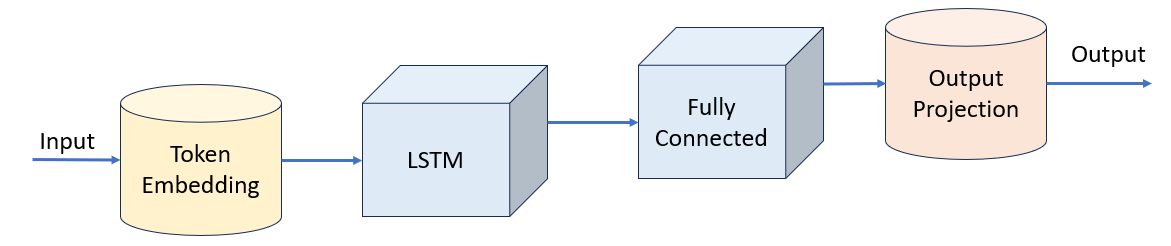 Here's the PyTorch code for the model.
python
class WordPredictionLSTMModel(nn.Module):
    def __init__(self, num_embed, embed_dim, pad_idx, lstm_hidden_dim, lstm_num_layers, output_dim, dropout):
        super().__init__()
        self.vocab_size = num_embed
        self.embed = nn.Embedding(num_embed, embed_dim, pad_idx)
        self.lstm = nn.LSTM(embed_dim, lstm_hidden_dim, lstm_num_layers, batch_first=True, dropout=dropout)
        self.fc = nn.Sequential(
            nn.Linear(lstm_hidden_dim, lstm_hidden_dim * 4),
            nn.LayerNorm(lstm_hidden_dim * 4),
            nn.LeakyReLU(),
            nn.Dropout(p=dropout),

            nn.Linear(lstm_hidden_dim * 4, output_dim),
        )
    #

    def forward(self, x):
        x = self.embed(x)
        x, _ = self.lstm(x)
        x = self.fc(x)
        x = x.permute(0, 2, 1)
        return x
    #
#
Here's the model summary using torchinfo.
LSTM Model Summary
text
=================================================================
Layer (type:depth-idx) Param #
=================================================================
WordPredictionLSTMModel -
├─Embedding: 1–1 3,379,200
├─LSTM: 1–2 4,087,200
├─Sequential: 1–3 -
│ └─Linear: 2–1 2,474,328
│ └─LayerNorm: 2–2 6,288
│ └─LeakyReLU: 2–3 -
│ └─Dropout: 2–4 -
│ └─Linear: 2–5 20,757,000
=================================================================
Total params: 30,704,016
Trainable params: 30,704,016
Non-trainable params: 0
=================================================================
Interpreting the accuracy : After training this model on 12M English language sentences for about 8 hours on a P100 GPU, we achieved a loss of 4.03, a top-1 accuracy of 29% and a top-5 accuracy of 49%. This means that 29% of the time, the model was able to correctly predict the next token, and 49% of the time, the next token in the training set was one of the top 5 predictions by the model.
What should our success metric be? While the top-1 and top-5 accuracy numbers for our model aren't impressive, they aren't as important for our problem. Our candidate words are a small set of possible words that fit the swipe pattern. What we want from our model is to be able to select an ideal candidate to complete the sentence such that it is syntactically and semantically coherent. Since our model learns the nature of language through the training data, we expect it to assign a higher probability to coherent sentences. For example, if we have the sentence "The baseball player" and possible completion candidates ("ran", "swam", "hid"), then the word "ran" is a better follow-up word than the other two. So, if our model predicts the word ran with a higher probability than the rest, it works for us.
Interpreting the loss : A loss of 4.03 means that the negative log-likelihood of the prediction is 4.03, which means that the probability of predicting the next token correctly is e^-4.03 = 0.0178 or 1/56. A randomly initialized model typically has a loss of about 8.8 which is -log_e(1/6600), since the model randomly predicts 1/6600 tokens (6600 being the vocabulary size). While a loss of 4.03 may not seem great, it's important to remember that the trained model is about 120x better than an untrained (or randomly initialized) model.
Next, let's take a look at how we can use this model to improve suggestions from our swipe keyboard.
Using the model to prune invalid suggestions
Let's take a look at a real example. Suppose we have a partial sentence "I think" , and the user makes the swipe pattern shown in blue below, starting at "o", going between the letters "c" and "v", and ending between the letters "e" and "v".
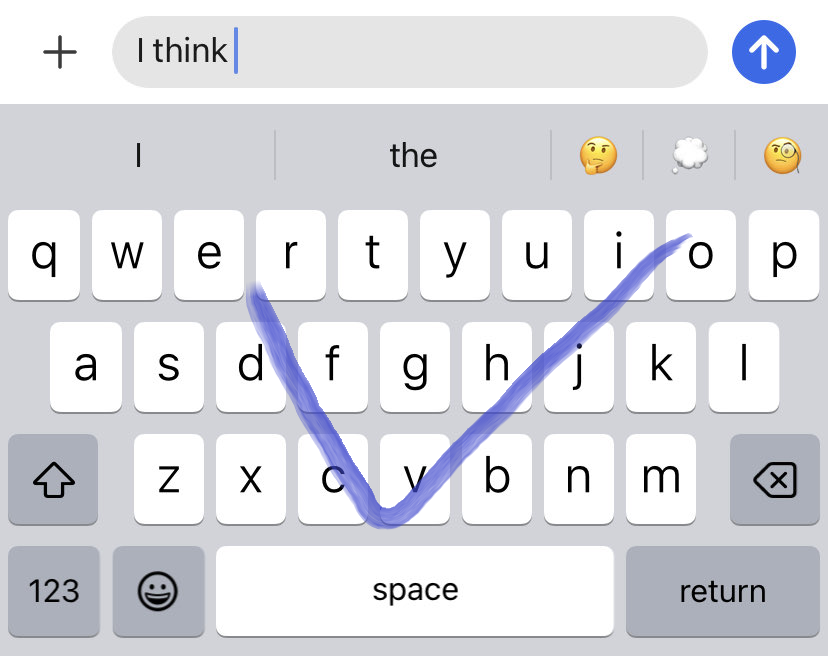 Some possible words that could be represented by this swipe pattern are
- Over
- Oct (short for October)
- Ice
- I've (with the apostrophe implied)
Of these suggestions, the most likely one is probably going to be "I've". Let's feed these suggestions into our model and see what it spits out.
text
[I think] [I've] = 0.00087
[I think] [over] = 0.00051
[I think] [ice] = 0.00001
[I think] [Oct] = 0.00000
The value after the = sign is the probability of the word being a valid completion of the sentence prefix. In this case, we see that the word "I've" has been assigned the highest probability. Hence, it is the most likely word to follow the sentence prefix "I think".
The next question you might have is how we can compute these next-word probabilities. Let's take a look.
Computing the next word probability
To compute the probability that a word is a valid completion of a sentence prefix, we run the model in eval (inference) mode and feed in the tokenized sentence prefix. We also tokenize the word after adding a whitespace prefix to the word. This is done because the HuggingFace pre-tokenizer splits words with spaces at the beginning of the word, so we want to make sure that our inputs are consistent with the tokenization strategy used by HuggingFace Tokenizers.
Let's assume that the candidate word is made up of 3 tokens T0, T1, and T2.
- We first run the model with the original tokenized sentence prefix. For the last token, we check the probability of predicting token T0. We add this to the "probs" list.
- Next, we run a prediction on the prefix+T0 and check the probability of token T1. We add this probability to the "probs" list.
- Next, we run a prediction on the prefix+T0+T1 and check the probability of token T2. We add this probability to the "probs" list.
The "probs" list contains the individual probabilities of generating the tokens T0, T1, and T2 in sequence. Since these tokens correspond to the tokenization of the candidate word, we can multiply these probabilities to get the combined probability of the candidate being a completion of the sentence prefix.
The code for computing the completion probabilities is shown below.
python
 def get_completion_probability(self, input, completion, tok):
      self.model.eval()
      ids = tok.encode(input).ids
      ids = torch.tensor(ids, device=self.device).unsqueeze(0)
      completion_ids = torch.tensor(tok.encode(completion).ids, device=self.device).unsqueeze(0)
      probs = []
      for i in range(completion_ids.size(1)):
          y = self.model(ids)
          y = y[0,:,-1].softmax(dim=0)
          # prob is the probability of this completion.
          prob = y[completion_ids[0,i]]
          probs.append(prob)
          ids = torch.cat([ids, completion_ids[:,i:i+1]], dim=1)
      #
      return torch.tensor(probs)
  #
We can see some more examples below.
text
[That ice-cream looks] [really] = 0.00709
[That ice-cream looks] [delicious] = 0.00264
[That ice-cream looks] [absolutely] = 0.00122
[That ice-cream looks] [real] = 0.00031
[That ice-cream looks] [fish] = 0.00004
[That ice-cream looks] [paper] = 0.00001
[That ice-cream looks] [atrocious] = 0.00000

[Since we're heading] [toward] = 0.01052
[Since we're heading] [away] = 0.00344
[Since we're heading] [against] = 0.00035
[Since we're heading] [both] = 0.00009
[Since we're heading] [death] = 0.00000
[Since we're heading] [bubble] = 0.00000
[Since we're heading] [birth] = 0.00000

[Did I make] [a] = 0.22704
[Did I make] [the] = 0.06622
[Did I make] [good] = 0.00190
[Did I make] [food] = 0.00020
[Did I make] [color] = 0.00007
[Did I make] [house] = 0.00006
[Did I make] [colour] = 0.00002
[Did I make] [pencil] = 0.00001
[Did I make] [flower] = 0.00000

[We want a candidate] [with] = 0.03209
[We want a candidate] [that] = 0.02145
[We want a candidate] [experience] = 0.00097
[We want a candidate] [which] = 0.00094
[We want a candidate] [more] = 0.00010
[We want a candidate] [less] = 0.00007
[We want a candidate] [school] = 0.00003

[This is the definitive guide to the] [the] = 0.00089
[This is the definitive guide to the] [complete] = 0.00047
[This is the definitive guide to the] [sentence] = 0.00006
[This is the definitive guide to the] [rapper] = 0.00001
[This is the definitive guide to the] [illustrated] = 0.00001
[This is the definitive guide to the] [extravagant] = 0.00000
[This is the definitive guide to the] [wrapper] = 0.00000
[This is the definitive guide to the] [miniscule] = 0.00000

[Please can you] [check] = 0.00502
[Please can you] [confirm] = 0.00488
[Please can you] [cease] = 0.00002
[Please can you] [cradle] = 0.00000
[Please can you] [laptop] = 0.00000
[Please can you] [envelope] = 0.00000
[Please can you] [options] = 0.00000
[Please can you] [cordon] = 0.00000
[Please can you] [corolla] = 0.00000

[I think] [I've] = 0.00087
[I think] [over] = 0.00051
[I think] [ice] = 0.00001
[I think] [Oct] = 0.00000

[Please] [can] = 0.00428
[Please] [cab] = 0.00000

[I've scheduled this] [meeting] = 0.00077
[I've scheduled this] [messing] = 0.00000
These examples show the probability of the word completing the sentence before it. The candidates are sorted in decreasing order of probability.
Since Transformers are slowly replacing LSTM and RNN models for sequence-based tasks, let's take a look at what a Transformer model for the same objective would look like.
A Transformer model
Transformer-based models are a very popular architecture for training language models to predict the next word in a sentence. The specific technique we'll use is the causal attention mechanism. We'll train just the transformer encoder layer in PyTorch using causal attention. Causal attention means we'll allow every token in the sequence to only look at the tokens before it. This resembles the information that a unidirectional LSTM layer uses when trained only in the forward direction.
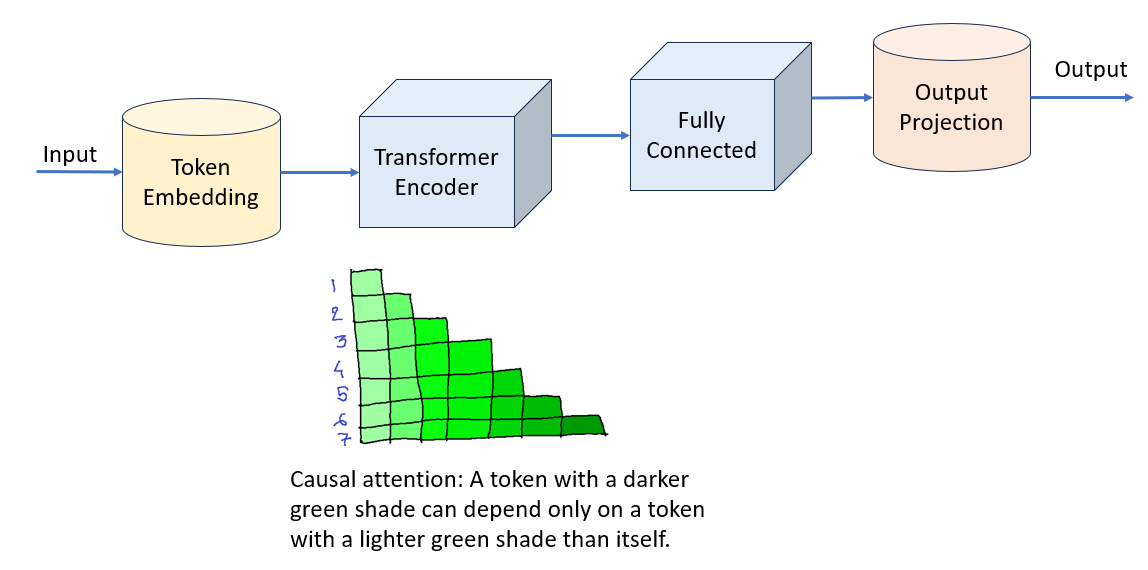 The Transformer model we'll see here is based directly on the nn.TransformerEncoder and nn.TransformerEncoderLayer in PyTorch.
python
import math

def generate_src_mask(sz, device):
    return torch.triu(torch.full((sz, sz), True, device=device), diagonal=1)
#

class PositionalEmbedding(nn.Module):
    def __init__(self, sequence_length, embed_dim):
        super().__init__()
        self.sqrt_embed_dim = math.sqrt(embed_dim)
        self.pos_embed = nn.Parameter(torch.empty((1, sequence_length, embed_dim)))
        nn.init.uniform_(self.pos_embed, -1.0, 1.0)
    #

    def forward(self, x):
        return x * self.sqrt_embed_dim + self.pos_embed[:,:x.size(1)]
    #
#

class WordPredictionTransformerModel(nn.Module):
    def __init__(self, sequence_length, num_embed, embed_dim, pad_idx, num_heads, num_layers, output_dim, dropout, norm_first, activation):
        super().__init__()
        self.vocab_size = num_embed
        self.sequence_length = sequence_length
        self.embed_dim = embed_dim
        self.sqrt_embed_dim = math.sqrt(embed_dim)
        self.embed = nn.Sequential(
            nn.Embedding(num_embed, embed_dim, pad_idx),
            PositionalEmbedding(sequence_length, embed_dim),
            nn.LayerNorm(embed_dim),
            nn.Dropout(p=0.1),
        )

        encoder_layer = nn.TransformerEncoderLayer(
            d_model=embed_dim, nhead=num_heads, dropout=dropout, batch_first=True, norm_first=norm_first, activation=activation,
        )
        self.encoder = nn.TransformerEncoder(encoder_layer, num_layers=num_layers)
        self.fc = nn.Sequential(
            nn.Linear(embed_dim, embed_dim * 4),
            nn.LayerNorm(embed_dim * 4),
            nn.LeakyReLU(),
            nn.Dropout(p=dropout),

            nn.Linear(embed_dim * 4, output_dim),
        )
    #

    def forward(self, x):
        src_attention_mask = generate_src_mask(x.size(1), x.device)
        x = self.embed(x)
        x = self.encoder(x, is_causal=True, mask=src_attention_mask)
        x = self.fc(x)
        x = x.permute(0, 2, 1)
        return x
    #
#
We can plug this model in place of the LSTM model that we used before since it's API is compatible. This model takes longer to train for the same amount of training data and has comparable performance.
Transformer models are better for long sequences. In our case, we have sequences of length 256. Most of the context needed to perform next-word completion tends to be local, so we don't really need the power of Transformers here.
Conclusion
We saw how we can solve very practical NLP problems using deep learning techniques based on LSTM (RNN) and Transformer models. Not every language task requires the use of models with billions of parameters. Specialized applications that require modeling language itself, and not memorizing large volumes of information can be handled using much smaller models that can be deployed easily and more efficiently than the massive language models that we are used to seeing these days.
All the image(s) except for the first one were created by the author(s).
Register Now to Continue Reading
Unlock Towards Data Science with a Free Account
All articles on Towards Data Science are available to registered users. Create a free account today to access this article and thousands more.
Register for freeSign in to your account
 Written By
See all from Dhruv Matani
Hands On TutorialsLanguage ModelLlmNext Word PredictionTransformers
Share This Article
Towards Data Science is a community publication. Submit your insights to reach our global audience and earn through the TDS Author Payment Program.
Write for TDS
Related Articles
Large Language Models
How prompt evaluation with a systematic approach composed of algorithmic testing with input/output data fixtures can make prompt engineering for complex AI tasks more reliable.
Ugo Pradère
March 14, 202513 min read
Data Science
Applying machine learning methodology to prompt building
Julian Yip
May 5, 202443 min read
Evaluating the evolution and application of language models on real world tasks
Tula Masterman
March 23, 20247 min read
Artificial Intelligence
Traditional RAG vs. dynamic RAG
Atisha Rajpurohit
December 5, 20249 min read
Learn how we use LLM Agents to improve and customise transactions in a chatbot!
Ng Wei Cheng
August 20, 202414 min read
Artificial Intelligence
Techniques and dangers of using LLMs to evaluate LLM outputs.
Maksym Petyak
November 10, 20237 min read
Data Science
Some questions to answer: What makes popular music popular? How is today's music different from that of over 30 years ago?
Dea Bardhoshi
June 9, 20218 min read
Artificial Intelligence
Exploring the limits of artificial intelligence: why mastering patterns may not equal genuine reasoning
Salvatore Raieli
October 31, 202413 min read
Machine Learning
Tips and tricks for successful building of a marketing strategy using ML
Elena K.
August 1, 20238 min read
Your home for data science and AI. The world's leading publication for data science, data analytics, data engineering, machine learning, and artificial intelligence professionals.
Subscribe to Our NewsletterWrite For TDS•About•Advertise•Privacy Policy•Terms of Use
© Insight Media Group, LLC 2026•The New Stack•roadmap.sh•Creator Network
Recommended Articles
Close