保留正文与补采附件。源页面当前未重新核验;具体限制见交付清单。
 We value your privacy
We use cookies to enhance your browsing experience, serve personalised ads or content, and analyse our traffic. By clicking "Accept All", you consent to our use of cookies.
Customise Reject All Accept All
Customise Consent Preferences
 We use cookies to help you navigate efficiently and perform certain functions. You will find detailed information about all cookies under each consent category below.
The cookies that are categorised as "Necessary" are stored on your browser as they are essential for enabling the basic functionalities of the site. ... Show more
NecessaryAlways Active
Necessary cookies are required to enable the basic features of this site, such as providing secure log-in or adjusting your consent preferences. These cookies do not store any personally identifiable data.
-
Cookie
BCTempID
-
Duration
10 minutes
-
Description
No description available.
-
Cookie
__cf_bm
-
Duration
1 hour
-
Description
This cookie, set by Cloudflare, is used to support Cloudflare Bot Management.
-
Cookie
AWSALBCORS
-
Duration
7 days
-
Description
Amazon Web Services set this cookie for load balancing.
-
Cookie
_cfuvid
-
Duration
session
-
Description
Cloudflare sets this cookie to track users across sessions to optimize user experience by maintaining session consistency and providing personalized services
-
Cookie
li_gc
-
Duration
6 months
-
Description
Linkedin set this cookie for storing visitor's consent regarding using cookies for non-essential purposes.
-
Cookie
__hssrc
-
Duration
session
-
Description
This cookie is set by Hubspot whenever it changes the session cookie. The __hssrc cookie set to 1 indicates that the user has restarted the browser, and if the cookie does not exist, it is assumed to be a new session.
-
Cookie
__hssc
-
Duration
1 hour
-
Description
HubSpot sets this cookie to keep track of sessions and to determine if HubSpot should increment the session number and timestamps in the __hstc cookie.
-
Cookie
wpEmojiSettingsSupports
-
Duration
session
-
Description
WordPress sets this cookie when a user interacts with emojis on a WordPress site. It helps determine if the user's browser can display emojis properly.
-
Cookie
BCSessionID
-
Duration
1 year 1 month 4 days
-
Description
Blueconic sets this cookie as a unique identifier for the BlueConic profile.
-
Cookie
_octo
-
Duration
1 year
-
Description
No description available.
-
Cookie
logged_in
-
Duration
1 year
-
Description
No description available.
-
Cookie
__Secure-YEC
-
Duration
past
-
Description
YouTube sets this cookie to stores the user's video player preferences using embedded YouTube video
-
Cookie
__eoi
-
Duration
6 months
-
Description
Description is currently not available.
-
Cookie
AWSALBTGCORS
-
Duration
7 days
-
Description
No description available.
-
Cookie
login-status-p
-
Duration
past
-
Description
Description is currently not available.
-
Cookie
AWSALBTG
-
Duration
7 days
-
Description
No description available.
-
Cookie
csrf_token
-
Duration
session
-
Description
No description available.
-
Cookie
token_v2
-
Duration
1 day
-
Description
Description is currently not available.
-
Cookie
D
-
Duration
1 year
-
Description
Description is currently not available.
-
Cookie
PHPSESSID
-
Duration
session
-
Description
This cookie is native to PHP applications. The cookie stores and identifies a user's unique session ID to manage user sessions on the website. The cookie is a session cookie and will be deleted when all the browser windows are closed.
-
Cookie
VISITOR_PRIVACY_METADATA
-
Duration
6 months
-
Description
YouTube sets this cookie to store the user's cookie consent state for the current domain.
-
Cookie
cookietest
-
Duration
session
-
Description
The cookietest cookie is typically used to determine whether the user's browser accepts cookies, essential for website functionality and user experience.
-
Cookie
__Host-airtable-session
-
Duration
1 year
-
Description
This cookie is used to enable us to integrate the services of Airtable.
-
Cookie
__Host-airtable-session.sig
-
Duration
1 year
-
Description
This cookie is used to enable us to integrate the services of Airtable.
-
Cookie
m
-
Duration
1 year 1 month 4 days
-
Description
Stripe sets this cookie for fraud prevention purposes. It identifies the device used to access the website, allowing the website to be formatted accordingly.
-
Cookie
BIGipServer*
-
Duration
session
-
Description
Marketo sets this cookie to collect information about the user's online activity and build a profile about their interests to provide advertisements relevant to the user.
-
Cookie
__cfruid
-
Duration
session
-
Description
Cloudflare sets this cookie to identify trusted web traffic.
-
Cookie
_GRECAPTCHA
-
Duration
6 months
-
Description
Google Recaptcha service sets this cookie to identify bots to protect the website against malicious spam attacks.
-
Cookie
__Secure-YNID
-
Duration
6 months
-
Description
Google cookie used to protect user security and prevent fraud, especially during the login process.
-
Cookie
cookieyes-consent
-
Duration
1 year
-
Description
CookieYes sets this cookie to remember users' consent preferences so that their preferences are respected on subsequent visits to this site. It does not collect or store any personal information about the site visitors.
Functional
Functional cookies help perform certain functionalities like sharing the content of the website on social media platforms, collecting feedback, and other third-party features.
-
Cookie
lidc
-
Duration
1 day
-
Description
LinkedIn sets the lidc cookie to facilitate data center selection.
-
Cookie
brw
-
Duration
1 year
-
Description
No description available.
-
Cookie
brwConsent
-
Duration
5 minutes
-
Description
Description is currently not available.
-
Cookie
WMF-Uniq
-
Duration
1 year
-
Description
Description is currently not available.
-
Cookie
loom_anon_comment
-
Duration
1 year
-
Description
No description available.
-
Cookie
loom_referral_video
-
Duration
session
-
Description
Description is currently not available.
-
Cookie
VISITOR_INFO1_LIVE
-
Duration
6 months
-
Description
A cookie set by YouTube to measure bandwidth that determines whether the user gets the new or old player interface.
-
Cookie
yt-remote-connected-devices
-
Duration
Never Expires
-
Description
YouTube sets this cookie to store the user's video preferences using embedded YouTube videos.
-
Cookie
ytidb::LAST_RESULT_ENTRY_KEY
-
Duration
Never Expires
-
Description
The cookie ytidb::LAST_RESULT_ENTRY_KEY is used by YouTube to store the last search result entry that was clicked by the user. This information is used to improve the user experience by providing more relevant search results in the future.
-
Cookie
yt-remote-device-id
-
Duration
Never Expires
-
Description
YouTube sets this cookie to store the user's video preferences using embedded YouTube videos.
-
Cookie
yt-remote-session-name
-
Duration
session
-
Description
The yt-remote-session-name cookie is used by YouTube to store the user's video player preferences using embedded YouTube video.
-
Cookie
yt-remote-fast-check-period
-
Duration
session
-
Description
The yt-remote-fast-check-period cookie is used by YouTube to store the user's video player preferences for embedded YouTube videos.
-
Cookie
yt-remote-session-app
-
Duration
session
-
Description
The yt-remote-session-app cookie is used by YouTube to store user preferences and information about the interface of the embedded YouTube video player.
-
Cookie
yt-remote-cast-available
-
Duration
session
-
Description
The yt-remote-cast-available cookie is used to store the user's preferences regarding whether casting is available on their YouTube video player.
-
Cookie
yt-remote-cast-installed
-
Duration
session
-
Description
The yt-remote-cast-installed cookie is used to store the user's video player preferences using embedded YouTube video.
-
Cookie
cp_session
-
Duration
3 months
-
Description
Codepen sets this cookie for Help systems found in the website.
-
Cookie
loid
-
Duration
1 year 1 month 4 days
-
Description
This cookie is set by the Reddit. The cookie enables the sharing of content from the website onto the social media platform.
Analytics
Analytical cookies are used to understand how visitors interact with the website. These cookies help provide information on metrics such as the number of visitors, bounce rate, traffic source, etc.
-
Cookie
__hstc
-
Duration
6 months
-
Description
Hubspot set this main cookie for tracking visitors. It contains the domain, initial timestamp (first visit), last timestamp (last visit), current timestamp (this visit), and session number (increments for each subsequent session).
-
Cookie
hubspotutk
-
Duration
6 months
-
Description
HubSpot sets this cookie to keep track of the visitors to the website. This cookie is passed to HubSpot on form submission and used when deduplicating contacts.
-
Cookie
_ga
-
Duration
1 year 1 month 4 days
-
Description
Google Analytics sets this cookie to calculate visitor, session and campaign data and track site usage for the site's analytics report. The cookie stores information anonymously and assigns a randomly generated number to recognise unique visitors.
-
Cookie
ga*
-
Duration
1 year 1 month 4 days
-
Description
Google Analytics sets this cookie to store and count page views.
-
Cookie
__Host-psifi.analyticsTrace
-
Duration
6 hours
-
Description
Description is currently not available.
-
Cookie
__Host-psifi.analyticsTraceV2
-
Duration
6 hours
-
Description
Description is currently not available.
-
Cookie
_gh_sess
-
Duration
session
-
Description
GitHub sets this cookie for temporary application and framework state between pages like what step the user is on in a multiple step form.
-
Cookie
YSC
-
Duration
session
-
Description
YSC cookie is set by Youtube and is used to track the views of embedded videos on Youtube pages.
-
Cookie
ajs_anonymous_id
-
Duration
1 year
-
Description
This cookie is set by Segment to count the number of people who visit a certain site by tracking if they have visited before.
-
Cookie
vuid
-
Duration
1 year 1 month 4 days
-
Description
Vimeo installs this cookie to collect tracking information by setting a unique ID to embed videos on the website.
Performance
Performance cookies are used to understand and analyse the key performance indexes of the website which helps in delivering a better user experience for the visitors.
-
Cookie
AWSALB
-
Duration
7 days
-
Description
AWSALB is an application load balancer cookie set by Amazon Web Services to map the session to the target.
-
Cookie
acq
-
Duration
past
-
Description
Description is currently not available.
-
Cookie
acq.sig
-
Duration
past
-
Description
Description is currently not available.
-
Cookie
ptc
-
Duration
2 years
-
Description
No description available.
Advertisement
Advertisement cookies are used to provide visitors with customised advertisements based on the pages you visited previously and to analyse the effectiveness of the ad campaigns.
-
Cookie
muc_ads
-
Duration
1 year 1 month 4 days
-
Description
Twitter sets this cookie to collect user behaviour and interaction data to optimize the website.
-
Cookie
guest_id_marketing
-
Duration
1 year 1 month 4 days
-
Description
Twitter sets this cookie to identify and track the website visitor.
-
Cookie
guest_id_ads
-
Duration
1 year 1 month 4 days
-
Description
Twitter sets this cookie to identify and track the website visitor.
-
Cookie
personalization_id
-
Duration
1 year 1 month 4 days
-
Description
Twitter sets this cookie to integrate and share features for social media and also store information about how the user uses the website, for tracking and targeting.
-
Cookie
guest_id
-
Duration
1 year 1 month 4 days
-
Description
Twitter sets this cookie to identify and track the website visitor. It registers if a user is signed in to the Twitter platform and collects information about ad preferences.
-
Cookie
bcookie
-
Duration
1 year
-
Description
LinkedIn sets this cookie from LinkedIn share buttons and ad tags to recognize browser IDs.
-
Cookie
__Secure-ROLLOUT_TOKEN
-
Duration
6 months
-
Description
YouTube sets this cookie to manage feature rollout and experimentation. It helps Google control which new features or interface changes are shown to users as part of testing and staged rollouts, ensuring consistent experience for a given user during an experiment.
-
Cookie
yt.innertube::nextId
-
Duration
Never Expires
-
Description
YouTube sets this cookie to register a unique ID to store data on what videos from YouTube the user has seen.
-
Cookie
yt.innertube::requests
-
Duration
Never Expires
-
Description
YouTube sets this cookie to register a unique ID to store data on what videos from YouTube the user has seen.
-
Cookie
session_tracker
-
Duration
session
-
Description
This cookie is set by the Reddit. This cookie is used to identify trusted web traffic. It also helps in adverstising on the website.
-
Cookie
edgebucket
-
Duration
session
-
Description
Reddit sets this cookie to save the information about a log-on Reddit user, for the purpose of advertisement recommendations and updating the content.
-
Cookie
did
-
Duration
1 year
-
Description
Arbor sets this cookie to show targeted ads to site visitors.This cookie expires after 2 months or 1 year.
Uncategorised
Other uncategorised cookies are those that are being analysed and have not been classified into a category as yet.
No cookies to display.
Reject All Save My Preferences Accept All
Toggle SearchToggle Mobile Navigation
Publish AI, ML & data-science insights to a global community of data professionals.
Sign inSubmit an Article
LatestEditor's PicksNewsletterShipAI
Write For TDS
LinkedInXToggle Search
Data Science
Ridge Regression: A Robust Path to Reliable Predictions
Learn how regularization reduces overfitting and improves model stability in linear regression.
Niklas Lang
January 30, 202510 min read
 Photo by Nicolas J Leclercq on Unsplash
Overfitting must always be considered when training meaningful machine learning models. With this problem, the model adapts too much to the training data and, therefore, only provides poor predictions for new, unseen data. Ridge regression, also known as L2 regularization, offers an effective solution to this problem when training a linear regression. By including an additional coefficient, the so-called regularization parameter, this architecture prevents the emergence of too large regression coefficients and thus reduces the risk of overfitting.
In the following article, we look at ridge regression and its mathematical principles. We also look in detail at how the results can be interpreted and highlight the differences from other regularization methods. Finally, we explain step by step, using a simple example, how to implement ridge regression in Python.
Learn this step by step with the interactive AI and Data Scientist and Machine Learning roadmaps.
What is the Ridge Regression?
Ridge regression is a modification of linear regression that extends an additional regularization term to avoid overfitting. In contrast to classic linear regression, which is trained to create an optimal model that minimizes the residuals between the prediction and the actual data, ridge regression also considers the size of the regression coefficients and attempts to prevent individual, very large model coefficients.
By avoiding very large coefficients, there is less likelihood that the model will learn excessively complex relationships from the training data and thus overfit. Rather, the regularization parameter helps the regression to generalize better, i.e. to recognize the underlying structure in the data and thus also deliver better results with new, unseen data.
What does the Ridge Regression look like mathematically?
Ridge regression is based on classical linear regression, which attempts to learn the parameters for a linear regression equation. For example, this regression equation looks like this:
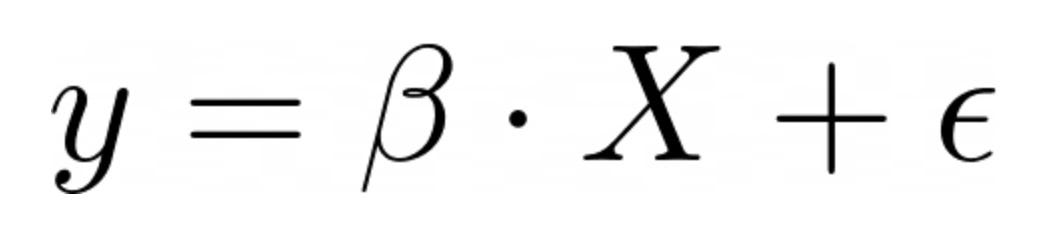 Here are:
- y is the target variable that the model should predict, such as an optimal property value or the average fuel consumption of a car.
- X contains values from the data set that could explain the size of the target variable, for example, the number of rooms in the property or the number of cylinders in an engine.
- β is the so-called regression coefficient, learned during training and mathematically describes the relationship between X and y. For example, a coefficient of 60,000 could mean that the value of a property increases by €60,000 with each additional room.
- ε is an error term that measures the deviations between the model's prediction and the actual value. This can occur, for example, if the data set does not include all the relevant properties required for the prediction. In the real estate example, the age of the residential unit could be a decisive factor in determining the price. If this is not present in the data set, the model will probably not be able to predict the price accurately.
The aim of linear regression is now to learn the values of β in such a way that the residual sum of squares (RSS), i.e. the squared difference between the prediction ŷᵢ and the actual value yᵢ, is minimized:
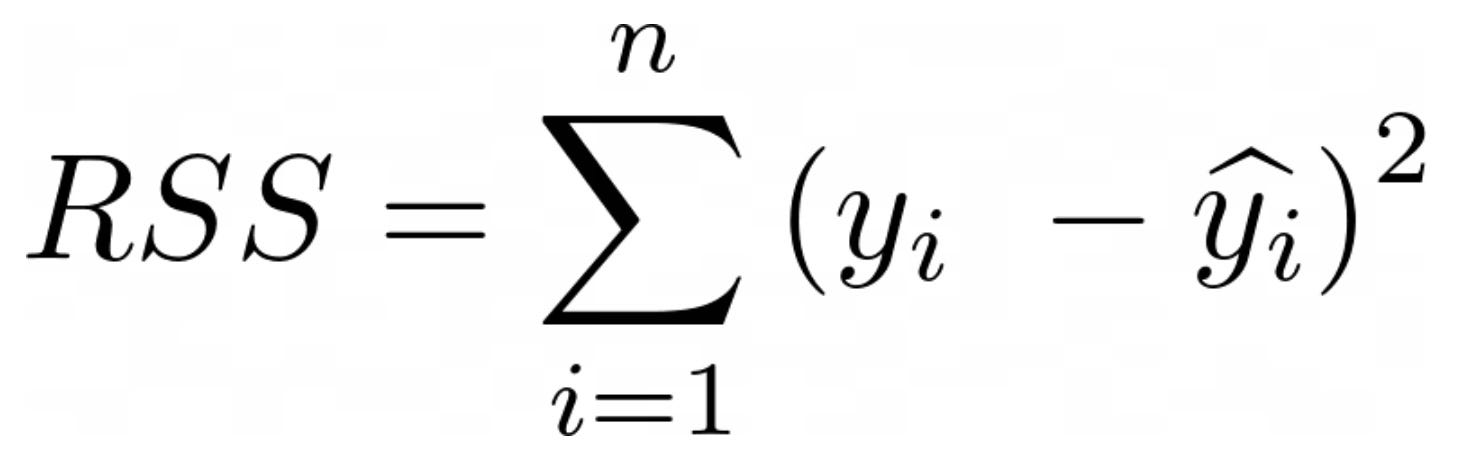 The L2 regularization now adds a further penalty term to this residual sum of squares, which is intended to ensure that the individual regression coefficients do not become too large. Mathematically, the ridge regularization then looks as follows:
 Here are:
- RSS is the residual sum of squares, as already known from linear regression.
- λ is the regularization parameter, which determines how strong the influence of the regularization is. We will examine its meaning in the next section.
- The sum term contains the sum of all squared regression coefficients. On the one hand, the square ensures that all regression coefficients have a positive sign and, therefore, have a negative influence on the cost function, on the other hand, very large values are significantly more important, as they are increased even more by squaring.
Due to this structure, the regularization term has an overall negative influence on the cost function. However, if individual coefficients become very large, this is significantly stronger than if the parameters do not grow too much. Therefore, the model is incentivized to keep the model coefficients as small as possible during training, as this is the only way to minimize the cost function.
What does the Regularization Parameter λ do?
The regularization parameter λ is a decisive factor in ridge regression, which controls the strength of the penalty that a model receives if the regression coefficients increase too much. Since the parameter must always be positive, the following two cases can be distinguished:
- λ = 0: In this special case, the regularization term is eliminated and the ridge regression corresponds to the classic linear regression. Thus, the model behaves accordingly and only focuses on minimizing the residual sum of squares without taking the size of the coefficients into account. This increases the risk of overfitting, as the model may learn overly complex relationships in the training data.
- λ → ∞ : As λ increases, the strength of the penalty for the model increases. As a result, the regression focuses more on keeping the size of the coefficients small than on reducing the deviation between the prediction and the actual value. In the limiting case, the model can only reach the target by keeping the coefficients close to 0. This leads to a straightforward model that is unlikely to recognize the correlations in the data and therefore only delivers poor results.
The choice of λ is a critical decision that significantly affects the performance of the ridge regression. A hyperparameter must be set before training and cannot be adjusted during training. A too-small λ can lead to overfitting, while a too-large λ leads to a simpler model that may not be able to recognize the underlying structures sufficiently.
Introducing an error term gives the model a systematic error, i.e. a distortion or bias, which leads to a smoothing of the model. In addition, the variance of the model is reduced, making it less sensitive to strongly fluctuating training data, as the coefficients are less large. These properties increase the model's generalization ability and reduce the risk of overfitting.
How can the Ridge Regression be interpreted?
The interpretation of ridge regression follows that of linear regression in many areas, with the difference that the size of the coefficients is significantly influenced by the regularization parameter. The following principles of linear regression still apply:
- The size of the coefficients β is decisive so that larger parameters indicate a stronger relationship between the independent and dependent variables.
- The distances can also be used for a relative comparison by sorting the parameters according to their absolute size to decide which independent variable has the greatest influence on the dependent variable.
- In addition, the signs retain the same meaning as in linear regression. Accordingly, a negative sign in front of a coefficient means that an increase in the independent variable leads to a decrease in the dependent variable and vice versa.
In addition to these similarities, however, it should be noted that the regularization parameter of the ridge regression has a decisive influence on the size of the coefficients. In general, the coefficients of the ridge regression are usually smaller than those of a comparable linear regression due to the regularization. This behavior is particularly pronounced when there is strong multicollinearity between the variables. Due to the structure of the model, the regularization parameter forces the coefficients to be closer to 0 without setting them completely to 0, as can happen with lasso regression, for example.
Overall, the ridge regression provides better results with multicollinear data by distributing the influence better and more evenly across the variables and also penalizing strongly correlated variables. This often makes the models easier to interpret than comparable linear regressions trained with the same data. In addition, it can be generalized that the smaller the regularization parameter λ , the more the results and the interpretation of the ridge regression resemble the results of a comparable linear regression.
What are the Differences to Other Regularization Methods?
Ridge regression is a regularization method that aims to prevent overfitting. Although it has similarities with other methods, such as L1 regularization or Elastic Net, it also differs significantly in its effects.
Ridge Regression vs L1 Regularization (Lasso)
Ridge regression is one of the various regularization techniques and has similarities with methods such as Lasso regression or Elastic Net. The distinction here mainly concerns the handling of the regression coefficient and the resulting properties for the models. In this section, we will therefore look at lasso regression, which is very similar in structure to ridge regression.
Lasso regression, also known as L1 regularization, adds up the absolute value of the coefficients in the regularization term:
 The regularization parameter λ has the same function here and determines the strength of the regularization. By summing the absolute coefficients, compared to the squared values, all coefficients are penalized equally for their size.
Due to this difference in structure, lasso regression can set the coefficients of individual variables completely to zero, which results in variable selection. Ridge regression, on the other hand, only reduces the size of all coefficients without setting them completely to zero. For this reason, ridge regression should primarily be selected if all predictors are to be retained and there is a problem with multicollinearity. Lasso regression, on the other hand, is suitable if you want to perform additional variable selection, as it can remove individual variables from the model by setting their coefficients to zero.
Ridge Regression vs Elastic Net
Elastic net combines the properties of lasso and ridge regression by including both L1 and L2 regularization. This results in the following cost function:
 This structure combines the advantages of both architectures and the Elastic Net is particularly suitable for high-dimensional data where both variable selection and strongly correlated predictors need to be handled. The parameters λ₁ and λ₂ can also be used to customize the strength of these two approaches.
How can you implement the Ridge Regression in Python?
With the help of scikit-learn, ridge regression can be used very easily in Python. In this tutorial, we will look at a data set on Californian real estate prices and try to train a model that can predict these prices very accurately.
First, we import the necessary libraries. We import NumPy to handle the data set. We also need scikit-learn to use the ridge regression, train the model using the train-test-split, and then evaluate the performance independently.
We can simply import the dataset from the scikit-learn datasets and then save the target variables and the data set with the features separately. We then split the data into training and test data sets to finally evaluate the generalization ability of the model by making predictions for new data.
Once we have prepared the data, we can prepare the model we have already imported. To do this, we set the regularization parameter to 1.0 and initialize the model. This can then be optimized using the training data set and the training labels.
We now use the trained model to calculate predictions for the test data set.
We use the mean squared error to calculate the deviation between the predictions for the test data set and the actual labels. This provides information on the model's prediction quality.
The regularization parameter λ is a hyperparameter that must be defined before training. It therefore makes sense to train the model with different parameter values and compare their results. In our example, the results for different alphas are identical, so we had already selected the correct alpha value.
Finally, as an additional evaluation, the individual coefficients and their size can be visualized using Matplotlib. This provides an insight into which characteristics have the greatest influence on the predictions.
As you can see, scikit-learn can train a functional ridge regression in just a few lines of code. The performance can be further improved using additional parameters as required.
This is what you should take with you
- Ridge regression is a regularization method used to reduce the risk of overfitting when training linear regressions.
- A so-called regularization term is added to the cost function, penalizing the model if the size of the regression coefficients increases too much. This procedure prevents the model from adapting too strongly to the training data.
- In general, the coefficients of a ridge regression are smaller than those of a comparable linear regression. Apart from this, the models and their coefficients can be compared similarly.
- Ridge regression differs from lasso regression because it cannot set the coefficients to zero and therefore does not select variables.
- Ridge regression can be imported into Python using scikit-learn and is easy to use.
Register Now to Continue Reading
Unlock Towards Data Science with a Free Account
All articles on Towards Data Science are available to registered users. Create a free account today to access this article and thousands more.
Register for freeSign in to your account
 Written By
See all from Niklas Lang
Data ScienceMachine LearningPythonRegularizationRidge Regression
Share This Article
Towards Data Science is a community publication. Submit your insights to reach our global audience and earn through the TDS Author Payment Program.
Write for TDS
Related Articles
Artificial Intelligence
A Metric for Evaluating Recommendation Engines
Kurtis Pykes
August 8, 20205 min read
Data Science
Some questions to answer: What makes popular music popular? How is today's music different from that of over 30 years ago?
Dea Bardhoshi
June 9, 20218 min read
Data Science
How to use network science and Python to map out the popular show
Milan Janosov
December 2, 20247 min read
Data Science
Learn about SQL joins and how to avoid common pitfalls in 11 minutes
Ivo Bernardo
September 1, 202212 min read
Programming
Level up your SQL skills with this simple explanation
Terence Shin, MSc, MBA
September 26, 20203 min read
Artificial Intelligence
Taste of Next Generation Enterprise AI - No Coding Needed!
Col Jung
August 5, 202111 min read
Machine Learning
Beginner's Guide To Anaconda
Ujjwal Dalmia
December 5, 20206 min read
Programming
Introduction to SQL procedures, their applications and benefits, and how to encrypt SQL code
Jiayan Yin
January 31, 20258 min read
Programming
An abstract class is a class, but not one you can create objects from directly....
Artemis N.
October 16, 20214 min read
Your home for data science and AI. The world's leading publication for data science, data analytics, data engineering, machine learning, and artificial intelligence professionals.
Subscribe to Our NewsletterWrite For TDS•About•Advertise•Privacy Policy•Terms of Use
© Insight Media Group, LLC 2026•The New Stack•roadmap.sh•Creator Network
Recommended Articles
Close