保留正文与补采附件。源页面当前未重新核验;具体限制见交付清单。
 We value your privacy
We use cookies to enhance your browsing experience, serve personalised ads or content, and analyse our traffic. By clicking "Accept All", you consent to our use of cookies.
Customise Reject All Accept All
Customise Consent Preferences
 We use cookies to help you navigate efficiently and perform certain functions. You will find detailed information about all cookies under each consent category below.
The cookies that are categorised as "Necessary" are stored on your browser as they are essential for enabling the basic functionalities of the site. ... Show more
NecessaryAlways Active
Necessary cookies are required to enable the basic features of this site, such as providing secure log-in or adjusting your consent preferences. These cookies do not store any personally identifiable data.
-
Cookie
BCTempID
-
Duration
10 minutes
-
Description
No description available.
-
Cookie
__cf_bm
-
Duration
1 hour
-
Description
This cookie, set by Cloudflare, is used to support Cloudflare Bot Management.
-
Cookie
AWSALBCORS
-
Duration
7 days
-
Description
Amazon Web Services set this cookie for load balancing.
-
Cookie
_cfuvid
-
Duration
session
-
Description
Cloudflare sets this cookie to track users across sessions to optimize user experience by maintaining session consistency and providing personalized services
-
Cookie
li_gc
-
Duration
6 months
-
Description
Linkedin set this cookie for storing visitor's consent regarding using cookies for non-essential purposes.
-
Cookie
__hssrc
-
Duration
session
-
Description
This cookie is set by Hubspot whenever it changes the session cookie. The __hssrc cookie set to 1 indicates that the user has restarted the browser, and if the cookie does not exist, it is assumed to be a new session.
-
Cookie
__hssc
-
Duration
1 hour
-
Description
HubSpot sets this cookie to keep track of sessions and to determine if HubSpot should increment the session number and timestamps in the __hstc cookie.
-
Cookie
wpEmojiSettingsSupports
-
Duration
session
-
Description
WordPress sets this cookie when a user interacts with emojis on a WordPress site. It helps determine if the user's browser can display emojis properly.
-
Cookie
BCSessionID
-
Duration
1 year 1 month 4 days
-
Description
Blueconic sets this cookie as a unique identifier for the BlueConic profile.
-
Cookie
_octo
-
Duration
1 year
-
Description
No description available.
-
Cookie
logged_in
-
Duration
1 year
-
Description
No description available.
-
Cookie
__Secure-YEC
-
Duration
past
-
Description
YouTube sets this cookie to stores the user's video player preferences using embedded YouTube video
-
Cookie
__eoi
-
Duration
6 months
-
Description
Description is currently not available.
-
Cookie
AWSALBTGCORS
-
Duration
7 days
-
Description
No description available.
-
Cookie
login-status-p
-
Duration
past
-
Description
Description is currently not available.
-
Cookie
AWSALBTG
-
Duration
7 days
-
Description
No description available.
-
Cookie
csrf_token
-
Duration
session
-
Description
No description available.
-
Cookie
token_v2
-
Duration
1 day
-
Description
Description is currently not available.
-
Cookie
D
-
Duration
1 year
-
Description
Description is currently not available.
-
Cookie
PHPSESSID
-
Duration
session
-
Description
This cookie is native to PHP applications. The cookie stores and identifies a user's unique session ID to manage user sessions on the website. The cookie is a session cookie and will be deleted when all the browser windows are closed.
-
Cookie
VISITOR_PRIVACY_METADATA
-
Duration
6 months
-
Description
YouTube sets this cookie to store the user's cookie consent state for the current domain.
-
Cookie
cookietest
-
Duration
session
-
Description
The cookietest cookie is typically used to determine whether the user's browser accepts cookies, essential for website functionality and user experience.
-
Cookie
__Host-airtable-session
-
Duration
1 year
-
Description
This cookie is used to enable us to integrate the services of Airtable.
-
Cookie
__Host-airtable-session.sig
-
Duration
1 year
-
Description
This cookie is used to enable us to integrate the services of Airtable.
-
Cookie
m
-
Duration
1 year 1 month 4 days
-
Description
Stripe sets this cookie for fraud prevention purposes. It identifies the device used to access the website, allowing the website to be formatted accordingly.
-
Cookie
BIGipServer*
-
Duration
session
-
Description
Marketo sets this cookie to collect information about the user's online activity and build a profile about their interests to provide advertisements relevant to the user.
-
Cookie
__cfruid
-
Duration
session
-
Description
Cloudflare sets this cookie to identify trusted web traffic.
-
Cookie
_GRECAPTCHA
-
Duration
6 months
-
Description
Google Recaptcha service sets this cookie to identify bots to protect the website against malicious spam attacks.
-
Cookie
__Secure-YNID
-
Duration
6 months
-
Description
Google cookie used to protect user security and prevent fraud, especially during the login process.
-
Cookie
cookieyes-consent
-
Duration
1 year
-
Description
CookieYes sets this cookie to remember users' consent preferences so that their preferences are respected on subsequent visits to this site. It does not collect or store any personal information about the site visitors.
Functional
Functional cookies help perform certain functionalities like sharing the content of the website on social media platforms, collecting feedback, and other third-party features.
-
Cookie
lidc
-
Duration
1 day
-
Description
LinkedIn sets the lidc cookie to facilitate data center selection.
-
Cookie
brw
-
Duration
1 year
-
Description
No description available.
-
Cookie
brwConsent
-
Duration
5 minutes
-
Description
Description is currently not available.
-
Cookie
WMF-Uniq
-
Duration
1 year
-
Description
Description is currently not available.
-
Cookie
loom_anon_comment
-
Duration
1 year
-
Description
No description available.
-
Cookie
loom_referral_video
-
Duration
session
-
Description
Description is currently not available.
-
Cookie
VISITOR_INFO1_LIVE
-
Duration
6 months
-
Description
A cookie set by YouTube to measure bandwidth that determines whether the user gets the new or old player interface.
-
Cookie
yt-remote-connected-devices
-
Duration
Never Expires
-
Description
YouTube sets this cookie to store the user's video preferences using embedded YouTube videos.
-
Cookie
ytidb::LAST_RESULT_ENTRY_KEY
-
Duration
Never Expires
-
Description
The cookie ytidb::LAST_RESULT_ENTRY_KEY is used by YouTube to store the last search result entry that was clicked by the user. This information is used to improve the user experience by providing more relevant search results in the future.
-
Cookie
yt-remote-device-id
-
Duration
Never Expires
-
Description
YouTube sets this cookie to store the user's video preferences using embedded YouTube videos.
-
Cookie
yt-remote-session-name
-
Duration
session
-
Description
The yt-remote-session-name cookie is used by YouTube to store the user's video player preferences using embedded YouTube video.
-
Cookie
yt-remote-fast-check-period
-
Duration
session
-
Description
The yt-remote-fast-check-period cookie is used by YouTube to store the user's video player preferences for embedded YouTube videos.
-
Cookie
yt-remote-session-app
-
Duration
session
-
Description
The yt-remote-session-app cookie is used by YouTube to store user preferences and information about the interface of the embedded YouTube video player.
-
Cookie
yt-remote-cast-available
-
Duration
session
-
Description
The yt-remote-cast-available cookie is used to store the user's preferences regarding whether casting is available on their YouTube video player.
-
Cookie
yt-remote-cast-installed
-
Duration
session
-
Description
The yt-remote-cast-installed cookie is used to store the user's video player preferences using embedded YouTube video.
-
Cookie
cp_session
-
Duration
3 months
-
Description
Codepen sets this cookie for Help systems found in the website.
-
Cookie
loid
-
Duration
1 year 1 month 4 days
-
Description
This cookie is set by the Reddit. The cookie enables the sharing of content from the website onto the social media platform.
Analytics
Analytical cookies are used to understand how visitors interact with the website. These cookies help provide information on metrics such as the number of visitors, bounce rate, traffic source, etc.
-
Cookie
__hstc
-
Duration
6 months
-
Description
Hubspot set this main cookie for tracking visitors. It contains the domain, initial timestamp (first visit), last timestamp (last visit), current timestamp (this visit), and session number (increments for each subsequent session).
-
Cookie
hubspotutk
-
Duration
6 months
-
Description
HubSpot sets this cookie to keep track of the visitors to the website. This cookie is passed to HubSpot on form submission and used when deduplicating contacts.
-
Cookie
_ga
-
Duration
1 year 1 month 4 days
-
Description
Google Analytics sets this cookie to calculate visitor, session and campaign data and track site usage for the site's analytics report. The cookie stores information anonymously and assigns a randomly generated number to recognise unique visitors.
-
Cookie
ga*
-
Duration
1 year 1 month 4 days
-
Description
Google Analytics sets this cookie to store and count page views.
-
Cookie
__Host-psifi.analyticsTrace
-
Duration
6 hours
-
Description
Description is currently not available.
-
Cookie
__Host-psifi.analyticsTraceV2
-
Duration
6 hours
-
Description
Description is currently not available.
-
Cookie
_gh_sess
-
Duration
session
-
Description
GitHub sets this cookie for temporary application and framework state between pages like what step the user is on in a multiple step form.
-
Cookie
YSC
-
Duration
session
-
Description
YSC cookie is set by Youtube and is used to track the views of embedded videos on Youtube pages.
-
Cookie
ajs_anonymous_id
-
Duration
1 year
-
Description
This cookie is set by Segment to count the number of people who visit a certain site by tracking if they have visited before.
-
Cookie
vuid
-
Duration
1 year 1 month 4 days
-
Description
Vimeo installs this cookie to collect tracking information by setting a unique ID to embed videos on the website.
Performance
Performance cookies are used to understand and analyse the key performance indexes of the website which helps in delivering a better user experience for the visitors.
-
Cookie
AWSALB
-
Duration
7 days
-
Description
AWSALB is an application load balancer cookie set by Amazon Web Services to map the session to the target.
-
Cookie
acq
-
Duration
past
-
Description
Description is currently not available.
-
Cookie
acq.sig
-
Duration
past
-
Description
Description is currently not available.
-
Cookie
ptc
-
Duration
2 years
-
Description
No description available.
Advertisement
Advertisement cookies are used to provide visitors with customised advertisements based on the pages you visited previously and to analyse the effectiveness of the ad campaigns.
-
Cookie
muc_ads
-
Duration
1 year 1 month 4 days
-
Description
Twitter sets this cookie to collect user behaviour and interaction data to optimize the website.
-
Cookie
guest_id_marketing
-
Duration
1 year 1 month 4 days
-
Description
Twitter sets this cookie to identify and track the website visitor.
-
Cookie
guest_id_ads
-
Duration
1 year 1 month 4 days
-
Description
Twitter sets this cookie to identify and track the website visitor.
-
Cookie
personalization_id
-
Duration
1 year 1 month 4 days
-
Description
Twitter sets this cookie to integrate and share features for social media and also store information about how the user uses the website, for tracking and targeting.
-
Cookie
guest_id
-
Duration
1 year 1 month 4 days
-
Description
Twitter sets this cookie to identify and track the website visitor. It registers if a user is signed in to the Twitter platform and collects information about ad preferences.
-
Cookie
bcookie
-
Duration
1 year
-
Description
LinkedIn sets this cookie from LinkedIn share buttons and ad tags to recognize browser IDs.
-
Cookie
__Secure-ROLLOUT_TOKEN
-
Duration
6 months
-
Description
YouTube sets this cookie to manage feature rollout and experimentation. It helps Google control which new features or interface changes are shown to users as part of testing and staged rollouts, ensuring consistent experience for a given user during an experiment.
-
Cookie
yt.innertube::nextId
-
Duration
Never Expires
-
Description
YouTube sets this cookie to register a unique ID to store data on what videos from YouTube the user has seen.
-
Cookie
yt.innertube::requests
-
Duration
Never Expires
-
Description
YouTube sets this cookie to register a unique ID to store data on what videos from YouTube the user has seen.
-
Cookie
session_tracker
-
Duration
session
-
Description
This cookie is set by the Reddit. This cookie is used to identify trusted web traffic. It also helps in adverstising on the website.
-
Cookie
edgebucket
-
Duration
session
-
Description
Reddit sets this cookie to save the information about a log-on Reddit user, for the purpose of advertisement recommendations and updating the content.
-
Cookie
did
-
Duration
1 year
-
Description
Arbor sets this cookie to show targeted ads to site visitors.This cookie expires after 2 months or 1 year.
Uncategorised
Other uncategorised cookies are those that are being analysed and have not been classified into a category as yet.
No cookies to display.
Reject All Save My Preferences Accept All
Toggle SearchToggle Mobile Navigation
Publish AI, ML & data-science insights to a global community of data professionals.
Sign inSubmit an Article
LatestEditor's PicksNewsletterShipAI
Write For TDS
LinkedInXToggle Search
Conversational AI
Sesame Speech Model: How This Viral AI Model Generates Human-Like Speech
A deep dive into residual vector quantizers, conversational speech AI, and talkative transformers.
Avishek Biswas
April 11, 20258 min read
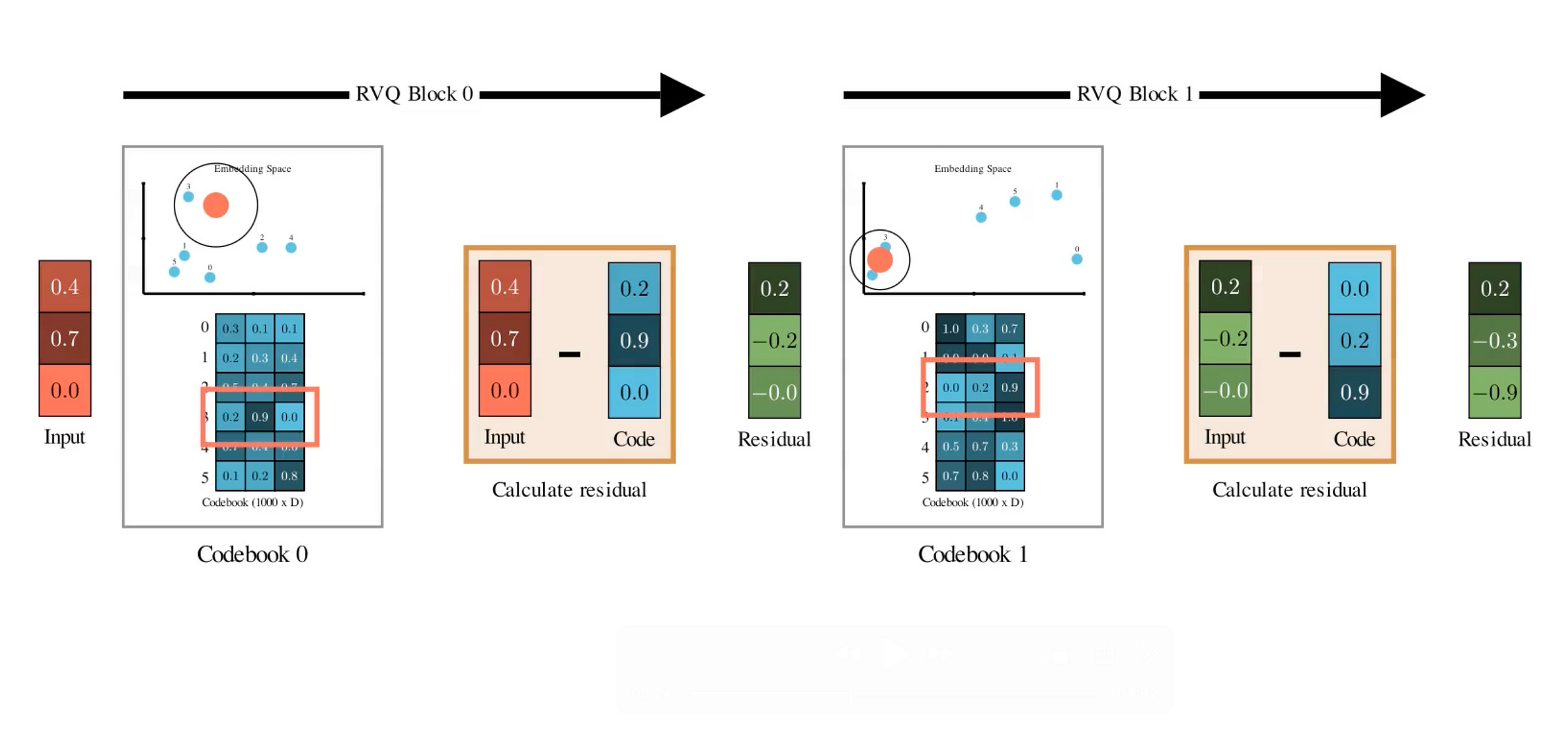 Sesame encodes speech using a pretty fascinating Deep Learning technique called Residual Vector Quantization (Illustration by the author)
Recently, Sesame AI published a demo of their latest Speech-to-Speech model. A conversational AI agent who is really good at speaking, they provide relevant answers, they speak with expressions, and honestly, they are just very fun and interactive to play with.
Note that a technical paper is not out yet, but they do have a short blog post that provides a lot of information about the techniques they used and previous algorithms they built upon.
Thankfully, they provided enough information for me to write this article and make a YouTube video out of it. Read on!
Training a Conversational Speech Model
Sesame is a Conversational Speech Model , or a CSM. It inputs both text and audio, and generates speech as audio. While they haven’t revealed their training data sources in the articles, we can still try to take a solid guess. The blog post heavily cites another CSM, 2024’s Moshi, and fortunately, the creators of Moshi did reveal their data sources in their paper. Moshi uses 7 million hours of unsupervised speech data, 170 hours of natural and scripted conversations (for multi-stream training), and 2000 more hours of telephone conversations (The Fischer Dataset).
···
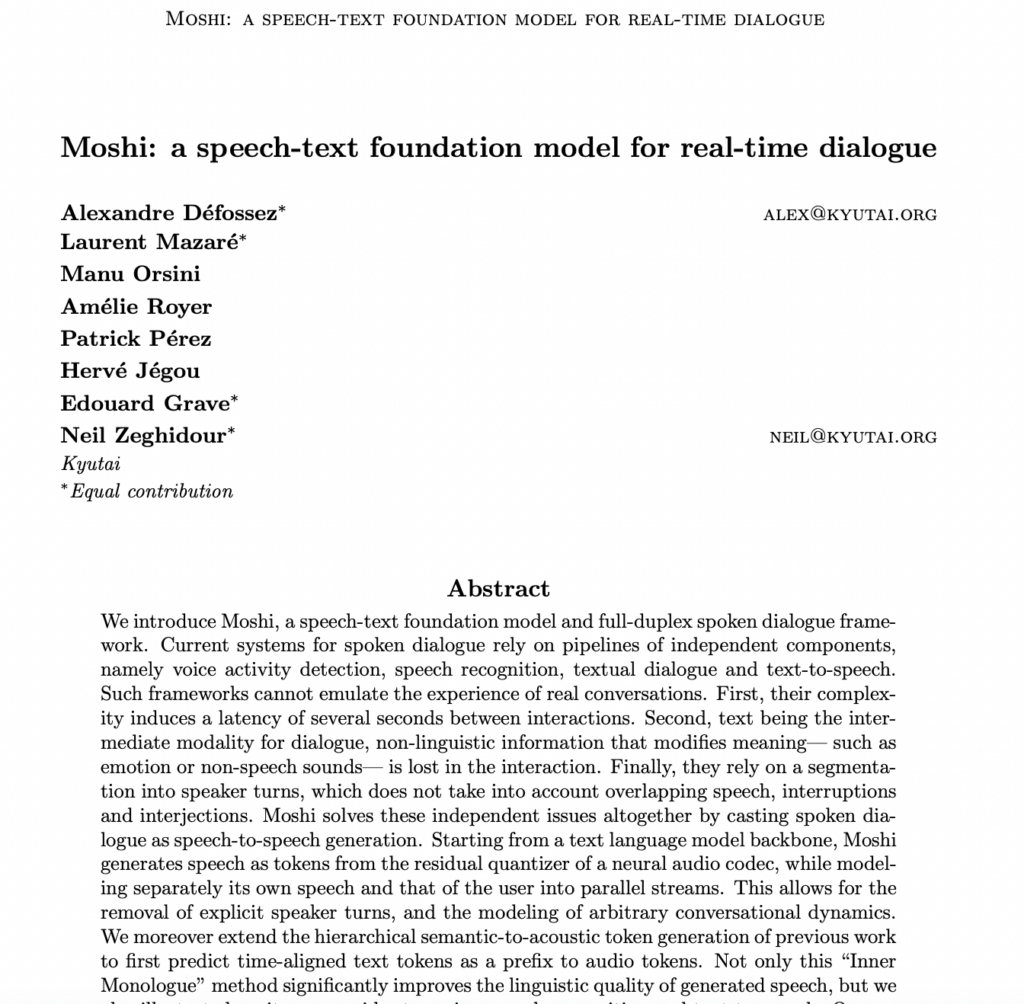 Sesame builds upon the Moshi Paper (2024)
Learn this step by step with the interactive AI Engineer roadmap.
But what does it really take to generate audio?
In raw form, audio is just a long sequence of amplitude values — a waveform. For example, if you’re sampling audio at 24 kHz, you are capturing 24,000 float values every second.
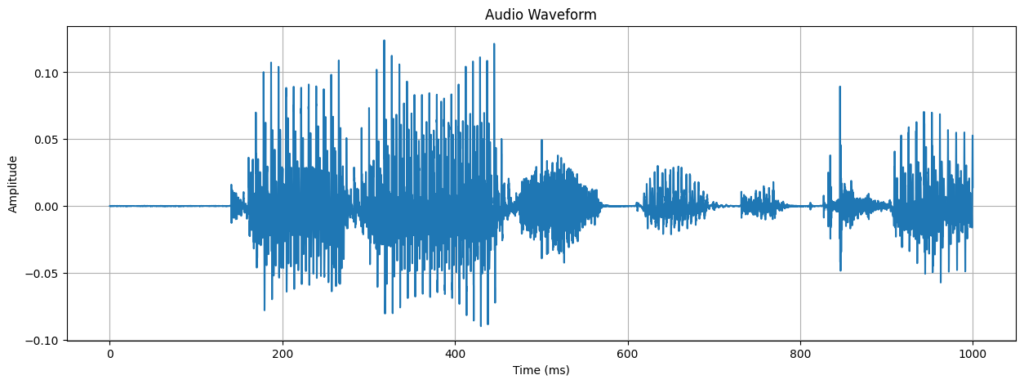 There are 24000 values here to represent 1 second of speech! (Image generated by author)
Of course, it is quite resource-intensive to process 24000 float values for just one second of data , especially because transformer computations scale quadratically with sequence length. It would be great if we could compress this signal and reduce the number of samples required to process the audio.
We will take a deep dive into the Mimi encoder and specifically Residual Vector Quantizers (RVQ) , which are the backbone of Audio/Speech modeling in Deep Learning today. We will end the article by learning about how Sesame generates audio using its special dual-transformer architecture.
Preprocessing audio
Compression and feature extraction are where convolution helps us. Sesame uses the Mimi speech encoder to process audio. Mimi was introduced in the aforementionedMoshi paperas well. Mimi is a self-supervised audio encoder-decoder model that converts audio waveforms into discrete "latent" tokens first, and then reconstructs the original signal. Sesame only uses the encoder section of Mimi to tokenize the input audio tokens. Let’s learn how.
Mimi inputs the raw speech waveform at 24Khz, passes them through several strided convolution layers to downsample the signal, with a stride factor of 4, 5, 6, 8, and 2. This means that the first CNN block downsamples the audio by 4x, then 5x, then 6x, and so on. In the end, it downsamples by a factor of 1920, reducing it to just 12.5 frames per second.
The convolution blocks also project the original float values to an embedding dimension of 512. Each embedding aggregates the local features of the original 1D waveform. 1 second of audio is now represented as around 12 vectors of size 512. This way, Mimi reduces the sequence length from 24000 to just 12 and converts them into dense continuous vectors.
 Before applying any quantization, the Mimi Encoder downsamples the input 24KHz audio by 1920 times, and embeds it into 512 dimensions. In other words, you get 12.5 frames per second with each frame as a 512-dimensional vector. (Image from author’s video)
What is Audio Quantization?
Given the continuous embeddings obtained after the convolution layer, we want to tokenize the input speech. If we can represent speech as a sequence of tokens, we can apply standard language learning transformers to train generative models.
Mimi uses a Residual Vector Quantizer or RVQ tokenizer to achieve this. We will talk about the residual part soon, but first, let’s look at what a simple vanilla Vector quantizer does.
Vector Quantization
The idea behind Vector Quantization is simple: you train a codebook , which is a collection of, say, 1000 random vector codes all of size 512 (same as your embedding dimension).
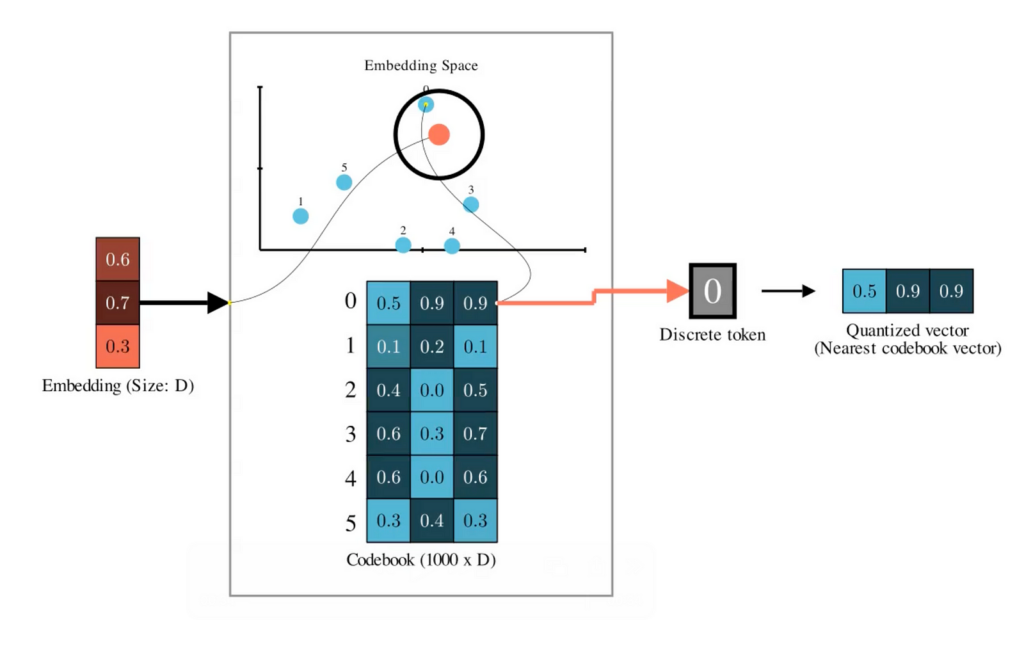 A Vanilla Vector Quantizer. A codebook of embeddings is trained. Given an input embedding, we map/quantize it to the nearest codebook entry. (Screenshot from author’s video)
Then, given the input vector, we will map it to the closest vector in our codebook — basically snapping a point to its nearest cluster center. This means we have effectively created a fixed vocabulary of tokens to represent each audio frame, because whatever the input frame embedding may be, we will represent it with the nearest cluster centroid. If you want to learn more about Vector Quantization, check out my video on this topic where I go much deeper with this.
Residual Vector Quantization
The problem with simple vector quantization is that the loss of information may be too high because we are mapping each vector to its cluster’s centroid. This “snap” is rarely perfect, so there is always an error between the original embedding and the nearest codebook.
The big idea of Residual Vector Quantization is that it doesn’t stop at having just one codebook. Instead, it tries to use multiple codebooks to represent the input vector.
- First , you quantize the original vector using the first codebook.
- Then , you subtract that centroid from your original vector. What you’re left with is the residual — the error that wasn’t captured in the first quantization.
- Now take this residual, and quantize it again , using a second codebook full of brand new code vectors — again by snapping it to the nearest centroid.
- Subtract that too, and you get a smaller residual. Quantize again with a third codebook… and you can keep doing this for as many codebooks as you want.
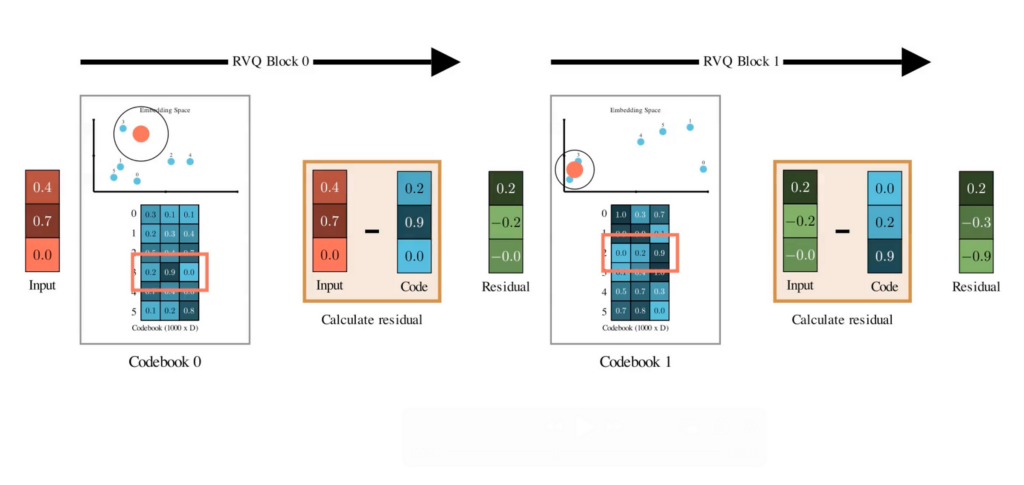 Residual Vector Quantizers (RVQ) hierarchically encode the input embeddings by using a new codebook and VQ layer to represent the previous codebook’s error. (Illustration by the author)
Each step hierarchically captures a little more detail that was missed in the previous round. If you repeat this for, let’s say, N codebooks, you get a collection of N discrete tokens from each stage of quantization to represent one audio frame.
The coolest thing about RVQs is that they are designed to have a high inductive bias towards capturing the most essential content in the very first quantizer. In the subsequent quantizers, they learn more and more fine-grained features.
If you're familiar with PCA, you can think of the first codebook as containing the primary principal components, capturing the most critical information. The subsequent codebooks represent higher-order components, containing information that adds more details.
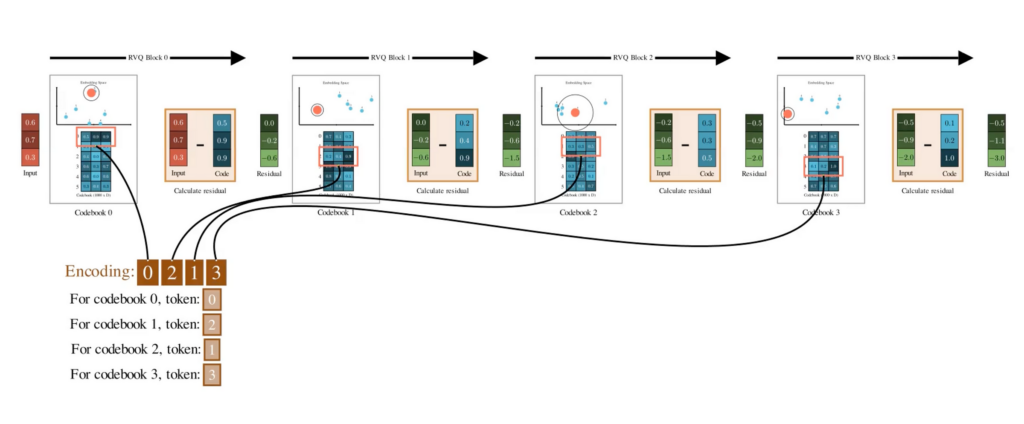 Residual Vector Quantizers (RVQ) uses multiple codebooks to encode the input vector — one entry from each codebook. (Screenshot from author’s video)
Acoustic vs Semantic Codebooks
Since Mimi is trained on the task of audio reconstruction, the encoder compresses the signal to the discretized latent space, and the decoder reconstructs it back from the latent space. When optimizing for this task, the RVQ codebooks learn to capture the essential acoustic content of the input audio inside the compressed latent space.
Mimi also separately trains a single codebook (vanilla VQ) that only focuses on embedding the semantic content of the audio. This is why Mimi is called a split-RVQ tokenizer - it divides the quantization process into two independent parallel paths: one for semantic information and another for acoustic information.
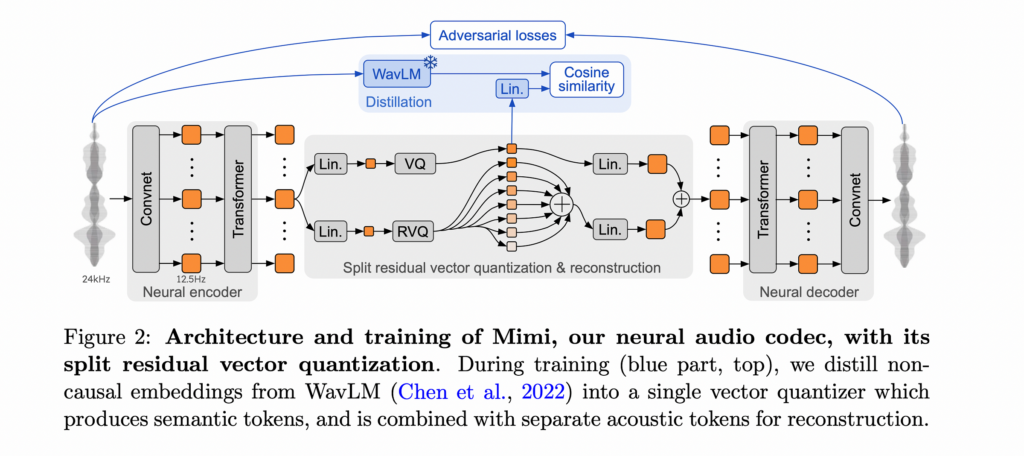 The Mimi Architecture (Source: Moshi paper) License: Free
To train semantic representations, Mimi used knowledge distillation with an existing speech model called WavLM as a semantic teacher. Basically, Mimi introduces an additional loss function that decreases the cosine distance between the semantic RVQ code and the WavLM-generated embedding.
···
Audio Decoder
Given a conversation containing text and audio, we first convert them into a sequence of token embeddings using the text and audio tokenizers. This token sequence is then input into a transformer model as a time series. In the blog post, this model is referred to as the Autoregressive Backbone Transformer. Its task is to process this time series and output the "zeroth" codebook token.
A lighterweight transformer called the audio decoder then reconstructs the next codebook tokens conditioned on this zeroth code generated by the backbone transformer. Note that the zeroth code already contains a lot of information about the history of the conversation since the backbone transformer has visibility of the entire past sequence. The lightweight audio decoder only operates on the zeroth token and generates the other N-1 codes. These codes are generated by using N-1 distinct linear layers that output the probability of choosing each code from their corresponding codebooks.
You can imagine this process as predicting a text token from the vocabulary in a text-only LLM. Just that a text-based LLM has a single vocabulary, but the RVQ-tokenizer has multiple vocabularies in the form of the N codebooks, so you need to train a separate linear layer to model the codes for each.
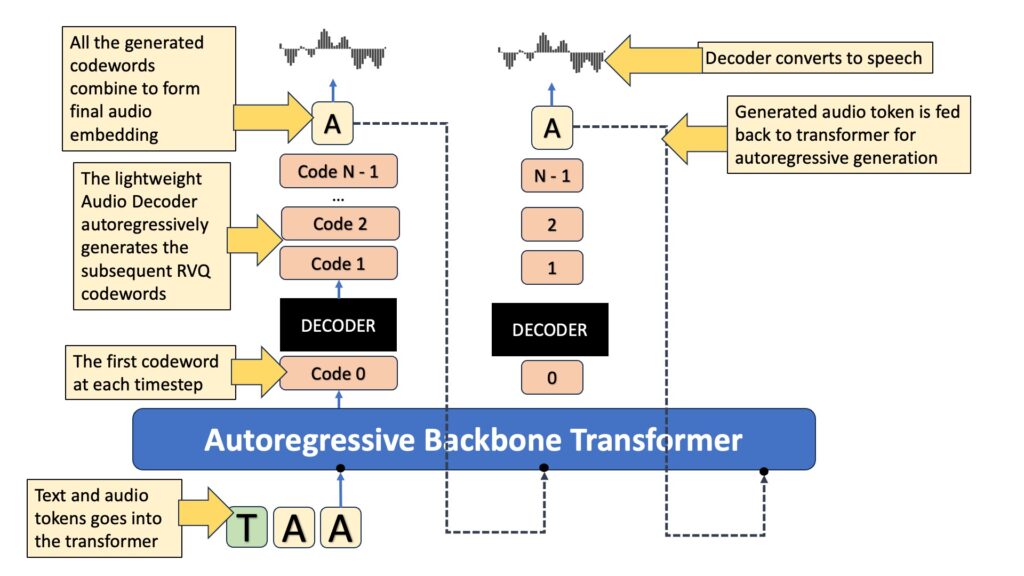 The Sesame Architecture (Illustration by the author)
Finally, after the codewords are all generated, we aggregate them to form the combined continuous audio embedding. The final job is to convert this audio back to a waveform. For this, we apply transposed convolutional layers to upscale the embedding back from 12.5 Hz back to KHz waveform audio. Basically, reversing the transforms we had applied originally during audio preprocessing.
In Summary
So, here is the overall summary of the Sesame model in some bullet points.
- Sesame is built on a multimodal Conversation Speech Model or a CSM.
- Text and audio are tokenized together to form a sequence of tokens and input into the backbone transformer that autoregressively processes the sequence.
- While the text is processed like any other text-based LLM, the audio is processed directly from its waveform representation. They use the Mimi encoder to convert the waveform into latent codes using a split RVQ tokenizer.
- The multimodal backbone transformers consume a sequence of tokens and predict the next zeroth codeword.
- Another lightweight transformer called the Audio Decoder predicts the next codewords from the zeroth codeword.
- The final audio frame representation is generated from combining all the generated codewords and upsampled back to the waveform representation.
Thanks for reading!
References and Must-read papers
Check out my ML YouTube Channel
Sesame Blogpost and Demo
Relevant papers:
Moshi: https://arxiv.org/abs/2410.00037
SoundStream: https://arxiv.org/abs/2107.03312
HuBert: https://arxiv.org/abs/2106.07447
Speech Tokenizer: https://arxiv.org/abs/2308.16692
Register Now to Continue Reading
Unlock Towards Data Science with a Free Account
All articles on Towards Data Science are available to registered users. Create a free account today to access this article and thousands more.
Register for freeSign in to your account
 Written By
See all from Avishek Biswas
Artificial IntelligenceDeep LearningMachine LearningResidual Vector QuantizationVoice Assistant
Share This Article
Towards Data Science is a community publication. Submit your insights to reach our global audience and earn through the TDS Author Payment Program.
Write for TDS
Related Articles
Artificial Intelligence
Top tier courses from Stanford, Berkeley, and more.
Terence Shin, MSc, MBA
August 10, 20204 min read
Machine Learning
A well-known ML technique is now transforming reinforcement learning and control theory
Avi Mohan, Ph.D.
February 28, 20216 min read
Artificial Intelligence
Analyzing the 10 best free websites to gain more knowledge about machine learning and data science
Bharath K
January 30, 20219 min read
Deep Learning
Welcome to this guide about the V-Net, the cousin of the well known U-Net, for 3D images segmentations. You will know it inside out!
François Porcher
July 28, 20237 min read
Machine Learning
Guide to using the standardized syntax within Tidymodels to build and compare various models and metrics
Deepsha Menghani
May 15, 20247 min read
Artificial Intelligence
An overview of linear algebra concepts for machine learning
Luay Matalka
December 12, 202012 min read
Machine Learning
Your daily dose of data science
TDS Editors
January 14, 20211 min read
Deep Learning
A case study of colorizing images coming from an old-school video game using Deep Learning in Python
Eryk Lewinson
April 17, 202016 min read
Artificial Intelligence
How to Extract Personal Information from Text Corpus Using NER Like a Pro
Rechitasingh
March 29, 20249 min read
Your home for data science and AI. The world's leading publication for data science, data analytics, data engineering, machine learning, and artificial intelligence professionals.
Subscribe to Our NewsletterWrite For TDS•About•Advertise•Privacy Policy•Terms of Use
© Insight Media Group, LLC 2026•The New Stack•roadmap.sh•Creator Network
Recommended Articles
Close